- Physics Lab Equipment
- Chemistry Lab Equipment
- Biology Lab Equipment
- Anatomical Lab Equipment
- Learning
- Educational Lab Equipment
- Magnets
- Agriculture
- Astronomy
- Earth Science
- Geography Lab Equipment
- Safety Lab Coat
- Laboratory
- Meteorological
- Electricity & Magnetism
- Heat
- School Lab Equipment
- Lab Glassware
- Science Lab Equipment
- Tvet Lab Equipment
- Robotics Kits Supplier and Manufacturer for Schools India
- Math Lab Equipment Manufacturers and Exporters in Ambala
- STEM Kits Manufacturers and Supplier India
- Engineering Lab Equipment
- Hospital Lab Equipment
- Water, Sanitation & Hygiene Supplies
- Cold Chain, Solar & Communication Equipment
- Nutrition
The Middle School range brings together integer dice, snap-on cubes and an attribute block desk set for the stage when pupils stop only working with quantities and start reasoning about rules. Maths teachers use them in middle-school lessons, maths corners and labs for signed numbers, number properties, algebraic identities and logical sorting. These aids are made by ScienceLab in Ambala.
Middle-school maths aids by topic
| Group | What it covers | Example products |
|---|---|---|
| Signed numbers | Dice that produce positive and negative numbers, so pupils roll, write an integer sentence, solve it and check it with a partner. | Integer Dice |
| Number properties and algebra models | Fifty cubes that snap together on all six sides, for odd and even numbers, factors and primes, HCF and LCM, square and cube numbers, area, volume and algebraic identities. | Blocks (50Pcs) |
| Logical sorting and attributes | Sixty plastic blocks in five shapes, two sizes, two thicknesses and three colours, kept in a tray whose shape sorter doubles as a tracing template. | Attribute Blocks Desk Set |
Using middle-school aids to move from models to rules
Model first, then calculate. Pupils roll the Integer Dice, show each result on a number line or with red and yellow Integer Counters, and only then write the answer. Once the sign rules hold across many rolls, they drop the model and work mentally. The Integer Dice page gives no count of dice, faces or number range, so check the dice in hand before planning a game around a fixed range.
Give each group of four its own Blocks (50Pcs) set. Arranging a number of cubes into every possible rectangle lists its factors, and a number above one that makes only a single row is prime. A side length that two numbers can both use as a rectangle edge is a common factor, and the longest such side is the HCF. Building cubes with edges of two and three cubes links cube numbers to volume.
With the Attribute Blocks Desk Set, groups sort by one attribute, then by two, and set hidden rules for the next group to guess. Foldable Sorting Ring circles laid on the desk turn two overlapping rules into a Venn diagram. Wipe the blocks with a damp cloth and pack each piece back into its place in the tray.
Frequently Asked Questions About Middle School
Why does subtracting a negative number make the answer bigger?
Removing a negative works like cancelling a debt: what is left goes up. On a number line, subtracting a positive number moves left, so subtracting a negative reverses the move and goes right. With Integer Counters, add pairs of opposite colours, which together make zero, until there are enough negatives to take away. The counters left over show the answer.
Why do pupils confuse the minus sign for subtraction with the sign of a negative number?
The same mark does two jobs: it can name an operation or the sign of a number. Ask pupils to read each expression aloud, saying minus for subtraction and negative for the sign, and to put negative numbers in brackets when writing. Rolling the Integer Dice and writing every result as a full sentence gives steady practice.
Do pupils at this stage still need hands-on aids?
Yes, when an idea is new. A model lets pupils test a rule before they trust it, such as why subtracting a negative adds, or why a prime builds only one rectangle. Keep each model short: build or roll, record in symbols, then repeat without the model. The same cubes and blocks help pupils who need to go back a step.
Can the snap-on cubes be mixed with cubes a school already owns?
Only if the size and joints match. The Blocks (50Pcs) page says the cubes connect on all six sides but gives no cube size, so test a sample against the cubes already in use before mixing sets. Keeping each set of fifty in its own box also keeps group counts right for factor and area work.
Why does the attribute block desk set hold exactly sixty blocks?
Five shapes times two sizes, two thicknesses and three colours gives sixty, so every combination appears once. That is what makes the set work for logic: any two blocks differ in at least one attribute, and a missing block can be named exactly. Packing the blocks back into the shape sorter tray shows a gap at once.
Ranges before and beside middle-school maths
- Learning: the umbrella learning page, which groups this stage with nursery and primary aids, classroom stationery, boxed school kits and sports gear.
- Primary: the stage before, when pupils still handle number sticks, Dienes blocks and fraction circles to learn place value, tables and fractions before rules take over.
- Maths Lab Equipment: the full maths lab range, with integer counters, an integer board game, algebra tiles and linking cubes that carry these aids into secondary algebra.
- Pre-Primary: the nursery and kindergarten stage, where children count to ten with dice and bead racks long before signed numbers appear.
To request a quotation or a catalogue for this range, send the product names, codes and quantities through our contact page or add the items to your enquiry cart.
Last updated: 15 November 2026
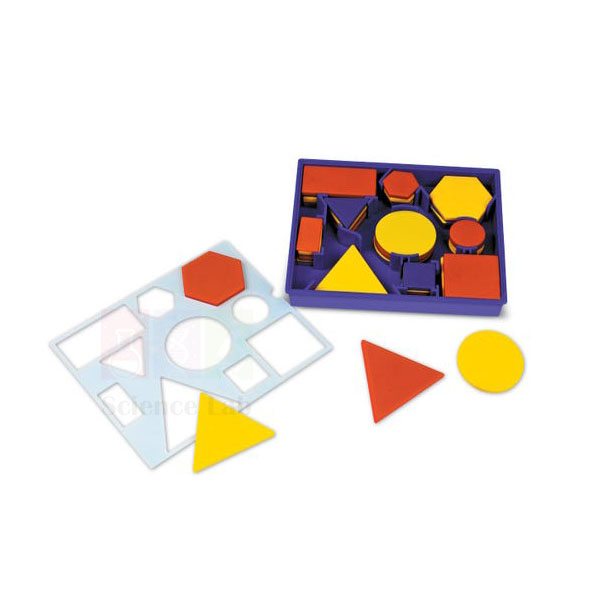
Attribute Blocks Desk Set
Attribute Blocks Desk Set (Product Code: SLE/LMS/01) is a sixty-piece set of plastic attribute blocks used to teach shapes, sorting, patterns, size and counting in primary and middle school maths lessons. The blocks come in five shapes, two sizes, two thicknesses and three colours, packed in a storage tray whose shape sorter doubles as a tracing template. Part of our mathematics lab kits for India and abroad, it is made by Jain Scientific Equipments Pvt Ltd (ScienceLab), an OEM science kit manufacturer in India, at its own factory in Ambala.
Specifications
| Parameter | Detail |
|---|---|
| Pieces | Sixty |
| Attributes | Five shapes, two sizes, two thicknesses, three colours |
| Material | Plastic |
| Storage | Tray with shape sorter that can be used for tracing |
| Teaching focus | Shapes, sorting, patterns, size and counting |
| Product code | SLE/LMS/01 |
| Manufacturer | Jain Scientific Equipments Pvt Ltd (ScienceLab) — OEM |
| Country of origin | India (made in Ambala, Haryana) |
What Is the Attribute Blocks Desk Set Used For?
Each block differs from the others in four attributes, shape, size, thickness and colour, and with sixty pieces every combination appears exactly once, which makes the set well suited to logical sorting. Children group blocks by one attribute and then by two, build "one-difference" trains where each block changes in only one way from the last, and describe pieces precisely, such as "the thick, large, red one". The same blocks support counting, comparing sizes and repeating patterns.
The shape sorter in the storage tray gives every piece a place to go, so packing away becomes a matching task in itself, and pupils can trace the sorter openings to draw shapes in their notebooks. For group work, split the blocks between tables and ask each group to invent a sorting rule for the others to guess. Wipe the plastic blocks with a damp cloth to keep them clean between classes.
OEM Manufacturer
Jain Scientific Equipments Private Limited, trading as ScienceLab, is the OEM (original equipment manufacturer) of the Attribute Blocks Desk Set and produces it at its licensed factory at Saha, Ambala, Haryana. Schools, teacher-training institutes, dealers and importers in India and international markets order it factory-direct, often as part of a complete mathematics lab, and every quotation comes straight from the manufacturer. Ask us about replacement pieces or repeat orders for sets already in use. See our company profile.
Related Middle School Learning Aids
Manipulatives that extend sorting, pattern and counting work:
- Attribute Blocks — the maths lab version to compare
- Sorting Ring — for Venn-style sorting of the blocks
- Plastic Pattern Blocks — for pattern and tiling activities
- Linking Cubes — for counting and early measurement
- Blocks (50Pcs) — snap-on cubes from the same range
Browse the Middle School category, or the wider Maths Lab Equipment range.
Frequently Asked Questions
How many pieces are in the Attribute Blocks Desk Set?
The Attribute Blocks Desk Set (SLE/LMS/01) has sixty plastic blocks covering five shapes, two sizes, two thicknesses and three colours. Five times two times two times three gives sixty, so each combination of attributes appears once in the set.
What is the storage tray of the desk set for?
The Attribute Blocks Desk Set comes in a storage tray with a shape sorter. Pupils return each block to its matching opening when packing up, and the sorter can also be used as a template for tracing shapes onto paper.
Which shapes and colours are in the Attribute Blocks Desk Set?
The Attribute Blocks Desk Set includes five shapes in three colours, but the listing does not name them. If your lesson plan needs particular shapes or colours, ask us through the contact page to confirm the exact set before ordering.
Which maths skills do attribute blocks support?
The Attribute Blocks Desk Set is used to teach shapes, sorting, patterns, size and counting. Classifying by several attributes also builds logical reasoning and precise mathematical vocabulary, which helps pupils later with sets, Venn diagrams and data handling.
Who manufactures the Attribute Blocks Desk Set?
Jain Scientific Equipments Pvt Ltd (ScienceLab) manufactures the Attribute Blocks Desk Set as the OEM at its licensed factory at Saha, Ambala, Haryana, India. Schools, dealers and importers in India and international markets can order it direct from the manufacturer.
What should a quotation request for the desk set include?
A quotation request for the Attribute Blocks Desk Set should give product code SLE/LMS/01, the number of desk sets (for example one per group of pupils), your delivery location and any other maths manipulatives you want quoted with it.
Request a Quote
Quotations for the Attribute Blocks Desk Set come direct from the manufacturer: send the number of sets and delivery details through our contact page, or add it to the enquiry cart with other maths lab items.
Last updated: 24 September 2026
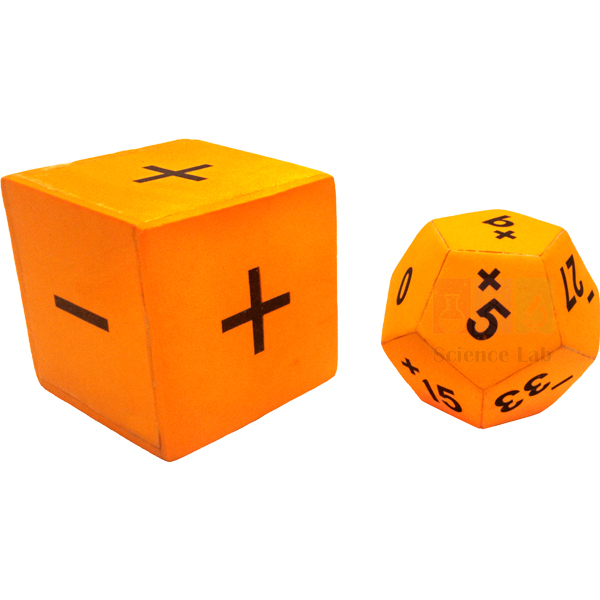
Integer Dice
Integer Dice (Product Code: SLE/LMS/02) is a maths learning aid used to generate positive and negative numbers for practising integer operations in middle school classrooms. Rolling the dice turns adding, subtracting and multiplying signed numbers into quick games that give every pupil plenty of practice. It is made by Jain Scientific Equipments Pvt Ltd (ScienceLab), an OEM school lab equipment manufacturer, at its own factory in Ambala, India.
Key Details
| Parameter | Detail |
|---|---|
| Type | Dice for positive and negative number (integer) practice |
| Range | Middle School learning aids |
| Product code | SLE/LMS/02 |
| Manufacturer | Jain Scientific Equipments Pvt Ltd (ScienceLab) — OEM |
| Country of origin | India (made in Ambala, Haryana) |
What Are Integer Dice Used For?
Integers are often the first topic where middle school pupils meet rules that feel counter-intuitive, such as subtracting a negative number. Dice make practice quick and varied: pupils roll, write the resulting integer sentence, solve it and check with a partner, so many different examples come up in a single lesson. Games such as racing along a number line from zero, or scoring the largest product, keep the whole class involved.
Pair the dice with a number line or two-colour integer counters so that pupils can model each roll before calculating, then move on to mental methods once the rules are secure. Give each group its own dice and a tray or cup to roll into, which keeps noise down and stops dice going missing. As the listing does not state the number of dice, faces or number range, confirm these details with us before planning activities around them.
What to Specify When Ordering
- The quantity you need, for example one set per group of pupils
- The number range and faces you expect, so we can confirm the current design
- Whether integer counters or an integer board game should be quoted together
OEM Manufacturer
ScienceLab is the trading name of Jain Scientific Equipments Private Limited, the OEM (original equipment manufacturer) of these Integer Dice, which it makes at its licensed factory at Saha, Ambala, Haryana. Schools, tutoring centres, dealers and importers in India and international markets buy them direct from the manufacturer, usually alongside other maths manipulatives, and repeat or follow-up orders are handled by the same team. Read more on our company profile page.
Related Middle School Learning Aids
Other aids for integer and number work:
- Integer Counters — to model positive and negative values physically
- Integer Board Game — game-based practice with signed numbers
- Fraction Dice — dice for fraction activities
- Transparent Dice — general-purpose dice for probability and games
- Attribute Blocks Desk Set — sorting and logic work from the same range
Browse the Middle School category, or the wider Maths Lab Equipment range.
Frequently Asked Questions
What are Integer Dice?
Integer Dice (SLE/LMS/02) are a maths learning aid from the ScienceLab Middle School range, used to generate positive and negative numbers so pupils can practise integer addition, subtraction and multiplication through games and quick-fire exercises.
How many Integer Dice are in a set and which numbers do they show?
The current listing for Integer Dice does not state the number of dice, the number of faces or the range of numbers printed on them. Please ask us through the contact page for these details before you plan activities or order class quantities.
How are Integer Dice used in a lesson?
With Integer Dice, pupils roll to create an integer sentence, such as adding or subtracting two signed numbers, solve it and check the answer with a partner. Modelling each roll on a number line or with integer counters helps pupils see why the sign rules work.
Which classes are Integer Dice suited to?
Integer Dice belong to the ScienceLab Middle School range, the stage at which integers and signed-number operations are usually introduced. They also work well for revision with older pupils and for enrichment with confident younger learners.
Who manufactures the Integer Dice?
Jain Scientific Equipments Pvt Ltd (ScienceLab) manufactures the Integer Dice as the OEM at its licensed factory at Saha, Ambala, Haryana, India. Schools, dealers and importers in India and international markets can order them direct from the manufacturer.
What should a quotation request for Integer Dice include?
A quotation request for Integer Dice should give product code SLE/LMS/02, the quantity or number of groups, your delivery location and any related items such as integer counters, so that the whole order can be quoted together.
Request a Quote
Quotes for Integer Dice come straight from the manufacturer: send the quantity and delivery details through our contact page, or add them to the enquiry cart with other maths learning aids.
Last updated: 24 September 2026
714.jpg)
Blocks (50Pcs)
Blocks (50Pcs) (Product Code: SLE/LMS/03) is a set of 50 snap-on cubes that connect on all six sides, used to build number, pattern and shape models in primary and middle school maths. One set serves a group of 4 children aged 2 to 16 years, covering concepts from counting and one-to-one correspondence to area, volume, HCF, LCM and algebraic identities. It is made by Jain Scientific Equipments Pvt Ltd (ScienceLab), an OEM manufacturer and school science kit supplier in India, at its own factory in Ambala.
Specifications
| Parameter | Detail |
|---|---|
| Pieces | 50 snap-on cubes |
| Connection | Can be connected on all six sides |
| Group size | For 4 children |
| Age range | 2–16 years; used in primary and middle classes |
| Number concepts | Sense of numberness; counting and operations of numbers; patterns in different ways of splitting a number; addition and subtraction facts; odd and even numbers and their properties; factors, prime numbers, HCF, LCM |
| Algebra and properties | Commutativity, distributivity; squares and cubes geometrically and as numbers; algebraic identities |
| Measurement | Area, perimeter, volume |
| Early number sense | Recognising colours, classifying by colour, making patterns, counting, one-to-one correspondence, comparing numbers |
| Product code | SLE/LMS/03 |
| Manufacturer | Jain Scientific Equipments Pvt Ltd (ScienceLab) — OEM |
| Country of origin | India (made in Ambala, Haryana) |
What Are the 50-Piece Snap-On Blocks Used For?
Because the cubes snap together on every face, pupils can build rods, flat rectangles and solid shapes rather than just towers. Rows of equal rods show multiplication as repeated groups and make commutativity visible, rectangles give area and perimeter by counting faces and edges, and building larger cubes links cube numbers to volume. Splitting a train of cubes in different ways explores number bonds and the difference between odd and even numbers.
For younger children the same set supports colour recognition, sorting by colour, simple patterns and one-to-one counting, while older pupils picture algebraic identities as squares built from smaller blocks and find factors, primes, HCF and LCM by arranging cubes into rectangles. As one of our mathematics lab kits for Indian schools, a set of 50 is sized for a group of 4 children, so order one set per group for whole-class work.
What to Specify When Ordering
- The number of sets, allowing one set per group of 4 children
- The classes or age groups using them, so we can suggest matching manipulatives
- Whether items such as base ten blocks or algebra tiles should be quoted together
OEM Manufacturer
The Blocks (50Pcs) set is made by Jain Scientific Equipments Private Limited, trading as ScienceLab, which is the OEM (original equipment manufacturer) and produces it at its licensed factory at Saha, Ambala, Haryana. Buying from the manufacturer means schools, dealers and importers in India and international markets get quotations and repeat supplies directly, without a trading intermediary. Ask us about extra cubes for sets already in use. More on the company is on our company profile page.
Related Middle School Learning Aids
Manipulatives often used alongside snap-on cubes:
- Linking Cubes — another cube set to compare for counting and measuring
- Interlocking Cubes — an alternative connecting-cube option
- Base Ten Blocks — for place value and larger numbers
- Algebra Tiles — for modelling algebraic expressions and identities
- Integer Dice — integer practice from the same range
Browse the Middle School category, or the wider Maths Lab Equipment range.
Frequently Asked Questions
How many cubes are in Blocks (50Pcs)?
Blocks (50Pcs), product code SLE/LMS/03, contains 50 snap-on cubes that can be connected on all six sides. The set is intended for a group of 4 children, so schools usually order one set per group for whole-class activities.
What age range are Blocks (50Pcs) for?
Blocks (50Pcs) are listed for ages 2 to 16 years and are used in both primary and middle classes. Young children count, sort colours and make patterns, while older pupils model area, volume, factors, square and cube numbers and algebraic identities.
Which maths topics can be taught with Blocks (50Pcs)?
According to its concept list, Blocks (50Pcs) supports number sense, addition and subtraction facts, odd and even numbers, multiplication, area, perimeter, volume, commutativity, distributivity, squares and cubes, algebraic identities, factors, prime numbers, HCF, LCM and pattern work.
How are these cubes different from ordinary building blocks?
The cubes in Blocks (50Pcs) snap on at all six faces, so they form rods, flat arrays and solid shapes that hold together when picked up. That makes it easy to show multiplication arrays, measure area and build cubes for volume work.
Who manufactures Blocks (50Pcs)?
Jain Scientific Equipments Pvt Ltd (ScienceLab) manufactures Blocks (50Pcs) as the OEM at its licensed factory at Saha, Ambala, Haryana, India. Schools, dealers and importers in India and international markets can order the set direct from the manufacturer.
What should a quotation request for Blocks (50Pcs) include?
A quotation request for Blocks (50Pcs) should give product code SLE/LMS/03, the number of sets (one per group of 4 children), the classes using them and your delivery location, plus any other maths manipulatives to be quoted together.
Request a Quote
Quotations for Blocks (50Pcs) come direct from the manufacturer: send the number of sets and delivery details through our contact page, or add the set to the enquiry cart with other maths learning aids.
Last updated: 24 September 2026