- Physics Lab Equipment
- Chemistry Lab Equipment
- Biology Lab Equipment
- Anatomical Lab Equipment
- Learning
- Educational Lab Equipment
- Magnets
- Agriculture
- Astronomy
- Earth Science
- Geography Lab Equipment
- Safety Lab Coat
- Laboratory
- Meteorological
- Electricity & Magnetism
- Heat
- School Lab Equipment
- Lab Glassware
- Science Lab Equipment
- Tvet Lab Equipment
- Robotics Kits Supplier and Manufacturer for Schools India
- Math Lab Equipment Manufacturers and Exporters in Ambala
- STEM Kits Manufacturers and Supplier India
- Engineering Lab Equipment
- Hospital Lab Equipment
- Water, Sanitation & Hygiene Supplies
- Cold Chain, Solar & Communication Equipment
- Nutrition
Chemistry lab equipment is the apparatus a teaching laboratory uses for heating, titration, separation, measurement, electrochemistry and safe chemical handling, for schools, colleges, universities and vocational institutes. Jain Scientific Equipments Pvt Ltd (ScienceLab), Ambala, makes most of the apparatus here, such as stands, clamps, racks, Bunsen burners, balances, burettes and condensers, at its own licensed factory, and supplies the test papers, consumables and investigation packs that go with them. The range lists 245 products, arranged below by topic, for buyers of chemistry lab equipment in India and abroad.
What Does the Chemistry Lab Equipment Range Include?
| Topic | What it covers | Example products |
|---|---|---|
| Glassware and vessels | Beakers, tubes, condensers and bottles | Beakers Euro Design, Test Tube, Aspirator Bottles Borosilicate |
| Heating | Gas and spirit burners, heating mantles and gauzes | Micro Burner, Glass Spirit Lamp, Gauze Wire, Ceramic Centre |
| Titration and volumetric work | Burette clamps, racks and pipette stands | Burette Clamps, Burette Rack, Pipette Stand |
| Separation and purification | Distillation, filtration, chromatography and centrifugation | Fractional Distillation Assembly, Filter Pump, Borosilicate Glass, Centrifuge Machine |
| Measurement | Weighing, colorimetry and melting point | Balance Triple Beam, Colorimeter, Apparatus Melting Point |
| Supports and clamps | Stands, clamps and boss heads | Retort Stand, Universal Clamp, Boss Head |
| Electrochemistry and gases | Cells, electrodes and gas generation | Daniell Cell, Electrode Platinum, Kipps Apparatus |
| Test papers and consumables | Indicator, filter and chromatography papers | Red Litmus Paper, Filter Paper, Chromatography Plates, TLC |
| Safety and storage | Storage cabinets, spill kits and hazard tape | Acids Storage Cabinet, Acid Spill Clean Up Kit, Hazard Warning Tape: Corrosive |
| Kits and investigations | Microscience kits and forensic or environmental chemistry activities | Basic Microscience Kit, Student, Flame Test Of Chemicals Lab Investigation, Environmental Chemistry: Water Treatment & Filtration |
Featured Chemistry Lab Equipment
| Product | Product Code | Typical Use |
|---|---|---|
| Burette | SLE/CH/42 | Delivering measured volumes in titrations |
| Liebig Condenser | SLE/CH/148 | Condensing vapour in distillation set-ups |
| Distillation Apparatus | SLE/CH/118 | Separating liquids by boiling point |
| Heating Mantles | SLE/CH/91 | Flame-free heating of round-bottom flasks |
| Bunsen Burner | SLE/CH/16 | General gas heating at student benches |
| Kjeldahl Distillation Digestion Unit | SLE/CH/85 | Nitrogen estimation by the Kjeldahl method in college labs |
| Hoffman Voltameter | SLE/CH/59 | Electrolysis of water and gas collection |
| Titration Kit, Student, Microscience | SLE/CH/178 | Small-scale titration practice for students |
OEM Manufacturing & Supply
ScienceLab (Jain Scientific Equipments Private Limited) is the OEM for the apparatus side of this range: stands, clamps, racks, Bunsen burners, balances, burettes, condensers, heating mantles, storage cabinets and the microscience kits are made at its licensed factory at 449, HSIIDC Industrial Area, Saha, Ambala, Haryana. Consumables and ready-made activity packs, such as test papers, TLC plates, spill kits, hazard tapes and the Forensic Chemistry and Environmental Chemistry investigations, are supplied rather than made in-house. Both go out from Ambala on one quotation to schools, colleges, dealers, tender buyers and importers in India and abroad. The company is incorporated under CIN U29309HR2020PTC087597, its factory holds Factory Licence AMB-ONLINE-CHD-J-414, and export orders ship under IEC AAECJ8618A.
Related Ranges
- Chemistry Lab — organised around setting up a practical room with kits, chemicals, consumables and charts, rather than apparatus by topic.
- Lab Glassware — dedicated pages for burettes, flasks and beakers.
- Burners and Heating Mantle — heating equipment in more depth.
- Stand bases, Rods and Rings, Bosshead and Retort Clamp — the full support hardware ranges.
- Balances — mechanical and electronic balances with mass sets.
Frequently Asked Questions
How is Chemistry Lab Equipment different from the Chemistry Lab page?
Chemistry Lab Equipment is the complete top-level chemistry apparatus catalogue, arranged by topic. Chemistry Lab, a sub-range of Laboratory, is organised around equipping a practical room with SCL-coded kits, chemicals, consumables and wall charts, so it suits buyers planning a new lab.
Does the Chemistry Lab Equipment range cover both school and university levels?
Yes. For schools, the Chemistry Lab Equipment range includes mini science kits, microscience kits and MicroChem Worksheets for Key Stages 3, 4 and 5, while the Kjeldahl Distillation Digestion Unit, Fractional Distillation Assembly and heating mantles serve college and university laboratories.
Who makes the Chemistry Lab Equipment on this page?
Jain Scientific Equipments Pvt Ltd (ScienceLab) manufactures the apparatus in the Chemistry Lab Equipment range, such as stands, clamps, racks, Bunsen burners, balances, burettes and condensers, at its Ambala factory. Test papers, spill kits, hazard tapes and the forensic and environmental chemistry packs are supplied by ScienceLab rather than made in-house.
Are chemical storage and spill-control items part of the Chemistry Lab Equipment range?
Yes. Chemistry Lab Equipment lists an Acids Storage Cabinet, Acid Storage Cabinet Vertical and Hazardous Storage Cabinet Horizontal, acid, caustic and solvent spill clean-up kits, and hazard warning tapes.
What should a quotation for Chemistry Lab Equipment include?
A Chemistry Lab Equipment quotation request should list SLE/CH codes or product names, quantities, the level of teaching, and the delivery location or destination country. Items from every topic above can be combined into one consolidated quotation for a complete laboratory.
Request a Quote or Catalogue
For a chemistry quotation or catalogue, contact ScienceLab, or build your list in the shopping cart and send it to us.
Last updated: 24 September 2026

Blow Pipe
Blow Pipe (Product Code: SLE/BL/13) is a nickel-plated brass laboratory blowpipe with a curved end, used to direct a fine, hot flame onto a sample on a charcoal block during dry tests in chemistry laboratories. School and college students use it for the charcoal block reduction tests of qualitative salt analysis and simple mineral identification. It is made by Jain Scientific Equipments Pvt Ltd (ScienceLab), an OEM manufacturer, at its own factory in Ambala, India.
Key Details
| Parameter | Detail |
|---|---|
| Type | Laboratory blowpipe |
| Material | Brass |
| Finish | Nickel plated |
| Tip | Curved end |
| Used with | Charcoal block |
| Product code | SLE/BL/13 |
| Manufacturer | Jain Scientific Equipments Pvt Ltd (ScienceLab) — OEM |
| Country of origin | India (made in Ambala, Haryana) |
What Is the Blow Pipe Used For?
It is used for the charcoal block test. A little of the powdered salt, usually mixed with sodium carbonate, is placed in a small cavity cut in the block. The tip of the blowpipe is held at the edge of a luminous burner flame and the user blows gently and continuously, bending the flame onto the sample. Holding the tip just outside the flame gives a reducing flame, while pushing it slightly into the flame gives an oxidising flame; students then note any coating on the charcoal and whether a metallic bead forms.
Continuous blowing takes practice: breathe through the nose and use the cheeks as a reservoir so the flame stays steady. The curved end lets the flame be aimed downwards onto the block while the user keeps a comfortable distance, which is why the blowpipe remains standard chemistry lab equipment for school salt analysis. For hygiene, give each student their own blowpipe or wipe the mouthpiece with alcohol between users, and let the metal tip cool before putting it away.
OEM Manufacturer
ScienceLab is the trading name of Jain Scientific Equipments Private Limited, the OEM (original equipment manufacturer) of this blow pipe. It is made at the company's own licensed factory at Saha, Ambala, Haryana, India, rather than bought in from a trader, and goes factory-direct to schools, colleges, institutions, dealers and importers.
Because the maker handles every order itself, a repeat class set or a replacement for a lost or damaged pipe is simply a matter of asking us. Read more about the company on our company profile.
Related Chemistry Lab Equipment
Items used with the blow pipe in dry tests:
- Charcoal Block — the block this blow pipe is designed to be used with
- Bunsen Burner — the usual flame source for blowpipe work
- Glass Spirit Lamp — an alternative flame source where gas is not available
- Blow Pipe Brass — the plain brass blow pipe in the same range
See more items in the Chemistry Lab Equipment range.
Frequently Asked Questions
What is the Blow Pipe made of?
The Blow Pipe (SLE/BL/13) is made of brass with a nickel-plated finish and has a curved end. The curve lets the user aim a fine flame down onto a sample resting on a charcoal block while keeping a comfortable working distance.
Is a charcoal block included with the Blow Pipe?
No charcoal block is listed as part of the Blow Pipe; our product details describe it as used with a charcoal block. Add the Charcoal Block to your enquiry separately, unless your quotation from ScienceLab states that blocks are included.
What length is the Blow Pipe?
The length of the Blow Pipe is not given in our current product details. If your practical manual or tender specifies a length, send it through our contact page and ScienceLab, as the manufacturer, will confirm what it can supply before quoting.
How is the Blow Pipe cleaned between students?
Clean the Blow Pipe by wiping the mouthpiece with alcohol between users, clearing any soot from the tip once the metal has cooled, and storing it dry. For hygiene, many schools issue one blow pipe to each student during salt analysis practicals.
Who manufactures the Blow Pipe?
The Blow Pipe is manufactured by Jain Scientific Equipments Pvt Ltd (ScienceLab), the OEM, at its own factory at Saha, Ambala, Haryana, India. Schools, colleges, dealers and importers buy it factory-direct, and repeat or replacement orders are handled by the manufacturer itself.
Can schools order the Blow Pipe as a class set?
Yes. Schools and colleges can order the Blow Pipe in class-set quantities, and ScienceLab supplies institutions and distributors in India and international markets. State the number of pipes and whether charcoal blocks and burners are needed so one quotation covers the whole dry-test station.
Request a Quote
Quotations for the Blow Pipe come directly from the manufacturer. Send your quantity through our contact page, or add it to the enquiry cart with charcoal blocks and burners for a complete dry-test set-up.
Last updated: 24 September 2026
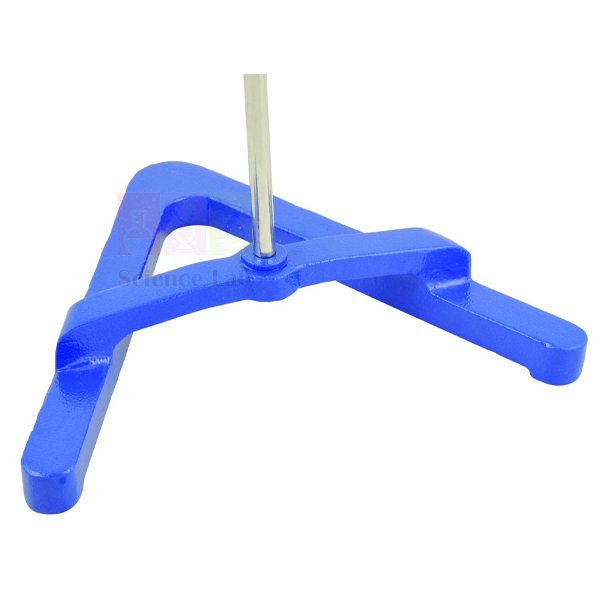
A-Shape Retort Stand Base
A-Shape Retort Stand Base (Product Code: SLE/CH/01) is a heavy cast iron base with an A-shaped footprint that forms the foundation of a retort stand, keeping clamps, rings and glassware steady on the bench. The base is finished in blue paint, sits on rubber feet and has a 10 x 1.5 mm tapped hole to receive the support rod. It is made by Jain Scientific Equipments Pvt Ltd (ScienceLab), Ambala, for school, college and research labs that need a dependable retort stand for lab work in India and abroad.
Specifications
| Parameter | Detail |
|---|---|
| Material | Cast iron |
| Finish | Blue paint |
| Rod fixing | Hole tapped 10 x 1.5 mm |
| Feet | Rubber feet |
| Version 1 (side length / rod) | 150 mm / 600 x 10 mm |
| Version 2 (side length / rod) | 150 mm / 700 x 10 mm |
Typical Use
The wide A-shaped footprint resists tipping when a flask, condenser or separating funnel is clamped away from the rod. Screw the rod firmly into the tapped hole, then add boss heads and clamps from the bottom up, keeping the heaviest load over the base rather than beyond its edge. The shorter rod suits routine filtration, burette work and heating over a burner; the longer rod gives headroom for distillation set-ups or when two clamps must be stacked.
The rubber feet protect bench tops and reduce sliding on smooth laminate. Wipe off chemical splashes promptly to protect the painted finish, and check that the rod remains tight in the thread before each practical session. Combined with a clamp and boss head, the base becomes the standard lab stand clamp boss head arrangement used in most chemistry and physics practicals.
Manufacturer
Jain Scientific Equipments Private Limited operates under the ScienceLab name from Ambala, Haryana, producing laboratory apparatus for education and research. The company is incorporated under CIN U29309HR2020PTC087597 and manufactures at its licensed factory at 449, HSIIDC Industrial Area, Saha, Ambala (Factory Licence AMB-ONLINE-CHD-J-414). More details are on the company profile.
Related Chemistry Lab Equipment
Parts that complete a working retort stand on this base:
- Retort Clamp Three Finger — grips flasks and condensers on the rod.
- Boss Head, With Detachable Attachment — fixes clamps to the rod at any height.
- Retort Rings — support funnels, wire gauze or evaporating dishes.
- Retort Stand — a complete stand option if you prefer to order one assembly.
- Stand With Base Plate H-Shape — an alternative base shape for comparison.
More stands and supports are listed under Chemistry Lab Equipment.
Frequently Asked Questions
What is the base made of?
Cast iron with a blue painted finish and rubber feet.
What thread does the rod hole have?
The hole is tapped 10 x 1.5 mm. The listed rods are 10 mm in diameter.
Which rod lengths are offered?
Two versions are listed, both with a 150 mm side length: one with a 600 x 10 mm rod and one with a 700 x 10 mm rod. Please state which version you need, and confirm with us whether the rod is included in your quotation.
Will it mark or slide on the bench?
The rubber feet help protect the work surface and improve grip on smooth benches.
How should it be cared for?
Wipe away chemical spills quickly, keep it dry, and check the rod thread is tight before use.
Can you supply bases in bulk for a new lab?
Yes. Share the quantity, rod version and any clamps or rings needed through our contact page; we supply institutions across India and international markets.
Request a Quote
Ask for a quotation on the A-Shape Retort Stand Base through our contact page, or add it with matching clamps to the enquiry cart.
Last updated: 24 September 2026
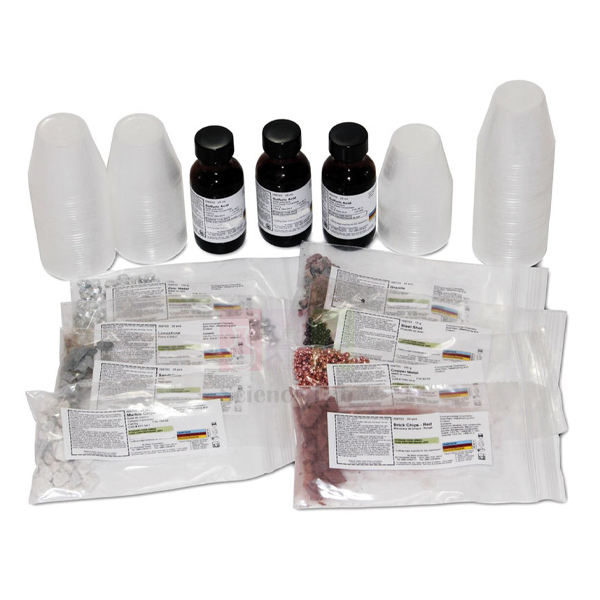
Acid Rain, Weathering & Erosion
Acid Rain, Weathering & Erosion (Product Code: SLE/CH/02) is a classroom activity kit in which student groups expose naturally occurring and construction materials to an acidic environment and compare them with the same materials kept in ‘normal’ rain, represented by tap water. It links chemistry with environmental studies by showing how acidity speeds up weathering and erosion. The kit is supplied by Jain Scientific Equipments Pvt Ltd (ScienceLab), Ambala, as an environmental science kit for schools that want a structured, group-based practical.
Key Details
| Parameter | Detail |
|---|---|
| Type | Student activity kit |
| Topic | Effect of acid rain on weathering and erosion of natural and man-made surfaces |
| Activity | Naturally occurring and construction materials exposed to an acidic environment |
| Comparison | Same materials exposed to ‘normal’ rain (tap water) |
| Teaching material | Teacher’s manual and student copy masters included |
| Class size | Sufficient materials for 15 groups |
Typical Use
Acid rain harms aquatic ecosystems and land areas, and it attacks both natural surfaces, such as the rock faces of mountainous regions, and man-made ones. Stones and metals used in buildings, statues and monuments can be affected, and the rate of weathering and erosion rises quickly as the rain becomes more acidic. This kit turns those ideas into an observation-based practical: each group sets up an acid sample and a tap-water control side by side, records the starting appearance of each material, and returns at intervals to note fizzing, dulling, pitting, colour change or loss of surface.
The student copy masters give a ready worksheet for recording observations, and the teacher’s manual supports planning and discussion. With materials for 15 groups, a full class can work in small teams at the same time, which makes it a practical chemistry experiment kit for middle and secondary classes studying environmental chemistry, rocks and corrosion. Follow the manual for handling the acid, have students wear eye protection and aprons, and keep the tap-water control untouched so the comparison stays fair.
Supplier
Jain Scientific Equipments Private Limited, which trades as ScienceLab, is based in Ambala, Haryana, and supplies teaching kits and laboratory apparatus to schools and colleges. Find out more on the company profile.
Related Chemistry Lab Equipment
Useful additions when running this acid rain activity:
- Paper, Universal, pH 1-14 — lets groups compare the acidity of the acid sample and the tap-water control.
- Digital Ph Meter(Pen Type) — for a numerical pH reading as an extension task.
- Glass Beaker Set of 5 — spare containers for extra samples or repeat trials.
- Acid Spill Clean Up Kit — keeps the room prepared for any spills during the practical.
- Acid Proof Aprons, Lab Coat, Pants, Shoe Covers and Sleeves — protective wear for students handling acid.
Explore more kits and apparatus in the Chemistry Lab Equipment category.
Frequently Asked Questions
How many students can use one kit?
The kit contains sufficient materials for 15 groups, so group size depends on how you divide your class.
Is teaching guidance included?
Yes. A teacher’s manual and student copy masters are included.
What does the experiment compare?
Students compare naturally occurring and construction materials placed in an acidic environment with the same materials exposed to tap water, which stands in for ‘normal’ rain.
Which exact materials and quantities are in the kit?
For a full contents list, please ask through our contact page and we will share it before you order.
Can the kit be reused?
The printed manual and copy masters can be kept for future classes; for repeat sessions, ask us about replacement materials for the consumable parts.
Do you supply kits for several schools at once?
Yes. Send the number of kits and delivery locations; we supply schools and institutions across India and international markets.
Request a Quote
To receive a quotation for the Acid Rain, Weathering & Erosion kit, write to us on the contact page or add it to your enquiry cart.
Last updated: 24 September 2026
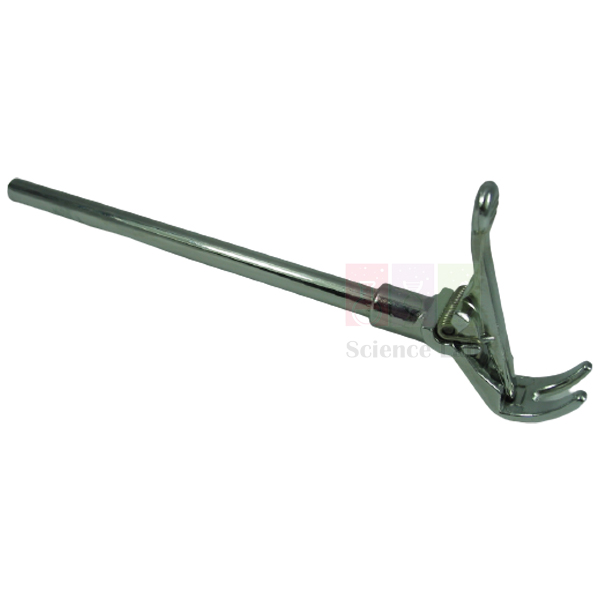
Alloy Test Tube and Thermometer Holder
Alloy Test Tube and Thermometer Holder (Product Code: SLE/CH/03) is a chrome plated alloy holder with spring-loaded jaws that close on test tubes or thermometers from the smallest sizes up to 25 mm. The spring action grips without the user having to keep squeezing, which helps students hold glassware steadily and keep their hands clear of heat and chemicals. Made by Jain Scientific Equipments Pvt Ltd (ScienceLab), Ambala, it is a practical piece of chemistry lab equipment for schools in India and for college teaching labs.
Specifications
| Parameter | Detail |
|---|---|
| Material | Alloy |
| Finish | Chrome plated |
| Jaws | Spring loaded |
| Tube size range | 0–25 mm |
| Holds | Test tubes and thermometers |
Typical Use
The most common job for this holder is gripping a test tube while its contents are warmed over a flame, for example when dissolving a salt, observing a decomposition or checking for a gas. Grip the tube near its mouth, tilt it slightly, point the open end away from everyone and move it gently through the flame so the liquid heats evenly. Because the jaws are sprung, the tube stays secure even when a student adjusts their hold. The same holder can steady a thermometer while a reading is taken from a beaker or tube, keeping the bulb off the glass wall.
The chrome plating resists everyday splashes, but it is still good practice to wipe the jaws after use and let the holder cool before storing it. Check that the spring closes firmly before each session; a weak grip on a hot tube is a hazard. For whole-class practicals, many schools issue one holder per bench along with a rack and brush so each group has a complete heating set.
Manufacturer
ScienceLab is the brand of Jain Scientific Equipments Private Limited, a laboratory apparatus company based in Ambala, Haryana, serving schools, colleges and laboratories. Visit the company profile to learn more.
Related Chemistry Lab Equipment
Items that complete a test-tube heating and measuring set:
- Test Tube — glass tubes for the holder to grip during reactions and heating.
- Bunsen Burner — heat source for warming tubes held in the jaws.
- Test Tube Stand (Wire Pattern) — somewhere safe to set tubes down after heating.
- Brush Test Tube — cleans residues from tubes after the practical.
- Laboratory Thermometer — a thermometer to use with the holder for temperature readings.
For more holders, clamps and racks, visit Chemistry Lab Equipment.
Frequently Asked Questions
What size of tube does it hold?
The spring-loaded jaws take tubes from 0 to 25 mm.
Can it hold a thermometer as well as a test tube?
Yes, it is designed as a test tube and thermometer holder.
What is it made of?
It is made of alloy with a chrome plated finish.
Can it be mounted on a retort stand?
The listing does not specify a stand mounting. If you need the holder fixed to a rod, ask us through the contact page and we will advise a suitable clamp.
How do I look after it?
Let it cool after heating work, wipe the jaws clean and store it dry. Check that the spring still closes firmly before each class.
Can I order it in class sets?
Yes. Tell us how many holders you need and the delivery location; we supply institutions in India and international markets.
Request a Quote
For a price on the Alloy Test Tube and Thermometer Holder, use our contact page or add it to the enquiry cart with your other bench items.
Last updated: 24 September 2026
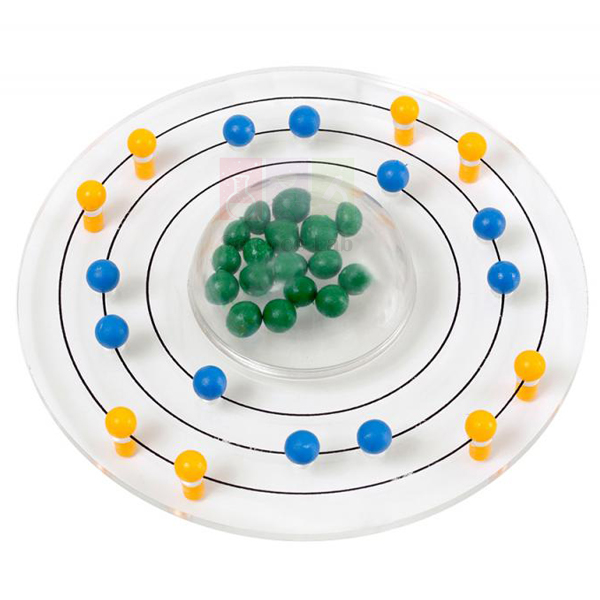
Atom Activity Model
Atom Activity Model (Product Code: SLE/CH/04) is a transparent, durable plastic model that lays out the structure of an atom — the nucleus, the protons, neutrons and electrons that make it up, and the electron layers around it — in a clear graphic form. Because it is transparent, teachers can place it on an overhead projector and show the whole class the same diagram while they build up an explanation. It is made by Jain Scientific Equipments Pvt Ltd (ScienceLab), Ambala, as an atom model kit for chemistry and physical science lessons in India and overseas.
Specifications
| Parameter | Detail |
|---|---|
| Type | Graphic model of atomic structure |
| Components shown | Nucleus; protons, neutrons and electrons; electron layers |
| Material | Durable plastic, transparent |
| Projection | Suitable for use with an overhead projector |
| Dimensions | 150 mm D x 25 mm H |
| Concepts supported | Atomic numbers, ionic and covalent bonding, electroneutrality, filling of electron layers, definition and calculation of ionic charge |
Typical Use
Teachers typically begin with the nucleus, pointing out protons and neutrons and using the proton count to explain how the atomic number identifies an element, and then move outward through the electron layers so students can see the order in which the layers fill. Comparing the number of electrons with the number of protons demonstrates electroneutrality; discussing what happens when an electron is lost or gained then shows how an ion forms and how its charge is worked out. The same layout supports a comparison of ionic bonding, where electrons are transferred, with covalent bonding, where they are shared.
On an overhead projector the transparent body lets the whole class follow each step, which works well for introducing the topic before students attempt worksheet problems. As a chemistry teaching kit item it also suits small-group revision, where students take turns using the model to explain atoms and ions to each other. Store it flat and clean the plastic with a soft, dry cloth to keep it clear for projection.
Manufacturer
The model comes from Jain Scientific Equipments Private Limited, known by its trading name ScienceLab, an Ambala, Haryana company that develops teaching aids and laboratory apparatus. Read our company profile for more.
Related Chemistry Lab Equipment
Teaching aids that extend lessons on atoms, elements and bonding:
- Modern Periodic Table Laminated — connects atomic number and electron layers to an element’s position.
- Chemical Bonding Chart — a wall reference for ionic and covalent bonding.
- NCERT Molecular Model Kit — moves students from single atoms to three-dimensional molecules.
- Atom Molecular Models Set — ball-and-link models for building molecules at the bench.
- Atom Models — an alternative atom model for comparison.
Find more models and apparatus in Chemistry Lab Equipment.
Frequently Asked Questions
Can it be used on an overhead projector?
Yes. The model is made of transparent plastic specifically so it can be used with an overhead projector.
What size is it?
It measures 150 mm D x 25 mm H.
Which topics does it help teach?
Atomic structure, atomic numbers, ionic and covalent bonding, electroneutrality, the filling of electron layers, and how ionic charge is defined and calculated.
What exactly is included in the supply?
A detailed contents list is not given here. Please ask through our contact page for the full contents before ordering.
Is it durable enough for student handling?
It is made of durable plastic. Wipe it with a soft, dry cloth and avoid solvents when cleaning.
Can schools order several units?
Yes. Share the quantity and delivery details; we supply schools and colleges across India and international markets.
Request a Quote
Request pricing for the Atom Activity Model on our contact page, or add it to the enquiry cart.
Last updated: 24 September 2026
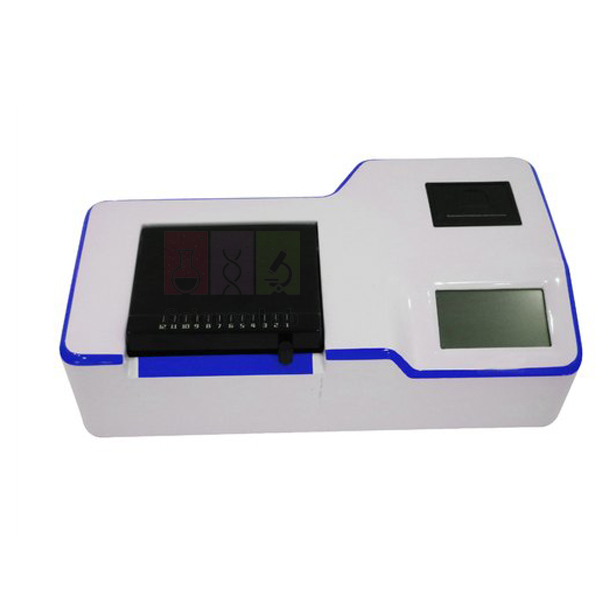
Aflatoxin meter
Aflatoxin meter (Product Code: SLE/CH/05) is a bench instrument that works on the solid-phase enzyme-linked immunosorbent assay (ELISA) principle to measure the aflatoxin B1 content of samples quantitatively. Used together with an aflatoxin B1 kit, it serves food, feed, edible oil, dairy, pharmaceutical, beverage and wine testing laboratories, as well as teaching labs that cover food safety. It is made by Jain Scientific Equipments Pvt Ltd (ScienceLab), Ambala, within its range of analytical lab instruments for India and international markets.
Specifications
| Parameter | Detail |
|---|---|
| Principle | Solid-phase ELISA (enzyme-linked immunosorbent assay) |
| System | Two parts: aflatoxin meter and B1 kit |
| Measures | Aflatoxin B1 content; other toxins can be measured with other matching kits |
| Minimum measure volume | 0.05 ng |
| Measuring range | 0.05–1 ng/ml (ppb) |
| Absorbance range | -0.041 to 1.999 A |
| Concentration range | 0.000–9999 |
| Wavelength | 450 ± 2 nm |
| Precision | ±0.1 ng/ml |
| Test speed | 20 pieces per hour |
| Light source | 36V / 20mA |
| Operating temperature | 5–35 °C |
| Power | 37 W |
| Working power supply | 220V ±10%, 50 Hz |
| Size | 350 x 270 x 210 mm |
| Weight | 9 kg |
| Applications | Food, feed, oils and fats, dairy products, pharmaceuticals, beverages, wine products |
Typical Use
Aflatoxins are toxic compounds produced by certain moulds on crops such as grains and oilseeds, and B1 is the one most often monitored. In an ELISA test, the prepared sample extract and kit reagents react in antibody-coated wells; after the washing and colour-development steps set out in the kit instructions, the meter reads the colour intensity at 450 nm and converts the absorbance into an aflatoxin B1 concentration. With a measuring range of 0.05–1 ng/ml (ppb), the instrument is aimed at trace-level screening, and a throughput of 20 pieces per hour suits routine batches in quality-control rooms.
For reliable results, follow the kit’s sample-preparation and timing steps closely, use calibrated pipettes, and run the instrument within its 5–35 °C operating temperature on a stable 220V supply. Because other kits can be used for other toxins, the same meter can grow with a lab’s testing programme. Food microbiology lab equipment set-ups in colleges and feed mills often place this meter alongside a balance, mixer and pipettes so that sample handling and reading happen at one bench.
Manufacturer
ScienceLab is the trading name of Jain Scientific Equipments Private Limited in Ambala, Haryana. The company is a registered MSME enterprise (Udyam UDYAM-HR-01-0003714), and its export orders are shipped under Importer-Exporter Code AAECJ8618A issued by the DGFT. See the company profile for background.
Related Chemistry Lab Equipment
Equipment used around the meter in an aflatoxin testing workflow:
- Micropipette — accurate dispensing of sample extract and kit reagents.
- Micropipette Tips — fresh tips for each sample to avoid carry-over.
- ELISA Washer 8 Channel — handles the plate washing steps of the assay.
- Electronic Compact Balance — weighs ground samples before extraction.
- Vortex Mixer — mixes sample extracts and reagents thoroughly.
More instruments are listed in Chemistry Lab Equipment.
Frequently Asked Questions
What does the meter measure?
It quantitatively measures aflatoxin B1 content in samples using the ELISA principle, with a measuring range of 0.05–1 ng/ml (ppb). Other toxins can be measured with other matching kits.
Is the B1 kit part of the supply?
The system is described as two parts, the meter and the B1 kit. Please confirm through our contact page which parts and how many kits your quotation should include.
What power supply does it need?
It runs on 220V ±10%, 50 Hz and has a power rating of 37 W.
How many tests can it handle?
The listed test speed is 20 pieces per hour.
Is a calibration certificate available?
Calibration documentation is not listed here. If your lab needs one, discuss it with us before ordering so we can confirm what can be arranged.
What warranty and after-sales support apply?
Warranty terms are not stated on this page; please ask for them with your quotation.
What should an institutional enquiry include?
Mention the sample types you test, the expected number of tests per day, kit requirements and delivery location. We supply institutions in India and international markets.
Request a Quote
For a quotation on the Aflatoxin meter, contact us through the contact page or add it to the enquiry cart together with pipettes and accessories.
Last updated: 24 September 2026
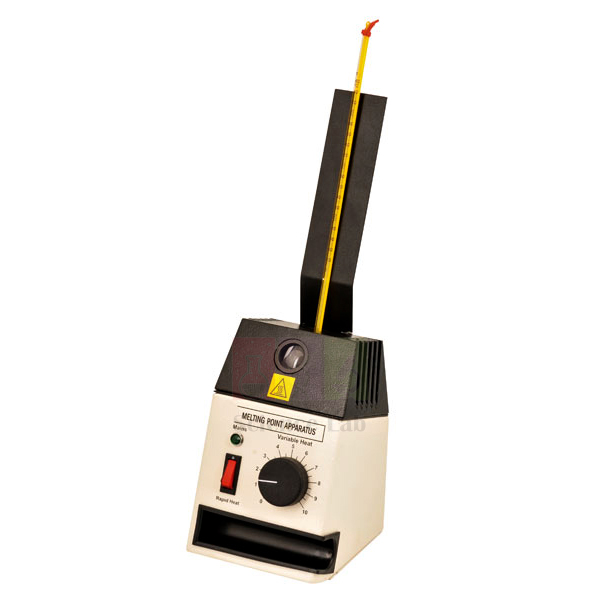
Apparatus Melting Point
Apparatus Melting Point (Product Code: SLE/CH/06) is an electrically heated instrument for finding the melting point of solid samples packed in capillary tubes, covering temperatures from ambient to 350 °C. Its ergonomic design puts safety and ease of operation first, which makes it well suited to school, college and university teaching labs where students check the purity and identity of organic compounds. It is made by Jain Scientific Equipments Pvt Ltd (ScienceLab), Ambala, and forms part of its chemistry lab instruments supplied across India and abroad.
Specifications
| Parameter | Detail |
|---|---|
| Temperature range | Ambient to 350 °C |
| Heating block | Aluminium, with ceramic insulation around it to minimise heat transfer to the casing |
| Controls | Single front-panel knob combining the main switch with an arbitrary 0 to 10 scale |
| Rapid heating | Rapid heat switch for reaching higher temperatures quickly |
| Sample viewing | Sample tubes illuminated from behind and magnified through a lens |
| Background | Rear selector for light or dark background |
| Electrical supply | 230V AC, 50/60Hz |
| Weight | 1.5 kg |
| Supplied with | Instructions |
| Optional accessories | Thermometer, capillary tubes, cooling plug |
Typical Use
A finely powdered sample is packed into the closed end of a capillary tube, which is placed in the heating block beside the thermometer. Students can use the rapid heat switch to approach the expected value quickly, then turn the control knob down to a lower setting so that the temperature climbs slowly through the melting range. Looking through the lens, with the tube lit from behind, they note the temperature at which the first droplet appears and the point at which the sample is completely liquid. A pure compound melts sharply over a narrow range, while an impure one melts lower and over a wider range, which is why the test is a standard step after recrystallisation.
The rear background selector helps with samples that are hard to see: a dark background suits white crystals and a light background suits coloured ones. Ceramic insulation keeps the outer casing cooler than the block, but the heating area should still be treated as hot until it has cooled, and a cooling plug (available as an accessory) can speed up turnaround between students. Keep the block clean of spilled powder and store the unit in a dry place when not in use.
Manufacturer
Jain Scientific Equipments Private Limited, trading as ScienceLab, is an Ambala, Haryana manufacturer of laboratory instruments and apparatus for education and research. Our company profile has further details.
Related Chemistry Lab Equipment
Consumables and alternatives for melting point work:
- Melting-Point Tubes — capillaries for packing the powdered sample.
- Capillary Tube Set — an alternative source of capillaries for class use.
- Glass Thermometer — the thermometer is an accessory, so order one if you do not already have it.
- Digital Melting Point Apparatus — a digital-readout option for comparison.
- Melting Point Apparatus Simple — a basic model for junior classes.
See all instruments in Chemistry Lab Equipment.
Frequently Asked Questions
What temperature range does it cover?
From ambient to 350 °C.
Is a thermometer included?
No. The thermometer, capillary tubes and cooling plug are available as accessories and should be ordered separately if needed.
How is the heating rate controlled?
A single front-panel knob with an arbitrary 0 to 10 scale sets the heat and also acts as the main switch; a separate rapid heat switch brings the block to higher temperatures quickly.
What power supply does it use?
230V AC, 50/60Hz. The unit weighs 1.5 kg.
Can a calibration certificate be provided?
This is not listed for the apparatus. If your lab needs one, please discuss it with us through the contact page before ordering.
What warranty applies?
Warranty terms are not given here; ask us and we will include them with your quotation.
Can you supply several units for a teaching lab?
Yes. Tell us the number of units and accessories required; we supply institutions across India and international markets.
Request a Quote
Get a quotation for the Apparatus Melting Point and its accessories via our contact page, or add them to the enquiry cart.
Last updated: 24 September 2026
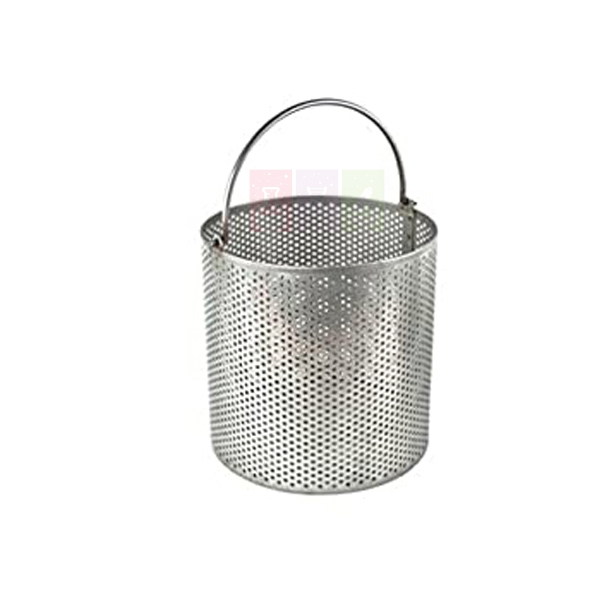
Autoclave Basket
Autoclave Basket (Product Code: SLE/CH/07) is a stainless steel basket with 3 mm diameter perforations that holds glassware, media bottles, instruments and waste bags inside an autoclave during steam sterilisation. The perforated walls let steam circulate around the load and allow condensate to drain away, while the basket makes it easy to load and unload hot items in one go. It is made by Jain Scientific Equipments Pvt Ltd (ScienceLab), Ambala, in five diameter and height combinations to suit different chambers used with an autoclave sterilizer in India and overseas.
Specifications
| Parameter | Detail |
|---|---|
| Material | Stainless steel |
| Perforation | 3 mm diameter |
| Size 1 | 210 mm dia. x 150 mm high |
| Size 2 | 220 mm dia. x 240 mm high |
| Size 3 | 280 mm dia. x 200 mm high |
| Size 4 | 380 mm dia. x 280 mm high |
| Size 5 | 480 mm dia. x 220 mm high |
Typical Use
In microbiology, pharmacy and biology labs, the basket is loaded on the bench with the items to be sterilised — loosely capped media bottles, plugged flasks, pipette containers, instruments or waste in autoclave bags — and then lowered into the chamber as one unit. After the cycle, the whole load lifts out together, which reduces handling of individual hot items. Leave space between items so steam can reach every surface, avoid packing the basket tight to the rim, and mark loads with indicator tape so sterilised and unsterilised items are never mixed up.
Choosing the right size matters: the basket diameter must be smaller than the chamber opening, and the height should leave clearance below the lid. The smaller 210 mm and 220 mm baskets suit compact vertical or portable units, while the 380 mm and 480 mm versions are intended for larger chambers. Stainless steel tolerates repeated steam cycles; rinse off spilled media and dry the basket after use to keep the perforations clear. Microbiology lab equipment buyers often order two baskets per autoclave so one can be loaded while the other is in the cycle.
Manufacturer
Jain Scientific Equipments Private Limited uses the trading name ScienceLab and makes laboratory apparatus at Ambala, Haryana, for schools, colleges, hospitals and research labs. Learn more on the company profile.
Related Chemistry Lab Equipment
Autoclaves and consumables used with this basket:
- Electric Autoclave — the sterilising unit the basket sits in.
- Portable Autoclave Single Drum — a compact option for smaller labs; match the basket size to its chamber.
- Autoclave Tape — marks each load and shows it has been through a cycle.
- Autoclave Bag — contains waste or small items within the basket.
- Draining Basket — an alternative basket style for comparison.
Browse the Chemistry Lab Equipment category for more lab essentials.
Frequently Asked Questions
Which sizes are available?
Five: 210 x 150 mm, 220 x 240 mm, 280 x 200 mm, 380 x 280 mm and 480 x 220 mm (diameter x height).
What is it made of?
Stainless steel, with 3 mm diameter perforations.
Which basket fits my autoclave?
Measure the inner diameter and usable height of your chamber and choose a basket that is smaller on both. If you are unsure, send us the autoclave details via the contact page and we will help you choose.
Can it go through repeated steam cycles?
Yes, it is designed for use inside an autoclave. Clean off media spills and dry it after use to keep the perforations clear.
Can I order different sizes together?
Yes. List each size and quantity in one enquiry.
Do you supply hospitals and institutions in bulk?
Yes. We supply institutions across India and international markets; include quantities and delivery location in your enquiry.
Request a Quote
For pricing on the Autoclave Basket in your chosen size, contact us via the contact page or use the enquiry cart.
Last updated: 24 September 2026
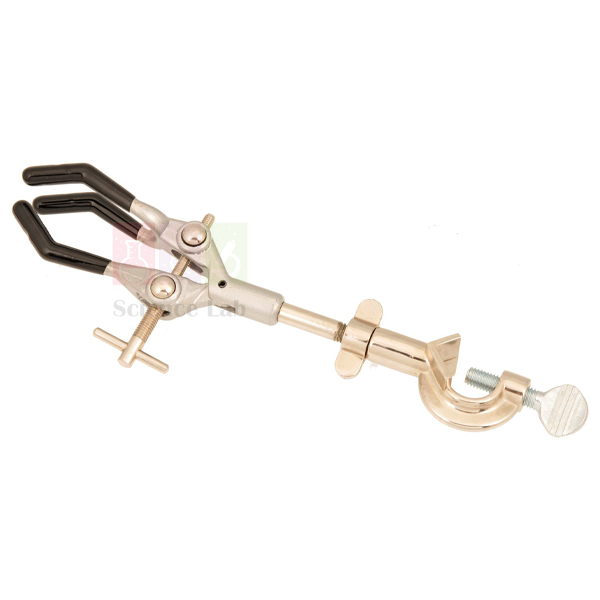
Three Prong Swivel Clamp
Three Prong Swivel Clamp (Product Code: SLE/CH/08) is a dual-adjustment laboratory clamp whose three PVC-covered fingers close around round and irregularly shaped objects, from flask necks to condensers and odd-shaped apparatus. Its jaws open to a maximum of 64.8 mm (2-9/16 in), and a wing nut on the shaft lets the clamp head rotate through a full 360° so glassware can be set at exactly the angle a set-up needs. Made by Jain Scientific Equipments Pvt Ltd (ScienceLab), Ambala, it is everyday chemistry lab equipment in India for school, college and research benches.
Specifications
| Parameter | Detail |
|---|---|
| Type | Three prong, dual adjustment clamp |
| Holds | Circular and irregular shaped objects |
| Maximum jaw opening | 64.8 mm (2-9/16 in) |
| Rotation | 360°, set with a shaft wing nut |
| Fingers | PVC covered |
| Rod grip | Clamp post holder grips rods up to 19 mm (3/4 in) |
Typical Use
Three fingers centre a round object better than two flat jaws, which is why this style of clamp is chosen for the neck of a round-bottom flask, a distillation head or a condenser. Because the two adjustments work independently, the clamp can be closed evenly around a tapered or irregular item rather than pinching it on one side. The 360° swivel is useful when a condenser has to slope downward to a receiver or when a flask must be tilted for a reflux or a gas-generation set-up; loosen the wing nut, set the angle, then tighten it before adding liquid.
The PVC-covered fingers cushion glass and reduce the risk of cracking, but they should be tightened only until the item is secure — over-tightening is a common cause of broken necks. Keep the covered fingers away from direct flame, and check the rod grip is firmly locked on a rod of up to 19 mm before hanging any load. Paired with a sturdy stand, it gives students a steady set-up for distillation and other assembled apparatus.
Manufacturer
This clamp is from Jain Scientific Equipments Private Limited, whose laboratory products carry the ScienceLab name and are made in Ambala, Haryana. More about the company is on the profile page.
Related Chemistry Lab Equipment
Items that pair with a swivel clamp in assembled set-ups:
- Retort Stand — the upright rod and base the clamp is fixed to.
- A-Shape Retort Stand Base — a heavy base for building your own stand.
- Distillation Apparatus — glassware that benefits from an angled, cushioned grip.
- Retort Clamp Four Finger — an alternative with four fingers for a different grip.
- Table Clamp For Rods — fixes a rod to the bench edge when a base will not fit.
For more clamps and supports, see Chemistry Lab Equipment.
Frequently Asked Questions
How wide do the jaws open?
The maximum jaw opening is 64.8 mm (2-9/16 in).
What rod sizes does it fit?
The clamp post holder grips rods up to 19 mm (3/4 in) in diameter.
Can the clamp be angled?
Yes. Loosening the shaft wing nut lets the clamp rotate through 360°; tighten it again once the angle is set.
Will it scratch or crack glassware?
The fingers are PVC covered to cushion the grip. Tighten only until the item is held firmly.
Can it be used close to a flame?
Keep the PVC-covered fingers away from direct flame and very hot surfaces; clamp glassware at a cooler point such as the neck.
Can I order clamps for a whole lab?
Yes. Send the number of clamps and any stands needed through our contact page; we supply institutions in India and international markets.
Request a Quote
Request a price for the Three Prong Swivel Clamp on our contact page or add it to the enquiry cart.
Last updated: 24 September 2026
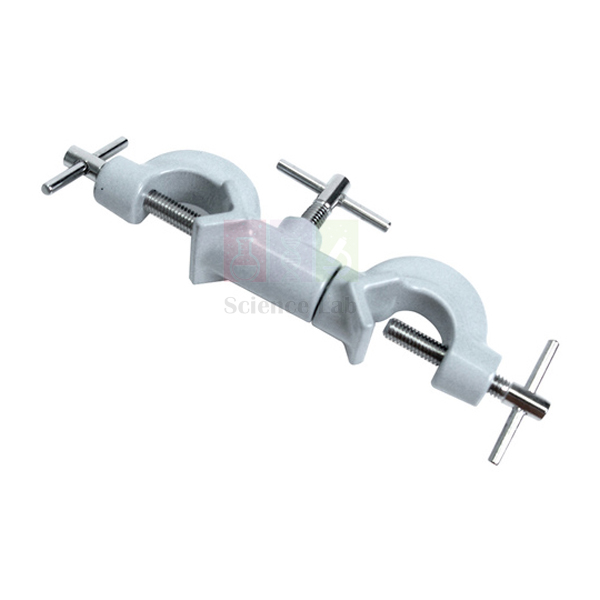
Adjustable Clamp Holder
Adjustable Clamp Holder (Product Code: SLE/CH/09) is the connecting piece that fixes a laboratory clamp to a support rod of up to 5/8 in diameter, and it can be swivelled and locked at any angle so the clamp can point up, down or sideways as the set-up demands. It has an enamel finish and is tightened by hand with plastic thumb screws, so no tools are needed at the bench. Made by Jain Scientific Equipments Pvt Ltd (ScienceLab), Ambala, it is a basic building block of school chemistry lab equipment in India and of college and research support stands.
Specifications
| Parameter | Detail |
|---|---|
| Rod size | For rods up to 5/8 in diameter |
| Adjustment | Swivels and locks to any angle |
| Finish | Enamel |
| Tightening | Plastic thumb screws |
Typical Use
On a retort stand, one side of the holder grips the upright rod and the other holds the shaft of a clamp, a ring or a burette clamp. Slide it to the working height, tighten the rod thumb screw, insert the clamp shaft, then swivel the clamp to the angle you need and lock it. The ability to set any angle helps with condensers that must slope, funnels that need to sit over a receiving flask, or clamps that must reach across to a second stand.
Plastic thumb screws are comfortable to turn and allow quick changes between experiments; tighten them firmly but without excessive force. Before hanging glassware, give the clamp a gentle tug to confirm it will not slip. The enamel finish protects the body from routine splashes — wipe it dry after use, and replace any holder whose thumb screws no longer hold, since a slipping clamp is a common cause of broken glass.
Manufacturer
Jain Scientific Equipments Private Limited trades as ScienceLab and manufactures laboratory apparatus in Ambala, Haryana. For institutions that need vendor registration details, the company’s GSTIN is 06AAECJ8618A1ZT and its Legal Entity Identifier is 3358004HRD1JIVXKYX49. Company information is on the profile page.
Related Chemistry Lab Equipment
Clamps and stands this holder connects together:
- Retort Stand — provides the upright rod the holder grips.
- Three Prong Swivel Clamp — a round-object clamp to mount in the holder.
- Retort Clamp Three Finger — a standard clamp for flasks and tubes.
- Burette Clamp, Die Cast – Double Clamp — for titration set-ups on the same stand.
- Funnel Holder — supports a funnel during filtration.
Explore all clamps and holders in Chemistry Lab Equipment.
Frequently Asked Questions
What rod diameter does it accept?
Rods up to 5/8 in diameter.
Can the clamp be set at an angle?
Yes. The holder swivels and locks at any angle.
Do I need tools to tighten it?
No. It is tightened by hand with plastic thumb screws.
Is a clamp included?
This listing is for the holder. Clamps are available separately — see the related items above or ask us to suggest a matching clamp.
How should it be maintained?
Wipe spills off the enamel finish, keep it dry, and check that the thumb screws still grip before each practical.
What details should a school or college include in a quotation request?
Give the quantity, the clamps and stands you plan to use, and your delivery address through our contact page. We supply institutions across India and international markets.
Request a Quote
To price the Adjustable Clamp Holder, contact us on the contact page or add it to the enquiry cart with your clamps and stands.
Last updated: 24 September 2026
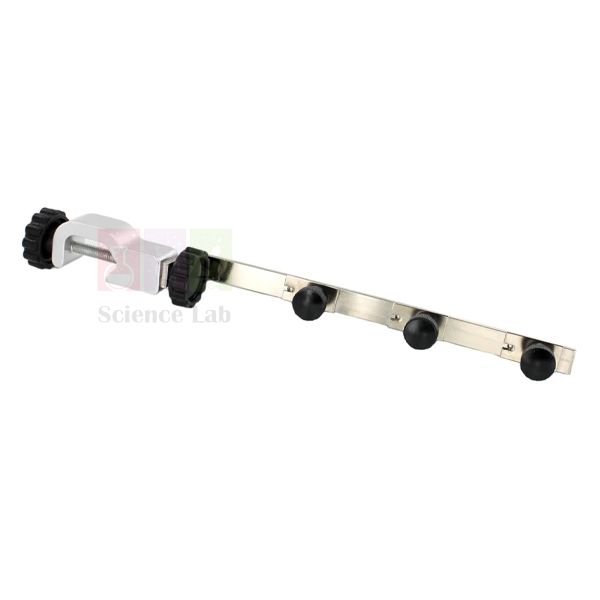
Pendulum Clamp
Pendulum Clamp (Product Code: SLE/CH/10) is a sturdy stand-mounted holder with an all-steel bracket from which up to 3 pendulums can hang at the same time without wobbling. Each pendulum holder has its own knurled thumbscrew and locking device, so the cord of one pendulum can be lengthened or shortened without disturbing the others. The bracket fixes to a support rod through a rod clamp tightened with a large knurled knob. Made by Jain Scientific Equipments Pvt Ltd (ScienceLab), Ambala, it turns an ordinary retort stand into simple pendulum apparatus for school and college physics and general science labs.
Specifications
| Parameter | Detail |
|---|---|
| Bracket | All steel, sturdy, holds pendulums without wobbling |
| Capacity | Up to 3 pendulums suspended at one time |
| Pendulum holders | Each with its own knurled thumbscrew and locking device for its cord |
| Adjustment | Each cord adjusts independently without disturbing the other pendulums |
| Mounting | Rod clamp tightened with a large knurled knob |
Typical Use
The classic investigation is how the period of a pendulum depends on its length. With three holders on one bracket, students can hang bobs on cords of three different lengths, set them swinging through small angles and time a fixed number of oscillations for each, then compare the results directly. Because each cord locks separately, one pendulum can be re-set to a new length while the other two stay exactly as they were, which saves time and keeps a controlled comparison. The same set-up shows that period is almost independent of bob mass when lengths are kept equal, and it can be used to demonstrate coupled or resonant pendulums.
Mount the rod clamp high on a stable stand, tighten the knurled knob firmly and make sure the bracket is level before measuring lengths from the point of suspension to the centre of each bob. A rigid, wobble-free bracket matters because any movement of the support changes the swing and spoils timing results. After use, release the cords, wipe the steel bracket dry and store the clamp with its thumbscrews loosely fitted so they are not lost.
Manufacturer
ScienceLab is the name under which Jain Scientific Equipments Private Limited, based in Ambala, Haryana, produces physics, chemistry and biology apparatus for educational institutions. Find out more on the company profile.
Related Laboratory Equipment
Everything else needed for a pendulum practical:
- Bob/Metallic Sphere (Small) With Hooks — bobs to hang from each holder.
- Cotton Thread Roll — cord for suspending the bobs.
- Stop Clock — times the oscillations.
- Meter Stick, White — measures effective pendulum length.
- Retort Stand — the support rod and base for the clamp.
More clamps and supports are in Chemistry Lab Equipment.
Frequently Asked Questions
How many pendulums can it hold?
Up to 3 pendulums can be suspended at one time.
Can I change one pendulum’s length without resetting the others?
Yes. Each holder has its own knurled thumbscrew and locking device, so each cord adjusts independently.
How does it attach to a stand?
The steel bracket is attached to a rod clamp that is tightened with a large knurled knob. Please check your stand rod size with us through the contact page if you are unsure about fit.
Are bobs and thread included?
They are not listed as part of the clamp. Bobs, thread and timing equipment are available separately.
Will the bracket move while pendulums swing?
The all-steel bracket is designed to hold pendulums without wobbling, provided the rod clamp is tightened on a stable stand.
Can you supply complete pendulum sets for a class?
Yes. Tell us the number of benches and the items you need; we supply schools and colleges across India and international markets.
Request a Quote
For a quotation on the Pendulum Clamp, use our contact page or add it to the enquiry cart with bobs and timers.
Last updated: 24 September 2026
257.jpg)
Fisher Clamp (Routine Improved Model)
Fisher Clamp (Routine Improved Model) (Product Code: SLE/CH/11) is a double burette clamp that holds two burettes securely in a vertical position on a single support rod while leaving the full graduated scale of each burette visible for reading. Its all-aluminium cast mount fits rods of 1/4 in to 1/2 in diameter, and the ends carry a sleek enamel finish with rubber finger grippers that cushion the glass. Made by Jain Scientific Equipments Pvt Ltd (ScienceLab), Ambala, it is a practical burette clamp for India’s school, college and quality-control titration benches.
Specifications
| Parameter | Detail |
|---|---|
| Type | Double burette clamp (holds two burettes) |
| Mount | All aluminium, cast |
| Rod diameter | 1/4 in to 1/2 in |
| Burette position | Held securely vertical, with the full burette scale left readable |
| Grip | Rubber finger grippers |
| Finish | Sleek enamel end |
Typical Use
Holding two burettes on one stand is useful in several ways: two students can titrate side by side from one set-up, a teacher can run a demonstration titration next to the student burette, or a back titration can be carried out with one burette for each solution. Fix the mount on the rod at a height that lets the burette tip sit just inside the neck of the conical flask, press each burette into the rubber fingers and check that it hangs truly vertical before filling. Because the clamp leaves the scale uncovered, the meniscus can be read at eye level along the whole length of the burette.
The rubber grippers protect the glass and stop the burette from rotating when the stopcock is turned. Rinse any spilled reagent off the enamel ends and the aluminium mount, and inspect the rubber fingers from time to time — hardened or cracked grippers should be replaced before they let a burette slip. As part of a titration kit for schools in India, one double clamp per stand makes efficient use of bench space in crowded practical rooms.
Manufacturer
Jain Scientific Equipments Private Limited, operating as ScienceLab, is an apparatus maker in Ambala, Haryana, supplying clamps, stands and glassware for teaching and testing labs. Read the company profile for more.
Related Chemistry Lab Equipment
Items that complete a titration station:
- Burette — the graduated tubes the clamp holds.
- Burette Stand and Funnel Stand — a stand to carry the clamp and a filling funnel.
- Brush Burette — cleans burettes between titrations.
- Burette Rack — stores burettes safely when not clamped.
- Fisher Clamp — the standard model, for comparison.
More titration apparatus is in Chemistry Lab Equipment.
Frequently Asked Questions
How many burettes does it hold?
Two. It is a double burette clamp.
What rod sizes does it fit?
Rods from 1/4 in to 1/2 in in diameter.
Does it block the burette scale?
No. It holds the burettes vertically while still permitting a full reading of the burette scale.
What is the mount made of?
All-aluminium casting, with enamel-finished ends and rubber finger grippers.
How does it differ from the standard Fisher Clamp?
This is listed as the Routine Improved Model. For a side-by-side comparison of the two models, please ask through our contact page.
Can you supply clamps and burettes together for a lab?
Yes. Send one list with quantities for clamps, stands and burettes; we supply institutions in India and international markets.
Request a Quote
Ask for a quotation on the Fisher Clamp (Routine Improved Model) through the contact page, or add it to the enquiry cart.
Last updated: 24 September 2026
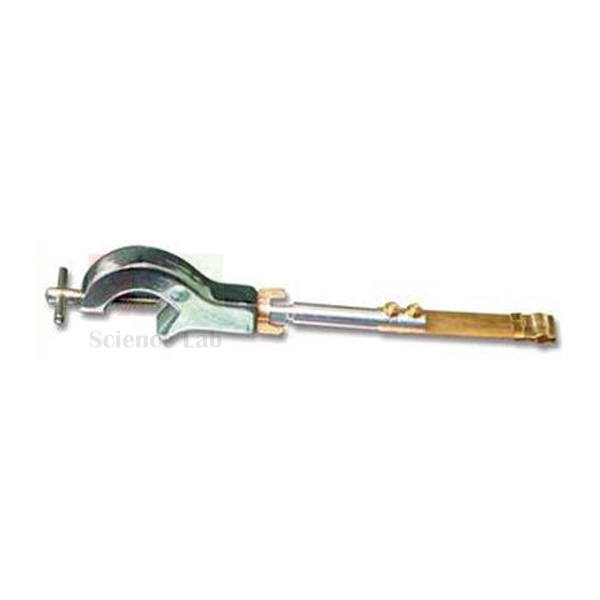
Thermometer Clamp
Thermometer Clamp (Product Code: SLE/CH/12) is a stand clamp made specifically for supporting thermometers, built from a polished aluminium muff with brass clamping jaws. The jaws can be rotated and locked at any angle, so a thermometer can be held upright in a beaker, angled into a flask neck or positioned beside a distillation head. Made by Jain Scientific Equipments Pvt Ltd (ScienceLab), Ambala, it keeps thermometers steady and hands free during heating, cooling and distillation experiments in school, college and research labs.
Specifications
| Parameter | Detail |
|---|---|
| Muff | Polished aluminium |
| Clamping jaws | Brass |
| Adjustment | Jaws rotate and lock at any angle |
| Purpose | Supporting thermometers |
Typical Use
Many temperature experiments go wrong because the thermometer rests on the bottom of the vessel or is held by hand. Clamping it lets the bulb sit in the middle of the liquid, clear of the hot glass, for cooling-curve, heating-curve, specific heat and rate-of-reaction work. In a laboratory distillation apparatus set-up the thermometer bulb must sit level with the side arm of the still head; the rotating brass jaws make it easy to set this position and lock it, even when the stand is not directly beside the flask.
Grip the thermometer on its stem, away from the bulb and scale, and tighten the jaws just enough to hold it — glass thermometers crack if squeezed hard. Slide the muff onto the stand rod, adjust the height so the bulb is immersed to the right depth, then fix the angle. After use, wipe the brass jaws and the polished muff to keep them free of chemical deposits, and store the clamp dry.
Manufacturer
ScienceLab is the trade name of Jain Scientific Equipments Private Limited, an Ambala, Haryana company making clamps, supports and other laboratory apparatus for educational and research users. See our company profile.
Related Chemistry Lab Equipment
Items used with a thermometer clamp:
- Immersion Thermometer — a thermometer to mount in the brass jaws.
- Distillation Apparatus — where accurate thermometer positioning matters most.
- Glass Beaker — for heating and cooling experiments with a clamped thermometer.
- Retort Stand — the rod the aluminium muff mounts on.
- Alloy Test Tube and Thermometer Holder — a spring-jaw alternative that also takes test tubes.
For more clamps, visit Chemistry Lab Equipment.
Frequently Asked Questions
What materials is it made from?
A polished aluminium muff with brass clamping jaws.
Can the thermometer be held at an angle?
Yes. The jaws can be rotated and locked at any angle.
Is a thermometer supplied with the clamp?
No thermometer is listed with the clamp; thermometers are available separately.
What rod diameter and thermometer size does it take?
These dimensions are not listed here. Send us your rod and thermometer sizes through the contact page and we will confirm the fit.
How do I avoid breaking thermometers?
Clamp on the stem, not the bulb, and tighten only until the thermometer no longer slips.
Can you supply clamps for every bench?
Yes. Give us the quantity and delivery location; we supply schools and institutions across India and international markets.
Request a Quote
For the price of the Thermometer Clamp, reach us on the contact page or add it to the enquiry cart with your thermometers and stands.
Last updated: 24 September 2026
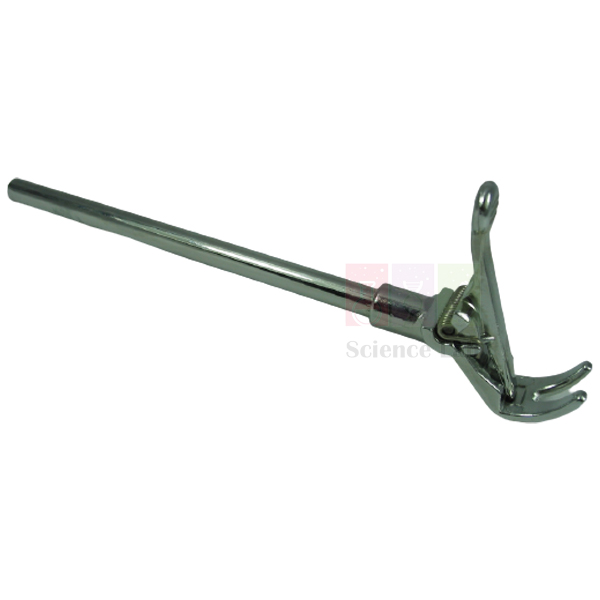
Boss Head, With Detachable Attachment
Boss Head, With Detachable Attachment (Product Code: SLE/CH/13) is a multipurpose aluminium section boss head whose phosphorus bronze clamps can hold objects either vertically or horizontally, giving more flexibility than a fixed-orientation boss. A brass-headed, nickel plated steel thumb screw and a plated wing-shaped nut secure a range of detachable attachments such as thermometer holders and suspension hangers, and the boss head is available with a thermometer hanger. Made by Jain Scientific Equipments Pvt Ltd (ScienceLab), Ambala, it is a versatile lab stand clamp and boss head component for physics and chemistry benches.
Specifications
| Parameter | Detail |
|---|---|
| Body | Aluminium section, multipurpose |
| Clamps | Phosphorus bronze; hold objects vertically or horizontally |
| Thumb screw | Brass headed, nickel plated steel |
| Attachment fixing | Plated wing-shaped nut |
| Attachments | Detachable, e.g. thermometer holders, suspension hangers |
| Option | Available with thermometer hanger |
Typical Use
A boss head is the joint between a stand rod and whatever needs to be held. With this model, the same boss can carry a rod or clamp shaft at right angles or in line, and the wing nut lets attachments be swapped without removing the boss from the stand. A physics teacher might fit a suspension hanger for a spring or pendulum experiment in one lesson and a thermometer holder for a heating experiment in the next, using the same stand each time.
Tighten the thumb screw firmly on the rod before hanging any load, and fix attachments with the wing nut until they no longer turn. The phosphorus bronze clamps provide a springy, corrosion-resistant grip, while the nickel plating on the screw resists rust. Keep the thread clean and free of chemical residue, and store detachable attachments together with the boss so the set stays complete for the next class.
Manufacturer
ScienceLab products are produced by Jain Scientific Equipments Private Limited of Ambala, Haryana. The company is registered under CIN U29309HR2020PTC087597 and operates a licensed factory at 449, HSIIDC Industrial Area, Saha, Ambala, under Factory Licence AMB-ONLINE-CHD-J-414. Read more on the company profile.
Related Chemistry Lab Equipment
Stands, clamps and alternatives that work with this boss head:
- Retort Stand — the rod and base the boss head fixes to.
- Thermometer Clamp — a dedicated clamp for holding thermometers on the stand.
- Retort Clamp Three Finger — a clamp to mount through the boss for flasks and tubes.
- Boss Head — the standard boss head without detachable attachments.
- Three Angle Bosshead — an alternative for fixing rods at different angles.
Find more supports in Chemistry Lab Equipment.
Frequently Asked Questions
Can it hold objects both vertically and horizontally?
Yes. The phosphorus bronze clamps are designed to hold objects in either orientation.
Which attachments can be fitted?
Attachments such as thermometer holders and suspension hangers are fixed with the plated wing-shaped nut. The boss head is available with a thermometer hanger.
Which attachments come in the standard supply?
Please confirm the attachments you need when enquiring through our contact page, and we will state them in the quotation.
What is it made of?
An aluminium section body, phosphorus bronze clamps, and a brass-headed nickel plated steel thumb screw.
What rod diameter does it fit?
The rod size is not listed here; share your stand rod diameter with us and we will confirm compatibility.
Do you supply boss heads in bulk?
Yes. We supply schools, colleges and labs across India and international markets; include quantities and attachment choices in your enquiry.
Request a Quote
Request a quotation for the Boss Head, With Detachable Attachment via our contact page or add it to the enquiry cart.
Last updated: 24 September 2026
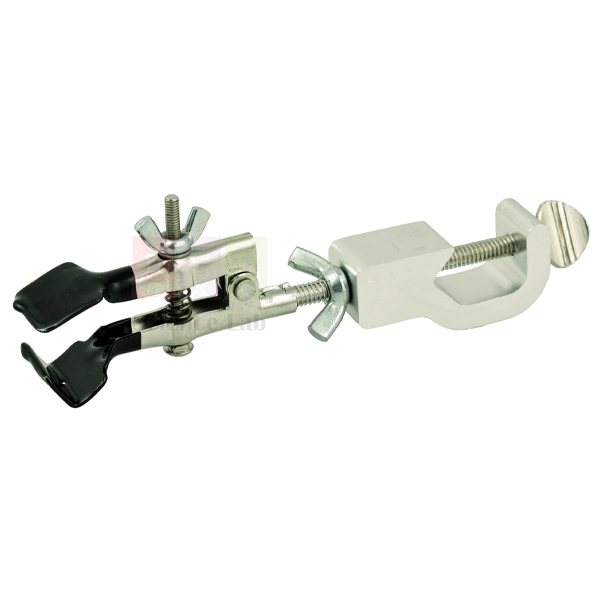
Universal Clamp
Universal Clamp (Product Code: SLE/CH/14) is an adjustable laboratory clamp whose jaws close around round objects from 9.5 mm up to 35 mm in diameter, holding them firmly on a stand while an experiment runs. Teachers, lab assistants and students use it when one clamp has to take test tubes, burettes, flask necks or glass tubing without swapping hardware between practicals. It is made by Jain Scientific Equipments Pvt Ltd (ScienceLab), Ambala, as part of our school chemistry lab equipment for institutions in India and abroad.
Specifications
| Parameter | Detail |
|---|---|
| Type | Universal clamp with adjustable jaws |
| Gripping range | Cylindrical objects from 9.5 mm to 35 mm diameter |
| Prong clamps | 8 mm diameter, 150 mm long |
| Jaw movement | Jaws rotate and can be locked in any position |
| Handling | Good reach during practicals; designed for a secure grip |
Typical Use
In a school or college practical, the Universal Clamp is the part of the familiar lab stand, clamp and boss head assembly that actually touches the glassware. It holds a boiling tube over a burner, steadies a delivery tube during gas collection, supports a condenser or thistle funnel, or keeps a burette upright during titration. Because the jaws rotate and lock, the clamped item can be tilted to the angle a procedure needs — useful for heating a test tube at a slant or aligning a side arm with a receiver.
For best results, tighten the jaws only until the glass is held without slipping; over-tightening is a common cause of cracked tubes. Keep the clamped object close to the rod where possible, and use the clamp’s reach only when the setup genuinely needs the extra distance from the stand.
Manufacturer
This clamp comes from Jain Scientific Equipments Private Limited, a company based in Ambala, Haryana, that trades under the ScienceLab brand and supplies laboratory apparatus to schools, colleges and distributors. Read our company profile for more about the business and its product range.
Related Chemistry Lab Equipment
Items usually ordered with a universal clamp to complete a stand setup:
- Boss Head, With Detachable Attachment — joins the clamp to a vertical rod at the working height
- Retort Stand — the base and rod on which the clamp is mounted
- Three Prong Swivel Clamp — an alternative three-finger grip for flasks and larger vessels
- Thermometer Clamp — holds a thermometer beside the clamped apparatus
- Table Clamp For Rods — fixes a support rod straight to the bench edge
See the complete Chemistry Lab Equipment range for more stands, clamps and holders.
Frequently Asked Questions
What sizes of glassware will the Universal Clamp hold?
Any cylindrical object from 9.5 mm to 35 mm in diameter. Items outside that range need a different clamp, such as a three-prong model for wider vessels.
Can the jaws hold a tube at an angle?
Yes. The jaws rotate and lock in any position, so a tube or funnel can be set vertical, horizontal or anywhere in between.
Is a boss head needed to fix it to a retort stand?
In a standard stand setup the clamp is attached to the rod through a boss head. Our listing does not state that one is included with the clamp, so please confirm the supply scope through our contact page when ordering.
How should the clamp be cared for?
Wipe off any acid or salt splashes after the practical, keep the tightening thread free of residue, and store clamps dry. Avoid forcing the jaws beyond their range, which can strain the mechanism.
What warranty applies?
Warranty terms are stated in our quotation for each order — ask us via the contact page for the current terms.
What should an institutional enquiry include?
Share the number of clamps, any matching stands or boss heads you need, and the delivery city or country; we will reply with pricing and lead time.
Do you supply clamps in bulk for export?
Yes. Class-set and distributor quantities can be supplied to buyers in India and international markets.
Request a Quote
To get pricing for the Universal Clamp, contact us or add it to your enquiry cart along with the other stand parts you need.
Last updated: 24 September 2026
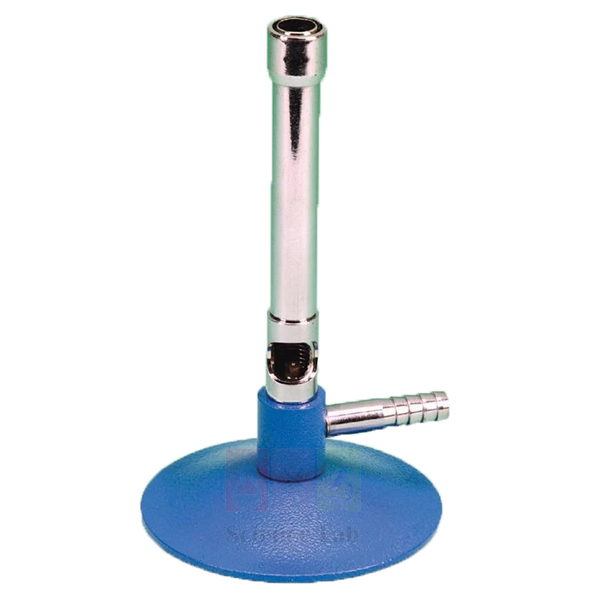
Micro Burner
Micro Burner (Product Code: SLE/CH/15) is a small gas burner with a narrow 9.5 mm burner tube and an overall height of just 100 mm, giving a compact, controllable flame for close-range heating. It suits students and technicians who need a gentle flame for tasks such as flaming inoculating loops, warming small samples or bending thin glass tubing. Produced by Jain Scientific Equipments Pvt Ltd (ScienceLab), Ambala, it is a practical addition to microbiology lab equipment and school chemistry benches alike.
Specifications
| Parameter | Detail |
|---|---|
| Type | Micro gas burner |
| Burner tube | Brass, nickel plated, 9.5 mm diameter |
| Air control | Rotatable air regulator |
| Base | Painted metal base |
| Overall height | 100 mm |
Typical Use
A micro burner earns its place where a full-size Bunsen flame would be wasteful or hard to control. In microbiology practicals it is kept beside the work area to sterilise loops and needles and to flame the mouths of culture tubes. In chemistry, the low profile lets it sit under small apparatus, while the smaller flame is well suited to flame tests, gently warming a watch glass or softening narrow glass tubing.
Turning the air regulator changes how much air mixes with the gas: open it for a hotter blue flame, close it down for a softer, visible flame that is easier to see on a busy bench. As with any chemistry lab equipment that uses gas, check the tubing for cracks before each session and keep paper and solvents well away from the flame.
Manufacturer
The Micro Burner is manufactured by Jain Scientific Equipments Private Limited, trading as ScienceLab from Ambala in Haryana, India. Our company profile gives an overview of the business and the laboratory ranges it produces.
Related Chemistry Lab Equipment
Products that go with a micro burner on the same bench:
- Bunsen Burner Tubing — connection tubing from the gas tap to the burner
- Bunsen Burner — a larger 12 mm tube burner when a bigger flame is needed
- Micro Bunsen Burner — an alternative small-flame burner from our Burners range
- Bunsen Burner Kit — a kit option for equipping a heating station
More heating and support apparatus is listed under Chemistry Lab Equipment.
Frequently Asked Questions
How is the Micro Burner different from a standard Bunsen burner?
Its burner tube is 9.5 mm across and the unit stands 100 mm tall, so it produces a smaller, more localised flame than a full-size Bunsen burner and fits under low apparatus.
Which gas does it run on?
Our product documentation for this item does not specify the gas type. Tell us whether your lab uses LPG or piped natural gas through the contact page and we will confirm suitability before you order.
Can the flame be adjusted?
Yes, the rotatable air regulator lets you change the air-gas mix, moving the flame from a soft luminous flame to a hotter non-luminous one.
Is gas tubing included?
The listing covers the burner itself. Tubing can be ordered separately, for example our Bunsen Burner Tubing.
How do I keep the burner working well?
Let it cool before handling, brush away soot or spilled material from the tube opening, and keep the painted base dry so it does not corrode.
What about warranty?
We confirm warranty terms in each quotation; contact us for details that apply to your order.
Can you supply a full lab or an overseas distributor?
Yes. We supply micro burners in class-set and wholesale quantities across India and to international markets.
Request a Quote
Send the quantity you need through our contact form, or add the Micro Burner to the enquiry cart and submit your list in one go.
Last updated: 24 September 2026
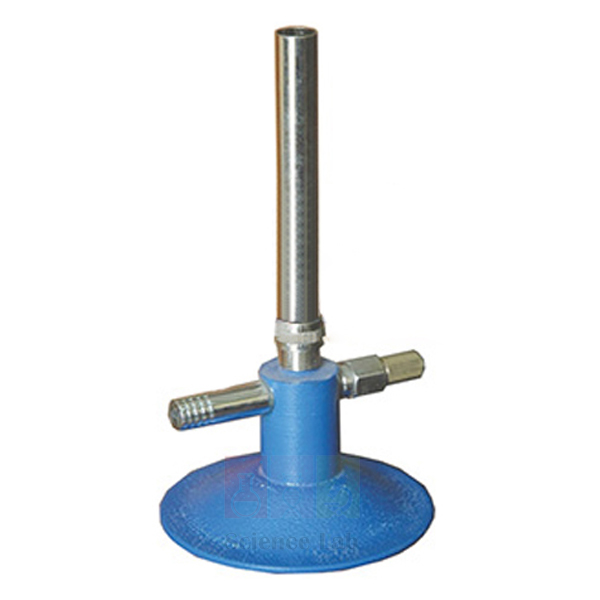
Bunsen Burner
Bunsen Burner (Product Code: SLE/CH/16) is a routine-heating gas burner built around a 12 mm nickel-plated brass tube, with a threaded needle valve to set flame intensity and a rotatable air regulator to shape the flame. It runs on either natural gas or LPG, so the same model can serve labs with piped supply and those using cylinders. Manufactured by Jain Scientific Equipments Pvt Ltd (ScienceLab), Ambala, it is a standard Bunsen burner for schools in India, colleges and training laboratories.
Specifications
| Parameter | Detail |
|---|---|
| Burner tube | Brass, nickel plated, 12 mm |
| Gas control | Rotary, threaded needle valve acting as flame intensity regulator |
| Air control | Rotatable air regulator |
| Gas inlet | Serrated inlet tube for secure tubing grip |
| Base | Coated metal base |
| Gas compatibility | Natural gas and LPG |
| Intended duty | Routine laboratory heating |
Typical Use
This burner is the everyday heat source of a chemistry practical: boiling water in a beaker on a tripod and gauze, heating solids in a test tube, evaporating solutions to crystallise a salt, and running the dry tests and flame tests of school salt analysis. Biology and physics classes use it too, for warming water baths or demonstrating heat transfer.
The needle valve is what sets this model apart from a basic burner. Students can open the valve a little for a small, steady flame or further for vigorous heating, while the air regulator switches between a yellow safety flame and the hot blue cone. The serrated inlet helps tubing stay on during use; push the tubing well over the serrations and inspect it regularly for cracks.
Manufacturer
Jain Scientific Equipments Private Limited produces this burner under its ScienceLab trading name at Ambala, Haryana, and supplies it to educational and research buyers. Learn more in our company profile.
Related Chemistry Lab Equipment
Useful companions for a Bunsen burner heating station:
- Rubber Pipe For Bunsen Burner — flexible gas connection from the tap to the serrated inlet
- Burner Bunsen With Stopcock — a version with a stopcock for complete gas shut-off at the burner
- Bunsen Burner with Flame Stabilizer — an alternative when a steadier flame is wanted
- Micro Burner — a compact burner for small, close-range heating tasks
Browse the wider Chemistry Lab Equipment range for stands, clamps and glassware to complete the setup.
Frequently Asked Questions
Can this Bunsen burner be used with LPG cylinders?
Yes. It is suitable for both natural gas and LPG, so it can be used with piped supply or cylinder installations.
What does the needle valve do?
The threaded needle valve regulates how much gas reaches the tube, letting you set the flame size precisely without adjusting the gas tap on the bench.
How do I get a hot blue flame instead of a yellow one?
Rotate the air regulator to open the air holes. More air gives a hotter, non-luminous blue flame; less air gives the cooler yellow flame used as a visible safety flame.
Is the rubber gas tubing part of the supply?
The listing is for the burner. Tubing is available separately, such as our Rubber Pipe For Bunsen Burner; please mention it in your enquiry if needed.
Does the burner need any maintenance?
Occasionally remove soot and spilled residue from the tube top, keep the needle valve free of grit, and replace any tubing that has hardened or cracked.
What warranty is offered?
Warranty cover is set out in our quotation; contact us to confirm the terms for your order.
What details do you need to quote for a school or college?
The number of burners, the gas type used in your lab, any tubing or stands required, and the delivery address in India or overseas.
Request a Quote
For prices on single units or a full class set, contact us or place the Bunsen Burner in your enquiry cart.
Last updated: 24 September 2026
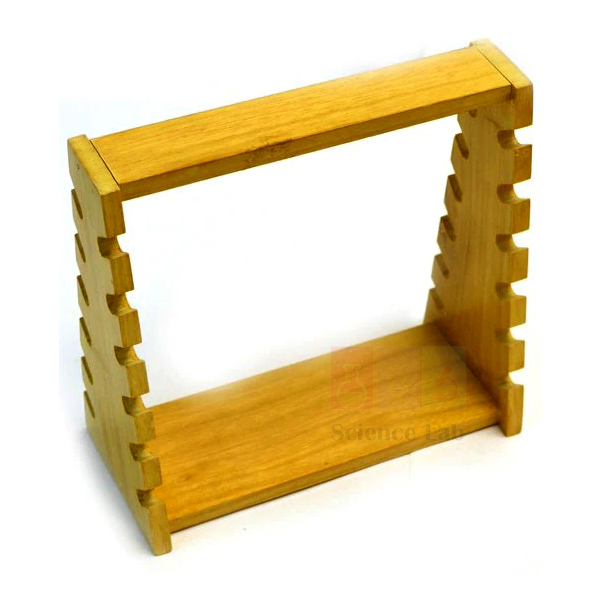
Pipette Stand
Pipette Stand (Product Code: SLE/CH/17) is a polished beech wood rest that holds up to 12 pipettes lying horizontally, six on each side, so clean pipettes stay off the bench and their tips stay uncontaminated between readings. It is aimed at chemistry teachers, lab technicians and students who carry out repeated measurements with volumetric or graduated pipettes. The stand is made by Jain Scientific Equipments Pvt Ltd (ScienceLab), Ambala, and forms part of our chemistry lab equipment for schools and colleges in India and overseas.
Specifications
| Parameter | Detail |
|---|---|
| Type | Horizontal pipette stand |
| Material | Beech wood, well polished |
| Capacity | Up to 12 pipettes |
| Arrangement | Pipettes rest horizontally, 6 on each side |
Typical Use
During volumetric analysis a pipette is picked up and put down many times — to rinse it, draw the aliquot, deliver it into the flask and repeat for concordant readings. Laying it flat on the bench risks rolling, breakage and a dirty tip. This stand gives each pipette a fixed horizontal place, and with six positions per side, two students or two groups can share one stand from opposite sides of a bench.
Horizontal storage also stops liquid left in the pipette from running into the bulb or the pipette filler. Label each position for a particular volume or reagent so pipettes are not mixed up between solutions, and wipe the polished wood dry if a drop is spilled on it.
Manufacturer
The stand is produced by Jain Scientific Equipments Private Limited, which operates under the ScienceLab name from Ambala, Haryana. The company is a registered MSME enterprise (Udyam UDYAM-HR-01-0003714), and its export consignments move under Importer-Exporter Code AAECJ8618A issued by the DGFT. Visit our company profile for background on the business.
Related Chemistry Lab Equipment
Other pipetting items used in the same titration workflow:
- Pipette Stand Foldable — holds pipettes upright and folds away when not in use
- Pipette Filler — draws liquid into the pipette without mouth pipetting
- Bulb Type, Pipette Filler — a simple squeeze-bulb option for student use
- Pipette Stand, Vertical — an upright alternative where drainage is preferred
The full Chemistry Lab Equipment category lists more stands and racks for glassware.
Frequently Asked Questions
How many pipettes does the stand take?
Up to 12, arranged horizontally with 6 on each side.
Why store pipettes horizontally rather than upright?
Lying flat, a pipette cannot tip over and any remaining liquid does not run up into the filler. Upright stands are better when you want wet pipettes to drain, so some labs keep one of each.
What is it made of?
Well-polished beech wood, which is light, easy to wipe and gentle on glass.
Will it take my pipette sizes?
The supported diameter range is not stated in our listing for this model. Send us the pipette volumes you use via the contact page and we will confirm fit.
How should the wooden stand be cleaned?
Wipe with a damp cloth and dry straight away. Do not soak it in water or leave acids and alkalis on the surface.
Is there a warranty?
Warranty terms are given with the quotation — ask us for the terms applicable to your order.
Can you supply pipette stands for many labs at once?
Yes. We handle multi-lab and distributor orders for customers in India and international markets; share quantities and delivery location for a quotation.
Request a Quote
Ask for pricing through our contact page or add the Pipette Stand to your enquiry cart.
Last updated: 24 September 2026
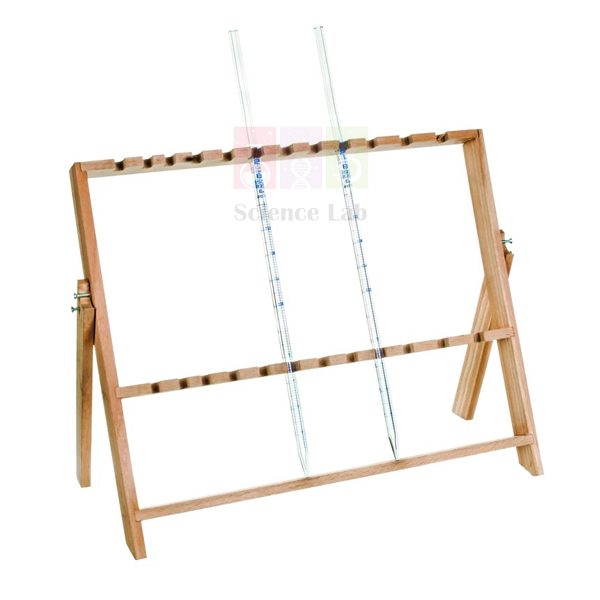
Pipette Stand Foldable
Pipette Stand Foldable (Product Code: SLE/CH/18) is a wooden stand that holds up to 12 pipettes upright, accepting stems from 6 mm to 12 mm in diameter, and folds down when the session is over. Made from well-polished beech wood, it suits laboratories where bench and cupboard space is tight, such as shared school labs and mobile teaching setups. It is manufactured by Jain Scientific Equipments Pvt Ltd (ScienceLab), Ambala, alongside our wider chemistry lab glassware and support range.
Specifications
| Parameter | Detail |
|---|---|
| Type | Foldable vertical pipette stand |
| Material | Beech wood, well polished |
| Capacity | Up to 12 pipettes, held vertically |
| Pipette diameter | 6 mm to 12 mm |
| Storage | Folds easily when not in use |
Typical Use
Holding pipettes vertically lets rinse water and reagent traces drain downward after washing, so pipettes are ready for the next titration practical rather than left lying wet on a tray. Twelve places are enough for a group to keep separate pipettes for acid, base and standard solutions, each in its own marked slot, which cuts down on cross-contamination in volumetric work.
The folding design is the practical difference from a fixed stand. At the end of the period the stand can be emptied, folded and slid into a drawer or lab kit box, making it handy for labs that are set up and packed away daily or for teachers who carry apparatus between classrooms. Check that each pipette falls within the 6–12 mm range so it sits securely.
Manufacturer
ScienceLab is the trading name of Jain Scientific Equipments Private Limited, an Ambala, Haryana company that makes educational and laboratory apparatus. Find out more on our company profile page.
Related Chemistry Lab Equipment
Items that pair with a vertical pipette stand:
- Pipette Stand — a fixed beech wood stand that rests 12 pipettes horizontally
- Pipette Controller — controlled aspiration and dispensing for repeated measurements
- Pipette Carousel Stand — a rotating option for storing pipettes on a central bench
- Pipette Stand, Polypropylene — a plastic alternative for wet or chemical-heavy areas
Explore more holders and racks in our Chemistry Lab Equipment category.
Frequently Asked Questions
Which pipette diameters fit this stand?
Pipettes from 6 mm to 12 mm in diameter. Stems thinner or thicker than that may not sit securely.
How many pipettes can it hold at once?
Up to 12, all standing vertically.
What is the advantage of the folding design?
It takes up far less room in storage, so the stand can be packed into a drawer or kit box between lessons and set up again in seconds.
Should pipettes go in tip down or tip up?
For draining after washing, most labs place them tip down; follow your own lab’s practice and keep tips clear of the bench surface.
How do I look after the beech wood?
Keep it dry, wipe off spills promptly, and avoid placing it near a burner or in a drying oven.
What warranty do you provide?
Terms are confirmed at quotation stage — please contact us for details.
Can I order these for export?
Yes, foldable pipette stands can be shipped to distributors and institutions in India and international markets; include quantity and destination in your enquiry.
Request a Quote
For a price on the Pipette Stand Foldable, reach us through the contact page or use the enquiry cart to send your full list.
Last updated: 24 September 2026
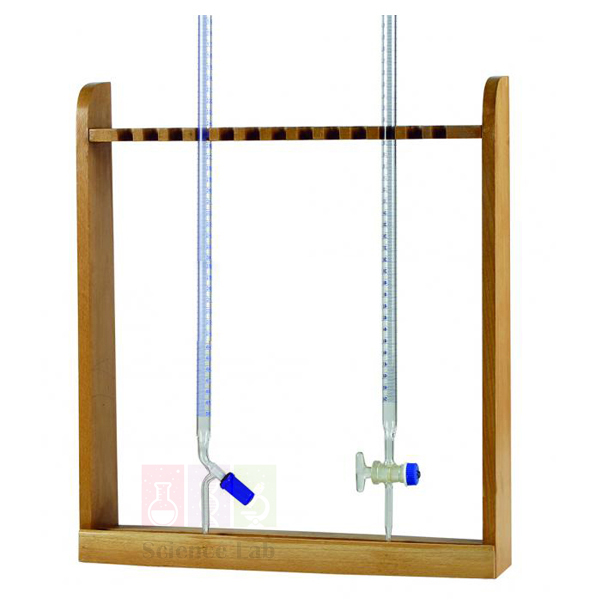
Burette Rack
Burette Rack (Product Code: SLE/CH/19) is a tiered storage frame in polished beech wood that keeps up to 13 burettes standing upright in vertical recesses along one side of its upper tier. It gives lab staff a single, orderly place to park a whole class set of burettes between titration sessions instead of laying them in drawers where stopcocks and tips get chipped. The rack is made by Jain Scientific Equipments Pvt Ltd (ScienceLab), Ambala, and belongs to our chemistry lab equipment for schools, colleges and quality-control labs in India and abroad.
Specifications
| Parameter | Detail |
|---|---|
| Type | Multi-burette storage rack |
| Construction | Tiered wooden frame |
| Material | Polished beech wood |
| Burette holding | Vertical recesses on one side of the upper tier |
| Capacity | Up to 13 burettes |
Typical Use
Burettes are long, fragile and easily damaged at the jet and stopcock. A rack like this is kept on a side bench or near the sink: after a titration class, students rinse their burettes and return them to the recesses, where they stand vertically and drain. At the start of the next volumetric analysis practical, the technician can see at a glance that all burettes are present and clean before handing them out to be mounted on a burette stand.
With capacity for 13, one rack covers a typical group practical. Because the recesses run along a single side, place the rack with that side facing the user so burettes can be lifted out without reaching across others. Keep the rack away from direct burner heat and wipe the polished wood if reagents drip onto it.
Manufacturer
This rack is manufactured by Jain Scientific Equipments Private Limited, known in the market as ScienceLab and based in Ambala, Haryana, India. Our company profile explains more about the company.
Related Chemistry Lab Equipment
Equipment that belongs to the same titration setup:
- Burette — the graduated glass tube the rack is designed to store
- Burette, Class-B, with PTFE Key Stopcock — a burette option with a non-greased PTFE key
- Brush Burette — a long brush for cleaning burettes before they go back on the rack
- Burette Stand and Funnel Stand — holds the burette in position during the titration itself
- Burette Racks — a hardwood holder for a single burette at the student bench
Visit our Chemistry Lab Equipment category for the complete range.
Frequently Asked Questions
How many burettes can the rack store?
Up to 13 burettes, each standing in its own vertical recess.
Is this rack used during titration, or only for storage?
It is mainly for storing and draining burettes. During the titration the burette is normally clamped on a burette stand so the flask can be swirled beneath it.
Will it take burettes of different capacities?
Our listing does not give recess dimensions for this model. Tell us which burettes you use through the contact page and we will confirm they fit.
What wood is used?
The frame is polished beech wood.
How do I keep the rack in good condition?
Let burettes drip over a sink or tray rather than onto the wood where possible, wipe up any spills, and keep the rack out of prolonged damp.
What is covered under warranty?
Warranty terms are provided in each quotation; please ask for them when you enquire.
What should we include in a tender or bulk request?
The number of racks, any burettes or stands to be bundled, and the delivery location in India or abroad — we will reply with a formal quotation.
Request a Quote
Please contact us for a quotation, or add the Burette Rack to your enquiry cart with the rest of your titration apparatus.
Last updated: 24 September 2026
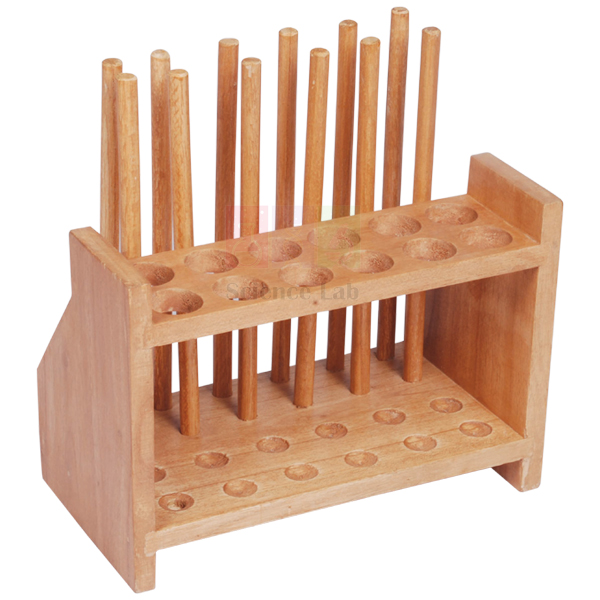
Test Tube Rack With Drying Pegs
Test Tube Rack With Drying Pegs (Product Code: SLE/CH/21) combines two jobs on one polished beech wood platform: two rows of holes to hold test tubes during an experiment, and 12 vertical pegs on which freshly washed tubes can be hung upside down to dry quickly. Having both on a single base saves bench space and keeps clean and in-use tubes together at each workstation. Made by Jain Scientific Equipments Pvt Ltd (ScienceLab), Ambala, it is a practical test tube rack for school labs in India, college practical rooms and teaching labs abroad.
Specifications
| Parameter | Detail |
|---|---|
| Type | Test tube rack with integrated drying pegs |
| Material | Beech wood, well polished |
| Tube holding | Two rows of holes |
| Drying pegs | 12 vertical pegs for quick drying of test tubes |
| Customisation | Can be made to individual preference on request |
Typical Use
In qualitative chemistry practicals students often work through a sequence of test-tube reactions, washing and reusing the same tubes several times in one session. With this rack, tubes in use stand in the two rows of holes while washed tubes are inverted on the pegs to drain, so nobody has to walk to a separate drying board. It works just as well in biology for food tests or enzyme experiments that use multiple tubes side by side.
Rinse tubes with distilled water before hanging them so they dry without marks, and leave space between wet tubes on the pegs to let air circulate. Because the rack is wooden, it should be kept away from open flames; place hot tubes back only after they have cooled a little. For labs with special needs, such as a different hole layout, the design can be customised, which makes it a flexible piece of chemistry lab equipment for schools setting up new benches.
Manufacturer
Jain Scientific Equipments Private Limited makes this rack under the ScienceLab brand in Ambala, Haryana, serving schools, colleges and dealers. More about us is available in our company profile.
Related Chemistry Lab Equipment
Items used with this rack during test-tube experiments:
- Test Tube — glass tubes to stock the rack and pegs
- Brush Test Tube — for scrubbing tubes before they go on the drying pegs
- Test Tube Holder — for gripping a tube while heating it over a burner
- Test Tube Racks — a simpler beech wood rack in 6 and 12 tube sizes without pegs
- Drying Rack — a dedicated rack for drying larger batches of glassware
See all racks, stands and holders under Chemistry Lab Equipment.
Frequently Asked Questions
How many drying pegs does the rack have?
Twelve vertical pegs, in addition to the two rows of holes for holding tubes upright.
How many test tubes fit in the holes?
The rack has two rows of holes; the number of holes per row and the hole diameter are not stated in our listing. Contact us with your tube size and we will confirm, or ask for a custom layout.
Can the design be changed for our lab?
Yes. The rack can be customised to individual preference; describe the layout you need when you enquire.
What is the benefit over a plain test tube rack?
It adds drying pegs on the same platform, so washing and reuse of tubes happen at the workstation without a separate drying board.
How should the rack be cleaned?
Wipe it with a damp cloth and dry it; do not immerse the wooden rack or leave corrosive spills on it.
Which warranty terms apply?
These are confirmed in our quotation for your order — please ask when you request pricing.
Do you deliver in bulk to institutions and overseas buyers?
Yes, we supply schools, colleges and distributors in India and international markets.
Request a Quote
For pricing or a custom version, contact us or add this rack to your enquiry cart.
Last updated: 24 September 2026
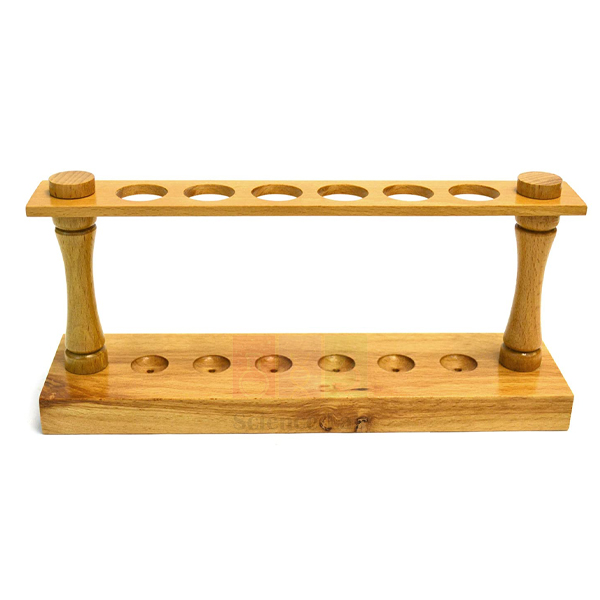
Test Tube Racks
Test Tube Racks (Product Code: SLE/CH/20) are sturdy beech wood racks offered in two sizes — for 6 tubes or for 12 tubes — with a carefully polished finish that helps the wood resist damage from everyday spills. They give each student or group a stable place to stand test tubes during reactions, observations and waiting steps. The racks are made by Jain Scientific Equipments Pvt Ltd (ScienceLab), Ambala, as part of our educational lab equipment for schools and colleges in India and international markets.
Specifications
| Parameter | Detail |
|---|---|
| Type | Wooden test tube rack |
| Material | Beech wood, robust build |
| Available sizes | 6 tubes and 12 tubes |
| Finish | Finely polished to minimise damage from spills |
| Customisation | Can be made to individual preference on request |
Typical Use
Choosing between the two sizes is mostly about how the class is organised. The 6-tube rack suits an individual student doing a short sequence of tests, such as the preliminary tests in salt analysis or a set of indicator colour changes. The 12-tube rack suits a pair or small group running comparisons side by side — for example a reactivity series, a set of food tests or a dilution series where each tube needs to stay in order.
Many schools buy a mix: a 6-tube rack for each student position and a few 12-tube racks for demonstrations and group work. Keep the racks dry after washing up, stand hot tubes on a heat-resistant mat for a moment before returning them, and label positions with a marker strip when the order of tubes matters.
Manufacturer
These racks are manufactured by Jain Scientific Equipments Private Limited, trading as ScienceLab in Ambala, Haryana. For purchase departments and tender buyers who need vendor registration details, the company’s GSTIN is 06AAECJ8618A1ZT and its Legal Entity Identifier is 3358004HRD1JIVXKYX49. Our company profile has more information.
Related Chemistry Lab Equipment
Products commonly ordered with test tube racks:
- Test Tube 12 x 100 mm — glass test tubes for stocking student racks
- Test Tube Holder, Metal — for holding a tube safely while heating
- Brush, Bristle Test Tube Fan Shape — for cleaning tubes after the practical
- Test Tube Rack With Drying Pegs — a version with 12 drying pegs built in
- Test Tube Stand 3 Tier — a tiered alternative for larger numbers of tubes
Find more in our Chemistry Lab Equipment range.
Frequently Asked Questions
Which sizes are available?
Two: a rack for 6 test tubes and a rack for 12 test tubes. Please state the size and quantity of each in your enquiry.
What hole diameter do the racks have?
Hole size is not specified in our current listing. Share the outer diameter of your test tubes via the contact page and we will confirm fit or suggest a customised version.
Can you make a rack with a different layout?
Yes, the racks can be customised to your preference, for example to suit a particular tube count or bench arrangement.
Are wooden racks suitable for chemical work?
Yes for routine school and college use — the polished finish is meant to limit damage from spills. Wipe spills promptly and avoid prolonged contact with strong acids.
Is warranty offered?
Warranty terms are included in our quotation; ask us for the terms that apply.
What does a school need to send for a quotation?
The number of 6-tube and 12-tube racks, any customisation, and your delivery address. Tender buyers can request our registration details at the same time.
Can racks be supplied to overseas distributors?
Yes, we export to distributors and institutions in international markets as well as supplying across India.
Request a Quote
To order Test Tube Racks, send your requirements through our contact page or add them to the enquiry cart.
Last updated: 24 September 2026
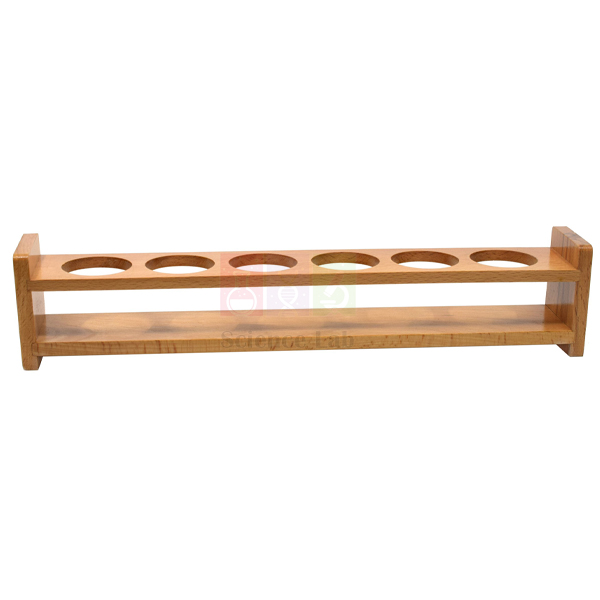
Bottle Stand
Bottle Stand (Product Code: SLE/CH/22) is a polished beech wood holder with 45 mm diameter holes sized for 60 ml dropping bottles, supplied in a 6-hole or a 12-hole version. It keeps a bench set of indicators and test reagents upright, together and in a fixed order, so bottles are not knocked over or mixed up during practicals. The stand is manufactured by Jain Scientific Equipments Pvt Ltd (ScienceLab), Ambala, for school chemistry lab equipment sets and college teaching labs.
Specifications
| Parameter | Detail |
|---|---|
| Type | Reagent / dropping bottle stand |
| Material | Beech wood, well polished |
| Hole diameter | 45 mm |
| Suitable bottles | 60 ml dropping bottles |
| Versions | 6 holes or 12 holes |
Typical Use
A bottle stand turns a loose collection of reagent bottles into an organised bench kit. Teachers typically fill a 6-hole stand with the essentials for acid-base indicator work — phenolphthalein, methyl orange, litmus and universal indicator — and a 12-hole stand with the wider range of test solutions used in salt analysis or food tests. Each group gets an identical stand, which makes it easy to check that every bottle has come back at the end of the lesson.
Keeping bottles in fixed positions also helps students find the right reagent quickly and reduces the chance of dropper mix-ups. Write the reagent name on the wood beside each hole or on a strip along the edge, wipe up drips so stains do not build up on the polish, and store the stand away from heat sources.
Manufacturer
The Bottle Stand is made by Jain Scientific Equipments Private Limited, a laboratory apparatus maker based in Ambala, Haryana, whose products are sold under the ScienceLab name. Read our company profile to learn more.
Related Chemistry Lab Equipment
Bottles and related items for filling the stand:
- Bottle Dropping — glass dropping bottles for indicators and test reagents
- Amber Dropping Bottle — for light-sensitive solutions such as silver nitrate
- Dropping Bottle — a plastic option for less breakable student sets
- Bottle Reagent, W.M. Glass — stock bottles for refilling the dropping bottles
Our Chemistry Lab Equipment category lists further stands and bench accessories.
Frequently Asked Questions
Which bottles fit the Bottle Stand?
It is designed for 60 ml dropping bottles; the holes are 45 mm in diameter. Before ordering other bottles, check that their outer diameter suits a 45 mm hole.
How many bottles does it hold?
Choose the 6-hole version for a compact indicator set or the 12-hole version for a fuller reagent kit.
Are dropping bottles included with the stand?
The listing is for the stand. Bottles are available separately — mention them in your enquiry if you want a complete set.
Can it be used for other small containers?
Any container that sits securely in a 45 mm hole can be used, but the stand is sized with 60 ml dropping bottles in mind.
How do I clean the stand?
Wipe with a slightly damp cloth, dry it at once and avoid soaking the wood. Clean indicator stains early before they set.
What about warranty?
We state warranty terms in the quotation; contact us if you need them in advance.
Can we order stands for a whole school or a distributor network?
Yes. Tell us how many 6-hole and 12-hole stands you need and the delivery destination in India or abroad.
Request a Quote
Request pricing through our contact page or add the Bottle Stand to your enquiry cart together with bottles.
Last updated: 24 September 2026
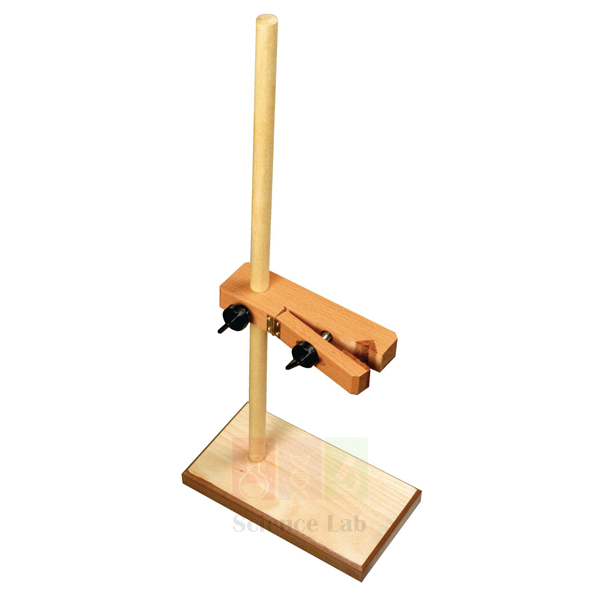
Burette Racks
Burette Racks (Product Code: SLE/CH/23) is a single-burette holder built entirely from seasoned hardwood, with a 200 × 100 mm base, a rod of approximately 460 mm height and 16 mm diameter, and moulded plastic clamping screws that grip the burette without metal touching the glass. It gives each student a self-contained burette stand for titrations at the bench. Manufactured by Jain Scientific Equipments Pvt Ltd (ScienceLab), Ambala, it is a straightforward burette stand for labs in India and international markets that prefer wood over metal hardware.
Specifications
| Parameter | Detail |
|---|---|
| Type | Burette holder for a single burette |
| Material | Seasoned hardwood throughout, well polished |
| Base size | 200 × 100 mm |
| Rod size | Approx. 460 × 16 mm (height × diameter) |
| Clamping | Moulded plastic clamping screws |
Typical Use
This holder is set up at a student position for acid-base, redox or precipitation titrations. The burette is clamped to the wooden rod with the plastic screws, the conical flask sits on the base beneath the jet (a white tile makes the end-point colour easier to see), and the student operates the stopcock with one hand while swirling the flask with the other. The hardwood base is broad enough to keep the tall rod steady during this routine.
Because it is dedicated to one burette and needs no boss head or separate clamp, it suits titration kit setups for schools where quick assembly matters. Tighten the plastic screws just enough to hold the burette vertical, check the alignment against a vertical edge before reading, and wipe the base if titrant drips onto it.
Manufacturer
Made by Jain Scientific Equipments Private Limited, which trades as ScienceLab and is based in Ambala, Haryana. You can read about the company in our company profile.
Related Chemistry Lab Equipment
Other items used around a burette holder:
- Burette, Class-B, with Glass Key — a burette to mount on the holder
- Burette Brush — for cleaning the burette bore between titrations
- Burette Rack — a beech wood rack that stores up to 13 burettes after class
- Burette Clamps — for mounting burettes on a standard metal retort stand instead
- Burette Stand, Hard Wood, Single — another hardwood single-burette option from our range
The Chemistry Lab Equipment category has more titration and support apparatus.
Frequently Asked Questions
How many burettes does this holder take?
One. It is designed for a single burette; for storing a number of burettes together, see our multi-burette Burette Rack.
What are the main dimensions?
The base measures 200 × 100 mm and the rod is approximately 460 mm tall with a 16 mm diameter.
Why plastic clamping screws?
Moulded plastic screws hold the glass without metal-to-glass contact, which is gentler on the burette and does not corrode from acid splashes.
Is a burette supplied with it?
The listing is for the holder only. Burettes can be quoted separately — tell us the capacity and type you need.
How should the wooden holder be maintained?
Wipe spills straight away, keep it dry and away from burner heat, and avoid over-tightening the screws.
Is there a warranty?
Warranty details are given with our quotation; contact us to confirm them.
Can you supply a full class set?
Yes. Share the number of student positions and the delivery location in India or overseas, and we will quote for holders and any burettes required.
Request a Quote
Send your requirement via the contact page or add this item to your enquiry cart.
Last updated: 24 September 2026
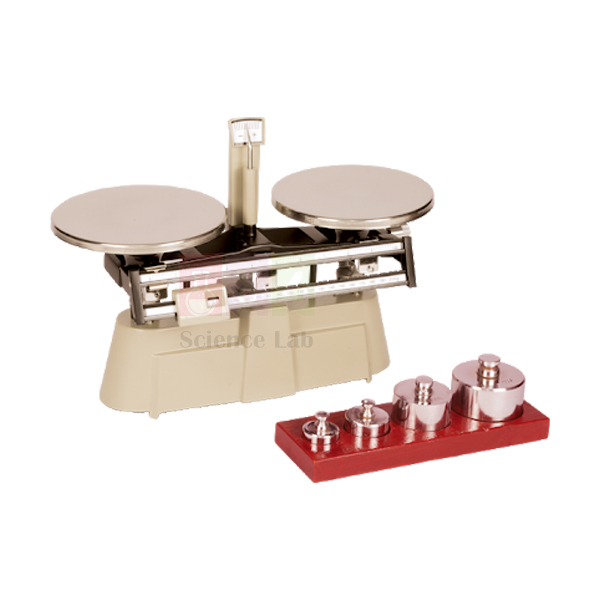
Balance Double Beam
Balance Double Beam (Product Code: SLE/CH/24) is a single-pan mechanical balance on a wooden base with a capacity of 311 g and a sensitivity of ±2 mg. Captive weights slide along the beam scales and the result is read from an index scale and pointer, so there are no loose weights to lose or mix up. It is intended for speed when weighing routine samples, which makes it a dependable chemical balance for Indian school, college and training labs. The balance is made by Jain Scientific Equipments Pvt Ltd (ScienceLab), Ambala.
Specifications
| Parameter | Detail |
|---|---|
| Type | Double beam balance, single pan, captive sliding weights |
| Reading | Index scale and pointer |
| Capacity | 311 g |
| Sensitivity | ±2 mg |
| Scale division – rear scale | 0 to 1 g × 100 mg |
| Scale division – middle scale | 0 to 1 g × 100 mg |
| Scale division – front scale | 0 to 1 g × 100 mg |
| Distance from suspension | 170 mm |
| Hook to pan | 170 mm |
| Pan diameter | 110 mm |
| Mounting | Wooden base |
Typical Use
A beam balance of this kind is used wherever many samples of similar mass have to be weighed one after another: measuring out salts for solution preparation, weighing crucibles before and after heating in water-of-crystallisation experiments, or checking reagent portions in school practicals. Pharmacy and teaching labs that train students in the principle of the double beam balance also value it, because every step of the weighing is visible on the beams rather than hidden inside electronics.
Set the balance on a level, vibration-free bench away from draughts, zero it with the pan empty, and then slide the captive weights until the pointer returns to the index. Never place hot objects or loose chemicals directly on the 110 mm pan; use a watch glass or weighing boat, and clean the pan after each session.
Manufacturer
The balance is manufactured by Jain Scientific Equipments Private Limited, operating as ScienceLab from Ambala in Haryana, India. Details of the company are in our company profile.
Related Chemistry Lab Equipment
Other weighing options and alternatives from our range:
- Balance Triple Beam — higher capacity (610 g, extendable to 2610 g) for heavier samples
- Electronic Compact Balance — a digital option with LCD readout for quick weighing
- Double Beam Balance — the double beam model listed in our Balances range
- Triple-Beam Balance — a further mechanical alternative for class sets
More apparatus is available in the Chemistry Lab Equipment category.
Frequently Asked Questions
What is the maximum load of this balance?
311 g, with a sensitivity of ±2 mg.
Does it need a separate set of weights?
No separate weight box is listed as required — the balance uses captive weights that slide on the beam scales and stay attached to the instrument.
How large is the weighing pan?
The pan is 110 mm in diameter, with 170 mm from hook to pan.
Is a calibration certificate available?
Please discuss calibration documentation with us before ordering through the contact page; we will tell you what can be provided for your order.
How should the balance be looked after?
Keep it covered when not in use, clean the pan and beams with a soft dry cloth, and avoid moving it while loaded. Recheck zero whenever it is relocated.
What warranty is given?
Warranty terms are part of our quotation for each order; ask us for current terms.
What information does an institutional quotation need?
The number of balances, whether you need calibration documentation, and the delivery address in India or your export destination.
Request a Quote
For pricing, please contact us or add the Balance Double Beam to your enquiry cart.
Last updated: 24 September 2026
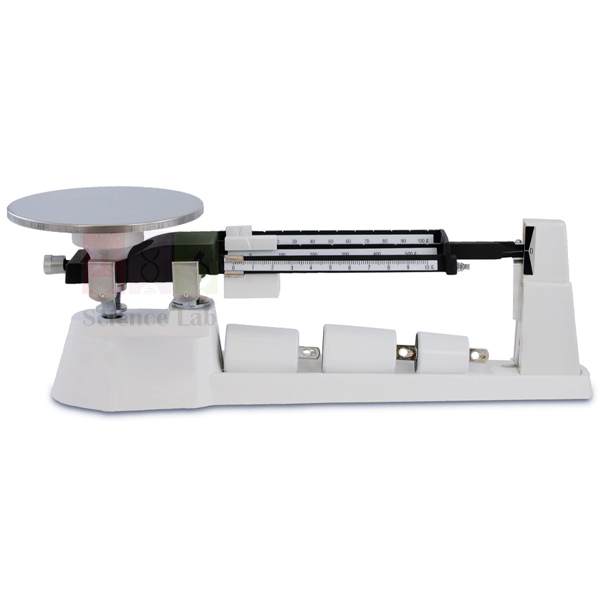
Balance Triple Beam
Balance Triple Beam (Product Code: SLE/CH/25) is a single-pan mechanical balance with three notched weighing beams and centre-indicating sliding masses, giving a direct capacity of 610 g that can be raised to 2610 g by hanging supplementary masses on the end of the beam. Magnetic damping brings the pointer to rest quickly, and a 150 mm stainless steel pan takes beakers, specimens and bulky samples. Manufactured by Jain Scientific Equipments Pvt Ltd (ScienceLab), Ambala, it is a versatile piece of chemistry lab equipment for schools and colleges in India and abroad.
Specifications
| Parameter | Detail |
|---|---|
| Type | Single-pan triple beam balance with three tiered, notched beams |
| Capacity (beams only) | 610 g |
| Capacity (with supplementary masses) | Up to 2610 g |
| Beam 1 | 0 to 500 g × 100 g |
| Beam 2 | 0 to 100 g × 10 g |
| Beam 3 | 0 to 10 g × 0.1 g |
| Supplementary masses | 2 × 1000 g, hung on the end of the beam; stored in the recessed base when not required |
| Damping | Magnetic |
| Pan | Stainless steel, 150 mm diameter |
Typical Use
The triple beam balance is a workhorse for class practicals that need a wider weighing range than a small beam balance offers. Students use it to find the mass of irregular solids for density determination, to weigh beakers of water in heat and calorimetry experiments, and to measure larger quantities of salts or soil samples. Mass measurement is part of CBSE physics practical work as much as chemistry, so one balance often serves both departments.
Weighing is done beam by beam: move the rider on the 0–500 g beam to the largest notch that keeps the pointer from dropping, then the rider on the 0–100 g beam, and finish with the fine 0–10 g beam read to 0.1 g. For loads over 610 g, hang the 1000 g supplementary masses on the beam end and add their value to the reading. Magnetic damping means the pointer settles in a few seconds, so students spend less time waiting. Store the masses in the base recess so they are not misplaced.
Manufacturer
This balance is produced by Jain Scientific Equipments Private Limited (CIN U29309HR2020PTC087597), which trades as ScienceLab. The company manufactures at its licensed factory at 449, HSIIDC Industrial Area, Saha, Ambala, Haryana (Factory Licence AMB-ONLINE-CHD-J-414). See our company profile for more.
Related Chemistry Lab Equipment
Other balances and weighing tools you may compare or add:
- Balance Double Beam — a smaller-capacity beam balance for finer routine weighing
- Electronic Compact Balance — a battery-powered digital alternative
- Triple Beam Balance — the triple beam model in our Measuring range
- Hanging Pan Balance — for weighing loads that need a hanging pan
- Force Meter/Spring Balance — for teaching the difference between mass and weight
Browse the complete Chemistry Lab Equipment category for more.
Frequently Asked Questions
What is the capacity of the Balance Triple Beam?
610 g using the three beams alone, and up to 2610 g when the two 1000 g supplementary masses are hung on the end of the beam.
What is the finest reading?
The finest beam reads 0 to 10 g in 0.1 g divisions.
Are the supplementary masses included?
Yes, the specification lists 2 × 1000 g supplementary masses, which store in the recessed base when not in use.
What does magnetic damping do?
It slows the beam’s swing so the pointer settles quickly, making readings faster and steadier than on an undamped balance.
Can you provide a calibration certificate?
Calibration paperwork should be discussed with us before ordering — please raise it through the contact page.
How should I care for the balance?
Keep it level and clean, return all riders to zero after use, and never drop objects onto the stainless steel pan.
What warranty applies?
Warranty terms are confirmed in the quotation for your order.
Do you supply balances for tenders and export?
Yes. Tender and distributor quantities can be supplied across India and to international markets; our company registration details are available on request.
Request a Quote
For prices and lead time, contact us or add the Balance Triple Beam to your enquiry cart.
Last updated: 24 September 2026
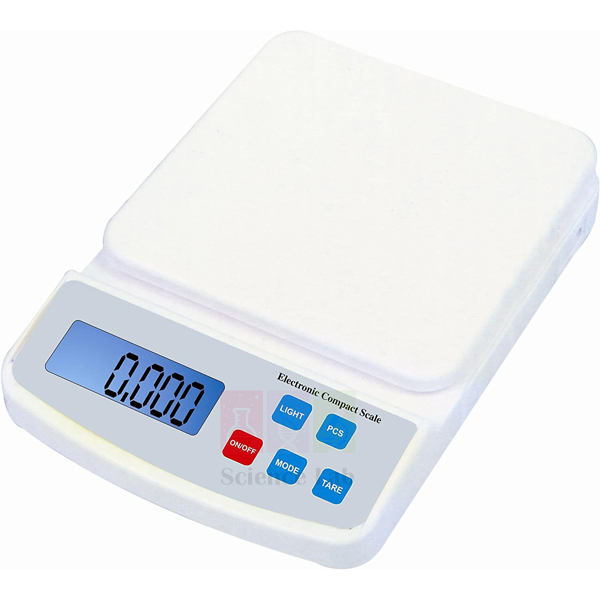
Electronic Compact Balance
Electronic Compact Balance (Product Code: SLE/CH/26) is a battery-operated digital weighing balance with a high contrast LCD display, offered in seven capacity options from 200 g with 0.01 g readability up to 5000 g with 2 g readability. It switches between ct, gm and dwt weighing units and is designed for straightforward, accurate readings without mains power at the bench. Made by Jain Scientific Equipments Pvt Ltd (ScienceLab), Ambala, it is a convenient digital weighing balance for labs in India and international markets, from school practical rooms to field and quality-check stations.
Specifications
| Parameter | Detail |
|---|---|
| Type | Electronic compact balance |
| Display | High contrast LCD |
| Power | Simple battery operation |
| Weighing units | ct, gm, dwt |
Available capacity and readability options:
| Capacity | Readability |
|---|---|
| 200 g | 0.01 g |
| 300 g | 0.01 g |
| 500 g | 0.01 g |
| 1000 g | 0.1 g |
| 1500 g | 0.1 g |
| 2000 g | 1 g |
| 5000 g | 2 g |
Typical Use
The model you choose depends on what you weigh most often. The 200 g, 300 g and 500 g versions read to 0.01 g, which suits weighing out solids for standard solutions, measuring small reagent portions and recording mass changes in reactions. The 1000 g and 1500 g models, reading to 0.1 g, cover general bench weighing of beakers, soil or plant samples, while the 2000 g and 5000 g models are for bulk materials, water volumes and physics loads where gram-level resolution is enough.
Battery operation lets the balance be used anywhere — on a demonstration trolley, in a classroom without bench sockets, or on field trips — which is useful in junior science labs that share equipment between rooms. Place it on a firm, level surface, allow it to settle after switching on, tare with the container in place, and keep liquids and powders off the display and pan edge.
Manufacturer
Jain Scientific Equipments Private Limited, trading as ScienceLab, is based in Ambala, Haryana, and manufactures educational and laboratory equipment for customers in India and abroad. See our company profile for more.
Related Chemistry Lab Equipment
Other weighing equipment to compare or pair with this balance:
- Compact Balance 300g — a compact balance listed in our Balances range
- Compact Balance 2000g — a higher-capacity compact option from the same range
- Electronic Pocket Scales — very portable scales for small samples
- Electronic Balances — further digital balances for laboratory use
- Balance Triple Beam — a mechanical alternative that needs no batteries
See our full Chemistry Lab Equipment range for more apparatus.
Frequently Asked Questions
Which model should I order?
Pick the smallest capacity that covers your heaviest item: 200–500 g models read to 0.01 g, 1000–1500 g to 0.1 g, 2000 g to 1 g and 5000 g to 2 g. Please state the capacity you need in your enquiry.
What do ct and dwt mean?
They are weighing units in addition to grams: ct is the carat and dwt is the pennyweight. Most school and college users will work in gm.
What batteries does it use, and can it run on mains?
Our listing states battery operation but does not specify battery type or a mains adaptor. Contact us and we will confirm the power details for the model you choose.
Is a calibration certificate supplied?
Please discuss calibration documentation with us before placing the order so we can advise what is possible for your model.
How do I keep readings reliable?
Use it on a stable, draught-free surface, let it settle after switching on, avoid overloading beyond the rated capacity, and remove batteries if the balance will be stored for a long period.
What is the warranty?
Warranty terms are confirmed in our quotation for each order.
Can we buy a mix of capacities for several labs?
Yes. List how many of each capacity you need and the delivery location in India or abroad, and we will quote the whole order together.
Request a Quote
To request pricing for one or more capacities, contact us or add the Electronic Compact Balance to your enquiry cart.
Last updated: 24 September 2026
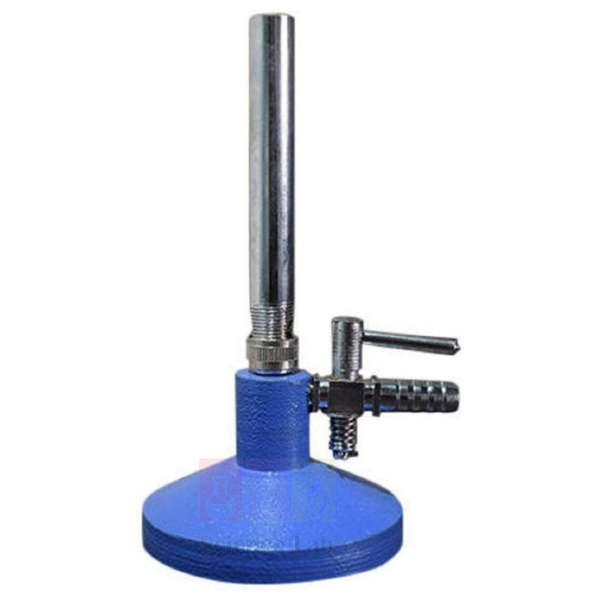
Burner Bunsen With Stopcock
Burner Bunsen With Stopcock (Product Code: SLE/CH/27) is a Bunsen burner fitted with its own stopcock, so the gas can be shut off completely at the burner rather than only at the bench tap. It also has an air regulator for flame control and comes with one spare gas nipple for use with LPG. That combination of on-burner shut-off and LPG readiness makes it a sensible choice for any school lab setup in India or abroad where many students light burners at once. It is manufactured by Jain Scientific Equipments Pvt Ltd (ScienceLab), Ambala.
Key Details
| Parameter | Detail |
|---|---|
| Type | Bunsen burner with stopcock |
| Gas shut-off | Stopcock to completely stop the flow of gas |
| Air control | Air regulator provided |
| Supplied with | One spare gas nipple for use with LPG |
| Suitable for | General heating in school, college and teaching laboratories |
Typical Use
The stopcock is the reason to choose this burner. When a class is heating test tubes, running flame tests or boiling solutions, students can turn the gas off at the burner the moment they finish, without reaching across the bench to the service tap — and a teacher can see at a glance whether each burner is closed. It also lets a burner be left connected to the supply while turned fully off between steps of a practical.
For labs that run on cylinders, the spare nipple provided for LPG means the burner can be set up for that gas. Fit the correct nipple before connecting the tubing, then light the burner with the air regulator nearly closed and open it gradually to obtain the hot blue flame. Always close the stopcock and the bench tap at the end of the session.
Manufacturer
This burner comes from Jain Scientific Equipments Private Limited, an Ambala, Haryana manufacturer that sells its laboratory apparatus under the ScienceLab brand. Our company profile gives more background.
Related Chemistry Lab Equipment
Products that complete a burner station:
- Burner Tubing — connects the burner to the gas tap or cylinder regulator
- Bunsen Burner — a needle-valve model when fine flame adjustment matters more than shut-off
- Bunsen Burner Pilot Flame — an alternative with a pilot flame for repeated relighting
- Bunsen Burner with Stopcock — the stopcock burner listed in our Burners range
Find stands, gauze and glassware in the Chemistry Lab Equipment category.
Frequently Asked Questions
What is the stopcock for?
It stops the gas flow completely at the burner, giving students a shut-off within easy reach and an extra safety point besides the bench tap.
Can it be used with LPG?
Yes — a spare gas nipple is provided for use with LPG. For other gas supplies, tell us what your lab uses and we will confirm.
Can I control the flame temperature?
Yes, through the air regulator: more air gives a hotter blue flame, less air a cooler yellow flame.
What is the burner tube size and height?
Tube dimensions are not stated in our current listing for this model. Please contact us for the dimensional details.
How do I maintain the stopcock?
Operate it gently, keep it free of dust and spilled material, and check for gas leaks with soapy water if it ever feels loose. Replace tubing that shows cracks.
Is there a warranty?
Warranty terms are confirmed in our quotation for your order.
Can you equip a whole lab or an export order?
Yes. Send the number of burners, the gas type and the destination in India or abroad, and we will quote burners and tubing together.
Request a Quote
For prices, contact us or add this burner to your enquiry cart.
Last updated: 24 September 2026
Absorption Tower Calcium Chloride
Absorption Tower Calcium Chloride (Product Code: SLE/CH/28) is a cylindrical glass drying tower with a tubule at its base, 335 mm tall and 65 mm in diameter, holding 250 ml of drying agent. Filled with anhydrous calcium chloride or a similar desiccant, it removes moisture from a gas stream passing through it, or protects a reaction vessel from damp air. It is used in chemistry teaching labs, college practicals and research setups, and is manufactured by Jain Scientific Equipments Pvt Ltd (ScienceLab), Ambala, within our chemistry lab glassware range.
Specifications
| Parameter | Detail |
|---|---|
| Type | Calcium chloride absorption (drying) tower |
| Material | Glass |
| Shape | Cylindrical, with tubule at base |
| Dimensions | 335 mm height × 65 mm diameter |
| Capacity | 250 ml |
Typical Use
A drying tower sits in the gas line between the generator and the point of use. In a school or college gas collection apparatus, gas from a flask or Kipp-type generator enters through the tubule at the base, rises through the packed calcium chloride and leaves dry at the top, ready to be collected or passed into the next stage of the experiment. It can also be fitted to the inlet of an apparatus as a guard, so that air drawn in is dried first.
Place a plug of glass wool or cotton above the tubule so granules do not fall into the inlet, then fill with lumps or granules of drying agent, leaving space for another plug at the top. Clamp the tower upright on a stand, since a 335 mm glass column filled with desiccant is top-heavy. Replace the drying agent once it turns wet or cakes, and remember that calcium chloride is not suitable for drying every gas — check your procedure before use.
Manufacturer
The absorption tower is made by Jain Scientific Equipments Private Limited, which trades as ScienceLab from Ambala, Haryana, and supplies laboratory glassware and apparatus to educational and research buyers. More information is on our company profile.
Related Chemistry Lab Equipment
Items used with a calcium chloride drying tower:
- Calcium Chloride — the drying agent used to pack the tower
- Calcium Chloride Tube, Borosilicate Glass — a smaller guard tube for flask necks and condensers
- Absorption Tube — for smaller absorption or drying stages in a gas train
- Absorption Tube with Side Arms — a side-arm version for in-line connections
- Universal Clamp — to hold the tower securely on a retort stand
Explore more glassware in the Chemistry Lab Equipment category.
Frequently Asked Questions
How much drying agent does the tower hold?
It has a capacity of 250 ml.
Is calcium chloride supplied with the tower?
No, the listing is for the glass tower only. Calcium chloride can be ordered separately from our range.
What type of glass is used?
Our listing describes it as glass without naming the grade. If you need a specific glass type, please ask through the contact page before ordering.
How is the gas connected?
Gas enters through the tubule at the base; connect it with suitable rubber or silicone tubing and fit an outlet at the top according to your setup.
How do I clean and reuse it?
Empty the spent drying agent, rinse the tower with water to dissolve residues, then dry it completely before refilling. Handle the column by its body rather than the tubule.
What warranty or breakage terms apply?
Terms for glassware are set out in our quotation; contact us to confirm them for your order.
Can you supply glassware for export or large institutional orders?
Yes. We pack and ship glassware for buyers in India and international markets; include quantities and destination in your enquiry.
Request a Quote
For a quotation, contact us or add the Absorption Tower Calcium Chloride to your enquiry cart together with the drying agent.
Last updated: 24 September 2026
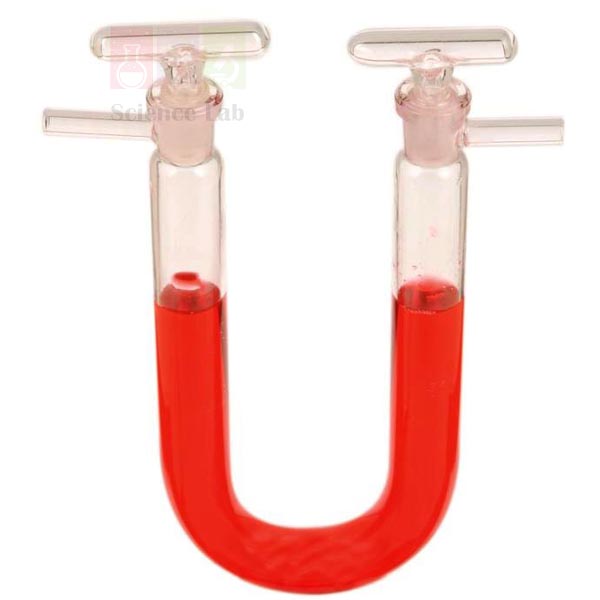
Calcium Chloride Tube, Borosilicate Glass
Calcium Chloride Tube, Borosilicate Glass (Product Code: SLE/CH/29) is a U-shaped drying tube with a side tube and stopper, used to strip moisture from a gas stream or to keep damp air away from a reaction. Chemistry teachers, college demonstrators and analysts pack it with a granular drying agent and connect it in line with gas generators and reaction flasks. It belongs to the range of borosilicate laboratory glassware in India made by Jain Scientific Equipments Pvt Ltd (ScienceLab), Ambala.
Specifications
| Parameter | Detail |
|---|---|
| Type | Calcium chloride (drying) tube |
| Material | Borosilicate glass |
| Shape | U-shape with side tube |
| Closure | Stopper |
| Sizes available | 100 x 12 mm; 125 x 15 mm; 150 x 18 mm |
| Supplied as | Empty tube; drying agent is a separate item |
Typical Use
In a gas-preparation practical the tube sits between the generating flask and the receiver: gas enters one limb, passes through the packed drying agent and leaves through the side tube before it is collected. It is a routine addition to school gas collection apparatus in India whenever students need a dry sample of a gas such as hydrogen, oxygen or carbon dioxide. Fitted to the top of a reflux condenser, the same tube works as a guard tube that stops atmospheric moisture from entering a water-sensitive reaction.
Fill it with small lumps or granules rather than fine powder, which packs tightly and chokes the gas flow, and hold the charge in place with a loose plug of glass wool or cotton at each end. Replace the drying agent as soon as it turns wet or caked, and remember that calcium chloride is not suitable for drying ammonia.
Manufacturer
ScienceLab is the trading name of Jain Scientific Equipments Private Limited, based in Ambala, Haryana, which makes laboratory glassware, apparatus and teaching equipment for schools, colleges and research labs. The company is a registered MSME (Udyam UDYAM-HR-01-0003714) and ships overseas under Importer-Exporter Code AAECJ8618A issued by the DGFT. Read more on our company profile.
Related Chemistry Lab Equipment
These items are used with a calcium chloride tube in drying and gas-handling set-ups:
- Calcium Chloride 200g — a pack of calcium chloride for charging the tube.
- Silica Gel Coarse — an alternative granular desiccant for the packing.
- Absorption Tower Calcium Chloride — a larger drying vessel for longer gas runs.
- Silicone Tube — flexible tubing to join the side tube to the rest of the apparatus.
Browse the full Chemistry Lab Equipment range for stands, clamps and other glassware.
Frequently Asked Questions
What is supplied with the calcium chloride tube?
The U-shaped borosilicate glass tube with its side tube and stopper. The drying agent is ordered separately, so you can choose calcium chloride or another desiccant to suit the gas you are drying.
Which of the three sizes should I order?
Pick by how much drying agent and gas flow you need: 100 x 12 mm suits small student set-ups, while 125 x 15 mm and 150 x 18 mm hold a larger charge for longer runs. If you need to confirm how a size will fit an existing apparatus, ask us through the contact page.
Can calcium chloride dry any gas?
No. It works for many common laboratory gases, but it reacts with ammonia, so a different drying agent is needed for that gas.
How should the tube be cleaned between uses?
Tip out the spent drying agent, rinse with tap water to dissolve the residue, finish with distilled water and let the tube dry completely before refilling it.
Is there a warranty or cover for breakage in transit?
Warranty and transit-breakage terms for glassware are agreed at the quotation stage. Please raise them through the contact page so they are written into your order.
Can you supply schools and distributors in bulk, including export?
Yes. ScienceLab supplies institutions and distributors in India and international markets; send the sizes, quantities and delivery location and we will prepare a quotation.
Request a Quote
Send the size and quantity you need through our contact page, or add this tube to the enquiry cart with other glassware for one combined quotation.
Last updated: 24 September 2026
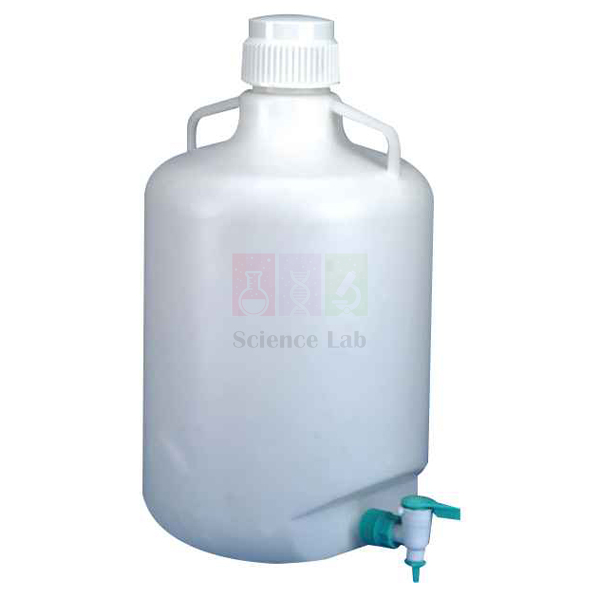
Carboy With Stop Cock
Carboy With Stop Cock (Product Code: SLE/CH/30) is a polypropylene storage container with a leak-proof spigot, used to hold and dispense distilled water and other laboratory solutions at the bench. Labs that want an alternative to heavy glass carboys choose it for daily water supply, rinsing stations and stock solutions. It is made by Jain Scientific Equipments Pvt Ltd (ScienceLab), Ambala, as part of its lab plastic ware range for schools, colleges and testing laboratories in India.
Specifications
| Parameter | Detail |
|---|---|
| Material | Polypropylene |
| Capacity | 10 litres; 20 litres |
| Outlet | Leak-proof spigot (stop cock) screwed to the body |
| Sterilisation | Autoclavable |
| Intended contents | Distilled water and other laboratory solutions |
Typical Use
Most labs place the carboy on a shelf or bench edge next to the water still so that students and technicians can draw distilled water from the spigot without lifting or tipping a heavy container. It is equally useful for bulk buffer, dilute acid or salt solutions that are drawn off in small portions through the day, which keeps the stock sealed and reduces contamination compared with repeated pouring.
Stand the carboy slightly above the receiving vessel so the tap drains freely, and keep the spigot closed when refilling. Label each carboy with its contents and filling date, rinse it with a little of the new solution before topping up, and use the autoclavable body to sterilise it when it is needed for microbiology or media work. This makes it a practical, durable piece of chemistry lab equipment in India for both teaching and routine testing.
Manufacturer
Jain Scientific Equipments Private Limited trades as ScienceLab from Ambala, Haryana, producing plasticware, glassware and apparatus for teaching and testing laboratories. Company background and facilities are described on our company profile.
Related Chemistry Lab Equipment
Items that complete a distilled-water or solution-dispensing station:
- Distiller for Distilled Water — produces the water that is stored in the carboy.
- Wash Bottle LDPE with Narrow Mouth — carries water from the carboy to individual benches for rinsing.
- Plastic Funnel — for refilling the carboy without spills.
- Measuring Cylinder, Polypropylene — measures the volumes drawn from the spigot.
- Aspirator Polythene — a jerry can type alternative for dispensing.
More storage and handling items are listed in Chemistry Lab Equipment.
Frequently Asked Questions
Which capacities are available?
Two: 10 litres and 20 litres. The smaller size is easier to lift for refilling; the larger one suits busy labs that use a lot of distilled water.
Can the carboy be autoclaved?
Yes, the polypropylene carboy is autoclavable. Loosen the closure before the cycle so pressure can equalise, and let it cool before handling.
Is the stop cock fixed or replaceable?
The leak-proof spigot is screwed to the body. For a spare spigot, please ask through our contact page with the capacity of your carboy.
Can I store organic solvents in it?
It is intended for distilled water and laboratory solutions. For organic solvents, strong oxidisers or other aggressive chemicals, confirm compatibility with us before use.
Why choose polypropylene instead of a glass carboy?
It is lighter to move and much less likely to break if knocked, which matters in student labs, and it can still be sterilised in an autoclave.
What should an institutional enquiry include?
The capacity, quantity, delivery address and any tender or purchase-order format you use. We supply buyers across India and international markets.
Request a Quote
Tell us the capacity and number of carboys through the contact form, or place them in the enquiry cart and we will reply with a quotation.
Last updated: 24 September 2026
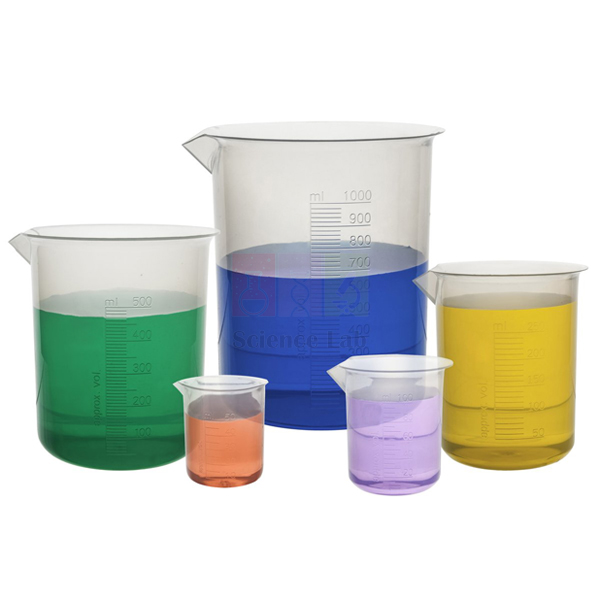
Beakers Euro Design
Beakers Euro Design (Product Code: SLE/CH/31) are polypropylene beakers offered in seven capacities, from a small 25 ml size for reagent portions up to 2000 ml for preparing bulk solutions. Being plastic, they are a shatter-resistant choice for student benches, weighing rooms and field kits where glass breakage is a concern. They are made by Jain Scientific Equipments Pvt Ltd (ScienceLab), Ambala, and are a practical choice when a school in India wants a matching beaker set for every workstation.
Specifications
| Parameter | Detail |
|---|---|
| Pattern | Euro design |
| Material | Polypropylene |
| Capacities | 25 ml; 50 ml; 100 ml; 250 ml; 500 ml; 1000 ml; 2000 ml |
Typical Use
In class practicals these beakers hold water baths for test tubes at room temperature, carry measured portions of dilute acids and bases to the bench, collect filtrate under a funnel and serve as mixing vessels for indicator and salt solutions. The larger 1000 ml and 2000 ml sizes are handy for making up stock solutions or soaking small apparatus, while the 25 ml and 50 ml beakers suit weighing out solids on a balance.
Because polypropylene softens under direct heat, keep these beakers away from burner flames and hot plates and use borosilicate glass for anything that must be boiled. Wash them with warm water and a mild detergent using a soft brush, as abrasive powders scratch the surface. Their light weight and resistance to breakage make them a sensible part of school chemistry lab equipment in India for younger classes.
Manufacturer
The beakers come from Jain Scientific Equipments Private Limited, which operates under the ScienceLab name in Ambala, Haryana, and manufactures laboratory plasticware and teaching apparatus. You can learn more about us on the company profile page.
Related Chemistry Lab Equipment
Useful companions for mixing, measuring and cleaning:
- Stirring Rod, Polypropylene — stirs solutions without scratching the beaker wall.
- Measuring Cylinder, Polypropylene — for accurate volumes before transfer into the beaker.
- Glass Beaker — the glass alternative when a solution has to be heated.
- Beaker Brush — cleans the inside and base after use.
For more benchware, visit Chemistry Lab Equipment.
Frequently Asked Questions
What sizes can I order?
Seven capacities are listed: 25, 50, 100, 250, 500, 1000 and 2000 ml. You can order single sizes or a mix for a class set.
Can these beakers be heated on a burner or hot plate?
No. They are polypropylene and should not be exposed to a flame or hot plate; choose a borosilicate glass beaker for heating.
Are they graduated, and what does Euro design refer to?
Euro design is the pattern name for this beaker. Graduation marks and exact dimensions are not stated in this listing, so please confirm them through our contact page if they matter for your work.
Can they be autoclaved?
Autoclave suitability is not stated for this item. Ask us before sterilising them so we can advise on the grade supplied.
How many beakers should a school lab order?
Most schools plan one set of the sizes they use per workstation plus spares; tell us the number of benches and we will suggest quantities.
Do you ship outside India?
Yes, we supply schools, colleges and distributors in India and international markets.
Request a Quote
List the capacities and quantities you need and send them via the contact page, or build your list in the enquiry cart for a single quotation.
Last updated: 24 September 2026
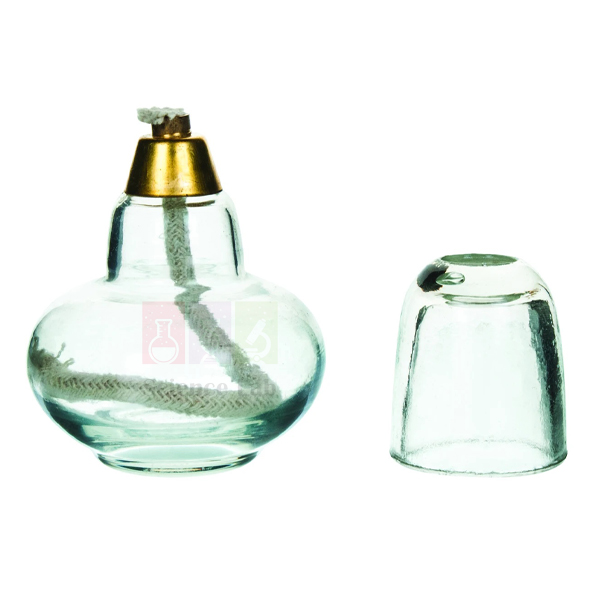
Glass Spirit Lamp
Glass Spirit Lamp (Product Code: SLE/CH/32) is a glass-bodied burner with a brass wick holder and a glass top cover, giving a small, steady flame from methylated spirit or alcohol. It is the go-to heat source for classrooms without a gas line, for flaming inoculating loops in biology, and for gentle warming of test tubes in junior science lab equipment sets. The lamp is made by Jain Scientific Equipments Pvt Ltd (ScienceLab), Ambala, alongside its wider range of chemistry lab glassware for schools in India and international markets.
Specifications
| Parameter | Detail |
|---|---|
| Body | Glass |
| Wick holder | Brass |
| Cover | Glass top cover |
| Capacity | 60 ml; 125 ml |
Typical Use
Students use the spirit lamp to warm small quantities of liquid in a test tube held with a holder, to dry a glass slide, or to sterilise a wire loop before and after transferring a culture. Because it needs no gas supply or tubing, it is easy to set out on every bench for a practical and to pack away afterwards; the 60 ml lamp suits short class sessions, while the 125 ml size runs longer between refills.
Fill the lamp away from any flame and do not overfill it. Keep the wick trimmed level so the flame burns evenly without smoking, and put the flame out by placing the glass top cover over it rather than blowing on it. The cover also stops the spirit from evaporating between lessons. Never refill a lamp that is still lit or warm.
Manufacturer
ScienceLab is the brand name used by Jain Scientific Equipments Private Limited of Ambala, Haryana, a maker of laboratory glassware, heating apparatus and school science equipment. Visit the company profile for more about the business.
Related Chemistry Lab Equipment
Accessories and alternatives that go with a spirit lamp:
- Wicks For Glass Spirit Burner — replacement wicks when the old one chars or shortens.
- Methylated Spirit — the usual fuel for the lamp.
- Test Tube Holder — holds the tube safely over the flame.
- Bunsen Burner — a hotter gas-fired option where a gas supply is available.
Other heating and support items are in Chemistry Lab Equipment.
Frequently Asked Questions
What fuel does the spirit lamp use?
Methylated spirit or a similar alcohol. Do not use petrol, kerosene or other volatile fuels in a glass spirit lamp.
What is the difference between the two sizes?
Only the fuel capacity: 60 ml or 125 ml. The larger lamp burns for longer before it needs refilling.
Is a wick included, and can it be replaced?
The lamp is built around its brass wick holder; please confirm the wick supplied with your order via our contact page. Replacement wicks are listed separately.
Is a spirit lamp hot enough for every experiment?
It gives a gentler flame than a Bunsen burner, which suits warming, drying and loop sterilisation. For strong heating or boiling larger volumes, use a gas burner.
How do I put out the flame safely?
Place the glass top cover over the wick to starve the flame of air, then leave the lamp to cool before moving or refilling it.
Can you supply lamps for a whole school or district order?
Yes. Send the size, quantity and delivery location; we supply institutions in India and international markets.
Request a Quote
For prices and delivery, write to us through the contact page or add the lamp and its wicks to the enquiry cart.
Last updated: 24 September 2026
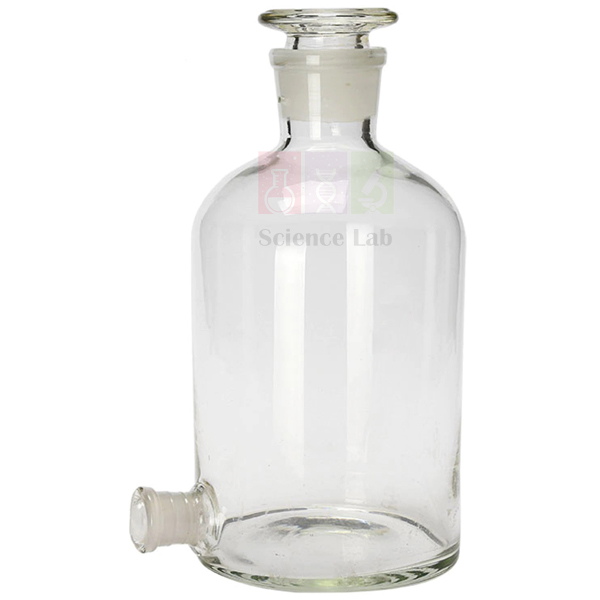
Aspirator Bottles Borosilicate
Aspirator Bottles Borosilicate (Product Code: SLE/CH/33) are glass bottles with a stopcock at the bottom and a stopper in the neck, built for storing a liquid and drawing it off from below without lifting the bottle. Laboratories use them for distilled water and working solutions, and chemistry teachers use them as water aspirators in gas and air-flow experiments. The bottles are made in borosilicate glass by Jain Scientific Equipments Pvt Ltd (ScienceLab), Ambala, and belong to its range of borosilicate glassware for laboratories in India and international markets.
Specifications
| Parameter | Detail |
|---|---|
| Material | Borosilicate glass |
| Outlet | Stopcock at the bottom |
| Neck closure | Stopper |
| Capacity | 1 litre; 2 litres; 5 litres |
Typical Use
As a storage vessel, the aspirator bottle stands on a shelf with its stopcock over the sink or bench, so a measured flow of distilled water or reagent can be run off while the neck stays stoppered against dust. In experiments it works on water displacement: as water runs out of the bottom outlet, air or gas is drawn in through tubing at the top, which lets students pull a sample of air through an absorption tube or measure the volume of gas produced in a reaction.
Choose the 1 litre bottle for bench-top demonstrations, the 2 litre for group practicals and the 5 litre for a central water or solution supply. Glass lets you see the level and the clarity of the contents, and borosilicate stands up better than soda glass to washing with hot water. Place larger filled bottles on a firm, low shelf, and turn the stopcock gently to avoid stressing the glass joint. Schools choosing a laboratory glassware supplier in India can pair these bottles with plastic aspirators for younger classes.
Manufacturer
Jain Scientific Equipments Private Limited, trading as ScienceLab, manufactures laboratory glassware and apparatus in Ambala, Haryana. For vendor registration, the company's GSTIN is 06AAECJ8618A1ZT and its Legal Entity Identifier (LEI) is 3358004HRD1JIVXKYX49. See the company profile for more.
Related Chemistry Lab Equipment
Items that connect to or work alongside an aspirator bottle:
- Silicone Tube — connects the outlet or neck to the rest of an apparatus.
- Stopcock — adds flow control or a two-way switch on the connecting tubing.
- Distiller for Distilled Water — supplies the water stored in the bottle.
- Aspirator Polythene — an unbreakable plastic alternative.
- Wash Bottle LDPE with Narrow Mouth — for carrying water from the bottle to each bench.
Explore more glassware in Chemistry Lab Equipment.
Frequently Asked Questions
Which capacities are offered?
Three: 1 litre, 2 litres and 5 litres, all in borosilicate glass with a bottom stopcock and neck stopper.
Can the bottle be used as an aspirator for drawing air or gas?
Yes. Fill it with water, connect tubing at the neck and open the stopcock; the outflowing water draws air or gas into the bottle.
Can I heat the bottle or pour boiling liquid into it?
It is a storage and dispensing vessel, not a heating vessel. Borosilicate tolerates hot washing water, but avoid direct heating and sudden temperature changes on a filled bottle.
What if the stopcock or stopper is damaged?
Contact us through the contact page with the bottle size and we will advise on replacement parts.
How should the bottle be cleaned?
Rinse through the neck and let the water run out of the stopcock so the outlet is flushed as well; finish with distilled water and drain with the stopper removed.
What details do you need for a tender or purchase order?
The capacities, quantities, delivery address and any vendor forms. We supply laboratories in India and international markets.
Request a Quote
Send your requirement through the contact page, or add the bottles you need to the enquiry cart and submit them together.
Last updated: 24 September 2026
Bottle Reagent, W.M. Glass
Bottle Reagent, W.M. Glass (Product Code: SLE/CH/34) is a wide-mouth glass reagent bottle closed with a dustproof flat stopper of glass or polythene. The wide mouth makes it easy to scoop out crystals, powders and granules, so it is the standard container for solid reagents on the chemistry shelf. It is made by Jain Scientific Equipments Pvt Ltd (ScienceLab), Ambala, a laboratory glassware manufacturer supplying schools, colleges and testing labs.
Specifications
| Parameter | Detail |
|---|---|
| Body | Glass |
| Mouth | Wide mouth (W.M.) |
| Stopper | Dustproof flat stopper, glass or polythene |
| Capacity | 60 ml; 125 ml; 250 ml; 500 ml; 1000 ml |
Typical Use
A row of these bottles typically holds the solid salts, metal pieces and powders students draw from during salt analysis and preparation practicals, with each bottle labelled on the front and the flat stopper keeping dust and moisture out between lessons. Small 60 ml and 125 ml bottles are practical for the reagent set on each bench, while the 500 ml and 1000 ml sizes serve as stock containers in the prep room.
Use a clean, dry spatula for each reagent so that samples are not cross-contaminated, and put the stopper back straight away. A glass stopper suits most dry solids; a polythene stopper is the better choice for substances that tend to make a glass stopper stick, such as alkalis. For substances affected by light, choose the amber version of this bottle instead.
Manufacturer
Operating as ScienceLab, Jain Scientific Equipments Private Limited produces glassware, plasticware and laboratory apparatus at Ambala in Haryana. The company profile explains who we are and what we make.
Related Chemistry Lab Equipment
Items that complete a reagent shelf built around wide-mouth bottles:
- Bottle Reagent, W.M. Glass Amber Colour — the amber version for light-sensitive solids.
- Reagent Bottle, Narrow Mouth — better suited to liquid reagents.
- Spatula, Spoon End — scoops solids out through the wide mouth.
- Label Book Sticker Type — for marking each bottle's contents.
- Bottle Brush — cleans the inside before a bottle is reused.
See all items in Chemistry Lab Equipment.
Frequently Asked Questions
Which sizes are available?
Five: 60 ml, 125 ml, 250 ml, 500 ml and 1000 ml, all with a wide mouth and flat stopper.
Can I choose between a glass and a polythene stopper?
The listing offers the dustproof flat stopper in glass or polythene. State your preference for each size when you enquire and we will confirm availability.
Is this bottle suitable for liquids?
It can hold liquids, but a narrow-mouth reagent bottle pours more cleanly and limits evaporation, so it is usually preferred for solutions.
What type of glass is used?
The listing specifies glass without naming the grade. If you need a particular glass type for your application, ask us through the contact page.
How do I free a stuck glass stopper?
Tap the stopper gently with a wooden handle or warm the neck slightly with warm water, then twist; do not force it, as the neck can crack.
Can you supply a full reagent-bottle set for a new lab?
Yes. Tell us the sizes and number of bottles; we supply institutions and distributors in India and international markets.
Request a Quote
Share the sizes, stopper type and quantities on our contact page, or collect them in the enquiry cart for a single quote.
Last updated: 24 September 2026
Bottle Reagent, W.M. Glass Amber Colour
Bottle Reagent, W.M. Glass Amber Colour (Product Code: SLE/CH/35) is an amber soda glass bottle with a wide mouth and a dustproof flat stopper. The amber tint cuts down the light reaching the contents, which is why chemists keep light-sensitive salts, stains and prepared reagents in it. It is made by Jain Scientific Equipments Pvt Ltd (ScienceLab), Ambala, and comes in six sizes, from a compact 30 ml bottle to a 1000 ml stock bottle.
Specifications
| Parameter | Detail |
|---|---|
| Glass | Soda glass, amber colour |
| Mouth | Wide mouth (W.M.) |
| Stopper | Dustproof flat stopper |
| Capacity | 30 ml; 60 ml; 125 ml; 250 ml; 500 ml; 1000 ml |
Typical Use
Amber bottles protect reagents that darken or decompose in daylight. In a school or college prep room they are the usual home for silver nitrate crystals, iodine and potassium permanganate, and for making up silver nitrate solution or iodine solution for the lab when the wide mouth is useful for adding solids. The 30 ml size is convenient for small, costly reagents shared across a class; the larger bottles hold the stock.
Store the bottles in a cupboard or on a shaded shelf even though the glass filters light, and label each one clearly, because amber glass makes it harder to see the contents. Close the flat stopper right after use to keep out dust and moisture, and wipe the neck before closing so that crystals do not build up around the stopper.
Manufacturer
This bottle is produced by Jain Scientific Equipments Private Limited, the Ambala, Haryana company behind the ScienceLab brand, which makes glassware and apparatus for education and testing. More information is on our company profile.
Related Chemistry Lab Equipment
Other containers and tools for storing and dispensing light-sensitive reagents:
- Reagent Bottle Narrow Mouth, Amber Glass — amber storage for liquid reagents that need controlled pouring.
- Bottle Dropping — amber dropping bottle for dispensing small quantities of solution.
- Bottle Reagent, W.M. Glass — the non-amber wide-mouth bottle for ordinary solids.
- Spatula, 140mm — for taking solid reagent out of the wide mouth.
Find more storage items in Chemistry Lab Equipment.
Frequently Asked Questions
Why choose amber glass over a colourless bottle?
Amber glass blocks much of the light that breaks down sensitive reagents, so solutions and salts keep longer. For reagents that are not light-sensitive, the plain wide-mouth bottle is sufficient.
What glass is the bottle made of?
Soda glass in amber colour. It is intended for storage, not for heating.
How many sizes are there?
Six: 30, 60, 125, 250, 500 and 1000 ml. The 30 ml size is only offered in this amber version within this pair of listings.
What is the stopper made of?
The listing describes a dustproof flat stopper without naming its material. Please check the stopper type for your order through our contact page.
Can these bottles be supplied with labels printed for our reagents?
Custom labelling is not part of this listing; ask us when you enquire and we will tell you what is possible for your quantity.
Do you supply export and distributor orders?
Yes, to buyers in India and international markets. Include the sizes, quantities and destination with your enquiry.
Request a Quote
Ask for pricing through our contact page, or add the amber bottles to the enquiry cart alongside other storage glassware.
Last updated: 24 September 2026
Bottle McCARTNEY, BIJOU
Bottle McCARTNEY, BIJOU (Product Code: SLE/CH/36) is a small narrow-mouth bottle for culture media and vaccines, sealed with an aluminium screw cap and a rubber liner. Microbiology, pathology and teaching labs use it to hold agar slopes, broths, sera and small reagent volumes in a closed, labelled container. It is made by Jain Scientific Equipments Pvt Ltd (ScienceLab), Ambala, and is a practical culture media bottle for laboratories in India, offered in three sizes.
Specifications
| Parameter | Detail |
|---|---|
| Application | Media and vaccine bottle |
| Mouth | Narrow mouth |
| Cap | Aluminium screw cap |
| Seal | Rubber liner |
| Capacity | 7 ml; 14 ml; 28 ml |
Typical Use
The name joins two long-established laboratory bottle styles: the small Bijou and the larger McCartney. In a microbiology lab, molten agar is dispensed into the bottles, which are then laid at an angle to set as slopes for maintaining stock cultures; the screw cap limits drying out during storage far better than a cotton plug. The smallest 7 ml bottle suits single-use aliquots of media or serum, the 14 ml size holds a working slope, and the 28 ml bottle takes larger broth or diluent volumes.
Label every bottle with its contents and date before filling, and keep the rubber liner seated inside the cap so the seal stays effective. When preparing media, fill the bottles through a funnel or dispenser to keep the neck clean, and tighten the caps fully only once the contents have cooled. Handled this way, the bottles are a dependable part of the microbiology lab equipment used in Indian colleges and diagnostic labs.
Manufacturer
Jain Scientific Equipments Private Limited runs the ScienceLab brand from Ambala, Haryana, making laboratory bottles, glassware and teaching apparatus for institutions. Read about the company on the company profile.
Related Chemistry Lab Equipment
Other items used when preparing and storing media:
- Petri Dish Glass With Lid — plates for sub-culturing organisms kept on slopes.
- Universal Bottle Pp Cap — a larger screw-cap bottle with a polypropylene cap.
- Bottle, McCartney — the McCartney listing in our glassware bottle range.
- Bottle Brush — cleans narrow necks before bottles are reused.
Browse more in Chemistry Lab Equipment.
Frequently Asked Questions
Which sizes are available?
Three capacities: 7 ml, 14 ml and 28 ml, each with an aluminium screw cap and rubber liner.
What is the bottle body made of?
The listing specifies the cap and liner but not the body material. Please confirm it with us through the contact page before ordering, especially if you plan to sterilise the bottles.
Can the bottles be autoclaved with their caps?
Sterilisation suitability is not stated for this item. Tell us your sterilisation method when you enquire and we will advise.
Why use a rubber-lined screw cap instead of a cotton plug?
The liner seals the bottle, so media and samples lose less moisture and are less exposed to airborne contamination during storage.
Are spare caps or liners available?
Ask us about spare aluminium caps and rubber liners for your bottle size; availability is confirmed at the time of quotation.
Can you supply hospital, college or export orders?
Yes. We supply laboratories and distributors in India and international markets; please state the sizes and quantities needed.
Request a Quote
Request prices through the contact page, or put the sizes you need into the enquiry cart for one reply.
Last updated: 24 September 2026
Aspirator Polythene
Aspirator Polythene (Product Code: SLE/CH/37) is a rigid, jerry can type polythene container with a plastic screw cap and a stopcock outlet, used to store water or solutions and run them off at the bench. It gives prep rooms, field stations and student labs a lightweight dispenser that will not shatter if it is knocked over. The aspirator is made by Jain Scientific Equipments Pvt Ltd (ScienceLab), Ambala, a chemistry lab instruments supplier to schools and colleges.
Key Details
| Parameter | Detail |
|---|---|
| Type | Aspirator, jerry can type |
| Material | Polythene, rigid body |
| Closure | Plastic screw cap |
| Outlet | Stopcock |
| Purpose | Storing and dispensing water and laboratory solutions |
| Capacity | Please confirm on enquiry |
Typical Use
The jerry can shape stacks neatly on a shelf and is easy to carry by hand, so the aspirator is often filled at a central water still and moved to wherever students are working. Placed at the edge of a bench, it lets them run off distilled water, dilute acids, buffers or washing solutions through the stopcock in controlled amounts. It is also handy on outdoor or field practicals where a glass bottle would be at risk of breaking. As a school laboratory equipment supplier in India, ScienceLab recommends it for junior classes, where durability matters most.
Keep the screw cap slightly open, or remove it, while dispensing so air can enter and the flow stays smooth. Rinse the container with some of the new solution before refilling, label the contents on the side, and flush the stopcock with clean water when changing from one solution to another.
Manufacturer
ScienceLab is the trading name of Jain Scientific Equipments Private Limited (CIN U29309HR2020PTC087597), headquartered in Ambala, Haryana. The company manufactures at its licensed factory at 449, HSIIDC Industrial Area, Saha, Ambala (Factory Licence AMB-ONLINE-CHD-J-414). See our company profile for details.
Related Chemistry Lab Equipment
Storage vessels and accessories that fit the same workflow:
- Aspirator Bottles Borosilicate — glass aspirators in stated capacities when you need to see the contents.
- Carboy With Stop Cock — an autoclavable polypropylene dispenser in fixed capacities.
- Plastic Funnel — for refilling through the screw-cap neck.
- Distiller for Distilled Water — the source of water stored in the aspirator.
Browse the complete Chemistry Lab Equipment category.
Frequently Asked Questions
What capacity is the polythene aspirator?
The capacity is not given in this listing. Please ask through our contact page and we will confirm the sizes currently available.
How is it different from a glass aspirator bottle?
It is a rigid polythene jerry can with a screw cap, so it is lighter and far less likely to break, while a glass aspirator lets you see the contents and suits long-term storage of more reactive solutions.
What liquids can be stored in it?
Water and most everyday aqueous laboratory solutions. For solvents or strongly oxidising chemicals, check compatibility with us first.
Can the stopcock be replaced if it wears out?
Ask us for a replacement stopcock and mention the capacity of your aspirator so we supply the right fitting.
How should the aspirator be cleaned?
Rinse with warm water and a mild detergent, run clean water through the stopcock, then rinse with distilled water and leave it open to drain and dry.
Do you accept tender and export orders?
Yes; send quantities, delivery location and any tender documents. We supply buyers in India and international markets.
Request a Quote
Contact us through the contact page for capacity options and pricing, or add the aspirator to your enquiry cart.
Last updated: 24 September 2026
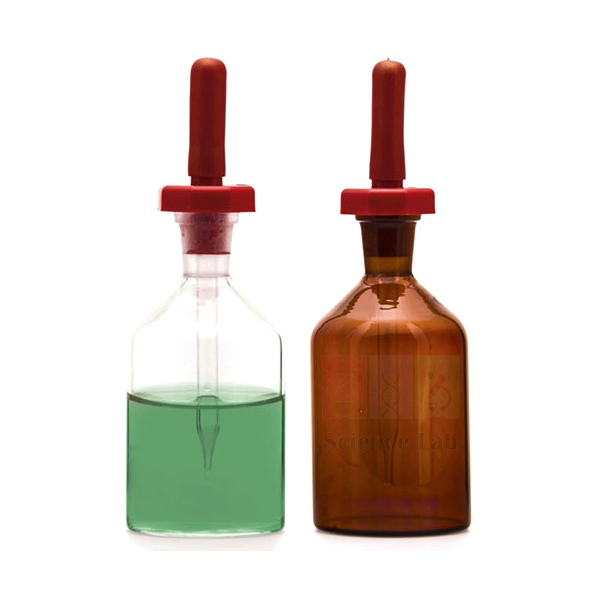
Bottle Dropping
Bottle Dropping (Product Code: SLE/CH/38) is an amber glass bottle fitted with a rubber teat dropping pipette that is ground into the neck, so the pipette doubles as the stopper. It lets students add indicators and test reagents drop by drop without a separate dropper, and the amber glass helps protect light-sensitive solutions. The bottle is made by Jain Scientific Equipments Pvt Ltd (ScienceLab), Ambala, and is a staple of any acid base indicator kit on the school bench.
Specifications
| Parameter | Detail |
|---|---|
| Bottle | Amber glass |
| Dropper | Rubber teat dropping pipette, ground into the neck |
| Capacity | 30 ml; 60 ml |
| Also listed | Dropper only |
Typical Use
Dropping bottles hold the indicators and small-volume reagents used in titrations, qualitative tests and pH work: phenolphthalein, methyl orange, universal indicator solution, dilute silver nitrate or barium chloride for anion tests, and similar solutions. A set of labelled bottles in a rack on each bench saves time and cuts waste, because students add exactly the few drops they need instead of pouring from a stock bottle. The 30 ml size is enough for a single bench; the 60 ml size is better for a shared tray.
Squeeze the teat before dipping the pipette into the liquid, never after, so no air is blown through the solution. Return the pipette to its own bottle straight away to avoid mixing reagents, keep the ground neck clean so the fit stays snug, and replace the rubber teat when it hardens or cracks.
Manufacturer
Jain Scientific Equipments Private Limited, known to customers as ScienceLab, is based in Ambala, Haryana and produces glassware and teaching apparatus for chemistry, biology and physics labs. Our company profile has more information.
Related Chemistry Lab Equipment
Items that support indicator and reagent work with dropping bottles:
- Bottle Reagent, W.M. Glass Amber Colour — amber stock bottles for refilling the droppers.
- Dropper Bottle, 10 ml — a smaller bottle for costly or rarely used reagents.
- Dropping Bottle — the plastic alternative in our plasticware range.
- Test Tube Racks — hold the tubes that receive the drops during tests.
More bench items are in Chemistry Lab Equipment.
Frequently Asked Questions
What sizes are available?
Two capacities, 30 ml and 60 ml, both in amber glass with a ground-in rubber teat pipette.
Can I buy the dropper on its own?
The listing also includes a dropper-only option. Tell us the bottle size it must fit when you enquire so we can confirm the right pipette.
Does the amber glass make it suitable for light-sensitive solutions?
Amber glass reduces the light reaching the contents, which helps solutions such as silver nitrate keep longer. Store the bottles away from direct sunlight as well.
Can the rubber teat be replaced?
Rubber ages with use and some chemicals. Ask us about replacement teats or droppers through the contact page.
Is it suitable for strong acids or organic solvents?
Glass handles most reagents, but concentrated acids and many solvents attack rubber teats. Use it mainly for aqueous indicators and dilute reagents.
Can you supply complete sets for a school lab or distributor?
Yes. We supply institutions and distributors in India and international markets; give us the sizes, quantities and delivery location.
Request a Quote
Tell us the sizes and quantities through our contact page, or add the dropping bottles to the enquiry cart for a combined quotation.
Last updated: 24 September 2026
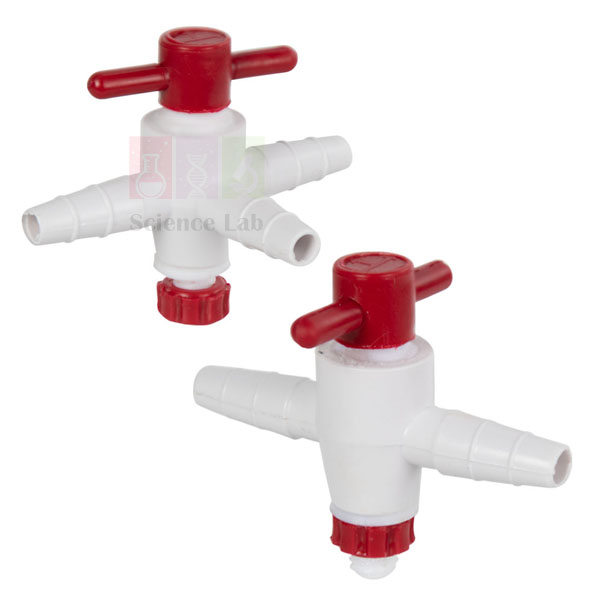
Stopcock
Stopcock (Product Code: SLE/CH/39) is an in-line polypropylene valve fitted with a PTFE plug, with serrated tubulations that accept tubing from 6 mm to 10 mm. Pushed into a length of rubber or silicone tubing, it turns a flexible line into one you can open, close or divert by hand. It is available as a 2-way or 3-way stopcock and is made by Jain Scientific Equipments Pvt Ltd (ScienceLab), Ambala, as one of the small lab equipment accessories that teaching and research labs in India keep in their spares drawer.
Specifications
| Parameter | Detail |
|---|---|
| Body material | Polypropylene |
| Plug | PTFE |
| Connections | Serrated tubulations |
| Tubing accepted | 6 mm to 10 mm |
| Options | Stopcock 2 way; Stopcock 3 way |
Typical Use
A 2-way stopcock simply opens or shuts a line, for example on the outlet tubing of an aspirator bottle, on a water supply to a condenser, or on the vacuum line between a filter pump and a filter flask so suction can be released without pulling the tubing off. A 3-way stopcock connects one inlet to either of two outlets, which lets a technician switch gas between two pieces of apparatus, vent a system to air, or change over between two water feeds without disconnecting anything.
The serrations grip the tubing firmly; warming or wetting the tubing end makes it easier to push on. Turn the handle through its positions before connecting so you know which way each port is open. The PTFE plug turns smoothly without grease, which keeps the flow path clean, and the polypropylene body is light enough not to drag tubing down. Keeping a few in stock alongside other lab equipment spare parts saves re-plumbing a set-up when a line needs a new control point.
Manufacturer
Jain Scientific Equipments Private Limited trades as ScienceLab and makes laboratory plasticware, glassware and apparatus in Ambala, Haryana. Learn more on our company profile.
Related Chemistry Lab Equipment
Tubing and apparatus a stopcock is typically fitted to:
- Silicone Tube — flexible tubing to push onto the serrated ends.
- Rubber Tubing — general-purpose tubing for water and gas lines.
- Filter Pump, Borosilicate Glass — vacuum source whose line can be isolated with the stopcock.
- Aspirator Polythene — a dispenser whose outlet tubing can be given extra flow control.
See more fittings and glassware in Chemistry Lab Equipment.
Frequently Asked Questions
What tubing sizes does it fit?
The serrated tubulations accept tubing from 6 mm to 10 mm. If your tubing is at either end of that range, send us its size through the contact page and we will confirm the fit.
Should I choose the 2-way or 3-way version?
Choose 2-way to open and close a single line; choose 3-way when one supply must be switched between two destinations or vented.
Does the PTFE plug need grease?
PTFE is naturally low-friction, so the plug turns without grease; this avoids contaminating the liquid or gas passing through.
Can it be used on a vacuum line?
Yes, it is commonly placed in vacuum tubing to isolate or release suction. Use thick-walled tubing so the line does not collapse.
How do I clean it?
Flush it with warm water in each open position, rinse with distilled water and let it dry; remove any deposits before they harden in the bore.
Can I order mixed 2-way and 3-way stopcocks in bulk?
Yes. List the quantity of each type in your enquiry; we supply labs in India and international markets.
Request a Quote
Send the type and quantity through the contact page, or add stopcocks and tubing to the enquiry cart to receive one quotation.
Last updated: 24 September 2026
Basin Crystallising Without Spout
Basin Crystallising Without Spout (Product Code: SLE/CH/40) is a flat-bottomed borosilicate glass dish used to evaporate saturated solutions slowly so that crystals can form in school and college chemistry laboratories. Its plain rim without a spout lets a clock glass or paper cover sit evenly, and it comes in three sizes from 100 x 50 mm to 190 x 100 mm. It is made by Jain Scientific Equipments Pvt Ltd (ScienceLab), an OEM manufacturer of borosilicate glassware in India, at its own factory in Ambala.
Specifications
| Parameter | Detail |
|---|---|
| Material | Borosilicate glass |
| Base | Flat bottom |
| Rim | Without spout |
| Sizes (diameter x depth) | 100 x 50 mm; 150 x 75 mm; 190 x 100 mm |
| Product code | SLE/CH/40 |
| Manufacturer | Jain Scientific Equipments Pvt Ltd (ScienceLab) — OEM |
| Country of origin | India (made in Ambala, Haryana) |
What Is a Crystallising Basin Used For?
The classic class practical is growing copper sulphate crystals or alum crystals: a hot, filtered, saturated solution is poured into the basin, covered loosely and left undisturbed so that well-formed crystals grow over the following days. The wide, shallow shape gives a large surface for evaporation, and the flat bottom keeps the dish stable on a shelf or window sill. Beyond crystallisation, the basin serves as a shallow bath for cooling a flask, a tray for soaking slides or small glassware, and a container for demonstrations with floating or reacting solids.
When warming a solution in the basin, set it on a wire gauze rather than in a direct flame and heat gently. Clean off crystal crusts with warm water before they harden, since scraping can scratch the glass. A few basins in each size round out a crystallization kit for school practicals, from individual student work to teacher demonstrations.
What to Specify When Ordering
- Size, given as diameter x depth: 100 x 50 mm, 150 x 75 mm or 190 x 100 mm
- Quantity of each size, for example the smallest for individual students and the largest for demonstrations or bigger batches
- Matching accessories, such as clock glasses to cover the basins or stirring rods for preparing the solution
- Delivery location, so the manufacturer can quote packing and dispatch for India or international markets
OEM Manufacturer
Basin Crystallising Without Spout is manufactured by Jain Scientific Equipments Private Limited, which trades as ScienceLab and is the OEM (original equipment manufacturer) of this borosilicate basin. The company makes its laboratory glassware and chemistry teaching apparatus at its own licensed factory at 449, HSIIDC Industrial Area, Saha, Ambala, Haryana, India, and supplies it factory-direct to schools, colleges, institutions, dealers and importers in India and international markets. Because quotations come straight from the manufacturer, ask us about repeat orders, extra sizes or replacement basins. Read more on the company profile.
Related Chemistry Lab Equipment
Items used in the same crystallisation workflow:
- Clock Glass (Borosilicate Glass) — a cover that keeps dust out while evaporation continues
- Filter Paper — clears the hot solution of insoluble matter before it goes into the basin
- Stirring Rod, Glass — dissolves the solid and helps seed crystals
- Gauze Wire, Ceramic Centre — spreads the heat when the basin is warmed
- Potash Alum — a salt that grows well-shaped crystals from a saturated solution
More glassware is listed in Chemistry Lab Equipment.
Frequently Asked Questions
What sizes does the Basin Crystallising Without Spout come in?
The Basin Crystallising Without Spout comes in three sizes, given as diameter x depth: 100 x 50 mm, 150 x 75 mm and 190 x 100 mm. State the size and quantity of each when you ask for a quotation.
Why choose a crystallising basin without a spout?
A crystallising basin without a spout has a plain, level rim, so a clock glass or filter-paper cover sits flat and there is no low point where solution can creep over the edge during slow evaporation. If you mainly need to pour, a spouted design suits better.
Can the Basin Crystallising Without Spout be heated?
Yes, gently. The Basin Crystallising Without Spout is borosilicate glass, so it handles hot solutions and gentle warming on a wire gauze well; avoid a direct flame on an empty or dry basin and avoid sudden cooling.
How do I get large, well-shaped crystals in the basin?
Use a hot, filtered, saturated solution, cover the crystallising basin loosely and leave it somewhere still at a steady temperature. Moving the Basin Crystallising Without Spout while crystals grow disturbs them and produces many small crystals instead of a few large ones.
Who manufactures the Basin Crystallising Without Spout?
The Basin Crystallising Without Spout is manufactured by Jain Scientific Equipments Pvt Ltd (ScienceLab), the OEM, at its own licensed factory at Saha, Ambala, Haryana, India, and is sold factory-direct to schools, colleges, dealers and importers.
Can you supply crystallising basins for class sets or export orders?
Yes. ScienceLab supplies the Basin Crystallising Without Spout in class-set quantities to schools, colleges and distributors across India and international markets; tell us the sizes, quantities and destination so the manufacturer can quote directly.
Request a Quote
Let us know the sizes and quantities via the contact page, or add basins to the enquiry cart with the rest of your glassware list; the quotation comes direct from the manufacturer.
Last updated: 24 September 2026

Burette Stand and Funnel Stand
Burette Stand and Funnel Stand (Product Code: SLE/CH/41) is a polished hardwood stand that holds one burette and one funnel at the same time, with cork-lined jaws, plastic screws and a base standing on four rubber feet. It gives each titration or filtration station a steady, all-in-one support without a separate retort stand and clamps. Made by Jain Scientific Equipments Pvt Ltd (ScienceLab), Ambala, it is a practical burette stand for student benches in school and college labs across India.
Specifications
| Parameter | Detail |
|---|---|
| Holds | One burette and one funnel |
| Material | Polished hardwood |
| Jaws | Cork lined |
| Screws | Plastic |
| Feet | Four rubber feet on the base for stability |
| Base size | 330 x 110 mm |
| Overall height | 490 mm |
Typical Use
During an acid-base or redox titration, the burette is gripped in the cork-lined jaw above a conical flask while the funnel position holds a small funnel ready for refilling, or supports a filter funnel for a parallel filtration. Cork protects the glass from scratching and grips it without the need to overtighten, and the plastic screws do not rust from acid splashes the way metal ones can. This makes it a tidy fit for school titration kits, with one stand set out at each bench.
Align the burette vertically before tightening the jaw, and place a white tile or sheet of paper on the base under the flask so the end point colour change is easy to see. Wipe spills off the wood promptly with a damp cloth and dry it, and keep the stand away from standing water so the polish lasts.
Manufacturer
Jain Scientific Equipments Private Limited operates as ScienceLab in Ambala, Haryana, and makes laboratory stands, glassware and teaching apparatus. It is registered as an MSME manufacturing enterprise under Udyam UDYAM-HR-01-0003714, and its export consignments are handled under DGFT Importer-Exporter Code AAECJ8618A. More on our company profile.
Related Chemistry Lab Equipment
Everything else needed at a titration or filtration station:
- Burette — an acrylic burette to mount in the stand.
- Glass Funnel — sits in the funnel position for filling or filtering.
- Conical Flask — receives the titrant below the burette tip.
- Filter Paper — for filtrations run through the funnel.
- Brush Burette — cleans the burette bore after each session.
Find more stands and supports in Chemistry Lab Equipment.
Frequently Asked Questions
What does the stand hold?
One burette and one funnel at the same time, each in its own cork-lined jaw.
How much bench space does it need?
The base measures 330 x 110 mm and the stand is 490 mm high overall, so it fits on a standard student bench with a flask below the burette.
Will it hold glass as well as plastic burettes?
The cork-lined jaws grip burettes of either material without scratching them. If you use an unusually wide or narrow burette, send its outer diameter via the contact page and we will confirm the fit.
Is the stand stable on a wet or smooth bench?
The four rubber feet stop it sliding on smooth or damp surfaces and keep the base from scratching the bench.
How do I care for the hardwood?
Wipe it with a damp cloth, dry it straight away and avoid soaking; do not leave acids standing on the wood.
What should a school or institutional quotation request include?
The number of stands, delivery location and whether you also need burettes, funnels or flasks. We supply buyers in India and international markets.
Request a Quote
Ask for prices and delivery times through the contact page, or add the stand with burettes and funnels to the enquiry cart.
Last updated: 24 September 2026
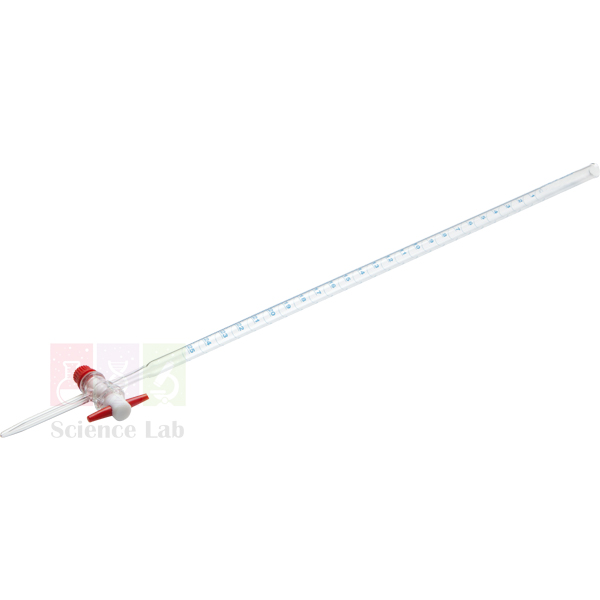
Burette
Burette (Product Code: SLE/CH/42) is a plastic burette with a transparent acrylic body and a leakproof stopcock fitted with a self-lubricating PTFE plug, used to deliver measured volumes of titrant in volumetric analysis. Each burette is individually calibrated, and the plastic body is much less prone to breakage than glass, which suits student titrations. It is made by Jain Scientific Equipments Pvt Ltd (ScienceLab), Ambala, in 25 ml, 50 ml and 100 ml capacities.
Specifications
| Parameter | Detail |
|---|---|
| Material | Polymethyl Methacrylate/TPX |
| Body | Transparent acrylic |
| Stopcock | Leakproof, with self-lubricating PTFE plug |
| Calibration | Each burette individually calibrated |
| Chemical resistance | Unaffected by dilute mineral acids and bases, except hydrofluoric acid and ammonium hydroxide |
| Working range | pH 1–14; up to 5% wt/wt acids or 30% bases |
| Capacity | 25 ml; 50 ml; 100 ml |
Typical Use
In a standard acid-base titration the burette is clamped vertically, filled with the titrant, and run into a conical flask containing the analyte and a few drops of indicator until the colour changes at the end point. The acrylic burette handles the dilute hydrochloric acid, sulphuric acid and sodium hydroxide solutions used in most school and college volumetric analysis kits in India, and its clear body lets students read the meniscus easily. The 25 ml size suits short titrations with small samples, 50 ml is the common class size, and 100 ml avoids refilling during longer runs.
Rinse the burette with a little of the titrant before filling, remove the air bubble from the tip by running some liquid through, and read the bottom of the meniscus at eye level. Keep it away from hydrofluoric acid, ammonium hydroxide and organic solvents, and do not dry it in a hot oven; rinse with distilled water and let it drain upside down instead.
Manufacturer
ScienceLab is the trade name of Jain Scientific Equipments Private Limited, a manufacturer of laboratory plasticware, glassware and apparatus located in Ambala, Haryana. Visit the company profile to learn more.
Related Chemistry Lab Equipment
Supports and glassware used with the burette in titrations:
- Burette Stand and Funnel Stand — hardwood stand holding a burette and a funnel together.
- Fisher Clamp — polypropylene clamp for mounting the burette on a retort stand rod.
- Conical Flask — the titration flask placed under the burette tip.
- Glass Funnel — for filling the burette without spills.
- Brush Burette — long brush for cleaning the bore.
For more titration equipment, see Chemistry Lab Equipment.
Frequently Asked Questions
Which capacities can I order?
Three: 25 ml, 50 ml and 100 ml, all with the acrylic body and PTFE-plug stopcock.
Which chemicals should not be used in it?
Hydrofluoric acid and ammonium hydroxide are listed as exceptions to the body's chemical resistance. Use it within pH 1–14 and up to 5% wt/wt acids or 30% bases, and avoid organic solvents.
Does the stopcock need greasing?
No. The PTFE plug is self-lubricating, so it turns smoothly without grease that could contaminate the titrant.
Is a calibration certificate supplied?
Each burette is individually calibrated. If your lab needs a calibration certificate or tolerance statement, please discuss it with us through the contact page before ordering.
How does it compare with a glass burette?
It is much less likely to break, which suits student use; a glass burette is the better choice for organic solvents or for reagents stronger than the stated limits.
Can you supply class sets and export orders?
Yes. Tell us the capacities and quantities; we supply schools, colleges and distributors in India and international markets.
Request a Quote
Send your capacity and quantity requirement through the contact page, or add burettes and stands to the enquiry cart for one quotation.
Last updated: 24 September 2026
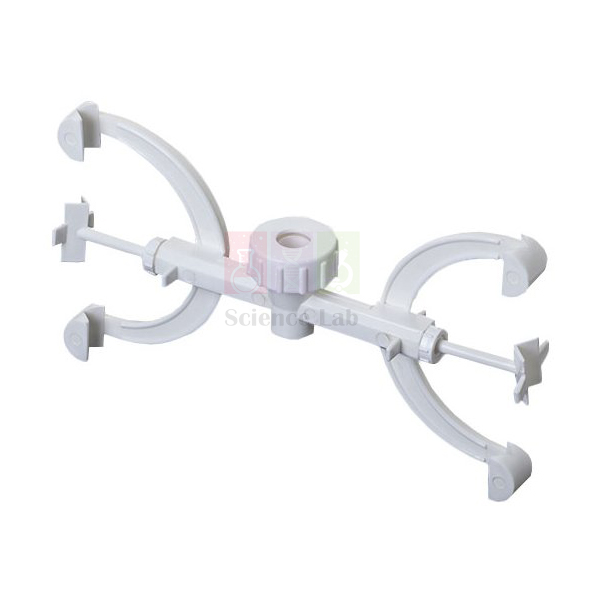
Fisher Clamp
Fisher Clamp (Product Code: SLE/CH/43) is a burette clamp moulded in polypropylene, which makes it completely corrosion proof around acids, alkalis and wet benches. A spring-loaded jack in the middle holds the burette in a vice-like grip so it cannot slip, and two tapered wedges lock the clamp firmly onto a support rod. It comes as a single or double clamp and is made by Jain Scientific Equipments Pvt Ltd (ScienceLab), Ambala, for chemistry labs looking for a burette clamp in India that stands up to acid spills and damp benches.
Specifications
| Parameter | Detail |
|---|---|
| Material | Polypropylene, moulded; completely corrosion proof |
| Burette grip | Spring-loaded jack in the middle giving a vice-like grip; prevents slipping |
| Rod fixing | Two tapered wedges for a firm grip on rods |
| Rod diameter | 1/2 inch or 3/8 inch |
| Versions | Fisher Clamp Single; Fisher Clamp Double |
Typical Use
The clamp slides onto the vertical rod of a retort stand and is locked in place with its wedges; the burette is then pressed against the spring-loaded jack, which pushes it into the jaws and holds it upright over the titration flask. The single version holds one burette, while the double version holds two side by side, which is useful when a titration uses two solutions or when two students share one stand. Because the whole clamp is plastic, it does not rust or seize if acid or alkali drips onto it during a titration.
Set the clamp at a height that leaves room to swirl a conical flask under the burette tip, and check that the burette hangs vertically before starting. Wipe off any spills after each session. Paired with a sturdy retort stand, it gives a secure set-up for school and college titration practicals in labs across India.
Manufacturer
The Fisher Clamp is made by Jain Scientific Equipments Private Limited, which trades under the ScienceLab name from Ambala, Haryana, producing stands, clamps, plasticware and glassware for teaching laboratories. See our company profile for more.
Related Chemistry Lab Equipment
Supports and glassware used with a Fisher clamp:
- Retort Stand — provides the upright rod the clamp is fixed to.
- Burette — acrylic burette to hold in the clamp.
- Fisher Clamp (Routine Improved Model) — an alternative Fisher clamp model.
- Burette Clamp, Die Cast – Double Clamp — a metal double clamp option.
More clamps and stands are listed in Chemistry Lab Equipment.
Frequently Asked Questions
What is the difference between the single and double clamp?
The single clamp holds one burette; the double clamp holds two burettes on the same rod.
Which rod sizes does it fit?
The tapered wedges are designed to grip rods of 1/2 inch or 3/8 inch diameter. For other rod sizes, ask us via the contact page.
Will it hold both glass and plastic burettes?
Yes, the spring-loaded jack presses the burette into the jaws whichever material it is made of. For unusually thick or thin burettes, confirm the fit with us.
Why choose polypropylene over a metal clamp?
Polypropylene is completely corrosion proof, so it will not rust, stain or seize after acid or alkali spills, and it is lighter on the stand.
How should I clean it?
Rinse with water, wipe dry and keep it away from direct flames or hot plates, as polypropylene softens with heat.
Can you supply clamps in quantity for a school or distributor?
Yes. State how many single and double clamps you need; we supply buyers in India and international markets.
Request a Quote
Request a price through the contact page, or add single or double clamps to the enquiry cart together with stands and burettes.
Last updated: 24 September 2026
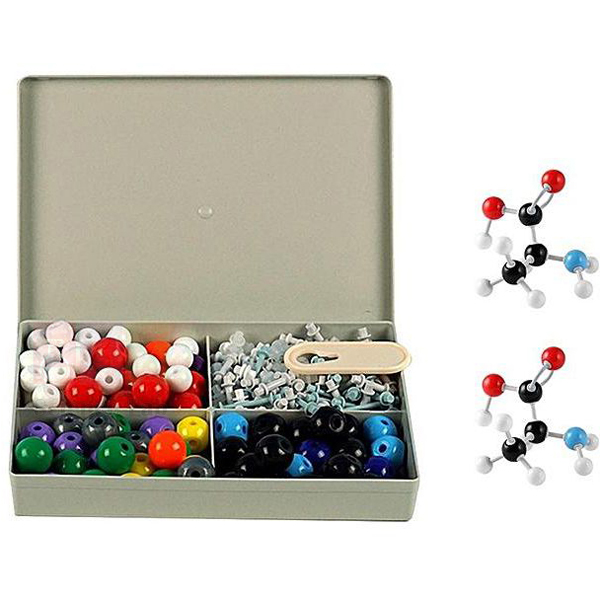
New Improved Organic And Inorganic Molecular Set
New Improved Organic And Inorganic Molecular Set (Product Code: SLE/CH/44) is a ball-and-link model set for building organic molecules together with inorganic structures, ranging from simple molecules to complex ions. It is a versatile demonstration and student set suited to ordinary and advanced level courses or equivalent, so chemistry teachers can show bonding at the front of the class and learners can then build the same structures themselves. The set is made by Jain Scientific Equipments Pvt Ltd (ScienceLab), Ambala, as part of its school chemistry lab equipment in India.
Specifications
| Parameter | Detail |
|---|---|
| Type | Ball-and-link molecular model set for demonstration and student use |
| Structures covered | Organic molecules and inorganic molecules, from simple ones to complex ions |
| Course level | Ordinary and advanced level courses or equivalent |
| Covalent bond links | Grey flexible links in two lengths, for single and double covalent bonds |
| Other bond links | Mauve links for ionic, coordinate and hydrogen bonds |
| Atom balls | Eight atom types, quantities as listed below |
The set comprises the following balls:
- Carbon (6)
- Oxygen (22)
- Nitrogen (10)
- Sulphur (12)
- Halogen (8)
- Metal (14)
- Phosphorus (7)
- Hydrogen (14)
Typical Use
Because the set carries two families of links, one model can show more than one kind of bonding. Students join atoms with the grey links to build single-bonded and double-bonded covalent molecules such as methane, ethene or ethanol, then switch to the mauve links to mark a hydrogen bond between two water molecules, the coordinate bond in an ammonium ion, or the ionic attraction in a simple salt. Seeing the bond types in different colours makes it easier to discuss why some substances are gases, why water has a high boiling point for its size, and how a metal ion holds its surrounding ligands in a complex ion.
As a chemistry teaching kit for schools in India, it works well when the teacher builds a reference model first and small groups then copy and modify it. Sorting the balls by atom type into a tray before the lesson, and counting them back afterwards, keeps the set complete from one class to the next. Store the flexible links loosely rather than tightly bent so they keep their shape.
Manufacturer
Jain Scientific Equipments Private Limited trades under the ScienceLab name and is based in Ambala, Haryana. The company produces teaching apparatus for chemistry, physics and biology laboratories and serves schools, colleges and training institutes in India and international markets. More about the business is available on the company profile.
Related Chemistry Lab Equipment
These items help build a complete structure-and-bonding module around this set:
- Molecular Model Set – Inorganic/Organic Student — a smaller set for individual or paired practice after the class demonstration.
- Molecular Model Set – Inorganic/Organic Teacher — a teacher set with lone-pair paddles for discussing molecular shape.
- Organic Chemistry Molecular Models Kits — an alternative for courses that concentrate on organic structures.
- Atom Activity Model — introduces the parts of the atom before students move on to bonding.
See the full range in our Chemistry Lab Equipment category.
Frequently Asked Questions
Which atoms are included in the set?
Balls for carbon, oxygen, nitrogen, sulphur, halogen, metal, phosphorus and hydrogen, in the quantities shown above, plus grey and mauve links. Please ask us to confirm the packing list in your quotation if exact counts matter for your lesson plan.
Can it show ionic and hydrogen bonds as well as covalent bonds?
Yes. Grey links in two lengths represent single and double covalent bonds, and separate mauve links represent ionic, coordinate and hydrogen bonds.
Is it meant for the teacher or for students?
Both. It is described as a demonstration student set, so it can be used at the front of the class or handed to a group for hands-on model building at ordinary and advanced level.
Can I order extra balls or links later?
Please ask through our contact page with the atom types and quantities you need, and we will tell you what can be supplied separately.
How should the set be cleaned?
Wipe balls and links with a damp cloth and mild soap, let them dry fully, and keep them in their box away from direct sun and heat so the links do not deform.
What should a school or college quotation request include?
The number of sets, the course level, whether you also need student or teacher sets for the same lab, and the delivery address. That lets us quote everything in one reply.
Do you supply schools outside India?
Yes, we supply institutions in India and international markets. Share your country and quantity so that packing and shipping can be confirmed with the quotation.
Request a Quote
To order this molecular set, send your quantity and delivery details through our contact page, or add it to the enquiry cart together with the other models and apparatus on your list.
Last updated: 24 September 2026
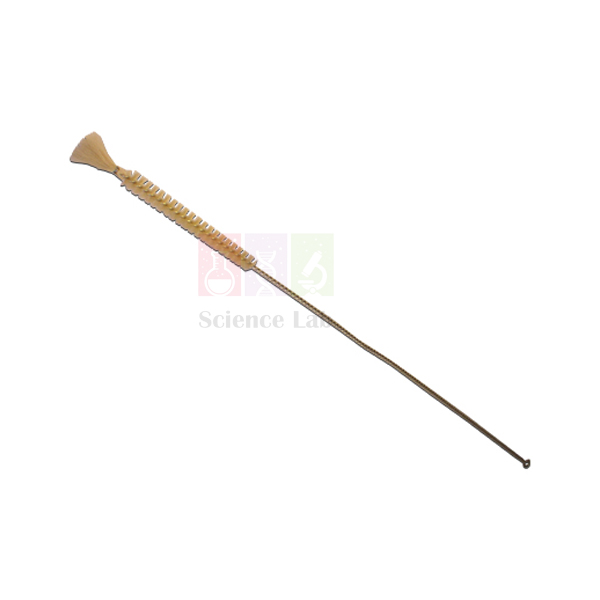
Brush Burette
Brush Burette (Product Code: SLE/CH/45) is a long cleaning brush with a nylon bristle end mounted on an iron wire handle, 900 mm in overall length, so it can be passed down the full bore of a burette from the open top. Lab assistants, teachers and students use it to loosen residue and stubborn films from the inside of burettes before rinsing and refilling them for the next titration. It is supplied by Jain Scientific Equipments Pvt Ltd (ScienceLab), Ambala, which acts as a chemistry consumables supplier in India and for overseas laboratories.
Specifications
| Parameter | Detail |
|---|---|
| Type | Burette cleaning brush |
| Bristles | Nylon, forming the bristle end |
| Handle | Iron wire, with the bristle end mounted on it |
| Overall length | 900 mm |
| Suitable for | Cleaning the inside of burettes and similar long, narrow glass tubes |
Typical Use
A burette that is not properly clean holds droplets on its inner wall, which spoils the meniscus reading and the accuracy of a titration. After a practical, drain the burette, fill it partly with warm water and a little laboratory detergent, and slide the brush in from the top. Work it gently up and down along the graduated section, then rinse several times with tap water and finally with distilled water. When water drains from the wall in an even film without forming beads, the burette is ready to be rinsed with titrant and used again.
The long wire handle lets you reach the lower end without forcing the brush, but stop short of the stopcock and jet so the wire tip does not scratch the bore or dislodge a plug. In busy school titration sessions it helps to keep one brush beside each sink, and to hang it bristle-end down after use so water drains away from the wire.
Supplier
Jain Scientific Equipments Private Limited trades as ScienceLab from Ambala, Haryana, and supplies cleaning brushes and other consumables alongside the laboratory apparatus it manufactures for schools, colleges and institutes. Institutional and tender buyers who need vendor registration details can use GSTIN 06AAECJ8618A1ZT and LEI 3358004HRD1JIVXKYX49. Read more on the company profile.
Related Chemistry Lab Equipment
Items used with this brush in the titration and glassware-care routine:
- Burette — the titration burette this brush keeps clean between runs.
- Burette Rack — a wooden rack that holds several washed burettes while they drain and dry.
- Burette Stand and Funnel Stand — holds a cleaned burette and a filling funnel during the titration.
- Wash Bottle LDPE with Narrow Mouth — for the final distilled-water rinse after brushing.
- Burette Brush — an alternative burette brush from our glassware range.
Browse more items in the Chemistry Lab Equipment category.
Frequently Asked Questions
How long is the Brush Burette?
The overall length is 900 mm, long enough to reach down a burette from the top opening.
What is it made of?
It has a nylon bristle end mounted on an iron wire handle.
Will it fit the bore of my burette?
The bristle diameter is not listed here, so please tell us the burette type and capacity through our contact page and we will confirm the fit before you order.
Can it be used on other glassware?
Yes, it is also handy for other long, narrow items such as glass tubing or condenser inner tubes, provided the bristles can pass through without force.
How can I make the brush last longer?
Rinse it after each use, hang it to dry, and avoid leaving it soaking in acid or strong cleaning solutions, which can attack the iron wire. Replace it once the bristles flatten or splay.
Is it sold singly or in packs?
Pack quantities are not listed on this page. Mention how many brushes you need and we will quote accordingly.
Can you ship brushes with a larger lab order abroad?
Yes. We supply India and international markets, and consumables like this can be packed with the rest of your apparatus order.
Request a Quote
For a quotation, send the quantity and your delivery location via the contact page, or place the Brush Burette in the enquiry cart along with your burettes and stands.
Last updated: 24 September 2026
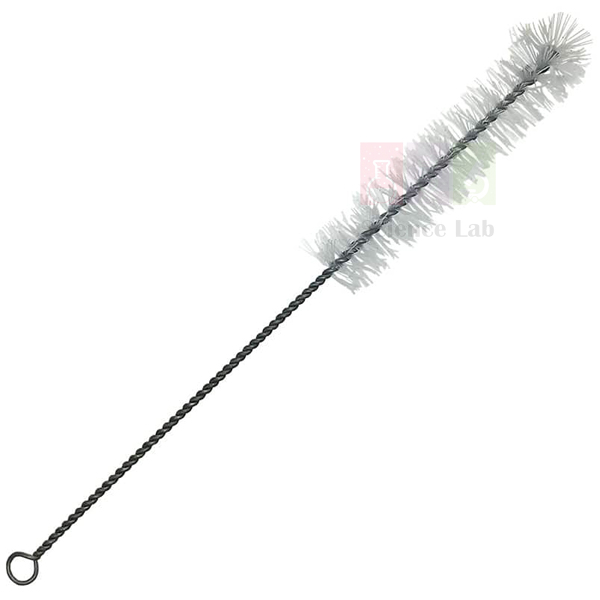
Brush Test Tube
Brush Test Tube (Product Code: SLE/CH/46) is a hand brush for scrubbing test tubes, made with nylon bristles set on an iron wire stem. It measures 260 mm overall with a bristle head of 90 x 45 mm, a compact size that is easy to handle at a student sink. Schools, colleges and routine testing labs use it to remove precipitates, dried solutions and scorch marks after qualitative tests. It is supplied by Jain Scientific Equipments Pvt Ltd (ScienceLab), Ambala, a lab consumables supplier in India that also serves overseas institutions.
Specifications
| Parameter | Detail |
|---|---|
| Type | Test tube cleaning brush |
| Bristles | Nylon |
| Stem | Iron wire |
| Overall length | 260 mm |
| Head size | 90 x 45 mm |
Typical Use
Salt analysis, flame tests and simple reactions leave test tubes coated with precipitates, oily films or charred residue. Empty the tube into the correct waste container, add a little water and detergent, then twist the brush in and out so the nylon bristles sweep the rounded bottom as well as the walls. Rinse with tap water and finish with distilled water before standing the tube upside down to dry.
Push the brush in gently and do not ram it against the bottom of the tube, because the wire stem can crack thin glass. Stubborn deposits usually come away more easily after a short soak rather than hard scrubbing. For a class set, one brush per bench keeps the clean-up at the end of a practical quick and orderly.
Supplier
ScienceLab is the trading name of Jain Scientific Equipments Private Limited, based in Ambala, Haryana. Alongside the teaching apparatus it manufactures, the company supplies everyday consumables such as cleaning brushes so that institutions can source a complete laboratory order from one place. Details are on the company profile.
Related Chemistry Lab Equipment
Useful companions for washing, handling and drying test tubes:
- Test Tube — borosilicate test tubes that this brush keeps ready for the next practical.
- Test Tube Rack With Drying Pegs — lets washed tubes drain on pegs beside the rack holes.
- Drying Rack — a wall-mountable peg rack for draining tubes, flasks and beakers.
- Test Tube Holder — for gripping tubes safely while heating them during tests.
- Brush, Bristle Test Tube Fan Shape — an alternative brush with a fanned tip for rounded tube bottoms.
More items are listed in our Chemistry Lab Equipment category.
Frequently Asked Questions
What size is the brush?
It is 260 mm long overall, and the bristle head measures 90 x 45 mm.
Which test tubes does it suit?
Compare the head size with the inside diameter of your tubes. If you are unsure, send us your tube sizes through the contact page and we will advise.
Why nylon bristles?
Nylon is flexible and tolerates water and detergents well, so it can scrub glass repeatedly without the bristles going soft quickly.
Can I use it with acids or cleaning solutions?
Brief contact during rinsing is normally fine, but do not leave the brush standing in acid or harsh cleaning liquids, because the iron wire stem can corrode.
How many brushes should a school lab order?
Many labs keep one per student bench plus spares, as brushes wear out with regular use. Tell us your bench count and we can suggest a quantity for the quotation.
Can these brushes be added to an export consignment?
Yes. We supply institutions in India and international markets and can pack brushes together with your glassware and apparatus.
Request a Quote
Send the number of brushes and your delivery details using our contact page, or add this item to the enquiry cart with the test tubes and racks you need.
Last updated: 24 September 2026
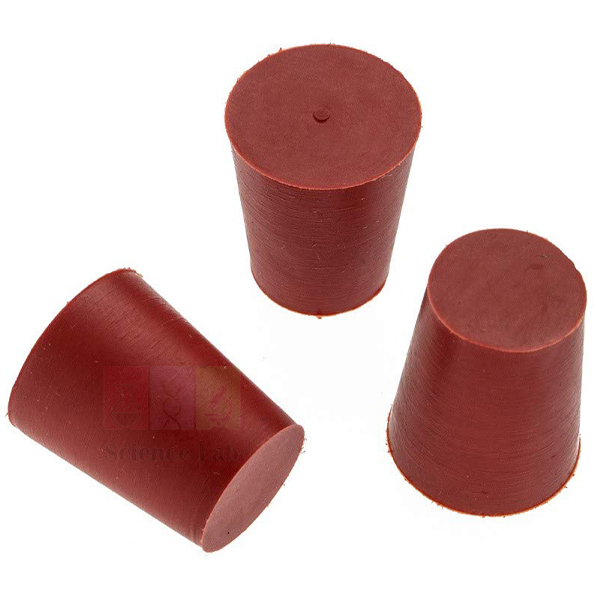
Rubber Cork
Rubber Cork (Product Code: SLE/CH/47) is a tapered stopper in soft, solid red rubber for closing test tubes, flasks and bottles and for carrying glass tubing into sealed apparatus. The rubber resists acid, alkali and ammonia, and the corks are offered with one hole or with two holes in a wide series of sizes. Chemistry teachers and lab technicians looking for a dependable rubber stopper for lab work in India use them to build gas generators, distillation set-ups and wash bottles. They are supplied by Jain Scientific Equipments Pvt Ltd (ScienceLab), Ambala.
Specifications
| Parameter | Detail |
|---|---|
| Material | Solid, soft rubber |
| Colour | Red |
| Resistance | Acid, alkali and ammonia |
| Bore options | With one hole; with two holes |
| Size range | Top diameter from 9.0 mm to 60.0 mm (full list below) |
Available sizes (all dimensions in mm):
| Top Dia (mm) | Bottom Dia (mm) | Height (mm) |
|---|---|---|
| 9.0 | 6.0 | 16.0 |
| 13.0 | 9.0 | 15.5 |
| 14.0 | 11.0 | 18.5 |
| 16.5 | 13.0 | 20.0 |
| 19.0 | 14.0 | 21.0 |
| 21.0 | 15.0 | 22.0 |
| 22.5 | 17.5 | 23.0 |
| 24.5 | 20.0 | 24.0 |
| 26.0 | 20.0 | 27.5 |
| 26.0 | 21.0 | 27.5 |
| 28.0 | 21.5 | 31.5 |
| 30.0 | 26.0 | 33.0 |
| 33.5 | 30.0 | 33.5 |
| 34.5 | 30.0 | 34.5 |
| 38.5 | 31.0 | 37.0 |
| 41.5 | 32.0 | 42.5 |
| 43.5 | 34.0 | 40.5 |
| 45.0 | 35.0 | 36.5 |
| 49.5 | 40.0 | 40.5 |
| 53.5 | 48.5 | 33.5 |
| 58.0 | 44.0 | 45.0 |
| 60.0 | 51.0 | 56.0 |
Typical Use
A one-hole cork holds a thermometer or a single delivery tube, for example when heating a solid in a boiling tube and leading the gas away to a trough. A two-hole cork lets you fit a thistle funnel and a delivery tube into a conical flask to make a simple gas generator, or build a wash bottle with a long and a short tube. The taper means one size seals a range of neck openings, so the cork should sit roughly one-third to one-half of its height inside the neck.
To choose a size, measure the inside diameter of the neck: it should fall between the bottom and top diameters listed above. Moisten glass tubing with water or glycerol and twist it gently through the hole while protecting your hand with a cloth; never force the glass. Rinse corks after use and keep them away from oils, solvents and direct sunlight, which can harden rubber over time.
Supplier
Jain Scientific Equipments Private Limited, trading as ScienceLab, is based in Ambala, Haryana. Besides the apparatus it manufactures, the company supplies consumables such as rubber corks so that schools, colleges and laboratories in India and international markets can complete their orders in one place. See the company profile for more.
Related Chemistry Lab Equipment
Items that are commonly fitted or used with rubber corks:
- Delivery Tube — glass tubes that pass through a bored cork to carry gas to a gas jar or trough.
- Conical Flask — a common vessel for two-hole cork gas generators.
- Boiling Tube — stoppered with a one-hole cork when heating solids to collect gas.
- Cork Borer Sharpener — keeps borer edges sharp if you enlarge or add holes yourself.
- Cork Stoppers — natural wood corks as an alternative where rubber is not needed.
Browse the Chemistry Lab Equipment category for more.
Frequently Asked Questions
Which sizes can I order?
The sizes in the table run from 9.0 mm to 60.0 mm top diameter, each with its bottom diameter and height. Quote the top and bottom diameter when ordering so we pick the right cork.
How do I find the right size for my flask?
Measure the inside diameter of the neck. Choose a cork whose bottom diameter is a little smaller and whose top diameter is a little larger than that measurement.
Are they available with holes?
Yes, with one hole or with two holes. If you need corks without any hole, please confirm availability through our contact page.
What chemicals do they resist?
The rubber is resistant to acid, alkali and ammonia. For organic solvents or oils, ask us before use, as rubber can swell in such liquids.
How should rubber corks be stored?
Keep them clean and dry in a closed box, away from heat, sunlight and oily materials, so they stay soft and seal well.
Can I order a mixed assortment of sizes?
List the sizes, the bore option and the quantity of each in your enquiry and we will prepare a quotation for the mixed lot.
Request a Quote
Share your size list and quantities through the contact page, or add Rubber Cork to the enquiry cart along with the flasks and tubing it will fit.
Last updated: 24 September 2026
Oak Ridge Centrifuge Tubes
Oak Ridge Centrifuge Tubes (Product Code: SLE/CH/49) are screw-cap centrifuge tubes made of polypropylene, offered in 30 ml and 50 ml capacities. Their excellent contact clarity lets you see a pellet or phase boundary through the wall, and they can be used up to 50000 x G, which makes them suitable for high-speed separations in chemistry, biochemistry and life-science labs. College and research labs pair them with a suitable laboratory centrifuge in India to spin down precipitates, cells and suspensions. They are supplied by Jain Scientific Equipments Pvt Ltd (ScienceLab), Ambala.
Specifications
| Parameter | Detail |
|---|---|
| Type | Oak Ridge style centrifuge tube with screw cap |
| Material | Polypropylene |
| Clarity | Excellent contact clarity |
| Maximum rating | Up to 50000 x G |
| Capacity | 30 ml; 50 ml |
| Cap limitation | The screw cap should not be used below 4°C |
Typical Use
These tubes are used wherever a sample needs to be separated into a solid pellet and a clear supernatant: collecting a fine precipitate in analytical chemistry, pelleting bacteria or yeast from a culture, clarifying a cell lysate, or separating two liquid phases after an extraction. The clear polypropylene wall helps you judge when the supernatant can be decanted without disturbing the pellet.
Fill tubes to similar levels and place them opposite each other so the rotor stays balanced. The 50000 x G figure is the tube's own limit; the force actually applied depends on your centrifuge's rotor radius and speed, so always stay within the lower of the tube rating and the rotor rating. Because the screw cap should not be used below 4°C, check the temperature setting before a refrigerated run, and inspect tubes for cracks or crazing before each reuse.
Supplier
These tubes are supplied by ScienceLab, the trading name of Jain Scientific Equipments Private Limited, Ambala, Haryana. For vendor registration, buyers can use the supplying company's CIN U29309HR2020PTC087597 and GSTIN 06AAECJ8618A1ZT. The company serves laboratories in India and international markets; more is on the company profile.
Related Chemistry Lab Equipment
Equipment and alternatives used in the same centrifugation workflow:
- Centrifuge Machine — a microprocessor-controlled centrifuge; confirm its rotor accepts tubes of this size.
- Laboratory Centrifuge — a low-speed swing-out model for routine clinical and teaching work.
- Centrifuge Tubes — smaller graduated tubes when you do not need Oak Ridge volumes.
- Micro Centrifuge Tube, 1.5ml — for microlitre-scale samples in a micro centrifuge.
- Universal Tube Rack — an adjustable rack to hold tubes upright while filling and decanting.
Explore the wider Chemistry Lab Equipment category.
Frequently Asked Questions
What capacities are available?
Two: 30 ml and 50 ml. State the capacity and quantity for each in your enquiry.
How fast can these tubes be spun?
They can be used up to 50000 x G. The real limit in your lab is whichever is lower: that figure or the rating of the rotor you are using.
Can I use them in a refrigerated centrifuge?
Yes, as long as the run stays at or above 4°C, because the screw cap should not be used below 4°C.
Will they fit my centrifuge?
That depends on your rotor or bucket inserts. Send us the centrifuge make and rotor details through our contact page and we will help check compatibility.
Can the tubes be autoclaved or reused?
Autoclaving and chemical compatibility beyond the details above are not stated here, so please ask us before sterilising. Whenever tubes are reused, discard any that show cracks, crazing or a damaged thread.
What pack sizes do you supply?
Pack quantities are not listed on this page. Tell us how many tubes you need of each capacity and we will quote.
Do you ship to laboratories outside India?
Yes, we supply India and international markets; include your country so shipping can be quoted with the tubes.
Request a Quote
Send capacity, quantity and delivery details via our contact page, or add the tubes to the enquiry cart together with a centrifuge or tube racks.
Last updated: 24 September 2026
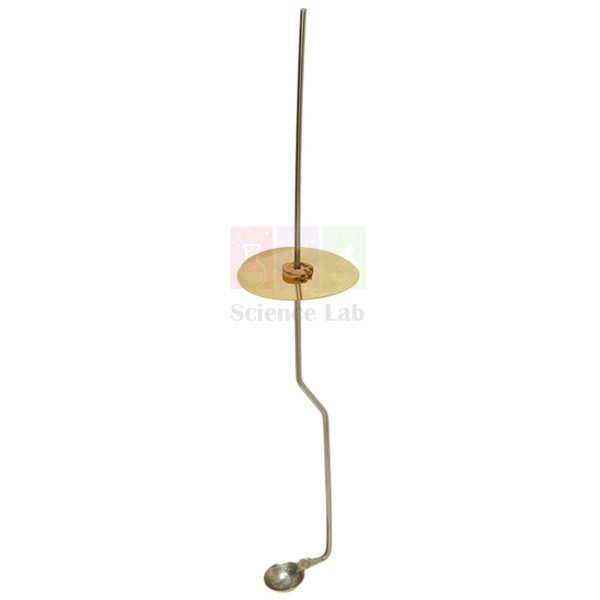
Deflagrating Spoon
Deflagrating Spoon (Product Code: SLE/CH/50) is a long-handled combustion spoon for burning small quantities of a substance inside a jar of gas. It has a brass cup of about 20 mm diameter on a chrome-plated iron wire of about 350 mm, and comes complete with a 75 mm sliding disc and a cork that hold the wire at any length. Chemistry teachers use it for classic demonstrations of combustion in oxygen, and students use it in supervised practicals on the properties of gases. It is made by Jain Scientific Equipments Pvt Ltd (ScienceLab), Ambala.
Specifications
| Parameter | Detail |
|---|---|
| Cup | Brass, about 20 mm diameter |
| Handle | Iron wire, about 350 mm long |
| Finish | Chrome plated |
| Sliding disc | 75 mm diameter |
| Supplied with | Sliding disc and cork for holding the wire at any length |
Typical Use
A typical lesson starts by collecting jars of oxygen over water. A small piece of sulphur or charcoal is placed in the brass cup, warmed in a Bunsen flame until it starts to burn, and then lowered into the jar so the class can compare how brightly it burns in air and in pure oxygen. The sliding disc rests across the mouth of the jar like a lid, slowing the escape of gas and fumes, while the cork fixes the wire so the cup hangs at the chosen depth. Afterwards a little water or indicator can be shaken in the jar to test whether the product is an acidic or basic oxide.
Use only small amounts, and carry out sulphur burning in a fume cupboard or a well-ventilated room, because the gas produced is irritating. Let the spoon cool before scraping out residue, and clean the cup after each use so deposits do not build up. This spoon forms part of any basic set of gas collection apparatus in India, alongside gas jars, a trough and a beehive shelf.
Manufacturer
ScienceLab is the trading name of Jain Scientific Equipments Private Limited, which makes chemistry, physics and biology teaching apparatus in Ambala, Haryana, for schools and colleges in India and international markets. Learn more on the company profile.
Related Chemistry Lab Equipment
Everything needed to prepare the gas and run the combustion test:
- Gas Jar, Glass — the jar that holds the collected gas while the spoon is lowered in.
- Gas Jar Cover — ground-glass cover to seal filled jars until the demonstration.
- Beehive Shelf, Porcelain — supports the gas jar in the trough while oxygen is collected.
- Pneumatic Trough — the water trough used for collecting gas over water.
- Bunsen Burner — to ignite the sample in the cup before it goes into the jar.
For more apparatus, visit our Chemistry Lab Equipment category.
Frequently Asked Questions
What is the sliding disc for?
The 75 mm disc sits over the mouth of the gas jar like a lid, limiting the loss of gas and fumes while the substance burns. Together with the cork it lets you set the wire at any length.
How large is the cup?
The brass cup is about 20 mm in diameter, which is enough for the small quantities used in school demonstrations.
Which substances are usually burned in it?
Common choices are sulphur, charcoal and similar small solids for oxygen demonstrations. Always follow your school's safety guidance on which substances and amounts are permitted.
Will the disc fit my gas jars?
It fits jars whose mouth is smaller than 75 mm across. If you are unsure, give us your jar size through the contact page.
How do I clean it?
Allow it to cool fully, scrape out the residue, wash the cup with water and dry it so the wire and plating stay in good condition.
What should I include when requesting a quotation?
The number of spoons, whether you also need gas jars, covers or a trough, and the delivery address. For orders outside India, add your country so shipping can be included.
Request a Quote
Ask for a price through our contact page, or add the Deflagrating Spoon to the enquiry cart with the gas jars and trough for your combustion experiments.
Last updated: 24 September 2026
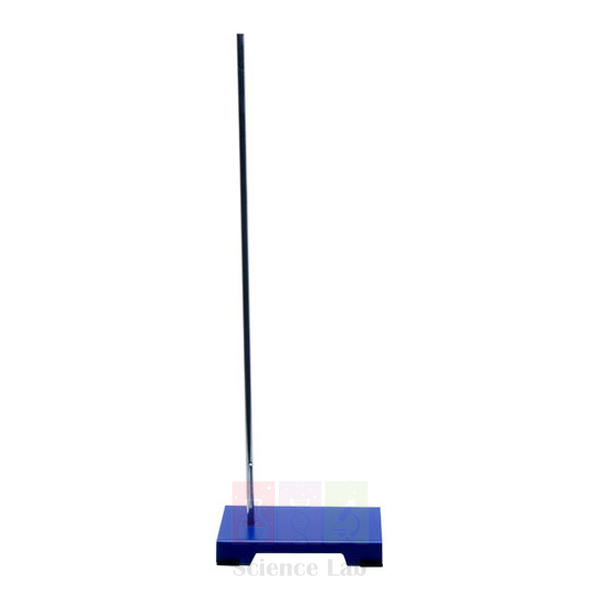
Retort Stand
Retort Stand (Product Code: SLE/CH/51) is the basic support stand of the chemistry bench: a cast iron rectangular base, finished in stove hammertone paint, carrying a 12.5 mm diameter chrome-plated M.S. rod. One end of the rod is half round and the other is machine threaded, fixing into the hole in the base with a washer and hexagonal nut. Schools, colleges and industrial training labs use it to hold clamps, rings and bosses for titration, filtration, heating and distillation. It is made by Jain Scientific Equipments Pvt Ltd (ScienceLab), Ambala, and offered in several base and rod sizes for any retort stand lab requirement in India.
Specifications
| Parameter | Detail |
|---|---|
| Base | Cast iron, rectangular, with hole for the rod |
| Base finish | Stove hammertone painted |
| Rod | M.S., 12.5 mm diameter, chrome plated |
| Rod ends | One end half round; other end machine threaded |
| Fixing | Washer and hexagonal nut |
Available sizes:
| Base Size (mm) | Rod Length (mm) | Approx. Weight of Base |
|---|---|---|
| 175 x 125 | 500 | Please confirm with us |
| 200 x 125 | 600 | 1.30 kg |
| 225 x 150 | 600 | 1.70 kg |
| 225 x 150 | 750 | 2.02 kg |
| 300 x 150 | 750 | 2.07 kg |
Typical Use
With a boss head and clamp, the stand holds a burette for titration, a flask over a burner, or a condenser during distillation; with a retort ring and wire gauze it becomes a heating support or a funnel holder for filtration. The shorter rods suit single-clamp jobs at a student bench, while the longer rods and larger bases are better for tall assemblies such as a distillation set-up where the flask, still head and condenser are clamped at different heights.
For stability, arrange the apparatus so its weight sits over the base rather than beyond it, and turn the base so the long side lies under the load. Check that the nut under the base is tight before loading the rod, and wipe spills off the painted base promptly. A class set of stands with matching clamps and bosses, the standard lab stand, clamp and boss head arrangement found across India, makes practical sessions quicker to set up.
Manufacturer
Jain Scientific Equipments Private Limited operates under the ScienceLab brand from Ambala, Haryana, making laboratory stands, clamps and teaching apparatus for institutions in India and international markets. Visit the company profile for background on the business.
Related Chemistry Lab Equipment
Fittings that turn this stand into a working set-up:
- Boss Head, With Detachable Attachment — connects clamps and rods to the stand rod at any height.
- Retort Clamp Three Finger — grips flasks, condensers and tubes on the stand.
- Burette Clamps — hold a burette straight for titration.
- Retort Rings — support gauze, basins or funnels on the rod.
- Gauze Wire — spreads the flame under glassware resting on a ring.
See the complete Chemistry Lab Equipment category.
Frequently Asked Questions
Which base and rod sizes are available?
Five combinations, from a 175 x 125 mm base with a 500 mm rod up to a 300 x 150 mm base with a 750 mm rod, as listed in the size table.
What diameter is the rod?
The rod is 12.5 mm in diameter. Check that your boss heads and clamps open wide enough for this size.
How is the rod fixed to the base?
The machine-threaded end passes into the hole in the cast iron base and is secured with a washer and hexagonal nut, so the rod can be removed for compact storage.
What does the smallest base weigh?
The weight for the 175 x 125 mm base is not confirmed on this page, so please ask through our contact page if it matters for your application. Approximate weights for the other sizes are given in the table.
Which size should a school choose?
Smaller bases with 500 mm or 600 mm rods suit everyday student work; the 750 mm rod with a larger base is the better choice for distillation or other tall assemblies.
Are clamps and boss heads included?
No, the stand is described as a base and rod. Add the clamps, bosses and rings you need to the same enquiry.
Can you supply stands in bulk for new labs or export?
Yes. We supply India and international markets; send the sizes and quantities and we will quote with packing and delivery.
Request a Quote
Tell us the sizes and number of stands on our contact page, or add the Retort Stand to the enquiry cart together with clamps and boss heads.
Last updated: 24 September 2026
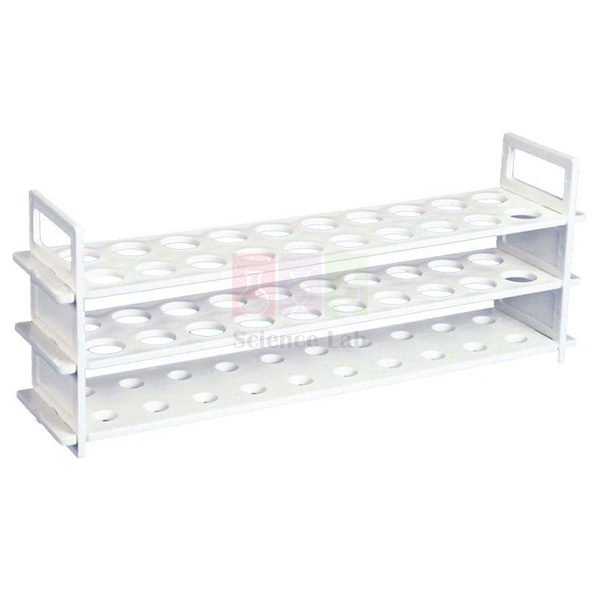
Test Tube Stand 3 Tier
Test Tube Stand 3 Tier (Product Code: SLE/CH/52) is a moulded polypropylene rack built in three tiers: tubes pass through the upper and middle plates and rest on the base, so they stand straight while their contents stay in view. The layout makes tubes easy to insert and remove, and the rack is autoclavable and can withstand sub-freezing temperatures, so it moves from the bench to the sterilizer or the freezer without a change of rack. It suits chemistry, microbiology and clinical labs in schools, colleges and hospitals, and is made by Jain Scientific Equipments Pvt Ltd (ScienceLab), Ambala, within its lab plastic ware range for India and overseas buyers.
Specifications
| Parameter | Detail |
|---|---|
| Design | 3-tier rack (upper, middle and base plates) |
| Material | Polypropylene (PP) |
| PP version appearance | Every part coloured and opaque |
| PC version appearance | Transparent upper and middle plates (please confirm availability) |
| Sterilisation | Autoclavable |
| Temperature | Withstands sub-freezing temperatures |
| Handling | Clear view of tube contents; convenient insertion and removal of tubes |
Typical Use
Because each tube is guided at two heights, it stays upright even when only a few places are filled, which is useful for colour-change tests, serial dilutions and precipitation reactions where students need to compare tubes side by side. In microbiology, a rack of culture tubes can go through the autoclave and then be stored cold without transferring the tubes. For sample storage, the rack's tolerance of sub-freezing temperatures means it can hold labelled tubes in a freezer.
Choose the coloured PP rack when you want to colour-code sets, for example one colour per class group or per test series. Wash the rack in warm detergent solution, rinse, and let it dry before autoclaving. Load tubes of a diameter that passes freely through the upper plate; forcing larger tubes can strain the plates.
Manufacturer
ScienceLab is the brand under which Jain Scientific Equipments Private Limited, Ambala, Haryana, makes and exports laboratory racks, stands and teaching apparatus for schools, colleges and laboratories in India and international markets. Details are on the company profile.
Related Chemistry Lab Equipment
Items used alongside this rack when working with test tubes:
- Test Tube — borosilicate tubes to stand in the rack.
- Test Tube Holder — for lifting and heating individual tubes safely.
- Brush Test Tube — for cleaning tubes before they return to the rack.
- Autoclave Basket — a stainless steel basket for carrying racks and tubes into the autoclave.
- Test Tube Stand (Wire Pattern) — a submersible alternative when tubes must sit in a water bath.
Browse the full Chemistry Lab Equipment range.
Frequently Asked Questions
What is the rack made of?
It is made of polypropylene. In the PP version every part is coloured and opaque.
Is there a version with see-through plates?
A PC (polycarbonate) rack with transparent upper and middle plates is also described. Please confirm its availability through our contact page.
Can it be autoclaved?
Yes, the rack is autoclavable. Clean off residues first and allow it to cool in the autoclave before handling.
Can I keep it in a freezer?
Yes. The rack can withstand sub-freezing temperatures, so it can hold tubes during cold storage.
How many tubes does it hold, and of what size?
The number of places and tube diameter are not listed on this page. Tell us the tubes you use and we will confirm the matching rack before quoting.
Can I order several colours for colour-coding?
Colour options are not specified here, so mention the colours you would like in your enquiry and we will confirm what can be supplied.
Do you supply these racks for export orders?
Yes. We serve buyers in India and international markets; include your country and quantity so freight can be quoted.
Request a Quote
Send your quantity, tube size and preferred version via the contact page, or add the Test Tube Stand 3 Tier to the enquiry cart with the tubes and brushes you need.
Last updated: 24 September 2026
706.jpg)
Test Tube Stand (Wire Pattern)
Test Tube Stand (Wire Pattern) (Product Code: SLE/CH/53) is a grid-style test tube rack that follows the open layout of a traditional wire rack but is moulded from a special blend of polypropylene. The blend makes the rack sink in a water bath and stay stable even in agitated water, so it is an economical substitute for wire racks in incubation and heating work. It is submersible, autoclavable, stackable when empty and easy to take apart for cleaning, and is offered in formats from 13 mm x 90 tubes to 30 mm x 21 tubes. The rack is made by Jain Scientific Equipments Pvt Ltd (ScienceLab), Ambala.
Specifications
| Parameter | Detail |
|---|---|
| Material | Polypropylene, special blend that sinks in a water bath |
| Stability | Stays stable even in agitated water |
| Construction | Grid base with square openings; fold-up sides and end bars that lock into the rack top |
| Sterilisation | Autoclavable |
| Storage | Stackable when empty; space saving |
| Cleaning | Easily disassembled |
| Colours | Available in different colours |
Formats (tube diameter x number of tubes):
- 13 mm x 90 tubes
- 16 mm x 60 tubes
- 20 mm x 40 tubes
- 25 mm x 24 tubes
- 30 mm x 21 tubes
Typical Use
Ordinary plastic racks tend to float and tip when placed in a water bath, spilling tubes. This rack is weighted by its material rather than by metal, so a full load of tubes can be incubated at a set temperature for enzyme experiments, serological tests, sugar tests with Benedict's reagent or culture work, and the rack stays put even if the bath is shaken. The open grid lets water circulate around every tube for even heating, and the rack can go straight from the bath into the autoclave.
Pick the format by tube diameter: the 13 mm and 16 mm versions suit small test tubes and culture tubes in large numbers, while the 25 mm and 30 mm versions take boiling tubes and larger vessels. Different colours help separate batches or classes, and when the session is over the racks stack together to save cupboard space. This makes it a practical piece of microbiology lab equipment in India for teaching and routine labs alike.
Manufacturer
ScienceLab is the trading name of Jain Scientific Equipments Private Limited, Ambala, Haryana, a registered MSME enterprise (Udyam UDYAM-HR-01-0003714) that makes teaching and laboratory apparatus. Export consignments are handled under Importer-Exporter Code AAECJ8618A issued by the DGFT. More on the company profile.
Related Chemistry Lab Equipment
Equipment used with this rack in water-bath and sterilisation work:
- Digital Unstirred Water Bath — a stable-temperature bath to hold the submerged rack.
- Test Tube — borosilicate tubes for the smaller rack formats.
- Float Rack — holds microcentrifuge tubes in the same bath.
- Autoclave Basket — for carrying loaded racks into the autoclave.
- Water Bath Stainless Steel Test Tube Rack — a metal alternative for water-bath use.
Find more in our Chemistry Lab Equipment category.
Frequently Asked Questions
Why is it called wire pattern if it is plastic?
It copies the open grid layout of a wire rack but is moulded in polypropylene, offering an economical substitute for wire racks that also sinks and stays stable in a water bath.
Which sizes are available?
Five formats: 13 mm x 90, 16 mm x 60, 20 mm x 40, 25 mm x 24 and 30 mm x 21 tubes. The first figure is the tube diameter, the second the number of places.
Will it float in the water bath?
No. The special polypropylene blend makes it sink, and it stays stable even in agitated water.
Can it be autoclaved and cleaned easily?
Yes. It is autoclavable, and it can be disassembled so that the grid, sides and end bars can be washed separately.
Will it fit my water bath?
Outer dimensions are not listed on this page. Send us your bath's internal size and the format you want through the contact page and we will check the fit.
Can I choose colours?
The rack is available in different colours. Mention your preferred colours and quantities per format when you enquire.
What should a tender or bulk enquiry include?
The format and quantity for each size, colour preferences and delivery location, whether in India or abroad. We can then quote the full order in one document.
Request a Quote
Request pricing through our contact page, or add the Test Tube Stand (Wire Pattern) to the enquiry cart with the water bath and tubes for your lab.
Last updated: 24 September 2026
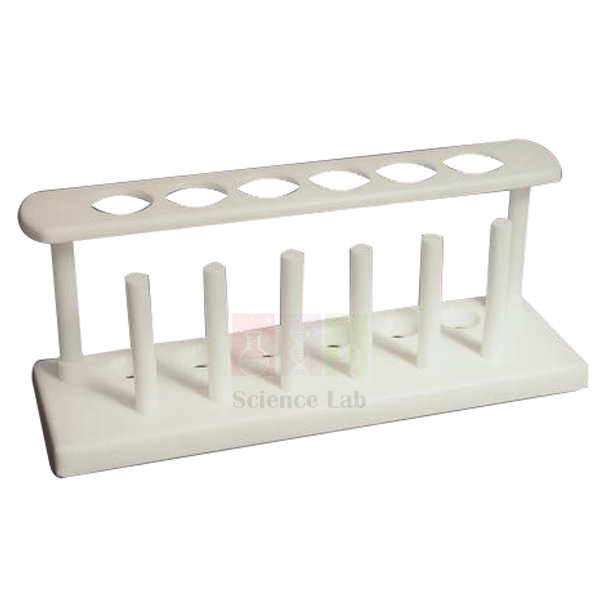
Test Tube Stand, Polythene
Test Tube Stand, Polythene (Product Code: SLE/CH/54) is a compact student rack in high-density polythene that holds 2 tubes of 25 mm diameter and 4 tubes of 16 mm diameter, with 6 vertical pegs along the rear edge of the base for drying washed tubes. Its 210 x 82 mm base gives the rack a steady footprint on a crowded bench. It is a natural choice for individual student places in school and college chemistry and biology labs, and is made by Jain Scientific Equipments Pvt Ltd (ScienceLab), Ambala, a school laboratory equipment supplier in India and abroad.
Specifications
| Parameter | Detail |
|---|---|
| Material | High-density polythene |
| Base size | 210 x 82 mm |
| Large tube places | 2 tubes of 25 mm diameter |
| Small tube places | 4 tubes of 16 mm diameter |
| Drying pegs | 6 vertical pegs at the rear edge of the base |
Typical Use
The mixed layout matches the way many school practicals are run: the four smaller places hold the test tubes for a set of reagent tests, while the two larger places take boiling tubes or wider tubes for heating, gas tests or larger volumes. A single rack therefore covers a typical student's needs for a qualitative analysis session, and the drying pegs mean washed tubes can be left upside down on the same rack at the end of the lesson.
High-density polythene does not rust and is easy to wipe clean after spills of dilute acids or salt solutions. Keep hot tubes in a holder or on a heatproof mat until they have cooled, rather than placing them straight into the plastic rack. With one rack per student, benches stay tidier and breakages from rolling tubes are reduced.
Manufacturer
Based in Ambala, Haryana, Jain Scientific Equipments Private Limited trades as ScienceLab and produces practical apparatus for science teaching, supplying schools, colleges and training institutes in India and international markets. See the company profile for more.
Related Chemistry Lab Equipment
What a student place usually needs alongside this rack:
- Test Tube — borosilicate tubes for the smaller places.
- Boiling Tube — for heating work; check its diameter against the larger places.
- Test Tube Holder — to hold tubes during heating before they return to the rack.
- Brush Test Tube — to clean tubes before hanging them on the drying pegs.
- Test Tube Rack With Drying Pegs — a larger wooden rack for demonstration benches.
More options are in the Chemistry Lab Equipment category.
Frequently Asked Questions
How many tubes does it hold?
Six in total: 2 tubes of 25 mm diameter and 4 tubes of 16 mm diameter, plus 6 pegs for drying.
What is the footprint?
The base measures 210 x 82 mm, which gives stability without taking much bench space.
What material is it made from?
High-density polythene, which is light, does not rust and is easy to clean.
Can I put hot tubes straight into it?
Let tubes cool first. The rack is plastic, so a tube straight from a flame can soften or mark it.
Can it be autoclaved?
Autoclave use is not stated for this rack. If you need to sterilise it, ask us through our contact page before ordering.
How should a school quotation request be worded?
Give the number of racks (often one per student place), any matching tubes or holders, and the delivery address in India or abroad.
Request a Quote
Send your quantity through the contact page, or add the Test Tube Stand, Polythene to the enquiry cart together with tubes and holders for each student place.
Last updated: 24 September 2026
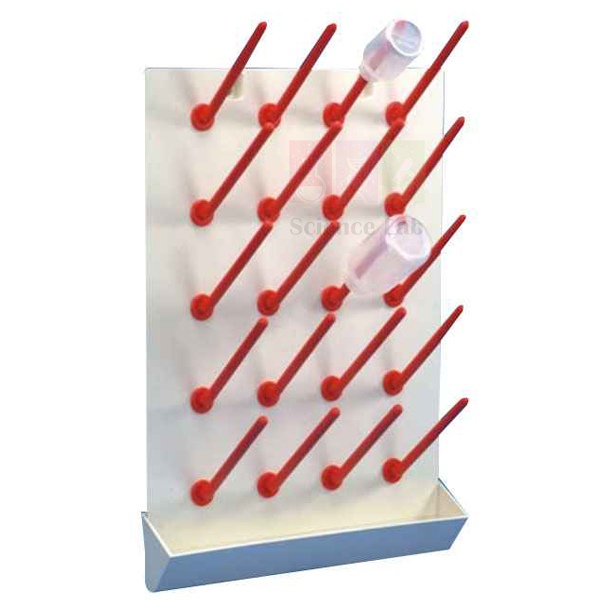
Drying Rack
Drying Rack (Product Code: SLE/CH/55) is a peg board in ABS plastic with 18 pegs on which washed flasks, beakers and test tubes are hung upside down to drain and air-dry. Two holes are provided so the rack can be fixed to the wall above a sink, keeping wet glassware off the bench and letting water run straight away. School labs, college practical rooms and routine testing labs use it at their wash-up stations. It is made by Jain Scientific Equipments Pvt Ltd (ScienceLab), Ambala, as part of its chemistry lab equipment in India and for overseas buyers.
Specifications
| Parameter | Detail |
|---|---|
| Material | ABS plastic |
| Pegs | 18 |
| Suitable for | Drying flasks, beakers and test tubes |
| Mounting | Two holes for wall mounting |
Typical Use
After a practical, glassware is scrubbed, rinsed with tap water and given a final rinse with distilled water. Hanging each item neck-down on a peg lets the last of the water drain out and air circulate inside, so borosilicate laboratory glassware is dry and free of drip marks by the next lesson. Heavier items such as conical flasks are best placed on the lower pegs and light test tubes higher up, so that drips do not fall onto glass that is already dry.
Mount the rack on a wall above the sink or draining board, using screws suited to your wall through the two holes, and check that it is level. ABS is easy to wipe down, so clean the pegs occasionally to stop residue transferring to freshly washed glass. Do not hang glassware that is still hot from an oven or flame on the plastic pegs.
Manufacturer
Jain Scientific Equipments Private Limited, known by its trading name ScienceLab, is based in Ambala, Haryana, and makes laboratory fittings and teaching apparatus for institutions in India and international markets. The company profile has more information.
Related Chemistry Lab Equipment
Products that go with this rack at the wash-up station:
- Conical Flask — one of the most common items hung on the pegs to dry.
- Test Tube — small tubes that dry quickly on the upper pegs.
- Brush Test Tube — for scrubbing tubes before they go on the rack.
- Wash Bottle LDPE with Narrow Mouth — for the final distilled-water rinse before drying.
- Drying Rack Glass & Plastic Ware — a larger coated-wire rack if you need more capacity.
For other lab accessories, see the Chemistry Lab Equipment category.
Frequently Asked Questions
How many items can it hold?
It has 18 pegs, each holding one flask, beaker or test tube.
Can it be fixed to a wall?
Yes. Two holes are provided for wall mounting. Fixing screws and plugs are not listed, so use ones suited to your wall.
Can it stand on a bench instead?
It is designed with wall-mounting holes. If you need a free-standing unit, ask us about alternatives through the contact page.
What is ABS and why use it here?
ABS is a tough, rigid plastic that does not rust in a wet sink area and can be wiped clean easily.
Can I hang glassware straight from a drying oven?
No. Let hot glassware cool before placing it on the plastic pegs.
How many racks does a school lab need?
That depends on how much glassware is washed at once; many labs fit one rack per sink. Tell us your layout and we will suggest a quantity for the quotation, for delivery in India or abroad.
Request a Quote
Ask for a quotation on the contact page, or add the Drying Rack to the enquiry cart along with brushes and wash bottles for your wash-up area.
Last updated: 24 September 2026
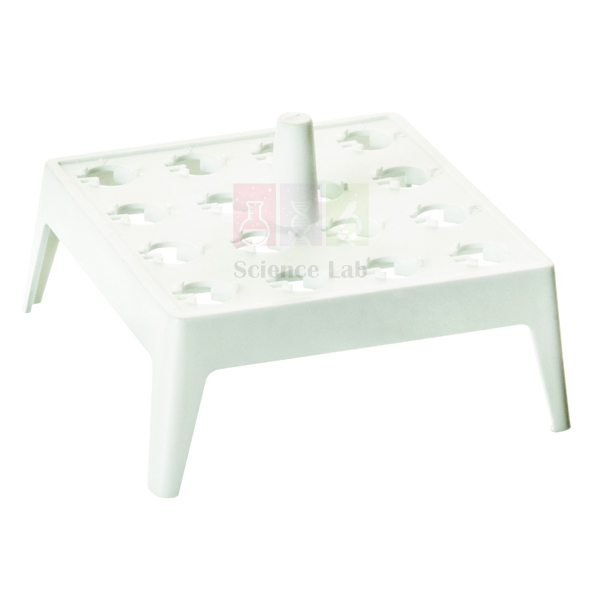
Float Rack
Float Rack (Product Code: SLE/CH/56) is a compact polypropylene rack that holds 16 microcentrifuge tubes of 1.5 ml on the surface of a water bath during incubation. Its top carries a raised alphanumeric index so each position can be identified at a glance, and a central rod lets you lift the loaded rack out of the water without touching the tubes. Easy to load and autoclavable, it is used in microbiology and immunology labs for enzyme digestions, heat treatments and other timed incubations of small samples. It is made by Jain Scientific Equipments Pvt Ltd (ScienceLab), Ambala.
Specifications
| Parameter | Detail |
|---|---|
| Material | Moulded polypropylene |
| Capacity | 16 microcentrifuge tubes (MCTs) of 1.5 ml |
| Identification | Raised alphanumeric index on the surface |
| Handling | Central rod for convenient lifting |
| Sterilisation | Autoclavable |
| Application | Incubation of tubes in water baths |
Typical Use
Many molecular biology and immunology protocols call for a short incubation of microtubes at a fixed temperature, such as a restriction digest, a heat-inactivation step, antigen–antibody binding or a heat-shock transformation. Pressing the capped tubes into the float rack and setting it on the bath keeps them upright, in contact with the water and in a known order, so no tube tips over or gets mixed up. The raised index lets you note positions on your worksheet and find the right tube again after incubation.
Close tube caps firmly before floating the rack so no water enters. Lift the rack by its central rod, shake off excess water, and move it to a bench rack or centrifuge. Between uses, wash the rack and autoclave it if your protocol requires sterile handling. It fits easily into a small bath, making it a convenient part of a microbiology lab setup in India for teaching or research.
Manufacturer
The ScienceLab brand belongs to Jain Scientific Equipments Private Limited of Ambala, Haryana, which produces laboratory racks and teaching apparatus for colleges, research institutions and schools in India and international markets. Read the company profile for more.
Related Chemistry Lab Equipment
Items used in the same microtube incubation workflow:
- Micro Centrifuge Tube, 1.5ml — the tube size the rack is built to hold.
- Serological Water Bath — a thermostatically controlled bath to float the rack in.
- Micro Centrifuge — to spin tubes down before and after incubation.
- MCT Twin Rack — a bench rack for sorting and storing microtubes.
- Test Tube Stand (Wire Pattern) — a submersible rack for larger tubes in the same bath.
Explore the Chemistry Lab Equipment category for more.
Frequently Asked Questions
How many tubes does the Float Rack hold?
It holds 16 microcentrifuge tubes of 1.5 ml.
Can I use smaller or larger microtubes?
The rack is specified for 1.5 ml tubes. For other sizes, ask us through the contact page before ordering.
Is it autoclavable?
Yes, the polypropylene rack is autoclavable.
How do I keep track of samples?
Use the raised alphanumeric index on the rack surface to record each tube's position before incubation.
How do I remove it from a hot bath?
Lift it by the central rod, which keeps your fingers away from the water and the tube caps.
Can I order racks in different colours?
Colour options are not listed here. Mention any colour-coding need in your enquiry and we will confirm what can be supplied.
Do you supply research institutes abroad?
Yes, we supply India and international markets. Share your quantity and country for a delivered quotation.
Request a Quote
Request a price via our contact page, or add the Float Rack to the enquiry cart together with microtubes and a water bath.
Last updated: 24 September 2026
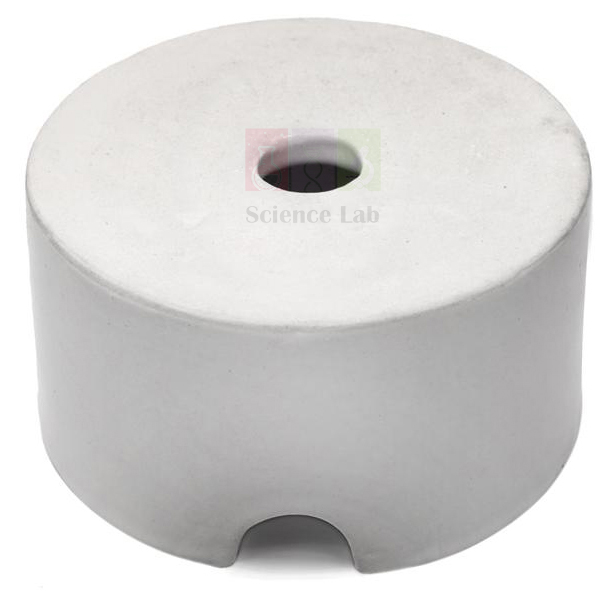
Beehive Shelf, Porcelain
Beehive Shelf, Porcelain (Product Code: SLE/CH/57) is a small dome-shaped porcelain support placed in a pneumatic trough for collecting gases over water. It is glazed inside and outside, so it sheds water and deposits easily, and it is offered in 75 mm and 100 mm diameters to suit different trough and gas jar sizes. Chemistry teachers and students use it whenever oxygen, hydrogen or another sparingly soluble gas is prepared and collected in the lab. It is made by Jain Scientific Equipments Pvt Ltd (ScienceLab), Ambala, a school science lab equipment manufacturer serving India and international markets.
Specifications
| Parameter | Detail |
|---|---|
| Material | Porcelain |
| Finish | Glazed inside and outside |
| Diameter | 75 mm; 100 mm |
| Purpose | Use in pneumatic troughs for gas collection |
Typical Use
A beehive shelf lifts the mouth of a gas jar just clear of the bottom of the trough. The delivery tube from the gas generator is led under the shelf, and the gas rises through the opening in the top into an inverted gas jar that was filled with water and stood on the shelf. As gas collects, it pushes the water out of the jar; once the jar is full, a cover is slid under its mouth and it is lifted out ready for testing. This set-up is used for classic experiments such as collecting oxygen from heated potassium permanganate or hydrogen from zinc and dilute acid.
The 75 mm size suits smaller troughs and narrow gas jars, while the 100 mm size gives a broader platform for wider jars. Because the porcelain is glazed on both faces it does not soak up water, and it can simply be rinsed and dried after the lesson. Handle it with care, as porcelain can chip if dropped into a trough or knocked against glassware.
Manufacturer
Jain Scientific Equipments Private Limited carries on business as ScienceLab in Ambala, Haryana, making apparatus for chemistry, physics and biology teaching. Buyers completing vendor registration or tender paperwork can quote the company's GSTIN, 06AAECJ8618A1ZT, and its Legal Entity Identifier, 3358004HRD1JIVXKYX49. For more about the business, open the company profile.
Related Chemistry Lab Equipment
The other parts of a gas-collection-over-water set-up:
- Pneumatic Trough — the water trough in which the shelf sits.
- Gas Jar, Glass — the inverted jar that stands on the shelf and fills with gas.
- Delivery Tube — carries gas from the generator to the underside of the shelf.
- Deflagrating Spoon — for burning substances in the collected oxygen.
- Beehive Shelves — a white glazed porcelain alternative listed separately.
Find more apparatus in the Chemistry Lab Equipment category.
Frequently Asked Questions
Which sizes are available?
Two diameters: 75 mm and 100 mm. Choose the one that best matches your trough and the base of your gas jars.
Why porcelain rather than plastic?
Porcelain is heavy enough to stay on the bottom of the trough, and the glaze stops it absorbing water.
Is it glazed on both sides?
Yes, it is glazed inside and outside, which makes cleaning simple.
Is a trough or gas jar included?
No, the shelf is supplied on its own. Add a pneumatic trough, gas jars and covers to the same enquiry if you need a complete set.
Will it suit my existing trough?
Measure the trough depth and the width of your gas jars and share them through our contact page; we will recommend the right diameter.
Can you supply class sets or export orders?
Yes. Tell us the number of shelves in each size and the destination, in India or abroad, and we will quote with suitable packing for porcelain.
Request a Quote
Send sizes and quantities through the contact page, or add the Beehive Shelf, Porcelain to the enquiry cart along with troughs and gas jars.
Last updated: 24 September 2026
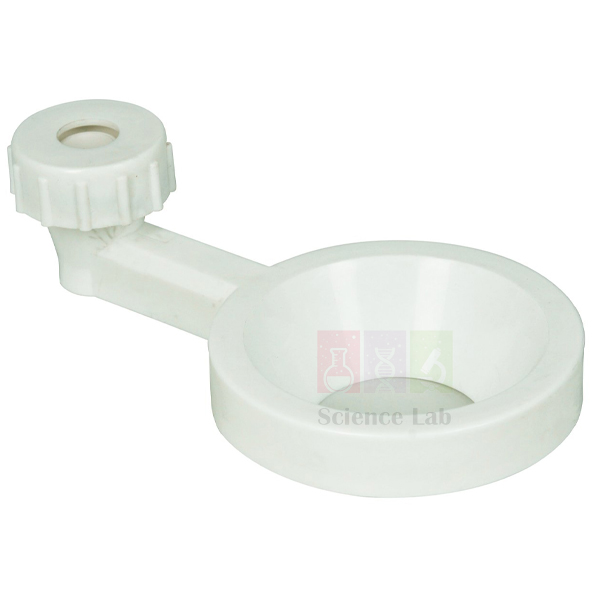
Funnel Holder
Funnel Holder (Product Code: SLE/CH/58) is a non-corrosive holder that keeps a funnel steady above a flask or beaker during filtration. Its outer ring takes funnels of 3 to 6 inch diameter, and a removable inner lid holds smaller funnels of 1 to 3 inch diameter, so one holder covers everything from a small analytical funnel to a large filling funnel. It is available as a Single Funnel Holder or a Double Funnel Holder for running two filtrations side by side. The holder is made by Jain Scientific Equipments Pvt Ltd (ScienceLab), Ambala, a laboratory equipment supplier in India and to overseas institutions.
Specifications
| Parameter | Detail |
|---|---|
| Type | Funnel holder |
| Construction | Non-corrosive |
| Outer ring | Holds funnels of 3 to 6 inch diameter |
| Inner lid | Removable; holds smaller funnels of 1 to 3 inch diameter |
| Versions | Single Funnel Holder; Double Funnel Holder |
Typical Use
Gravity filtration is one of the first separation techniques students learn: a folded filter paper is placed in a funnel, the funnel is held above a conical flask or beaker, and the mixture is poured in so the solid stays on the paper and the clear filtrate collects below. Holding the funnel by hand is tiring and risks spills, so a holder frees both hands for pouring and rinsing. With the inner lid in place, small funnels sit securely for filtering a few millilitres in salt analysis; lift the lid out and the outer ring takes a larger funnel for filtering a whole reaction mixture or decanting a solution.
The double version is handy when comparing two filtrations, such as filtering the same mixture through different papers, or when two students share one bench position. Position the stem of the funnel so it touches the inside wall of the receiving vessel; this speeds filtration and prevents splashing. Because the holder is non-corrosive, it can simply be rinsed after contact with dilute acids or salt solutions and left to dry.
Manufacturer
ScienceLab is the trading name used by Jain Scientific Equipments Private Limited, an apparatus maker in Ambala, Haryana, that supplies schools, colleges and laboratories in India and international markets. Visit the company profile to learn more.
Related Chemistry Lab Equipment
Items used together with this holder in filtration work:
- Glass Funnel — a short-stem borosilicate funnel to sit in the holder.
- Plastic Funnel — an unbreakable option for student benches.
- Filter Paper — folded into the funnel to retain the solid.
- Conical Flask — collects the filtrate beneath the funnel.
- Funnel Stand, Double — a free-standing wooden stand as an alternative support.
See more in the Chemistry Lab Equipment category.
Frequently Asked Questions
What funnel sizes does it hold?
The outer ring holds funnels of 3 to 6 inch diameter; with the removable inner lid fitted it holds smaller funnels of 1 to 3 inch diameter.
What is the difference between the single and double versions?
The single holder supports one funnel; the double holder supports two, so two filtrations can run at the same time.
How is the holder mounted?
The mounting arrangement is not described on this page. Tell us whether you plan to use it on a stand rod or on its own, via the contact page, and we will confirm the right version.
Will it rust if acid splashes on it?
The holder is non-corrosive. Rinse off chemical splashes with water after use to keep it clean.
Are funnels included?
No, funnels and filter paper are ordered separately. Add them to the same enquiry for a complete filtration set.
What details help you prepare a quotation?
The version (single or double), quantity, any funnels or stands you need with it, and whether delivery is within India or abroad.
Request a Quote
Get a quotation by writing to us through the contact page, or add the Funnel Holder to the enquiry cart with funnels and filter paper.
Last updated: 24 September 2026
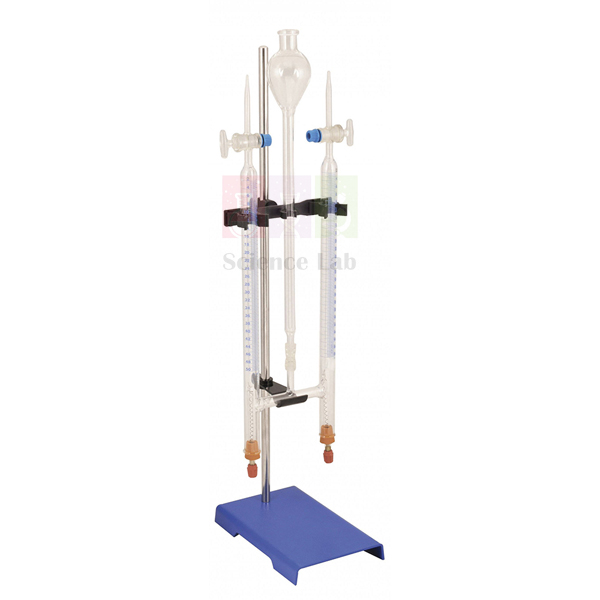
Hoffman Voltameter
Hoffman Voltameter (Product Code: SLE/CH/59) is a borosilicate glass electrolysis apparatus used to demonstrate the decomposition of water, to determine chemical composition by electrolysis, and to evaluate the electrochemical equivalent of hydrogen. Two connected limbs, each graduated for 50 cm³, rise from a central reservoir tube with a funnel-shaped bulb, and each limb has a stopcock at the top for drawing off and testing the collected gas. It comes with one pair of platinum electrodes and one pair of carbon electrodes. Schools, colleges and teacher-training labs use it as the standard electrolysis apparatus in India, and it is made by Jain Scientific Equipments Pvt Ltd (ScienceLab), Ambala.
Specifications
| Parameter | Detail |
|---|---|
| Material | Borosilicate glass |
| Limbs | Two connected limbs, graduated for 50 cm³ capacity, each with a stopcock at the top |
| Reservoir | Integral reservoir tube with funnel-shaped bulb; capacity 200 cm³ |
| Electrodes supplied | One pair platinum electrodes; one pair carbon electrodes |
| Platinum electrodes | For electrolysis of water |
| Carbon electrodes | For electrolysis of ammonia or hydrochloric acid |
| Overall dimensions | 700 x 85 mm (height x width) |
| Stand | Not included (supplied without stand) |
Typical Use
For the electrolysis of water, the platinum electrodes are fitted and the apparatus is clamped upright. With both stopcocks open, water made conducting with a little dilute acid is poured into the funnel bulb until the limbs are full; the stopcocks are then closed and a low-voltage DC supply is connected. Gas collects at the top of each limb, and students can read the volumes on the graduations and see that the hydrogen volume is about twice the oxygen volume. Opening a stopcock lets them test each gas with a lighted or glowing splint. Recording the current and time alongside the volume of hydrogen allows the electrochemical equivalent of hydrogen to be worked out.
For the electrolysis of hydrochloric acid or ammonia solution, the carbon electrodes are used in place of platinum. Carry out these runs in a well-ventilated room or fume cupboard, keep flames away from collected hydrogen except during the controlled splint test, and rinse the glassware thoroughly with water afterwards. This apparatus is a mainstay of borosilicate laboratory glassware in India for chemistry and physics departments alike.
Manufacturer
Jain Scientific Equipments Private Limited, which trades as ScienceLab, is based in Ambala, Haryana, and makes glass apparatus, electrical demonstration equipment and other teaching aids for institutions in India and international markets. Company details are on the company profile.
Related Chemistry Lab Equipment
Items needed to run electrolysis experiments with this voltameter:
- Hoffman Voltameter Stand — a metal stand with support clamp, needed because the voltameter is supplied without one.
- Power Supply, Smoothed — a stepped low-voltage supply with DC output to drive the electrolysis.
- Digital Ammeter — measures the DC current for electrochemical equivalent calculations.
- Voltameter — a simpler base-mounted voltameter with graduated test tubes for junior classes.
Browse the Chemistry Lab Equipment category for more.
Frequently Asked Questions
Which electrodes are included?
One pair of platinum electrodes and one pair of carbon electrodes. Platinum is used for the electrolysis of water, carbon for ammonia or hydrochloric acid.
Is a stand supplied?
No, the voltameter is supplied without a stand. The Hoffman Voltameter Stand listed above can be ordered with it.
How much gas can each limb collect?
Each limb is graduated for 50 cm³, and the reservoir holds 200 cm³ of electrolyte.
How tall is the apparatus?
Overall dimensions are 700 x 85 mm (height x width), so check the clearance in your fume cupboard or under shelves.
What power supply do I need?
A low-voltage DC source. The voltage and current you need depend on the electrolyte; ask us through the contact page if you would like a matching power supply quoted.
How should the glassware be cared for?
Rinse with distilled water after each use, keep stopcocks clean and lightly greased if they are ground glass, and store the apparatus supported upright or packed flat so the limbs are not stressed.
Can you supply this with a stand and power supply for export?
Yes. We supply India and international markets and can quote the voltameter, stand and accessories together with suitable glassware packing.
Request a Quote
Ask for pricing through the contact page, or add the Hoffman Voltameter to the enquiry cart with its stand and power supply.
Last updated: 24 September 2026
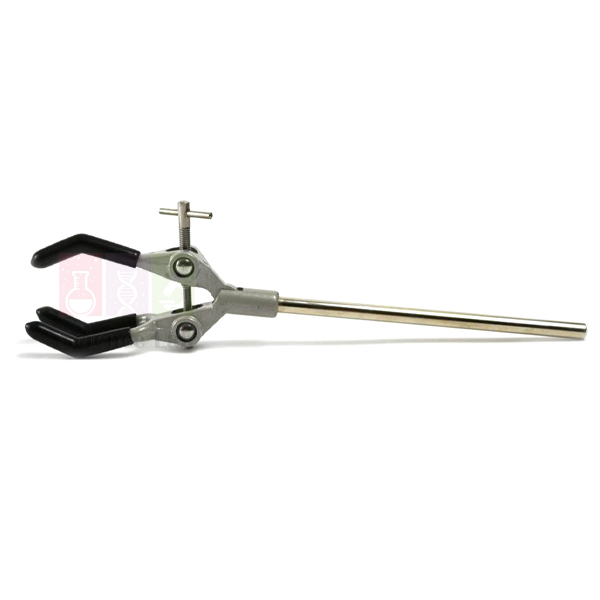
Retort Clamp Three Finger
Retort Clamp Three Finger (Product Code: SLE/CH/60) is a three-prong clamp that holds round glassware — flasks, condensers, boiling tubes — steady on a support stand while it is heated, filled or connected to other apparatus. Its rubber-covered jaws close around articles up to 75 mm in diameter, which covers most of the glassware handled on school and college chemistry benches. The clamp is made by Jain Scientific Equipments Pvt Ltd (ScienceLab), Ambala, India, and is a routine part of any retort stand lab set-up in India and international markets.
Specifications
| Parameter | Detail |
|---|---|
| Type | Three prong (three finger) retort clamp |
| Clamp body | Die cast in alloy |
| Other parts | Plated brass |
| Grip capacity | Accepts articles up to 75 mm diameter |
| Jaw adjustment | Nickel plated brass pommels with twin screw |
| Jaw lining | Rubber covered |
| Rod | 15 cm long, mild steel or aluminium |
Typical Use
Teachers use this clamp to grip the neck of a flask above a burner during heating or simple distillation, to hold a condenser at the right angle, or to steady a boiling tube while a gas is prepared and collected. Because the jaws are driven by a twin screw, both sides close together and the glass stays centred rather than being pushed to one side, which reduces strain on the joint where tubing or a stopper is fitted.
The 15 cm rod is pushed into a boss head on the upright stand rod — the familiar lab stand, clamp and boss head arrangement — so the height and angle can be adjusted before any liquid is added. Tighten the pommels only until the rubber lining just grips; overtightening can crack thin-walled glass, and the rubber should be kept clear of the direct flame.
Manufacturer
ScienceLab is the trading name of Jain Scientific Equipments Private Limited, an Ambala, Haryana company that manufactures stand hardware, glassware accessories and teaching apparatus for schools, colleges and laboratories. Our company profile gives more background on the business and its product range.
Related Chemistry Lab Equipment
Items usually ordered with a three finger clamp to complete the stand assembly:
- Boss Head — joins the clamp rod to the upright rod of the stand
- Retort Stand — the base and upright rod on which the clamp is mounted
- Retort Clamp Four Finger — the larger option for objects up to 100 mm
- Conical Flask — typical glassware held in the jaws
- Bunsen Burner — heat source placed below a clamped flask
See the wider Chemistry Lab Equipment range for stands, clamps and bench accessories.
Frequently Asked Questions
What size of glassware does this clamp hold?
Articles up to 75 mm in diameter. For wider vessels, choose the four finger version.
Can I choose the rod material?
Yes — the clamp is fitted with a 15 cm rod in either mild steel or aluminium. Mention your preference in the enquiry and we will confirm it in the quotation.
Is a boss head part of the clamp?
The listing covers the clamp with its rod. If your stands do not already have spare boss heads, add them to the same enquiry.
Will the jaws mark or crack glass?
The rubber covering cushions the glass, so marking is unlikely. Cracks usually come from overtightening or clamping glass that is still expanding with heat, so tighten gently and recheck after warming.
How should the clamp be looked after?
Wipe off acid or salt spills soon after a practical, dry the screws, and keep solvents away from the rubber lining so it stays soft.
What should a school or college quotation request include?
The quantity, rod material, delivery location and any stands or boss heads needed alongside. Warranty terms are stated in the quotation itself.
Do you supply in bulk or overseas?
Yes. We supply institutions and distributors across India and international markets; contact us with quantities for a delivered quote.
Request a Quote
To order the Retort Clamp Three Finger, send your quantity and delivery details through our contact page, or add it to the enquiry cart together with the stands and boss heads you need.
Last updated: 24 September 2026
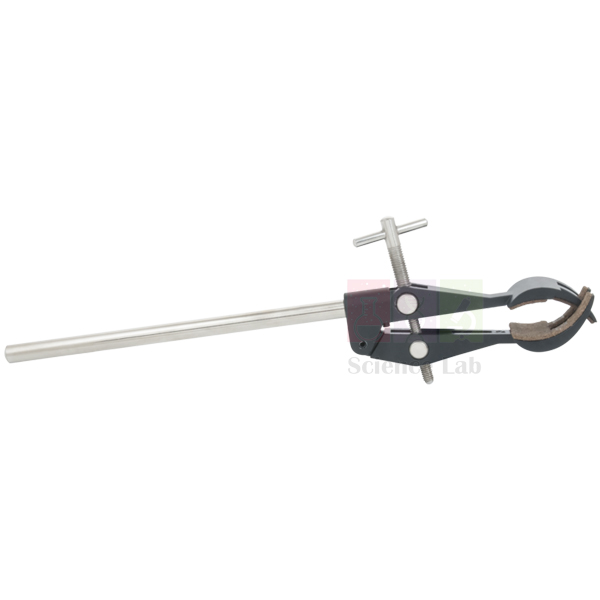
Retort Clamp Four Finger
Retort Clamp Four Finger (Product Code: SLE/CH/61) is a strong, four-prong clamp for bigger vessels, holding objects up to 100 mm across securely on a support stand. Four cork-lined jaws spread the grip around the glass, and a plated brass tommy bar lets the user tighten it by hand without tools. It is made by Jain Scientific Equipments Pvt Ltd (ScienceLab), Ambala, for college and school laboratories that stock chemistry lab equipment in India and international markets. Note that it is supplied without a boss head.
Specifications
| Parameter | Detail |
|---|---|
| Type | Four prong (four finger) retort clamp |
| Construction | Die cast, strong |
| Grip capacity | Holds objects up to 100 mm |
| Jaw lining | Cork lined, for secure contact |
| Adjusting screw | Plated brass, with tommy bar |
| Stem | Anodized aluminium, 150 x 8 mm (length x dia.) |
| Boss head | Not included |
Typical Use
The four finger design is chosen when a three-prong clamp is too small or too narrow to hold the load safely: large round-bottom or distillation flasks, wide-necked bottles and gas-generating vessels that carry extra weight once filled. Four contact points hold the vessel squarely, so it is less likely to rotate in the jaws when tubing or a stopper is pushed into the neck.
Fit the 8 mm stem into a boss head on the stand rod — the usual lab stand, clamp and boss head combination — and set the height before the vessel is loaded. Cork lining gives a firm, slightly yielding contact on glass; turn the tommy bar until the cork just bites, and check again once the flask warms up. Keep the cork dry between sessions so it does not harden or crumble.
Manufacturer
Jain Scientific Equipments Private Limited trades as ScienceLab from Ambala, Haryana, making stand hardware and teaching apparatus for education and research. The company is incorporated under CIN U29309HR2020PTC087597 and runs a licensed factory at 449, HSIIDC Industrial Area, Saha, Ambala (Factory Licence AMB-ONLINE-CHD-J-414). More detail is on our company profile.
Related Chemistry Lab Equipment
Since this clamp comes without a boss head, most buyers add the fittings below:
- Boss Head — needed to fix the 8 mm stem to the stand rod
- Boss Head, With Detachable Attachment — an alternative connector for the same job
- Retort Stand — the upright support that carries clamp and load
- A-Shape Retort Stand Base — a stable base for heavier, larger vessels
- Retort Clamp Three Finger — the smaller clamp for articles up to 75 mm
More stands, clamps and bench fittings are listed under Chemistry Lab Equipment.
Frequently Asked Questions
Does the clamp come with a boss head?
No. It is supplied without one, so order a boss head for each clamp unless your stands already have spares.
What is the largest object it will hold?
Objects up to 100 mm. For smaller glassware, the three finger clamp is lighter and easier to position.
Why cork rather than rubber on the jaws?
Cork gives a secure, cushioned contact on glass. Keep it dry and replace worn lining before it loses grip.
Will the stem fit my existing boss heads?
The stem is 150 x 8 mm anodized aluminium. Check that your boss heads close firmly on an 8 mm rod, or ask us to match suitable ones.
Can you provide company registration details for our vendor file?
Yes. Along with the quotation we can share the CIN and other company registration details your purchase department needs.
Is warranty cover offered?
Warranty terms for this clamp are set out in the quotation; please raise any specific requirement when you enquire.
Can you supply larger quantities for several labs?
Yes. Institutional and distributor orders are supplied across India and international markets.
Request a Quote
For a price on the Retort Clamp Four Finger with matching boss heads, write to us through the contact page or place the items in the enquiry cart and submit your list.
Last updated: 24 September 2026
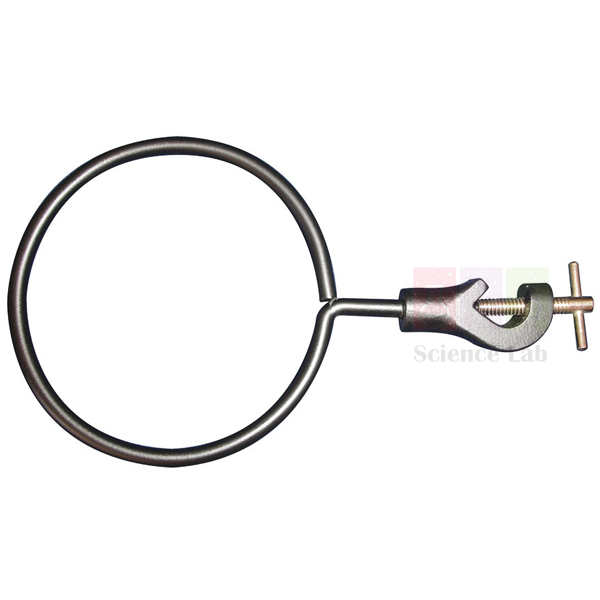
Retort Rings
Retort Rings (Product Code: SLE/CH/62) are cast iron support rings that lock onto the upright rod of a stand to carry a filter funnel, a separating funnel, a wire gauze or an evaporating dish at a chosen height. Each ring is cast with its own boss and a chrome-plated brass thumbscrew, so no separate connector is needed. The rings are made by Jain Scientific Equipments Pvt Ltd (ScienceLab), Ambala, and form a basic part of retort stand lab work in India and international markets.
Specifications
| Parameter | Detail |
|---|---|
| Ring material | Cast iron, with boss |
| Finish | Hammertone painted |
| Thumbscrew | Brass, chrome plated, fitted to the boss |
| Rod compatibility | Rods up to 13 mm dia. |
| Ring centre to supporting rod | Approx. 120 mm, the same for all sizes |
| Sizes | More than one ring size; confirm the sizes you need on enquiry |
Typical Use
In filtration practicals the ring holds a funnel above a beaker so the filtrate runs straight down. For solvent extraction it cradles a separating funnel, which is then easy to lift out and shake — the usual set-up whenever students use a separating funnel in an India lab syllabus. Set a wire gauze on the ring and it becomes a stand for heating a beaker or evaporating dish over a Bunsen flame.
Because the centre of every ring sits roughly 120 mm out from the rod, a burner fits underneath without the flame touching the stand rod. Two rings on one rod can hold a funnel above a gauze-supported receiver. Tighten the thumbscrew fully before loading, and place a gauze between flame and glass rather than resting glassware directly on the hot iron.
Manufacturer
These rings come from Jain Scientific Equipments Private Limited, which trades as ScienceLab and is based in Ambala, Haryana, where the company produces laboratory hardware and educational apparatus. Visit our company profile to learn more about the business.
Related Chemistry Lab Equipment
Apparatus used on or around a retort ring in filtration, extraction and heating work:
- Retort Stand — the upright rod that the ring clamps onto
- Gauze Wire — laid on the ring to spread burner heat under glassware
- Separatory Funnel — rests in the ring during liquid-liquid extraction
- Glass Funnel — supported in the ring for gravity filtration
- Bunsen Burner — heat source placed below the ring
The full Chemistry Lab Equipment section lists further stands, supports and heating accessories.
Frequently Asked Questions
Which stand rods does the ring fit?
Rods up to 13 mm in diameter. If your stands have thicker rods, tell us the diameter before ordering.
Do I need a separate boss head?
No. The ring is cast with its own boss and chrome-plated brass thumbscrew, so it clamps straight onto the rod.
What ring sizes can I order?
The ring is made in more than one size, all with the same approx. 120 mm offset from the rod. Contact us for the current size list.
Can glassware sit directly on the ring over a flame?
It is better not to. Put a wire gauze on the ring so heat spreads evenly and glass does not touch hot iron at a single point.
How do I keep the ring in good condition?
Wipe off spills once it has cooled, keep the thumbscrew thread free of deposits, and store rings dry to protect the painted finish.
Can you quote for a full set of stand hardware?
Yes. List the rings, stands, clamps and gauzes you need and we will quote them together for delivery across India and international markets.
Request a Quote
Tell us the ring sizes and quantities you require on the contact page, or build your list in the enquiry cart and send it for a quotation.
Last updated: 24 September 2026
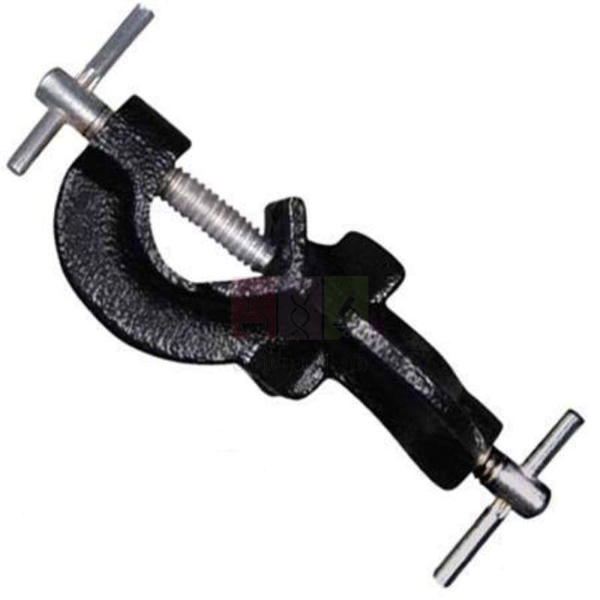
Boss Head
Boss Head (Product Code: SLE/CH/63) is the connector block that locks a clamp rod to the upright rod of a laboratory stand, usually at right angles, so clamps and holders can be set at any height. Two vee grooves in the die-cast aluminium alloy body seat round rods accurately, and two chrome-plated thumb screws hold each rod firmly. It is made by Jain Scientific Equipments Pvt Ltd (ScienceLab), Ambala, in small and large sizes, and is a core item in every lab stand clamp boss head kit supplied in India and international markets.
Specifications
| Parameter | Detail |
|---|---|
| Body material | Die cast aluminium alloy |
| Rod seating | Two vee grooves in the body, accurate for a firm grip |
| Screws | Two chrome plated thumb screws |
| Sizes available | Small size; Large size |
Typical Use
Any clamp with a plain stem — a retort clamp, thermometer clamp or condenser clamp — needs a boss head to attach it to a stand. One groove sits on the vertical stand rod and the other takes the clamp stem; each has its own thumb screw, so the clamp can be raised, lowered or swung round without taking the whole assembly apart. When planning a practical, count one boss head for every clamp that will be on the stand.
For a secure set-up, tighten the screw on the stand rod first, then position and tighten the clamp stem. Arrange the boss head so its open side faces up, allowing the load to press the rod into the groove rather than away from it. Schools replacing lost or worn fittings often order boss heads with other lab equipment accessories in one enquiry.
Manufacturer
ScienceLab is the brand of Jain Scientific Equipments Private Limited, based in Ambala, Haryana, which manufactures support-stand hardware alongside a broad range of teaching and laboratory apparatus. Our company profile describes the business in more detail.
Related Chemistry Lab Equipment
Stands and clamps that are joined together with a boss head:
- Retort Stand — provides the upright rod the boss head grips
- Retort Clamp Four Finger — supplied without a boss head, so it needs one of these
- Retort Clamp Three Finger — its 15 cm rod mounts through a boss head
- Thermometer Clamp — holds a thermometer on the same stand
- Boss Head, With Detachable Attachment — an alternative connector design
Browse all stand fittings in Chemistry Lab Equipment.
Frequently Asked Questions
Should I order the small or the large size?
Choose the size that matches your stand rod and clamp stem diameters. Send us those two diameters through the contact page and we will recommend the right one.
How does it hold two rods at once?
The body has two vee grooves, each with its own chrome-plated thumb screw, so the stand rod and clamp stem are tightened independently.
Why vee grooves instead of round holes?
A vee seats a round rod along two lines of contact, which centres it accurately and gives a firm grip across a range of rod diameters.
Any tips for making it last?
Tighten by hand only — pliers can strip the thread in the aluminium body — and wipe chemical spills off the screws before storing.
How many boss heads does a class set need?
Usually one per clamp on each stand. Share your stand and clamp counts and we will size the order.
Do you handle tender and export orders?
Yes. We quote for schools, colleges and distributors throughout India and in international markets.
Request a Quote
Send the size and number of boss heads you need via our contact page, or add them to the enquiry cart with the clamps and stands on your list.
Last updated: 24 September 2026
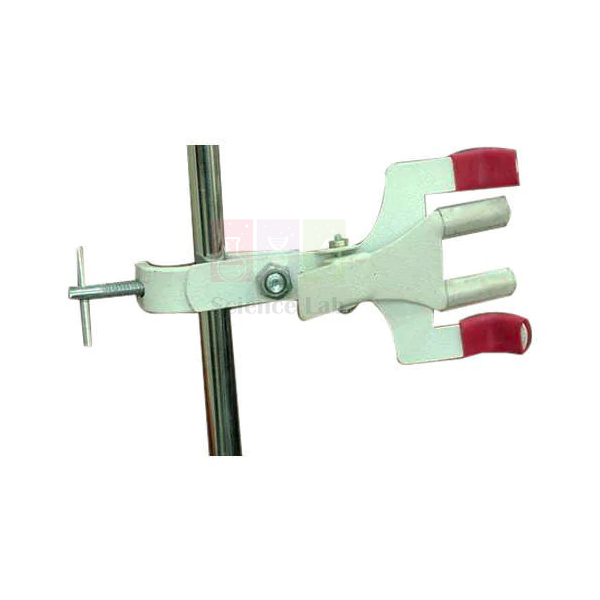
Burette Clamps
Burette Clamps (Product Code: SLE/CH/64) hold a burette straight and steady on a stand rod throughout a titration. The clamp is die-pressed from thick M.S. sheet and chrome plated; each burette sits in a V-groove and is pressed in place by a spring-loaded jaw, and the bosshead takes rods up to 18 mm in diameter. Versions for a single or a double burette are made by Jain Scientific Equipments Pvt Ltd (ScienceLab), Ambala, for any burette clamp India lab requirement and for international markets.
Specifications
| Parameter | Detail |
|---|---|
| Type | Depressed burette clamp |
| Material | Thick M.S. (mild steel) sheet |
| Construction | Die-pressed symmetrically, non-breakable |
| Jaws | Two jaws with V-grooves; the burette rests in one and the other presses it by spring force |
| Finish | Well chrome plated |
| Bosshead | Accommodates rods up to 18 mm dia. |
| Versions | For single burette; for double burette |
Typical Use
A burette that leans gives parallax errors at the meniscus and drips down the side of the flask, so a clamp that holds it truly vertical is basic to accurate acid-base, redox and complexometric titrations. The spring-loaded jaw lets a student slide the burette in or out for filling and rinsing without loosening a screw, while the V-grooves keep it aligned each time it is replaced.
The double version holds two burettes side by side — useful for back-titrations, for running a blank next to the sample, or for sharing one stand between two students. Mount the clamp high enough for a conical flask to swirl freely under the jet. Schools assembling a titration kit for school practicals in India typically pair this clamp with a stand, burette and flask for each bench.
Manufacturer
The clamp is produced by Jain Scientific Equipments Private Limited, trading as ScienceLab, an Ambala, Haryana manufacturer of titration hardware and laboratory apparatus for education and industry. Further information is on our company profile page.
Related Chemistry Lab Equipment
Everything else needed on a titration bench:
- Burette — the graduated tube the clamp holds
- Burette Stand and Funnel Stand — a support for the burette and filling funnel
- Retort Stand — a general stand whose rod the bosshead grips
- Conical Flask — the titration flask placed under the jet
- Brush Burette — for cleaning the burette between runs
Find more titration and stand apparatus in our Chemistry Lab Equipment category.
Frequently Asked Questions
Should I choose the single or double clamp?
Single suits one burette per stand. Double holds two burettes side by side, which helps with blanks, back-titrations or two students sharing a stand.
What rod diameter does the bosshead take?
Rods up to 18 mm in diameter, which covers most laboratory stand rods.
How does the clamp hold the burette without a screw on the glass?
The burette rests in a V-groove and a second jaw presses it in by spring force, giving steady pressure without point loading from a screw.
Is it strong enough for daily student use?
Yes — it is die-pressed from thick M.S. sheet and is non-breakable in normal use, with a chrome-plated finish.
How should it be cleaned after titrations?
Wipe acid or alkali splashes off promptly with a damp cloth and dry the clamp, so the plating stays in good condition.
What warranty applies?
Warranty terms are included in our quotation; contact us if you need them before placing an order.
Can you supply complete lab quantities or export orders?
Yes. We supply schools, colleges and distributors across India and international markets.
Request a Quote
State whether you need single or double clamps, and how many, on our contact page; alternatively add them to the enquiry cart with your burettes and stands.
Last updated: 24 September 2026
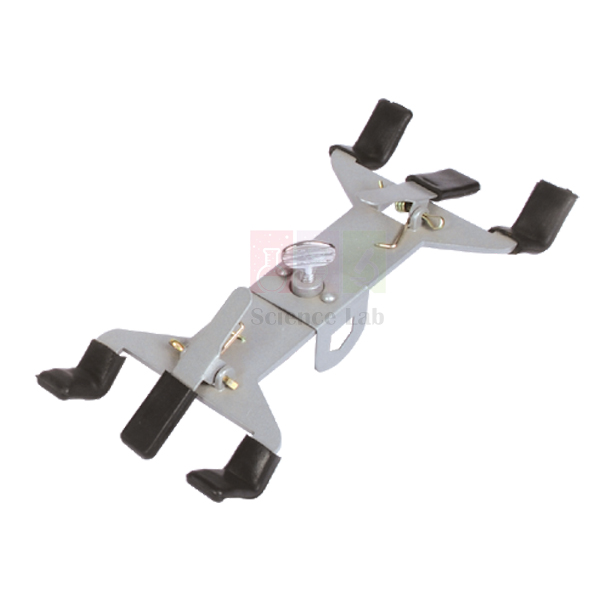
Burette Clamps Light Weight
Burette Clamps Light Weight (Product Code: SLE/CH/65) are aluminium burette clamps that combine a light body with the mechanical strength needed for daily titration classes. Rubber-covered, spring-action jaws give a positive grip and quick release, and a single thumb screw fixes the clamp to a rod of nominal 13 mm diameter. Made by Jain Scientific Equipments Pvt Ltd (ScienceLab), Ambala, they suit student benches where a light burette stand in an India lab is moved and reset often, and are also supplied to international markets.
Specifications
| Parameter | Detail |
|---|---|
| Body | Light-weight aluminium, mechanically strong |
| Jaws | Rubber covered, with spring action for a positive grip |
| Finish | Smooth enamel finish with rubber finger grippers |
| Fixing | Single thumb screw, for a rod of nominal 13 mm dia. |
| Holds | One or two burettes |
| Operation | Positive grip and release |
| Versions | Burette Clamp Single; Burette Clamp Double |
Typical Use
In a busy volumetric analysis class the clamp is opened and closed dozens of times a session as burettes are filled, read and rinsed. The spring-action jaws open with a squeeze of the rubber finger grippers and close again on their own, so students can change a burette with one hand while the other steadies the glass. The rubber covering protects the burette’s outer surface and graduations from metal contact.
Being aluminium, the clamp adds little weight at the top of a stand, which keeps lighter student stands stable when a full burette is fitted. It is a good match for teaching labs putting together a volumetric analysis kit for India schools and colleges, where the double version lets two burettes share one rod — for example one titrant and one blank.
Manufacturer
Jain Scientific Equipments Private Limited, trading as ScienceLab, is based in Ambala, Haryana and makes laboratory hardware and educational apparatus. It is registered as an MSME manufacturing enterprise (Udyam UDYAM-HR-01-0003714), and export consignments are shipped under Importer-Exporter Code AAECJ8618A issued by DGFT. Read our company profile for more.
Related Chemistry Lab Equipment
Items used with a lightweight burette clamp in titration practicals:
- Burette, Class-B, with PTFE Key Stopcock — a burette to mount in the jaws
- Burette Stand — a dedicated stand for titration set-ups
- Burette Clamps — the chrome-plated M.S. sheet version for rods up to 18 mm
- Conical Flask, Pyrex — receiving flask for the titration
- Burette Brush — keeps the burette bore clean between practicals
Our Chemistry Lab Equipment listing has more clamps, stands and titration accessories.
Frequently Asked Questions
How is this different from the standard Burette Clamps?
This model has a light aluminium body with rubber-covered spring jaws and fits rods of nominal 13 mm. The standard model is chrome-plated M.S. sheet with a bosshead that takes thicker stand rods.
Will it fit my stand rod?
It is designed for a rod of nominal 13 mm diameter. If your stands use a different rod, tell us the size before ordering.
Can it hold two burettes?
Yes, choose Burette Clamp Double. Burette Clamp Single holds one.
Does the metal touch the burette?
No — the jaws are rubber covered, so the glass sits against rubber rather than bare metal.
How should the enamel finish be cleaned?
Use a damp cloth and mild detergent, then dry. Avoid abrasive pads that could scratch the enamel.
Can you share MSME and export registration details for our records?
Yes. The Udyam and IEC numbers above can be included with the quotation for your vendor file.
Do you supply bulk orders?
Yes, for institutions and distributors in India and international markets — contact us with quantities.
Request a Quote
Ask for pricing on single or double lightweight clamps through our contact page, or collect the items you need in the enquiry cart and send one request.
Last updated: 24 September 2026
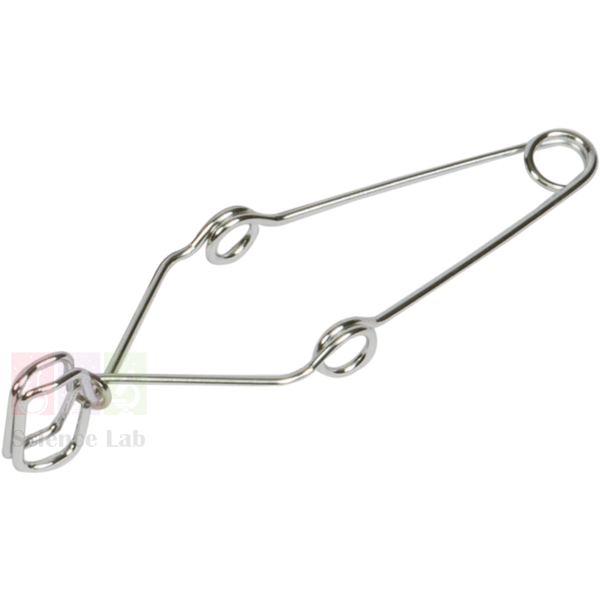
Test Tube Holder
Test Tube Holder (Product Code: SLE/CH/66) is a hand-held clip for gripping a test tube while it is heated, shaken or poured, keeping fingers well away from the flame and the contents. It is formed from chrome-plated spring steel wire with finger grips, measures 130 mm overall, and its jaws take tubes up to 38 mm in diameter. The holder is made by Jain Scientific Equipments Pvt Ltd (ScienceLab), Ambala, and is standard issue for every student carrying out a salt analysis practical in school, in India and international markets.
Specifications
| Parameter | Detail |
|---|---|
| Material | Spring steel wire, chrome plated |
| Tube capacity | Jaws accept tubes up to 38 mm diameter |
| Jaw alignment | Maintained by a wire collar |
| Handle | Finger grips |
| Overall length | 130 mm |
Typical Use
Dry-heating a salt, warming a solution to speed a reaction, and running preliminary tests for gases all involve holding a tube in or near a flame. Clip the holder near the mouth of the tube, keep the tube tilted and pointed away from yourself and others, and move it gently through the flame so the contents heat evenly and do not bump out. The wire collar keeps the two jaws lined up, so the tube does not twist loose as it is tilted.
The same holder is handy for dipping a tube into a hot water bath, or for carrying a warm tube back to the rack. In a flame test kit for school practicals in India, it is usually issued with a Bunsen burner or spirit lamp and a stand of clean tubes at each bench. After use, rest the holder on the bench rather than leaving it clipped to a hot tube.
Manufacturer
This holder is a product of Jain Scientific Equipments Private Limited of Ambala, Haryana, which uses the trading name ScienceLab for its laboratory apparatus and teaching equipment. Learn more on our company profile.
Related Chemistry Lab Equipment
Apparatus used alongside a test tube holder at the bench:
- Test Tube — the glassware the holder grips
- Bunsen Burner — the usual gas flame for heating tubes
- Glass Spirit Lamp — a flame source where gas is not available
- Test Tube Stand (Wire Pattern) — holds tubes upright before and after heating
- Brush Test Tube — for cleaning tubes after the practical
You can view other holders and racks in the Chemistry Lab Equipment range.
Frequently Asked Questions
What tube sizes does it hold?
The jaws accept tubes up to 38 mm in diameter, so standard school test tubes and wider boiling tubes are both covered.
Where on the tube should it be clipped?
Near the mouth, about a quarter of the way down, so most of the tube can be heated and your hand stays clear of the flame.
Does the handle get hot?
It is metal, so avoid holding it in the flame. The 130 mm length keeps the finger grips at a distance from the heated tube in normal use.
How do I keep it in good order?
Wipe off any chemical splashes, dry it after washing, and avoid prising the jaws wider than needed so the spring keeps its tension.
Can I order a set for a whole class?
Yes. Tell us the number of benches or students and we will quote a class quantity.
Do you ship outside India?
Yes, we supply institutions and distributors in India and international markets; contact us for export terms.
Request a Quote
Request a price for the Test Tube Holder through the contact page, or add it to the enquiry cart with your test tubes, stands and burners.
Last updated: 24 September 2026
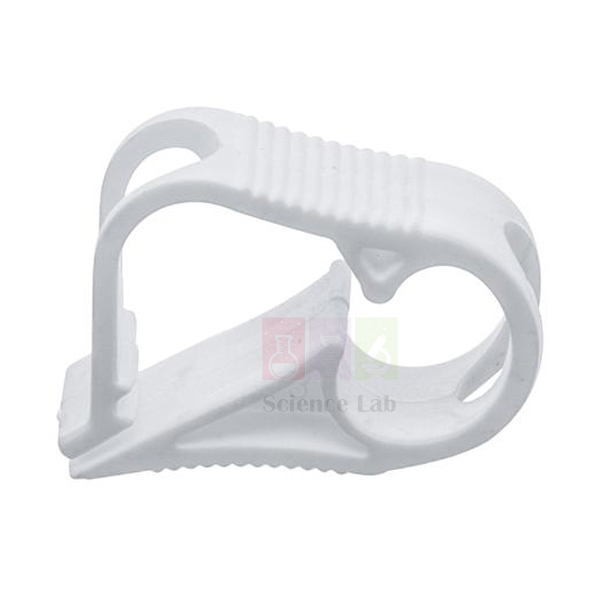
Pinch Clip
Pinch Clip (Product Code: SLE/CH/67) is a small clip that squeezes a length of flexible laboratory tubing flat, stopping the flow of liquid or gas through it until the clip is released. It works as a simple on/off valve on rubber or silicone tubing in burettes, siphons and gas apparatus. The clip is made by Jain Scientific Equipments Pvt Ltd (ScienceLab), Ambala, for school and college chemistry labs that build their own gas collection apparatus in India and international markets.
Key Details
| Parameter | Detail |
|---|---|
| Type | Clip for flexible laboratory tubing |
| Purpose | Closing off rubber or silicone tubing to stop liquid or gas flow |
| Suitable for | Burettes fitted with rubber tubing and a glass jet, siphons, gas delivery and collection set-ups |
| Supplied as | Individual clips; material, size and pack quantity confirmed on enquiry |
Typical Use
On a simple burette made from a glass tube, a short piece of rubber tubing and a jet, the pinch clip takes the place of a stopcock: pressing it opens the tubing and lets titrant run, releasing it shuts the flow. In gas preparation, a clip on the delivery tubing holds the gas back while a gas jar is positioned, and it can seal off a side arm or siphon line when the apparatus is being dismantled.
A pinch clip gives quick on/off control. Where a steady, adjustable drip is needed, a screw clip is the better choice. Fit the clip on a straight, undamaged section of tubing, and move it slightly now and then so the rubber does not take a permanent crease. These clips are small and easily lost, so labs usually keep spares with their chemistry lab equipment consumables.
Manufacturer
ScienceLab is the trading name of Jain Scientific Equipments Private Limited, a manufacturer of laboratory fittings and educational apparatus located in Ambala, Haryana. See our company profile for details of the company.
Related Chemistry Lab Equipment
Tubing and apparatus that a pinch clip is normally used on:
- Rubber Tubing — the flexible tubing the clip closes
- Silicone Tube — an alternative tubing that also takes the clip
- Hoffman Screw Clip — for gradual, adjustable flow control
- Delivery Tube — carries gas to the collecting vessel
- Gas Jar, Glass — collects the gas released through the tubing
Explore further clips and fittings under Chemistry Lab Equipment.
Frequently Asked Questions
What tubing size does the clip fit?
We do not list a tubing size on this page. Send us the outer diameter and wall thickness of your tubing through the contact page and we will confirm a suitable clip.
How is a pinch clip different from a Hoffman screw clip?
A pinch clip is an open/shut control. A Hoffman screw clip closes the tubing progressively with a screw, so the flow rate can be set.
Is tubing included?
No, the clip is supplied on its own. Rubber or silicone tubing can be added to the same order.
Can it replace a burette stopcock?
On a rubber-tube burette, yes — that is one of its classic uses. Glass burettes with a built-in stopcock do not need it.
What is it made of, and are colours available?
Material and finish options are confirmed at the time of quotation; please ask if you have a specific requirement.
Can you supply clips in larger quantities?
Yes. We supply schools, colleges and distributors in India and international markets.
Request a Quote
Share your tubing size and required quantity via our contact page, or add the Pinch Clip to the enquiry cart along with the tubing you need.
Last updated: 24 September 2026
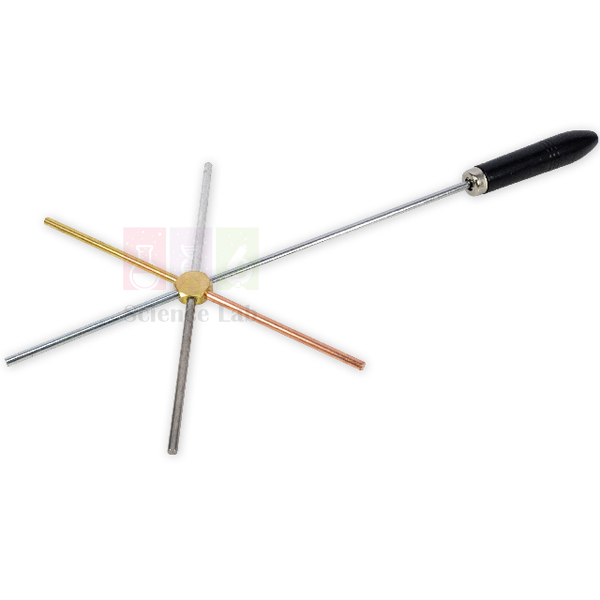
Heat Conductometer
Heat Conductometer (Product Code: SLE/CH/68) is a classroom demonstration set for comparing how well different metals conduct heat. Five metal rods — aluminium, brass, iron, copper and stainless steel — are fitted radially on a brass disk, so heat applied at the centre travels out along all five at the same time and students can see which rod passes it on fastest. It comes with a Teacher’s Guide and is made by Jain Scientific Equipments Pvt Ltd (ScienceLab), Ambala, as a compact heat energy science kit for schools in India and international markets.
Specifications
| Parameter | Detail |
|---|---|
| Purpose | Demonstrating and testing heat conductivity in a variety of metals |
| Metal rods | Five: aluminium, brass, iron, copper and stainless steel |
| Arrangement | Rods radially fitted on a brass disk |
| Rod size | 75 mm length x 5 mm dia. |
| Brass disk | 27 mm dia. |
| Included | Teacher’s Guide |
Typical Use
A common method is to fix a small, equal bead of wax to the outer tip of each rod, support the set so the rods are level, and heat the central brass disk gently with a burner or spirit lamp. As heat is conducted outwards, the wax beads soften and drop one after another; the order in which they fall ranks the five metals by conductivity. Because every rod has the same 75 mm length and 5 mm diameter, the comparison is fair and the only variable is the metal itself.
The set fits lessons introducing the properties of different elements as well as thermodynamics topics on conduction, and it works as a physics experiment kit for school classes as much as in chemistry. Students can extend the activity by reading the rod tips with an infra-red thermometer at fixed intervals. Let the disk and rods cool completely before handling them or removing wax.
Manufacturer
The Heat Conductometer is made by Jain Scientific Equipments Private Limited, known by its trading name ScienceLab, which designs and manufactures science demonstration apparatus in Ambala, Haryana. Our company profile has more about the company.
Related Laboratory Equipment
Useful additions for a lesson on heat conduction:
- Apparatus Heat/Thermal Conductivity — a further apparatus for conductivity experiments
- Heat Transfer Kit — extends the topic to other modes of heat transfer
- Bunsen Burner — a heat source for the central disk
- Thermometer, Infra Red, Hand Held — measures rod-tip temperatures without contact
- Wax — for the melting-bead method on the rod tips
More demonstration apparatus is listed in Chemistry Lab Equipment.
Frequently Asked Questions
Which metals are included?
Five rods: aluminium, brass, iron, copper and stainless steel, all fitted on one brass disk.
What comes in the set?
The rod-and-disk assembly and a Teacher’s Guide. A heat source and wax are not part of the listing and can be ordered separately.
What are the dimensions?
Each rod is 75 mm long and 5 mm in diameter; the brass disk is 27 mm in diameter.
Which rod should conduct heat fastest?
In general, copper conducts heat best of these metals and stainless steel least. Let students observe and record the order before telling them the answer.
How do I clean it after the practical?
Once cool, lift off wax residue with a cloth or warm water, then dry the rods fully.
Is it available for bulk or export orders?
Yes. We supply institutions and distributors in India and international markets; contact us with the number of sets required.
Request a Quote
Ask for a quotation on the Heat Conductometer through our contact page, or place it in the enquiry cart with any burners or accessories for the lesson.
Last updated: 24 September 2026
MCT Twin Rack
MCT Twin Rack (Product Code: SLE/CH/69) is a two-sided rack for microcentrifuge tubes (MCTs): one face holds 0.5 ml tubes and the other holds 1.5 ml tubes, with 108 holes on each side. An alphanumeric index on each face of the base identifies every position, and a transparent top gives a clear view while protecting the stored tubes. It is made by Jain Scientific Equipments Pvt Ltd (ScienceLab), Ambala, for molecular biology, biotechnology and clinical teaching labs that source from a lab plastic ware supplier in India, and for international markets.
Specifications
| Parameter | Detail |
|---|---|
| Capacity | Rack for 0.5 ml and 1.5 ml MCTs |
| Holes | 108 on each side — one side for 0.5 ml, the other for 1.5 ml MCTs |
| Design | Twin purpose rack |
| Position marking | Unique alphanumeric index on each face of the base |
| Cover | Transparent top, for viewing and protecting stored tubes |
Typical Use
During DNA extraction, enzyme digests or sample aliquoting, tubes move constantly between the bench, a laboratory centrifuge and the freezer. Keeping them in an indexed rack means each sample has a recorded address — for example a row letter and column number — so nothing is mixed up when the lids all look the same. When the day’s work switches from 1.5 ml tubes to smaller 0.5 ml tubes, simply turn the rack over instead of reaching for a second rack.
With the transparent top in place, tubes can be checked for labels and volumes without being lifted out, and they stay covered while waiting for the next step. Note the index position of each sample in the lab notebook before loading, and keep the rack level when moving it so open tubes do not spill.
Manufacturer
ScienceLab is the trading name of Jain Scientific Equipments Private Limited, an Ambala, Haryana manufacturer of laboratory plasticware, racks and teaching apparatus. For institutional buyers completing vendor forms, the company’s GSTIN is 06AAECJ8618A1ZT and its Legal Entity Identifier (LEI) is 3358004HRD1JIVXKYX49. See our company profile for more.
Related Laboratory Equipment
Items used with this rack in microcentrifuge-tube workflows:
- Micro Centrifuge Tube, 1.5ml — tubes for the 1.5 ml side of the rack
- Micro Centrifuge — spins the tubes between preparation steps
- Micropipette — for dispensing small volumes into the racked tubes
- Micropipette Tips — disposable tips for the pipette
- PCR Tube Rack — a stackable rack for PCR tube work
Other racks and holders are listed under Chemistry Lab Equipment.
Frequently Asked Questions
How many tubes can the rack hold?
There are 108 holes on each side: one side for 0.5 ml MCTs and the other for 1.5 ml MCTs.
Will 2 ml tubes fit?
The rack is specified for 0.5 ml and 1.5 ml MCTs only. For other tube sizes, contact us with your tube dimensions.
What is the transparent top for?
It lets you see the tubes and their labels while acting as a protective cover over them.
How does the indexing work?
Each face of the base carries its own alphanumeric index, so every hole on either side has a unique reference for record-keeping.
Can it be autoclaved?
The rack material is not stated on this page, so please confirm autoclave or disinfectant compatibility with us before sterilising. Wiping with mild detergent is safe for routine cleaning.
Can you quote for a university or hospital lab?
Yes. Include quantities and delivery address; our GSTIN and LEI can accompany the quotation for your vendor records.
Do you supply overseas?
Yes, to laboratories and distributors in international markets as well as across India.
Request a Quote
For pricing on the MCT Twin Rack, write to us through the contact page or add it to your enquiry cart together with tubes, tips and pipettes.
Last updated: 24 September 2026
Micro Test Plates
Micro Test Plates (Product Code: SLE/CH/71) are multi-well plates used to run many small-volume tests side by side, most often ELISA (enzyme-linked immunosorbent assay) work in immunology, microbiology and biotechnology labs. They are offered in two formats — a Flat Bottom ELISA Plate and a U Bottom ELISA Plate — and are supplied by Jain Scientific Equipments Pvt Ltd (ScienceLab), Ambala, as part of its range for laboratories that need a lab consumables supplier in India and international markets.
Key Details
| Parameter | Detail |
|---|---|
| Type | Micro test plate for ELISA work |
| Formats | Flat Bottom ELISA Plate; U Bottom ELISA Plate |
| Suitable for | ELISA and other multi-sample, small-volume tests |
| Well count, material and pack size | Confirmed on enquiry |
Typical Use
The well shape decides which plate to pick. Flat bottom wells give an even liquid layer that a plate reader can measure optically, so they are the usual choice when colour development in an ELISA is read as absorbance. U bottom wells collect small volumes at the centre, which helps with mixing, dilution series, and tests where a settled button or even film is judged by eye.
In practice, samples and reagents are pipetted into the wells with a micropipette, the plate is incubated and washed between steps, and results are read well by well. Since fresh plates are normally used for each assay run, many labs keep them on the same reorder list as tips and other disposable lab equipment in India. Label the plate edge and record the well layout before starting, so every result can be traced back to its sample.
Supplier
Micro Test Plates are supplied by Jain Scientific Equipments Private Limited, which trades as ScienceLab from Ambala, Haryana, and also manufactures laboratory and teaching apparatus. Read more about the company on our company profile.
Related Laboratory Equipment
Instruments and accessories used in the same plate-based workflow:
- ELISA Reader 8 Channel — reads absorbance of the developed wells
- ELISA Washer 8 Channel — for the wash steps between reagents
- Micropipette — dispenses samples and reagents into each well
- Micropipette Tips — fresh tips between samples
- Micro Tip Box — keeps tips racked and ready at the bench
For more lab supplies, visit the Chemistry Lab Equipment category.
Frequently Asked Questions
Should I choose flat bottom or U bottom?
Choose flat bottom when results will be read in a plate reader; choose U bottom for mixing, dilutions and visual end-points in small volumes.
How many wells does each plate have?
The well count is not listed on this page. Contact us and we will confirm the format before you order.
Will the plates fit my ELISA reader?
Plate readers take plates of a set footprint. Send us your reader model and we will check compatibility.
Can the plates be reused?
ELISA plates are normally used once, because coated or stained wells are difficult to clean reliably. Ask us if you need guidance for a specific assay.
What pack sizes are available?
Pack quantities are given in the quotation. Tell us your monthly usage and we can suggest a sensible order size.
Do you supply laboratories outside India?
Yes. We supply institutions and distributors in India and international markets.
Request a Quote
Let us know the plate format and quantity through our contact page, or add Micro Test Plates to the enquiry cart alongside pipettes and tips.
Last updated: 24 September 2026
PCR Tube Rack
PCR Tube Rack (Product Code: SLE/CH/70) keeps PCR tubes upright and in order while reactions are set up, loaded and stored. Its top and base are made of tough, transparent polycarbonate with a polypropylene middle section, and the tube positions are spaced uniformly so a multipipette can fill a whole row at once. Several racks stack together to save shelf space. It is made by Jain Scientific Equipments Pvt Ltd (ScienceLab), Ambala, for teaching and research labs buying PCR equipment in India and international markets.
Specifications
| Parameter | Detail |
|---|---|
| Use | Keeping PCR tubes |
| Top and base | Tough, transparent polycarbonate |
| Middle portion | Polypropylene |
| Tube positions | Uniformly placed to facilitate multipipette use |
| Storage | A number of racks can be stacked together to save shelf space |
| Capacity (as listed) | Rack for 0.5 ml and 1.5 ml MCTs |
Typical Use
Setting up a PCR means adding master mix, primers and template to a row of small tubes in exactly the same way. Even spacing lets a multichannel pipette line up with a full row, which speeds up loading and cuts down on missed or doubled wells. The clear polycarbonate top and base let you see the tubes and their liquid levels from above and below, so a quick glance confirms every tube has been filled before it goes into the thermal cycler.
Between runs, stack the loaded or empty racks to keep the bench and cold-store shelves tidy. A rack per student group keeps samples separate in practical classes, and labs that source from a lab plastic ware supplier in India often order these racks with tubes and tips so each workstation is equipped the same way.
Manufacturer
The rack is made by Jain Scientific Equipments Private Limited, an Ambala, Haryana company that trades as ScienceLab and produces plasticware, racks and apparatus for education and research laboratories. More is available on our company profile.
Related Laboratory Equipment
Instruments and plasticware used in the same PCR workflow:
- Polymerase Chain Reaction (PCR) Machine — runs the thermal cycling for the racked tubes
- PCR Microplate — a plate format for larger sample batches
- Micropipette — for measuring reaction components
- MCT Twin Rack — holds 0.5 ml and 1.5 ml tubes for sample preparation
- Micro Centrifuge — brings liquid down to the tube bottom before cycling
Further racks appear in our Chemistry Lab Equipment range.
Frequently Asked Questions
Which tube sizes fit the rack?
Our listing gives the capacity as a rack for 0.5 ml and 1.5 ml MCTs. If you use smaller PCR tubes or strips, send us the tube format through the contact page so we can confirm the fit before you order.
Why is the rack made of two plastics?
The polycarbonate top and base are tough and transparent for visibility, while the middle section is polypropylene.
Can I use a multichannel pipette with it?
Yes — the tube positions are uniformly spaced for multipipette use.
Do the racks stack?
Yes. Several racks can be stacked together to save shelf space.
How should the rack be cleaned?
Wipe with water or a mild detergent and let it dry. Check with us before autoclaving or using strong solvents, as the two plastics behave differently.
What details should a lab include when requesting a quote?
The number of racks, the tube format you use, and the delivery location. We supply across India and international markets.
Request a Quote
Send your PCR Tube Rack requirement via the contact page, or list it in the enquiry cart with any pipettes and tubes you also need.
Last updated: 24 September 2026
Micro Tip Box
Micro Tip Box (Product Code: SLE/CH/72) is a racked, lidded box that holds micropipette tips upright so they can be picked up directly on the pipette shaft without being touched by hand. Two capacities are offered: one box takes 96 micro tips of 2-200 µl and the other takes 100 micro tips of 200-1000 µl. The box is made by Jain Scientific Equipments Pvt Ltd (ScienceLab), Ambala, for biology, biotechnology and analytical labs that buy from a lab plastic ware supplier in India, and for international markets.
Specifications
| Parameter | Detail |
|---|---|
| Type | Box for micropipette tips |
| Capacity, small-volume tips | 96 micro tips of 2-200 µl |
| Capacity, large-volume tips | 100 micro tips of 200-1000 µl |
Typical Use
Loose tips in a bag are easily contaminated and slow to fit. In a tip box each tip stands in its own hole, so the user presses the pipette straight down onto a tip and lifts it out without contact from gloves or fingers. Keep the lid closed between uses to keep dust out, and work across the box row by row so partly used boxes are easy to top up.
Match the box to the pipette on the bench: the 2-200 µl box for small-volume work such as reagent additions and ELISA loading, and the 200-1000 µl box for larger transfers and dilutions. Labs usually keep a filled box for each pipette and refill from bulk tips, so repeat orders to a lab consumables supplier in India stay simple and predictable.
Manufacturer
Jain Scientific Equipments Private Limited is the company behind the ScienceLab brand; from its base in Ambala, Haryana it produces laboratory plasticware, instruments and educational apparatus. The company profile gives an overview of its work.
Related Laboratory Equipment
Pipettes and tips that go with this box:
- Micropipette Tips — tips for filling and refilling the box
- Filtered Micropipette Tips — for work where aerosol carry-over must be avoided
- Micropipette — the instrument that picks tips from the box
- Micro Test Plates — the plates often loaded using these tips
Browse related bench supplies in Chemistry Lab Equipment.
Frequently Asked Questions
Which box do I need?
Pick the 96-tip box for 2-200 µl tips, or the 100-tip box for 200-1000 µl tips, to match the pipettes you use.
Are tips supplied with the box?
The listing describes the box and its capacity. Tips are available as separate items; confirm in your enquiry if you want the boxes filled.
Is the box available in different colours?
Our original listing mentions colour options for sample identification. Please confirm which colours are currently available when you request a quote.
Can the box be autoclaved?
Autoclave suitability is not stated here. Ask us before sterilising so we can confirm for the box being supplied.
How many boxes should a lab keep?
A common approach is one box per pipette in use, plus spares for rotation while others are refilled.
Do you take bulk and export orders?
Yes, from institutions and distributors in India and international markets.
Request a Quote
Tell us which capacity you need and how many boxes through the contact page, or add them to the enquiry cart with your tips and pipettes.
Last updated: 24 September 2026
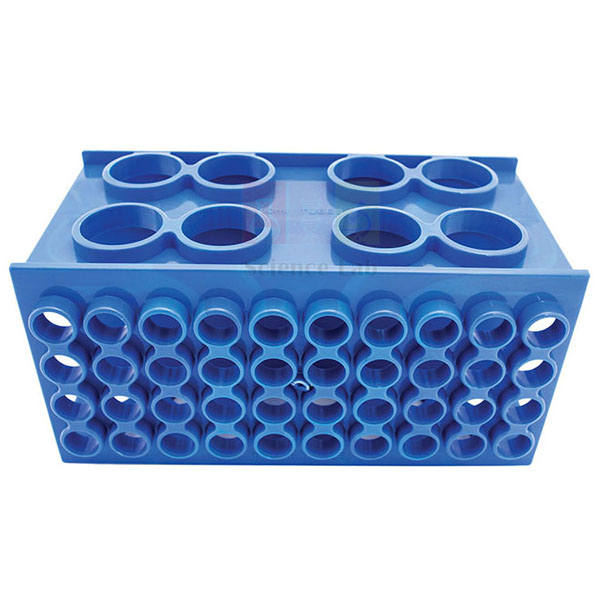
Universal Multi Rack
Universal Multi Rack (Product Code: SLE/CH/73) is a single rack that holds four different test tube sizes, so narrow tubes, standard tubes and wide tubes can share one compact footprint on the bench or in a cupboard. It is made from thick, sturdy plastic and designed for efficient storage. The rack is made by Jain Scientific Equipments Pvt Ltd (ScienceLab), Ambala, and is a practical test tube rack for school labs in India and international markets where mixed tube sizes are in daily use.
Specifications
| Parameter | Detail |
|---|---|
| Material | Thick, sturdy plastic |
| Tube sizes held | Four different sizes |
| 12 mm dia. tubes | 40 places |
| 15 mm outer dia. tubes | 24 places |
| 20 mm dia. tubes | 20 places |
| 50 mm dia. tubes | 8 places |
| Dimensions | 100 mm L x 95 mm W x 115 mm H |
| Design | Compact, for efficient storage |
Typical Use
Most practicals use more than one kind of tube — small tubes for spot reactions, standard test tubes for qualitative tests, larger tubes for heating or culture work. Instead of setting out several racks, one Universal Multi Rack keeps the whole set together, which frees bench space and makes it easier to see at a glance whether every tube has been returned after class.
The 40 small positions suit a full set of narrow tubes for a class demonstration, while the eight large positions take wide tubes or small bottles. Place the rack on a level surface away from the burner, and let hot tubes cool a little before standing them in the plastic. Labs that buy from a lab plastic ware supplier in India often pair it with single-size racks for bulk tube storage.
Manufacturer
ScienceLab is a brand of Jain Scientific Equipments Private Limited, registered with the Ministry of Corporate Affairs under CIN U29309HR2020PTC087597. The company manufactures laboratory and educational apparatus at its licensed factory in Saha, Ambala, Haryana, which holds Factory Licence AMB-ONLINE-CHD-J-414. Our company profile has further details.
Related Chemistry Lab Equipment
Tubes and accessories that go with a multi-size rack:
- Test Tube — standard tubes to fill the rack
- Universal Tube Rack — another rack option in our plasticware range
- Test Tube Holder — for handling tubes during heating
- Brush Test Tube — cleans tubes before they go back in the rack
- Drying Rack — drains washed tubes and glassware
See all racks and stands in the Chemistry Lab Equipment category.
Frequently Asked Questions
How many tubes does it hold?
It has 40 places for 12 mm tubes, 24 for 15 mm outer-diameter tubes, 20 for 20 mm tubes and 8 for 50 mm tubes.
Will my tubes fit?
Compare your tube outer diameters with the four sizes listed. If your tubes are close to a size limit, send us the diameters and we will confirm the fit before dispatch.
How much space does it take?
The rack measures 100 mm long, 95 mm wide and 115 mm high.
Can hot tubes go straight into it?
It is a plastic rack, so let tubes cool first rather than placing them in straight from the flame.
How should it be cleaned?
Wash with warm water and a mild detergent, rinse, and air-dry.
Can you share company registration details with a tender or purchase order?
Yes. Our CIN and factory licence details can be provided with the quotation for your records.
Do you supply class sets and export orders?
Yes, to schools, colleges and distributors across India and international markets.
Request a Quote
Ask for a price on the Universal Multi Rack via the contact page, or add it to the enquiry cart with the tubes and brushes you need.
Last updated: 24 September 2026
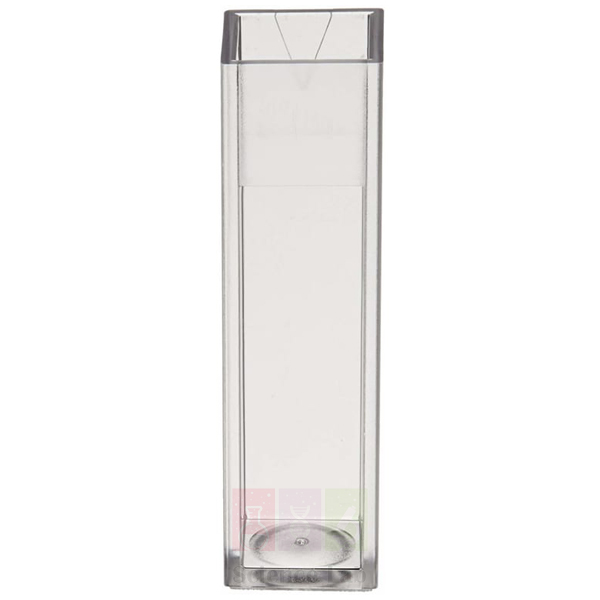
Cuvettes, Plastic
Cuvettes, Plastic (Product Code: SLE/CH/74) are small, clear-walled sample cells that hold a liquid in the light beam of a colorimeter or spectrophotometer, so its colour or absorbance can be measured. They are used in school, college and research labs for concentration measurements, reaction-rate studies and biochemical assays. These cuvettes are supplied by Jain Scientific Equipments Pvt Ltd (ScienceLab), Ambala, for labs that rely on a chemistry consumables supplier in India and international markets.
Key Details
| Parameter | Detail |
|---|---|
| Type | Plastic sample cuvette |
| Purpose | Holding liquid samples for colour and absorbance measurement |
| Suitable for | Colorimeters and spectrophotometers with a matching cuvette holder |
| Supplied as | Size, volume, path length and pack quantity confirmed on enquiry |
Typical Use
A classic practical is plotting a calibration line for a coloured solution such as copper sulphate: a blank cuvette of solvent sets the zero, then standards of known concentration are read one after another, and an unknown is measured against the resulting graph. Cuvettes are equally useful for following a colour change over time in rate experiments, or for reading enzyme and protein assays in biology and biochemistry.
Hold a cuvette only by the faces that are not in the light path, fill it to a consistent level, and wipe the clear faces with lint-free tissue before inserting it. Turn it the same way round in the holder every time. Plastic cuvettes are generally chosen for visible-light work; check with us before using them for UV measurements. Most labs keep a stock of them alongside other items from a lab consumables supplier in India.
Supplier
Plastic cuvettes are supplied by Jain Scientific Equipments Private Limited, which trades as ScienceLab from Ambala, Haryana, and manufactures a wide range of laboratory and teaching equipment. Visit our company profile to find out more.
Related Laboratory Equipment
Instruments and accessories used with cuvettes:
- Colorimeter — measures the colour intensity of the sample in the cuvette
- Digital Photo Colorimeter 5 Filters — a filter-based colorimeter for class practicals
- Single Beam Microprocessor UV-VIS Spectrophotometer — for wavelength-specific absorbance readings
- Plastic Microchemistry Pipets — for filling cuvettes cleanly
- Plastic Cuvettes — a further plastic cuvette listing in our measuring range
Further lab supplies are listed under Chemistry Lab Equipment.
Frequently Asked Questions
Will these cuvettes fit my instrument?
They are intended for colorimeters and spectrophotometers with a matching holder. Send us your instrument model through the contact page and we will confirm the fit.
Can they be used for UV readings?
Plastic cuvettes are typically used in the visible range. The wavelength range is not stated on this page, so ask us before planning UV work.
What volume and path length are they?
These details are not listed here and are confirmed on enquiry.
Are they reusable?
They can be rinsed and reused for routine classroom readings if the clear faces stay unscratched; replace any cuvette that is scratched or clouded, as it will affect results.
How are they packed and can I order in bulk?
Pack sizes are given in the quotation, and bulk quantities are supplied to institutions and distributors in India and international markets.
Request a Quote
Send your instrument model and required quantity via the contact page, or add Cuvettes, Plastic to the enquiry cart with any other lab supplies you need.
Last updated: 24 September 2026
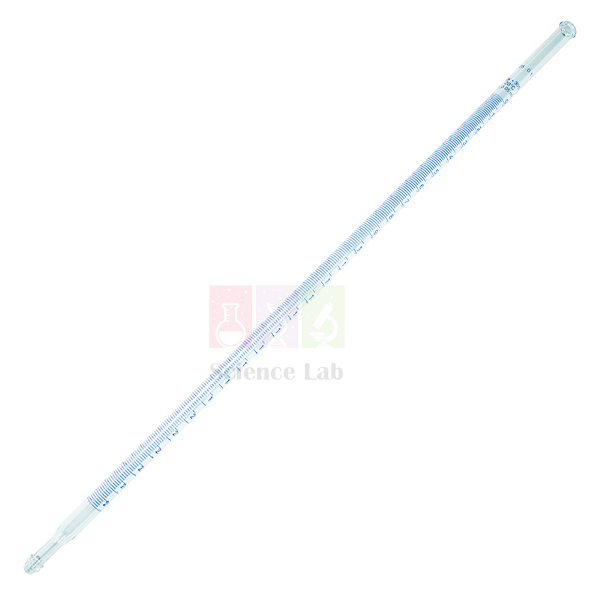
Open Manometer
The Open Manometer (Product Code: SLE/CH/75) is a borosilicate glass manometer tube with a long 50 cm arm and a funnel top, offered as the replacement tube for an open-type manometer. It turns an invisible pressure difference into a visible difference in liquid level, which is why teachers in school and college laboratories use it for practicals on gas and liquid pressure. It is made by Jain Scientific Equipments Pvt Ltd (ScienceLab), Ambala, as part of its chemistry lab equipment in India for schools, colleges and distributors.
Specifications
| Parameter | Detail |
|---|---|
| Type | Open manometer tube (replacement tube for the Open Manometer) |
| Material | Borosilicate glass |
| Arm length | 50 cm (19.7 in) |
| Top end | Funnel top for filling the manometric liquid |
| Supplied as | Glass tube; a stand, scale or tubing is not listed as included |
Typical Use
An open manometer compares a pressure with the atmosphere: one side is connected to the source under test while the other stays open to the air, and the gap between the two liquid levels shows how far the pressure is above or below atmospheric. The funnel top lets students pour in the liquid without spilling, and the 50 cm arm leaves enough height for a level difference that the whole class can read during demonstrations of gas supply pressure, breath pressure or pressure below a liquid surface.
For a steady reading, clamp the tube upright on a retort stand, tint the water with a few drops of food colouring, and connect the source with a short length of rubber tubing. Borosilicate laboratory glassware is chosen for its resistance to common laboratory chemicals and repeated washing; rinse the tube after each session and store it with the long arm supported so it cannot be knocked or bent under its own weight.
Manufacturer
This tube is produced by Jain Scientific Equipments Private Limited, which trades as ScienceLab and is based in Ambala, Haryana, India. The company makes laboratory glassware and teaching apparatus for educational institutions and distributors; read more on the company profile page.
Related Laboratory Equipment
Items usually set up alongside an open manometer for pressure demonstrations:
- Manometer, Glass — a complete glass manometer for physics pressure measurement
- U Tube Manometer — an alternative U-tube design for comparing two pressures
- Rubber Tube (Laboratory) — flexible tubing to connect the manometer to the source under test
- Retort Stand — holds the long arm vertical so levels are read correctly
- Food Colouring Blue — tints the water so the liquid levels stand out
See the complete Chemistry Lab Equipment range for more glassware, clamps and supports.
Frequently Asked Questions
What exactly is supplied under this listing?
The borosilicate manometer tube with a 50 cm (19.7 in) arm and funnel top, described as the replacement tube for the Open Manometer. A stand, scale and tubing are not listed as included, so please contact us to confirm the scope of supply before ordering.
Can it replace a broken tube on a manometer we already own?
That is its intended purpose. Whether it fits your existing board or clamps depends on your current mounting, so share its dimensions or a photo with us and we will advise.
Which liquid should be used inside?
Coloured water is the usual choice for school demonstrations because it is safe and easy to see. If your experiment needs a different manometric liquid, discuss it with your laboratory in-charge and with us before use.
How should the tube be cleaned?
Rinse it with clean water after every use. For stubborn residue, use a mild laboratory detergent, rinse thoroughly and let it drain dry in an upright position.
Is a calibration certificate available?
This is a direct-reading teaching item. If your institution needs any documentation, including calibration certificate availability, please raise it with us at the enquiry stage.
Do you supply schools in bulk or overseas?
Yes. ScienceLab supplies schools, colleges and distributors across India and international markets; tell us the quantity and delivery location for a quotation.
What warranty applies?
Warranty terms are confirmed with each quotation — contact us for current terms.
Request a Quote
To receive pricing for the Open Manometer, contact us with the quantity you need, or add it to your enquiry cart together with other laboratory items.
Last updated: 24 September 2026
144.jpg)
Steam Trap (Water Trap)
The Steam Trap (Water Trap) (Product Code: SLE/CH/76) is a standard component fitted into laboratory glassware set-ups to discharge condensate and non-condensable gases from a steam line. By catching the water that forms as steam cools in the connecting tubing, it keeps the flow of steam to the next vessel steady and stops that vessel from slowly flooding. Chemistry teachers, college demonstrators and research technicians use it when assembling steam distillation trains and similar laboratory distillation apparatus in India. It is made by Jain Scientific Equipments Pvt Ltd (ScienceLab), Ambala.
Key Details
| Parameter | Detail |
|---|---|
| Type | Steam trap, also called a water trap |
| Purpose | Discharges condensates and non-condensable gases |
| Used in | Laboratory glassware set-ups that carry steam |
| Suitable for | Teaching laboratories, college practicals and routine distillation work |
| Size and connections | Confirmed on enquiry |
Typical Use
In steam distillation, steam produced in one flask travels through tubing into a second flask that holds the mixture being separated. Some of that steam condenses on the way, and without a trap the water collects in the distilling flask and dilutes the charge. Placed between the steam source and the distilling flask, the trap separates this condensate, and also lets air and other gases that will not condense leave the line so the steam flow is not interrupted.
Mount the trap at a low point of the steam line so condensate drains into it naturally, keep the connecting tubing short, and empty the collected water between runs. Students should handle it with care once the set-up is hot, because steam burns can occur even when the glass looks clear. Pairing a trap with a Liebig condenser and a two-neck round bottom flask gives a complete, classroom-friendly distillation train.
Manufacturer
ScienceLab is the brand name of Jain Scientific Equipments Private Limited, a manufacturer of laboratory and teaching equipment located in Ambala, Haryana, India. Details of the company and its product lines are available on our company profile.
Related Chemistry Lab Equipment
Other parts of a steam or simple distillation train:
- Distillation Apparatus — the core distillation set into which the steam line feeds
- Fractional Distillation Assembly — for separating liquids with closer boiling points
- Liebig Condenser — condenses the distillate after the distilling flask
- Round Bottom Flask With Two Neck — allows steam inlet and vapour outlet on one flask
- Silicone Tube — flexible tubing for connecting the steam line
Browse all Chemistry Lab Equipment for further glassware and accessories.
Frequently Asked Questions
What does a steam trap do in a glassware set-up?
It removes condensate and non-condensable gases from the steam line, so mostly steam reaches the next vessel and the flow remains steady.
Where should it be placed?
Between the steam generator and the flask receiving the steam, ideally at a low point so the condensed water runs into it.
What size and joint type is it?
Dimensions, material details and connection type are not stated in our current listing. Please contact us with details of your apparatus so we can confirm a compatible trap.
Is it suitable for school practicals?
Yes, it is a standard item for glassware set-ups and suits supervised school and college distillation work.
How is it cleaned after use?
Let it cool completely, drain the water, rinse with clean water and allow it to dry before storage.
What information do you need for an institutional quotation?
Send the quantity, the rest of your distillation set-up, and the delivery location through our contact page or enquiry cart.
Can you ship it outside India?
Yes, we supply customers across India and international markets; shipping arrangements are confirmed with the quotation.
Request a Quote
For prices and availability of the Steam Trap (Water Trap), please send us an enquiry or place it in the enquiry cart with the rest of your distillation equipment.
Last updated: 24 September 2026
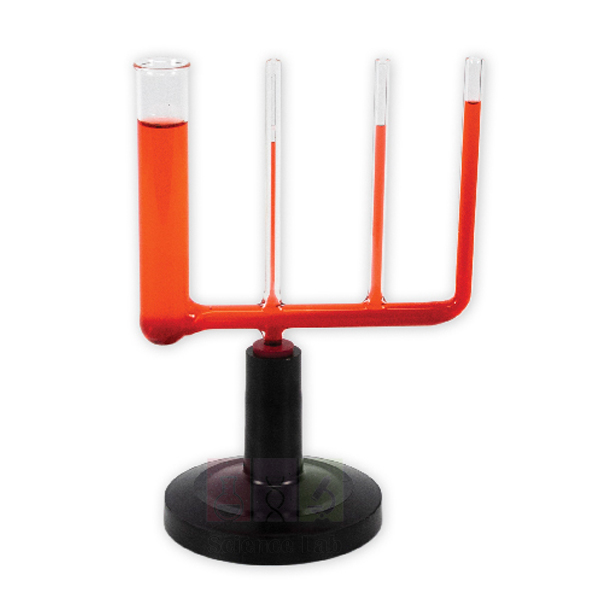
Capillary Tube Set
The Capillary Tube Set (Product Code: SLE/CH/77) is a ready-mounted demonstration piece in which 4 glass capillary tubes of different inner diameters rise from a common, larger reservoir tube. Pour in a liquid and the class sees at once that it climbs highest in the narrowest bore, giving students the evidence they need to draw their own conclusions about capillary action. Designed for middle-school and secondary science teachers, it is made by Jain Scientific Equipments Pvt Ltd (ScienceLab), Ambala, and arrives on its own stand with a Teacher’s Guide.
Specifications
| Parameter | Detail |
|---|---|
| Number of capillary tubes | 4, each with a different inner diameter |
| Tube material | Glass |
| Reservoir | Larger tube from which the capillaries rise |
| Tube height | Approx. 150 mm (6 in) |
| Mounting | Mounted on its own stand |
| Documentation | Teacher’s Guide included |
Typical Use
Because all four capillaries share one reservoir, the liquid starts at the same level in each, so any height difference can only come from the tube width. That makes the set a clear, fair-test capillary tube experiment: students record the level in each tube, rank them by bore, and relate the result to adhesion between water and glass and to surface tension. The same observation helps explain how water rises through soil, paper towels and the xylem of plants, linking chemistry and physics lessons to biology.
Stand the set on a level bench, fill the reservoir slowly so no air bubbles lodge in the narrow tubes, and add a drop of food colouring so the columns can be seen from the back of the room. Comparing plain water with soapy water is a simple extension that shows how lowering surface tension changes the rise.
Manufacturer
The set is made by Jain Scientific Equipments Private Limited, trading as ScienceLab, from its base in Ambala, Haryana, India, where it produces glass apparatus and demonstration equipment for science teaching. The company is a registered MSME enterprise (Udyam UDYAM-HR-01-0003714) and holds Importer-Exporter Code AAECJ8618A from the Directorate General of Foreign Trade for export consignments. Visit the company profile to learn more.
Related Laboratory Equipment
Useful additions for capillarity and surface-tension lessons:
- Food Colouring Red — colours the water so each liquid column is easy to read
- Dropper Bottle, 10 ml — for adding colouring or detergent a drop at a time
- Capillary Tube Apparatus — a physics set-up for measuring capillary rise in more detail
- Set of Capillary Tubes — loose capillaries for student group work
More demonstration apparatus is listed under Chemistry Lab Equipment.
Frequently Asked Questions
How many capillary tubes are in the set?
Four glass capillary tubes, each with a different inner diameter, rising from one larger reservoir tube.
Does it need a separate stand?
No. The set comes mounted on its own stand, so it can be placed directly on the bench.
Is teaching guidance included?
Yes, a Teacher’s Guide is supplied with the set to help plan the demonstration and discussion.
What liquid works best?
Coloured water is ideal for classrooms. Avoid leaving coloured or sugary liquids to dry inside the narrow tubes, as residue can block them.
How do I clean the capillaries?
Flush the reservoir with clean water several times so fresh water rises through each capillary, then let the set drain and dry upright.
Can you supply sets for every lab in a school group?
Yes, bulk orders for schools, colleges and distributors in India and international markets are welcome — share quantities through our contact page.
What about warranty on the glass parts?
Warranty terms are confirmed at quotation. Contact us for details.
Request a Quote
Ask for a price on the Capillary Tube Set through our contact form, or collect it in the enquiry cart with your other science lab requirements.
Last updated: 24 September 2026
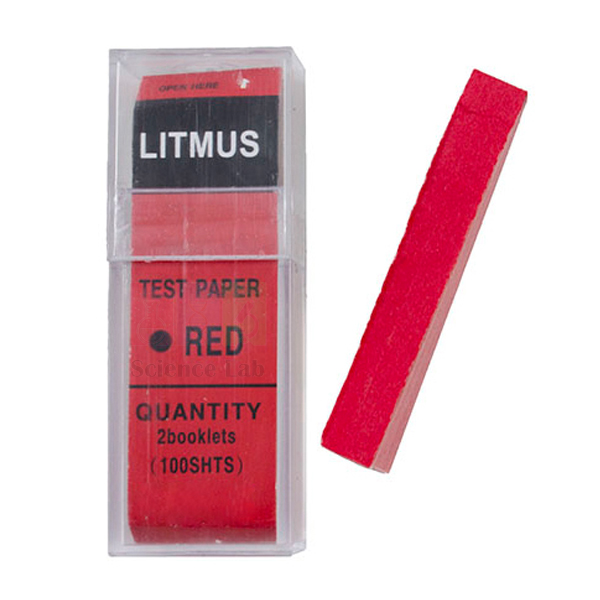
Red Litmus Paper
Red Litmus Paper (Product Code: SLE/CH/78) is an indicator test strip used to show whether a solution is alkaline in introductory acid–base lessons in school and college chemistry laboratories. The easy-to-use strips turn blue when dipped into an alkaline or basic solution and come 100 strips per vial, a staple among litmus paper for school labs in India. They are supplied by Jain Scientific Equipments Pvt Ltd (ScienceLab), Ambala, India.
Specifications
| Parameter | Detail |
|---|---|
| Type | Red litmus test strips |
| Indication | Turns blue in alkaline/basic solutions |
| Pack | 100 strips per vial |
| Handling | Easy to use; no preparation needed |
| Suitable for | Introductory acid–base lessons and quick bench tests |
| Shelf life | Depends on the chemical, its grade and storage conditions; ask us for the expiry date of the batch you are quoted |
| Product code | SLE/CH/78 |
| Supplied by | Jain Scientific Equipments Pvt Ltd (ScienceLab), Ambala, India |
What Is Red Litmus Paper Used For?
Red litmus answers one question: is this sample a base? Students touch a strip with a drop of the test liquid on a clean glass rod, and a blue patch confirms an alkaline solution such as soap water, lime water or a solution of baking soda. If the strip stays red, the sample is either acidic or neutral, which is why teachers pair it with blue litmus in an acid base indicator activity to sort samples into all three groups. Moistened red litmus held at the mouth of a test tube is also the classic check for alkaline gases such as ammonia.
Tear strips in half to make a vial last through more lab sessions, use a fresh piece for every sample, and keep the vial tightly closed and away from bottles of ammonia or other alkalis, because vapours in the air can turn unused strips blue. Handle strips with dry fingers or forceps so moisture does not spoil the rest of the vial.
Supplier
Red Litmus Paper is supplied by Jain Scientific Equipments Private Limited, which trades as ScienceLab from Ambala, Haryana, India. Indicator papers and other chemistry consumables are sourced for schools, colleges and distributors and can be quoted together with laboratory apparatus for India and international markets. Find out more on the company profile.
Related Chemistry Lab Equipment
Items used in the same acid–base testing activities:
- Blue Litmus Paper — the partner strip that identifies acids
- Paper, Universal, pH 1-14 — shows how strongly acidic or basic a sample is
- Stirring Rod, Glass — transfers a single drop of sample onto the strip
- Dropper Bottle, 10 ml — holds test solutions at each student station
- Magnesium Ribbon — burn it and test the dissolved ash with red litmus to show a basic oxide
The full Chemistry Lab Equipment range has more indicators and bench tools.
Frequently Asked Questions
How many strips are in one vial of Red Litmus Paper?
Each vial of Red Litmus Paper contains 100 strips. Tearing strips in half stretches a vial across more practical sessions, so tell us how many vials each lab needs when you request a quotation.
What does a colour change on Red Litmus Paper mean?
A change from red to blue on Red Litmus Paper means the sample is alkaline (basic). If the strip stays red, the sample is either acidic or neutral, and blue litmus paper is then used to tell those two apart.
Can Red Litmus Paper give a pH value?
No. Red Litmus Paper only shows whether a sample is basic; it does not indicate how strongly acidic or alkaline it is. For an approximate pH number, use universal indicator paper or solution read against a pH chart.
Can Red Litmus Paper detect gases?
Yes. When moistened with distilled water, Red Litmus Paper responds to alkaline gases, and holding it at the mouth of a test tube to detect ammonia is the common example in school salt analysis.
What is the shelf life of Red Litmus Paper?
Shelf life depends on the chemical, its grade and storage conditions, so no blanket period is given for Red Litmus Paper. Ask us for the expiry date of the batch you are quoted, and keep vials closed, dry and away from ammonia fumes.
Who supplies Red Litmus Paper?
Red Litmus Paper is supplied by Jain Scientific Equipments Pvt Ltd (ScienceLab), Ambala, Haryana, India, in vials of 100 strips, for schools, colleges and distributors in India and international markets, alongside other indicators and chemistry consumables.
Can you supply Red Litmus Paper for a whole school or distributor?
Yes. Red Litmus Paper is supplied in larger quantities to institutions and distributors across India and international markets. Share the number of vials and your delivery location through the contact page to receive a quotation.
Request a Quote
To order Red Litmus Paper, contact us with the number of vials needed or add it to the enquiry cart along with other chemistry consumables.
Last updated: 24 September 2026
Blue Litmus Paper
Blue Litmus Paper (Product Code: SLE/CH/79) is a vial of easy-to-use indicator strips that turn red when dipped into an acidic solution. Students in their first acids-and-bases unit use it to confirm that vinegar, lemon juice or a dilute mineral acid really is acidic, and laboratory staff keep it on hand as a fast pH indicator paper for spotting acid spills and residues. Each vial holds 100 strips, supplied by Jain Scientific Equipments Pvt Ltd (ScienceLab), Ambala.
Specifications
| Parameter | Detail |
|---|---|
| Type | Blue litmus test strips |
| Indication | Turns red in acidic solutions |
| Quantity | 100 strips per vial |
| Ease of use | Dip-and-read, no preparation |
| Intended for | Introductory chemistry lessons on acids and bases |
Typical Use
A common starter practical gives each group a tray of household and laboratory liquids and asks them to find the acids. A strip that turns red identifies an acid; a strip that stays blue tells students the sample is neutral or basic, and a second test with red litmus separates those two. Moistened blue litmus also responds to acidic gases, so it is used during gas tests in qualitative analysis, for example over a test tube releasing hydrogen chloride.
Place a strip on a white tile and add the sample with a clean dropper or glass rod rather than dipping the whole strip into a stock bottle, which avoids contaminating reagents. Store vials capped and well away from acid bottles, as acidic fumes in a busy lab can redden strips before they are used. For a class set, a single vial can be shared between several groups by cutting strips into shorter pieces.
Supplier
Blue Litmus Paper is supplied by Jain Scientific Equipments Private Limited under its trading name ScienceLab. The company is based in Ambala, Haryana, India, and equips school and college laboratories; more is on our company profile.
Related Chemistry Lab Equipment
Pair these with blue litmus when setting up an acid identification practical:
- Red Litmus Paper — completes the test by identifying bases
- Paper, Universal — for estimating how acidic a sample is
- Blue Litmus Solution — the liquid indicator form for test-tube work
- Dropper Bottle, Clear — dispenses samples a drop at a time
- Test Tube Racks — keeps labelled sample tubes upright during testing
Explore more indicators and glassware in Chemistry Lab Equipment.
Frequently Asked Questions
What colour change shows an acid?
The strip turns from blue to red when the sample is acidic.
What if the strip does not change colour?
The sample is neutral or basic. Test it with red litmus paper, which turns blue for bases.
How many strips does a vial contain?
100 strips per vial.
Is blue litmus paper enough to measure pH?
No, it only tells you whether a sample is acidic. Universal indicator paper gives an approximate pH value.
Why have some strips turned red in the vial?
They have been exposed to acidic fumes or moisture. Keep the vial closed and stored away from acids.
What should an institutional enquiry include?
The number of vials, whether you also need red litmus or universal paper, and your delivery location in India or overseas. Send it via our contact page.
Request a Quote
For Blue Litmus Paper pricing, get in touch or add the vials to your enquiry cart and submit them with the rest of your order.
Last updated: 24 September 2026

Pascal's Principle Demonstrator
Pascal's Principle Demonstrator (Product Code: SLE/CH/80) is a glass-bulb and piston apparatus used to show that pressure applied to a confined liquid is transmitted equally in all directions, in school physics lessons. Teachers fill it with water and push the piston, and jets squirt out of every hole in the 50 mm borosilicate bulb with equal reach. It is made by Jain Scientific Equipments Pvt Ltd (ScienceLab), an OEM manufacturer, at its own factory in Ambala, India, as part of its physics lab equipment range.
Specifications
| Parameter | Detail |
|---|---|
| Principle demonstrated | Pascal's law: liquid pressure is transmitted equally in all directions |
| Bulb | Borosilicate glass, 50 mm (2 in) diameter, with holes |
| Operation | Filled with water and pressurised by pushing the piston |
| Overall height | Approx. 250 mm (10 in) |
| Product code | SLE/CH/80 |
| Manufacturer | Jain Scientific Equipments Pvt Ltd (ScienceLab) — OEM |
| Country of origin | India (made in Ambala, Haryana) |
What Is the Pascal's Principle Demonstrator Used For?
It is the quickest way to introduce fluid pressure before moving on to hydraulic lifts, car brakes and hydraulic presses, which all rely on the same principle. Ask the class to predict whether water will leave only the hole in line with the piston; when every jet emerges with the same reach, they have seen for themselves that pressure acts equally throughout the liquid. Older students can then link the demonstration to calculations of force and area, and schools building up their physics lab equipment in India often teach it alongside buoyancy and manometer work.
Carry out the demonstration over a sink or a large tray, because water sprays in several directions at once. Press the piston smoothly rather than forcefully so the glass bulb is not stressed, and hold the unit so the jets point away from observers. Empty and dry the demonstrator after use so no water is left standing in the bulb.
OEM Manufacturer
ScienceLab is the trading name of Jain Scientific Equipments Private Limited, the OEM (original equipment manufacturer) of this demonstrator. The apparatus is made and assembled at the company's own licensed factory at Saha, Ambala, Haryana, India, rather than bought in from a trader. Schools, colleges, institutions, dealers and importers are supplied factory-direct, so questions about a replacement bulb or other spare parts go straight to the maker — just ask us. Read more on our company profile.
Related Laboratory Equipment
Other apparatus for a unit on pressure in fluids:
- Pascal's Sphere — a hollow sphere with nozzles and a hand pump, an alternative design for the same law
- Set to Demonstrate Archimedes’ Principle/Law — the natural next lesson on buoyancy
- Bernoulli Tube Apparatus — extends the topic to pressure in moving fluids
- Manometer, Glass — lets students measure pressure differences in liquids
Further apparatus is listed in our Chemistry Lab Equipment category.
Frequently Asked Questions
What does the Pascal's Principle Demonstrator show?
The Pascal's Principle Demonstrator shows Pascal's law: pressure applied to a confined liquid is transmitted equally in every direction. When the piston is pushed, water leaves every hole in the glass bulb with the same force, so students see the principle at a glance.
How big is the Pascal's Principle Demonstrator?
The Pascal's Principle Demonstrator has a borosilicate glass bulb 50 mm (2 in) in diameter, and the complete unit stands approx. 250 mm (10 in) high, compact enough for a front-bench demonstration in an ordinary classroom.
Does it need power or extra accessories?
No. The Pascal's Principle Demonstrator works by hand: fill it with water and push the piston. The only extras needed are water and a sink or large tray to catch the jets, because water sprays out in several directions at once.
Can students operate it themselves?
Yes, under teacher supervision. Students can push the piston of the Pascal's Principle Demonstrator themselves, but remind them to press smoothly rather than forcefully, because the bulb is glass, and to aim the jets away from other people.
Who manufactures the Pascal's Principle Demonstrator?
Jain Scientific Equipments Private Limited (ScienceLab) is the OEM that manufactures the Pascal's Principle Demonstrator at its own factory in Saha, Ambala, Haryana, India, and supplies it factory-direct to schools, colleges, dealers and importers in India and international markets.
Can I get a replacement glass bulb?
Ask us. Because ScienceLab manufactures the Pascal's Principle Demonstrator itself, requests for a replacement bulb or other spare parts go straight to the maker; quote product code SLE/CH/80 on our contact page and we will confirm what can be supplied.
What should a quotation request include?
For a quotation on the Pascal's Principle Demonstrator, give the product code SLE/CH/80, the number of units, any other fluid-pressure apparatus wanted on the same order, and the delivery location in India or abroad.
Request a Quote
Quotations for the Pascal's Principle Demonstrator come directly from the manufacturer. Send your requirement through our contact page, or save it in the enquiry cart while you plan the rest of your fluids lesson kit.
Last updated: 24 September 2026
Magnesium Ribbon
Magnesium Ribbon (Product Code: SLE/CH/82) is a thin strip of magnesium metal, 0.03 mm (0.0012 in) thick, used for combustion experiments and to demonstrate the principles of chemical change. When a short piece is lit it burns with a dazzling white flame and leaves a white powder that is clearly a new substance — the classic opening experiment for chemical reactions in secondary science. It is a flammable solid and is supplied by Jain Scientific Equipments Pvt Ltd (ScienceLab), Ambala, alongside the other lab chemicals and consumables schools order from us.
Specifications
| Parameter | Detail |
|---|---|
| Material | Magnesium metal, ribbon form |
| Thickness | 0.03 mm (0.0012 in) |
| Hazard classification | Flammable solid |
| Uses | Combustion experiments; demonstrating chemical changes |
| Pack length / weight | Confirmed on enquiry |
Typical Use
In the standard practical, students clean a few centimetres of ribbon with sandpaper to remove the dull oxide coating, grip it with crucible tongs and hold it in a Bunsen flame. It ignites and burns brightly, forming magnesium oxide; dissolving that ash in a little water and testing it with red litmus shows the oxide of a metal is basic. The same ribbon is used to compare the reactivity of metals with dilute acids, where the fizzing of hydrogen gives a visible sign of reaction.
Safety matters with this flammable solid: tell students not to stare directly at the burning metal, carry out burning over a heat-resistant mat, and wear safety goggles. Never try to put out burning magnesium with water — let it burn out or smother it with dry sand. Store the ribbon in a closed container, in a cool dry place away from open flames and oxidising chemicals.
Supplier
Magnesium Ribbon is supplied by Jain Scientific Equipments Private Limited, trading as ScienceLab, based in Ambala, Haryana, India. Alongside its own apparatus, the company provides chemicals and consumables for school and college laboratories; see the company profile.
Related Chemistry Lab Equipment
What you need to run the magnesium burning experiment safely:
- Crucible Tong — holds the ribbon at a safe distance while it burns
- Bunsen Burner — provides the flame to ignite the ribbon
- Sand Paper Sheets — removes the oxide layer so the ribbon lights readily
- Red Litmus Paper — shows that the dissolved magnesium oxide is basic
- Safety Goggles — eye protection for students near the bright flame
Find more reagents and apparatus in Chemistry Lab Equipment.
Frequently Asked Questions
How thick is the ribbon?
It is 0.03 mm (0.0012 in) thick.
How much ribbon is in one pack?
Pack length or weight is not stated in our current listing. Contact us and we will confirm the pack sizes available.
Why does the ribbon sometimes fail to light?
Magnesium develops a thin oxide coating in air. Rub it with sandpaper until it is shiny before holding it in the flame.
Is it safe for school use?
Yes, with supervision and eye protection. It is classed as a flammable solid, so keep it away from flames when not in use and never use water on burning magnesium.
How should it be stored?
In a closed container in a cool, dry chemical store, separate from oxidising agents.
Can you ship it internationally?
Because it is a flammable solid, transport is regulated. We supply customers in India and international markets, but shipping options must be confirmed with us before an export order is placed.
Request a Quote
For Magnesium Ribbon prices and pack options, please contact us or add it to your enquiry cart with the rest of your chemistry order.
Last updated: 24 September 2026
Electrode, Carbon, Pair
The Electrode, Carbon, Pair (Product Code: SLE/CH/83) is a set of carbon electrodes designed as replacement parts for the Hoffman Electrolysis Apparatus. Each pair comes with insulated lead wires and stoppers, so a laboratory can restore a voltameter whose electrodes have worn or broken without replacing the whole glass assembly. It is used by chemistry teachers and lab assistants maintaining electrolysis apparatus in India and overseas, and is made by Jain Scientific Equipments Pvt Ltd (ScienceLab), Ambala.
Specifications
| Parameter | Detail |
|---|---|
| Electrode material | Carbon |
| Quantity | One pair |
| Included | Carbon electrodes, insulated lead wires and stoppers |
| Designed for | Replacement in the Hoffman Electrolysis Apparatus |
Typical Use
In a Hoffman voltameter the electrodes sit at the bottom of the two side limbs, sealed in by stoppers, while the gases produced collect above them. Carbon is chosen because it conducts well yet does not dissolve in most electrolytes, which makes it well suited to electrolysing salt solutions such as brine, where the chlorine released at the anode would attack many metal electrodes. Students can then measure gas volumes in each limb and relate them to the ions discharged at each electrode.
To fit a new pair, drain and rinse the apparatus, push each stopper firmly into its limb so it seals without leaking, and route the insulated leads to a low-voltage DC supply, noting which electrode is the anode. Carbon anodes slowly wear during long oxygen-producing runs, so keeping a spare pair among your lab equipment spare parts avoids cancelled practicals. After use, rinse the electrodes with distilled water and let them dry before storage.
Manufacturer
These electrodes are made by Jain Scientific Equipments Private Limited, known by its trading name ScienceLab, headquartered in Ambala, Haryana, India. The company supplies complete apparatus as well as the spares that keep it running; see our company profile.
Related Chemistry Lab Equipment
Apparatus and alternatives for electrolysis practicals:
- Hoffman Electrolysis Apparatus — the complete apparatus these electrodes are made for
- Hoffman Voltameter — the glass voltameter used for gas-volume electrolysis
- Electrode Platinum — an inert metal alternative for water electrolysis
- Electrode, Carbon Rod — loose carbon rods for beaker-scale electrolysis
- Power Supply Variable — a DC source to drive the electrolysis
See all items in Chemistry Lab Equipment.
Frequently Asked Questions
What is included in the pair?
Two carbon electrodes together with insulated lead wires and stoppers.
Will these fit my existing Hoffman apparatus?
They are designed as replacement parts for the Hoffman Electrolysis Apparatus. If your apparatus came from another source, send us the limb and stopper size through our contact page so we can check the fit.
Why use carbon instead of metal electrodes?
Carbon is inexpensive and resists attack in many electrolytes, including chloride solutions. Platinum electrodes are the choice when the purest gases are required.
Is a power supply included?
No. Connect the leads to a separate low-voltage DC supply.
How long do carbon electrodes last?
Life depends on the electrolyte, current and running time; the anode wears fastest when oxygen is produced. We recommend keeping a spare pair.
Can spares be ordered in quantity for several labs?
Yes, we supply schools, colleges and distributors across India and international markets. Share quantities and delivery location for a quotation.
Request a Quote
To order replacement carbon electrodes, contact us or add them to your enquiry cart together with any other electrolysis apparatus you need.
Last updated: 24 September 2026
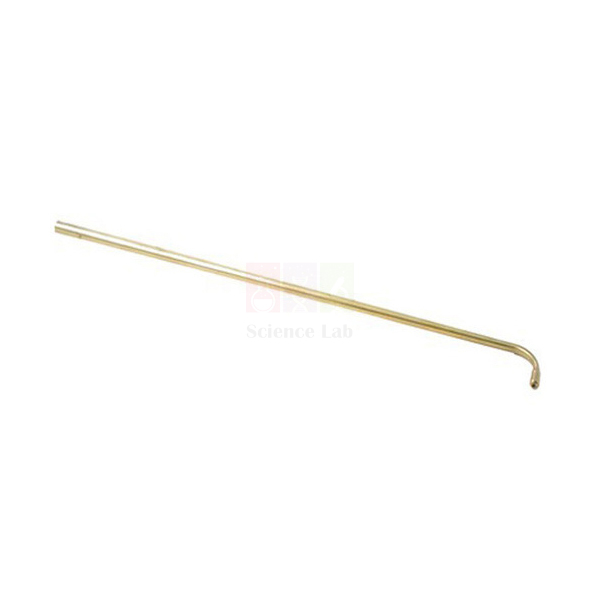
Blow Pipe Brass
The Blow Pipe Brass (Product Code: SLE/CH/84) is a cylindrical brass tube, 12 inches long in a single piece, with a galvanised surface finish. By blowing a steady stream of air through it into a flame, a student turns a broad burner flame into a small, intensely hot pointed flame that can be aimed at a sample. It remains a standard tool for the charcoal block tests of dry qualitative analysis in school chemistry lab equipment sets across India. It is made by Jain Scientific Equipments Pvt Ltd (ScienceLab), Ambala.
Specifications
| Parameter | Detail |
|---|---|
| Material | Brass |
| Shape | Cylindrical |
| Single piece length | 12 inch |
| Surface finish | Galvanised |
Typical Use
In the charcoal cavity test, a pinch of the salt is mixed with sodium carbonate, packed into a small hollow in a charcoal block, and heated with a blowpipe flame. The colour of the residue, any metallic bead and any incrustation help identify the metal ion, which is why the blowpipe features in salt analysis practicals for senior secondary and first-year college students. Holding the nozzle just outside the burner flame produces a reducing flame, while pushing it slightly into the flame gives an oxidising flame, so students learn to see both effects on the same sample.
The trick is to breathe through the nose while using puffed cheeks to push air through the pipe, giving a long, even blast rather than short puffs. Work over a heat-resistant surface, keep hair and sleeves clear of the flame, and allow the brass tip to cool before handing the pipe to the next student. Wipe the mouthpiece with alcohol between users for hygiene.
Manufacturer
This blowpipe comes from Jain Scientific Equipments Private Limited, whose products carry the ScienceLab name. The company is located in Ambala, Haryana, India, and manufactures metal and glass laboratory apparatus; visit the company profile for more.
Related Chemistry Lab Equipment
Everything needed for blowpipe and charcoal block tests:
- Charcoal Block — the support in which the sample is heated
- Bunsen Burner — supplies the flame the blowpipe directs
- Glass Spirit Lamp — a flame source for labs without a gas line
- Blow Pipe — an alternative blowpipe listed in our biology range
- Safety Goggles — protects eyes from spitting residue during heating
For more qualitative analysis apparatus, visit Chemistry Lab Equipment.
Frequently Asked Questions
What is the blow pipe made of?
Brass, in a cylindrical form with a galvanised surface finish.
How long is it?
12 inches, made as a single piece.
Which flame source can it be used with?
Any small laboratory flame, such as a Bunsen burner or spirit lamp, that can be directed onto a charcoal block.
How do I get a reducing or an oxidising flame?
Place the tip just outside the flame for a reducing flame, and slightly inside it for an oxidising flame.
How should it be cleaned?
Wipe the outside and the mouthpiece with alcohol after use and let it dry; avoid bending the tube.
What information is needed for a school or tender quotation?
Quantity, any matching items such as charcoal blocks, and the delivery location. Send them through our contact page or enquiry cart.
Do you supply outside India?
Yes, we supply customers across India and international markets.
Request a Quote
To buy the Blow Pipe Brass, send an enquiry or add it to your enquiry cart along with charcoal blocks and burners.
Last updated: 24 September 2026
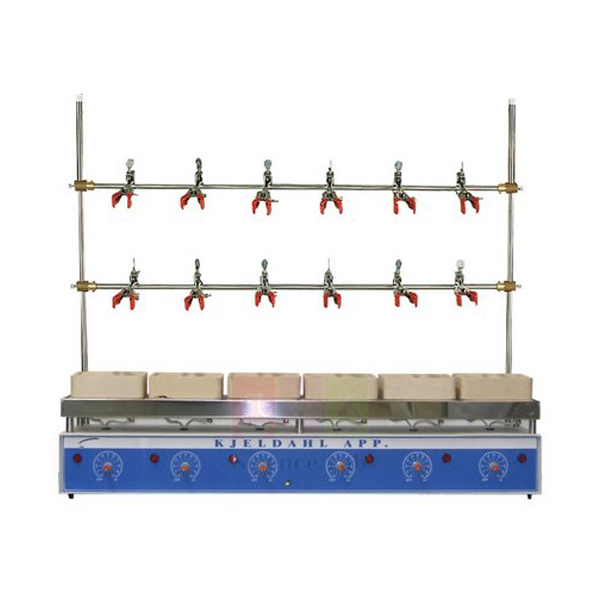
Kjeldahl Distillation Digestion Unit
The Kjeldahl Distillation Digestion Unit (Product Code: SLE/CH/85) combines both stages of the Kjeldahl nitrogen method on one stand: a set of mantle-type heating platforms for digestion and a second set for distillation. It is used in agricultural, food, dairy and pharmacy laboratories to determine total nitrogen and, from it, protein content. Offered in 3-test and 6-test versions with an energy regulator for every position, this Kjeldahl digestion unit is made by Jain Scientific Equipments Pvt Ltd (ScienceLab), Ambala, for colleges and testing laboratories in India and international markets.
Specifications
| Parameter | Detail |
|---|---|
| Heating platforms | Two sets of mantle-type heating platforms – one for digestion, one for distillation |
| Versions | 3 tests mantle type with 3 energy regulators; 6 tests mantle type with 6 energy regulators |
| Temperature control | Both units supplied with individual energy regulators |
| Fittings | Condenser rack, lead fume duct and a pair of hangers |
| Stand | Mild steel sheet tubular stand |
| Power supply | 220 V AC, 50 Hz, single phase |
Typical Use
In the digestion stage, samples such as grain, feed, soil or milk are heated with concentrated sulphuric acid in Kjeldahl flasks on the digestion mantles, converting organic nitrogen into ammonium sulphate while the acid fumes are drawn away through the lead fume duct. The cooled digest is then made alkaline and heated on the distillation mantles, and the released ammonia passes through condensers on the rack into a receiving flask of standard acid, where it is determined by titration. Having both stages on one stand keeps the workflow compact for teaching labs and routine testing.
Choose the 3-test unit for teaching demonstrations and small sample loads, or the 6-test unit when a class or quality-control lab processes several samples in one run. Because each position has its own energy regulator, operators can bring flasks up to temperature gradually and avoid frothing. Run the digestion under good ventilation, let flasks cool before moving them, and connect the unit to a properly earthed 220 V AC supply.
Manufacturer
ScienceLab is the trading name of Jain Scientific Equipments Private Limited (CIN U29309HR2020PTC087597), based in Ambala, Haryana, India. The company manufactures laboratory equipment at its licensed factory at 449, HSIIDC Industrial Area, Saha, Ambala (Factory Licence AMB-ONLINE-CHD-J-414). More about the company is on our company profile.
Related Chemistry Lab Equipment
Glassware and equipment used with the unit in a Kjeldahl analysis:
- Liebig Condenser — condenses the ammonia vapour during distillation
- Conical Flask — receiving flask for the distillate and for titration
- Burette — for titrating the collected ammonia
- Fume Cupboard, Ductless — extra fume protection during acid digestion
- Distillation Apparatus — a general distillation set for other laboratory separations
Browse related apparatus in Chemistry Lab Equipment.
Frequently Asked Questions
What versions are available?
A 3-test mantle-type unit with 3 energy regulators and a 6-test mantle-type unit with 6 energy regulators.
What is included with the unit?
Digestion and distillation heating platforms, a condenser rack, a lead fume duct and a pair of hangers, all on a mild steel sheet tubular stand.
Are Kjeldahl flasks and condensers supplied?
Glassware is not listed as part of the unit. Please contact us to confirm which flasks and condensers can be quoted with it.
What power supply does it need?
220 V AC, 50 Hz, single phase. If your site uses a different supply, tell us before ordering.
Is a calibration certificate available?
Calibration certificate availability should be discussed with us when you enquire, together with any other documentation your laboratory needs.
What warranty is offered?
Warranty terms are confirmed with the quotation — contact us for current terms.
What should an institutional or export quotation request include?
The version (3 or 6 tests), quantity, supply voltage at your site, and delivery location in India or abroad.
Request a Quote
For a price on the Kjeldahl Distillation Digestion Unit, contact us with the version you need, or add it to your enquiry cart and submit it with any glassware requirements.
Last updated: 24 September 2026

Beaker Tongs
Beaker Tongs (Product Code: SLE/CH/86) let students and technicians lift hot beakers off a hot plate, tripod or water bath without touching the glass. Made of nickel-plated steel, they are 25 cm (10 in) long and have plastic coated jaws that open up to 11 cm (4.5 in), wide enough to grip beakers from 100 ml up to 1000 ml. A basic safety item in any school chemistry lab equipment list in India, they are made by Jain Scientific Equipments Pvt Ltd (ScienceLab), Ambala.
Specifications
| Parameter | Detail |
|---|---|
| Material | Nickel-plated steel |
| Overall length | 25 cm (10 in) |
| Jaws | Plastic coated |
| Maximum jaw opening | 11 cm (4.5 in) |
| Beaker capacity range | 100 ml up to 1000 ml |
Typical Use
Whenever a beaker has been heated — boiling water for a water bath, evaporating a salt solution, or warming a reaction mixture — it must be moved with tongs rather than fingers. The 25 cm length keeps the hand well above rising steam, and the coated jaws grip the curved wall of the beaker firmly without scratching the glass. With one pair covering everything from a small 100 ml beaker to a 1000 ml beaker, a lab can equip each bench with a single tool instead of several sizes.
Close the jaws around the body of the beaker below the rim, lift slowly and keep the beaker level so hot liquid does not slop over the lip. Set it down on a heat-resistant mat rather than a cold, wet bench, which can crack hot glass. Do not rest the tongs on a hot plate or in a flame, as the plastic coating is there for grip and is not meant to be heated directly.
Manufacturer
Beaker Tongs are manufactured by Jain Scientific Equipments Private Limited, better known by its brand ScienceLab, from Ambala, Haryana, India. Learn more about the company on the company profile page.
Related Laboratory Equipment
Equipment used with beaker tongs when heating liquids:
- Glass Beaker — the vessels these tongs are designed to handle
- Hot Plate General Purpose — a common heat source for beakers
- Tripod, Stainless Steel — supports a beaker over a burner flame
- Gauze Wire, Ceramic Centre — spreads the flame evenly under the beaker
- Flask Tongs — the matching tool for hot conical and round flasks
More handling tools are listed in Chemistry Lab Equipment.
Frequently Asked Questions
What beaker sizes can these tongs hold?
Beakers from 100 ml up to 1000 ml; the jaws open to 11 cm (4.5 in).
What are the tongs made of?
Nickel-plated steel with plastic coated jaws.
Can they be used for crucibles or flasks?
They are shaped for beakers. For crucibles use crucible tongs, and for conical or round flasks use flask tongs.
How should they be cleaned?
Wipe with a damp cloth and dry immediately. Avoid leaving them in acids or wet for long periods, which can damage the plating.
Can you supply a pair for every bench?
Yes, we supply schools, colleges and distributors in bulk across India and international markets.
What warranty applies?
Warranty terms are given with the quotation — contact us for details.
Request a Quote
To price Beaker Tongs for your lab, contact us with the number of pairs required, or add them to the enquiry cart with your beakers and heating equipment.
Last updated: 24 September 2026

Filter Paper
Filter Paper (Product Code: SLE/CH/87) is a semi-permeable paper barrier placed across the flow of a liquid or air to hold back fine particles while the fluid passes through. In science labs it is used mainly to remove solids from liquids — separating sand from water is the example most students meet first. As one of the everyday lab consumables in schools, colleges and testing labs, it is supplied by Jain Scientific Equipments Pvt Ltd (ScienceLab), Ambala, to customers in India and international markets.
Key Details
| Parameter | Detail |
|---|---|
| Type | Semi-permeable paper filter medium |
| Purpose | Separates fine substances from liquids or air |
| Main laboratory use | Removing solids from liquids, e.g. sand from water |
| Placement | Perpendicular to the liquid or air flow |
| Grade, diameter and pack size | Confirmed on enquiry |
Typical Use
For gravity filtration, fold a circle of filter paper in half and then in half again, open it into a cone with three layers on one side, and seat it in a glass funnel. Moisten it with a few drops of water so it clings to the funnel wall, then pour the mixture down a glass rod into the cone. The solid residue stays on the paper and the clear filtrate collects in the flask below. This is the core step in separation-of-mixtures practicals, in purifying rock salt, and in removing undissolved solid before a solution is evaporated to grow crystals.
Keep the liquid level below the top edge of the paper so nothing bypasses the filter, and avoid poking the wet paper, which tears easily. Where filtration is slow, a Buchner funnel with a filter pump speeds things up. Store packs flat in a dry cupboard so the paper does not absorb moisture or dust before use.
Supplier
This consumable is supplied by Jain Scientific Equipments Private Limited, which operates as ScienceLab from Ambala, Haryana, India, and equips educational and research laboratories with apparatus and consumables. See the company profile for more.
Related Chemistry Lab Equipment
Items that complete a filtration set-up:
- Glass Funnel — holds the folded filter paper cone
- Funnel Holder — keeps the funnel steady above the collecting vessel
- Stirring Rod, Glass — guides the mixture into the filter without splashing
- Conical Flask — collects the filtrate
- Buchner Funnel, 90 mm, Porcelain — for faster suction filtration of larger volumes
Find more consumables in Chemistry Lab Equipment.
Frequently Asked Questions
What sizes and grades are available?
Grade, diameter and pack size are not given in our current listing. Contact us with your application and funnel size and we will confirm suitable options.
Can filter paper be used for air as well as liquids?
Yes, it can hold back fine substances from air as well as from liquids, although classroom use is mostly liquid filtration.
Can it be reused?
Filter paper is normally used once and discarded, because residue stays trapped in the fibres.
Is it the same as chromatography paper?
No. For separating dyes and inks, use chromatography paper, which is made for that purpose.
How should packs be stored?
Flat, dry and dust-free, away from chemical fumes.
Do you supply schools in bulk?
Yes, we supply institutions and distributors across India and international markets; share the quantity and delivery location for a quotation.
Request a Quote
For Filter Paper pricing, contact us with your required size and quantity, or add it to your enquiry cart with funnels and flasks.
Last updated: 24 September 2026
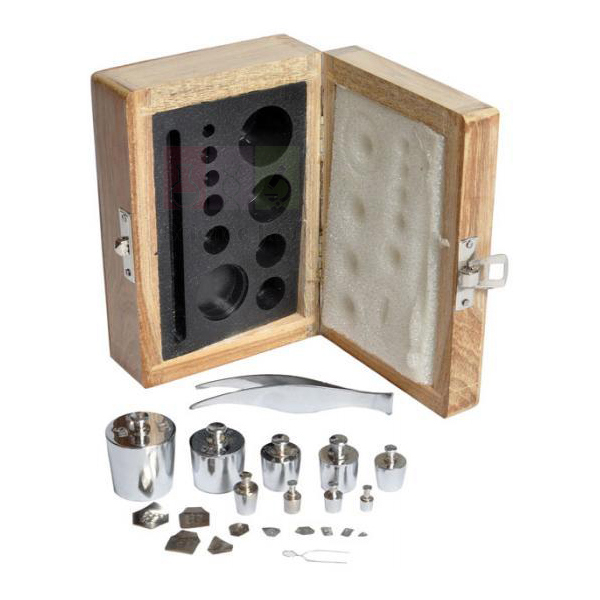
Analytical Weight Box
The Analytical Weight Box (Product Code: SLE/CH/89) is a complete set of reference masses for use with a two-pan chemical balance. It holds nine brass weights — one each of 1 g, 5 g, 10 g, 50 g and 100 g, and two each of 2 g and 20 g — together with a 1 to 500 mg fractional weight set, a 5 mg rider and forceps, all in a polished wooden box. Chemistry and physics students use it to weigh samples accurately when preparing solutions or recording masses in practicals. It is made by Jain Scientific Equipments Pvt Ltd (ScienceLab), Ambala, for use alongside a chemical balance in Indian school and college laboratories.
Specifications
| Parameter | Detail |
|---|---|
| Main weights | Nine brass weights |
| Single pieces | 1 g, 5 g, 10 g, 50 g and 100 g (one each) |
| Duplicated pieces | 2 g and 20 g (two each) |
| Fractional weights | 1 to 500 mg fractional weight set |
| Rider | 5 mg |
| Accessory | Forceps |
| Case | Polished wooden box |
Typical Use
The object goes on the left pan and weights are added to the right, starting with the largest piece that does not tip the beam and working down through the gram weights and then the milligram fractions. The duplicated 2 g and 20 g pieces make it possible to build every intermediate value, and the rider is moved along the graduated beam for the final small adjustment, so students learn the systematic weighing routine used with a traditional chemical balance.
Always lift weights with the forceps provided: moisture and oil from fingers slowly change their mass and can tarnish the brass. Return each piece to its own recess in the box after use, close the lid to keep dust out, and never weigh hot objects or place chemicals directly on the balance pan — use weighing paper or a watch glass.
Manufacturer
The Analytical Weight Box is manufactured by Jain Scientific Equipments Private Limited, which trades as ScienceLab from Ambala, Haryana, India. The company is a registered MSME manufacturer (Udyam UDYAM-HR-01-0003714), and its export shipments are handled under Importer-Exporter Code AAECJ8618A (DGFT). Read more on our company profile.
Related Laboratory Equipment
Balances and accessories used with a weight box:
- Chemical Balance — the two-pan balance this weight box is designed to serve
- Physical Balance — the physics lab counterpart that also uses a weight box
- Weighing Paper — keeps chemicals off the balance pan
- Plastic Weighing Boats — for weighing powders and granules
- Analytical Balance Mass Set — an alternative mass set in our balances range
Explore the Balances category or the wider Chemistry Lab Equipment range.
Frequently Asked Questions
What weights are in the box?
Nine brass weights (1 g, 5 g, 10 g, 50 g and 100 g once each; 2 g and 20 g twice each), a 1 to 500 mg fractional set, a 5 mg rider and forceps.
Which balance is it used with?
A two-pan beam balance such as a chemical or physical balance. It is not needed with a digital balance.
What is the rider for?
The 5 mg rider sits on the graduated beam of the balance and is slid along it to make the finest adjustment without adding more fractional weights.
Is a calibration certificate available?
Please discuss calibration certificate availability with us at the time of enquiry; tolerance class is not stated in our current listing.
How should the weights be cared for?
Handle only with forceps, keep them in their recesses in the closed box, and wipe with a soft dry cloth if dusty.
What warranty is provided?
Warranty terms are confirmed with the quotation — contact us.
Can you supply weight boxes for several labs or for export?
Yes, we supply institutions and distributors across India and international markets. Send quantity and delivery location via our contact page.
Request a Quote
To receive a quotation for the Analytical Weight Box, contact us or add it to your enquiry cart together with the balance it will be used on.
Last updated: 24 September 2026
Ballistic Galvanometer
The Ballistic Galvanometer (Product Code: SLE/CH/90) is a sensitive moving-coil instrument built to measure the total electric charge carried by a short pulse of current, rather than a steady current. Its heavy, slowly swinging coil receives the whole pulse before it starts to move, so the size of its first swing, or throw, indicates the charge that has passed. Physics departments in colleges and senior schools use it for capacitor and electromagnetic induction experiments, and it belongs among the physics lab instruments in India that make these classic practicals possible. It is made by Jain Scientific Equipments Pvt Ltd (ScienceLab), Ambala.
Key Details
| Parameter | Detail |
|---|---|
| Type | Ballistic galvanometer (moving-coil instrument) |
| Purpose | Measuring the charge passed in a brief current pulse |
| Suitable for | Capacitor discharge, comparison of capacitances, flux measurement with a search coil |
| Users | College and senior-school physics laboratories |
| Range, sensitivity and dimensions | Confirmed on enquiry |
Typical Use
A typical practical charges a capacitor from a known voltage and then discharges it through the galvanometer: the throw is proportional to the stored charge, so repeating the test with a second capacitor lets students compare the two capacitances. With a search coil connected, the galvanometer records the charge induced when the coil is pulled out of a magnetic field, giving a measure of the magnetic flux. Other undergraduate experiments use it to study mutual inductance and to find very high resistances by the leakage method.
Set the galvanometer on a firm, level bench away from vibration and magnets, and let the coil come to rest before each reading. Record the first throw only, then use a short-circuit or damping key to stop the coil before the next test. Keep the coil clamped, or the terminals shorted, whenever the instrument is moved, as this protects the delicate suspension.
Manufacturer
This instrument is built by Jain Scientific Equipments Private Limited, which markets its range as ScienceLab from Ambala, Haryana, India. For company background, see the company profile.
Related Laboratory Equipment
Items commonly used in ballistic galvanometer experiments:
- Capacitor (Charging and Discharging) — the circuit whose discharge the galvanometer measures
- Search Coil — for measuring magnetic flux by induced charge
- Power Supply Variable — charges the capacitor to a set voltage
- Moving Coil Galvanometer — a standard galvanometer for steady-current work
- Galvanometer 50-0-50mV — a centre-zero meter for simpler induction demonstrations
See more in Chemistry Lab Equipment and our Physics Lab Equipment range.
Frequently Asked Questions
How is a ballistic galvanometer different from an ordinary galvanometer?
Its coil swings slowly, so it measures the total charge of a short current pulse from its first throw, while an ordinary galvanometer indicates a steady current.
What are its range and sensitivity?
These specifications are not in our current product listing. Please contact us for the datasheet before ordering.
Which accessories do I need?
Typically a capacitor, a DC source, a charge–discharge key and, for flux experiments, a search coil. Accessories are not listed as included, so confirm with us what will be supplied.
Is a calibration certificate available?
Discuss calibration certificate availability with us when you request a quotation.
What warranty applies?
Warranty terms are confirmed at quotation — ask us for current terms.
What should a college quotation request include?
Quantity, the experiments you plan to run, any accessories needed, and the delivery location in India or overseas.
Request a Quote
For price and specification details of the Ballistic Galvanometer, contact us or add it to your enquiry cart with the rest of your physics practical equipment.
Last updated: 24 September 2026
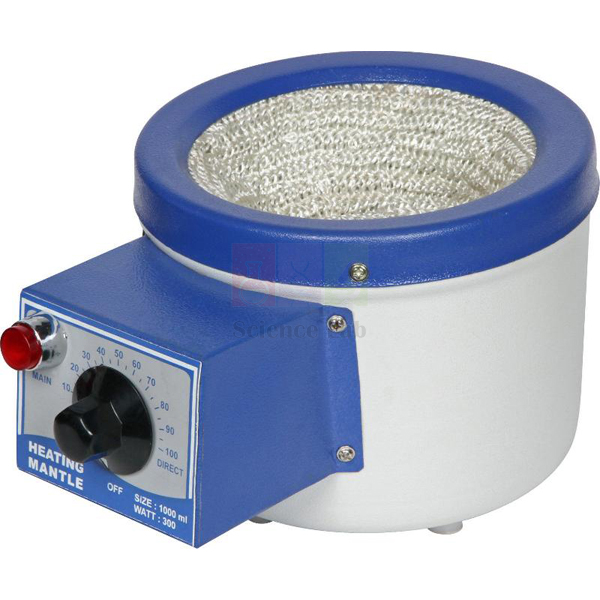
Heating Mantles
Heating Mantles (Product Code: SLE/CH/91) from this listing are 1000 ml, 220 V units that wrap a round bottom flask in an electrically heated glass-yarn net, giving even heat with no open flame. That makes them particularly useful for heating inflammable liquids, and they are widely used in laboratories working with chemicals, pharmaceuticals, dyes and glass plants, as well as in college chemistry and pharmacy lab equipment in India. Each mantle has an energy regulator and an inbuilt indicator light, and is made by Jain Scientific Equipments Pvt Ltd (ScienceLab), Ambala.
Specifications
| Parameter | Detail |
|---|---|
| Capacity | 1000 ml |
| Voltage | 220 V |
| Heating element | Electric heating net hand knitted from glass yarn, with no joint, to maintain the strength of the yarn |
| Maximum temperature | Stands high temperature up to 350°C |
| Body | Spun in one piece from non-rusting aluminium (up to 1000 ml capacity), stoving painted |
| Insulation | Lagged with special grade mineral wool |
| Control | Energy regulator |
| Other features | Original mantle wire; inbuilt indicator light; easy-to-replace mantle |
| Applications | Laboratories, chemicals, pharmaceuticals, dyes, glass plants |
Typical Use
A heating mantle is the preferred heat source for reflux, distillation and solvent recovery in a round bottom flask, because the hemispherical glass-yarn net matches the shape of the flask and spreads heat over its whole lower surface. There is no flame and no exposed hot plate, so volatile, inflammable solvents such as alcohols can be heated with far less fire risk than on a burner. Students in organic chemistry practicals and technicians in pharmaceutical and dye labs set the energy regulator low at first, then raise it until the liquid boils steadily.
Use a flask that matches the 1000 ml cavity so the net is in full contact with the glass, and never switch the mantle on empty or with a dry flask. Watch the indicator light to confirm power, clamp the flask neck separately rather than letting the mantle carry its weight, and allow the unit to cool before removing the flask. If the heating net is ever damaged, the mantle is designed to be replaced easily rather than scrapping the whole unit.
Manufacturer
These mantles are manufactured by Jain Scientific Equipments Private Limited, trading as ScienceLab, from its base in Ambala, Haryana, India, where it produces heating and general laboratory equipment. Read more on our company profile.
Related Laboratory Equipment
Glassware and alternative mantles for the same heating work:
- Round Bottom Flask — the flask shape the mantle is designed to heat
- Liebig Condenser — completes a distillation or reflux set-up on the mantle
- Heating Mantle 250ml — a smaller size for small-volume work
- Multi Position Heating Mantle — heats several flasks at once for class batches
- Heating Mantle With Stirrer (Rota Mantle) — adds stirring for mixtures that need agitation
Compare all models in the Heating Mantle category or browse Chemistry Lab Equipment.
Frequently Asked Questions
What flask size does this mantle take?
It is a 1000 ml heating mantle. For other flask sizes, see the related mantles above or ask us.
What is the maximum temperature?
The glass-yarn heating net stands high temperature up to 350°C.
Can it run on a different mains voltage?
This model is listed for 220 V. Tell us your supply voltage before ordering if it differs.
How is the temperature controlled?
Through the energy regulator, which varies the heating power; an inbuilt indicator light shows when the mantle is on.
Can the heating mantle be replaced if damaged?
Yes, it is designed as an easy-to-replace mantle. Contact us for replacement availability.
What warranty applies?
Warranty terms are confirmed with the quotation — contact us for details.
Do you supply mantles in bulk for colleges or for export?
Yes, we supply institutions and distributors across India and international markets. Share the quantity, voltage and delivery location for a quotation.
Request a Quote
To price Heating Mantles for your laboratory, contact us with the quantity and supply voltage, or add them to your enquiry cart with matching flasks and condensers.
Last updated: 24 September 2026
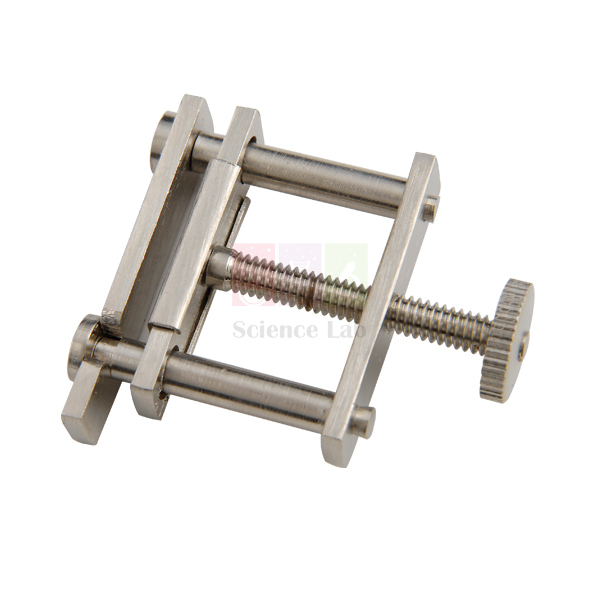
Hoffman Screw Clip
Hoffman Screw Clip (Product Code: SLE/CH/92) is a screw-adjusted clamp that squeezes flexible tubing to slow, meter or completely stop the flow of a liquid or gas. Unlike a spring pinch clip, which is either open or shut, the screw lets you set a partial restriction and leave it there, which makes it useful on gas-delivery lines, siphons and reservoir outlets in teaching laboratories. Chemistry teachers, lab technicians and students in schools and colleges rely on it whenever a set-up needs steady, hands-free flow control. It is made by Jain Scientific Equipments Pvt Ltd (ScienceLab), Ambala, as part of its school chemistry lab equipment in India.
Specifications
| Parameter | Detail |
|---|---|
| Type | Hoffman-pattern screw clip for flexible tubing |
| Construction | Screwed, with hinged side bar |
| Material | Copper, iron |
| Finish | Plated metal / plated brass |
| Tubing size | For use with tubes up to 20 mm outer diameter |
Typical Use
The hinged side bar swings aside so the clip can be placed around a length of tubing that is already connected at both ends, then closed and locked by the screw. Turning the screw presses the tube flat in small steps: a gas stream from a generator can be slowed to a countable bubble rate, the drip from a reservoir set to a chosen speed, or a line sealed completely so reagent is held back between stages of an experiment.
Before ordering, check that your tubing is no more than 20 mm across the outside. Avoid overtightening thin-walled tubing, which can split or take a permanent crease, and back the screw off when apparatus is put away so the tube recovers its round shape. Buyers sourcing from a chemistry lab instruments supplier often order these clips together with matching rubber tubing so every bench has a ready flow-control set.
Manufacturer
This clip is produced by Jain Scientific Equipments Private Limited, which trades under the brand ScienceLab from Ambala, Haryana, India, and supplies laboratory apparatus to schools, colleges and distributors. Learn more about the company in our company profile.
Related Chemistry Lab Equipment
Items usually ordered for the same tubing and flow-control set-ups:
- Rubber Tubing — flexible tubing for the clip to regulate; confirm the outer diameter is within 20 mm
- Vacuum Tubing — thick-walled tubing for suction lines that may also need a shut-off point
- Borosilicate Glass Tubing — glass delivery tubes joined to the flexible sections the clip controls
- Pinch Clip — spring clip for simple open-or-shut control where no fine adjustment is needed
- Hoffman Clips — another Hoffman-type clip in our range to compare before ordering
See the complete Chemistry Lab Equipment range for stands, clamps and other bench apparatus.
Frequently Asked Questions
What tubing size does the Hoffman Screw Clip accept?
It is made for tubes up to 20 mm outer diameter. If your tubing is close to that limit or unusually thick-walled, send us its dimensions through our contact page before ordering.
How is it different from a pinch clip?
A screw clip holds any setting between fully open and fully closed, so it can meter flow; a spring pinch clip only opens or shuts the tube.
Can I fit it without disconnecting my apparatus?
Yes. The hinged side bar opens so the clip can be placed around tubing mid-line, then closed and tightened.
What metal is it made from?
Copper and iron are listed for this clip, with a plated metal or plated brass finish. If you need a particular finish for a tender, mention it in your enquiry and we will confirm what is available.
Should it be used as the shut-off on a fuel gas line?
No. Use it to regulate flow within experimental set-ups; always close the gas tap or burner valve to shut off a fuel gas supply.
What warranty applies?
Warranty terms are not listed on this page; please ask through our contact page and we will confirm them with your quotation.
Do you supply in bulk to institutions and overseas buyers?
Yes. We supply schools, colleges and distributors across India and international markets; include the quantity, delivery location and your tubing size so we can quote accurately.
Request a Quote
Add the Hoffman Screw Clip to our enquiry cart or contact us with the quantity you need for a quotation.
Last updated: 24 September 2026
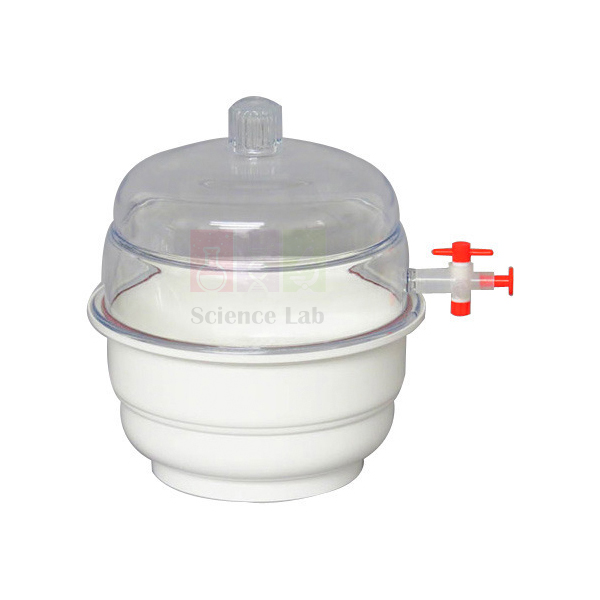
Vacuum Desiccator
Vacuum Desiccator (Product Code: SLE/CH/93) is a sealable chamber for drying samples, or keeping them dry, over a desiccant, with a stopcock that allows the air inside to be pumped out so moisture leaves faster. Its moulded polycarbonate dome is rigid and transparent, giving a clear view of the desiccant and samples without breaking the seal, while the lower part is polypropylene. Analytical, research and teaching laboratories use it to cool crucibles after ignition, store moisture-sensitive reagents and dry solids to constant weight. It is made by Jain Scientific Equipments Pvt Ltd (ScienceLab), Ambala, a laboratory equipment supplier in India.
Specifications
| Parameter | Detail |
|---|---|
| Materials | Polypropylene and polycarbonate |
| Top dome | Moulded in rigid, transparent polycarbonate; knurled knob on top for easy handling |
| Lower part | Polypropylene |
| Seal | Internal groove on the flange to hold a silicone rubber O-ring |
| Vacuum holding | Up to 740 mm of Hg for 24 hrs without any greasing |
| Stopcock | Polypropylene, fitted with a self-lubricating PTFE plug |
| Stopcock action | Three-way: vacuum creation, shutting off and vacuum releasing |
| Sterilisation | Autoclavable |
Typical Use
Charge the lower section with fresh desiccant, place the sample vessels inside, and seat the dome so the O-ring bears evenly on the flange. Connect the stopcock to a vacuum pump, turn the PTFE plug to the evacuating position and pump down, then turn it to shut off and disconnect the pump; the chamber is specified to hold up to 740 mm of Hg for 24 hrs with no grease on the flange. When you need to open it, turn the plug slowly to the release position so air bleeds back gently and does not scatter fine powders.
In gravimetric work, crucibles and weighing bottles are cooled here between heating and weighing so they do not pick up atmospheric moisture, and hygroscopic salts or dried precipitates can be stored for days. Keep the flange and O-ring free of dust, replace spent desiccant regularly, and clean the polycarbonate dome with mild detergent rather than harsh solvents. Chemistry, pharmacy and materials departments choosing lab equipment for college use in India will find it a dependable option for dry storage.
Manufacturer
Jain Scientific Equipments Private Limited trades as ScienceLab and is based in Ambala, Haryana, India, where it makes laboratory apparatus for education and research. Buyers completing vendor registration can use the company's GSTIN 06AAECJ8618A1ZT and Legal Entity Identifier (LEI) 3358004HRD1JIVXKYX49. Read our company profile for more background.
Related Laboratory Equipment
Items that complete a vacuum drying set-up:
- Vacuum Pump, Hand — manual pumping through the stopcock where no power point is nearby
- Vacuum Pump, Electric — for labs that pump the desiccator down frequently
- Vacuum Tubing — thick-walled tube to link the pump to the stopcock without collapsing
- Silica Gel Coarse — desiccant to charge the lower section
- Crucible with lid — one of the vessels most often cooled inside a desiccator before weighing
Browse our Chemistry Lab Equipment range for more drying, heating and weighing apparatus.
Frequently Asked Questions
How long does the Vacuum Desiccator hold vacuum?
It is specified to hold vacuum up to 740 mm of Hg for 24 hrs without greasing. A clean flange and an undamaged O-ring are needed to achieve this.
Do I need vacuum grease on the flange?
No. The silicone rubber O-ring seated in the flange groove seals without grease, so there is no grease residue to contaminate samples.
Is desiccant included?
A desiccant is not listed as part of the supply. Order it separately, for example our Silica Gel Coarse, or ask us to add it to your quotation.
Can it be autoclaved?
Yes, it is described as autoclavable. For the recommended cycle, please check with us through our contact page.
What internal diameter or capacity does it have?
Dimensions are not listed on this page; contact us with the size of the vessels you want to store and we will advise.
How does the three-way stopcock work?
The PTFE plug is turned to one position to evacuate the chamber, another to shut it off after pumping, and a third to release the vacuum before opening.
What should an institutional quotation request include?
State the quantity, any preferred size, whether you also need pumps or desiccant, and the delivery location. We supply institutions in India and international markets.
Request a Quote
To price the Vacuum Desiccator, add it to the enquiry cart or send your requirements through our contact page.
Last updated: 24 September 2026
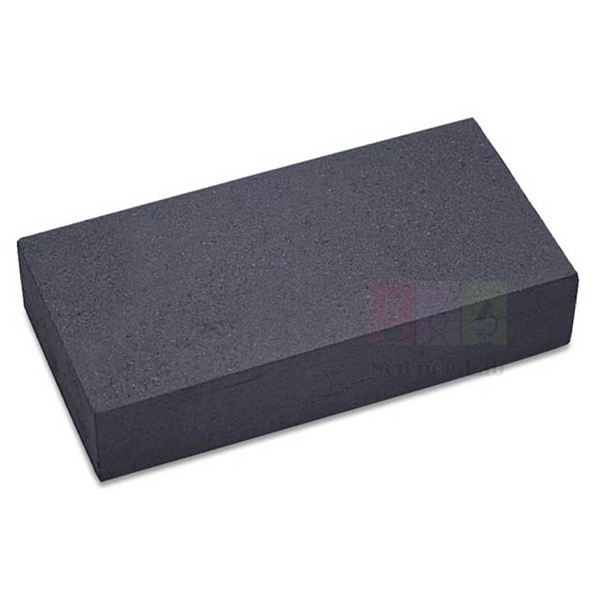
Charcoal Block
Charcoal Block (Product Code: SLE/CH/95) is a block of natural charcoal used as the working surface when soldering with a flame. While the joint is heated, the charcoal absorbs oxygen from around the work, which helps prevent firestain on silver, and the soft block can be carved with small dips in which scraps of silver melt into neat round balls. It also protects the bench beneath from the heat of the torch. Metalwork and jewellery-making students, craft workshops and chemistry teaching labs all use it. The block is supplied by Jain Scientific Equipments Pvt Ltd (ScienceLab), Ambala, as part of its range as a lab consumables supplier in India.
Key Details
| Parameter | Detail |
|---|---|
| Type | Natural charcoal block |
| Purpose | Surface to solder on |
| Key property | Absorbs oxygen during soldering to help prevent firestain |
| Workability | Soft enough to carve dips for forming small round balls of silver |
| Surface protection | Shields the work surface from the heat of a flame torch |
| Supplied as | Individual block; ask us for current dimensions and pack quantities |
Typical Use
Lay the pieces to be joined on the flat face, apply flux and solder, and play the torch flame over the work; the glowing charcoal reflects heat back into the joint and keeps oxygen away from the hot metal. To make granules or small spheres, scrape a shallow hollow into the block with a scriber, drop in a clipping of silver and heat until it draws up into a ball. Because the block is soft, it wears with every session, and some users tie iron wire binding around it to stop it breaking apart over long use.
In school chemistry, a charcoal block is also the traditional support for the charcoal cavity test in qualitative analysis, where a little of a salt is heated in a hollow using a blowpipe flame. Whichever way it is used, let the block cool fully and check that no part is still glowing before putting it away, and store it somewhere dry. Labs ordering from a chemistry consumables supplier in India often keep a few spare blocks for exactly this reason.
Supplier
This charcoal block is supplied by Jain Scientific Equipments Private Limited, the company behind the ScienceLab brand, based in Ambala, Haryana, India. Alongside the laboratory apparatus it manufactures, the company supplies consumables so institutions can source a complete bench set from one vendor. Visit our company profile to learn more.
Related Chemistry Lab Equipment
Apparatus used with a charcoal block for flame work:
- Blow Pipe Brass — directs a fine, hot flame onto a sample sitting in a charcoal cavity
- Bunsen Burner — the usual flame source for blowpipe work in school labs
- Micro Burner — a smaller flame for delicate heating on the block
- Crucible Tong — for moving hot pieces off the block safely
Explore the full Chemistry Lab Equipment range for burners and heating accessories.
Frequently Asked Questions
Why solder on charcoal instead of a ceramic board?
Charcoal absorbs oxygen around the joint, helping to prevent firestain, and it can be carved to hold small parts or form balls of silver. It also protects the surface underneath from torch heat.
How can I stop the block from cracking?
Tying iron binding wire around the block helps hold it together as it wears. Avoid dropping it and let it cool slowly after use.
Can it be used for the charcoal cavity test in chemistry?
Yes, that is a traditional use: a small sample is heated in a hollow in the block with a blowpipe flame, under teacher supervision and with good ventilation.
How long does a block last?
It is a consumable, so each heating burns away a little of the surface. Life depends on how often and how hard it is used, so there is no fixed figure.
What size is the block?
Dimensions are not listed on this page. Please ask through our contact page and we will confirm the current size.
Can you supply blocks in quantity for a workshop or school?
Yes. We supply institutions and distributors in India and international markets; tell us the number of blocks and delivery location for a quotation.
Request a Quote
Place the Charcoal Block in our enquiry cart or contact us with your quantity and we will respond with a quotation.
Last updated: 24 September 2026
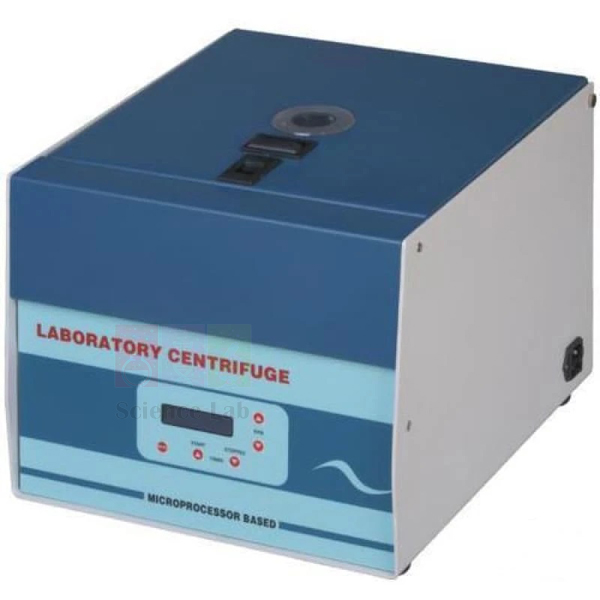
Centrifuge Machine
Centrifuge Machine (Product Code: SLE/CH/96) is a microprocessor-based bench centrifuge that spins sample tubes at controlled speed so denser material, such as precipitates, cells or suspended solids, is driven to the bottom of each tube. A square mild-steel body, powder coated, carries a double-walled lightweight ABS lid, and a two-line LCD panel shows the countdown timer and a digital rpm reading while the programmable controller holds the set speed. College chemistry and biology labs, paramedical teaching labs and research groups use it for routine separations. It is made by Jain Scientific Equipments Pvt Ltd (ScienceLab), Ambala, which supplies this laboratory centrifuge in India and international markets.
Specifications
| Parameter | Detail |
|---|---|
| Control | Microprocessor based |
| Body | Square M.S. (mild steel) body, powder coated |
| Lid | Double-walled, lightweight ABS |
| Display panel | Microprocessor-based LCD, 2 lines x 16 characters |
| Timer | 0–59 minute countdown timer |
| Speed | Digital rpm meter with programmable speed controller |
| Rotor head supplied | One angle head: 8 x 15 ml or 4 x 50 ml |
Typical Use
Fill tubes to the same level, place them in opposite positions in the angle head so the load is balanced, close the lid, then set the run time on the countdown timer and the speed on the programmable controller. The digital rpm meter lets students see when the rotor has reached the set speed, and the timer ends the run automatically, so a class can repeat a separation under the same conditions every time. Wait for the rotor to stop completely before opening the lid.
The 8 x 15 ml head suits batches of smaller tubes, for example several student groups separating precipitates at once, while the 4 x 50 ml head handles larger volumes such as sample preparation before analysis. Choose the head when ordering, keep the chamber clean and dry, and wipe up any spill immediately. For departments setting up lab equipment for research in India, it offers timed, repeatable runs in a compact bench unit.
Manufacturer
The Centrifuge Machine is manufactured by Jain Scientific Equipments Private Limited, trading as ScienceLab, a company based in Ambala, Haryana, India, that produces laboratory and teaching equipment. Our company profile gives further detail.
Related Laboratory Equipment
Tubes, racks and alternative centrifuges for the same separation work:
- Oak Ridge Centrifuge Tubes — sample tubes; choose a size that fits the 15 ml or 50 ml head you order
- Test Tube Racks — hold tubes upright while filling and after spinning
- Laboratory Centrifuge — another bench model to compare for your workload
- Micro Centrifuge — for very small sample volumes in microtubes
- Hand Centrifuge — a non-electric option for basic demonstrations
More apparatus is listed under Chemistry Lab Equipment.
Frequently Asked Questions
Which rotor head comes with the Centrifuge Machine?
One angle head is supplied: either 8 x 15 ml or 4 x 50 ml. Tell us which you need; if you want both, ask about an additional head through our contact page.
What is the maximum speed?
The maximum rpm is not listed on this page. The unit has a digital rpm meter and programmable speed controller; contact us for the full datasheet.
How long can a run be set for?
The countdown timer covers 0–59 minutes.
Why must the tubes be balanced?
An uneven load makes the rotor vibrate, which can damage the machine and disturb the separation. Always place tubes of equal fill opposite each other.
What power supply does it need?
Electrical ratings are not stated here. Mention your local mains voltage in your enquiry so we can confirm a suitable configuration.
Is a calibration certificate available?
Please discuss calibration certificate availability with us when you request a quotation.
What details should an institutional quotation include?
The rotor head choice, quantity, mains voltage, delivery location and any warranty or service terms you need confirmed. We supply institutions across India and international markets.
Request a Quote
Add the Centrifuge Machine to our enquiry cart or reach us through the contact page for pricing and availability.
Last updated: 24 September 2026
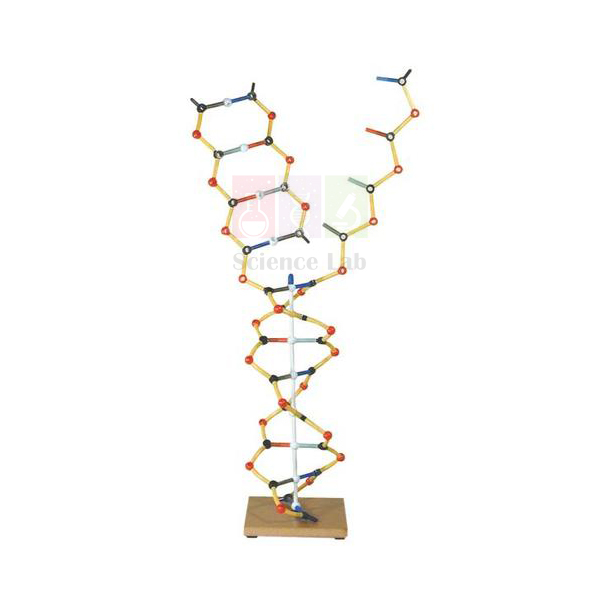
DNA-RNA Model
DNA-RNA Model (Product Code: SLE/CH/97) is a build-it-yourself molecular model kit that shows how nucleic acids are assembled: sugar and phosphate units form the backbone, coloured base tubes pair across the middle, and separate pieces stand for the hydrogen bonds between base pairs. Because white uracil tubes are included alongside thymine, the same set can be used to compare DNA with RNA. Biology, biochemistry and chemistry teachers in schools and colleges use it for lessons on genetics and molecular structure, and students use it for 3D science model kit projects in India. It is made by Jain Scientific Equipments Pvt Ltd (ScienceLab), Ambala.
Specifications
| Parameter | Detail |
|---|---|
| Base tubes | 30 coloured tubes: guanine red, cytosine green, thymine blue, adenine grey, uracil white |
| Hydrogen-bond pieces | 12 white two-prong centres representing the hydrogen bond between base pairs |
| Sugar units | 28 black trigonal atom centres |
| Phosphate units | 25 red two-prong atom centres |
| Backbone links | 50 yellow tubes linking the phosphate groups to the sugar rings |
| Display | Wooden base with support rod |
Typical Use
Students first join black sugar centres and red phosphate centres with yellow tubes to build each backbone, then attach base tubes and connect complementary pairs through the white hydrogen-bond pieces: adenine with thymine and guanine with cytosine. Swapping the blue thymine tubes for white uracil tubes turns a DNA segment into an RNA-style strand, which makes the difference between the two nucleic acids easy to see. The finished model stands on the wooden base and support rod for display during the lesson.
Sort the pieces by colour before class and give each group a colour key so base identity is never confused. Count the parts back into the box afterwards, since small components are easily lost. As a hands-on biology experiment kit for students, it works well for revision, group activities and project displays.
Manufacturer
ScienceLab is the brand name of Jain Scientific Equipments Private Limited, based in Ambala, Haryana, India. The company is incorporated under CIN U29309HR2020PTC087597 and manufactures at its licensed factory at 449, HSIIDC Industrial Area, Saha, Ambala (Factory Licence AMB-ONLINE-CHD-J-414). Find out more in our company profile.
Related Laboratory Equipment
Models and activities that pair well with this kit in a genetics unit:
- Molecular Model, RNA 12 Base — a dedicated RNA model for comparison with the DNA build
- Molecular Model Kit, Ten Layer DNA — a longer double-helix build for display
- DNA Activity Model — another hands-on DNA model for group work
- DNA extraction lab kit — lets students isolate real DNA after studying its structure
- DNA Fingerprinting Electrophoresis Lab Activity — extends the topic to DNA analysis
This model is listed in our Chemistry Lab Equipment category, alongside other teaching models and apparatus.
Frequently Asked Questions
What is included in the DNA-RNA Model?
30 coloured base tubes, 12 white hydrogen-bond centres, 28 black sugar centres, 25 red phosphate centres, 50 yellow linking tubes, and a wooden base with support rod.
Can it show RNA as well as DNA?
Yes. White uracil tubes are included, so students can replace thymine and build an RNA-style strand.
How are hydrogen bonds shown?
By the 12 white two-prong centres that connect the paired bases across the two strands.
How many base pairs can be built?
The kit is described by its part counts rather than a finished length. Contact us if you need a model of a particular size and we will advise.
Does it arrive assembled?
It is supplied as a kit of parts with the base and support rod, so students build the structure themselves.
How should the parts be cleaned?
Wipe them with a damp cloth and let them dry before storing. Keep small parts away from very young children.
Can schools order class sets or tender quantities?
Yes. Send the number of kits, delivery location and any tender paperwork you need; we supply institutions in India and international markets.
Request a Quote
To request pricing, add the DNA-RNA Model to the enquiry cart or write to us via the contact page.
Last updated: 24 September 2026
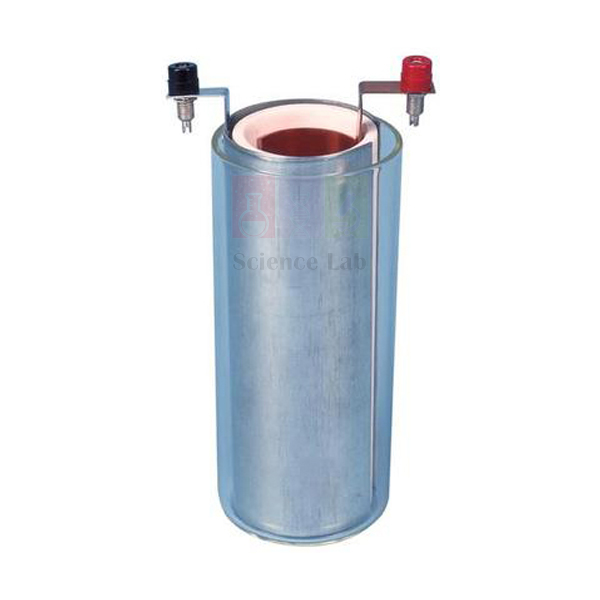
Daniell Cell
Daniell Cell (Product Code: SLE/CH/98) is a classic zinc–copper electrochemical cell for studying how a redox reaction between two metals and their salt solutions produces a voltage. It consists of a cylindrical zinc electrode and a copper electrode, a clay vessel and a battery glass; filled with electrolyte it supplies approx. 1.1 volts, and 4 mm jacks make connection to a meter straightforward. Chemistry and physics teachers in schools and colleges use it to introduce galvanic cells, electrode potentials and the origin of battery voltage. It is made by Jain Scientific Equipments Pvt Ltd (ScienceLab), Ambala, as an electrochemical cell kit for school and college labs.
Specifications
| Parameter | Detail |
|---|---|
| Purpose | Studying the properties of an electrochemical cell |
| Electrodes | Cylindrical zinc electrode and copper electrode |
| Vessels | Clay vessel and battery glass |
| Output voltage | Approx. 1.1 V when filled with cell electrolyte |
| Connections | Via 4 mm jacks |
| Dimensions | 105 mm in height, 65 mm diameter |
| Suitable filling | Copper sulphate solution (CuSO4), 10% concentration; zinc sulphate solution (ZnSO4), 10% concentration |
| Supplied | Without filling (electrolytes not included) |
Typical Use
Prepare 10% copper sulphate and 10% zinc sulphate solutions, place each electrode in the solution of its own metal with the clay vessel keeping the two liquids apart, and connect a voltmeter to the 4 mm jacks. Students should read close to 1.1 V, and can then discuss which electrode is oxidised, which way electrons flow through the external circuit, and why the clay vessel must let ions pass while stopping the solutions from mixing freely.
After the lesson, pour out both electrolytes, rinse the clay vessel and electrodes with clean water, and let everything dry so crystals do not build up in the clay. The zinc electrode is gradually consumed as the cell works, so inspect it before each class. As part of a school chemistry lab equipment set in India, the cell links electrochemistry theory to a reading students can take themselves.
Manufacturer
Jain Scientific Equipments Private Limited, known by its brand name ScienceLab, makes this cell and other teaching apparatus in Ambala, Haryana, India. You can read more about us in the company profile.
Related Chemistry Lab Equipment
What you need to fill, connect and measure the cell:
- Cupric Sulphate (Copper Sulphate) — for preparing the 10% copper sulphate electrolyte
- Zinc Sulfate 100 g — for preparing the 10% zinc sulphate electrolyte
- Digital Voltmeter — to read the approx. 1.1 V output
- Banana Plug Connectors Leads — plug leads for wiring the jacks to a meter; check plug size against the 4 mm jacks
- Student Voltaic Cell Set — for comparing other metal pairs in follow-up work
More electrochemistry and bench apparatus is available in our Chemistry Lab Equipment category.
Frequently Asked Questions
Are the electrolytes included with the Daniell Cell?
No. The cell is delivered without a filling. Copper sulphate and zinc sulphate solutions, each at 10% concentration, are the suitable fillings.
What voltage does it produce?
Approximately 1.1 volts when filled with the cell electrolyte.
How do I connect it to a meter?
Through its 4 mm jacks, using leads fitted with matching plugs.
How big is it?
It stands 105 mm high with a diameter of 65 mm, small enough for student benches.
Can it power a bulb or motor?
It is intended for studying cell properties rather than as a power source, and its current capacity is not specified. Contact us if you plan a load experiment.
How should it be stored between classes?
Empty both solutions, rinse all parts with water and let them dry fully before storing.
Do you supply sets for a whole class?
Yes. Tell us how many cells you need and whether the electrolytes should be quoted too; we supply institutions in India and international markets.
Request a Quote
Put the Daniell Cell in our enquiry cart or get in touch for a quotation covering quantity and delivery.
Last updated: 24 September 2026
Conductivity Demonstrator
Conductivity Demonstrator (Product Code: SLE/CH/99) is a simple classroom apparatus that shows at a glance whether a liquid conducts electricity. Two platinum electrodes are mounted on a non-conductive support together with a light globe and terminals; connected to a power source and dipped into a solution, the globe glows when the liquid carries a current and stays dark when it does not. Science and chemistry teachers in middle and secondary schools use it to separate electrolytes from non-electrolytes in front of the whole class. It is made by Jain Scientific Equipments Pvt Ltd (ScienceLab), Ambala, a school laboratory equipment supplier in India.
Specifications
| Parameter | Detail |
|---|---|
| Electrodes | Two platinum electrodes |
| Mounting | Non-conductive support |
| Indicator | Light globe |
| Connections | Terminals for attaching the power supply |
| Power source | Battery pack or 6V power supply |
Typical Use
Connect the terminals to a battery pack or 6V power supply, then lower the electrodes into a beaker of the test liquid. Salt solution or dilute acid lights the globe, while distilled water or sugar solution leaves it dark, which gives students a clear, visual contrast between ionic and molecular substances. Comparing the brightness across several solutions also opens a discussion of strong and weak electrolytes.
Rinse the electrodes in distilled water and blot them dry between samples so one solution does not contaminate the next, and disconnect the power before changing beakers. Platinum is chosen for the electrodes because it resists attack by the acids and salt solutions being tested. A chemistry lab instruments supplier can quote the demonstrator together with beakers and leads so the activity is ready to run.
Manufacturer
The Conductivity Demonstrator comes from Jain Scientific Equipments Private Limited, which operates under the ScienceLab name in Ambala, Haryana, India, producing science teaching apparatus. See our company profile for more about the business.
Related Laboratory Equipment
Items used alongside the demonstrator in a conductivity lesson:
- Glass Beaker — holds each test solution for the electrodes to dip into
- Crocodile Clips & Leads — for wiring the terminals to the power source
- Battery Holder, C — for making up a battery pack when mains power is not available
- Power Supply Variable — a bench supply option; confirm with us that it can deliver the 6V required
- Conductivity of Solutions Apparatus — an alternative apparatus for the same topic
Find further teaching apparatus in the Chemistry Lab Equipment category.
Frequently Asked Questions
What does the Conductivity Demonstrator show?
Whether a solution conducts electricity: the light globe glows for conducting liquids and stays off for non-conducting ones.
What power source does it need?
A battery pack or a 6V power supply connected to its terminals. If you want a supply quoted with it, mention this in your enquiry.
Why are the electrodes platinum?
Platinum is highly resistant to corrosion, so the electrodes stay clean and consistent when dipped into acids, bases and salt solutions.
Does it give a numerical conductivity reading?
No. It is a qualitative demonstrator; quantitative work needs a conductivity meter.
How should the electrodes be cleaned?
Rinse them in distilled water after each solution and dry gently. Do not scrape the platinum surfaces.
Is a replacement globe available?
Spare-part availability is not listed here; please ask through our contact page.
Can you quote for several schools at once?
Yes. Share the quantity for each delivery point and we will prepare a consolidated quotation for India or international delivery.
Request a Quote
Add this demonstrator to the enquiry cart or contact us to receive a quotation.
Last updated: 24 September 2026
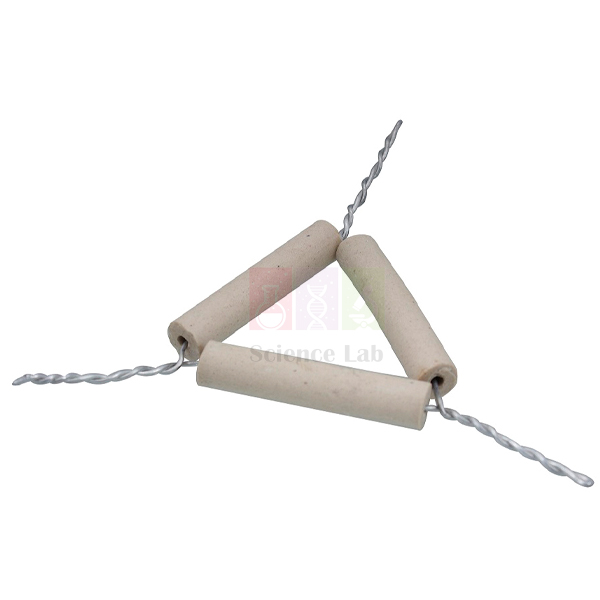
Pipeclay Triangle
Pipeclay Triangle (Product Code: SLE/CH/100) is a heating support used in laboratories when a substance must be heated directly over a Bunsen burner. The substance, usually held in a crucible or small dish, is placed in the triangle framework, which rests across a tripod or retort ring so the flame can reach the base of the vessel. It is a routine item in school and college chemistry practicals such as heating salts, igniting precipitates and burning metals in air. It is made by Jain Scientific Equipments Pvt Ltd (ScienceLab), Ambala, as part of its school chemistry lab equipment for India and international buyers.
Key Details
| Parameter | Detail |
|---|---|
| Type | Pipeclay triangle |
| Purpose | Holding a substance in its framework while it is heated |
| Heat source | Bunsen burner |
| Suitable for | Laboratory heating work in schools, colleges and teaching labs |
| Supplied as | Individual triangle; ask us about available sizes |
Typical Use
Set the triangle on a tripod or retort ring, seat the crucible so it sits securely in the framework with part of its body below the triangle, and light the Bunsen burner beneath. Classic practicals include heating hydrated copper sulphate to drive off water of crystallisation, heating magnesium ribbon in a lidded crucible to find the formula of its oxide, and igniting a filtered precipitate to constant mass in gravimetric analysis.
Choose a triangle that matches the crucible size so the vessel neither falls through nor perches on top. Lift hot crucibles with tongs, let the triangle cool in air on a heat-resistant surface, and never plunge it into water, as sudden cooling can crack it. Flat-bottomed glassware such as beakers belongs on a wire gauze instead. Schools buying chemistry lab equipment in India usually order triangles, tripods and crucibles together as a heating set.
Manufacturer
Jain Scientific Equipments Private Limited carries out business as ScienceLab from Ambala, Haryana, India, manufacturing apparatus for school, college and technical laboratories. More information is available in our company profile.
Related Chemistry Lab Equipment
The rest of a standard crucible-heating set-up:
- Crucible with lid — the vessel most often heated in a pipeclay triangle
- Tripod, Stainless Steel — supports the triangle over the burner
- Crucible Retort Ring — an alternative support when working on a retort stand
- Bunsen Burner — the heat source for the set-up
- Crucible Tong — for lifting hot crucibles in and out of the triangle
View all heating and bench apparatus in our Chemistry Lab Equipment category.
Frequently Asked Questions
What is a Pipeclay Triangle used for?
It holds a substance, normally in a crucible, steady in its framework while it is heated by a Bunsen burner.
What sizes are available?
Sizes are not listed on this page. Tell us the crucible sizes you use through our contact page and we will suggest a match.
Do I need a tripod as well?
Yes. The triangle rests across a tripod or a retort ring; it does not stand on its own.
Can I heat a beaker on it?
No. It is meant for crucibles and similar small vessels. Use a wire gauze under beakers and flasks.
How do I make it last longer?
Let it cool naturally after heating, avoid knocking it against hard surfaces, and replace it if it shows cracks.
Do you supply triangles in bulk for schools?
Yes. We supply institutions and distributors in India and international markets; include quantities and delivery details in your enquiry.
Request a Quote
Add the Pipeclay Triangle to our enquiry cart or send a message via the contact page for a quotation.
Last updated: 24 September 2026
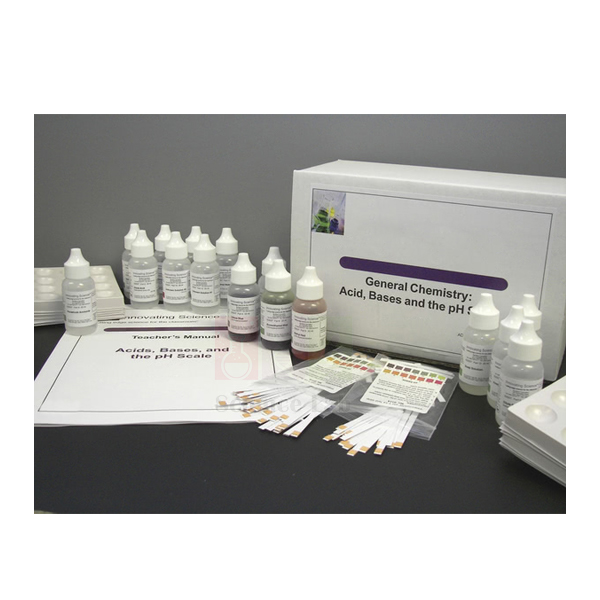
Acids, Bases And The pH Scale
Acids, Bases And The pH Scale (Product Code: SLE/CH/101) is a classroom lab activity kit used to teach the differences between acids and bases, the role of hydrogen and hydroxide ions and the meaning of the pH scale in secondary school chemistry. It holds enough materials for 15 groups, who test pH indicators, check household materials and identify four unknown clear solutions. It is supplied by Jain Scientific Equipments Pvt Ltd (ScienceLab), Ambala, India, as a ready-to-teach acid base indicator kit.
Key Details
| Parameter | Detail |
|---|---|
| Type | Classroom lab activity on acids, bases and pH |
| Learning objectives | Role of hydrogen and hydroxide ions in acids and bases; nature of the pH scale in relation to acid and base strength |
| Activities | Effects of acids and bases on several chemical pH indicators; pH of several common household materials; composition of four unknown clear solutions |
| Class size | Enough materials for 15 groups |
| Documentation | Teacher's manual and student copy masters included |
| Shelf life | Depends on the chemical, its grade and storage conditions; ask us for the expiry date of the batch you are quoted |
| Product code | SLE/CH/101 |
| Supplied by | Jain Scientific Equipments Pvt Ltd (ScienceLab), Ambala, India |
What Is the Acids, Bases and pH Scale Kit Used For?
The lesson builds in three steps. Groups first record the colour each indicator shows in known acids and bases, then apply those indicators to everyday household materials to place them on the pH scale, and finally combine their observations to deduce what each of the four unknown solutions is. Because the unknowns are clear, students cannot guess by appearance and must rely on evidence, so the final task is a good check of understanding.
Photocopy the student masters before class, set out one station per group, and make sure everyone wears eye protection when acids and bases are on the bench. To extend the lesson, add pH indicator paper or a pH meter so groups can compare indicator colours with a measured value. Departments that order from a lab chemicals supplier in India can list this kit with their other acid–base consumables so the practical is ready each term.
Supplier
This activity kit is supplied by Jain Scientific Equipments Private Limited, which trades as ScienceLab and is based in Ambala, Haryana, India. The company sources and supplies teaching kits, reagents and consumables for schools, colleges and distributors, so the kit can be quoted together with indicator paper, pH meters and dropper bottles on one order. Read our company profile for more.
Related Chemistry Lab Equipment
Useful additions for acid–base and pH lessons:
- Paper, Universal, pH 1-14 — lets groups check indicator results against a full-range pH paper
- Blue Litmus Paper — a quick acid test to introduce the topic
- pH Indicator Dispenser — hands out indicator in small, controlled amounts
- Waterproof pH Meter — measures pH values to compare with indicator colours
- Dropper Bottle, 10 ml — for dividing solutions between the 15 group stations
Browse more teaching kits under Chemistry Lab Equipment.
Frequently Asked Questions
How many students can use one Acids, Bases And The pH Scale kit?
One Acids, Bases And The pH Scale kit holds enough materials for 15 groups, so a whole class can work in small teams at the same time, each group testing indicators, household materials and the four unknown solutions.
What documentation comes with the kit?
The Acids, Bases And The pH Scale kit includes a teacher's manual and student copy masters. Teachers photocopy the student masters for each group before class and use the manual to plan and run the practical safely.
Which pH indicators are included?
The Acids, Bases And The pH Scale kit uses several chemical pH indicators, but the exact list is not given in our product notes. Contact us for the full contents list before you plan the lesson or match it to your syllabus.
Are the household materials included?
Our product notes for the Acids, Bases And The pH Scale kit do not say whether household test materials are included. Please confirm with us when you enquire, so you know whether to collect samples locally before the lesson.
What is the shelf life of the kit?
The shelf life of the Acids, Bases And The pH Scale kit depends on the chemicals it contains, their grade and storage conditions; ask us for the expiry date of the batch you are quoted, and keep the kit closed in a cool, dry place.
What safety precautions apply?
With the Acids, Bases And The pH Scale kit, students should wear eye protection, handle acids and bases only under teacher supervision and follow the teacher's manual. Rinse any splash with plenty of water and report it to the teacher at once.
Who supplies the Acids, Bases And The pH Scale kit?
Jain Scientific Equipments Private Limited, trading as ScienceLab in Ambala, Haryana, India, supplies the Acids, Bases And The pH Scale kit to schools, colleges and distributors in India and international markets, and can quote it together with related pH consumables.
Request a Quote
Add the Acids, Bases And The pH Scale kit to the enquiry cart, or contact us with the number of kits and your delivery location for a quotation.
Last updated: 24 September 2026
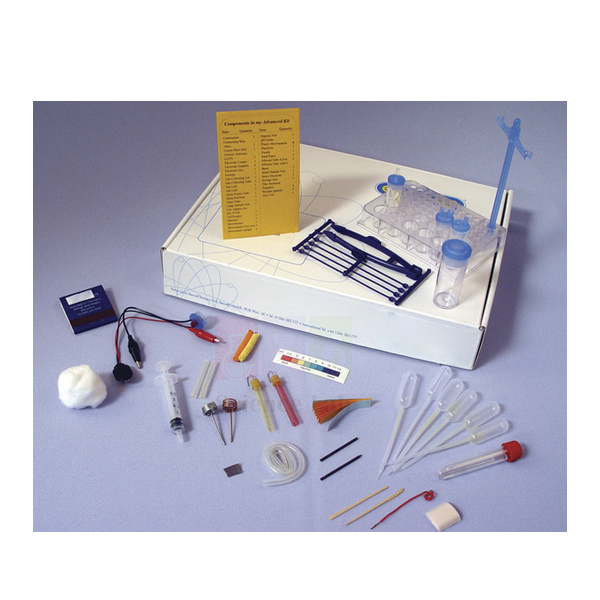
Advanced Microscience Kit, Student
Advanced Microscience Kit, Student (Product Code: SLE/CH/102) is the apparatus set for microscience chemistry, the approach in which practical work is carried out on a small scale with compact, purpose-designed equipment. The Advanced Kit provides all the physical hardware required to perform the experiments incorporated in the basic microscience kit, using durable, washable components whose design is based on equipment used for modern laboratory techniques. It is intended for individual students or small groups, making it a practical chemistry experiment kit in India for schools that want every learner to handle apparatus. It is made by Jain Scientific Equipments Pvt Ltd (ScienceLab), Ambala.
Key Details
| Parameter | Detail |
|---|---|
| Contents | All the physical hardware required to perform the experiments incorporated in the basic kit |
| Materials | Durable, washable |
| Comboplates | Dishwasher safe |
| Designed for | Individual use or small groups |
| Component design | Based on equipment used for modern laboratory techniques |
| Worksheets | Written for students and suited to the curriculum; can be linked to AQA, IB, OCR, Edexcel, WJEC, SEB, IEB and CIE schemes |
| Workbooks and guides | Must be ordered separately |
| Spares | All kit components available for separate purchase |
Typical Use
Schools usually issue one kit per student or per pair so each learner assembles and uses the apparatus personally rather than watching a demonstration. Working at small scale means reactions are set up quickly on the bench, smaller quantities of reagents are consumed, and there is less waste to dispose of, so more practical sessions fit into a term. Because the kit supplies the hardware behind the basic-kit experiments, teachers can plan a sequence of practicals knowing the apparatus is already on hand.
At the end of each session, Comboplates can go through a dishwasher and the other washable parts can be rinsed and dried before being packed back. Any lost or broken item can be bought individually rather than replacing the whole kit. Departments building a STEM science kit collection in India can combine it with other microscience sets for physics and water-quality work.
Manufacturer
ScienceLab is how Jain Scientific Equipments Private Limited is known to customers; the company is based in Ambala, Haryana, India, and manufactures science teaching apparatus. More detail is in our company profile.
Related Chemistry Lab Equipment
Other microscience items that extend this hardware set:
- Basic Microscience Kit, Student — the companion kit whose experiments this hardware supports
- Comboplate, Microscience — extra or replacement Comboplates for larger classes
- Water Monitoring Kit, Microscience — applies the small-scale method to water testing
- Electricity Kit Microscience — brings the same approach to electricity practicals
- Microscience Work Station, Biology, Physics and Chemistry — a multi-subject station for a microscience lab
The full Chemistry Lab Equipment range lists more kits and apparatus.
Frequently Asked Questions
How does the Advanced kit relate to the Basic Microscience Kit?
The Advanced Kit provides all the physical hardware needed to perform the experiments incorporated in the basic kit. For a component-by-component comparison, contact us.
Are workbooks and teacher guides included?
No. Workbooks and guides must be ordered separately.
Which syllabuses do the worksheets support?
They can be linked to AQA, IB, OCR, Edexcel, WJEC, SEB, IEB and CIE schemes. For other boards, ask us which experiments match your practical list.
Are chemicals part of the kit?
The kit is described as hardware; reagents are not listed. Please check with us if you also need consumables quoted.
Can individual parts be replaced?
Yes. All kit components are available for separate purchase.
How are the parts cleaned?
Comboplates are dishwasher safe, and the other components are made of washable materials.
Can you supply class sets?
Yes. Tell us the number of students or kits and your delivery location; we supply schools across India and international markets.
Request a Quote
Add the kit to the enquiry cart or reach us through the contact page to request pricing for class sets.
Last updated: 24 September 2026
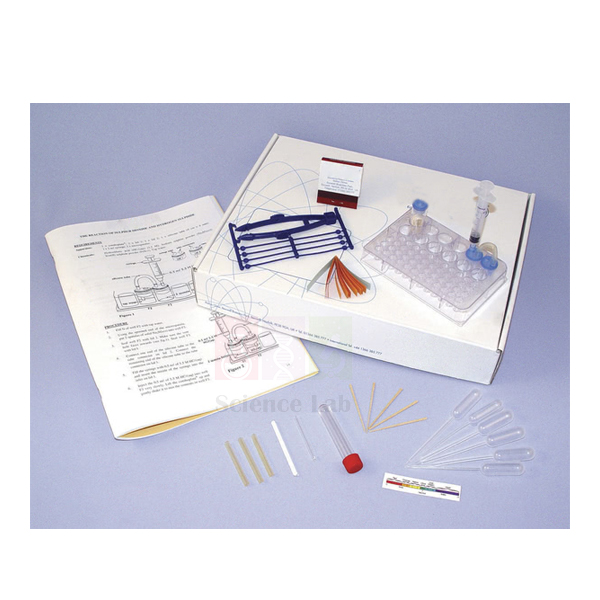
Basic Microscience Kit, Student
Basic Microscience Kit, Student (Product Code: SLE/CH/103) puts small-scale chemistry into each student's hands. It is built around the Comboplate, a development that inspired a family of physical apparatus giving students the opportunity to perform over a hundred chemical experiments that previously required macro-scale apparatus. The topics it supports run from chemical equilibrium and stoichiometry to rates of reaction, industrial pollution and the reactions of metals with salt solutions. Designed for individual use or small groups, it is a science kit for students in India and elsewhere who need regular hands-on practice. It is made by Jain Scientific Equipments Pvt Ltd (ScienceLab), Ambala.
Key Details
| Parameter | Detail |
|---|---|
| Core apparatus | Comboplate (dishwasher safe) |
| Materials | Durable, washable |
| Designed for | Individual use or small groups |
| Component design | Based on equipment used for modern laboratory techniques |
| Worksheets | Written for the students and suited to the curriculum; can be linked to AQA, IB, OCR, Edexcel, WJEC, SEB, IEB and CIE schemes |
| Workbooks and guides | Must be ordered separately |
| Spares | All kit components available for separate purchase |
Topics that may be covered with this kit:
- Chemical Equilibrium
- Acid Base Chemistry
- Enthalpy Changes
- Reactivity of Group 7 Elements
- Industrial Pollution
- Diffusion
- Solubility of Sulphates in Water
- Rates of Reaction
- Stoichiometry
- Reactions of Metals & Their Salt Solutions
Typical Use
The wells of a Comboplate act as a row of miniature test tubes and beakers, so a student can run a series of reactions side by side and compare them directly: a set of metals dropped into salt solutions to build a reactivity order, halide solutions mixed to show Group 7 displacement, or sulphate solutions combined to see which precipitate. Each test uses only drops of solution, which keeps reagent costs and waste low and makes it realistic to give every learner their own practical rather than a shared demonstration.
Plan the term's practicals from the topic list, hand out the matching worksheets, and collect the Comboplates for the dishwasher after class. Missing parts can be reordered one at a time. For a school science kit supplier in India, this is the entry-level set on which the wider microscience range is built.
Manufacturer
The kit is manufactured by Jain Scientific Equipments Private Limited, whose products are sold under the ScienceLab brand from Ambala, Haryana, India. Visit our company profile to learn about the company.
Related Chemistry Lab Equipment
Items that support the topics in this kit:
- Advanced Microscience Kit, Student — the hardware set for performing the basic-kit experiments
- Comboplate, Microscience — spare Comboplates so no student waits for a clean plate
- Titration Kit, Student, Microscience — takes the acid–base topic on to small-scale titration
- Paper, Universal, pH 1-14 — quick pH checks during acid–base work
- Microscience Work Station, Biology, Physics and Chemistry — a complete station for schools adopting microscience widely
See more in our Chemistry Lab Equipment category.
Frequently Asked Questions
Which topics can the Basic Microscience Kit cover?
Chemical equilibrium, acid–base chemistry, enthalpy changes, reactivity of Group 7 elements, industrial pollution, diffusion, solubility of sulphates in water, rates of reaction, stoichiometry, and reactions of metals and their salt solutions.
Do I also need the Advanced kit?
The Advanced Kit is described as providing the physical hardware for the basic-kit experiments. Send us your practical list via the contact page and we will confirm which kit, or combination, fits.
Is a workbook supplied?
Workbooks and guides are ordered separately from the kit.
Are the worksheets matched to exam boards?
They can be linked to AQA, IB, OCR, Edexcel, WJEC, SEB, IEB and CIE schemes; for other syllabuses, ask us to check coverage.
Does the kit include reagents?
Chemicals are not listed as part of the kit. Please confirm with us if you want them included in a quotation.
Can Comboplates go in a dishwasher?
Yes, they are dishwasher safe, and the rest of the kit is washable.
What should a school include when asking for a quotation?
The number of kits, whether you want spare Comboplates or workbooks, and the delivery address. We supply schools in India and international markets.
Request a Quote
Use the enquiry cart to add this kit, or contact us directly for class-set pricing.
Last updated: 24 September 2026

Chemiluminescence in Blood Stain Detection
Chemiluminescence in Blood Stain Detection (Product Code: SLE/CH/104) is a forensic chemistry demonstration kit used to show how luminol reveals hidden blood at a crime scene, in school and college science classes. Its special luminol formulation needs no separate hydrogen peroxide catalyst: re-hydrate it, use it with the simulated blood haemoglobin, and a faint glow appears once the lights are off. It is supplied by Jain Scientific Equipments Pvt Ltd (ScienceLab), Ambala, India, as a chemistry teaching kit for forensic science units.
Key Details
| Parameter | Detail |
|---|---|
| Type | Forensic chemistry demonstration (chemiluminescence) |
| Scenario | A scene with no visible blood is sprayed with a liquid and the lights are turned out, revealing a faint glow |
| Reagent | Special luminol formulation; no separate hydrogen peroxide catalyst required |
| Preparation | Re-hydrate, then use with the simulated blood haemoglobin |
| Quantity | Enough material for several demonstrations |
| Documentation | Instruction manual with suggested activities |
| Shelf life | Depends on the chemical, its grade and storage conditions; ask us for the expiry date of the batch you are quoted |
| Product code | SLE/CH/104 |
| Supplied by | Jain Scientific Equipments Pvt Ltd (ScienceLab), Ambala, India |
What Is the Chemiluminescence Blood Stain Detection Kit Used For?
It recreates a familiar investigation: crime scene officers have collected fingerprints, hair and fibres, yet no blood can be seen. Mark out a mock scene, apply the simulated blood haemoglobin where students cannot see it, re-hydrate the luminol and apply it as the manual describes, then darken the room completely. Afterwards, explain that luminol is oxidised in a reaction catalysed by the iron in haemoglobin, and that the energy released leaves the product molecule in an excited state that gives off light rather than heat.
Prepare the reagent shortly before the demonstration, keep everything else sealed until needed, and wear eye protection and gloves while handling it. The suggested activities let teachers extend the lesson into discussion of evidence, false positives and why forensic scientists confirm results with further tests, so this science kit with manual suits forensic and chemistry units in India and beyond.
Supplier
This demonstration kit is supplied by Jain Scientific Equipments Private Limited, which trades as ScienceLab from Ambala, Haryana, India. The company sources forensic and chemistry teaching kits for schools, colleges and training centres, and can combine this one with other crime-scene activities in a single quotation. Company background is on our company profile.
Related Chemistry Lab Equipment
Other forensic chemistry activities that fit the same unit:
- Forensics Using Simulated Blood — further investigations using safe simulated blood
- Presumptive Blood Test Kit — introduces a colour screening test alongside luminol detection
- Forensic Chemistry of Blood Types — moves from finding blood to typing it
- Forensic Chemistry of Dusting for Fingerprints — covers the fingerprint evidence mentioned in the scenario
- Crime Scene Investigation – Forensic Chemistry Of Whodunit — a wider crime-scene problem for students to solve
Discover more activities in our Chemistry Lab Equipment category.
Frequently Asked Questions
Does the Chemiluminescence in Blood Stain Detection kit use real blood?
No. The Chemiluminescence in Blood Stain Detection kit is designed to be used with simulated blood haemoglobin, so the class sees the luminol glow without anyone handling real blood.
Do I need to buy hydrogen peroxide separately?
No. The Chemiluminescence in Blood Stain Detection kit uses a special luminol formulation that does not require a separate hydrogen peroxide catalyst; you simply re-hydrate it and use it with the simulated blood haemoglobin.
How many demonstrations does one kit cover?
The Chemiluminescence in Blood Stain Detection kit contains enough material for several demonstrations. An exact number is not given in our product notes, so ask through our contact page if you need to plan a set number of classes.
How dark does the room need to be?
As dark as you can make it. The glow from the Chemiluminescence in Blood Stain Detection kit is faint, so close the blinds, switch off every light and give eyes a moment to adjust before applying the luminol.
What is the shelf life of the luminol kit?
The shelf life of the Chemiluminescence in Blood Stain Detection kit depends on the chemicals, their grade and storage conditions; ask us for the expiry date of the batch you are quoted, especially if you are ordering well ahead of the lesson.
Is there guidance for teachers?
Yes. The Chemiluminescence in Blood Stain Detection kit includes an instruction manual with suggested activities, which teachers can use to plan the demonstration and the follow-up discussion on forensic evidence.
Who supplies the Chemiluminescence in Blood Stain Detection kit?
Jain Scientific Equipments Private Limited (ScienceLab), Ambala, Haryana, India, supplies the Chemiluminescence in Blood Stain Detection kit to schools, colleges and distributors in India and international markets; include the quantity and delivery location in your enquiry.
Request a Quote
Add this kit to the enquiry cart or contact us for a quotation, together with any other forensic activities for the same unit.
Last updated: 24 September 2026
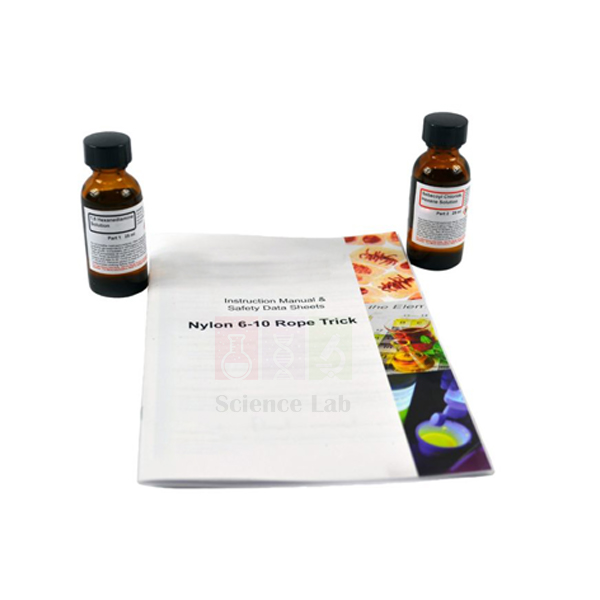
Chemistry Demonstration Nylon 6-10 Rope Trick
Chemistry Demonstration Nylon 6-10 Rope Trick (Product Code: SLE/CH/105) is a polymer chemistry demonstration kit used to make nylon and draw it out as a continuous rope in school and college chemistry lessons. It contains sufficient reagents for five demonstrations, with instructions, and produces Nylon 6-10, a synthetic polymer of high molecular weight built from up to millions of repeated chemical units. It is supplied by Jain Scientific Equipments Pvt Ltd (ScienceLab), Ambala, India, alongside the reagents it offers as a lab chemicals supplier in India.
Key Details
| Parameter | Detail |
|---|---|
| Type | Polymer chemistry demonstration kit |
| Polymer produced | Nylon 6-10 |
| Reagents | Sufficient for five demonstrations |
| Instructions | Included |
| Teaching focus | Synthetic polymers of high molecular weight consisting of up to millions of repeated, linked chemical units |
| Shelf life | Depends on the chemical, its grade and storage conditions; ask us for the expiry date of the batch you are quoted |
| Product code | SLE/CH/105 |
| Supplied by | Jain Scientific Equipments Pvt Ltd (ScienceLab), Ambala, India |
What Is the Nylon 6-10 Rope Trick Used For?
It is a vivid way to show polymerisation happening in real time. In the classic rope trick, two reagent solutions that do not mix are layered carefully in a beaker, and a film of polymer forms where they meet. Grip the film at the centre with forceps, lift it slowly and wind it onto a glass rod: fresh nylon keeps forming at the boundary, so a long rope can be drawn out while the class watches.
The name itself is a teaching point, because in Nylon 6-10 one monomer contributes six carbon atoms and the other ten to each repeating unit, which links neatly to lessons on condensation polymers. Follow the included instructions for quantities and the order of addition, wear goggles and gloves, work in a well-ventilated room and rinse the rope thoroughly before anyone handles it. Building the repeating unit with an organic molecular model set afterwards helps students connect what they saw to the structure of the chain.
Supplier
The Nylon 6-10 Rope Trick kit is supplied by Jain Scientific Equipments Private Limited, which trades as ScienceLab and is based in Ambala, Haryana, India. It is one of the demonstration reagent kits the company sources for schools and colleges, and it can be quoted with the beakers, forceps and goggles needed to run it. Our company profile has further details.
Related Laboratory Equipment
Apparatus and models used to run and explain the demonstration:
- Forceps (Tweezers) — for gripping the polymer film at the interface
- Stirring Rod, Glass — for winding up the nylon rope as it is drawn out
- Glass Beaker — the vessel in which the two solutions are layered
- Safety Goggles — eye protection for the demonstrator and nearby students
- Organic Chemistry Molecular Models Kits — to build the repeating unit and show how the chain grows
Find more kits and apparatus in our Chemistry Lab Equipment category.
Frequently Asked Questions
How many demonstrations can I run with the Nylon 6-10 Rope Trick kit?
The Chemistry Demonstration Nylon 6-10 Rope Trick kit contains sufficient reagents for five demonstrations, enough for a teacher to show the reaction to several classes or to repeat it when students revise polymers.
Are instructions provided?
Yes. Instructions are included with the Nylon 6-10 Rope Trick kit; follow them for the quantities of each solution and the order in which the layers are added, because careful layering is what lets the rope form cleanly.
What does "6-10" mean?
In the Nylon 6-10 Rope Trick, the name refers to the number of carbon atoms contributed by each of the two monomers that join to form the repeating unit of this nylon: six from one monomer and ten from the other.
Is it suitable for students to perform?
The Nylon 6-10 Rope Trick kit is designed as a demonstration. We recommend that a teacher runs it in a well-ventilated room, with students watching from a safe distance and everyone wearing eye protection.
What else do I need?
Apparatus such as a beaker, forceps and a glass rod is not listed as included with the Nylon 6-10 Rope Trick kit, so have these ready or order them together with the kit from the related items above.
What is the shelf life of the reagents?
The shelf life of the Nylon 6-10 Rope Trick kit depends on the chemicals, their grade and storage conditions; ask us for the expiry date of the batch you are quoted, and store the reagents as the instructions direct.
Who supplies the Nylon 6-10 Rope Trick kit?
Jain Scientific Equipments Private Limited, trading as ScienceLab from Ambala, Haryana, India, supplies the Nylon 6-10 Rope Trick kit to schools, colleges and distributors in India and international markets; share your quantity and delivery location for a quotation.
Request a Quote
Add the kit to the enquiry cart or send your requirement through the contact page, listing any beakers, forceps or goggles you also need.
Last updated: 24 September 2026
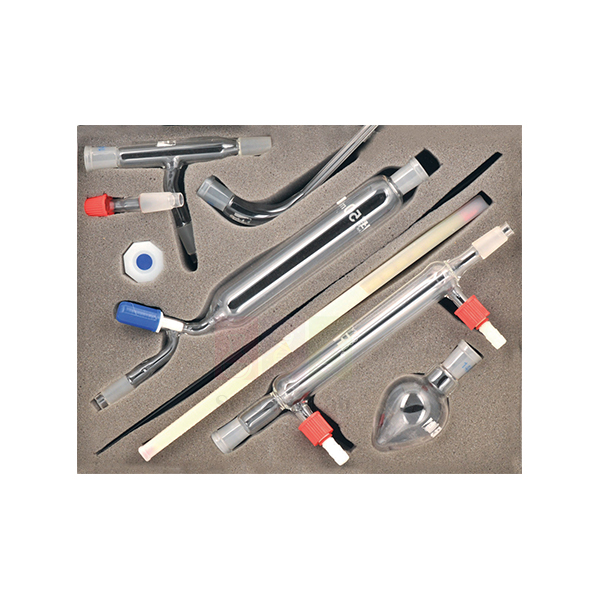
Organic Chemistry Kit
Organic Chemistry Kit (Product Code: SLE/CH/106) is a compact set of apparatus for small-scale organic preparations and purifications, built around a 50 ml pear-shaped flask. With a still head, Liebig condenser, receiver adaptor, 50 ml dropping funnel and thermometer, students can assemble a simple distillation, add a reagent dropwise to a reaction, or set the condenser upright for heating under reflux, all from one kit. It is used in senior secondary and undergraduate organic chemistry practicals. It is made by Jain Scientific Equipments Pvt Ltd (ScienceLab), Ambala, for institutions looking for laboratory distillation apparatus in India and international markets.
Specifications
| Parameter | Detail |
|---|---|
| Flask | 1 pear-shaped flask, 50 ml |
| Still head | 1 |
| Air leak / stream inlet | 1 |
| Dropping funnel | 1, 50 ml, with GP rotaflow tap |
| Stopper | 1 |
| Condenser | 1 Liebig condenser |
| Screwcap adaptor | 1 |
| Receiver adaptor | 1 |
| Thermometer | 1 |
Typical Use
For a simple distillation, the pear-shaped flask is clamped over the heat source, the still head fitted on top with the thermometer held through the screwcap adaptor at the side-arm level, and the Liebig condenser connected to the side arm with the receiver adaptor directing distillate into a collecting vessel. For a preparation, the dropping funnel with its rotaflow tap sits on the flask so a reagent can be added a little at a time while the mixture is heated or stirred; the stopper closes any unused opening, and the air leak inlet provides a controlled gas or air entry point where a procedure calls for one.
Clamp both the flask and the condenser, run cooling water in at the lower end of the condenser and out at the upper end, add anti-bumping granules before heating, and never heat a completely closed system. Because the flask holds 50 ml, reagent quantities stay small, which suits college labs and schools working under budget or safety limits. Departments buying from a chemistry lab instruments supplier often pair the kit with stands and clamps so each bench is complete.
Manufacturer
This kit is manufactured by Jain Scientific Equipments Private Limited, operating as ScienceLab in Ambala, Haryana, India, a maker of apparatus for chemistry, physics and biology teaching labs. See the company profile for more.
Related Chemistry Lab Equipment
Support and spare items for assembling the kit on the bench:
- Retort Stand — the upright support for clamping the assembly
- Universal Clamp — holds the flask and condenser securely to the stand
- Rubber Tubing — carries cooling water to and from the Liebig condenser
- Liebig Condenser — a separately listed condenser; confirm fit with the kit before ordering as a spare
- Fractional Distillation Assembly — for separations that need a fractionating set-up
Explore the Chemistry Lab Equipment category for more apparatus.
Frequently Asked Questions
What does the Organic Chemistry Kit contain?
One each of: 50 ml pear-shaped flask, still head, air leak/stream inlet, 50 ml dropping funnel with GP rotaflow tap, stopper, Liebig condenser, screwcap adaptor, receiver adaptor and thermometer.
What joint sizes are used?
Joint sizes are not listed on this page. Please contact us if you need them to match existing apparatus.
Are a stand and clamps included?
They are not listed in the kit contents, so order a retort stand and clamps separately if you do not already have them.
What is the thermometer range?
The range is not stated here; ask us for details before ordering if your procedure needs a specific range.
Can it be used for reflux as well as distillation?
Yes. With the Liebig condenser fitted vertically on the flask, the same kit can be used to heat a reaction under reflux.
Is a calibration certificate available for the thermometer?
Please discuss calibration certificate availability with us when you request a quotation.
Can you supply kits for a whole lab?
Yes. State the number of kits, any extra spares and your delivery location; we supply institutions across India and international markets.
Request a Quote
Add the Organic Chemistry Kit to our enquiry cart or contact us for pricing.
Last updated: 24 September 2026
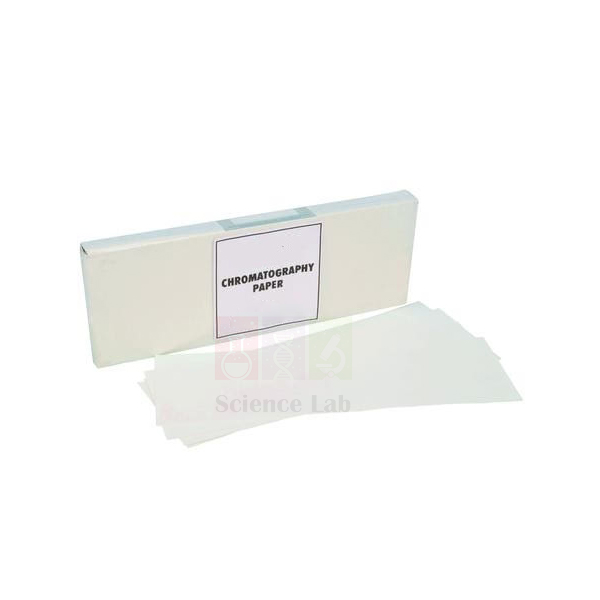
Chromatography Paper No. 1
Chromatography Paper No. 1 (Product Code: SLE/CH/107) is a pack of 100 sheets of No. 1 chromatography filter paper, each sheet measuring 200 x 200 mm and very thin. It is used in paper chromatography to separate a sample into its component parts, for example letting students split blended water-soluble inks into the original pigments to reveal their hidden colours. In wider laboratory work it helps test for the presence of various materials, monitor the rate and progress of a reaction, or determine the purity of a product. Suitable for school and college practicals and for experiments at home, it is a core consumable for any paper chromatography kit for school labs and is supplied by Jain Scientific Equipments Pvt Ltd (ScienceLab), Ambala.
Specifications
| Parameter | Detail |
|---|---|
| Grade | No. 1 chromatography filter paper |
| Pack size | 100 sheets |
| Sheet size | 200 x 200 mm |
| Thickness | Very thin |
| Absorbency | Absorbs liquids and provides more surface area for evaporation |
| Applications | Separating water-soluble inks; testing for the presence of materials; monitoring reaction rate and progress; checking product purity |
Typical Use
Cut a sheet into strips, draw a baseline in pencil a short distance from one end, and spot each ink or sample on the line. Stand the strip in a beaker with the solvent level below the baseline and cover it; as the solvent climbs, each component travels a different distance, leaving a row of separate spots. Students can then compare spots with known references or measure how far each has moved relative to the solvent front.
Handle sheets by the edges, because skin oils can distort the solvent flow, and never mark the baseline in ink, which would itself separate. Because the paper absorbs liquid readily and spreads it across a large surface, it also dries quickly between runs. Keep the pack sealed and flat in a dry cupboard. Labs sourcing from a chemistry consumables supplier in India usually order it with chromatography pens and TLC plates to cover both paper and thin-layer methods.
Supplier
This paper is supplied by Jain Scientific Equipments Private Limited, the company behind ScienceLab in Ambala, Haryana, India. The company supplies consumables such as this paper alongside its apparatus range; for vendor registration, its details are CIN U29309HR2020PTC087597 (Ministry of Corporate Affairs) and GSTIN 06AAECJ8618A1ZT. Read more in our company profile.
Related Chemistry Lab Equipment
Items used with chromatography paper in separation practicals:
- Chromatography Pens, Black — ink samples that separate into several colours on the paper
- Chromatography Plates, TLC — for comparing paper chromatography with thin-layer chromatography
- Forensic Chemistry of Chromatography (Document Analysis) — a ready-made investigation built on ink separation
- Glass Beaker — a simple developing vessel for paper strips
- Filter Paper — for general filtration work, kept separate from chromatography sheets
Browse more consumables and apparatus under Chemistry Lab Equipment.
Frequently Asked Questions
How many sheets are in a pack of Chromatography Paper No. 1, and what size are they?
Each pack holds 100 sheets, each 200 x 200 mm.
Can the sheets be cut into strips?
Yes. Cut them with clean scissors to whatever strip width your developing vessel needs.
Which solvent should I use?
Water works for separating water-soluble inks. Other samples may need a different solvent, as set out in your experiment method.
Can it be used outside the lab?
Yes, it can be used for various experiments in the laboratory and at home, with the usual care when handling solvents.
How should it be stored?
Keep it flat, dry and sealed in its pack, and handle sheets only by the edges.
Do you supply larger quantities for schools or distributors?
Yes. We supply institutions and distributors across India and international markets; tell us the number of packs and delivery location for a quotation.
Request a Quote
Add this paper to the enquiry cart or reach us through the contact page to request pricing.
Last updated: 24 September 2026
Chromatography Pens, Black
Chromatography Pens, Black (Product Code: SLE/CH/108) are water-based black marker pens with a 1.7 mm tip, used to show students that a single “black” ink is really a blend of several coloured dyes. A line or dot of ink is placed on paper or card, water is allowed to creep up through it, and the hidden colours spread apart into separate bands. They are a simple consumable to keep alongside a chromatography kit for school labs in India and are supplied by Jain Scientific Equipments Pvt Ltd (ScienceLab), Ambala, India.
Specifications
| Parameter | Detail |
|---|---|
| Pen type | Water-based marker pen |
| Ink colour | Black |
| Tip size | 1.7 mm |
| Suitable surfaces | Paper and card |
| Teaching purpose | Showing the separation of the colours used in black ink |
Typical Use
In a standard paper chromatography practical, students draw a pencil baseline near the bottom of a paper strip (pencil graphite does not dissolve, so it will not run), mark a small dot of black ink on it, and stand the strip in a container with a shallow layer of water kept below the ink mark. As the water rises through the paper it carries each dye at a different rate, depending on how soluble the dye is and how strongly it clings to the paper fibres. After a few minutes the single black spot opens into a ladder of blues, purples, yellows or browns, which students can sketch, compare and use to work out Rf values.
Let each ink spot dry before developing so it does not smear, and keep the caps firmly on between classes so the tips stay moist. The same pens make a good starting point for a mini forensic exercise, where students compare the pattern from an unknown note with patterns from several pens. Schools that order from us as a chemistry consumables supplier in India usually request these pens together with chromatography paper so that every bench has matching materials.
Supplier
These pens are supplied by Jain Scientific Equipments Private Limited, the company that trades under the ScienceLab brand. It is based in Ambala, Haryana, where it manufactures laboratory apparatus and supplies teaching consumables to schools and colleges in India and international markets. More background is available on our company profile page.
Related Chemistry Lab Equipment
Items commonly used in the same ink chromatography practical:
- Chromatography Paper No. 1 — the paper on which the black ink spot is developed
- Chromatography Plates, TLC — thin-layer plates for comparing the same separation on a coated surface
- Forensic Chemistry of Chromatography (Document Analysis) — a forensic activity built around identifying inks
- Glass Beaker — holds the water in which the paper strip stands
- Filter Paper — an everyday paper for quick demonstration runs
See the complete Chemistry Lab Equipment range for more chromatography and general bench items.
Frequently Asked Questions
How many pens are in one order unit?
The pack quantity is not listed in our current product notes. Tell us how many pens you need through our contact page and the pack format will be confirmed in your quotation.
What solvent do I need to separate the ink?
Plain water normally works, because the ink is water-based. Some teachers repeat the run with a different solvent as an extension activity to show how the solvent changes the result.
Which paper should I use with these pens?
They are intended for paper and card. Chromatography paper gives the cleanest bands for measurement, while card is handy for display work where the separated colours are mounted on a wall chart.
Can I spot this ink onto TLC plates?
The pens are described for paper and card only. If you plan to use them on thin-layer plates, ask us to check suitability before you order.
How should the pens be stored between lessons?
Replace the cap straight after use and keep the pens away from direct heat, so the water-based ink does not dry out in the tip.
Do you supply schools in bulk and overseas?
Yes. Class sets and larger institutional orders can be arranged for buyers in India and international markets; share your quantity and destination and we will respond with availability.
What should I include in an institutional quotation request?
Mention the product code SLE/CH/108, the number of pens, your delivery address and any tender or purchase-order format your institution follows.
Request a Quote
To order Chromatography Pens, Black, send your requirement through our contact page, or add this item to the enquiry cart together with other chromatography supplies and submit one combined request.
Last updated: 24 September 2026
Chromatography Plates, TLC
Chromatography Plates, TLC (Product Code: SLE/CH/109) are pre-coated thin-layer chromatography plates cut to 40 x 80 mm and packed 50 to a pack. Because the stationary layer is already applied, teachers and lab assistants can move straight to spotting and developing samples without preparing slurry-coated slides. The plates suit senior-school and college practicals on separating and identifying the components of coloured mixtures, and they are supplied by Jain Scientific Equipments Pvt Ltd (ScienceLab), Ambala, a lab consumables supplier to institutions across India.
Specifications
| Parameter | Detail |
|---|---|
| Product type | Pre-coated TLC plates |
| Plate size | 40 x 80 mm |
| Pack quantity | Pack of 50 plates |
| Technique | Thin-layer chromatography (TLC) |
Typical Use
A TLC run starts with a light pencil line drawn across the plate a short distance above its lower edge. Students apply tiny spots of each sample on this line with a fine capillary, allow them to dry, and then stand the plate in a covered jar or beaker containing a shallow pool of solvent that sits below the spots. The solvent rises through the coating by capillary action and carries each component a different distance. Once the front nears the top, the plate is removed, the solvent front is marked, and Rf values are calculated and compared with known references. Coloured substances such as inks and food dyes can be seen directly; colourless compounds may need a visualising method that suits the coating.
Compared with paper chromatography, thin-layer runs are quicker and usually give tighter, rounder spots, which makes them useful when a class has only one period for the whole practical. The compact 40 x 80 mm format fits small developing jars and leaves room for several side-by-side spots. Hold each plate by its edges, press gently with the pencil so the coating is not scraped, and keep solvent jars covered in a ventilated area. Plates like these are a routine reorder item for any chemistry lab equipment India schools maintain for analytical practicals.
Supplier
Jain Scientific Equipments Private Limited trades as ScienceLab and operates from Ambala, Haryana. Alongside the laboratory apparatus it manufactures, the company supplies chromatography consumables such as these plates to schools, colleges and distributors. Our company profile gives an overview of the business.
Related Chemistry Lab Equipment
Items that complete a thin-layer chromatography practical:
- Capillary Tube Set — fine tubes for applying small, even sample spots
- Chromatography Pens, Black — black ink samples whose hidden dyes separate well in class demonstrations
- Crime Scene Investigation – Forensic Chemistry Of Whodunit — a forensic activity that uses TLC analysis of ink
- Chromatography Paper No. 1 — for running the same mixture on paper and comparing the two methods
- Glass Beaker — can act as a simple developing chamber when covered
More separation and bench items are listed in our Chemistry Lab Equipment category.
Frequently Asked Questions
How many plates are in one pack, and what size are they?
Each pack holds 50 plates, and every plate measures 40 x 80 mm.
What is the coating and backing material?
The plates are pre-coated, but the layer type and backing are not stated in our current product notes. If your method depends on a particular layer, please confirm through our contact page before ordering.
Can the plates be cut into narrower strips?
Whether cutting is practical depends on the backing material, so ask us first; the 40 x 80 mm size is already small enough for most student developing jars.
Are solvents or a developing tank included?
No. This item covers the plates only; solvents, capillaries and a developing container are arranged separately.
How should unopened plates be stored?
Keep them flat in their pack, in a dry cupboard away from solvent fumes, because a coated layer can absorb moisture and contaminants that affect later results.
Can batch documentation be provided with the order?
Documentation requirements vary by institution, so please discuss what you need with our team when you request a quotation.
Is bulk supply available for colleges and export buyers?
Yes. Multiple packs can be supplied to institutions in India and international markets; include the number of packs and destination in your enquiry.
Request a Quote
Send the number of packs you need through our contact page, or place Chromatography Plates, TLC in the enquiry cart with any other items and submit a single request.
Last updated: 24 September 2026
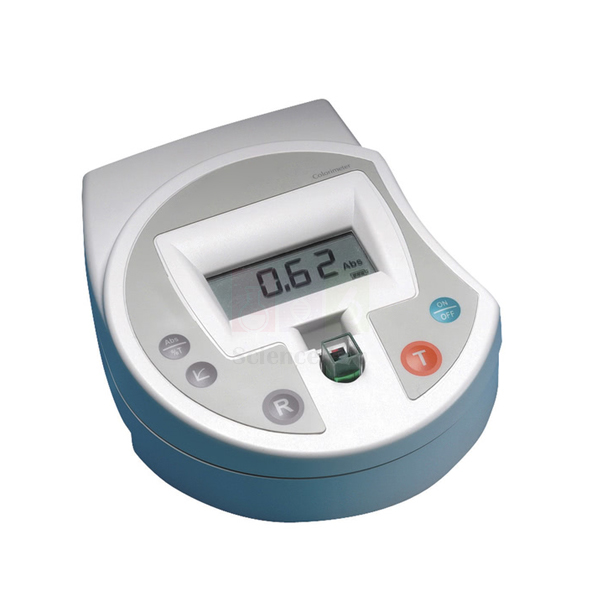
Colorimeter
The Colorimeter (Product Code: SLE/CH/110) is a compact bench instrument that measures how strongly a coloured solution absorbs light, so students can link the depth of a colour to the concentration of the substance that causes it. It has been designed for educational establishments such as schools and colleges: it is lightweight, ergonomically shaped to withstand student handling, and fitted with a large display that is easy to read from across a bench. Manufactured by Jain Scientific Equipments Pvt Ltd (ScienceLab), Ambala, it is one of the analytical lab instruments India teaching laboratories use to introduce quantitative light-absorption work.
Specifications
| Parameter | Detail |
|---|---|
| Intended users | Educational establishments such as schools and colleges |
| Construction | Compact, lightweight and ergonomically designed to withstand student use |
| Display | Large, easy-to-read display |
| Operation | Simple to set up and use, giving rapid results |
| Cuvette compatibility | Standard or semi-micro cuvettes with 10mm pathlength |
| Test tube compatibility | 16mm diameter test tubes |
| Optional adapters | Adapters for 10/12 mm test tubes are available |
Typical Use
The classic student investigation is a calibration curve: learners prepare a dilution series of a coloured solution, record a reading for each standard, plot reading against concentration, and then use the graph to find the concentration of an unknown sample. The same instrument supports reaction-rate work, where a solution that changes colour or turns cloudy is read at regular intervals, and simple biology practicals that follow a colour change produced by an indicator or an enzyme reaction. Because it gives rapid results and is quick to set up, several groups can share one unit during a busy practical period.
For reliable readings, zero the instrument with a blank of the solvent in the same type of container used for the samples, wipe the clear faces of each cuvette with a lint-free tissue, and always insert the cuvette facing the same way. Using 16mm test tubes directly saves a transfer step when a whole class is measuring many samples. Institutions that source their chemistry lab instruments supplier-direct from us often order transfer pipettes and racks with the colorimeter so each station is complete.
Manufacturer
This colorimeter is manufactured by Jain Scientific Equipments Private Limited, which markets its range under the name ScienceLab. The company is based in Ambala, Haryana, India, and produces teaching and laboratory equipment for schools, colleges and technical institutes. Visit our company profile for details of the business.
Related Chemistry Lab Equipment
Instruments and accessories that fit the same absorbance workflow:
- Digital Photo Colorimeter 5 Filters — an alternative colorimeter model with selectable filters
- Single Beam Microprocessor UV-VIS Spectrophotometer — for courses that need wavelength selection across the UV and visible range
- Test Tube 12 x 100 mm — narrow tubes that can be read with the optional 10/12 mm adapter
- Transfer Pipette, 3ml — for filling cuvettes cleanly without splashing the sample chamber
- Test Tube Racks — keeps a dilution series in order while readings are taken
Browse our wider Chemistry Lab Equipment range for supporting glassware and bench items.
Frequently Asked Questions
What sample containers does the colorimeter accept?
It reads samples in standard or semi-micro cuvettes with a 10mm pathlength, or in 16mm diameter test tubes. Adapters for 10/12 mm test tubes are also available.
Are cuvettes and test tube adapters included?
The standard contents are not listed in our current product notes, so the accessories supplied with each unit will be stated in your quotation. Please mention any adapters you need when you contact us.
Which wavelengths or filters does it offer?
Filter and wavelength details are not given in our present documentation for this model. Ask us for the datasheet before ordering if your syllabus specifies particular wavelengths.
What power supply does it need?
Power details are not listed here. Tell us the country where the instrument will be used and we will confirm the electrical configuration.
Will it stand up to daily student use?
It is designed to withstand student use. Good habits still help: keep liquids out of the sample chamber, wipe up spills immediately and store the unit covered.
Is a calibration certificate available?
Please discuss calibration certificate availability with us when you enquire. For everyday teaching, zeroing against a blank before each session keeps readings consistent.
What warranty applies?
Warranty terms are confirmed at the time of quotation; our team can explain them before you place an order.
What should a school or college include in its enquiry?
State the product code SLE/CH/110, the number of units, the country of use, any accessories such as adapters, and whether the order is for India or international delivery.
Request a Quote
Request pricing and availability for the Colorimeter through our contact page, or add it to the enquiry cart alongside other laboratory items for one consolidated quotation.
Last updated: 24 September 2026
Comboplate, Microscience
The Comboplate, Microscience (Product Code: SLE/CH/111) is a transparent 60-well plate on which students run chemistry, biology and physics experiments with drops of reagent instead of full test tubes. Its 48 small wells behave like “micro test tubes” and its 12 large wells like “micro beakers”, and every well is labelled by a grid reference so results can be recorded precisely. Manufactured by Jain Scientific Equipments Pvt Ltd (ScienceLab), Ambala, it is a practical piece of chemistry lab equipment for schools in India that want to run microscale practicals across a whole class.
Specifications
| Parameter | Detail |
|---|---|
| Total wells | 60 (two sections) |
| Small wells | 48 wells, volume 0.3 ml each |
| Large wells | 12 wells, volume approx 2.5 ml each |
| Well identification | Grid reference system |
| Format | Designed to the dimensions of standard 96-well and 48-well plates; combines features of the 24 and 96 well microplates used in industry, pharmacy, diagnostics and research |
| Optical properties | Optically clear and completely transparent; allows light to pass for overhead projection |
| Care | Dishwasher proof; may be used repeatedly |
| System role | Acts as a base for the ancillary components of the Microscience System |
| Applications | General microtitration, special procedures, and chemistry, biology and physics education experiments; suitable for a wide range of inorganic uses |
Typical Use
A favourite first lesson is acids and bases: a row of small wells receives a drop of indicator, students add acid or alkali drop by drop, and the colour changes are logged against each grid reference. Because the plate is completely transparent, a teacher can place it on an overhead projector and the whole class sees the colours develop at the same time. Microtitrations work the same way, with drops counted instead of burette readings, while the 12 larger wells take reactions that need a little more volume or mixing space, such as displacement reactions or small gas-producing tests.
The plate also serves as the base for other components of the Microscience System, so it pairs naturally with a titration kit for school use in India built around the same approach. After the practical, rinse the wells promptly so residues do not dry on, then wash the plate in a dishwasher and reuse it for the next class. Recording results by grid reference (for example, row and column) helps students write up methods that someone else could repeat exactly.
Manufacturer
ScienceLab is the trading name of Jain Scientific Equipments Private Limited, a laboratory equipment maker based in Ambala, Haryana, India. The company is a registered MSME enterprise (Udyam UDYAM-HR-01-0003714), and its export consignments move under Importer-Exporter Code AAECJ8618A issued by the DGFT. Read more on our company profile.
Related Chemistry Lab Equipment
Microscience items and accessories that work with this plate:
- Basic Microscience Kit, Student — an entry-level student kit for microscale chemistry
- Advanced Microscience Kit, Student — extends microscale work to more demanding practicals
- Titration Kit, Student, Microscience — for drop-count titrations carried out on the plate
- Water Monitoring Kit, Microscience — water-quality tests using the same microscale method
- Dropper Bottle, 10 ml — dispenses reagents one drop at a time into the wells
Find more items in our Chemistry Lab Equipment category.
Frequently Asked Questions
How many wells does the plate have, and what do they hold?
It has 60 wells: 48 small wells of 0.3 ml and 12 large wells of approximately 2.5 ml.
Which plastic is the plate made from?
Our current product notes mention both polystyrene and polypropylene for this plate, so we will confirm the exact material with your quotation. This matters if you plan to use organic solvents; please raise it through our contact page.
Can it be used on an overhead projector?
Yes. The plate is completely transparent and lets light pass through, which is why it is used for whole-class demonstrations of acids and bases.
How do I clean it between lessons?
Rinse the wells soon after use, then wash the plate in a dishwasher; it is dishwasher proof and may be used repeatedly.
Will it work with plate-handling equipment made for 96-well plates?
It follows the dimensions of standard 96-well and 48-well plates, but its well layout is different, so check compatibility with any specific instrument before relying on it.
Does it fit the other Microscience components?
It is designed to act as the base for the ancillary components of the Microscience System. Tell us which kit you use and we will confirm the match.
Can you supply class sets or export quantities?
Yes. We supply schools, colleges and distributors in India and international markets; include the number of plates and destination in your enquiry.
Request a Quote
For pricing on the Comboplate, Microscience, write to us via the contact page or add it to the enquiry cart together with any Microscience kits you need.
Last updated: 24 September 2026
Inner Reaction Vessel
The Inner Reaction Vessel (Product Code: SLE/CH/112) is a slim, small-volume container with a 5 ml capacity, measuring 50 mm in height and 14 mm in diameter. In small-scale chemistry, a vessel of this kind is typically used to hold a few millilitres of one reactant inside a larger container or apparatus, so that the reaction can be started, contained and observed with only a small quantity of chemicals. It is made by Jain Scientific Equipments Pvt Ltd (ScienceLab), Ambala, and joins the wider range of chemistry lab equipment India schools and colleges use for microscale practicals.
Specifications
| Parameter | Detail |
|---|---|
| Type | Small-volume inner reaction vessel |
| Capacity | 5 ml |
| Height | 50 mm |
| Diameter | 14 mm |
Typical Use
Working at the 5 ml scale lets a class repeat a reaction several times in one lesson while keeping chemical use, waste and clean-up to a minimum. Teachers use small inner vessels to keep a reagent apart until the moment it is needed, to confine a reaction whose gas or colour change is then watched in a surrounding container, or simply as compact reaction tubes when bench space is limited. The narrow 14 mm body keeps the liquid column tall, which makes small colour changes and bubbling easier to see.
Measure reagents into the vessel with a dropper or a small graduated pipette rather than pouring, and stand it securely before adding anything so it cannot tip. Because the material is not stated in our current notes, check with us before heating the vessel or using strong solvents. Clean it promptly with a narrow brush and leave it inverted to dry. It is a useful spare to keep with any chemistry experiment kit India teachers run at microscale.
Manufacturer
The Inner Reaction Vessel is manufactured by Jain Scientific Equipments Private Limited, better known by its trade name ScienceLab. The company is located in Ambala, Haryana, India, and serves educational and research laboratories. Our company profile has more information.
Related Chemistry Lab Equipment
Other small-scale items used alongside this vessel:
- Comboplate, Microscience — a 60-well plate for running parallel microscale tests
- Basic Microscience Kit, Student — a student kit built around low-volume chemistry
- Transfer Pipette, 1ml — for measuring small reagent volumes into the vessel
- Dropper Bottle, 10 ml — holds stock reagents and delivers them drop by drop
- Brush Test Tube — a narrow brush for cleaning slim vessels after use
See all items in the Chemistry Lab Equipment category.
Frequently Asked Questions
What are the capacity and dimensions?
The vessel holds 5 ml and measures 50 mm high with a 14 mm diameter.
What material is it made from?
The material is not recorded in our current product notes. Please confirm it through our contact page before ordering, especially if the vessel will be heated or used with solvents.
Which outer container or apparatus does it fit?
Its slim 14 mm diameter allows it to sit inside wider containers, but fit depends on your apparatus. Share the model or dimensions of your outer vessel and we will advise.
Is a lid or stopper supplied?
A closure is not listed for this item. Tell us if you need one and we will check what can be offered.
How should it be cleaned?
Rinse it straight after the reaction, scrub gently with a narrow brush and leave it upside down to drain and dry.
Can I order it in larger quantities for a whole class?
Yes. Class quantities and distributor orders for India and international markets can be quoted on request.
Request a Quote
Ask for a quotation on the Inner Reaction Vessel through our contact page, or add it to the enquiry cart with other microscale items.
Last updated: 24 September 2026
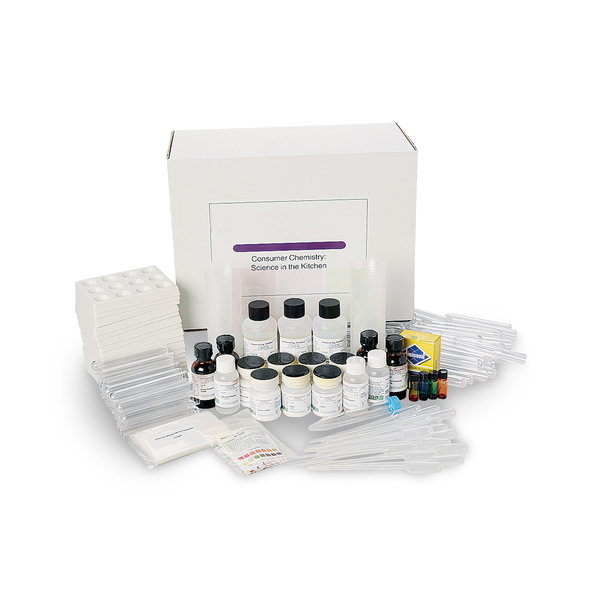
Consumer Chemistry Science Kit
Consumer Chemistry Science Kit (Product Code: SLE/CH/113) is a kitchen-themed chemistry kit used to teach chromatography, chemical identification tests, enzyme action, titration and the chemistry of cleaning products in school and college labs. It contains enough materials for fifteen groups, so a full class can work through each technique using materials found in an ordinary kitchen. It is supplied by Jain Scientific Equipments Pvt Ltd (ScienceLab), Ambala, India, as a chemistry teaching kit for integrated science courses.
Key Details
| Parameter | Detail |
|---|---|
| Theme | Scientific techniques applied to common kitchen materials |
| Group capacity | Enough materials for fifteen groups |
| Chromatography | Separation of commercial food colours |
| Chemical tests | Identifying an unknown cooking ingredient |
| Enzyme study | Protein-digesting ability of a common meat tenderizing enzyme |
| Titration | Quantifying vitamin C levels, then testing an unknown juice or soda |
| Cleaning materials | Differences and similarities between soap, hand dishwashing detergent and machine dishwashing detergent |
| Not provided | The juice or soda used as the unknown in the vitamin C test |
| Shelf life | Depends on the chemical, its grade and storage conditions; ask us for the expiry date of the batch you are quoted |
| Product code | SLE/CH/113 |
| Supplied by | Jain Scientific Equipments Pvt Ltd (ScienceLab), Ambala, India |
What Is the Consumer Chemistry Science Kit Used For?
Most teachers spread the activities over a short sequence of practical lessons, each introducing a different technique. The food-colour chromatography shows that one commercial colour can contain several dyes; the chemical tests train students to reason from observations to name an unknown ingredient; the meat-tenderiser activity turns protein digestion into something visible; the vitamin C titration develops careful end-point judgement; and the detergent comparison links structure to cleaning action.
Students can bring in a juice or soda of their own for the final vitamin C test, which gives the unit a satisfying real-world ending. Give each of the fifteen groups a labelled tray, keep the enzyme activity away from heat sources until it is needed, and collect results in a shared table so class data can be compared. Because the investigations draw on both chemistry and biology, schools often run it with other themed chemistry experiment kits in India so a single topic, such as food science, carries across a term.
Supplier
This kit is supplied by Jain Scientific Equipments Private Limited, the Ambala, Haryana company behind the ScienceLab name. It sources investigation kits and consumables for schools, colleges and distributors in India and international markets, and can quote this kit together with extra chromatography paper, burettes and beakers. Learn more on our company profile.
Related Chemistry Lab Equipment
Items that extend or support these kitchen-chemistry investigations:
- Chromatography Paper No. 1 — extra paper for repeating the food-colour separations
- Micro Burettes, Class-A — for finer volume readings if the vitamin C titration is extended
- Glass Beaker Set of 5 — general containers for preparing and holding test solutions
- Environmental Chemistry: Water Treatment & Filtration — another themed kit linking chemistry to daily life
- Organic Chemistry Kit — a follow-on kit for classes moving into organic reactions
Explore more kits in our Chemistry Lab Equipment range.
Frequently Asked Questions
How many groups can use one Consumer Chemistry Science Kit?
One Consumer Chemistry Science Kit contains enough materials for fifteen groups, so a typical class can carry out each kitchen-themed investigation in small teams rather than watching a single demonstration.
Is the juice or soda for the vitamin C test included?
No. The unknown juice or soda for the vitamin C titration is not provided with the Consumer Chemistry Science Kit, so students or teachers bring their own drink to test at the end of the unit.
Which techniques does the kit cover?
The Consumer Chemistry Science Kit covers chromatography of commercial food colours, chemical tests to identify an unknown cooking ingredient, the protein-digesting action of a meat tenderizing enzyme, vitamin C titration, and a comparison of soap with hand and machine dishwashing detergents.
Where can I see the full list of components?
A detailed component list for the Consumer Chemistry Science Kit is not part of our current product notes. Request it through our contact page and we will share it with your quotation so you can check it against your syllabus.
What is the shelf life of the kit?
The shelf life of the Consumer Chemistry Science Kit depends on the chemicals and other contents, their grade and storage conditions; ask us for the expiry date of the batch you are quoted, and keep the kit closed in a cool, dry cupboard.
Which class level is it suitable for?
The Consumer Chemistry Science Kit includes titration and enzyme work, so it suits supervised laboratory classes; compare the five investigations with your syllabus, and ask us through the contact page if you need help matching them.
Who supplies the Consumer Chemistry Science Kit?
Jain Scientific Equipments Private Limited (ScienceLab), based in Ambala, Haryana, India, supplies the Consumer Chemistry Science Kit to schools, colleges and school networks in India and international markets; tell us the number of kits and the destination.
Request a Quote
Send your requirement for the Consumer Chemistry Science Kit through our contact page, or add it to the enquiry cart with other kits for one combined quotation.
Last updated: 24 September 2026
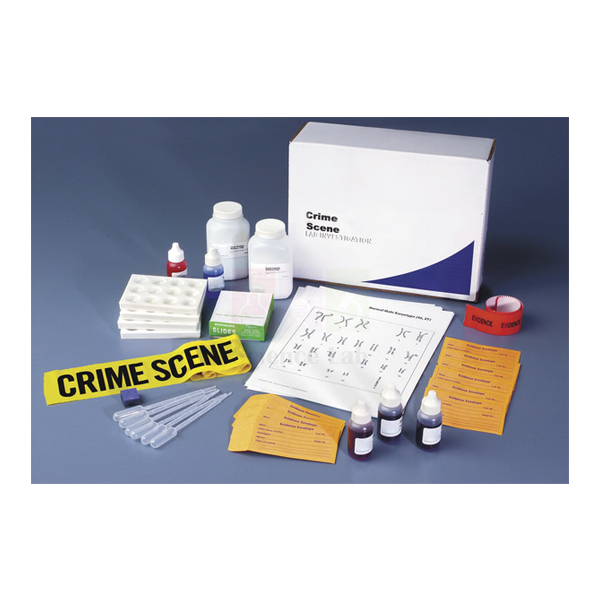
Crime Scene Investigation
Crime Scene Investigation (Product Code: SLE/CH/114) is a forensic science activity that lets students explore how criminal investigations actually work, from the first look at a crime scene to naming a likely suspect. Learners examine physical evidence, identify the victim through dental records and fingerprints, run tests on what they collect and work out the cause of death. With materials for up to 40 students, it is a STEM science kit India classrooms can use to connect chemistry and biology to a story students want to solve. It is supplied by Jain Scientific Equipments Pvt Ltd (ScienceLab), Ambala.
Key Details
| Parameter | Detail |
|---|---|
| Activity type | Forensic science investigation |
| Class size | Materials for up to 40 students |
| Evidence gathering | Examining the physical evidence of a crime scene |
| Victim identification | Using dental records and fingerprints |
| Evidence analysis | Various tests to analyse the evidence gathered |
| Cause of death | Tests to determine how the victim died |
| Outcome | Analysing all evidence to determine a suspect |
Typical Use
Teachers usually stage the activity as a mock case. A corner of the lab is marked off as the scene, teams of students take on roles such as scene examiner, evidence recorder and laboratory analyst, and every item they collect is labelled and logged before testing. Matching dental records and fingerprints teaches careful comparison and observation, while the evidence tests and cause-of-death analysis give practice in carrying out procedures and interpreting results. The investigation ends with each team presenting its case for a suspect and defending it with evidence, which builds scientific reasoning and communication at the same time.
For a class of up to 40, dividing students into small teams that rotate between evidence stations keeps everyone busy. Provide gloves and eye protection during the testing stage, and review the scenario in advance so it suits the age of your group. As a school science kit supplier in India, we find many schools run this investigation during science weeks or as the final project of a forensics unit.
Supplier
Jain Scientific Equipments Private Limited, trading as ScienceLab, supplies this investigation from its base in Ambala, Haryana, India. The company manufactures laboratory apparatus and also provides teaching kits and consumables for schools and colleges. See our company profile for more about who we are.
Related Chemistry Lab Equipment
Items that help you stage and extend the investigation:
- Crime Scene Tape — bright yellow tape to cordon off the mock scene
- Forensic Chemistry of Dusting for Fingerprints — deepens the fingerprint part of the case
- Forensics Using Simulated Blood — adds blood-evidence analysis to the scenario
- Crime Scene Investigation – Forensic Chemistry Of Whodunit — a smaller-group case built on ink chromatography
- Forensic Science Lab Investigation — another forensic activity for a follow-up lesson
More kits are listed in our Chemistry Lab Equipment category.
Frequently Asked Questions
How many students can take part?
It contains materials for up to 40 students, so a full class can work in teams.
What will students actually do?
They examine physical evidence, identify the victim through dental records and fingerprints, perform tests on the evidence, determine the cause of death and analyse everything to decide on a suspect.
Is a teacher guide included?
Teaching notes are not listed in our current product description. Ask through our contact page and we will confirm what documentation comes with the kit.
Can the kit be reused with another class?
That depends on which materials are consumed during the tests. Tell us how many classes you plan to run and we will advise on quantities.
Is the scenario suitable for younger students?
The case involves a victim and a cause of death, so teachers should review it against the maturity of their group; we can share further details before you buy.
Do you supply several kits for districts or overseas buyers?
Yes. Multi-school and export orders for India and international markets can be quoted on request.
Request a Quote
To buy Crime Scene Investigation, contact us through the contact page or add it to the enquiry cart with any other forensic items you need.
Last updated: 24 September 2026

Crime Scene Investigation – Forensic Chemistry Of Whodunit
Crime Scene Investigation – Forensic Chemistry Of Whodunit (Product Code: SLE/CH/115) is a forensic chemistry case in which students solve the crime of the missing frogs. Four possible suspects have been identified, and the class uses fingerprints, hair examination and chemical analysis of ink by Thin-Layer Chromatography to decide who is most likely responsible. With material for 6 groups and printed teaching resources, it doubles as a story-led chromatography kit for school India laboratories. The activity is supplied by Jain Scientific Equipments Pvt Ltd (ScienceLab), Ambala.
Key Details
| Parameter | Detail |
|---|---|
| Case scenario | The crime of the missing frogs |
| Suspects | Four possible suspects |
| Forensic techniques | Fingerprints, hair examination and chemical analysis of ink by Thin-Layer Chromatography |
| Printed resources | Teacher’s Manual, Student Guide and Analysis copy-masters |
| Group capacity | Material for 6 groups |
Typical Use
The lesson opens with the mystery: frogs have gone missing and four suspects are in the frame. Each of the 6 groups works through three lines of evidence. Fingerprint comparison narrows the field by pattern type, hair examination adds physical evidence that must be compared carefully, and the ink analysis brings in real chemistry, as students spot ink samples on a TLC plate, develop it and compare the separated bands with ink linked to each suspect. No single test is decisive on its own, so groups must weigh all three results before naming the most likely culprit, which mirrors how forensic scientists build a case.
The Teacher’s Manual sets out the running of the activity, while the Student Guide and Analysis copy-masters can be photocopied so every learner records observations in the same format. For teachers who prefer a science kit with manual India syllabuses can map onto, this makes preparation straightforward. Run the TLC stage in a ventilated area with solvent jars covered, and ask groups to present their verdict with evidence at the end of the session.
Supplier
This forensic activity is supplied by Jain Scientific Equipments Private Limited, which trades as ScienceLab from Ambala, Haryana, India, and also manufactures laboratory apparatus for education. Buyers completing vendor registration can use the company’s GSTIN 06AAECJ8618A1ZT and its Legal Entity Identifier, LEI 3358004HRD1JIVXKYX49. More details are on our company profile.
Related Chemistry Lab Equipment
Items that support the evidence stations in this case:
- Chromatography Plates, TLC — spare pre-coated plates for repeating the ink analysis
- Forensic Chemistry of Chromatography (Document Analysis) — a companion activity focused on questioned documents
- Forensic Comparison Microscope — for side-by-side hair comparison at the examination stage
- Crime Scene Tape — sets the scene when the case is introduced
- Crime Scene Investigation — a larger forensic investigation for up to 40 students
Browse other activities in our Chemistry Lab Equipment category.
Frequently Asked Questions
How many groups does the activity serve?
There is material for 6 groups.
Which printed resources come with it?
A Teacher’s Manual, a Student Guide and Analysis copy-masters are included.
Which forensic techniques are covered?
Fingerprints, hair examination and chemical analysis of ink by Thin-Layer Chromatography, applied to four possible suspects.
Do I need a microscope for the hair examination?
A microscope is not listed among the contents, so plan to use one from your laboratory for comparing hair samples.
Are TLC solvents and developing jars part of the kit?
Our current notes do not break down the chemical contents. Please confirm the full list through our contact page so you know what to prepare beforehand.
What details help us prepare an institutional quotation?
Share the product code SLE/CH/115, the number of kits, your delivery address and any vendor-registration forms your institution requires.
Can several kits be shipped for a school group or overseas?
Yes. We quote multi-kit orders for schools in India and international markets.
Request a Quote
Enquire about Crime Scene Investigation – Forensic Chemistry Of Whodunit through our contact page, or add it to the enquiry cart along with spare TLC plates.
Last updated: 24 September 2026
Crime Scene Tape
Crime Scene Tape (Product Code: SLE/CH/116) is a bright yellow roll of barrier tape, 30 m long, made for forensics crime scene lessons. Stretched across a doorway or around a set of benches, it instantly turns part of a classroom into a “scene” that students must investigate carefully and must not disturb. It is a small item from our school lab equipment supplier India range that adds realism to forensic activities, and it is supplied by Jain Scientific Equipments Pvt Ltd (ScienceLab), Ambala.
Specifications
| Parameter | Detail |
|---|---|
| Format | Tape roll |
| Length | 30 m |
| Colour | Bright yellow |
| Intended use | Forensics crime scene lessons |
Typical Use
Teachers tie the tape between retort stands, chair backs or door handles to mark the boundary of a mock crime scene before students arrive. The boundary does real teaching work: only the “scene examiners” may cross it, evidence must be photographed or sketched before anything is moved, and students learn why preserving a scene matters in forensic science. A 30 m roll is long enough to cordon off several separate scenes, so different teams can each have their own area during a single lesson.
The tape also makes an eye-catching border for forensic displays at open days and for a science fair project kit India students assemble around crime-solving themes. After the lesson, roll unused or undamaged lengths back up for the next class. Keep it for teaching scenarios only; genuine hazards in a laboratory should be marked with dedicated hazard warning tape so the two messages are never confused.
Supplier
Crime Scene Tape is supplied by Jain Scientific Equipments Private Limited, whose products are sold under the ScienceLab name. The company is headquartered in Ambala, Haryana, India, where it manufactures laboratory apparatus and provides supporting classroom supplies. Read our company profile for background.
Related Chemistry Lab Equipment
Forensic activities and safety items often ordered with this tape:
- Crime Scene Investigation — a full forensic case for up to 40 students
- Crime Scene Investigation – Forensic Chemistry Of Whodunit — a chromatography-based case that benefits from a taped-off scene
- DNA Murder Mystery Lab Investigation — a DNA fingerprinting simulation with a murder scenario
- Forensic Science Lab Investigation — further forensic practice for follow-up lessons
- Hazard Warning Tape — the right choice for marking real laboratory hazards
View all items in our Chemistry Lab Equipment category.
Frequently Asked Questions
How long is one roll?
Each roll is 30 m long.
What wording is printed on the tape?
The printed text is not specified in our current product notes. If a particular message is important for your lesson, check with us through our contact page.
What is the tape width, and is it adhesive?
Width and adhesive details are not listed. Ask us before ordering if either affects how you plan to use it.
Can I use it to mark a real hazard in the lab?
It is intended for forensics lessons. For genuine hazards, use purpose-made hazard warning tape instead.
Can the tape be reused?
Yes, lengths that are not torn or stretched can be rolled up and used again in later lessons.
Do you supply multiple rolls to schools and overseas buyers?
Yes. We quote multi-roll orders for schools in India and international markets, often together with forensic activity kits.
Request a Quote
Tell us how many rolls of Crime Scene Tape you need via our contact page, or add it to the enquiry cart with your forensic kits.
Last updated: 24 September 2026
Current Indicator LED
The Current Indicator LED (Product Code: SLE/CH/117) is a light-emitting diode indicator used to show, at a glance, whether an electric current is flowing in a circuit. In a chemistry classroom it is most often connected in series with a solution or a simple cell, so students can see immediately whether a liquid conducts or whether a cell is producing current. It is a simple companion to any electrochemical cell kit school laboratories use, and it is manufactured by Jain Scientific Equipments Pvt Ltd (ScienceLab), Ambala.
Key Details
| Parameter | Detail |
|---|---|
| Type | LED current indicator |
| Purpose | Gives a visual signal when current flows through the circuit |
| Suitable for | Classroom circuits, conductivity-of-solutions tests and simple electrochemistry demonstrations |
| Electrical ratings | Available on request — please confirm before ordering |
Typical Use
A common practical places the indicator in series with a low-voltage supply and a pair of electrodes dipped into different liquids. Tap water, salt solution, sugar solution and dilute acid can be tested in turn: where the LED lights, the liquid contains mobile ions and conducts; where it stays dark, it does not. Comparing how brightly the indicator glows gives a quick, qualitative sense of stronger and weaker electrolytes before students move on to measured readings with a meter. The same indicator can confirm that a home-made cell, such as two different metals in an electrolyte, is actually delivering current.
Like all LEDs, the indicator conducts in one direction only, so if it fails to light in a working circuit, reverse the connections before assuming there is no current. Use low-voltage supplies, keep connections dry and away from the liquid being tested, and rinse the electrodes between samples to avoid carry-over. It is a handy first step before setting up the electrolysis apparatus India schools use for decomposing solutions, because it shows students that current is flowing before products begin to form.
Manufacturer
The Current Indicator LED is manufactured by Jain Scientific Equipments Private Limited, which operates under the brand ScienceLab from Ambala, Haryana, India. The company supplies laboratory equipment to schools, colleges and technical institutes. Find out more on our company profile.
Related Chemistry Lab Equipment
Equipment used in the same conductivity and electrochemistry practicals:
- Conductivity Demonstrator — a ready-made set-up for comparing the conductivity of solutions
- Conductivity of Solutions Apparatus — electrodes and holder for testing liquids in turn
- Crocodile Clips & Leads — quick connections between the indicator, electrodes and supply
- Battery Holder, C — a simple low-voltage source for the test circuit
- Brownlee Electrolysis Apparatus — the next step once students have seen that solutions conduct
See more in our Chemistry Lab Equipment category.
Frequently Asked Questions
What does the Current Indicator LED show?
It lights up when current flows through the circuit it is connected to, giving a clear yes-or-no signal for conductivity and cell tests.
What operating voltage and current does it need?
The electrical ratings are not published in our current product notes. Please request them through our contact page so you can match the indicator to your power source.
Why doesn’t it light even though the circuit is complete?
An LED only conducts in one direction. Swap the two connections; if it still stays dark, check the supply and the electrode contacts.
Does it have built-in current limiting?
This is not stated in our documentation. Confirm with us before connecting it directly to a supply without a series resistor.
Can it tell strong and weak electrolytes apart?
Only roughly, through differences in brightness. For measured values, use an ammeter or conductivity meter alongside it.
Can you supply class quantities or export orders?
Yes. We quote class sets and larger orders for schools and distributors in India and international markets.
Request a Quote
For a quotation on the Current Indicator LED, reach us through the contact page or add it to the enquiry cart with leads and electrodes.
Last updated: 24 September 2026
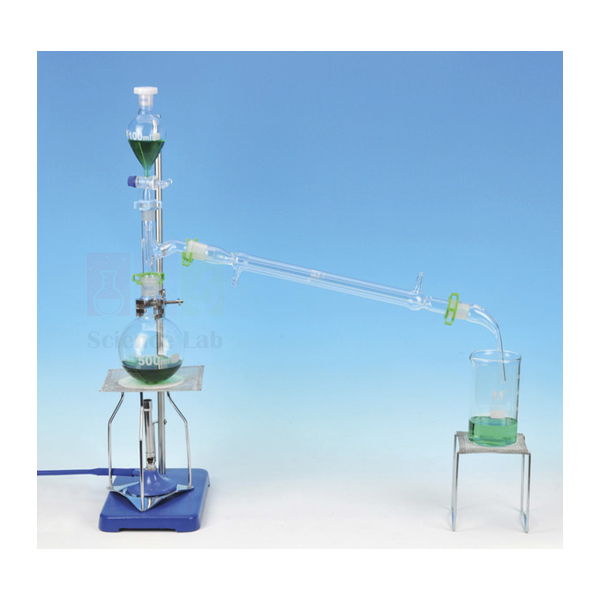
Distillation Apparatus
The Distillation Apparatus (Product Code: SLE/CH/118) is a borosilicate glass distilling set with 19/26 ground joints, built around a 500 ml round-bottom boiling flask, a still head, a Liebig condenser and a receiver adapter, plus a separating funnel with stopper. It gives schools and colleges everything in glass that is needed to heat a liquid mixture, condense the vapour and collect a purified distillate. Manufactured by Jain Scientific Equipments Pvt Ltd (ScienceLab), Ambala, it is a straightforward choice for institutions looking for laboratory distillation apparatus in India.
Specifications
| Parameter | Detail |
|---|---|
| Material | Borosilicate glass |
| Joint size | 19/26 |
| Boiling flask | Round-bottom, 500 ml |
| Other components | Separating funnel with stopper, still head, Liebig condenser, receiver adapter |
| Weight | 1.5 kg |
| Not included | Glass beaker and metal stands |
Typical Use
In a simple distillation practical, the 500 ml flask is clamped above a heat source and part-filled with the mixture, with a few anti-bumping granules added for smooth boiling. The still head directs vapour into the Liebig condenser, cooling water enters at the lower hose connection and leaves from the upper one, and the receiver adapter guides the condensed liquid into a beaker or flask. Students use this arrangement to obtain pure water from salt solution, to show that dissolved solids stay behind, and to separate liquids with clearly different boiling points. The separating funnel with stopper can be used to separate immiscible liquid layers, for example when a distillate forms two phases.
Because the set is supplied without stands, plan for a retort stand and clamps to support both the flask and the condenser. A thermometer is not listed among the components, so check how you will fit one if the practical records boiling temperature. Never heat a sealed system, lightly grease the 19/26 joints to stop them seizing, and allow the glass to cool before dismantling. Borosilicate glassware India labs rely on tolerates repeated heating well, but it should still be warmed gradually and kept away from sudden cold drafts or water splashes.
Manufacturer
This apparatus is manufactured by Jain Scientific Equipments Private Limited, which trades as ScienceLab and is based in Ambala, Haryana, India. The company produces glassware assemblies and teaching apparatus for chemistry laboratories. Our company profile explains more about the business.
Related Chemistry Lab Equipment
Items needed to set up and run the distillation, since stands and a beaker are not included:
- Retort Stand — supports the boiling flask and condenser
- Universal Clamp — holds the flask neck and condenser securely on the stand
- Heating Mantle — even, flame-free heating for a round-bottom flask
- Glass Beaker — collects the distillate at the receiver adapter
- Fractional Distillation Assembly — for mixtures whose boiling points are too close for simple distillation
See the full Chemistry Lab Equipment category for more glassware and supports.
Frequently Asked Questions
What is included in the set?
A 500 ml round-bottom boiling flask, a separating funnel with stopper, a still head, a Liebig condenser and a receiver adapter, all in borosilicate glass.
Are the stands and collecting beaker supplied?
No. The apparatus is supplied without a glass beaker and without metal stands, so order these separately if your lab does not already have them.
Will it connect to other glassware I already own?
The joints are 19/26, so it will mate with other 19/26 ground-glass components.
Which heat source should I use?
A heating mantle suits the round-bottom flask and is the safer choice for flammable liquids; for water-based mixtures, a burner with gauze or a water bath may also be used.
Is a thermometer included?
A thermometer is not part of the listed components. Ask us through our contact page if you need one matched to the still head.
Can individual parts be replaced if one breaks?
Please tell us which component you need; single items such as a Liebig condenser are also part of our range.
How heavy is it for shipping?
The set weighs 1.5 kg. We pack glassware for delivery across India and to international markets; share your destination for a shipping quote.
Request a Quote
Ask for a quotation on the Distillation Apparatus through our contact page, or add it to the enquiry cart together with stands, clamps and a heat source.
Last updated: 24 September 2026
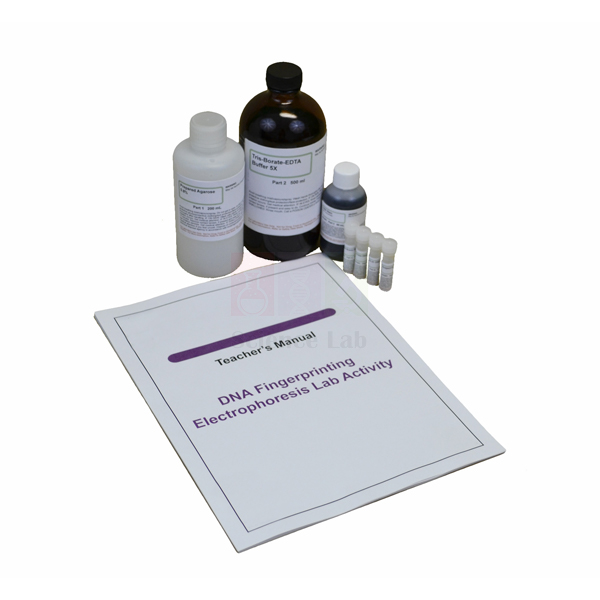
DNA Fingerprinting Electrophoresis Lab Activity
DNA Fingerprinting Electrophoresis Lab Activity (Product Code: SLE/CH/119) is a forensic biotechnology kit used to run agarose gel electrophoresis on four DNA samples and decide whether a suspect's DNA matches DNA found at a crime scene, in school and college labs. It serves 8 groups, includes a Teacher’s Guide and Student Study copymasters, and also teaches how restriction enzymes make DNA fingerprinting possible. It is supplied by Jain Scientific Equipments Pvt Ltd (ScienceLab), Ambala, India, as a gel electrophoresis kit for classrooms in India and abroad.
Specifications
| Parameter | Detail |
|---|---|
| Technique | Agarose gel electrophoresis |
| Crime Scene DNA | 10 µg |
| Victim DNA | 10 µg |
| Suspect #1 DNA | 10 µg |
| Suspect #2 DNA | 10 µg |
| Agarose | 200 mL prepared agarose 0.8% solution |
| Running buffer | 500 mL Tris-Borate-EDTA buffer, 5X |
| Stain | 60 mL DNA stain |
| Group capacity | Enough materials for 8 groups |
| Printed resources | Teacher’s Guide and Student Study copymasters |
| Shelf life | Depends on the chemical, its grade and storage conditions; ask us for the expiry date of the batch you are quoted |
| Product code | SLE/CH/119 |
| Supplied by | Jain Scientific Equipments Pvt Ltd (ScienceLab), Ambala, India |
What Is the DNA Fingerprinting Electrophoresis Kit Used For?
It puts students in the role of forensic analysts. The prepared 0.8% agarose solution is melted and poured into a casting tray with a comb to form wells, and the 5X Tris-Borate-EDTA concentrate is diluted to running strength as the Teacher’s Guide describes. Each group loads the crime scene, victim and two suspect samples into neighbouring wells and runs the gel; after staining, the fragments show as bands, and students compare each suspect's pattern with the crime-scene pattern to reach a conclusion.
Along the way, learners see how restriction enzymes cut DNA at specific sequences, why the resulting fragment patterns differ between individuals, and how evidence should be interpreted responsibly. The contents list does not include a gel tank, a power supply or a micropipette, so arrange these before the lesson. Wear gloves when handling gels and stain, and follow the disposal guidance provided; as a biotechnology lab kit in India it links neatly to forensic science topics.
Supplier
This activity is supplied by Jain Scientific Equipments Private Limited, which trades as ScienceLab from Ambala, Haryana, India, and sources reagent-based teaching kits for schools, colleges and distributors. For vendor registration, the supplying company is Jain Scientific Equipments Private Limited (CIN U29309HR2020PTC087597, GSTIN 06AAECJ8618A1ZT). See our company profile for more.
Related Chemistry Lab Equipment
Equipment and consumables needed to run the gels:
- Double Gel Electrophoresis Apparatus — a tank for casting and running agarose gels
- Electrophoresis Power Supply — provides the voltage that drives DNA through the gel
- Pipette Tip White 2-20 ul — tips for loading small sample volumes with a micropipette
- Electrophoresis: Agarose Gel Separation of Dyes — a practice run with visible dyes before working with DNA
- DNA Forensics Lab Investigation — a scenario-based follow-up with materials for up to 40 students
More investigation kits are listed in our Chemistry Lab Equipment category.
Frequently Asked Questions
What does the DNA Fingerprinting Electrophoresis Lab Activity contain?
The DNA Fingerprinting Electrophoresis Lab Activity contains four 10 µg DNA samples (crime scene, victim, suspect #1 and suspect #2), 200 mL prepared agarose 0.8% solution, 500 mL Tris-Borate-EDTA buffer 5X, 60 mL DNA stain, a Teacher’s Guide and Student Study copymasters.
How many groups can it serve?
The DNA Fingerprinting Electrophoresis Lab Activity has enough materials for 8 groups, so a class can be split into small teams, each loading and running its own set of crime scene, victim and suspect samples.
Is the electrophoresis equipment included?
No. The DNA Fingerprinting Electrophoresis Lab Activity covers samples, gel, buffer, stain and printed guides; a gel tank, power supply and micropipette are not in its contents list and must be arranged separately or quoted with the kit.
How is the 5X buffer used?
The Tris-Borate-EDTA buffer in the DNA Fingerprinting Electrophoresis Lab Activity is a 5X concentrate. Dilute it to running strength as the Teacher’s Guide describes before casting the gels and filling the tank.
What is the shelf life of the DNA samples and reagents?
The shelf life of the DNA Fingerprinting Electrophoresis Lab Activity depends on the reagents and samples, their grade and storage conditions; ask us for the expiry date of the batch you are quoted and follow the storage instructions supplied with the kit.
Who supplies the DNA Fingerprinting Electrophoresis Lab Activity?
Jain Scientific Equipments Private Limited, trading as ScienceLab in Ambala, Haryana, India, supplies the DNA Fingerprinting Electrophoresis Lab Activity to schools, colleges and distributors in India and international markets, and can quote gel tanks and power supplies alongside it.
What should an institutional quotation request include?
For the DNA Fingerprinting Electrophoresis Lab Activity, give the product code SLE/CH/119, the number of kits, whether you also need tanks, power supplies or pipette tips, and your delivery location in India or abroad.
Request a Quote
Request pricing for the DNA Fingerprinting Electrophoresis Lab Activity through our contact page, or add it to the enquiry cart with a gel tank and power supply.
Last updated: 24 September 2026
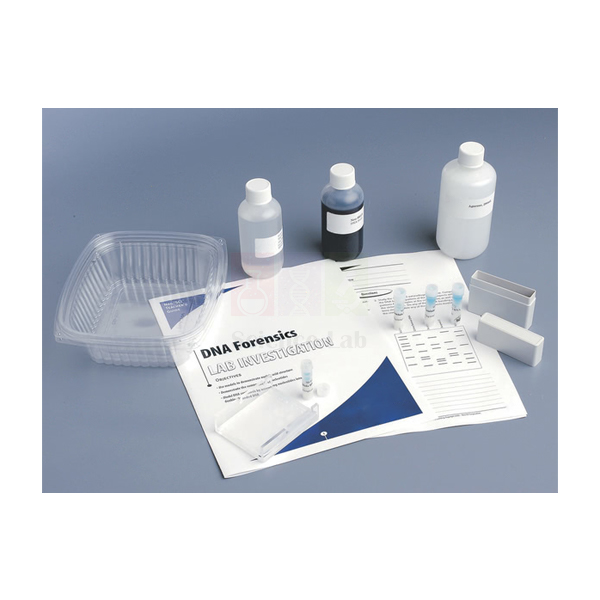
DNA Forensics Lab Investigation
The DNA Forensics Lab Investigation (Product Code: SLE/CH/120) explores how DNA technology is used to solve crimes. Students act as forensic scientists in a scenario-based DNA murder mystery, comparing the electrophoretic results of DNA samples from a “crime scene” with those from several suspects and using the fragment patterns on the gel to identify the culprit. With materials for up to 40 students, this genetics experiment kit India teachers can run with a whole class also opens a discussion about the ethics of powerful new technology. It is supplied by Jain Scientific Equipments Pvt Ltd (ScienceLab), Ambala.
Key Details
| Parameter | Detail |
|---|---|
| Theme | DNA technology in crime solving |
| Scenario | DNA murder mystery with a crime scene and suspects |
| Class size | Materials for up to 40 students |
| Core procedure | Simplified DNA fingerprinting; comparison of electrophoretic results |
| Concepts covered | DNA structure and extraction, gel electrophoresis, autoradiography, and why DNA fingerprinting is so accurate |
| Discussion element | Ethical considerations of using cutting-edge DNA technology |
Typical Use
A typical sequence starts with the case file: a crime has been committed, DNA has been recovered from the scene, and samples are available from the suspects. Before any analysis, students review how DNA is structured and how it is extracted from cells, then follow the simplified fingerprinting procedure and study the fragment patterns revealed on the gel. By lining up the crime-scene pattern against each suspect, they reach a verdict and explain which bands support it. Autoradiography is introduced as part of how fragment patterns have been visualised in forensic laboratories.
The closing discussion is what sets this activity apart. Groups debate questions such as who should hold DNA records, how evidence could be misused and how much weight a jury should give a match. Mixing hands-on analysis with this debate makes it suitable for biology, chemistry and general-studies classes alike. For schools building up an electrophoresis kit school India programme, it works well as the scenario lesson that follows a technique-focused practical.
Supplier
The DNA Forensics Lab Investigation is supplied by Jain Scientific Equipments Private Limited, the company behind the ScienceLab name, located in Ambala, Haryana, India. It manufactures teaching apparatus and supplies investigation kits to schools, colleges and distributors. Details are on our company profile.
Related Chemistry Lab Equipment
Kits and models that build the same DNA and forensics topic:
- DNA Fingerprinting Electrophoresis Lab Activity — a wet-lab gel electrophoresis activity for 8 groups
- DNA Murder Mystery Lab Investigation — a reusable pop-bead simulation of the fingerprinting protocol
- DNA extraction lab kit — lets students carry out the extraction step themselves
- DNA Activity Model — a hands-on model for teaching DNA structure beforehand
- Crime Scene Investigation — broadens the forensic unit beyond DNA evidence
Explore more in our Chemistry Lab Equipment category.
Frequently Asked Questions
How many students does it cover?
The investigation contains materials for up to 40 students.
Which topics does it teach?
DNA structure and extraction, gel electrophoresis, autoradiography, the basic concepts of DNA fingerprinting and why the process is so accurate, plus the ethical questions it raises.
What exactly is in the kit, and do I need electrophoresis equipment?
The individual components are not itemised in our current product notes. Request the contents list through our contact page and we will also confirm any equipment you need to provide.
How is it different from the DNA Murder Mystery Lab Investigation?
The Murder Mystery uses a completely reusable pop-bead model to simulate each step, whereas this investigation has students compare electrophoretic results of DNA samples and read the fragment patterns on a gel.
Does it include a discussion or ethics element?
Yes. It is designed to stimulate discussion on the ethical considerations of using cutting-edge DNA technology.
Which courses is it suited to?
It fits courses that cover DNA structure and biotechnology; compare the listed topics with your syllabus, and ask us if you need help matching it.
Can multiple kits be supplied for a school group or overseas?
Yes. We quote multi-kit orders for India and international markets.
Request a Quote
For availability and pricing on the DNA Forensics Lab Investigation, use our contact page or add it to the enquiry cart with related DNA kits.
Last updated: 24 September 2026
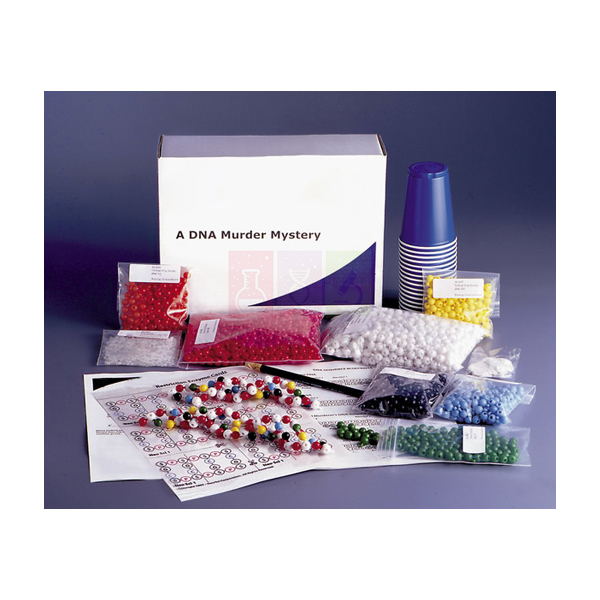
DNA Murder Mystery Lab Investigation
The DNA Murder Mystery Lab Investigation (Product Code: SLE/CH/121) is a completely reusable kit that challenges a class to solve a murder by simulating every step of the DNA fingerprinting protocol. Instead of biological samples, students work with “pop bead” DNA fingerprints, matching those of the suspects against samples collected at the scene of the crime. It supports up to 40 students and works as an engaging DNA model kit India schools can use year after year to introduce forensic applications of DNA technology. It is manufactured by Jain Scientific Equipments Pvt Ltd (ScienceLab), Ambala.
Key Details
| Parameter | Detail |
|---|---|
| Kit type | Completely reusable simulation kit |
| DNA representation | Pop-bead DNA fingerprints |
| Scenario | Solving a murder by matching suspects’ DNA fingerprints with samples from the crime scene |
| Class size | Materials for up to 40 students |
| Student activities | Simulate the DNA fingerprinting procedure; construct and interpret an autoradiogram; compare and evaluate DNA fingerprint patterns; compare the strengths and limitations of DNA profiling |
| Concepts covered | Basics of DNA fingerprinting, DNA structure and extraction, gel electrophoresis and autoradiography |
Typical Use
The simulation turns an abstract laboratory protocol into something students can hold. Working in teams, they assemble bead strands that stand for DNA from the crime scene and from each suspect, then move through the stages of the fingerprinting procedure in model form: cutting the strands into fragments, arranging the fragments by size as a gel would separate them, and recording the result as an autoradiogram. Comparing these patterns side by side lets them decide which suspect matches, and the final discussion asks them to weigh up where DNA profiling is powerful and where its limitations lie.
Because the fingerprints are built from pop beads rather than real samples, the activity fits an ordinary classroom as well as a laboratory and is ideal for introducing the topic before a wet-lab electrophoresis practical. At the end of the lesson, have each team break down its strands, count the beads back into labelled containers and return them to the kit so it is complete for the next class. It sits comfortably among the biology teaching aids India schools use to link genetics with real-world forensic science.
Manufacturer
This kit is manufactured by Jain Scientific Equipments Private Limited, which trades under the ScienceLab name from Ambala, Haryana, India, producing models, kits and apparatus for science education. You can learn more on our company profile.
Related Chemistry Lab Equipment
Models and kits that fit before or after this simulation:
- DNA Activity Model — introduces the double helix before fingerprinting is discussed
- DNA-RNA Model — compares DNA with RNA structure for extension lessons
- DNA Forensics Lab Investigation — moves students on to comparing electrophoretic results
- DNA Fingerprinting Electrophoresis Lab Activity — a wet-lab follow-up with real gels and stain
- Crime Scene Tape — adds atmosphere when the murder scenario is introduced
Browse all items in our Chemistry Lab Equipment category.
Frequently Asked Questions
Can the kit be used again with other classes?
Yes. It is completely reusable; the pop beads are simply taken apart and returned to the kit after each lesson.
How many students can work with one kit?
It contains materials for up to 40 students.
Does it require chemicals or electrophoresis equipment?
The DNA fingerprints are pop-bead models, so the core activity is a simulation rather than a wet-lab procedure. If you would like the full contents list, ask through our contact page.
What will students be able to do after the activity?
Construct and interpret an autoradiogram, compare and evaluate DNA fingerprint patterns, describe the fingerprinting procedure and discuss the strengths and limitations of DNA profiling.
How should the beads be looked after?
Count them back into labelled containers at the end of each session and wipe them clean if needed, so no pieces go missing between classes.
What information do you need for a school or tender quotation?
Include the product code SLE/CH/121, the number of kits, the delivery address and any purchase format your institution uses.
Is supply available for school chains and export buyers?
Yes. We quote multiple kits for schools and distributors in India and international markets.
Request a Quote
Request a quotation for the DNA Murder Mystery Lab Investigation via our contact page, or add it to the enquiry cart along with any DNA models you need.
Last updated: 24 September 2026
Dropper Bottle, 10 ml
The Dropper Bottle, 10 ml (Product Code: SLE/CH/122) is a small white bottle made from durable, chemical resistant polypropylene, fitted with a leakproof lid and a removable dropper. It lets students dispense indicators and reagents one drop at a time, which saves chemicals and keeps small-scale practicals tidy. Dishwasher proof and designed to be used repeatedly, it is made by Jain Scientific Equipments Pvt Ltd (ScienceLab), Ambala, a lab plastic ware supplier India schools and colleges order from for everyday bench items.
Specifications
| Parameter | Detail |
|---|---|
| Capacity | 10 ml |
| Material | Durable polypropylene |
| Colour | White |
| Chemical resistance | Chemical resistant |
| Closure | Leakproof lid |
| Dropper | Removable |
| Cleaning and reuse | Dishwasher proof; can be used repeatedly |
Typical Use
Small dropper bottles are the standard way to put indicators, test reagents and stains within reach of every student group. A set of labelled bottles on each bench might hold litmus or universal indicator, dilute acid and alkali, or a biological stain, so students add exactly the number of drops a method calls for instead of pouring. They are particularly useful in microscale chemistry, where reagents are dropped straight into the wells of a plate, and in teaching stations built around an acid base indicator kit where several solutions must be kept separate.
Label every bottle clearly and never swap droppers between bottles, as that is the quickest route to cross-contamination. The removable dropper makes refilling easy and lets the bottle and dropper be cleaned separately; after rinsing, both can go through a dishwasher and back into service. Keep the lid closed when not in use and store bottles upright in a tray so they are easy to count and check at the end of a lesson.
Manufacturer
The Dropper Bottle, 10 ml is manufactured by Jain Scientific Equipments Private Limited, known to customers as ScienceLab. The company is based in Ambala, Haryana, India, and makes plasticware, glassware and apparatus for teaching laboratories. More is available on our company profile.
Related Chemistry Lab Equipment
Items used alongside these bottles at the bench:
- Dropper Bottle Tray — keeps a set of bottles upright and organised
- Dropper Bottle, Amber — a glass alternative for light-sensitive solutions
- Dropper Bottle, Clear — a glass option when the liquid level must be visible
- Comboplate, Microscience — the well plate these bottles typically dispense into during microscale work
- pH Indicator Dispenser — a dedicated dispenser for indicator solutions
See our full Chemistry Lab Equipment category for more bench supplies.
Frequently Asked Questions
What is the bottle made of?
Durable, chemical resistant white polypropylene.
Will it leak if knocked over?
The lid is leakproof when closed; still, store bottles upright and close them after each use.
Can the dropper be taken out?
Yes, the dropper is removable, which makes refilling and cleaning straightforward.
Is it dishwasher safe and reusable?
Yes. The bottle is dishwasher proof and can be used repeatedly.
Is it suitable for light-sensitive reagents?
It is a white plastic bottle. For solutions that must be protected from light, an amber glass dropper bottle is the safer choice.
Which solvents can it hold?
Polypropylene is chemical resistant, but compatibility varies with some organic solvents, so check specific liquids with us through our contact page.
How are the bottles packed, and can you supply large quantities?
Pack quantity is not listed in our current notes and will be confirmed in your quotation. Bulk orders for schools, colleges and distributors in India and international markets are welcome.
Request a Quote
Tell us how many Dropper Bottle, 10 ml units you need through our contact page, or add the item to the enquiry cart with trays and other bench supplies.
Last updated: 24 September 2026
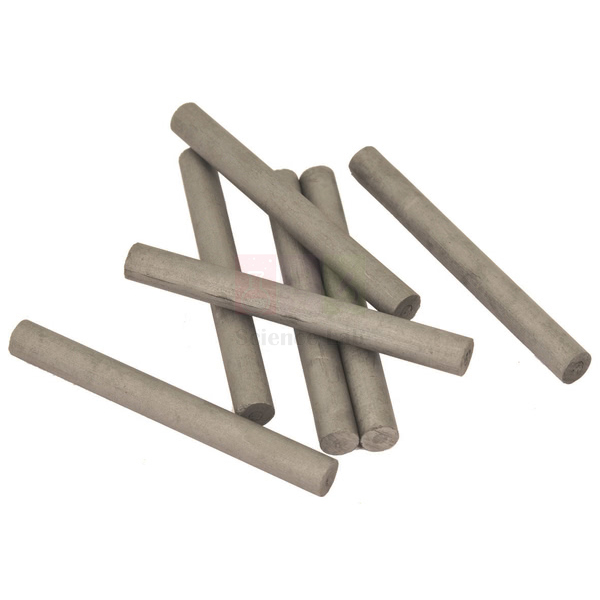
Electrode, Carbon Rod
Electrode, Carbon Rod (Product Code: SLE/CH/123) is a cylindrical carbon electrode for electrolysis experiments, packed 50 to a pack so that a teacher can equip every bench in a practical class and still keep spares on the shelf. Carbon conducts electricity yet stays largely unreactive in the electrolytes used in school practicals, which is why carbon rods remain the usual inert electrode for studying what happens at the anode and cathode. The rods are supplied by Jain Scientific Equipments Pvt Ltd (ScienceLab), Ambala, India, to secondary schools, junior colleges and teacher-training centres building up their school chemistry lab equipment in India.
Specifications
| Parameter | Detail |
|---|---|
| Material | Carbon |
| Shape | Cylindrical rod |
| Dimensions | 100 x 5 mm |
| Application | Electrolysis experiments |
| Pack size | 50 rods per pack |
Typical Use
In a typical practical, two rods are mounted so that they stand parallel in a beaker of electrolyte without touching, then connected to a low-voltage DC source with crocodile-clip leads. Students watch for gas bubbles, colour changes or metal deposits at each rod – for example copper plating onto the cathode from copper(II) sulphate solution, or bubbles forming during the electrolysis of dilute acids and salt solutions. Because the carbon itself takes no part in most of these reactions, the observations can be linked directly to the ions present in the solution.
Keep the metal clips above the liquid so that only carbon touches the electrolyte, rinse the rods with distilled water after each run and let them dry before storage. An anode that gives off oxygen or chlorine slowly wears and roughens over repeated use; buying from a chemistry consumables supplier in India in packs of 50 means worn pieces can be swapped out without interrupting a practical session.
Supplier
Electrode, Carbon Rod is supplied by Jain Scientific Equipments Private Limited, which trades under the name ScienceLab and is based in Ambala, Haryana, India. Vendor registration details for the supplying company are GSTIN 06AAECJ8618A1ZT and Importer-Exporter Code AAECJ8618A issued by the DGFT, under which shipments to overseas buyers are handled. More about the company is available in our company profile.
Related Chemistry Lab Equipment
Items that complete an electrolysis set-up built around these carbon rods:
- Electrode, Carbon, Pair — a paired format when a bench needs just two electrodes rather than a bulk pack
- Electrode Rod Holders — for mounting rod electrodes securely during a run
- Crocodile Clips & Leads — to connect each rod to the power source
- Brownlee Electrolysis Apparatus — a dedicated apparatus for class demonstrations of electrolysis
- Glass Beaker — the vessel that holds the electrolyte
Browse the complete Chemistry Lab Equipment range for more electrochemistry apparatus.
Frequently Asked Questions
How many electrodes come in one pack?
Fifty. Each pack holds 50 cylindrical carbon rods of 100 x 5 mm, so larger schools can order several packs to cover multiple sections.
Which experiments are these rods suited to?
Electrolysis of aqueous solutions where an inert electrode is needed, such as copper(II) sulphate, sodium chloride solution or dilute acids. The rods let students attribute every product they see to the electrolyte rather than to the electrode.
Can the rods be reused?
Yes, in most cases. Rinse and dry them after each practical; replace a rod once it becomes visibly pitted or crumbly, which happens first at anodes that release oxygen or chlorine.
Are holders, leads or a power supply included?
No – this listing covers the pack of 50 rods only. Holders, leads and electrolysis apparatus are available separately (see the related items above), and we can quote them together on request.
Is the grade or purity of the carbon specified?
The grade is not stated in this listing. If your syllabus or tender needs a particular grade, please ask through our contact page before ordering.
Do you supply schools in bulk or ship overseas?
Yes. We supply institutions across India and in international markets; include the product code SLE/CH/123, the number of packs and your delivery location in your enquiry so we can prepare an accurate quotation.
Request a Quote
To order Electrode, Carbon Rod, send your quantity and delivery details through our contact page, or add the item to the enquiry cart together with other laboratory items for a combined quotation.
Last updated: 24 September 2026
Electrode Platinum
Electrode Platinum (Product Code: SLE/CH/124) is a pair of platinum electrodes made from rectangular foil and fused into a protective glass tube, intended for the electrolysis of water and other experiments where the electrode must stay chemically inert. An internal connection lead runs through the tube and a rubber stopper to screw terminals, so the pair can be wired straight to a DC supply. It is made by Jain Scientific Equipments Pvt Ltd (ScienceLab), Ambala, India, for school, college and university laboratories that want platinum electrodes for their electrolysis apparatus in India.
Specifications
| Parameter | Detail |
|---|---|
| Supplied as | A pair of electrodes |
| Electrode form | Rectangular platinum foil |
| Mounting | Fused into a protective glass tube |
| Connection | Internal lead running through the tube and rubber stopper to screw terminals |
| Inner glass tube (holds the electrode) | Length 110 mm x dia. 8 mm |
| Outer glass tube (covers the electrode) | Length 115 mm x dia. 18 mm |
| Design feature | Foil shape exposes as much metal as possible to the reactant (water) |
Typical Use
The pair is the heart of a classic water-electrolysis demonstration: with the electrodes sealed into the apparatus and the water made conductive with a little dilute acid or salt, students see hydrogen collect above the cathode and oxygen above the anode in roughly a 2:1 volume ratio. Because platinum neither dissolves nor oxidises under these conditions, the gas volumes reflect the decomposition of water alone, which makes the result far cleaner than with reactive metal electrodes. The broad foil face spreads the current over a large area, so bubbles form evenly across the metal.
Handle the assembly by its glass, never by the foil, and tighten the screw terminals gently so that no strain reaches the glass-to-metal seal. After each session rinse the electrodes with distilled water and store them cushioned in their box, alongside the rest of your chemistry lab glassware in India, to protect both the foil and the tubes.
Manufacturer
Electrode Platinum is produced by Jain Scientific Equipments Private Limited, a company that trades as ScienceLab from Ambala, Haryana, India, and builds apparatus for teaching and research laboratories. For an overview of the company and its product groups, see our company profile.
Related Chemistry Lab Equipment
Apparatus and accessories that work alongside platinum electrodes in electrolysis practicals:
- Hoffman Voltameter — the traditional apparatus for collecting and comparing the gases from water
- Hoffman Voltameter Stand — holds the voltameter steady on the bench
- Water Electrolysis Apparatus (Hoffman Voltmeter) — an alternative complete set-up for the same experiment
- Crocodile Clips & Leads — link the screw terminals to your power source
- Electrode, Carbon Rod — a low-cost inert option for general electrolysis of solutions
More electrochemistry items are listed under Chemistry Lab Equipment.
Frequently Asked Questions
Is this a single electrode or a pair?
A pair. Both electrodes are rectangular platinum foil, which gives you a matched anode and cathode for one apparatus.
What size are the glass tubes?
The inner glass tube that holds the electrode measures 110 mm long by 8 mm in diameter, and the outer tube covering it measures 115 mm long by 18 mm in diameter.
Why is the platinum made as a rectangular foil rather than a wire?
The foil exposes as much metal as possible to the water. A larger working surface spreads the current and helps the gases form steadily during a demonstration.
Will it fit the voltameter we already own?
That depends on the size of the electrode openings on your apparatus. Send us the port dimensions or a photo through our contact page and we will confirm the fit before you order.
How should the electrodes be cleaned?
Rinse with distilled water after use and let them air-dry. Avoid abrasive pads or bending the foil, and do not pull on the terminals, as the glass seal is the most delicate part.
What warranty applies?
Warranty terms are not stated on this page. Please ask for them with your quotation so that they are confirmed in writing for your order.
Can you quote for several sets or for delivery abroad?
Yes. We supply institutions in India and international markets; mention the product code SLE/CH/124, the number of pairs and the delivery address.
Request a Quote
For pricing and availability of Electrode Platinum, write to us via the contact page or place it in the enquiry cart with any voltameter or accessories you need.
Last updated: 24 September 2026
Electrode, Lead
Electrode, Lead (Product Code: SLE/CH/125) is a spare electrode for the MicroScience system, sold in packs of 20 so that schools running MicroScience kits can replace electrodes that go missing, bend or corrode over a year of practicals. Keeping a pack of replacements on hand means a whole class can carry on with electrochemistry activities even when a few kits come back incomplete. It is supplied by Jain Scientific Equipments Pvt Ltd (ScienceLab), Ambala, India, as one of the lab equipment spare parts in India that keep student kits usable from one batch of learners to the next.
Key Details
| Parameter | Detail |
|---|---|
| Type | Spare lead electrode |
| Used with | The MicroScience system |
| Pack size | 20 per pack |
| Form and size | Not stated in this listing – please confirm with us before ordering |
Typical Use
Microscale kits let each student or pair carry out electrochemistry with only a few drops of solution, which cuts chemical consumption and waste compared with beaker-scale work. A lead electrode is typically combined with another metal or with a carbon electrode so that learners can compare how different materials behave, observe deposits or gas at the electrode surface, and discuss why some metals are more reactive than others. This makes the spare a practical part of any electrochemical cell kit for school use.
Lead is toxic if swallowed, so learners should handle the electrodes with gloves or wash their hands afterwards, and food and drink must stay out of the laboratory. Wipe electrodes clean and dry after each lesson, and collect worn or damaged pieces for disposal as heavy-metal waste rather than placing them in general bins.
Supplier
Electrode, Lead is supplied by Jain Scientific Equipments Private Limited, which trades as ScienceLab from its base in Ambala, Haryana, India, and serves schools and colleges with laboratory equipment and replacement parts. Our company profile gives more background on the business.
Related Chemistry Lab Equipment
Kits and components from the same microscale workflow:
- Basic Microscience Kit, Student — an entry-level student kit in the MicroScience range
- Advanced Microscience Kit, Student — the extended student kit for higher classes
- Comboplate, Microscience — the multi-well plate that microscale reactions are run in
- Microscience Work Station, Biology, Physics and Chemistry — a combined station for several science subjects
- Electrode, Carbon Rod — inert carbon electrodes to pair with metal electrodes
Find more practical apparatus in our Chemistry Lab Equipment category.
Frequently Asked Questions
How many electrodes are in a pack?
Twenty. The pack is intended for restocking several MicroScience kits at once.
Is this a lead-metal electrode or a connecting lead?
The catalogue lists it as a lead electrode and describes it as a spare electrode lead for the MicroScience system. Because the exact form and size are not stated here, please confirm them through our contact page so that the spares match the kits you already own.
Will these fit other microscale kits?
They are listed for the MicroScience system. For any other brand of kit, share its electrode dimensions with us and we will tell you whether the spare is suitable.
Is it safe for students to handle?
Yes, with normal laboratory precautions: supervised use, gloves or hand-washing afterwards, and no eating or drinking. Worn electrodes should be collected for heavy-metal disposal.
Can I order fewer than 20?
The item is listed as a pack of 20. If you need a different quantity, mention it in your enquiry and we will advise what is possible.
Do you supply spares to schools outside India?
Yes, we serve institutions in India and international markets. Quote product code SLE/CH/125 and your delivery country when you enquire.
Request a Quote
To restock your kits with Electrode, Lead, send the number of packs through our contact page or add it to the enquiry cart along with other MicroScience spares.
Last updated: 24 September 2026
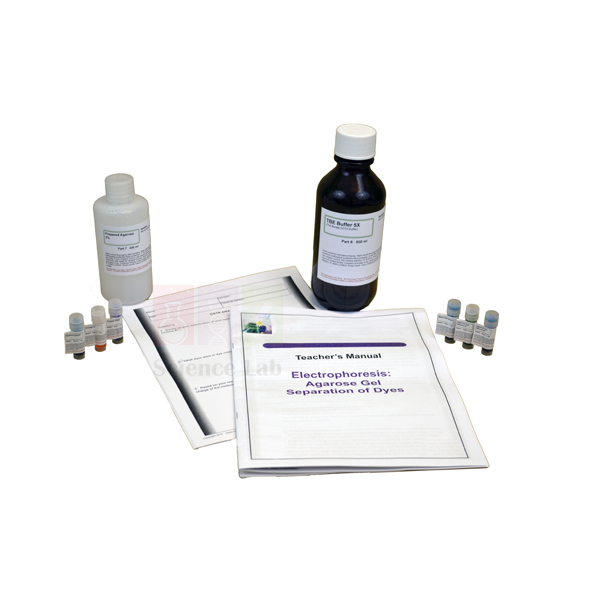
Electrophoresis: Agarose Gel Separation of Dyes
Electrophoresis: Agarose Gel Separation of Dyes (Product Code: SLE/CH/126) is a classroom kit used to introduce agarose gel electrophoresis with coloured dyes in school and college science labs. Unlike DNA, which cannot be seen during a run, the dyes move visibly through the gel, so students watch separation happen, and the kit holds enough materials for ten 20 ml gels. It is supplied by Jain Scientific Equipments Pvt Ltd (ScienceLab), Ambala, India, as a first hands-on electrophoresis kit for school labs in India.
Specifications
| Parameter | Detail |
|---|---|
| Activity | Separation of dyes by agarose gel electrophoresis |
| Materials supplied for | Ten 20 ml agarose gels (actual number of runs may vary with your equipment) |
| Samples | Dyes that can be observed during the procedure |
| Teaching material | Teacher’s Manual and Student Study Guide copymasters |
| Required, not included | Agarose electrophoresis chambers, electrophoresis power supplies, micropipettes capable of measuring 10 µl |
| Shelf life | Depends on the chemical, its grade and storage conditions; ask us for the expiry date of the batch you are quoted |
| Product code | SLE/CH/126 |
| Supplied by | Jain Scientific Equipments Pvt Ltd (ScienceLab), Ambala, India |
What Is the Agarose Gel Dye Electrophoresis Kit Used For?
It teaches the technique before students meet invisible samples. Groups cast an agarose gel, load small volumes of each dye into the wells with a micropipette and connect the chamber to the power supply; within the lesson the coloured bands begin to separate, and depending on their charge some dyes may travel towards the positive electrode while others head the opposite way. Students measure how far each band has moved and relate the distance to the charge and size of the dye molecules, the same reasoning they will later apply to DNA fragments.
Because the dyes are visible without staining, the activity is a convenient skills session for careful pipetting and gel handling. Students who can load 10 µl cleanly into a well without piercing the gel are ready for a DNA-based practical, and pairing the kit with a dedicated electrophoresis power supply lets several groups run gels at once.
What to Specify When Ordering
- The number of kits, bearing in mind each one has materials for ten 20 ml agarose gels
- Whether you also need agarose electrophoresis chambers, and how many
- Whether electrophoresis power supplies should be quoted to match the chambers
- Micropipettes capable of measuring 10 µl, and tips, if your lab does not already have them
Supplier
Jain Scientific Equipments Private Limited, trading as ScienceLab from Ambala, Haryana, India, supplies this kit to school, college and university laboratories. It can be quoted on one order with the chambers, power supplies and micropipettes it needs, so a department receives a complete electrophoresis set-up from a single vendor. Read more in our company profile.
Related Chemistry Lab Equipment
The kit needs a chamber, power and accurate pipetting; these items cover each step:
- Gel Electrophoresis Apparatus — a chamber in which to cast and run the agarose gels
- Electrophoresis Power Supply — provides the electric field that moves the dyes
- Micropipette — for loading small dye volumes into the wells
- Micropipette Tips — disposable tips so each dye is loaded without cross-contamination
- DNA Fingerprinting Electrophoresis Lab Activity — a natural follow-on once students have mastered the technique
Explore more practical kits in Chemistry Lab Equipment.
Frequently Asked Questions
How many gels can one kit run?
The Electrophoresis: Agarose Gel Separation of Dyes kit contains enough material for ten 20 ml agarose gels. The actual number of runs can vary with the size of your gel trays and chambers, so check your equipment before planning classes.
What equipment do I need besides the kit?
Alongside the Agarose Gel Separation of Dyes kit you need agarose electrophoresis chambers, electrophoresis power supplies and micropipettes capable of measuring 10 µl. These are not included, but we can quote them together with the kit.
Why use dyes instead of DNA?
Dyes in the Agarose Gel Separation of Dyes kit can be seen during the run, so students observe separation as it happens instead of waiting for a stain; it is a safe, colourful starting point before DNA work.
Are teacher notes and worksheets provided?
Yes. The Agarose Gel Separation of Dyes kit includes a Teacher’s Manual and Student Study Guide copymasters, which can be photocopied so every group has its own sheet for recording how far each band travels.
What is the shelf life of the kit?
The shelf life of the Agarose Gel Separation of Dyes kit depends on the chemicals, their grade and storage conditions; ask us for the expiry date of the batch you are quoted, particularly if you plan to use the kit across several terms.
Who supplies the Agarose Gel Separation of Dyes kit?
Jain Scientific Equipments Private Limited (ScienceLab), Ambala, Haryana, India, supplies the Electrophoresis: Agarose Gel Separation of Dyes kit to schools, colleges and distributors in India and international markets; include code SLE/CH/126, the number of kits and the delivery address.
Request a Quote
Request pricing for the kit and any chambers, power supplies or micropipettes you need via our contact page, or collect the items in the enquiry cart and send one combined enquiry.
Last updated: 24 September 2026
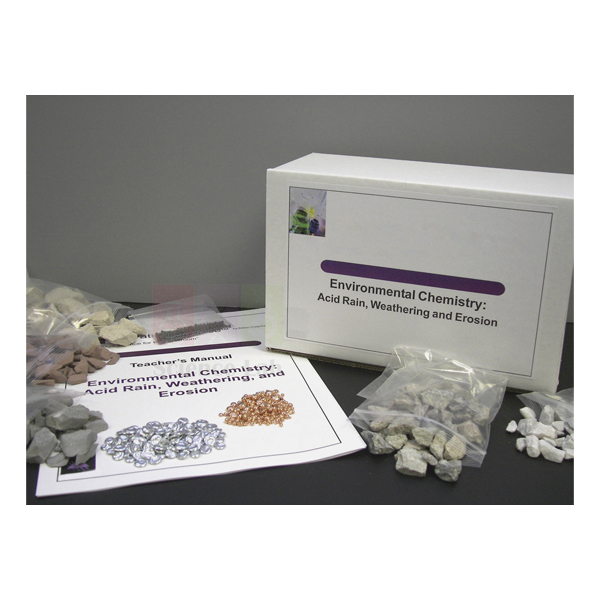
Environmental Chemistry: Acid Rain, Weathering & Erosion
Environmental Chemistry: Acid Rain, Weathering & Erosion (Product Code: SLE/CH/127) is a class activity kit in which students expose naturally occurring and construction materials to an acidic environment and compare them with matching samples left in ‘normal’ rain, represented by tap water. With sufficient materials for 15 groups plus a teacher’s manual and student copy masters, it gives teachers a ready-made environmental science kit for school chemistry, geography and environmental studies lessons. The kit is supplied by Jain Scientific Equipments Pvt Ltd (ScienceLab), Ambala, India.
Key Details
| Parameter | Detail |
|---|---|
| Type | Environmental chemistry activity kit |
| Investigation | Natural and construction materials in an acidic environment compared with tap water (‘normal’ rain) |
| Group capacity | Sufficient materials for 15 groups |
| Teaching material | Teacher’s manual and student copy masters |
| Topics covered | Acid rain, weathering, erosion, damage to natural and man-made surfaces |
Typical Use
Acid rain can be devastating to aquatic ecosystems and to land, and it attacks not only natural surfaces such as the exposed rock of mountainous regions but also the stones and metals used in buildings, statues and monuments. In this activity each group sets up paired samples, one in the acidic solution and one in tap water, and then records what changes: fizzing, discolouration, pitting or crumbling of the surface. Because weathering and erosion speed up sharply as rain becomes more acidic, comparing the two sets gives students direct evidence for a process that normally takes years outdoors.
For a fair test, ask groups to note each sample’s appearance before the start and to keep the containers side by side at the same temperature. The results link naturally to lessons on acids and carbonates, to geography units on rock weathering, and to class discussions on why carved stone on older buildings wears away faster in polluted cities, making the kit a useful earth science kit in India as well as a chemistry resource.
Supplier
This activity kit is supplied by Jain Scientific Equipments Private Limited, which trades as ScienceLab and is based in Ambala, Haryana, India. For tender forms and vendor registration, the company’s details are GSTIN 06AAECJ8618A1ZT and LEI 3358004HRD1JIVXKYX49. Learn more in our company profile.
Related Chemistry Lab Equipment
Useful additions when planning an environmental chemistry unit around this kit:
- Paper, Universal, pH 1-14 — lets students measure how acidic their ‘rain’ is compared with tap water
- Class Rock Pack — additional rock specimens for extending the weathering comparison
- Environmental Chemistry: Nitrates, Phosphates & Eutrophication — a companion activity on nutrient pollution of fresh water
- Environmental Chemistry: Water Treatment & Filtration — completes the unit with how polluted water is cleaned
- Safety Goggles — eye protection while students handle acidic solutions
More teaching kits are available in Chemistry Lab Equipment.
Frequently Asked Questions
How many groups can use one kit?
Fifteen. The kit contains sufficient materials for 15 groups, so a typical class can work in small teams at the same time.
Which materials do students test?
Naturally occurring materials and construction materials. The individual sample list is not given on this page; ask us via the contact page if you need it for lesson planning.
What is used as the control?
Tap water stands in for ‘normal’ rain, so students can compare each acid-exposed sample with an identical one in ordinary water.
Is teacher support included?
Yes. A teacher’s manual and student copy masters come with the kit.
Which subjects does the activity support?
Chemistry (acids and their reactions), geography and earth science (weathering and erosion) and environmental studies (air pollution and its effects on buildings and ecosystems).
What should a school quotation request include?
The product code SLE/CH/127, the number of kits, the delivery address and any vendor documents your tender requires. We supply institutions in India and international markets.
Request a Quote
Send your requirement for this acid rain kit through our contact page, or add it to the enquiry cart with the rest of your environmental chemistry order.
Last updated: 24 September 2026
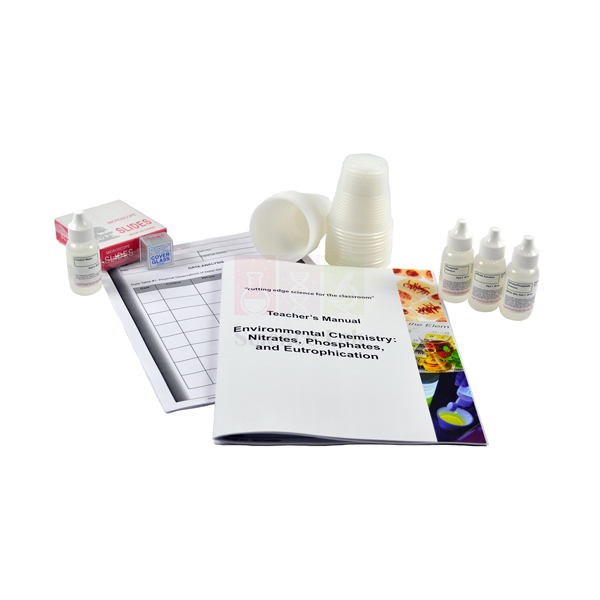
Environmental Chemistry: Nitrates, Phosphates & Eutrophication
Environmental Chemistry: Nitrates, Phosphates & Eutrophication (Product Code: SLE/CH/128) is a water-pollution investigation in which students build miniature ‘ponds’ and compare what happens when nitrates, phosphates, or a combination of the two are added. Along the way learners come to appreciate the importance and value of fresh water and the need to protect and conserve it. With enough materials for 15 groups and a teacher’s manual plus student copy masters, it works as a complete ecology science kit for India’s secondary classrooms and is supplied by Jain Scientific Equipments Pvt Ltd (ScienceLab), Ambala, India.
Key Details
| Parameter | Detail |
|---|---|
| Type | Water-pollution activity kit |
| Investigation | Effects of nitrates, of phosphates and of both together in miniature ‘ponds’ |
| Group capacity | Enough materials for 15 groups |
| Teaching material | Teacher’s manual and student copy masters |
| Learning outcomes | Point-source versus non-point-source pollution; role of nitrates and phosphates in eutrophication; natural and human contributions to water pollution |
Typical Use
Eutrophication begins when excess nutrients reach a lake or pond, feeding a surge of algae; when that growth dies and decays, oxygen in the water is used up and other aquatic life suffers. In this lab each group prepares a set of small ponds, doses them with nitrate, phosphate or both, and then observes and examines how the water changes over time – colour, cloudiness and visible growth. Comparing the three treatments shows students which nutrient drives the change and why the combination matters, while the accompanying discussion shows that a variety of factors, including natural ones, contribute to the overall problem of water pollution.
Keep every pond in the same light and temperature, label them clearly and ask students to keep a dated log with sketches or photographs. Many teachers add a plain-water pond for comparison. By the end, learners should be able to explain the difference between a point source, such as a single discharge pipe, and non-point sources like run-off from fields, which is exactly the kind of outcome a well-structured science kit with manual in India is expected to deliver.
Supplier
The kit is supplied by Jain Scientific Equipments Private Limited, which trades as ScienceLab and operates from Ambala, Haryana, India, serving schools, colleges and training institutes. Our company profile describes the business in more detail.
Related Chemistry Lab Equipment
Items that extend a fresh-water pollution project:
- Water Monitoring Kit, Microscience — lets students test water quality alongside their visual observations
- Water Analysis Kit — for analysing local pond or tap water samples
- Hand Magnifier — to examine growth in the miniature ponds more closely
- Environmental Chemistry: Water Treatment & Filtration — shows how polluted water is made fit for use
- Environmental Chemistry: Acid Rain, Weathering & Erosion — another pollution topic from the same series
See the full Chemistry Lab Equipment range for more classroom kits.
Frequently Asked Questions
What exactly do students compare?
The effects of nitrates, the effects of phosphates, and the effects of the two combined, each in its own miniature pond.
How many groups does the kit serve?
There are enough materials for 15 groups working at the same time.
What is the difference between point and non-point source pollution?
A point source enters water from one identifiable place, such as an outlet pipe; non-point pollution arrives from many diffuse places, such as run-off from farms and streets. The kit’s activity is designed so that students can explain this distinction.
Are the chemicals safe to handle in class?
Use normal laboratory precautions: goggles, hand-washing and supervised disposal. If you need safety information for the kit contents, request it through our contact page.
Is teacher guidance provided?
Yes, a teacher’s manual and student copy masters are included.
Can you supply kits for several schools or overseas?
Yes. We supply institutions in India and international markets; include product code SLE/CH/128, the number of kits and your delivery address in the enquiry.
Request a Quote
Ask for pricing on the eutrophication kit via our contact page, or place it in the enquiry cart together with water-testing items for one consolidated quote.
Last updated: 24 September 2026
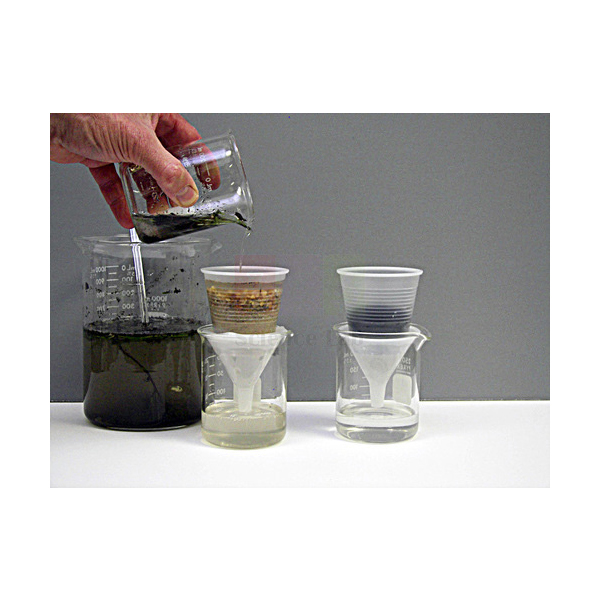
Environmental Chemistry: Water Treatment & Filtration
Environmental Chemistry: Water Treatment & Filtration (Product Code: SLE/CH/129) is a hands-on kit in which students carry out, on a small scale, several of the procedures used at a water treatment plant on a sample of ‘polluted’ water. They learn what each stage does and why it is needed, and they examine how the water changes after every step. Supplied by Jain Scientific Equipments Pvt Ltd (ScienceLab), Ambala, India, it is a practical water purification science kit for schools, with enough materials for 15 groups plus a teacher’s manual and student copy masters.
Key Details
| Parameter | Detail |
|---|---|
| Type | Water treatment activity kit |
| Investigation | Small-scale treatment of ‘polluted’ water using several treatment-plant procedures |
| Observations | Clarity, colour and odour of the water from the start of treatment to the end |
| Group capacity | Enough materials for 15 groups |
| Teaching material | Teacher’s manual and student copy masters |
Typical Use
Municipal plants clean water in stages – typically removing large debris, clumping fine particles together so they settle, filtering what remains and finally disinfecting. This kit lets each group reproduce several of those stages at bench scale. After every step students pour off a small sample and describe its clarity, colour and odour, so they can see which stage removes which kind of contamination and explain the reason each process exists.
A simple way to organise the lesson is to line up a labelled jar from each stage along the bench, turning the class results into a visual timeline from dirty to clear. Remind students that clear water is not necessarily safe water and that nothing produced in the activity should be tasted. The kit fits environmental science, chemistry and geography units, and makes a useful chemistry experiment kit in India for exploring separation techniques in a real-world context.
Supplier
Water Treatment & Filtration is supplied by Jain Scientific Equipments Private Limited, trading as ScienceLab, from Ambala, Haryana, India. The company equips school and college laboratories with apparatus, kits and consumables; see our company profile for more.
Related Chemistry Lab Equipment
Consumables and test kits that pair well with a water treatment practical:
- Filter Paper — for extra filtration trials or comparing filter media
- Glass Funnel — holds filter paper when groups repeat the filtration stage
- Water Monitoring Kit, Microscience — adds chemical tests to the visual checks on treated water
- Water And Soil Analysis Kit — for follow-up analysis of local water samples
- Environmental Chemistry: Nitrates, Phosphates & Eutrophication — explores how nutrients pollute fresh water in the first place
Browse the Chemistry Lab Equipment category for related apparatus.
Frequently Asked Questions
Which treatment steps does the kit reproduce?
Several of the procedures carried out at a water treatment plant. The exact sequence is not listed on this page, so please ask through our contact page if you need it for curriculum mapping.
What do students record?
Physical characteristics of the water – clarity, colour and odour – checked after each step from the beginning of treatment to the end.
How many groups can work at once?
The kit holds enough materials for 15 groups.
Is the treated water safe to drink?
No. This is a classroom demonstration of the principles only; treated samples must never be tasted or drunk.
Are teaching notes included?
Yes, a teacher’s manual and student copy masters are part of the kit.
What information speeds up a quotation?
The product code SLE/CH/129, the number of kits, the delivery address and whether you also need test kits or glassware. We supply institutions in India and international markets.
Request a Quote
Send your enquiry for this water treatment kit through the contact page or add it to the enquiry cart with filtration glassware and test kits.
Last updated: 24 September 2026
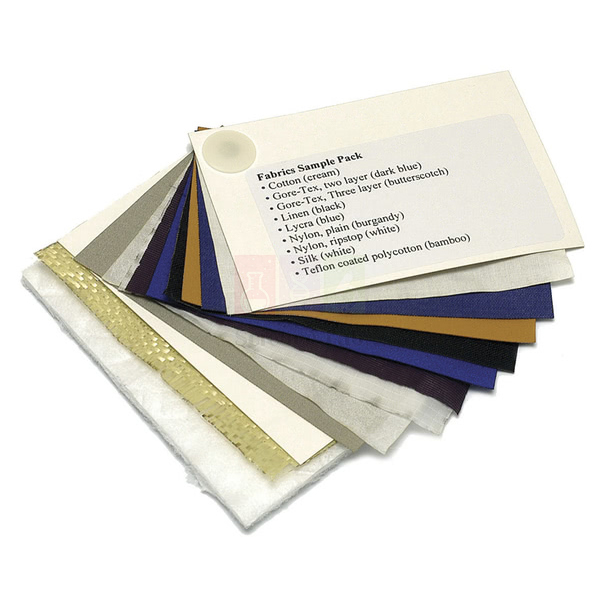
Fabrics Sample Pack
Fabrics Sample Pack (Product Code: SLE/CH/130) is a set of fabric swatches – linen, cotton, Thinsulate, Lycra, Gore-Tex, nylon, silk and Teflon-coated polycotton – held together by a tag, with every swatch in a different colour and a key card to identify each one. It puts real natural, synthetic and performance textiles into students’ hands for lessons on polymers, material properties and product design, making it a compact addition to any STEM science kit in India. The pack is supplied by Jain Scientific Equipments Pvt Ltd (ScienceLab), Ambala, India.
Key Details
| Parameter | Detail |
|---|---|
| Type | Fabric swatch sample pack |
| Fabrics included | Linen, cotton, Thinsulate, Lycra, Gore-Tex, nylon, silk, Teflon-coated polycotton |
| Identification | Each swatch is a different colour; key card included |
| Presentation | Swatches held together by a tag |
| Suitable for | Comparing natural, synthetic and coated or engineered textiles |
Typical Use
The eight fabrics fall neatly into groups for classification: plant fibres (linen and cotton), an animal fibre (silk), synthetic polymers (nylon and the stretch fibre Lycra) and performance materials designed for a job – Gore-Tex for waterproof yet breathable clothing, Thinsulate for insulation and Teflon-coated polycotton for water and stain resistance. Students can drip water on each swatch, stretch it gently, feel its warmth and examine the weave under a magnifier, then link what they observe to the structure of the fibre and to where each fabric is used in everyday products.
Because the colours differ and the key card holds the answers, teachers can run the lesson as a blind identification challenge: groups name each swatch from its properties first, then check against the card. Schools that buy from a lab consumables supplier in India often keep one pack per bench group so that every student can handle the samples during the same lesson.
Supplier
Fabrics Sample Pack is supplied by Jain Scientific Equipments Private Limited, which trades as ScienceLab and is based in Ambala, Haryana, India. The company supplies schools and colleges with teaching resources, apparatus and consumables – our company profile has more information.
Related Chemistry Lab Equipment
Resources that support a materials-and-properties unit:
- Metals and Smart Alloys Starter Pack — the companion sample set for metals and smart materials
- Mini Science Kit – Characteristics of Materials — activities on comparing everyday materials
- Hand Magnifier — for looking closely at weave and fibre structure
- Consumer Chemistry Science Kit — extends the lesson to the chemistry of everyday products
Other teaching resources are listed under Chemistry Lab Equipment.
Frequently Asked Questions
Which fabrics are in the pack?
Linen, cotton, Thinsulate, Lycra, Gore-Tex, nylon, silk and Teflon-coated polycotton – eight swatches in all, joined by a tag.
How do students know which swatch is which?
Each swatch is a different colour, and the included key card matches every colour to its fabric.
What size are the swatches?
Swatch dimensions are not stated in this listing. Please ask through our contact page if you need the size for planning tests.
Can the swatches be used for burn or chemical tests?
The pack works best as a reference set for handling and non-destructive tests such as water drops and stretching. For destructive tests, use separate offcuts under teacher supervision so the identified set stays complete.
Which subjects can use it?
Chemistry (natural and synthetic polymers), physics (insulation and waterproofing), design and technology, and home science or textiles courses.
Can we order packs for a whole class or for export?
Yes. We supply institutions in India and international markets; include code SLE/CH/130 and the number of packs in your enquiry.
Request a Quote
Ask for a quotation on Fabrics Sample Pack through our contact page, or add it to the enquiry cart with other materials-science resources.
Last updated: 24 September 2026
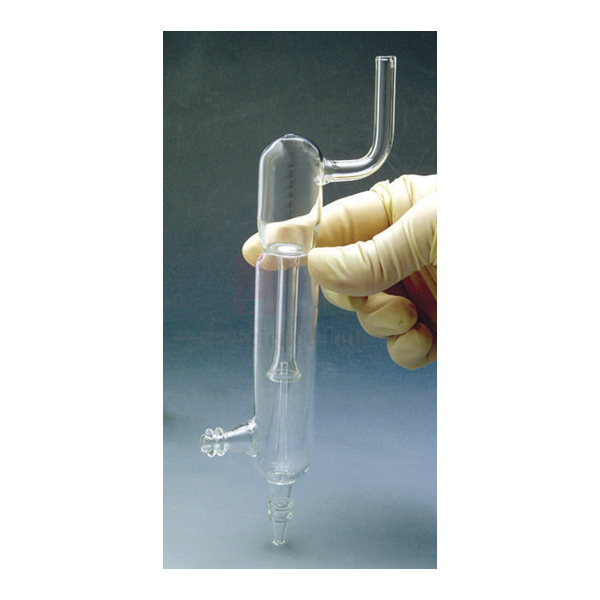
Filter Pump, Borosilicate Glass
Filter Pump, Borosilicate Glass (Product Code: SLE/CH/131) is a water-jet filter pump made from chemical-resistant borosilicate glass that creates a moderate vacuum when connected to a water supply. Fitted to a laboratory tap, it draws air out of a filter flask so that liquid is pulled through a Buchner funnel much faster than gravity filtration allows – a simple way to run suction filtration without an electric vacuum pump. It is made by Jain Scientific Equipments Pvt Ltd (ScienceLab), Ambala, India, and complements the borosilicate glassware India’s school and college laboratories already rely on.
Key Details
| Parameter | Detail |
|---|---|
| Type | Water-jet (aspirator) filter pump |
| Material | Chemical-resistant borosilicate glass |
| Operation | Creates a moderate vacuum when connected to a water supply |
| Driven by | Running tap water – no electrical supply needed |
| Typical application | Suction filtration with a Buchner funnel and filter flask |
Typical Use
Water rushing through the narrow jet inside the pump lowers the pressure around it, so air is dragged in through the side arm and carried away with the water. Connect the inlet to a tap with rubber tubing, and the side arm to a filter flask with thick-walled vacuum tubing; a Buchner funnel sealed into the flask with a bung completes the set-up. Students use it to collect crystals after recrystallisation, to separate precipitates quickly, or to dry a solid on the filter paper by drawing air through it.
Place a trap bottle between the pump and the flask, and when the filtration is finished always disconnect the tubing or let air into the flask before turning off the water – otherwise tap water can be sucked back into your filtrate. The glass body lets you see the water flow at a glance and resists chemical vapours drawn through it. Rinse the pump with clean water after use and store it where it cannot be knocked; laboratories buying from a lab glassware supplier in India often keep a spare for busy practical weeks.
Manufacturer
ScienceLab is the trading name of Jain Scientific Equipments Private Limited (CIN U29309HR2020PTC087597), based in Ambala, Haryana, India. The company manufactures laboratory apparatus at its licensed factory at 449, HSIIDC Industrial Area, Saha, Ambala (Factory Licence AMB-ONLINE-CHD-J-414). Read more in our company profile.
Related Chemistry Lab Equipment
Everything else needed for a vacuum filtration set-up:
- Conical Filter Flask — the side-arm flask that collects the filtrate under vacuum
- Buchner Funnel, 90 mm, Porcelain — holds the filter paper on its perforated plate
- Buchner Bungs (Black) — seal the funnel into the flask neck
- Vacuum Tubing — thick-walled tubing that will not collapse under suction
- Filter Pump, Edward Type — a metal-bodied alternative for heavy daily use
See more apparatus in Chemistry Lab Equipment.
Frequently Asked Questions
How does a glass filter pump make a vacuum without electricity?
Fast-flowing water in the jet creates low pressure that pulls air from the side arm. As long as the tap runs, the pump keeps drawing air from the connected flask.
How strong is the vacuum?
It produces a moderate vacuum, suitable for routine suction filtration. The exact level depends on your water pressure and temperature, and no figure is stated for this listing.
What tubing sizes do I need?
Connector dimensions are not listed here. Tell us your tap and flask fittings through the contact page and we will suggest suitable rubber and vacuum tubing.
How do I stop water sucking back into the flask?
Fit a trap bottle in the line and always release the vacuum or disconnect the tubing before closing the tap.
Should I choose the glass or the Edward type pump?
The borosilicate glass version is chemically resistant and lets you watch the flow; the Edward type is made of nickel plated brass and is the sturdier choice where glassware tends to get knocked.
What warranty and documentation are available?
Warranty terms are not given on this page. Ask for them, along with any vendor details your purchase department needs, when you request a quotation.
Do you supply several pumps for a lab or for export?
Yes, we supply institutions across India and in international markets. Mention product code SLE/CH/131 and the quantity required.
Request a Quote
For prices on the glass filter pump and a complete filtration set, contact us through the contact page or add the items to the enquiry cart.
Last updated: 24 September 2026
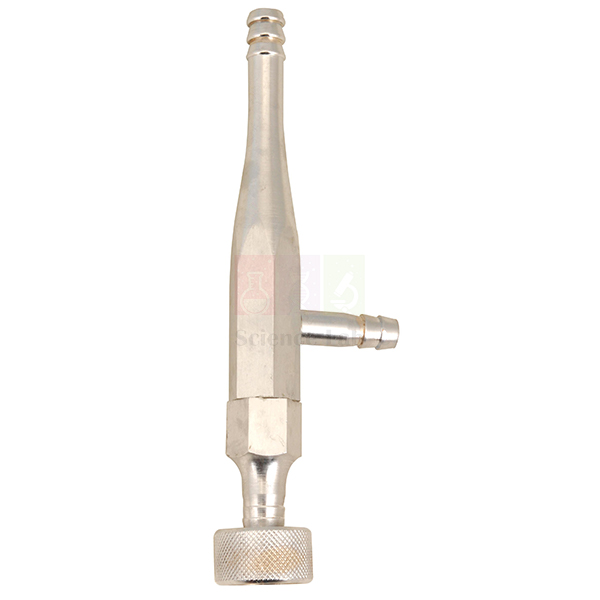
Filter Pump, Edward Type
Filter Pump, Edward Type (Product Code: SLE/CH/132) is a nickel plated brass water pump that produces a vacuum once its water inlet is connected to a running tap. It is a sturdy, no-electricity answer to everyday suction jobs in teaching laboratories – speeding up filtration through a Buchner funnel or drawing air out of a vacuum desiccator. The pump is made by Jain Scientific Equipments Pvt Ltd (ScienceLab), Ambala, India, and is a long-standing piece of chemistry lab equipment in India’s school, college and university laboratories.
Key Details
| Parameter | Detail |
|---|---|
| Type | Edward type water filter pump |
| Material | Nickel plated brass |
| Operation | Creates a vacuum when connected to a water supply via the water inlet |
| Driven by | Running water; no motor or electrical supply |
| Typical applications | Suction filtration and other light bench vacuum tasks |
Typical Use
Attach the water inlet to the laboratory tap with rubber tubing held by a hose clip, run the outlet into the sink, and connect the side vacuum port to your filter flask or desiccator with thick-walled vacuum tubing. With the tap turned on fully, the stream passing through the internal jet pulls air out of the connected vessel. The metal body stands up well to the knocks of a busy student laboratory, and the nickel plating keeps the brass from tarnishing at the sink.
Keep the pump roughly upright so that water drains freely, and add a trap bottle between the pump and your apparatus so that a drop in water pressure cannot send tap water back into the filtrate. If suction weakens over time, flush the pump with clean water and check the jet for debris or scale. For purchasing teams building a filtration station, the pump sits with tubing, flasks and bungs among the lab equipment accessories in India that are easiest to order together.
Manufacturer
Filter Pump, Edward Type is made by Jain Scientific Equipments Private Limited, which trades as ScienceLab and is based in Ambala, Haryana, India, producing apparatus for chemistry, physics and biology teaching. Details of the company are in our company profile.
Related Chemistry Lab Equipment
Pieces that connect to this pump in a working set-up:
- Rubber Tubing — links the water inlet to the tap
- Vacuum Tubing — carries suction from the side port without collapsing
- Conical Filter Flask — the receiving flask for suction filtration
- Vacuum Desiccator — can be evacuated with a water pump for drying samples
- Filter Pump, Borosilicate Glass — the all-glass version where chemical resistance matters most
Browse all items in Chemistry Lab Equipment.
Frequently Asked Questions
What is the Edward type pump made of?
Nickel plated brass. The metal construction makes it less vulnerable to breakage than an all-glass pump.
How does it connect to the tap?
Through its water inlet, normally with rubber tubing secured by a clip. Inlet and port dimensions are not stated here, so send us your tap details via the contact page if you want us to check the fit.
Can it be used with a vacuum desiccator?
Water pumps are commonly used to evacuate desiccators. The vacuum reached depends on your water pressure, so ask us if your procedure needs a particular level.
Do I need a trap bottle?
It is strongly recommended. A trap stops tap water from being drawn back into the flask if the water pressure drops or the tap is closed first.
How do I maintain it?
Flush it with clean water after use, let it drain, and inspect the jet occasionally for scale or debris, especially in hard-water areas.
Can you quote for a full lab set or an export shipment?
Yes. We supply institutions in India and international markets; include product code SLE/CH/132, the quantity and your delivery location.
Request a Quote
Request a price for the Edward type filter pump through our contact page, or add it with tubing and flasks to the enquiry cart.
Last updated: 24 September 2026
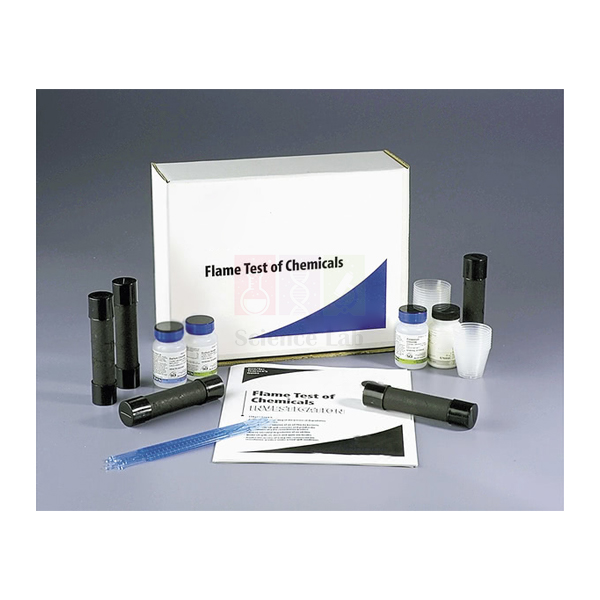
Flame Test Of Chemicals Lab Investigation
Flame Test Of Chemicals Lab Investigation (Product Code: SLE/CH/133) is a classroom investigation, sized for a class of 40 students, in which learners discover how elements can be identified by the colour they give to a flame. Students observe and record the colours emitted by metallic elements on heating, compare them with known standards to identify unknown samples, and use the results to explore the electronic structure of the atom. Supplied by Jain Scientific Equipments Pvt Ltd (ScienceLab), Ambala, India, it serves as a ready-to-run flame test kit for schools in India teaching atomic structure and qualitative analysis.
Key Details
| Parameter | Detail |
|---|---|
| Type | Flame test lab investigation |
| Class size | 40 students |
| Student tasks | Observe and record flame colours of metallic elements; relate results to known standards; identify unknown samples |
| Concepts | Electronic structure of the atom; relationship between colour and energy in the electromagnetic spectrum |
| Component list | Not detailed in this listing – available on request |
Typical Use
When a metal compound is heated in a hot, non-luminous flame, some of its electrons absorb energy and jump to higher energy levels; as they fall back they release light of particular wavelengths, which the eye sees as a characteristic colour. Sodium compounds, for instance, give an intense yellow-orange flame. Students first test the known standards and build a colour reference table, then use that table to name the unknowns, and finally discuss why a red flame corresponds to lower-energy light than a violet one.
Clean the sampling loop or splint thoroughly between samples, because a trace of sodium can mask fainter colours, and let students view the flames against a dark background. Viewing the same flames through a spectroscope turns a colour observation into a set of spectral lines, which is an effective extension for senior classes. Teachers looking for a chemistry teaching kit in India that connects practical work to atomic theory will find this investigation covers both in a single session.
Supplier
This lab investigation is supplied by Jain Scientific Equipments Private Limited, trading as ScienceLab from Ambala, Haryana, India, a supplier of practical kits and apparatus to schools and colleges. Visit our company profile to learn more.
Related Chemistry Lab Equipment
Equipment that supports a flame test lesson:
- Bunsen Burner — provides the hot, non-luminous flame the test depends on
- Spectroscope, Direct Vision — resolves each flame colour into its emission lines
- Safety Goggles — eye protection when working close to the flame
- Rust Race Lab Investigation — another investigation in the same series, on corrosion
Explore more investigations in Chemistry Lab Equipment.
Frequently Asked Questions
How many students is it designed for?
A class size of 40 students.
What will students learn?
How elements can be identified using flames, how flame colour relates to the electronic structure of the atom, and how colour relates to energy in the electromagnetic spectrum.
What exactly is in the kit?
The component list is not detailed on this page. Request it through our contact page so you can check what your laboratory needs to add.
Do we need a burner?
A hot, non-luminous flame is required, usually from a Bunsen burner. If your laboratory does not have enough burners, we can quote them with the kit.
Why do some colours look alike?
Faint colours can be hidden by sodium contamination or confused by eye. Careful cleaning between samples and a spectroscope both help students tell similar flames apart.
What safety precautions apply?
Goggles, tied-back hair, a clear bench and supervision near open flames. Allow hot loops or splints to cool before handling.
Can you supply several classes or export orders?
Yes. We supply institutions in India and international markets; include code SLE/CH/133 and the number of kits you need.
Request a Quote
Ask for pricing on the flame test investigation through the contact page, or add it to the enquiry cart along with burners and goggles.
Last updated: 24 September 2026
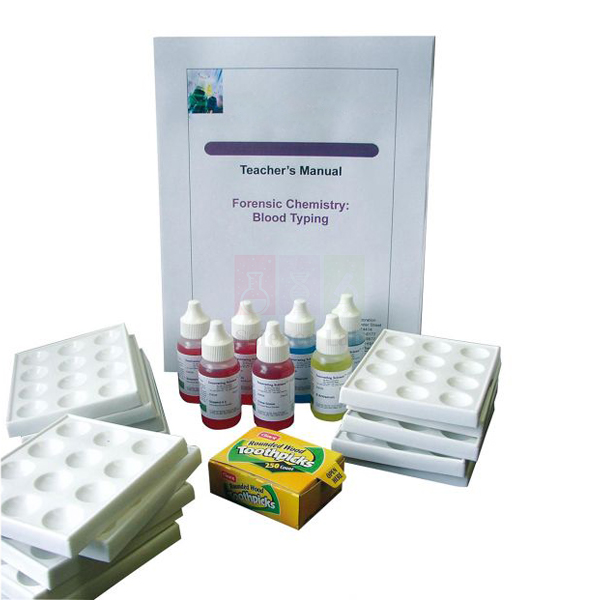
Forensic Chemistry of Blood Types
Forensic Chemistry of Blood Types (Product Code: SLE/CH/134) is a forensic science activity kit used to determine blood types from simulated samples and weigh them as evidence in a mock criminal investigation, in school and college classrooms. It uses Innovating Science Simulated Blood, which is safe for classroom use, and holds enough material for 15 groups. It is supplied by Jain Scientific Equipments Pvt Ltd (ScienceLab), Ambala, India, as a biology experiment kit for students that doubles as a chemistry and forensics lesson.
Key Details
| Parameter | Detail |
|---|---|
| Type | Forensic blood-typing activity |
| Sample material | Innovating Science Simulated Blood, safe for classroom use |
| Group capacity | Enough material for 15 groups |
| Teaching material | Teacher’s Manual plus Student Guide and Analysis copy-masters |
| Themes | Blood typing, inheritance, medical relevance and forensic evidence |
| Shelf life | Depends on the chemical, its grade and storage conditions; ask us for the expiry date of the batch you are quoted |
| Product code | SLE/CH/134 |
| Supplied by | Jain Scientific Equipments Pvt Ltd (ScienceLab), Ambala, India |
What Is the Forensic Blood Types Kit Used For?
Blood typing classifies blood by the presence or absence of specific antigens on the surface of red blood cells (erythrocytes). Because blood type is inherited, it matters for surgery, transfusions and paternity testing as well as for crime-scene work. In a typical session each group determines blood types from the simulated samples, records the results on the analysis sheets and then discusses whether those results support, or eliminate, a possible suspect’s involvement in a crime.
The key teaching point is that a blood type narrows the field rather than naming one person, which leads naturally into why investigators combine several lines of evidence. No real blood is involved, but students should still wear gloves and goggles, keep samples away from their mouths and clean the bench afterwards. Schools placing a science kit bulk order in India often buy this alongside other forensic activities to build a full crime-scene unit.
Supplier
Forensic Chemistry of Blood Types is supplied by Jain Scientific Equipments Private Limited, which trades as ScienceLab from Ambala, Haryana, India. The company sources practical kits of this kind for schools, colleges and distributors and can group several forensic activities into one quotation for a department. See our company profile for more.
Related Chemistry Lab Equipment
Other items for a forensic or blood-science unit:
- Blood Typing Kit, Simulated — an ABO-Rh typing activity with a biology focus, for comparison
- Forensics Using Simulated Blood — further crime-scene work with simulated blood
- Presumptive Blood Test Kit — shows how investigators first check whether a stain could be blood
- Human Blood Cell Types Model — a visual aid for explaining red blood cells
- Forensic Chemistry of Dusting for Fingerprints — adds fingerprint evidence to the same case study
Find more activities in Chemistry Lab Equipment.
Frequently Asked Questions
Does the Forensic Chemistry of Blood Types kit contain real blood?
No. The Forensic Chemistry of Blood Types kit uses Innovating Science Simulated Blood, which is safe for classroom use, so students can practise blood typing without handling real blood samples.
How many groups can take part?
The Forensic Chemistry of Blood Types kit has enough material for 15 groups, so a full class can work in small teams, each typing the simulated samples and completing its own analysis sheet.
What teaching resources are included?
The Forensic Chemistry of Blood Types kit includes a Teacher’s Manual plus Student Guide and Analysis copy-masters, which teachers photocopy so each group can record its results and work through the evidence questions.
Can a blood type prove who committed the crime?
No. In the Forensic Chemistry of Blood Types activity, students learn that blood type can support other evidence or eliminate a suspect, but many people share the same type, so it cannot identify one individual on its own.
What is the shelf life of the kit?
The shelf life of the Forensic Chemistry of Blood Types kit depends on the simulated blood and reagents, their grade and storage conditions; ask us for the expiry date of the batch you are quoted before planning several classes from one purchase.
Are refills available for repeat classes?
Refill options for the Forensic Chemistry of Blood Types kit are not listed in our product notes. Please ask through our contact page if you plan to run the activity with several classes over the year.
Who supplies the Forensic Chemistry of Blood Types kit?
Jain Scientific Equipments Private Limited, trading as ScienceLab in Ambala, Haryana, India, supplies the Forensic Chemistry of Blood Types kit to schools, colleges and distributors in India and international markets; include product code SLE/CH/134 and the number of kits.
Request a Quote
Request a quotation for the blood types kit through our contact page, or add it to the enquiry cart with other forensic science activities.
Last updated: 24 September 2026
680.jpg)
Forensic Chemistry of Chromatography (Document Analysis)
Forensic Chemistry of Chromatography (Document Analysis) (Product Code: SLE/CH/135) is a crime-solving activity in which students use thin-layer chromatography (TLC) to compare the ink on a ransom note with ink from markers tied to possible suspects. The storyline is simple and engaging: the school library’s computers have been stolen, and the thief left behind a note demanding money. Supplied by Jain Scientific Equipments Pvt Ltd (ScienceLab), Ambala, India, with enough material for 15 groups, it is a chromatography kit for schools in India that wraps separation science inside a mystery students want to solve.
Key Details
| Parameter | Detail |
|---|---|
| Type | Forensic document-analysis activity |
| Technique | Thin-Layer Chromatography |
| Scenario | Stolen library computers and a ransom note; note ink compared with ink from suspects’ markers |
| Group capacity | Enough material for 15 groups |
| Teaching material | Teacher’s Manual plus Student Guide and Analysis copy-masters |
Typical Use
Students place small spots of ink from the ransom note and from each suspect marker along a pencil baseline on the TLC plate, then stand the plate in a shallow layer of solvent. As the solvent climbs, the dyes that make up each ink travel different distances and separate into bands. Matching band patterns and positions suggests that the note could have been written with a particular marker, while a clear mismatch helps rule a marker out – exactly the kind of evidence a document examiner provides.
For clean results, keep the spots small, make sure the baseline sits above the solvent level, cover the developing container and mark the solvent front as soon as the plate is removed. Students can then calculate retention factors to compare inks numerically. Because the case ends with each group presenting its conclusion, the activity also works well as a science fair project kit in India or as the centrepiece of a forensic science week.
Supplier
This activity is supplied by Jain Scientific Equipments Private Limited, which trades as ScienceLab from Ambala, Haryana, India. Buyers completing vendor registration can use the company's GSTIN 06AAECJ8618A1ZT; it also holds DGFT Importer-Exporter Code AAECJ8618A for international consignments. More details are in our company profile.
Related Chemistry Lab Equipment
Chromatography supplies and companion forensic cases:
- Chromatography Plates, TLC — extra plates for repeat runs or student-designed tests
- Chromatography Pens, Black — additional inks for comparison exercises
- Chromatography Paper No. 1 — for comparing paper chromatography with TLC
- Crime Scene Investigation – Forensic Chemistry Of Whodunit — a broader forensic case for the same unit
- Forensic Chemistry of Drug Detection — a toxicology mystery using chemical tests
See all practical kits in Chemistry Lab Equipment.
Frequently Asked Questions
Which separation technique does the activity use?
Thin-Layer Chromatography, used to separate the ink on the ransom note and the ink in markers linked to suspects.
How many groups can work at once?
There is enough material for 15 groups.
Does a matching ink pattern prove who wrote the note?
Not on its own. It can provide evidence that the note could, or could not, have been written with a particular marker, which students then weigh alongside the rest of the case.
What else might we need to run it?
The full component list is not shown on this page. Ask through our contact page and we will confirm what is supplied and what your laboratory should provide, such as containers for developing the plates.
Why TLC rather than paper chromatography?
TLC usually gives quicker and sharper separations, so a class can complete the analysis within a single practical period. Paper chromatography makes a useful comparison exercise afterwards.
Are teacher notes included?
Yes, a Teacher’s Manual and Student Guide and Analysis copy-masters are included.
How do I request a quotation for several schools?
Send product code SLE/CH/135, the number of kits and delivery addresses; we supply institutions in India and international markets.
Request a Quote
For pricing on the document-analysis kit, write to us through the contact page or add it with extra TLC plates to the enquiry cart.
Last updated: 24 September 2026
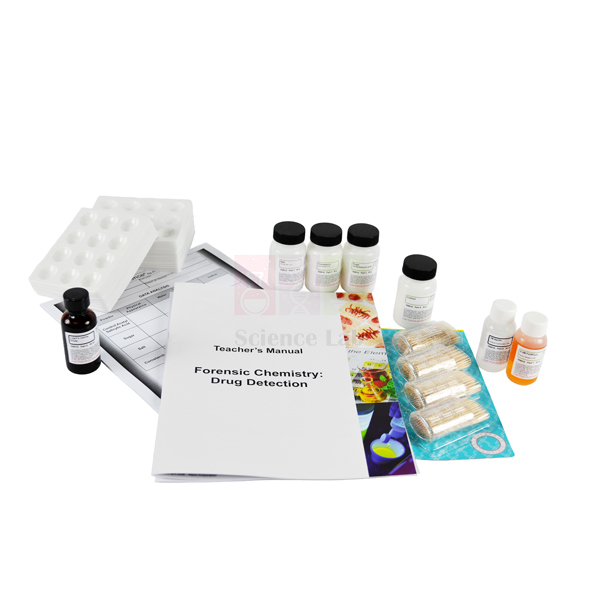
Forensic Chemistry of Drug Detection
Forensic Chemistry of Drug Detection (Product Code: SLE/CH/136) casts students as forensic toxicologists. Everyone who ate the school cafeteria’s chilli became ill, and aspirin appears to have been stolen from the nurse’s office – so could one of the cafeteria ingredients have been swapped for it? Groups answer the question with a series of chemical tests, including tests on control aspirin. With enough material for 15 groups, it is a science kit for students in India that teaches controls, evidence and careful reasoning, supplied by Jain Scientific Equipments Pvt Ltd (ScienceLab), Ambala, India.
Key Details
| Parameter | Detail |
|---|---|
| Type | Forensic toxicology activity |
| Scenario | Illness after the cafeteria chilli; aspirin missing from the nurse’s office |
| Method | Series of chemical tests on cafeteria ingredients, including tests on control aspirin |
| Group capacity | Enough material for 15 groups |
| Teaching material | Teacher’s manual, Student’s guide and Analysis copy-masters |
Typical Use
The investigation is built on the idea of a control. Students first run each test on the known aspirin sample to see what a positive result looks like, then repeat the same tests on every cafeteria ingredient. Any ingredient that responds like the control becomes a suspect substitution; any that does not can be cleared. Writing up the findings on the analysis sheets teaches students to separate observations from conclusions, just as a toxicologist’s report must.
Because the storyline involves food and a medicine, set a firm rule before starting: nothing on the bench is tasted, and every sample is handled with a clean spatula or dropper to prevent cross-contamination. Goggles should be worn throughout. Teachers can extend the lesson by explaining that real forensic laboratories follow quick screening tests with confirmatory instrumental analysis, which makes this a thought-provoking chemistry experiment kit for India’s senior secondary classes.
Supplier
This drug-detection activity is supplied by Jain Scientific Equipments Private Limited, which trades as ScienceLab and is based in Ambala, Haryana, India, supplying schools and colleges with kits and laboratory apparatus. Read more in our company profile.
Related Chemistry Lab Equipment
Items that deepen the aspirin chemistry or support the testing:
- Properties of Aspirin — explores the compound at the centre of the case
- Greener Synthesis Of Acetylsalicylic Acid — shows how aspirin itself is made
- Micro Test Plates — handy for running small-scale spot tests side by side
- Safety Goggles — eye protection during chemical testing
- Forensic Science Lab Investigation — a broader forensic investigation for the same unit
More kits are listed in Chemistry Lab Equipment.
Frequently Asked Questions
What is the case students have to solve?
Everyone who ate the cafeteria’s chilli became ill. Students must decide whether any ingredient could have been substituted with aspirin taken from the nurse’s office.
Why do students test control aspirin?
The control shows what a positive result looks like, giving a reliable reference against which every ingredient is judged.
How many groups does one kit serve?
There is enough material for 15 groups.
Is it appropriate for a school laboratory?
Yes, with standard precautions: goggles, supervision and a strict no-tasting rule, since the scenario involves food and a medicine.
Which chemicals and apparatus are included?
The component list is not detailed on this page. Request it through our contact page to see what your laboratory will need to provide.
What documentation comes with the kit?
A Teacher’s manual, a Student’s guide and Analysis copy-masters.
Do you ship to international schools?
Yes, we supply institutions in India and international markets. Quote code SLE/CH/136, the number of kits and the destination.
Request a Quote
Ask for a price on the drug-detection kit via our contact page, or place it in the enquiry cart with your other forensic chemistry kits.
Last updated: 24 September 2026
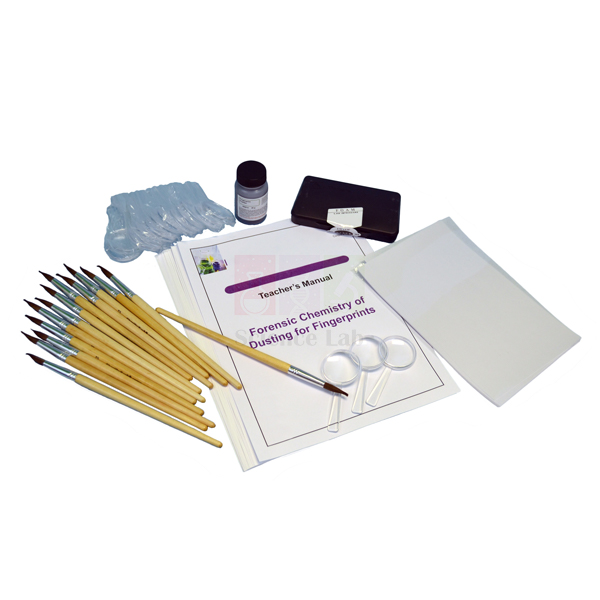
Forensic Chemistry of Dusting for Fingerprints
Forensic Chemistry of Dusting for Fingerprints (Product Code: SLE/CH/137) is a forensic science kit that teaches students to identify and classify different types of fingerprints, recognise their distinguishing characteristics and reveal hidden prints by dusting – the oldest and most commonly used method of fingerprint detection. It contains enough material for 15 groups, including 15 fingerprinting brushes and 15 hand magnifiers so that every group has its own tools. Supplied by Jain Scientific Equipments Pvt Ltd (ScienceLab), Ambala, India, it is a STEM science kit in India that brings crime-scene methods into the classroom.
Key Details
| Parameter | Detail |
|---|---|
| Type | Forensic fingerprinting activity |
| Group capacity | Enough material for 15 groups |
| Skills taught | Identifying and classifying fingerprint types; distinguishing characteristics; dusting for fingerprints |
| Teaching material | Teacher’s Manual and Student Study Guide copymasters |
Kit includes:
- 1 bottle Fingerprinting Powder
- Ink Pad
- Acetate Sheets
- 15 Fingerprinting Brushes
- 15 Hand Magnifiers
Typical Use
The lesson usually runs in two parts. First, students roll their own fingertips on the ink pad, study the prints with a hand magnifier and sort them into the main pattern families – loops, whorls and arches – before looking for finer ridge details such as endings and forks. Next, they leave latent prints on a smooth surface, dust them lightly with the brush and powder until the ridges appear, and keep the developed prints on acetate sheets for side-by-side comparison with their inked records.
Use very little powder and a light, twirling brush stroke, and tap off any excess rather than rubbing, or the ridge detail will smear. Work over scrap paper, keep the powder away from faces and have students wash their hands afterwards. With fixed contents per group, the kit is also straightforward to specify when a school prepares a science kit tender in India for its forensic or general science laboratory.
Supplier
Forensic Chemistry of Dusting for Fingerprints is supplied by Jain Scientific Equipments Private Limited, trading as ScienceLab and based in Ambala, Haryana, India. The company provides practical kits, apparatus and consumables to schools and colleges – our company profile explains more.
Related Chemistry Lab Equipment
Tools and cases that build on fingerprint work:
- Forensic Comparison Microscope — compares two prints or traces side by side at higher magnification
- Hand Magnifier — extra lenses if individual students need their own
- Gloves W/o Powder Nitrile Disposable — let students handle evidence without adding their own prints
- Crime Scene Investigation — a wider scenario in which fingerprints are one clue among many
- Forensic Chemistry of Blood Types — adds blood evidence to the same forensic unit
Browse further kits in Chemistry Lab Equipment.
Frequently Asked Questions
What does the kit contain?
One bottle of fingerprinting powder, an ink pad, acetate sheets, 15 fingerprinting brushes and 15 hand magnifiers, plus Teacher’s Manual and Student Study Guide copymasters.
How many groups can use it at the same time?
Fifteen. With 15 brushes and 15 magnifiers, each group has a full set of tools.
Which fingerprint types do students learn?
They learn to identify and classify different types of fingerprints and their distinguishing characteristics, typically starting with the loop, whorl and arch patterns.
Why focus on dusting?
Dusting is the oldest and most commonly used method of fingerprint detection, so it is the natural starting point before other techniques.
Can we buy extra powder?
The kit includes one bottle. Separate refill packs are not listed on this page, so ask through our contact page if you expect heavy use.
Is the powder safe for students?
Use it with sensible precautions: small amounts, no inhaling, gloves where possible and hand-washing afterwards. Ask us if you need safety information for your records.
Do you supply schools in bulk or overseas?
Yes. We supply institutions in India and international markets; include product code SLE/CH/137 and the quantity in your enquiry.
Request a Quote
For pricing on the fingerprint dusting kit, contact us via the contact page or add it to the enquiry cart with gloves and magnifiers.
Last updated: 24 September 2026
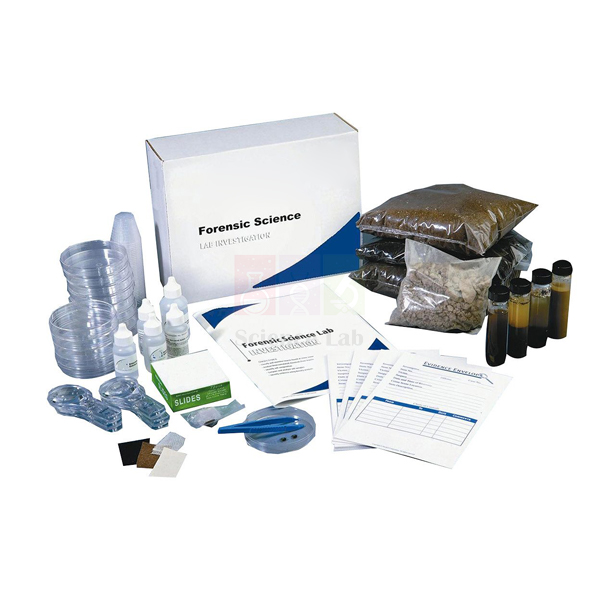
Forensic Science Lab Investigation
Forensic Science Lab Investigation (Product Code: SLE/CH/138) is a classroom crime-scene activity in which the whole class becomes the team of lead investigators on a murder mystery and experiences many aspects of how a forensic laboratory works. Students collect the evidence themselves, then analyse it with a combination of forensic tools — fibre and soil composition analysis, density analysis, insect identification and chemical analysis — before using their results to solve the case. The kit contains materials for up to 40 students, which makes it a practical choice for teachers looking for a chemistry experiment kit in India that ties several lab skills to one story. It is supplied by Jain Scientific Equipments Pvt Ltd (ScienceLab), Ambala.
Specifications
| Parameter | Detail |
|---|---|
| Type | Forensic science investigation kit built around a murder mystery |
| Class size | Materials for up to 40 students |
| Techniques covered | Fibre composition analysis, soil composition analysis, density analysis, insect identification, chemical analysis |
| Student role | Lead investigators who collect the evidence and analyse the results |
| Learning outcome | Students combine their findings to solve the murder mystery |
| Supplied by | Jain Scientific Equipments Pvt Ltd (ScienceLab), Ambala, India |
Typical Use
Most teachers open the case with a short briefing on the scenario and then split the class into evidence teams. One team compares fibres, another looks at soil composition, others carry out density measurements, identify insects or run the chemical tests. Because students gather the evidence before they analyse it, the activity builds habits that matter in any laboratory: careful handling, clear labelling and honest recording of what was actually observed. The investigation closes with each team presenting its findings and the class deciding which conclusion the combined evidence really supports.
The kit suits a forensic science unit, a cross-curricular project week or an after-school science club, and it fits well in schools planning school chemistry lab equipment in India around enquiry-based practical work. A useful approach is to set each type of analysis up as a separate station and rotate groups, so every student practises more than one technique. Keep hand lenses or a microscope nearby for the fibre and insect work, and have students wear eye protection during the chemical analysis.
Supplier
This investigation kit is supplied by ScienceLab, the trading name of Jain Scientific Equipments Private Limited, an educational laboratory equipment company based in Ambala, Haryana. Schools can place one enquiry for the kit together with the microscopes, glassware and safety items a forensic practical usually calls for, and the company serves customers across India and international markets. You can read more about us on our company profile.
Related Laboratory Equipment
These items extend the same forensic lessons, either as extra evidence stations or as tools for looking at samples more closely.
- Crime Scene Investigation – Forensic Chemistry Of Whodunit — a second case for classes that want another scenario to solve.
- Forensic Chemistry of Dusting for Fingerprints — adds fingerprint evidence as an extra station.
- Forensic Chemistry of Chromatography (Document Analysis) — ink and document evidence for an extension lesson.
- Magnifying Glass — for close inspection of fibres, soil particles and insects.
- Forensic Comparison Microscope — side-by-side viewing when comparing fibre samples.
More practical kits and apparatus are listed in our Chemistry Lab Equipment category.
Frequently Asked Questions
How many students can use one kit?
The kit contains materials for up to 40 students. How you divide them into teams is up to you; small evidence teams of a few students each work well.
Which forensic techniques do students practise?
Fibre and soil composition analysis, density analysis, insect identification and chemical analysis, all used together to solve a single murder mystery.
Is a teacher guide included?
The printed documentation supplied with the kit is not detailed on this page. Please ask through our contact page and we will confirm what accompanies the kit before you order.
Will we need any apparatus from our own lab?
Possibly. Density work generally needs a balance and a measuring vessel, and magnifiers help with fibres and insects. Ask us for the list of items the kit expects the school to provide.
Can the used materials be replenished?
Replacement materials are not listed separately here. Tell us which parts of the kit you have used and we will advise on restocking or a new kit.
What should an institutional quotation request include?
The product code SLE/CH/138, the number of kits, your delivery address and any tender or purchase-order format your institution uses. We supply schools and colleges in India and international markets.
Request a Quote
For pricing and availability of the Forensic Science Lab Investigation (SLE/CH/138), send your quantity and delivery location through our contact page, or add the kit to the enquiry cart together with any other items for your forensic science unit.
Last updated: 24 September 2026
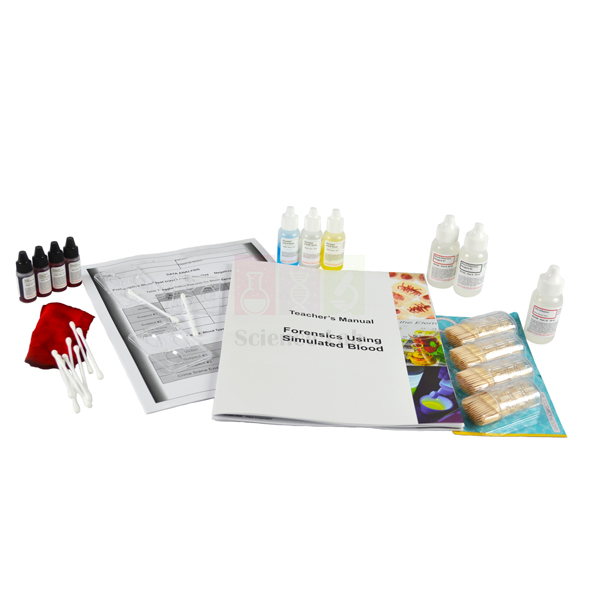
Forensics Using Simulated Blood
Forensics Using Simulated Blood (Product Code: SLE/CH/139) puts students in the role of crime-lab technicians who assist investigators by examining evidence collected at a crime scene. They first use a presumptive blood test to find out whether a stain on a piece of cloth may be blood, then determine the blood type of a sample from the scene and compare it with samples from two suspects. Along the way they meet an important idea about evidence: blood type alone is not enough to prove guilt, but it can help exonerate a suspect. The kit holds enough materials for 10 groups, uses simulated blood and simulated antisera rather than real samples, and is supplied by Jain Scientific Equipments Pvt Ltd (ScienceLab), Ambala, as a ready-to-teach science kit for students in India and abroad.
Specifications
| Parameter | Detail |
|---|---|
| Groups served | Enough materials for 10 groups |
| Part 1 | Presumptive blood test on a stained piece of cloth |
| Part 2 | Blood typing of the crime scene sample and comparison with samples from two suspects |
| Typing sera | Simulated anti-A, anti-B and anti-Rh serum |
| Teaching material | Teacher’s Manual and Student Study Guide copymasters |
Kit includes:
- 1 pc cloth
- 1 btl 70% ethanol
- 1 btl blood detection reagent #1
- 1 btl blood detection reagent #2
- 4 simulated blood samples: Victim, Suspect #1, Suspect #2 and Crime Scene Evidence
- 40 blood typing trays
- 10 cotton swabs
- 1 btl simulated anti-A serum
- 1 btl simulated anti-B serum
- 1 btl simulated anti-Rh serum
Typical Use
The lesson runs in two stages. In the first, each group works on the stained cloth with a cotton swab, the 70% ethanol and the two blood detection reagents, following the Teacher’s Manual, to decide whether the stain could be blood. This shows students why investigators screen evidence before committing it to fuller testing. In the second stage, groups place the crime scene sample on a blood typing tray with the simulated anti-A, anti-B and anti-Rh sera, read the reactions, and then repeat the typing for the victim and both suspects so the results can be compared side by side.
The discussion afterwards is where the real learning happens. A match between the scene sample and a suspect only places that person in a group of people who share the same blood type, whereas a mismatch can rule a suspect out — a good way to introduce the difference between class evidence and individual evidence. Schools comparing chemistry teaching kits in India often choose this one for its photocopiable Student Study Guide, which keeps every group recording results in the same format. Gloves and eye protection are good practice when handling the reagents.
Supplier
ScienceLab is the trading name of Jain Scientific Equipments Private Limited, a company in Ambala, Haryana, that supplies forensic and chemistry teaching kits to schools and colleges in India and international markets. For purchase departments that need vendor registration details, the company’s GSTIN is 06AAECJ8618A1ZT and its Legal Entity Identifier (LEI) is 3358004HRD1JIVXKYX49. Background on the business is on our company profile.
Related Laboratory Equipment
Teachers running this activity often pair it with the items below, either to restock the kit or to widen the forensic unit.
- Forensics using Simulated Blood – Refill — the refill for this kit when you want to run the activity again.
- Presumptive Blood Test Kit — extra practice with stain screening on its own.
- Forensic Chemistry of Blood Types — a further blood-typing case for another class.
- Chemiluminescence in Blood Stain Detection — extends the stain-detection theme with a light-emitting reaction.
- Gloves W/o Powder Nitrile Disposable — hand protection while students handle reagents.
See the full range in our Chemistry Lab Equipment category.
Frequently Asked Questions
How many groups does the kit serve?
There are enough materials for 10 groups. The kit includes 40 blood typing trays and 10 cotton swabs to share between them.
Does the kit contain real blood?
No. The four blood samples and the anti-A, anti-B and anti-Rh sera are all simulated, so no biological material is handled.
What does the presumptive test tell students?
It indicates whether the stain on the cloth may be blood. It is a screening step, which is why the activity then moves on to blood typing and comparison with the suspects.
Is teaching material included?
Yes. A Teacher’s Manual and Student Study Guide copymasters are included, so you can photocopy the student pages for each group.
Can we restock the kit after use?
Yes, a separate refill is listed: Forensics using Simulated Blood – Refill. Please confirm its current contents with us before ordering.
How should the reagents be stored?
Storage guidance is not given on this page. Follow the bottle labels and the Teacher’s Manual, and ask through our contact page if you need details before the kit arrives.
Can you supply several kits for a school group or overseas order?
Yes. Send the product code SLE/CH/139, quantity and delivery address; we supply institutions across India and international markets.
Request a Quote
To receive a quotation for Forensics Using Simulated Blood, write to us via the contact page or add the kit, and its refill if needed, to the enquiry cart.
Last updated: 24 September 2026

Forensics using Simulated Blood – Refill
Forensics using Simulated Blood – Refill (Product Code: SLE/CH/140) is the refill kit for the Forensics Using Simulated Blood classroom activity. Schools that already own the main kit order the refill to restock it once a class set of materials has been used, so the same crime-lab exercise can be run again with the next group of students instead of buying the complete kit a second time. It is supplied by Jain Scientific Equipments Pvt Ltd (ScienceLab), Ambala, and helps science departments keep a popular forensic practical running term after term.
Key Details
| Parameter | Detail |
|---|---|
| Type | Refill kit |
| For use with | The Forensics Using Simulated Blood kit |
| Purpose | Restocking the main kit so the activity can be repeated |
| Contents | Please confirm the current refill contents with us before ordering |
| Supplied by | Jain Scientific Equipments Pvt Ltd (ScienceLab), Ambala, India |
Typical Use
The simplest routine is to check the main kit at the end of each forensic unit and order a refill before the next one begins. When the refill arrives, lay it out next to what remains in the original kit and work through the instructions you use for the activity, so every group starts the lesson with a complete set rather than discovering a gap halfway through the practical.
Departments that run the simulated-blood activity with several sections of the same grade usually keep one main kit and plan refills around the number of groups they expect to teach in the year. As a school science kit supplier in India, we can quote the refill together with other consumables for the unit, such as gloves and eye protection, so one order covers the whole practical. If you are unsure whether your existing kit needs a refill or a replacement, tell us what is left and we will advise.
Supplier
The refill is supplied by ScienceLab — the name under which Jain Scientific Equipments Private Limited of Ambala, Haryana, trades. Besides teaching apparatus, the company provides activity kits and the replacement materials that keep them in use, for schools and colleges in India and international markets. Company background is available on our company profile.
Related Laboratory Equipment
These items belong to the same forensic practical, from the parent kit to the protective wear students need while working.
- Forensics Using Simulated Blood — the complete activity kit this refill restocks.
- Presumptive Blood Test Kit — additional stain-screening practice for faster groups.
- Forensic Chemistry of Blood Types — another blood-typing case to vary the unit.
- Gloves W/o Powder Nitrile Disposable — disposable hand protection for each group.
- Safety Goggles — eye protection while reagents are in use.
Browse all forensic and chemistry kits in the Chemistry Lab Equipment category.
Frequently Asked Questions
Is the refill a complete kit on its own?
It is sold as a refill for the Forensics Using Simulated Blood kit. If you are starting without the main kit, order Forensics Using Simulated Blood and ask us whether you also need a refill.
What exactly is inside the refill?
The refill contents are not itemised on this page. Please request the current list through our contact page before placing an order.
How many groups will one refill cover?
That is not stated here. Tell us how many groups you plan to run and we will confirm how many refills you need.
Will it match a main kit we bought some time ago?
Send us the product code of your kit and roughly when it was bought, and we will check that the refill matches before dispatch.
Can refills be ordered in bulk or for delivery outside India?
Yes. Include the product code SLE/CH/140, the quantity and the delivery address in your enquiry; we supply schools in India and international markets.
Request a Quote
To price the Forensics using Simulated Blood – Refill, contact us through the contact page or add it to the enquiry cart with the main kit or other items for the unit.
Last updated: 24 September 2026
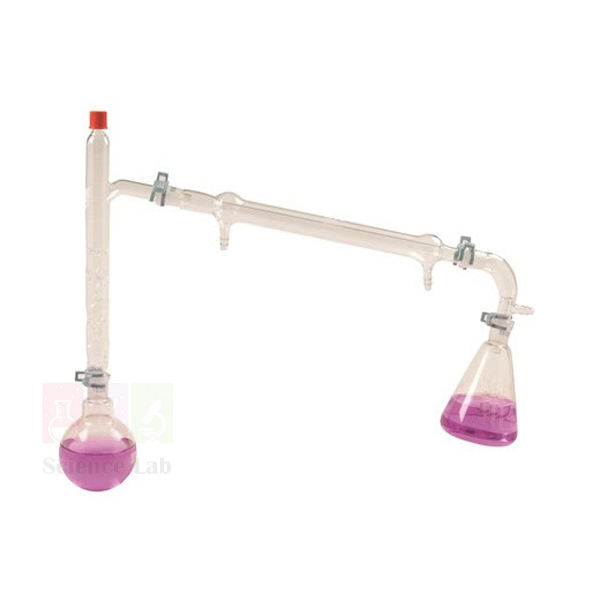
Fractional Distillation Assembly
Fractional Distillation Assembly (Product Code: SLE/CH/141) is a set of borosilicate glass components, all with 19/26 joints, for separating a mixture of liquids according to their boiling points. Its Vigreux column gives rising vapour extra surface on which to condense and re-evaporate several times before it reaches the condenser, which is what makes fractional distillation separate close-boiling liquids more cleanly than a simple distillation. Chemistry teachers, college demonstrators and laboratory technicians use it for practical classes and demonstrations, and it suits institutions looking for laboratory distillation apparatus in India that arrives as one matched set. It is made by Jain Scientific Equipments Pvt Ltd (ScienceLab), Ambala.
Specifications
| Parameter | Detail |
|---|---|
| Material | Borosilicate glass |
| Joint size | 19/26 |
| Boiling flask | Round-bottom boiling flask, 250 ml |
| Fractionating column | Vigreux column |
| Condenser | Liebig condenser |
| Receiver adapter | Vacuum receiver adapter |
| Receiving flask | Erlenmeyer flask, 250 ml |
| Joint clips | 4 x joint clip, 19/26 |
Typical Use
To set up, clamp the 250 ml round-bottom flask over a suitable heat source, fit the Vigreux column vertically in its neck, and attach the Liebig condenser so that it slopes down towards the vacuum receiver adapter and the 250 ml Erlenmeyer flask. Cooling water enters the condenser at the lower connection and leaves at the upper one, keeping the jacket full. The four 19/26 joint clips hold the connections together while the apparatus is hot. A classic class experiment is separating an ethanol and water mixture, collecting the first fraction while the more volatile liquid distils over and changing the receiver as the distillate changes.
For smooth boiling, add anti-bumping granules and fill the flask no more than about half full. Heat gradually so the vapour climbs the column slowly; heating too fast floods the column and undoes the separation. Leave the side connection on the receiver adapter open to the air for distillation at normal pressure. As a piece of borosilicate laboratory glassware in India’s school and college labs, the set should be allowed to cool before dismantling, and the joints should be cleaned promptly so they do not seize.
Manufacturer
Jain Scientific Equipments Private Limited trades as ScienceLab and manufactures laboratory apparatus in Ambala, Haryana, for schools, colleges and teaching laboratories. This assembly is offered as a set in a single joint size, so the flask, column, condenser and adapter connect directly without extra adapters. Customers in India and international markets can read more on our company profile.
Related Laboratory Equipment
A working fractional distillation bench needs support, heating and water connections as well as the glassware; these items cover that workflow.
- Heating Mantle 250ml — controlled heating sized for a 250 ml round-bottom flask.
- Retort Stand — supports the flask, column and condenser.
- Universal Clamp — grips the flask neck and condenser securely.
- Rubber Tubing — carries cooling water to and from the condenser.
- Distillation Apparatus — a simple distillation set for comparing the two techniques.
More glassware and apparatus are in our Chemistry Lab Equipment category.
Frequently Asked Questions
Which components come in the assembly?
A 250 ml round-bottom boiling flask, a Vigreux column, a Liebig condenser, a vacuum receiver adapter, a 250 ml Erlenmeyer flask and four 19/26 joint clips.
What joint size does it use?
All connections are 19/26, and the four joint clips supplied are the same size.
Is a thermometer or still head included?
Neither is listed in the component set. If you want to monitor the vapour temperature, ask through our contact page and we will suggest a suitable arrangement.
Can the assembly be used under reduced pressure?
The receiver adapter is a vacuum type with a side connection for a vacuum line or for venting. Please confirm your reduced-pressure procedure with us before use, as vacuum work needs glassware inspected for flaws.
What heat source should we use?
A heating mantle suited to 250 ml round-bottom flasks gives the most even heating. Avoid an open flame when distilling flammable liquids.
Can individual parts be replaced?
A Liebig Condenser is listed separately; for other replacement parts, send the part name and joint size and we will quote.
What about warranty and transit breakage?
These terms are confirmed on each quotation. Please ask when you enquire so they are stated clearly for your order.
Request a Quote
To order the Fractional Distillation Assembly for one bench or a whole lab, send your quantity through the contact page or add it to the enquiry cart with any stands, clamps or heating mantles you need.
Last updated: 24 September 2026
Glass Combustion Tube
Glass Combustion Tube (Product Code: SLE/CH/142) is a small, clear glass tube for heating very small quantities of material in a flame, measuring 4 mm in outer diameter, 2.5 mm in inner diameter and 53 mm in length. The glass is heat resistant and chemical resistant, so the tube copes with direct heating and with contact with the reagents used in routine small-scale tests. Chemistry students, teachers and laboratory technicians use it where only a trace of sample is needed, and it is a handy item of chemistry lab glassware for India’s school and college practical rooms. It is made by Jain Scientific Equipments Pvt Ltd (ScienceLab), Ambala.
Specifications
| Parameter | Detail |
|---|---|
| Material | Glass |
| Colour | Clear |
| Outer diameter | 4 mm |
| Inner diameter | 2.5 mm |
| Length | 53 mm |
| Properties | Heat resistant; chemical resistant |
Typical Use
Combustion tubes are used when a sample has to be heated strongly and watched closely: a few crystals are placed inside, the tube is held in the flame, and students record what happens — a change of colour, melting, gas given off, droplets condensing on the cooler part of the glass, or a residue left behind. With a bore of only 2.5 mm, the tube holds a tiny amount of material, which keeps reactions contained and reduces the quantity of chemical each student uses. That makes it a good fit for small-scale qualitative tests and for microscale teaching where many students work at once.
Warm the tube gently at first and then increase the heat, holding it with suitable tongs or a holder and pointing the open end away from everyone nearby. Heat-resistant glass still dislikes sudden temperature changes, so let the tube cool on a heat-resistant mat rather than dropping it into water. Eye protection is essential whenever glass is heated in a flame. For schools buying school chemistry lab equipment in India for a full class, it is worth ordering spare tubes, since a tube that has been strongly heated with a sample is often easier to replace than to clean.
Manufacturer
Jain Scientific Equipments Private Limited, known to customers as ScienceLab, produces laboratory glassware and teaching apparatus in Ambala, Haryana. Small glass items like this tube are usually ordered in quantity for class practicals, and the company can send them in the same consignment as larger apparatus to schools and colleges in India and international markets. See our company profile for more about the business.
Related Laboratory Equipment
Heating a combustion tube safely needs a steady flame and eye protection; the items below complete that set-up or offer other narrow glass tubes.
- Bunsen Burner — an adjustable gas flame for strong heating.
- Glass Spirit Lamp — a gentler flame for labs without a gas supply.
- Capillary Tube Set — other fine glass tubes for small-scale work.
- Borosilicate Glass Tubing — stock tubing when you need other lengths.
- Safety Goggles — eye protection whenever glass is heated.
Explore more items in our Chemistry Lab Equipment category.
Frequently Asked Questions
What are the dimensions of the tube?
Outer diameter 4 mm, inner diameter 2.5 mm and length 53 mm.
Is the tube made of borosilicate glass?
The listing describes it as clear, heat-resistant and chemical-resistant glass. If your procedure requires a particular glass grade, please confirm it with us through the contact page.
Can it go directly into a flame?
Yes, it is heat resistant and intended for heating. Warm it gradually and avoid cooling it suddenly to reduce the risk of cracking.
Can the tubes be reused?
They can be cleaned and reused if the residue comes away. Tubes charred by strong heating are usually replaced instead.
How many tubes come in a pack?
The pack quantity is not stated on this page. Tell us how many tubes you need and we will quote accordingly.
Do you supply larger quantities for schools or export?
Yes. Send the product code SLE/CH/142, the quantity and the delivery address; we supply institutions in India and international markets.
Request a Quote
For a quotation on the Glass Combustion Tube, use our contact page or add the item to the enquiry cart along with burners and safety goggles for the practical.
Last updated: 24 September 2026
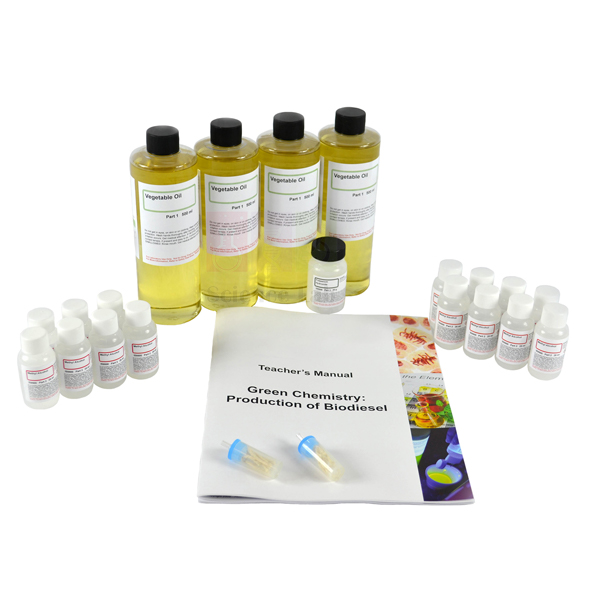
Green Chemistry: Production Of Biodiesel
Green Chemistry: Production Of Biodiesel (Product Code: SLE/CH/143) is a classroom kit in which students carry out a two-phase process to produce small batches of crude biodiesel. The fuel they make is of sufficient quality to demonstrate the burning qualities of both biodiesel and vegetable oil, and an optional small-scale washing exercise lets classes go through the full process needed to reach the quality levels required for use in vehicles. Sufficient materials are included for 15 groups, together with a teacher’s manual and student copy masters. It suits teachers looking for a chemistry experiment kit in India that connects reaction chemistry with renewable energy, and it is supplied by Jain Scientific Equipments Pvt Ltd (ScienceLab), Ambala.
Specifications
| Parameter | Detail |
|---|---|
| Groups served | Sufficient materials for 15 groups |
| Process | Two-phase production of small batches of crude biodiesel |
| Demonstration | Burning qualities of biodiesel compared with vegetable oil |
| Optional extension | Small-scale washing procedure for the crude biodiesel |
| Teaching material | Teacher’s manual and student copy masters |
Typical Use
The activity gives a concrete example of green chemistry: turning a renewable raw material, vegetable oil, into a usable fuel. In general terms, biodiesel is made by chemically converting the fats in the oil into a thinner, more easily burned liquid, leaving a glycerol by-product behind. Students work through the two phases of the process in their groups, then compare how the crude biodiesel and the original vegetable oil burn, which makes the difference between the two liquids easy to see rather than just read about.
Classes with extra time can add the optional washing exercise, which shows why fuel sold for vehicles needs further purification than the crude product. The kit also works as an environmental science kit for school energy topics, prompting discussion of renewable feedstocks, emissions and the trade-offs of biofuels. Run the practical in a well-ventilated room, have students wear eye protection, and keep the burning comparison under close teacher supervision on a heat-resistant surface.
Supplier
ScienceLab is the trading name of Jain Scientific Equipments Private Limited, a company based in Ambala, Haryana; for vendor registration, its details are CIN U29309HR2020PTC087597 and GSTIN 06AAECJ8618A1ZT. Chemistry activity kits such as this one are supplied from Ambala to schools and colleges in India and international markets. More detail is on our company profile.
Related Laboratory Equipment
These items support the same green chemistry lessons, from a companion kit to the apparatus and protection used during the practical.
- Greener Synthesis Of Acetylsalicylic Acid — a second green chemistry practical built on a renewable starting material.
- Organic Chemistry Kit — broader organic practicals for the same course.
- Separating Funnel (Separator) — handy for separating liquid layers if you run the optional washing step.
- Magnetic Stirrer With Hot Plate — mixing and gentle warming where the manual calls for it.
- Safety Goggles — eye protection throughout the practical and burning test.
More kits are listed in our Chemistry Lab Equipment category.
Frequently Asked Questions
How many groups can use one kit?
The kit has sufficient materials for 15 groups.
Can the biodiesel students make be used in a vehicle?
No. The kit produces crude biodiesel intended for classroom demonstration of burning qualities. The optional washing exercise shows the extra steps needed to reach vehicle-quality fuel, but the classroom product should not be put into an engine.
Is the washing procedure required?
No, it is optional. Use it if you want students to experience the full process of producing biodiesel.
What teaching support is included?
A teacher’s manual and student copy masters, so you can photocopy the student instructions for each group.
What will the school need to provide?
The list of school-supplied items is not given on this page. Ask through our contact page and we will send it with your quotation.
How should the kit materials be stored until use?
Follow the labels and the teacher’s manual; if you need storage information before delivery, please ask us.
What should a tender or purchase enquiry include?
The product code SLE/CH/143, number of kits, delivery address and your institution’s purchase format. The company registration details above can be added to vendor forms.
Request a Quote
To request pricing for Green Chemistry: Production Of Biodiesel, send your details through the contact page or place the kit in the enquiry cart with any glassware and safety items for the practical.
Last updated: 24 September 2026
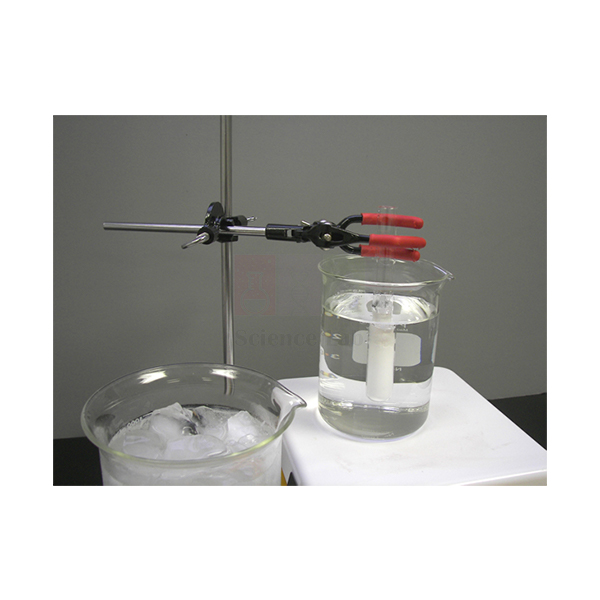
Greener Synthesis Of Acetylsalicylic Acid
Greener Synthesis Of Acetylsalicylic Acid (Product Code: SLE/CH/144) is a multi-step organic chemistry kit that shows how to produce sodium salicylate from a naturally occurring, renewable resource and carry it through to acetylsalicylic acid, the active compound in aspirin. Students convert the sodium salicylate to salicylic acid, check for salicylic acid with a quick confirmatory test, and then use their own prepared salicylic acid for the final synthesis. There are enough materials for 15 groups, plus a teacher’s manual and student copy masters. With its step-by-step structure it works well as a chemistry teaching kit for organic chemistry classes in India and overseas, supplied by Jain Scientific Equipments Pvt Ltd (ScienceLab), Ambala.
Specifications
| Parameter | Detail |
|---|---|
| Groups served | Enough materials for 15 groups |
| Starting point | A naturally occurring, renewable resource |
| Step 1 | Production of sodium salicylate |
| Step 2 | Conversion of sodium salicylate to salicylic acid |
| Check | Quick confirmatory test for the presence of salicylic acid |
| Step 3 | Synthesis of acetylsalicylic acid from the prepared salicylic acid |
| Teaching material | Teacher’s manual and student copy masters |
Typical Use
Because each step produces the starting material for the next, the practical is usually spread over more than one lesson and teaches students something single-step experiments cannot: losses and impurities carry forward, so careful technique early on decides the result at the end. The route also illustrates a core green chemistry idea, using a renewable feedstock, and invites comparison with the way salicylic acid is commonly manufactured from petrochemical sources.
The quick confirmatory test gives groups a checkpoint before they commit their salicylic acid to the final synthesis, which keeps weaker groups from carrying a failed intermediate into the last step. Teachers who want to push further can have students collect the final crystals by suction filtration and compare melting points as a simple purity check. Schools in India looking for a science kit with manual and copy masters ready to photocopy will find the student sheets make marking consistent across groups. Eye protection and supervised handling of reagents are essential throughout, and the product is for laboratory study only.
Supplier
Kits like this one are supplied by ScienceLab, which is how Jain Scientific Equipments Private Limited of Ambala, Haryana, trades. Alongside the apparatus it manufactures, the company supplies chemistry activity kits so that a school or college can place a single order for kits, glassware and heating equipment, with delivery across India and to international markets. Read more on our company profile.
Related Laboratory Equipment
The items below fit the same synthesis workflow, from heating and filtration to checking the product.
- Green Chemistry: Production Of Biodiesel — a companion green chemistry kit for the same unit.
- Water Bath — steady, gentle warming for reaction steps that need heat.
- Filter Pump, Borosilicate Glass — suction for collecting crystals quickly.
- Conical Filter Flask — the receiving flask for suction filtration.
- Apparatus Melting Point — an extension for judging product purity.
Find more practical kits in our Chemistry Lab Equipment category.
Frequently Asked Questions
What natural resource is the starting material?
This page describes it as a naturally occurring, renewable resource; the teacher’s manual gives the details. If you need to know before ordering, for example for a risk assessment, ask through our contact page.
How many groups does the kit cover?
There are enough materials for 15 groups.
May students take the aspirin they make?
No. The acetylsalicylic acid produced is a laboratory product for study only and must never be tasted or swallowed.
How do students know the intermediate step worked?
A quick confirmatory test for salicylic acid is part of the activity, so each group checks its salicylic acid before the final synthesis.
What equipment should the school provide?
That list is not given on this page. We can send it with your quotation, and we can also quote any glassware or heating equipment you are missing.
Can you supply kits for several classes or an export order?
Yes. Quote the product code SLE/CH/144, the number of kits and the delivery address; we supply India and international markets.
Request a Quote
For a price on the Greener Synthesis Of Acetylsalicylic Acid kit, contact us via the contact page or add it to the enquiry cart with any filtration or heating apparatus you need.
Last updated: 24 September 2026
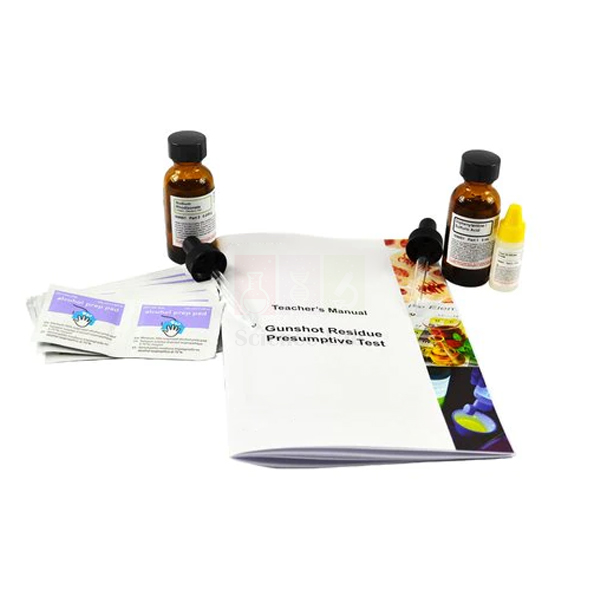
Gunshot Residue Presumptive Test Kit
Gunshot Residue Presumptive Test Kit (Product Code: SLE/CH/145) is a two-part chemical test kit used to check whether a surface may have been exposed to a discharged firearm, in forensic science and chemistry teaching labs. A rapid colour change indicates nitrates and lead, and each kit contains instructions and enough materials for 30 tests. It is supplied by Jain Scientific Equipments Pvt Ltd (ScienceLab), Ambala, India, alongside other forensic teaching materials for institutions in India and international markets.
Specifications
| Parameter | Detail |
|---|---|
| Tests per kit | Enough materials for 30 tests |
| Test format | Two-part presumptive test |
| Substances indicated | Nitrates and lead |
| Result | Rapid colour change |
| Purpose | Checking whether a surface has been exposed to a discharged firearm |
| Included | Instructions |
| Shelf life | Depends on the chemical, its grade and storage conditions; ask us for the expiry date of the batch you are quoted |
| Product code | SLE/CH/145 |
| Supplied by | Jain Scientific Equipments Pvt Ltd (ScienceLab), Ambala, India |
What Is the Gunshot Residue Presumptive Test Kit Used For?
In a teaching lab, it shows how a presumptive test works in practice. Students follow the instructions, run both parts of the test on surfaces the teacher provides, and record whether the colour change appears for nitrates, for lead, or for both. The two-part design is a useful talking point: a single positive could come from an everyday source, since nitrates are also found in fertilisers, so finding both substances gives a stronger indication than either result alone.
With 30 tests per kit, plan the lesson so each group runs a known negative, such as a clean surface, next to its test sample; this teaches students to trust a result only when the control behaves as expected. Gloves stop hands contaminating the test area, and eye protection should be worn while reagents are in use. Colleges that rely on a chemistry consumables supplier in India often order this kit with blood and drug screening activities to build a complete presumptive-testing module.
Supplier
Jain Scientific Equipments Private Limited, trading as ScienceLab from Ambala, Haryana, India, supplies this test kit as part of its forensic and chemistry teaching range. Schools, colleges and training institutes can combine it with other forensic activity kits, gloves and goggles in a single enquiry. Company background is available on our company profile.
Related Laboratory Equipment
These products sit in the same forensic screening workflow, either as further presumptive tests or as protection while testing:
- Presumptive Blood Test Kit — the same screening idea applied to blood stains
- Forensic Chemistry of Drug Detection — chemical screening for a different type of evidence
- Forensic Science Lab Investigation — a full murder-mystery investigation for the whole class
- Gloves W/o Powder Nitrile Disposable — avoids contaminating test surfaces and protects skin
- Safety Goggles — eye protection while reagents are handled
See more forensic and chemistry kits in our Chemistry Lab Equipment category.
Frequently Asked Questions
How many tests does one kit provide?
Each Gunshot Residue Presumptive Test Kit contains instructions and enough materials for 30 tests, so a class can run each sample alongside a clean-surface control and still have tests left for repeats.
What does the Gunshot Residue Presumptive Test Kit detect?
The Gunshot Residue Presumptive Test Kit indicates nitrates and lead, two substances associated with a discharged firearm, through a rapid colour change in two separate parts of the test.
Does a positive result prove a firearm was discharged?
No. The Gunshot Residue Presumptive Test Kit is a screening test, so a positive result is only an indication. Nitrates and lead can come from other sources, and firm conclusions need confirmatory laboratory analysis.
Can the kit be used for real casework?
The Gunshot Residue Presumptive Test Kit is offered as a presumptive screening test for teaching and training. Evidence in real investigations must be examined by a forensic laboratory using confirmatory methods.
Is it suitable for school students?
The Gunshot Residue Presumptive Test Kit can be used in supervised chemistry and forensic science lessons. Teachers should read the instructions and prepare a risk assessment beforehand, with gloves and eye protection for every student.
What is the shelf life of the kit?
The shelf life of the Gunshot Residue Presumptive Test Kit depends on the chemicals, their grade and storage conditions; ask us for the expiry date of the batch you are quoted before ordering stock for later terms.
Who supplies the Gunshot Residue Presumptive Test Kit?
Jain Scientific Equipments Private Limited (ScienceLab), Ambala, Haryana, India, supplies the Gunshot Residue Presumptive Test Kit to colleges, schools and training institutes in India and international markets; send product code SLE/CH/145, quantity and delivery address.
Request a Quote
To price the Gunshot Residue Presumptive Test Kit, get in touch through the contact page or add it to the enquiry cart with the other forensic kits for your course.
Last updated: 24 September 2026
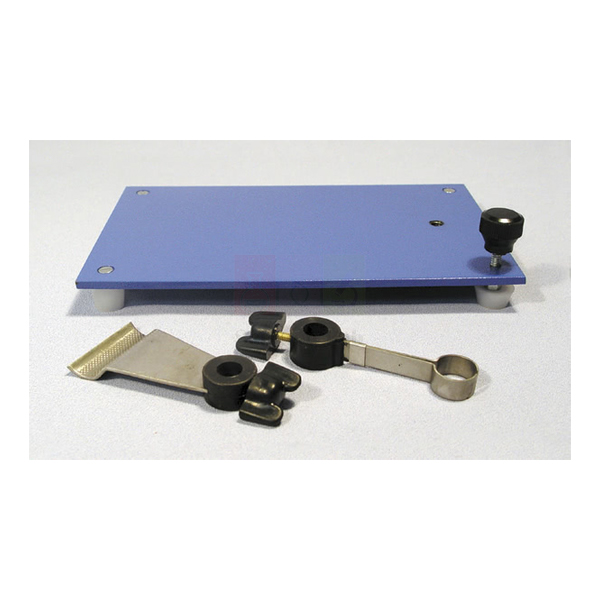
Hoffman Voltameter Stand
Hoffman Voltameter Stand (Product Code: SLE/CH/146) is a metal stand with a support clamp, made to hold a Hoffman’s voltameter securely upright during electrolysis experiments, and it is supplied with a 600 mm rod. A Hoffman’s voltameter is tall glassware, so a dedicated stand keeps it steady and vertical while students watch gas collect and read the volumes. Chemistry and physics teachers, lab assistants and demonstrators use it wherever electrolysis of water is taught, and it is a sensible companion purchase for anyone sourcing electrolysis apparatus in India. The stand is made by Jain Scientific Equipments Pvt Ltd (ScienceLab), Ambala.
Specifications
| Parameter | Detail |
|---|---|
| Construction | Metal stand |
| Rod | Supplied with 600 mm rod |
| Clamp | Support clamp for holding the voltameter |
| For use with | Hoffman’s voltameter |
Typical Use
In the classic demonstration, water made conductive with a little acid or salt is electrolysed in the Hoffman’s voltameter: hydrogen collects above one electrode and oxygen above the other, with roughly twice as much hydrogen as oxygen by volume. For those volumes to be read fairly, the side tubes must stand truly vertical and must not shift when the taps are opened or the leads are connected. The support clamp holds the voltameter in that position, and the 600 mm rod gives enough height to set the apparatus at a comfortable viewing level on the bench.
Stand the base on a level bench, fit the rod, then close the clamp gently around the voltameter — firm enough to hold it, never so tight that it stresses the glass. Route the electrical leads so they cannot catch on the stand, and wipe away any spilled electrolyte promptly to protect the metal parts. Schools in India equipping a chemistry lab for class demonstrations will find that ordering the stand with the voltameter avoids improvised clamping on general-purpose retort stands.
Manufacturer
The stand is manufactured by ScienceLab, the trading name of Jain Scientific Equipments Private Limited, which produces metal stands, clamps and teaching apparatus in Ambala, Haryana. Because it is made for use with the Hoffman’s voltameter, buyers can source the stand and the glassware from the same maker and receive them together, whether the order is for a school in India or for international markets. Visit our company profile to learn more.
Related Laboratory Equipment
An electrolysis demonstration also needs the voltameter itself, a power source and a way to watch the current; these items complete the set-up.
- Hoffman Voltameter — the glass apparatus this stand is made to hold.
- Hoffman Electrolysis Apparatus — an alternative electrolysis set listed under electricity equipment.
- Voltameter — another voltameter design for comparison or extra benches.
- Power Supply, Stepped — a bench supply for the electrodes; ask us which output suits your voltameter.
- Digital Multimeter — for monitoring the current during electrolysis.
Browse stands, clamps and more in our Chemistry Lab Equipment category.
Frequently Asked Questions
Is the voltameter included with the stand?
No. This listing covers the metal stand, support clamp and 600 mm rod. The glass voltameter is available separately as the Hoffman Voltameter.
How long is the rod?
The stand is supplied with a 600 mm rod.
Will it hold a voltameter we already own?
The clamp is made for a Hoffman’s voltameter. If yours is from another maker, send its dimensions through our contact page and we will check the fit.
What finish does the metal have?
The finish is not specified on this page. Please ask us if your lab requires a particular finish.
Can the stand be used for other apparatus?
Its clamp is intended for the voltameter. For general clamping work, a standard retort stand with universal clamps is the better choice.
Is there a warranty?
Warranty terms are stated on each quotation; ask when you enquire so they are clear for your order.
Do you supply sets for several labs or export?
Yes. Send the product code SLE/CH/146, quantity and delivery address; we supply institutions in India and international markets.
Request a Quote
To price the Hoffman Voltameter Stand, with or without the voltameter, write to us through the contact page or add both items to the enquiry cart.
Last updated: 24 September 2026
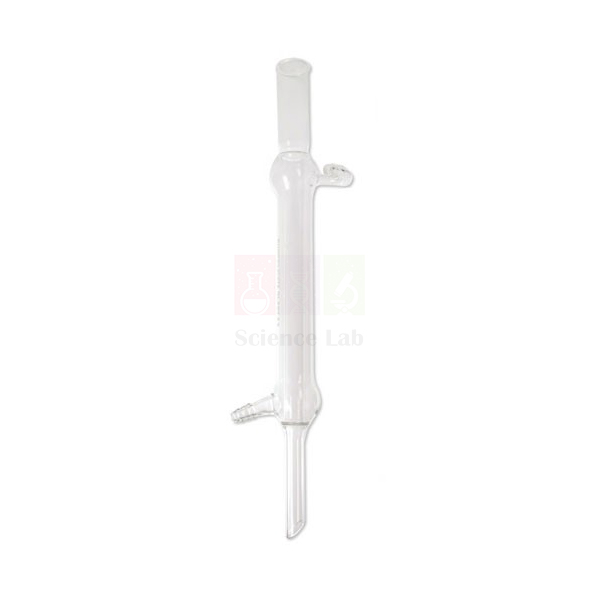
Liebig Condenser
Liebig Condenser (Product Code: SLE/CH/148) is a straight, water-cooled condenser in borosilicate glass, with the inner tube integral with the body and a 200 mm jacket length. Its narrow jacket keeps the cooling water flowing close to the inner tube for efficient cooling, so hot vapour passing through is turned back into liquid quickly during distillation or reflux. School chemistry labs, college practical rooms and teaching laboratories use it as a standard part of their glassware, and it is a common requirement for buyers looking for a Liebig condenser in India. It is made by Jain Scientific Equipments Pvt Ltd (ScienceLab), Ambala.
Specifications
| Parameter | Detail |
|---|---|
| Material | Borosilicate glass |
| Construction | Inner tube integral with body |
| Jacket length | 200 mm |
| Jacket design | Narrow jacket for efficient cooling |
Typical Use
In a simple distillation the condenser is clamped at a downward slope between the still head and the receiver, so condensed liquid runs out of the lower end into the collecting flask. Cooling water goes in at the lower connection and out at the upper one, which keeps the jacket completely full and gives the best cooling along the full 200 mm length. Because the inner tube is integral with the body, there is no separate seal between tube and jacket that could loosen or leak with repeated heating.
Clamped vertically above a boiling flask, the same unit works as a reflux condenser in the lab, returning condensed solvent to the reaction so it can be heated for longer without boiling dry. Start the water flow before switching on the heat, keep the flow steady rather than fierce, and hold the condenser with a clamp around the middle of the jacket. Let the glass cool before draining and dismantling, and never run cold water through a condenser that has been heated while dry.
Manufacturer
ScienceLab is the name under which Jain Scientific Equipments Private Limited, an Ambala, Haryana manufacturer of laboratory glassware and teaching apparatus, is known to customers. A Liebig condenser is also part of the company’s Fractional Distillation Assembly, so labs using that set can order a spare from the same source after checking the joint size with us. Institutions in India and international markets can find more on our company profile.
Related Laboratory Equipment
A condenser is one part of a distillation or reflux set-up; these items make up the rest of that workflow.
- Fractional Distillation Assembly — a complete set with a Vigreux column for separating close-boiling liquids.
- Distillation Apparatus — a ready-made simple distillation set.
- Round Bottom Flask — the boiling flask for distillation or reflux.
- Rubber Tubing — water connections to the condenser jacket.
- Universal Clamp — holds the condenser securely at the right angle.
Find more glassware and supports in our Chemistry Lab Equipment category.
Frequently Asked Questions
What is the jacket length?
The jacket is 200 mm long.
What joints or end fittings does it have?
End fittings are not specified on this page. Tell us the joint size of your flask and still head through our contact page and we will confirm a match.
Can it be used for reflux as well as distillation?
Yes. Clamp it at a downward slope for distillation, or vertically above the flask for reflux.
Why is a narrow jacket better?
It keeps the cooling water close to the inner tube, which gives efficient cooling without needing a large volume of water in the jacket.
How should it be cleaned?
Rinse the inner tube with a suitable solvent or water after use and let it drain. Avoid sudden temperature changes, such as cold water on hot glass.
Can you replace condensers across a whole lab?
Yes. Send the product code SLE/CH/148, the quantity and your delivery address; we supply institutions in India and international markets.
Request a Quote
For a quotation on the Liebig Condenser, contact us via the contact page or add it to the enquiry cart together with flasks, clamps and tubing.
Last updated: 24 September 2026
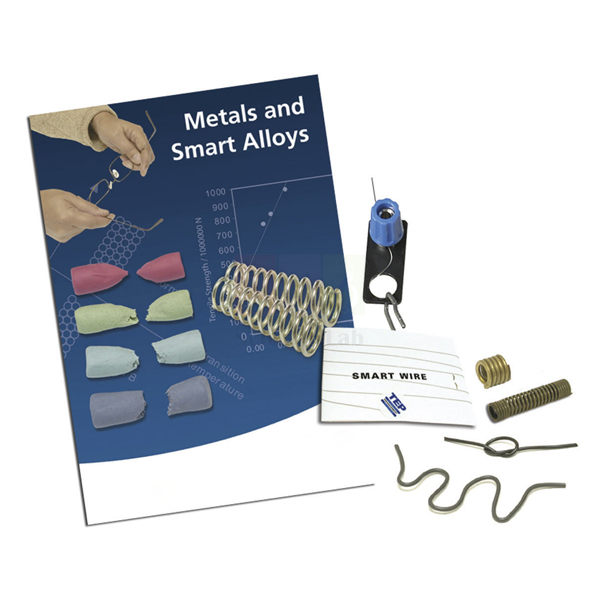
Metals and Smart Alloys Starter Pack
Metals and Smart Alloys Starter Pack (Product Code: SLE/CH/149) brings together a variety of smart alloys — a two-way memory spring, a smart spring, smart wire, memory wire and superelastic wire — with wire holders for securing the materials during experiments. It gives students hands-on contact with metals that recover a remembered shape when warmed or spring back from bending that would permanently deform an ordinary wire, topics that many GCSE courses refer to under smart alloys and shape memory alloys. The practical activities are described in the accompanying booklet ‘Metals and smart alloys’. It makes a compact STEM science kit for India’s secondary classrooms and is supplied by Jain Scientific Equipments Pvt Ltd (ScienceLab), Ambala.
Specifications
| Parameter | Detail |
|---|---|
| Smart alloy items | Two-way memory spring, smart spring, smart wire, memory wire, superelastic wire |
| Accessories | Wire holders for securing the materials |
| Activity guide | Accompanying booklet ‘Metals and smart alloys’ |
| Curriculum link | Smart alloys and shape memory alloys, referred to in many GCSE courses |
Typical Use
A typical first demonstration is the shape memory effect: bend a length of memory wire into a new shape at room temperature, then lower it into warm water and watch it return to its original form. The two-way memory spring goes a step further, changing shape as it is warmed and changing back as it cools, which shows students that the alloy “remembers” two states. The superelastic wire makes a striking contrast — it can be bent sharply and springs straight again without any heating at all. The wire holders keep each sample in place so students can observe and compare them safely.
Placing an ordinary metal wire alongside the smart alloys helps students see the difference between permanent deformation and shape recovery, and leads naturally into discussion of real applications such as spectacle frames, dental braces and small actuators. Use warm water rather than a naked flame to trigger shape changes, and handle hot beakers with tongs. The pack is also a strong starting point for a science fair project kit in India, where students can investigate the temperatures at which each item changes shape.
Supplier
ScienceLab — the trading name of Jain Scientific Equipments Private Limited, based in Ambala, Haryana — supplies this starter pack as part of its chemistry and materials-science teaching range. The company can quote the pack together with the beakers, thermometers and tongs used in the activities, for schools and colleges in India and international markets. Our company profile has more about the business.
Related Laboratory Equipment
Smart alloy lessons rely on warm water, temperature readings and safe handling; these items support that work or extend the materials topic.
- Fabrics Sample Pack — another materials sample set for properties lessons.
- Physical Properties of Glass — a companion activity on how materials behave.
- Glass Beaker — for the warm-water baths that trigger shape recovery.
- Digital Thermometer — records the water temperature at which each item changes.
- Beaker Tongs — safe handling of hot beakers during demonstrations.
More teaching kits are in our Chemistry Lab Equipment category.
Frequently Asked Questions
What is included in the pack?
A two-way memory spring, smart spring, smart wire, memory wire, superelastic wire, wire holders and the booklet ‘Metals and smart alloys’.
Does it come with activity instructions?
Yes. The practical activities are described in the accompanying booklet.
How is the shape memory effect triggered?
Usually by warming, for example in warm water. Follow the booklet for each item, since the springs and wires respond differently.
Can the alloys be used again and again?
Smart alloys can generally be cycled repeatedly if handled with care. Avoid heating them in a flame or kinking them sharply, and store them as the booklet advises.
What lengths or quantities of wire are supplied?
These are not stated on this page. Please ask through our contact page if you need exact quantities for planning.
Is it only for GCSE courses?
Many GCSE courses refer to smart alloys, but the pack suits any secondary syllabus that covers the properties and uses of metals and materials.
Can you supply several packs or ship abroad?
Yes. Send the product code SLE/CH/149, quantity and delivery address; we supply India and international markets.
Request a Quote
To price the Metals and Smart Alloys Starter Pack, reach us through the contact page or add it to the enquiry cart with any beakers or thermometers you need.
Last updated: 24 September 2026
Microburner
Microburner (Product Code: SLE/CH/150) is a pack of 20 spare micro burners for the MicroScience system, used to replace burners that go missing, wear out or get damaged in student microscale kits. In microscale chemistry each student or pair heats only tiny quantities of chemicals, so a small burner gives all the heat the practical needs while keeping flames and chemical use to a minimum. Keeping a pack of spares on the shelf means every kit is complete at the start of a lesson, which matters when a whole class is working at once. The pack is supplied by Jain Scientific Equipments Pvt Ltd (ScienceLab), Ambala, as part of its range of chemistry consumables for schools in India and abroad.
Specifications
| Parameter | Detail |
|---|---|
| Pack size | Pack of 20 |
| Type | Spare micro burners |
| For use with | MicroScience system |
Typical Use
Microscale kits are popular because they work as a portable science kit for students: each set is compact and easy to carry between rooms, but small parts such as burners are easy to mislay or wear out. A good routine is to check every kit at the end of term, replace any missing or damaged burner from the spare pack, and note how many spares remain so the next order can be placed in good time. Buying spares as a pack of 20 saves reordering individual pieces.
In use, stand the burner on a stable, heat-resistant surface, keep hair, sleeves and paper well away, and follow the MicroScience instructions for fuelling, lighting and putting out the flame. Never refuel a burner while it is lit or still hot, and let each one cool before returning it to its kit. Store spares with the kits they serve so that a replacement is always to hand at the bench.
Supplier
Spare parts like these are supplied by ScienceLab, the trading name of Jain Scientific Equipments Private Limited in Ambala, Haryana, which also lists student microscience kits and comboplates in its chemistry range. Institutional buyers who need vendor details for purchase orders can use GSTIN 06AAECJ8618A1ZT and LEI 3358004HRD1JIVXKYX49. The company serves schools and colleges in India and international markets; see our company profile.
Related Chemistry Lab Equipment
These microscience items are used in the same microscale practicals as the burners.
- Basic Microscience Kit, Student — a student kit for introductory microscale practicals.
- Advanced Microscience Kit, Student — the extended student kit for further practicals.
- Comboplate, Microscience — the multi-well plate used for many microscale reactions.
- Microscience Work Station, Biology, Physics and Chemistry — a larger station covering three sciences.
- Titration Kit, Student, Microscience — microscale titration for the same classes.
See all microscale and general items in our Chemistry Lab Equipment category.
Frequently Asked Questions
How many burners are in a pack?
Each pack contains 20 spare micro burners.
Which kits do they fit?
They are spares for the MicroScience system. If you use a different microscale kit, send a photo or description through our contact page and we will check compatibility.
What fuel do the burners use?
Fuel details are not given on this page. Follow the instructions supplied with your MicroScience kit, or ask us before ordering.
Can I buy fewer than 20?
The item is listed as a pack of 20. For other quantities, please ask and we will advise what is possible.
How should the burners be used safely?
On a stable, heat-resistant surface under supervision, never refuelled while lit or hot, and allowed to cool before storage.
What details does a school purchase order need?
The product code SLE/CH/150, number of packs, delivery address and any vendor form; the registration details above can be copied onto it. We supply India and international markets.
Request a Quote
To order Microburner spare packs, send your quantity through the contact page or add them to the enquiry cart together with any microscience kits you need.
Last updated: 24 September 2026
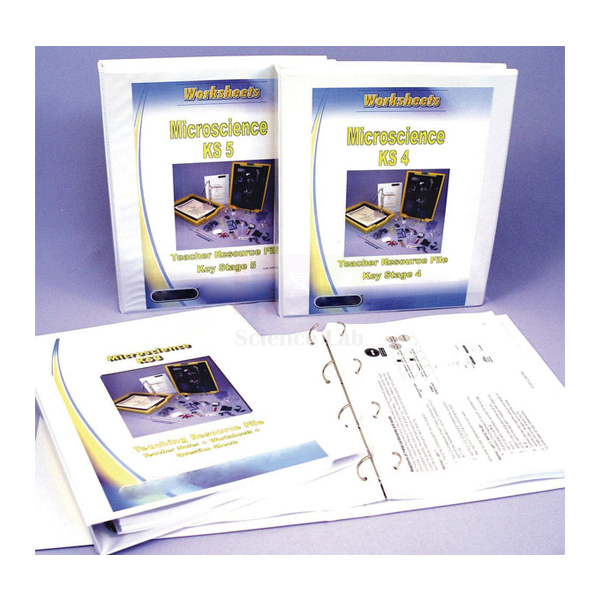
MicroChem Worksheets, Key Stage 3, in binder
MicroChem Worksheets, Key Stage 3, in binder (Product Code: SLE/CH/151) is a series of worksheets that helps teachers deliver chemistry and biology practicals at Key Stage 3, the stage where many students first learn to follow a method and record results on their own. The resources cover a wide range of practical experiments using the Microscience System, and every worksheet sets out the equipment and chemicals required, the relevant AQA, Edexcel, OCR and QCA specification points, a risk assessment and detailed instructions. Photocopying is unrestricted for recipient schools. The binder suits schools that use microscale kits as core chemistry lab equipment for lower-secondary classes, in India or elsewhere, and it is supplied by Jain Scientific Equipments Pvt Ltd (ScienceLab), Ambala.
Key Details
| Parameter | Detail |
|---|---|
| Format | Worksheet series supplied in a binder |
| Level | Key Stage 3 |
| Subjects | Chemistry and biology |
| Practical system | Microscience System (microscale equipment) |
| On every worksheet | Equipment and chemicals list; relevant AQA, Edexcel, OCR and QCA specifications; risk assessment; detailed instructions |
| Care notes | Notes on use and care of Microscale equipment in each file |
| Copying | Photocopying unrestricted for recipient schools |
Typical Use
A teacher chooses a practical from the binder, photocopies the sheet for each pair, and passes the equipment and chemicals list to the lab technician so trays can be prepared before the lesson. Students then work from the detailed instructions, which builds the habit of reading a whole method before touching any apparatus. With younger classes it helps to go through the risk assessment on the sheet together at the start, so safe practice is modelled rather than just assumed.
The notes on use and care of Microscale equipment are worth sharing with students early in the year: learning to handle small-scale apparatus carefully keeps the kits complete and working for longer. Because the binder covers biology as well as chemistry, a department can plan one set of microscience kits to support practicals in both subjects — a practical consideration when planning biology lab equipment for school practicals in India on a limited budget.
Supplier
The binder is supplied by ScienceLab, the trading name of Jain Scientific Equipments Private Limited, whose business is based in Ambala, Haryana. Besides printed teaching resources such as this one, the company lists microscience kits, comboplates and spare burners, so a school can put the worksheets and the apparatus they call for on one enquiry. It serves schools in India and international markets; more is on our company profile.
Related Laboratory Equipment
These items are used alongside Key Stage 3 microscale practicals or help students progress to the next stage.
- Basic Microscience Kit, Student — a student kit for running introductory microscale practicals.
- Comboplate, Microscience — the multi-well plate used in many microscale reactions.
- Microburner — spare burners for the MicroScience system.
- Molecular Model Set – Key Stage 3 Chemistry — modelling work for the same key stage.
- MicroChem Worksheets, Key Stage 4, in binder — the next binder as students move up.
See more in our Chemistry Lab Equipment category.
Frequently Asked Questions
Which subjects and level does the binder cover?
Chemistry and biology practicals at Key Stage 3.
May we photocopy the worksheets?
Yes. Photocopying is unrestricted for recipient schools, so you can make copies for every class.
What equipment do the practicals need?
They are written for the Microscience System, and each worksheet lists the equipment and chemicals required. Send us the practicals you plan to run through our contact page and we will help match kits.
Is safety information included?
Yes, each worksheet includes a risk assessment. Review it against your own school’s safety policy before use.
How many worksheets are in the binder?
The number of worksheets is not stated on this page. Ask us for the contents list before ordering.
Can you supply several binders or ship overseas?
Yes. Include the product code SLE/CH/151, quantity and delivery address; we supply India and international markets.
Request a Quote
To order the Key Stage 3 MicroChem Worksheets binder, contact us via the contact page or add it to the enquiry cart with the microscience kits your practicals require.
Last updated: 24 September 2026
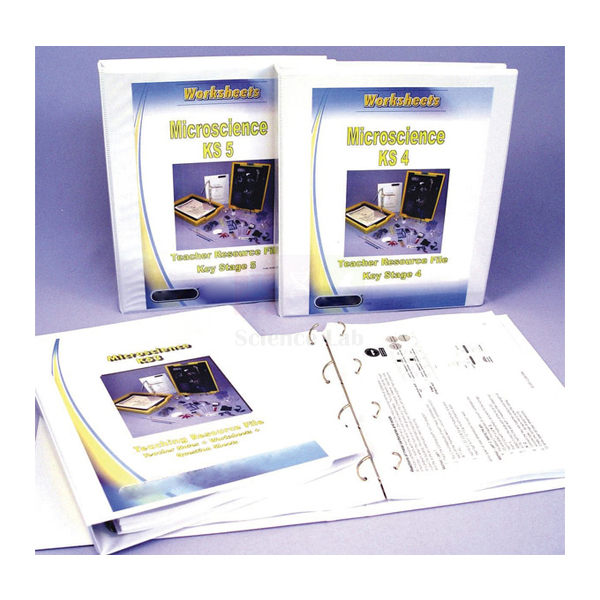
MicroChem Worksheets, Key Stage 4, in binder
MicroChem Worksheets, Key Stage 4, in binder (Product Code: SLE/CH/152) is a series of worksheets for teaching chemistry and biology at Key Stage 4, when practical work feeds directly into examination courses. The resources cover a wide range of practical experiments using the Microscience System, and each worksheet notes the relevant specifications covered for AQA, Edexcel, OCR and QCA alongside the equipment and chemicals required, a risk assessment and detailed instructions. Each file also contains notes on the use and care of Microscale equipment, and photocopying is unrestricted for recipient schools. For departments building educational laboratory equipment in India or overseas around microscale methods, the binder gives exam-stage classes a ready structure, and it is supplied by Jain Scientific Equipments Pvt Ltd (ScienceLab), Ambala.
Key Details
| Parameter | Detail |
|---|---|
| Stage | Key Stage 4 |
| Subjects covered | Chemistry and biology |
| Specification references | Relevant specifications covered for AQA, Edexcel, OCR and QCA, noted on each worksheet |
| Also on each worksheet | Equipment and chemicals list, risk assessment, detailed instructions |
| Apparatus | Practical experiments using the Microscience System |
| Equipment care | Each file contains notes on use and care of Microscale equipment |
| Copying rights | Photocopying unrestricted for recipient schools |
| Presentation | Supplied in a binder |
Typical Use
At Key Stage 4 the specification references are often the first thing a head of department looks at. Because each sheet names the relevant AQA, Edexcel, OCR and QCA specifications, practicals can be slotted into a scheme of work where they support the content students will be examined on, and gaps in practical coverage become easier to spot. The risk assessment on each sheet gives the department a consistent safety record for every practical, which is useful when several teachers share the same scheme.
Running exam-course practicals at microscale means each group uses only small amounts of chemicals, so a class can repeat an experiment to check its results without large costs or much waste. Teachers commonly copy a fresh sheet for every student to annotate and keep with their notes as revision material. The care notes in the file help students treat the microscale apparatus properly, so kits stay in good order through a busy exam year.
Supplier
Jain Scientific Equipments Private Limited, trading as ScienceLab from Ambala, Haryana, supplies this worksheet binder together with a range of microscience apparatus, so exam-stage practicals and the kit they depend on can be sourced in one place. Orders are handled for schools and colleges in India and international markets. For background on the company, see our company profile.
Related Laboratory Equipment
These products support Key Stage 4 practical work or connect to the binders either side of it.
- Advanced Microscience Kit, Student — the extended student kit for more demanding microscale practicals.
- Titration Kit, Student, Microscience — microscale titration, a staple of exam-course chemistry.
- Prepared Microscope Slide Set – Key Stage 4 Biology — slides for the biology side of the same stage.
- MicroChem Worksheets, Key Stage 3, in binder — the preceding binder for lower-secondary classes.
- MicroChem Worksheets, Key Stage 5, in binder — the follow-on binder for post-16 students.
Browse further items in our Chemistry Lab Equipment category.
Frequently Asked Questions
How does this binder differ from the Key Stage 3 and Key Stage 5 binders?
All three share the same worksheet format; this one is written for Key Stage 4 chemistry and biology. Choose the binder that matches the stage you teach.
Which exam boards are referenced?
Each worksheet notes the relevant specifications covered for AQA, Edexcel, OCR and QCA. Check the references against the specification version your students are following, as syllabuses are revised from time to time.
Can every student have a copy?
Yes. Photocopying is unrestricted for recipient schools.
Can the practicals be run without the Microscience System?
The worksheets are written for the Microscience System. Adapting a practical to conventional apparatus is at the teacher’s discretion, and the risk assessment would then need reviewing.
Is a contents list available before we buy?
The list of practicals is not given on this page. Ask through our contact page and we will share what we can.
What should our quotation request include?
The product code SLE/CH/152, the number of binders, any microscience kits you want quoted alongside, and the delivery address in India or abroad.
Request a Quote
For pricing on the Key Stage 4 MicroChem Worksheets binder, write to us through the contact page or add it to the enquiry cart along with the kits for your exam-course practicals.
Last updated: 24 September 2026
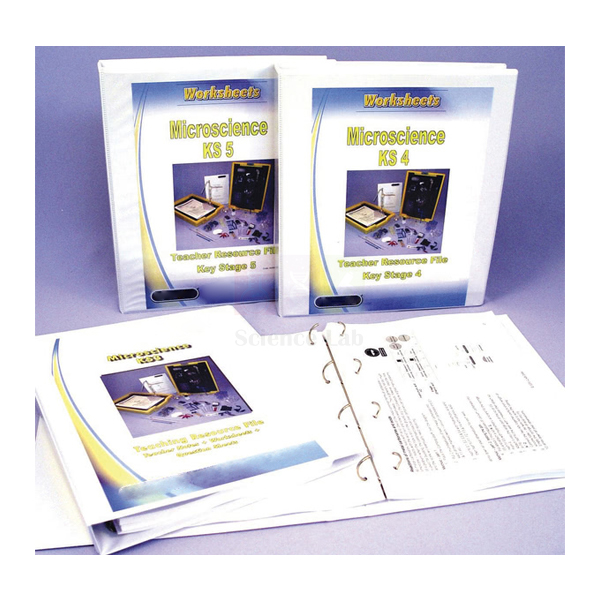
MicroChem Worksheets, Key Stage 5, in binder
MicroChem Worksheets, Key Stage 5, in binder (Product Code: SLE/CH/153) collects practical worksheets for teaching chemistry and biology at Key Stage 5, the post-16 stage where students are expected to work with growing independence at the bench. The resources cover a wide range of practical experiments using the Microscience System. Each worksheet gives a list of the equipment and chemicals required, a risk assessment, detailed instructions and the relevant specifications covered for AQA, Edexcel, OCR and QCA, while each file adds notes on the use and care of Microscale equipment. Photocopying is unrestricted for recipient schools, so every student can keep a personal copy. The binder is supplied by Jain Scientific Equipments Pvt Ltd (ScienceLab), Ambala, for schools and colleges in India and international markets.
Key Details
| Parameter | Detail |
|---|---|
| Resource type | Series of practical worksheets in a binder |
| Key stage | Key Stage 5 |
| Disciplines | Chemistry and biology |
| Built around | The Microscience System |
| Worksheet contents | Equipment and chemicals required; risk assessment; detailed instructions; relevant AQA, Edexcel, OCR and QCA specifications |
| In each file | Notes on use and care of Microscale equipment |
| Reproduction | Unrestricted photocopying for recipient schools |
Typical Use
Post-16 students are often asked to prepare for a practical before they arrive: reading the method, checking the equipment list and noting the hazards from the risk assessment. The worksheets in this binder support exactly that routine, and because copying is unrestricted, each student can file the sheets in a lab book or practical folder as a running record of the techniques they have carried out. Teachers can then use lesson time for the experiment itself and for discussing results.
Working at microscale is particularly useful at this level, where reagents can be costly or hazardous: small quantities cut expense and waste and make it realistic for students to repeat a practical when a result looks doubtful. Lab technicians benefit too, since the equipment and chemicals list on each sheet makes preparation predictable. Schools preparing a school science lab tender in India can list the binder alongside the microscience kits it is written for, so the resources and apparatus arrive together.
Supplier
ScienceLab is the trading name used by Jain Scientific Equipments Private Limited, which operates from Ambala, Haryana, and supplies this binder as part of its microscale teaching resources for advanced classes. Colleges and schools can request it with the related microscience apparatus for delivery within India or to international markets. Further details are on our company profile.
Related Laboratory Equipment
Advanced microscale practicals draw on the apparatus below, and the Key Stage 4 binder covers the stage before.
- Microscience Work Station, Biology, Physics and Chemistry — a larger station for departments running several sciences at microscale.
- Advanced Microscience Kit, Student — student apparatus for the more involved practicals.
- Water Monitoring Kit, Microscience — microscale water testing for extended investigations.
- Microburner — spare burners to keep MicroScience kits complete.
- MicroChem Worksheets, Key Stage 4, in binder — the preceding binder for exam-course classes.
Explore the wider range in our Chemistry Lab Equipment category.
Frequently Asked Questions
Who is this binder intended for?
Teachers of chemistry and biology at Key Stage 5, the post-16 stage, who run practicals with the Microscience System.
Can students keep their own copies?
Yes. Photocopying is unrestricted for recipient schools, so each student can have a personal set.
What does each worksheet contain?
A list of equipment and chemicals required, a risk assessment, detailed instructions and the relevant specifications covered for AQA, Edexcel, OCR and QCA.
Is a digital version available?
The product is listed as a binder. If you need another format, please ask through our contact page.
How many practicals are included?
The number is not stated on this page. We can share the contents list on request.
Can the binder be included in a tender or bulk order?
Yes. Quote the product code SLE/CH/153, the number of binders and any related kits; we supply India and international markets.
Request a Quote
To request the Key Stage 5 MicroChem Worksheets binder, use our contact page or add it to the enquiry cart together with the microscience apparatus for your advanced classes.
Last updated: 24 September 2026
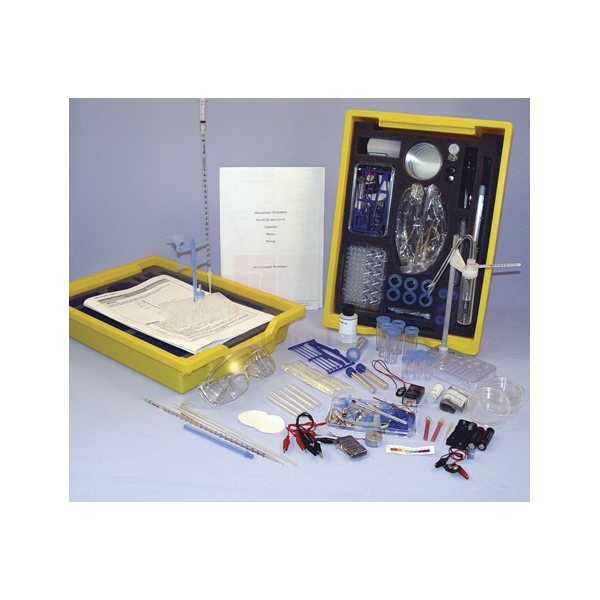
Microscience Work Station, Biology, Physics and Chemistry
Microscience Work Station, Biology, Physics and Chemistry (Product Code: SLE/CH/154) is a Microscience workstation that brings biology, chemistry and physics practicals together in one kit and encompasses a large proportion of the Year 10 (Key Stages 3 & 4) practical curriculum. It is designed for individual use or for small groups, which lets a science department give every student hands-on practical time instead of watching a single teacher demonstration. Manufactured by Jain Scientific Equipments Pvt Ltd (ScienceLab), Ambala, India, it is a practical STEM science kit in India for secondary-school laboratories that need one system across three subjects.
Specifications
| Parameter | Detail |
|---|---|
| Type | Microscience kit / work station |
| Subjects covered | Biology, Chemistry and Physics |
| Curriculum coverage | A large proportion of the Year 10 (Key Stages 3 & 4) practical curriculum |
| Mode of use | Individual use or small groups |
| Worksheets | Curriculum-based worksheets written for students; can be linked to AQA, IB, OCR, Edexcel, WJEC, SEB, IEB and CIE schemes |
| Workbooks and guides | Available to complement the work station; must be ordered separately |
Topics that may be covered with this work station include:
- Materials and their properties – separating mixtures
- Acids and bases
- Materials and their properties – useful products from oil
- Materials and their properties – rates of reaction
- Materials and their properties – the periodic table
- Materials and their properties – useful products from air
- Materials and their properties – energy transfer in reactions
- Materials and their properties – useful products from ores and rocks
- Patterns of behaviour – metal
- Chemical equilibrium
- Organic chemistry
- Miscellaneous experiments – many more can be performed
Typical Use
A typical lesson starts with the teacher issuing one work station per student or per small group, together with the worksheet for the day’s topic – for example separating a mixture, comparing rates of reaction or following an acid–base change. Students work through the steps on the sheet, record their observations and answer the questions, while the teacher moves between groups. Because the same kit serves several topics, a department can run a sequence of practicals across the term without setting up different apparatus for each one.
Schools that follow the Indian system and look for a science lab kit for class 10 can map the listed topics against their own syllabus before ordering. Plan the worksheet and guide order alongside the kits, since workbooks and guides are supplied separately. After each session, have students rinse and dry the items they used and return them to their places in the work station so the next class finds a complete set.
Manufacturer
This work station is made by Jain Scientific Equipments Private Limited, the Ambala, Haryana company that trades under the ScienceLab name and builds practical kits for school science departments. The company is incorporated under CIN U29309HR2020PTC087597 and manufactures at its licensed factory at 449, HSIIDC Industrial Area, Saha, Ambala (Factory Licence AMB-ONLINE-CHD-J-414). Read more in our company profile.
Related Chemistry Lab Equipment
Other Microscience items that extend the same practical programme:
- Comboplate, Microscience — a reaction plate for small-volume chemistry work in the same Microscience approach
- Advanced Microscience Kit, Student — an individual student kit for schools that want a chemistry-focused set
- Titration Kit, Student, Microscience — supports the acids and bases topic with titration practice
- Electricity Kit Microscience — adds physics circuit work to the programme
- Water Monitoring Kit, Microscience — environmental water testing in the same format
See the full range in Chemistry Lab Equipment.
Frequently Asked Questions
Does one work station cover biology, chemistry and physics?
Yes. The work station covers all three subjects; the topic list above gives examples, and many more experiments can be performed with it. For a complete experiment list, please contact us.
Are the workbooks and teacher guides included?
No. Workbooks and guides are available but must be ordered separately, so list them as separate lines in your enquiry if you need them.
Which examination schemes do the worksheets link to?
The worksheets are written for students, suited to the curriculum, and can be linked to AQA, IB, OCR, Edexcel, WJEC, SEB, IEB and CIE schemes. Teachers following other boards can map the topics to their own syllabus.
Can a student work with it alone?
Yes. It is designed for individual use as well as for small groups, so you can decide the ratio of kits to students.
Can I get an itemised component list before ordering?
The component-by-component list is not published on this page. Ask for it through our contact page and we will share the current packing details with your quotation.
What should an institutional quotation request include?
State the number of work stations, whether they are for individual or group use, the workbooks and guides required, and the delivery address. This lets us quote the full set in one go.
Do you supply schools outside India?
Yes. ScienceLab supplies schools and colleges in India and international markets; share your destination and quantity so we can confirm packing and shipping.
Request a Quote
To price this work station for your school, send your requirement through our contact page or add it to the enquiry cart together with any other kits you need.
Last updated: 24 September 2026

Mini Science Kit – Changing Sounds
Mini Science Kit – Changing Sounds (Product Code: SLE/CH/155) is a topic kit for investigating how sounds are made, how they travel and how they can be changed. Its activities lead pupils from making their first sounds to measuring vibrations, exploring pitch and finding out which material muffles sound most effectively. Made by Jain Scientific Equipments Pvt Ltd (ScienceLab), Ambala, India, it is a focused science kit for students that turns the sound topic into a series of short, practical investigations.
Key Details
| Parameter | Detail |
|---|---|
| Type | Mini science kit (topic kit) |
| Topic | Sound – making, transmitting and changing sounds |
| Activities | Seven activities, listed below |
| Concepts covered | Vibration, sound travelling through materials, pitch, sound insulation (muffling) |
| Suitable for | Classroom or small-group investigations on sound |
Activities performed with this kit:
- Making sounds
- Watching sound travel
- Which material can sound travel through?
- What is pitch?
- Measuring vibrations
- Investigating pitch
- Which material is most effective for muffling sound?
Typical Use
The activities follow a natural teaching order. Pupils begin by producing sounds and noticing that something always vibrates when a sound is made. They then watch sound travel and test whether it passes through different materials, before turning to pitch – first asking what pitch is, then investigating how changing a vibrating object changes the note. The measuring-vibrations activity links what pupils hear to what they can observe, which helps younger learners connect the idea of a vibration with the sound itself.
The muffling investigation makes a good end-of-topic fair test: keep the sound source, distance and listener the same and change only the material around the source. Run it in the quietest part of the room and let each group record its results in a simple table. Used this way, the kit works as an introductory sound wave experiment kit that builds prediction, observation and fair-testing skills alongside the science of sound.
Manufacturer
Jain Scientific Equipments Private Limited produces the Changing Sounds kit in Ambala, Haryana, where it operates under the trading name ScienceLab and makes topic kits and apparatus for school science. Background on the company is in our company profile.
Related Laboratory Equipment
Apparatus that extends the sound investigations:
- Tuning Fork Set, Aluminium — forks of different notes for comparing pitch in the investigating-pitch activity
- Tuning Fork on Resonance Box — shows how a hollow box makes a vibration louder
- Metal Slinky, Helical Spring — lets pupils see a vibration pass along as a wave
- Mini Science Kit – Characteristics of Materials — companion kit on material properties, useful before the muffling test
More kits are listed in Chemistry Lab Equipment.
Frequently Asked Questions
Which sound topics does this kit cover?
Making sounds, sound travelling through materials, pitch, measuring vibrations and muffling – seven activities in all, as listed above.
Are tuning forks included?
The component list is not published on this page, so please check the contents with us through the contact page. Tuning fork sets are also available as separate items if you want more sound sources.
How many pupils can share one kit?
That depends on how you group your class. Tell us your class size and how many groups you run, and we will suggest a quantity when we quote.
Is it part of a wider series?
Yes. The Mini Science Kit series also covers topics such as light and shadows, electricity, magnets and springs, and heat, so a school can build a set of topic kits for the year.
How should the kit be looked after?
Check the contents against the packing list after each lesson, wipe items clean and dry, and store the kit closed so small parts stay together for the next class.
Can you supply multiple kits for several schools?
Yes. We handle bulk orders for schools in India and international markets – send quantities and delivery locations for a consolidated quotation.
Request a Quote
For pricing and availability, write to us via the contact page or add this kit to the enquiry cart.
Last updated: 24 September 2026

Mini Science Kit – Characteristics of Materials
Mini Science Kit – Characteristics of Materials (Product Code: SLE/CH/156) helps pupils discover why everyday things are made from the materials they are. Through its activities children examine what their clothes are made of, test how high a ball bounces, compare hard-wearing materials and the strongest fabric, measure how absorbent different papers are and learn which materials are flammable. Produced by Jain Scientific Equipments Pvt Ltd (ScienceLab), Ambala, India, it is a hands-on science kit for primary school and middle-school lessons on materials and their properties.
Key Details
| Parameter | Detail |
|---|---|
| Type | Mini science kit (topic kit) |
| Topic | Characteristics of materials |
| Properties explored | Composition of clothing, bounce, wear resistance, fabric strength, absorbency, flammability |
| Activities | Seven activities, listed below |
| Purpose | Comparing materials through simple, repeatable tests |
Activities performed with this kit:
- What are our clothes made of?
- What affects how high a ball bounces?
- Characteristics
- Hard wearing materials
- Strongest fabric
- Absorbency of different papers
- Flammable materials
Typical Use
Each activity asks pupils to compare several materials under the same conditions, so the kit is a natural way to teach fair testing. Children might sort clothing samples by what they are made of, drop a ball from a fixed height onto different surfaces and record the rebound, rub materials to see which wear first, load strips of fabric to find the strongest, and time how quickly different papers soak up water. Recording results in a table and ranking the materials helps pupils link each property to a real use – why a raincoat, a towel or a pair of jeans is made the way it is.
The flammable-materials activity should be carried out by the teacher as a demonstration, with a heat-proof surface, water nearby and pupils at a safe distance. For the other tests, use the same sample size each time and repeat measurements to spot odd results. As a compact science experiment kit, it slots into a materials unit over several lessons without needing a full laboratory.
Manufacturer
The kit comes from Jain Scientific Equipments Private Limited, a science equipment maker in Ambala, Haryana, known to schools by its trading name ScienceLab. Our company profile describes what we make and how we work with institutions.
Related Laboratory Equipment
Items that make the materials tests more precise:
- Magnifying Glass — for looking closely at the weave and fibres of clothing fabrics
- Meter Stick, White — a fixed scale for reading ball-bounce heights
- Force Meter/Spring Balance — puts a number on the pull a fabric strip withstands
- Filter Paper — an extra paper type for the absorbency comparison
- Mini Science Kit – Solids and Liquids — continues the materials theme with states of matter
Browse other kits in Chemistry Lab Equipment.
Frequently Asked Questions
What can pupils investigate with this kit?
Clothing materials, what affects ball bounce, general characteristics of materials, hard-wearing materials, the strongest fabric, absorbency of papers and flammable materials.
Is the flammable-materials activity safe for a class?
It should be run as a teacher demonstration under your school’s safety rules, not as a pupil activity. Keep a heat-proof mat and water at hand.
Are fabric and paper samples part of the kit?
The detailed contents are not listed here. Please ask us through the contact page for the current packing list before you order.
How do we make the bounce test fair?
Drop the same ball from the same height each time, change only the surface, and read the rebound against a fixed vertical scale. Repeat each drop and take the typical value.
What should we include in a quotation request?
Give the number of kits, your school name and delivery address, and any extra items such as magnifiers or metre sticks you want packed with them.
Can you deliver to schools abroad?
Yes. We supply institutions in India and international markets; let us know the destination so we can confirm shipping.
Request a Quote
Ask for a price through our contact page, or place the kit in the enquiry cart with the rest of your list.
Last updated: 24 September 2026

Mini Science Kit – Dissolving and Changes
Mini Science Kit – Dissolving and Changes (Product Code: SLE/CH/157) is a topic kit about what happens when materials are mixed, dissolved, heated or separated again. Pupils investigate what makes a solid dissolve more quickly, how temperature affects dissolving, which changes occur on mixing, how evaporation works and how dirty water can be cleaned. Made by Jain Scientific Equipments Pvt Ltd (ScienceLab), Ambala, India, it serves as an introductory solubility experiment kit for school science lessons on reversible and irreversible changes.
Key Details
| Parameter | Detail |
|---|---|
| Type | Mini science kit (topic kit) |
| Topic | Dissolving, mixing and changing materials |
| Processes studied | Dissolving rate, effect of temperature, mixing, evaporation, cleaning water |
| Activities | Seven activities, listed below |
| Suitable for | Group investigations on changes of materials |
Activities performed with this kit:
- What makes a solid dissolve more quickly?
- What changes occur when materials are mixed?
- Changing materials
- Cleaning water
- Evaporation
- Temperature and the effects on dissolving
- Mixing materials
Typical Use
A common starting point is the dissolving-speed challenge: groups predict whether stirring, crushing the solid or warming the water will make it disappear faster, then change one factor at a time and time the result. The temperature activity builds on this by comparing the same solid in cooler and warmer water. Pupils then mix different materials, sort the changes they see into those that can be reversed and those that cannot, and leave a solution to evaporate so they can recover the dissolved solid.
The cleaning-water activity shows how settling and filtering remove visible particles – a simple taste of what a full water purification science kit explores in more depth. Remind pupils that filtered classroom water is still not safe to drink. Use warm tap water rather than boiling water for the temperature tests, and label every container so results are not mixed up between groups.
Manufacturer
Jain Scientific Equipments Private Limited, which does business as ScienceLab from its base in Ambala, Haryana, manufactures this kit as part of its range of topic kits for schools. You can learn about the company on our company profile page.
Related Laboratory Equipment
Useful additions for dissolving and separating work:
- Plastic Beaker Set of 5 — unbreakable containers for side-by-side dissolving tests
- Plastic Funnel — holds the filter during the cleaning-water activity
- Filter Paper — separates insoluble particles from the water
- Digital Pocket Thermometer — records water temperature for the temperature-and-dissolving test
- Mini Science Kit- Heat — follows on with melting and changes of state
Find more in Chemistry Lab Equipment.
Frequently Asked Questions
Which experiments are covered?
Seven: dissolving speed, changes on mixing, changing materials, cleaning water, evaporation, temperature and dissolving, and mixing materials.
Are the solids for dissolving supplied?
The kit’s contents are not itemised on this page. Many schools use everyday solids such as salt and sugar for these tests; ask us via the contact page to confirm what is packed.
Is the cleaned water safe to drink?
No. The activity removes visible dirt only and does not make water safe for drinking; treat it as a model of the process.
Do we need a heat source?
Warm tap water is usually enough to show the effect of temperature. If your lesson plan calls for heating, follow your school’s laboratory safety procedures.
How should containers be cleaned after use?
Rinse them in clean water, let them dry fully and store them in the kit so residues do not affect the next class’s results.
Can several kits be ordered for a school chain or tender?
Yes. We quote for multiple schools and deliver across India and international markets; include quantities per site in your request.
Request a Quote
Send your enquiry through the contact page, or collect this kit and related items in the enquiry cart.
Last updated: 24 September 2026

Mini Science Kit – Earth, Sun and Moon
Mini Science Kit – Earth, Sun and Moon (Product Code: SLE/CH/158) is an astronomy topic kit that helps children understand the movements behind everyday events in the sky. Its activities tackle the relative sizes of bodies in space, whether the Sun really moves, day and night, sunrise and sunset, the seasons and the phases of the Moon. Manufactured by Jain Scientific Equipments Pvt Ltd (ScienceLab), Ambala, India, it is a compact earth science kit for schools that want pupils to model the Earth–Sun–Moon system rather than just read about it.
Key Details
| Parameter | Detail |
|---|---|
| Type | Mini science kit (topic kit) |
| Topic | Earth, Sun and Moon |
| Phenomena explained | Relative sizes, apparent movement of the Sun, day and night, sunrise and sunset, seasons, phases of the Moon |
| Activities | Six activities, listed below |
| Suitable for | Classroom modelling and observation work on space science |
Activities performed with this kit:
- What are the relative sizes of…?
- Does the Sun move?
- The Seasons
- Day and Night
- Sunrise and Sunset
- Phases of the Moon
Typical Use
Space topics are hard to observe directly in a single lesson, so this kit relies on modelling. With the room darkened and a lamp standing in for the Sun, pupils turn a model Earth to see how one half is always lit, which explains day and night and why sunrise comes earlier to places further east. Asking “Does the Sun move?” opens a discussion of apparent motion: the Sun seems to cross the sky because the Earth spins. Moving the model Earth around the lamp with its axis tilted shows why the seasons change, and circling a small ball around a pupil’s head in lamplight recreates the phases of the Moon.
Pair the classroom models with real observations – the Moon’s shape over several evenings, or the Sun’s position at the same time each morning. Older pupils can extend the Moon diary into a science fair project. Never let pupils look directly at the Sun during outdoor observations.
Manufacturer
This astronomy kit is manufactured by Jain Scientific Equipments Private Limited in Ambala, Haryana, the company behind the ScienceLab brand of school science equipment. It is a registered MSME enterprise (Udyam UDYAM-HR-01-0003714) and ships export orders under Importer-Exporter Code AAECJ8618A issued by the DGFT. Visit our company profile for more.
Related Laboratory Equipment
Models and tools that support the same lessons:
- Earth Globe Model — a larger globe for demonstrating rotation, time zones and the seasons
- Solar System Model — places the Earth and Moon among the other planets
- Torch — a portable light source to play the part of the Sun in a darkened room
- Mini Science Kit – Light and Shadows — links the Sun’s apparent path to shadows that change through the day
Explore more kits in Chemistry Lab Equipment.
Frequently Asked Questions
Does the kit explain why we have seasons?
Yes. The Seasons is one of the six activities; modelling the tilted Earth moving around the Sun shows why daylight and warmth change through the year.
Do we need a darkened room?
It helps. The day-and-night and Moon-phase models are much clearer when the only strong light comes from the lamp or torch acting as the Sun.
What is actually in the box?
The item-by-item contents are not published here. Please request the packing list through our contact page so you know whether to add a globe or light source.
How does the kit deal with the idea that the Sun moves?
The “Does the Sun move?” activity helps pupils separate what they see from what happens: the Sun appears to rise and set because the Earth rotates.
Is it a good fit for a tender or bulk purchase?
Yes. Send the number of kits per school and delivery addresses and we will prepare one consolidated quotation.
Do you export this kit?
We supply India and international markets; tell us the destination country when you enquire so shipping can be arranged.
Request a Quote
Contact us through the contact page or add the kit to the enquiry cart to receive pricing.
Last updated: 24 September 2026

Mini Science Kit – Electricity
Mini Science Kit – Electricity (Product Code: SLE/CH/159) introduces simple circuits through a sequence of practical questions: what makes a circuit complete, what a switch does, which materials conduct, how to change the brightness of a bulb and how to draw what has been built as a circuit diagram. Built by Jain Scientific Equipments Pvt Ltd (ScienceLab), Ambala, India, it is an electricity experiment kit for school classrooms that want every group connecting circuits with their own hands.
Key Details
| Parameter | Detail |
|---|---|
| Type | Mini science kit (topic kit) |
| Topic | Electricity and simple circuits |
| Skills developed | Building and changing circuits, testing conductors, using switches, controlling bulb brightness, drawing circuit diagrams |
| Activities | Seven activities, listed below |
| Suitable for | Small-group circuit work in school science |
Activities performed with this kit:
- Understanding a complete circuit
- Changing circuits
- Which materials conduct electricity the best?
- What is a switch?
- How do I change the brightness of a bulb?
- Can you draw a circuit diagram?
- How do I change the wires to affect the brightness of the bulb?
Typical Use
Pupils first build a loop that lights a bulb and then break it at different points to see that current needs a complete path. From there they change the circuit – adding or removing components – and predict what will happen to the bulb before testing. The conductor activity turns into a quick sorting exercise: groups place everyday objects in a gap in the circuit and record which ones let the bulb light. Adding a switch shows how a circuit is opened and closed deliberately, just like the switches at home.
The two brightness activities lead pupils to see that the number of cells, the number of bulbs and the wires themselves all affect how bright a bulb glows. Finishing with circuit diagrams helps pupils record their designs in standard symbols. Use only low-voltage cells for these activities – never mains electricity – and disconnect circuits when they are not being observed so cells do not run down.
Manufacturer
ScienceLab is the name under which Jain Scientific Equipments Private Limited, an Ambala, Haryana company, makes and ships physics, chemistry and biology teaching equipment; this electricity kit is part of that range. Details are on our company profile.
Related Laboratory Equipment
Components and next-step kits for circuit lessons:
- Circuits Kit Bulb Holder — extra holders for series and parallel bulb comparisons
- Circuits Kit Push Switch — a second switch type for the what-is-a-switch activity
- Simple Circuit Module Buzzer — lets pupils hear, not just see, whether a circuit is complete
- Electricity Kit Microscience — a follow-on kit for older students moving to measured circuit work
Further kits are in Chemistry Lab Equipment.
Frequently Asked Questions
Are cells and bulbs included?
The component list is not shown on this page. Ask us through the contact page for the packing list, including whether cells and spare bulbs are supplied.
Is the kit safe for young pupils?
Circuit work of this kind is carried out with low-voltage cells, which is the safe way to teach it. Pupils must never connect anything to a mains socket.
What does changing the wires teach?
Pupils find that the wires in a circuit affect how bright the bulb is – an early introduction to the idea of resistance.
Why does a bulb sometimes fail to light?
Usually a loose connection, a flat cell or a blown bulb. Checking each connection in turn is itself a useful fault-finding exercise.
Does it cover circuit diagrams?
Yes. One activity asks pupils to draw the circuits they build, so they practise standard symbols.
How do I order kits for a whole school?
Send the number of kits and your delivery location; we supply schools in India and international markets and can combine this kit with other topic kits in one quotation.
Request a Quote
Request pricing through the contact page or add the kit to your enquiry cart.
Last updated: 24 September 2026

Mini Science Kit – Friction and Force
Mini Science Kit – Friction and Force (Product Code: SLE/CH/160) gives pupils a practical route into forces they meet every day: friction between surfaces, the upward push of water and the drag of air. Activities cover reading forcemeters, testing which surfaces let objects slide, weighing objects in air and in water, spinners, shapes moving through water and the fall of a parachute. It is made by Jain Scientific Equipments Pvt Ltd (ScienceLab), Ambala, India, as a force and motion experiment kit for school science lessons.
Key Details
| Parameter | Detail |
|---|---|
| Type | Mini science kit (topic kit) |
| Topic | Friction and force |
| Forces explored | Friction, weight, upthrust in water, water resistance, air resistance |
| Measurement skill | Reading forcemeters |
| Activities | Six activities, listed below |
Activities performed with this kit:
- How to read forcemeters?
- Which surfaces allow objects to slide?
- Weighing in air and water
- Spinners
- Shapes moving in water
- Fall of a parachute
Typical Use
Teachers usually open with forcemeter practice, because every later activity depends on reading a scale accurately. Pupils then drag the same object across different surfaces and compare the pull needed, discovering that rough surfaces create more friction than smooth ones. Weighing an object first in air and then while it hangs in water shows that the reading drops – the water pushes up on it. The shapes-in-water activity asks which shapes move through water most easily, a good lead-in to why boats and fish are streamlined.
Spinners and parachutes move the focus to air resistance. Groups drop them from the same height, time the fall and change one feature, such as canopy size, to see the effect. As a friction experiment kit for school science, it rewards careful fair testing: repeat each measurement, keep the same object and height, and record results in a table. Dry any items that have been in water before packing them away.
Manufacturer
Jain Scientific Equipments Private Limited makes this forces kit at Ambala in Haryana and sells it under its ScienceLab trading name to schools and colleges. Find out more in our company profile.
Related Laboratory Equipment
Measuring tools and apparatus for the same unit:
- Force Meter/Spring Balance — additional forcemeters so every group can take readings at once
- Friction Demonstration Device (Tribometer) — a dedicated set-up for comparing sliding friction
- Inclined Plane with Roller & Pan — extends the sliding tests to slopes and rolling
- Stopwatch, Digital — times the parachute and spinner drops
More kits appear in Chemistry Lab Equipment.
Frequently Asked Questions
Does the kit come with forcemeters?
The packing list is not published on this page, so please confirm the contents with us via the contact page. Forcemeters can also be ordered separately.
How should pupils read a forcemeter?
Hold it vertically, check that it reads zero before hanging anything on it, let the pointer settle and read the scale at eye level.
What does weighing in water demonstrate?
That water pushes upward on an object (upthrust), so the forcemeter shows a smaller reading than in air.
What links the spinner and parachute activities?
Both show air resistance slowing a falling object; changing their size or shape changes how long they take to land.
How do we keep the kit in good condition?
Do not stretch forcemeters beyond their scale, dry everything used in water, and store parachute canopies loosely so they do not tangle.
Can you quote for several schools or export orders?
Yes. We supply India and international markets; list the quantity for each delivery address in your enquiry.
Request a Quote
For a quotation, use our contact page or add the kit to the enquiry cart.
Last updated: 24 September 2026

Mini Science Kit – Gases Around Us
Mini Science Kit – Gases Around Us (Product Code: SLE/CH/161) helps pupils recognise that gases are real materials even though most of them cannot be seen. Activities move from the differences between solids and liquids to naming gases, defining solids, liquids and gases, tracking where water goes, and comparing the amount of air in different soils. Made by Jain Scientific Equipments Pvt Ltd (ScienceLab), Ambala, India, it works as an entry-level chemistry experiment kit on the states of matter.
Key Details
| Parameter | Detail |
|---|---|
| Type | Mini science kit (topic kit) |
| Topic | Gases and the states of matter |
| Key ideas | Solids, liquids and gases; naming gases; air in soil; what happens to water |
| Activities | Six activities, listed below |
| Suitable for | Classroom and school-ground investigations on materials |
Activities performed with this kit:
- Differences between solids and liquids
- Naming gases
- Where does water go?
- Defining solids
- Comparing the amount of air in different soils
- Defining solids, liquids and gases
Typical Use
The kit builds a vocabulary step by step. Pupils first sort materials into solids and liquids and agree on a definition of a solid, then add gases to the picture – learning the names of common gases such as oxygen and carbon dioxide and comparing how the three states hold their shape, flow and fill a space. The “Where does water go?” activity follows water that seems to disappear from a wet surface or an open dish, introducing the idea that it has turned into a gas in the air.
The soil activity is a favourite because the evidence is visible: when water is poured onto a dry soil sample, bubbles of air escape, and different soils release different amounts. Collect samples from several parts of the school grounds, keep the sample size and volume of water the same, and compare results between groups. Tip used soil outdoors rather than into laboratory sinks.
Manufacturer
Gases Around Us is one of the topic kits manufactured by Jain Scientific Equipments Private Limited in Ambala, Haryana; the company trades as ScienceLab. Our company profile has further background.
Related Laboratory Equipment
Items that help with the soil and states-of-matter activities:
- Garden Auger Soil — takes soil samples from different spots for the air-in-soil comparison
- Measuring Cylinder, Polypropylene — measures the same volume of water for each soil sample
- Syringe — shows that trapped air can be squashed while water cannot
- Mini Science Kit – Solids and Liquids — a companion kit on comparing and separating solids and liquids
See all kits in Chemistry Lab Equipment.
Frequently Asked Questions
What will pupils learn about gases?
That gases are a state of matter alongside solids and liquids, how to name common gases, and how to tell the three states apart by their properties.
How is the air in soil compared?
Water is added to equal amounts of different soils and pupils observe the air that escapes; soils with more air spaces release more.
Are soil samples provided?
Local soils from the school grounds work well and show real differences. For the exact kit contents, please ask via our contact page.
Where does the water go in that activity?
It evaporates – the liquid becomes water vapour, an invisible gas, which is why the kit places this activity in a unit about gases.
How do we clean up after the soil tests?
Empty soil outdoors, rinse containers over a bucket rather than a sink, and dry all items before storage.
Can this kit be added to a larger school order?
Yes. Combine it with other topic kits in one enquiry; we supply India and international markets.
Request a Quote
Get pricing by writing to us through the contact page or by adding the kit to the enquiry cart.
Last updated: 24 September 2026

Mini Science Kit – Light and Shadows
Mini Science Kit – Light and Shadows (Product Code: SLE/CH/162) turns the playground and the classroom into a light laboratory. Pupils find out how shadows are formed and how they can be changed, track shadows through the day, use them as evidence that the Earth spins on its axis, test which surfaces reflect light well, explore mirrors and sort materials by whether they let light through. Manufactured by Jain Scientific Equipments Pvt Ltd (ScienceLab), Ambala, India, it is an optics experiment kit for school lessons that combine indoor tests with outdoor observation.
Key Details
| Parameter | Detail |
|---|---|
| Type | Mini science kit (topic kit) |
| Topic | Light, shadows and reflection |
| Concepts covered | Shadow formation, daily shadow changes, Earth’s rotation, reflective surfaces, mirrors, transparent and opaque materials |
| Activities | Eight activities, listed below |
| Setting | Classroom tests plus outdoor Sun and shadow observations |
Activities performed with this kit:
- How are shadows formed?
- How do shadows change throughout the day?
- How do we know the Earth spins on its axis?
- Which surfaces reflect light the best?
- Does the Sun shine from the same direction at the same time each day?
- Do all materials let light through?
- What can you see with a mirror?
- How can a shadow change?
Typical Use
Indoors, pupils block a beam of light with different objects to see that a shadow forms wherever light cannot pass, then move the object or the light to make the shadow bigger, smaller or a different shape. They hold materials up to the light and group them as letting light through, letting some through or blocking it, and compare how well shiny and dull surfaces reflect. Mirror activities reveal how reflection lets us see round corners or behind us.
Outdoors, a shadow marked on the ground every hour shows its length and direction changing as the day goes on – evidence that the Earth is turning. Repeating the observation at the same time on different days answers whether the Sun shines from the same direction each day. Remind pupils never to look straight at the Sun or reflect sunlight into anyone’s eyes with a mirror.
Manufacturer
Jain Scientific Equipments Private Limited manufactures the Light and Shadows kit at Ambala, Haryana, and markets its educational range as ScienceLab. For institutional and tender paperwork, its vendor registration details are GSTIN 06AAECJ8618A1ZT and LEI 3358004HRD1JIVXKYX49. See our company profile for more about the company.
Related Laboratory Equipment
Useful companions for light and shadow lessons:
- Mirror, Plane Glass — extra plane mirrors so each group can try the mirror activity
- Light Box and Optical Set — a steady light source for indoor shadow and reflection tests
- Magnetic Compass Small Size — records the direction of the Sun and of shadows during outdoor observations
- Mini Science Kit – Earth, Sun and Moon — builds on the Earth’s rotation with day, night and the seasons
View more in Chemistry Lab Equipment.
Frequently Asked Questions
Can all the activities be done indoors?
Most can, using a lamp or torch. The activities on daily shadow changes, the Earth’s rotation and the Sun’s direction need outdoor observations on a sunny day.
How does a shadow show that the Earth spins?
As the Earth rotates, the Sun appears to move across the sky, so a shadow cast by a fixed object slowly changes direction and length through the day.
How are materials classified in the light-through activity?
Pupils sort them into transparent (light passes through), translucent (some light passes) and opaque (light is blocked, forming a shadow).
Are mirrors safe for children to handle?
Handle glass mirrors with care, hold them by the edges and store them flat. Never use a mirror to reflect sunlight towards someone’s face.
Where can I see the full contents list?
Contents are not itemised on this page; ask through our contact page and we will send the current list with your quotation.
Do you ship outside India?
Yes. We serve schools in India and international markets – include your country and quantity in the enquiry.
Request a Quote
Send us your requirement via the contact page or add this kit to the enquiry cart.
Last updated: 24 September 2026

Mini Science Kit – Magnets and Springs
Mini Science Kit – Magnets and Springs (Product Code: SLE/CH/163) combines two classic force topics in one box. Pupils investigate magnets and magnetic materials, test whether magnets work through other materials, compare the strength of different magnets, reveal magnetic fields and finish by making a catapult that stores and releases energy. From Jain Scientific Equipments Pvt Ltd (ScienceLab), Ambala, India, it is a practical magnetism experiment kit that lets children discover forces acting at a distance and forces from stretched materials.
Key Details
| Parameter | Detail |
|---|---|
| Type | Mini science kit (topic kit) |
| Topic | Magnets and springs |
| Magnetism activities | Magnets through materials, investigating magnets, magnetic materials, magnet strength, magnetic fields |
| Springs activity | Making a catapult |
| Activities | Six activities, listed below |
Activities performed with this kit:
- Do magnets work through other materials?
- Investigating magnets
- Investigating magnetic materials
- Investigating the strength of magnets
- Magnetic fields
- Making a catapult
Typical Use
Magnet lessons often begin with free exploration: pupils find that magnets attract and repel each other and that only some materials stick to them. They then sort a collection of objects into magnetic and non-magnetic, and discover that being metal is not enough – iron and steel are attracted, while many other metals are not. To compare strength, groups count how many paper clips each magnet can hold or place sheets of card between magnet and clip until the pull stops, which also answers whether magnets work through other materials.
Mapping the field around a magnet, for example with small plotting compasses, shows the invisible pattern of the force. The catapult activity switches to springs: the further a spring or elastic band is stretched, the more energy it stores and the further a light object travels. As a physics experiment kit for school, it works best with clear safety rules – launch only soft, light objects at targets on the floor, never towards people.
Manufacturer
Made in Ambala, Haryana, by Jain Scientific Equipments Private Limited – the company that trades as ScienceLab – this kit belongs to a series of topic kits for school science. Learn more on our company profile.
Related Laboratory Equipment
Magnets and accessories that extend the investigations:
- Bar Magnet (Plastic) — extra bar magnets so each group can test attraction and repulsion
- Steel Horseshoe Magnet — a different magnet shape for the strength comparison
- Plotting Compass, Single Glass Face — traces the magnetic field lines around a magnet
- Materials Collection for Magnetism Studies — a ready set of objects for sorting magnetic and non-magnetic materials
Other kits are listed in Chemistry Lab Equipment.
Frequently Asked Questions
Which types of magnet are in the kit?
The magnet types and quantities are not listed on this page. Please ask via our contact page for the current contents.
How can pupils compare magnet strength fairly?
Use the same test for every magnet – for example, the number of paper clips held in a chain, or the number of card sheets the magnet can still attract through.
How is the magnetic field made visible?
Small plotting compasses placed around the magnet point along the field lines, and pupils can draw the pattern they reveal.
How should magnets be stored?
Keep them in pairs with opposite poles together, avoid dropping them, and store them away from phones, cards and electronic equipment.
Is the catapult activity safe?
Yes, with supervision: use light, soft projectiles, aim at floor targets and keep everyone behind the launch line.
What information do you need for a school quotation?
The number of kits, any extra magnets or compasses, and the delivery address. We supply India and international markets.
Request a Quote
Ask for a price on our contact page or add the kit to the enquiry cart.
Last updated: 24 September 2026

Mini Science Kit – Solids and Liquids
Mini Science Kit – Solids and Liquids (Product Code: SLE/CH/164) is built around three focused investigations: comparing solids and liquids, discovering how some solids can behave like liquids, and separating a mixture of solids. Together they help pupils move beyond “hard things and runny things” to properties they can test and describe. Manufactured by Jain Scientific Equipments Pvt Ltd (ScienceLab), Ambala, India, it is a portable science kit for students that fits easily into a states-of-matter or materials unit.
Key Details
| Parameter | Detail |
|---|---|
| Type | Mini science kit (topic kit) |
| Topic | Solids and liquids |
| Skills practised | Comparing properties, classifying materials, separating mixtures |
| Activities | Three activities, listed below |
| Suitable for | Small-group work on states of matter |
Activities performed with this kit:
- How some solids behave like liquids?
- Comparing solids and liquids
- Separating a mixture of solids
Typical Use
In the comparison activity pupils test how solids and liquids behave when they are poured, squeezed or moved into a different container: a solid keeps its own shape, while a liquid flows and takes the shape of whatever holds it. The next activity challenges that rule. Fine, grainy solids such as sand, salt or rice can be poured and settle into the shape of a container – yet a close look shows each grain is still a tiny solid with a fixed shape. This is a helpful moment to discuss why scientists classify materials by the behaviour of their particles, not just by how they look.
Separating a mixture of solids brings in practical problem-solving: groups decide which property – grain size, magnetism or whether one part dissolves – they can use to pull the mixture apart, and then test their plan. Used as a simple chemistry teaching kit for separation techniques, it encourages pupils to explain why they chose each method. Sweep up spilt grains rather than washing them into sinks.
Manufacturer
Jain Scientific Equipments Private Limited, the Haryana manufacturer known as ScienceLab, produces this kit at Ambala alongside its other school science equipment. Read about the company in our company profile.
Related Laboratory Equipment
Items that support comparing and separating materials:
- Measuring Cylinder Set of 5 — containers of different shapes for pouring solids and liquids side by side
- Magnifying Glass 2 — shows the individual grains of a solid that pours like a liquid
- Methods of Separation of Substances chart — a wall reference while pupils plan their separation
- Mini Science Kit – Gases Around Us — adds gases to complete the three states of matter
Browse more in Chemistry Lab Equipment.
Frequently Asked Questions
What does “solids that behave like liquids” mean?
Grainy solids can be poured and take the shape of a container, much like a liquid, but each grain keeps its own shape – so they remain solids.
Which separation methods can pupils try?
That depends on the mixture: sieving separates by grain size, a magnet removes iron-containing pieces, and dissolving followed by filtering separates a soluble solid from an insoluble one.
How many lessons does the kit support?
It has three activities; each can fill a lesson with discussion and recording, and they combine well with other topic kits on materials.
Can I see the packing list?
The contents are not itemised on this page. Please request them through the contact page before ordering.
What is the best way to clean up afterwards?
Collect dry grains back into their containers, wipe surfaces with a damp cloth and let wet items dry before packing the kit away.
Do you take bulk and export orders?
Yes. We supply schools in India and international markets – share quantities and destination for a quotation.
Request a Quote
Enquire through the contact page or place this kit in the enquiry cart for a price.
Last updated: 24 September 2026

Mini Science Kit – Teeth and Eating
Mini Science Kit – Teeth and Eating (Product Code: SLE/CH/165) connects biology with everyday health. Its activities ask what pupils already know about teeth, have them look at their own teeth and at animal teeth, explore why we eat and what cats eat, investigate what causes tooth decay and check how well they brush. Manufactured by Jain Scientific Equipments Pvt Ltd (ScienceLab), Ambala, India, it is a compact health education kit for schools that links the shape of teeth to diet and good dental habits.
Key Details
| Parameter | Detail |
|---|---|
| Type | Mini science kit (topic kit) |
| Topic | Teeth, eating and dental health |
| Themes | Human teeth, animal teeth and diet, reasons for eating, tooth decay, tooth brushing |
| Activities | Seven activities, listed below |
| Suitable for | Biology and health lessons on nutrition and the body |
Activities performed with this kit:
- What do we know about teeth?
- Looking at your teeth
- Looking at animal teeth
- Why do we eat?
- What do cats eat?
- What causes tooth decay?
- How well do you brush your teeth?
Typical Use
The topic usually opens with a discussion of what pupils already know, followed by a close look at their own teeth in a mirror to spot incisors for cutting, canines for tearing and molars for grinding. Comparing these with animal teeth shows how tooth shape matches diet – the question “What do cats eat?” leads naturally to the sharp teeth of a meat-eater. “Why do we eat?” widens the lesson to energy, growth and a balanced diet.
The decay and brushing activities turn knowledge into habits: sugary food feeds bacteria that produce acid, which attacks tooth enamel, and pupils then check how thoroughly they clean their own teeth. As a biology experiment kit for students, it works best with firm hygiene rules – each pupil uses only their own mirror or brush, hands are washed before and after, and nothing that has been near one child’s mouth is passed to another.
Manufacturer
Jain Scientific Equipments Private Limited, trading as ScienceLab in Ambala, Haryana, manufactures this kit as part of its line of biology and general science teaching aids. More about the company is on our company profile.
Related Laboratory Equipment
Models and tools for teeth and digestion lessons:
- Dental Caries Model — shows the stages of tooth decay in close-up
- Human Teeth (Denture) — a full set of teeth for naming tooth types
- Human Digestive System Model — follows food from the mouth through the rest of digestion
- Hand Lens — for a closer look at tooth shapes on models or specimens
More kits are available in Chemistry Lab Equipment.
Frequently Asked Questions
What does the kit teach about teeth and eating?
Types of human teeth, how animal teeth suit their diet, why we need food, what causes tooth decay and how to brush effectively.
Is it hygienic for pupils to examine their own teeth?
Yes, if each pupil uses only their own mirror and washes hands before and after. Do not share any item that touches the mouth.
Does the kit include animal teeth or skull specimens?
The contents are not detailed on this page. Please check with us through the contact page; teeth and skull models are also available separately.
How is tooth decay explained?
Bacteria in plaque feed on sugars and produce acid that slowly dissolves enamel, which is why limiting sugary snacks and brushing well both matter.
How should reusable items be cleaned?
Wash them in warm soapy water, rinse, dry completely and store them in the closed kit.
What should a school include when requesting a quotation?
The number of kits, any extra models, and the delivery address. We supply schools across India and international markets.
Request a Quote
For prices, contact us through the contact page or add the kit to the enquiry cart.
Last updated: 24 September 2026
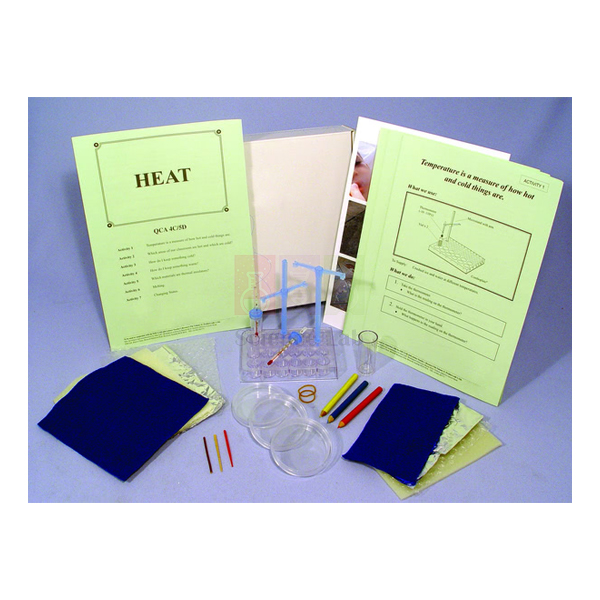
Mini Science Kit - Heat
Mini Science Kit - Heat (Product Code: SLE/CH/166) is a topic kit used to teach heat and temperature through hands-on activities in school science classrooms. It covers seven activities, from changing states and melting to keeping things warm or cold and finding out which materials are thermal insulators. It is made by Jain Scientific Equipments Pvt Ltd (ScienceLab), an OEM manufacturer, at its own factory in Ambala, India, as a heat energy science kit for group investigations.
Key Details
| Parameter | Detail |
|---|---|
| Type | Mini science kit (topic kit) |
| Topic | Heat and temperature |
| Concepts covered | Changes of state, melting, temperature, keeping things cold and warm, thermal insulators |
| Activities | Seven, listed below |
| Product code | SLE/CH/166 |
| Manufacturer | Jain Scientific Equipments Pvt Ltd (ScienceLab) — OEM |
| Country of origin | India (made in Ambala, Haryana) |
Activities performed with this kit:
- Changing states
- Melting
- Looking at Temperature
- How to keep things cold
- How to keep things warm
- Hot or cold?
- Which materials are thermal insulators?
What Is the Heat Mini Science Kit Used For?
It gives pupils a reason to measure rather than guess. A memorable way into the "Hot or cold?" activity is the classic three-bowl test: after one hand has been in cool water and the other in warm, lukewarm water feels different to each hand, showing that touch is an unreliable judge of temperature. Pupils then practise reading temperatures and watch ice melt and change state, noting how long it takes in different places around the room.
The keeping-warm and keeping-cold activities are two sides of one idea. Groups wrap identical containers of warm water, or of ice, in different materials and record the temperature at regular intervals; the most effective wrapping slows heat moving in either direction, which answers which materials are thermal insulators. Plotting the readings as simple line graphs lets groups compare results, making this science kit for students in India a natural bridge between practical work and data handling.
OEM Manufacturer
Jain Scientific Equipments Private Limited (CIN U29309HR2020PTC087597), trading as ScienceLab, is the OEM (original equipment manufacturer) of the Mini Science Kit - Heat. The kit is made and assembled at the company's own licensed factory at 449, HSIIDC Industrial Area, Saha, Ambala, Haryana (Factory Licence AMB-ONLINE-CHD-J-414), and supplied factory-direct to schools, institutions, dealers and importers. Repeat orders and requests for replacement items come straight to the manufacturer, so just ask us. More details are on our company profile.
Related Laboratory Equipment
Instruments and teaching aids for the heat topic:
- Digital Thermometer — quick, easy-to-read temperatures for the insulation tests
- Ice Melting Kit — ice melts at once on one square but not on the other, a striking follow-up on conduction
- Heat Transfer Kit — insulated containers, an aluminium bar and thermometers for measuring heat flow
- Investigating Heat Poster — a classroom display to reinforce the key ideas
Browse further items in Chemistry Lab Equipment.
Frequently Asked Questions
What activities does the Mini Science Kit - Heat cover?
The Mini Science Kit - Heat covers seven activities: changing states, melting, looking at temperature, how to keep things cold, how to keep things warm, hot or cold, and which materials are thermal insulators.
Are thermometers included?
The component list of the Mini Science Kit - Heat is not published on this page, so please confirm the contents through our contact page. Digital thermometers can be quoted separately if you need extra ones for group work.
Do we need a burner or hot plate?
Several Mini Science Kit - Heat activities can be run with warm tap water and ice rather than a flame. If your lesson plan does involve heating, follow your school's laboratory safety procedures and supervise pupils closely.
What is a thermal insulator?
A thermal insulator is a material that slows the flow of heat, such as wool, foam or air trapped in fabric. The Mini Science Kit - Heat lets pupils compare materials to find which keep hot things hot and cold things cold for longest.
Who manufactures the Mini Science Kit - Heat?
Jain Scientific Equipments Private Limited (ScienceLab) is the OEM that manufactures the Mini Science Kit - Heat at its own factory in Saha, Ambala, Haryana, India, and supplies it factory-direct to schools, dealers and importers in India and international markets.
How should the kit be cared for?
After each lesson with the Mini Science Kit - Heat, dry any containers and materials that were used, check that nothing is cracked or missing, and store the kit closed in a dry cupboard so it is ready for the next class.
Can you supply class sets?
Yes. The Mini Science Kit - Heat can be quoted in class sets for schools, school networks and dealers in India and international markets; include the number of kits, any extra thermometers and the delivery location in your enquiry.
Request a Quote
Quotations for the Mini Science Kit - Heat come directly from the manufacturer. Send your requirement through our contact page, or add the kit to the enquiry cart together with thermometers and other heat-topic resources.
Last updated: 24 September 2026
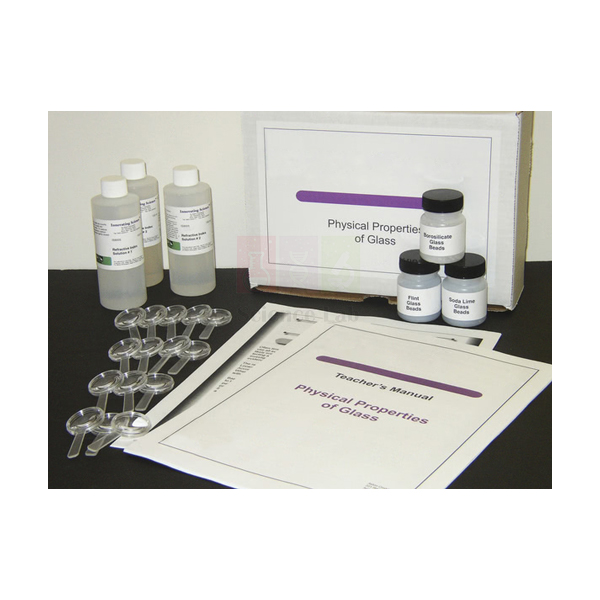
Physical Properties of Glass
Physical Properties of Glass (Product Code: SLE/CH/167) is a forensic science activity in which students learn about the different chemical and physical characteristics and properties of glass, and find out how forensic scientists use these differences to help provide evidence that solves crimes. There is enough material for 15 groups, and the activity comes with a Teachers Manual and Student Guide and Analysis copy-masters. It is supplied by Jain Scientific Equipments Pvt Ltd (ScienceLab), Ambala, India, as a science kit with manual support for chemistry and forensic science classes.
Key Details
| Parameter | Detail |
|---|---|
| Type | Forensic chemistry activity kit |
| Subject | Chemical and physical characteristics and properties of glass |
| Forensic application | How differences between glasses are used as evidence in criminal investigations |
| Group capacity | Enough material for 15 groups |
| Teaching material | Teachers Manual; Student Guide and Analysis copy-masters |
Typical Use
During a criminal investigation, police and crime scene investigators use every available tool and piece of evidence to work backwards and build the most likely picture of what happened, and each type of evidence supplies a different piece of the puzzle. Glass is a common example: a broken window, bottle or headlamp can leave fragments at a scene and on a suspect. In this activity students examine how glasses differ in their chemical and physical properties and then apply that knowledge the way a forensic examiner would – deciding whether two samples could share a source.
The Teachers Manual sets out the lesson, while the Student Guide and Analysis copy-masters give each group a structured record of observations and conclusions. With material for 15 groups, one kit can serve a full class working in pairs or threes, which makes it practical school chemistry lab equipment for a forensic-themed unit. Treat any glass samples with care: wear eye protection, handle pieces with tweezers or gloves, and put broken fragments in a dedicated broken-glass container.
Supplier
This forensic activity reaches schools through Jain Scientific Equipments Private Limited, the Ambala, Haryana company that trades as ScienceLab and sources practical kits and consumables alongside the apparatus it builds. Our company profile gives the background.
Related Chemistry Lab Equipment
Kits and tools for a complete forensic science unit:
- Crime Scene Investigation — a wider scenario in which glass can be one line of evidence
- Forensic Science Lab Investigation — further forensic techniques for the same course
- Forensic Comparison Microscope — views two samples side by side for detailed comparison
- Forensic Chemistry of Dusting for Fingerprints — adds fingerprint evidence to the investigation
- Crime Scene Tape — marks out a mock scene for role-play
See more in Chemistry Lab Equipment.
Frequently Asked Questions
How many student groups does one kit serve?
There is enough material for 15 groups, so a typical class can work in small teams at the same time.
What teacher and student material comes with it?
A Teachers Manual plus Student Guide and Analysis copy-masters, which you can reproduce for each group.
Which properties of glass do students test?
The activity covers chemical and physical characteristics of glass; the specific procedures are set out in the Teachers Manual. For a detailed list of tests and materials before ordering, please ask through our contact page.
Can the kit be used with more than one class?
The copy-masters can be reused, but the practical material is sized for 15 groups. Contact us about replacement materials if you plan to run the activity again.
What safety precautions apply?
Eye protection, careful handling of any glass pieces, and disposal of fragments in a broken-glass container. Follow your school’s laboratory rules for any reagents used.
Do you supply forensic kits to institutions abroad?
Yes. We supply schools and colleges in India and international markets; tell us your destination and quantity when you enquire.
Request a Quote
Ask for pricing through our contact page, or add this activity to the enquiry cart with other forensic kits.
Last updated: 24 September 2026

Gas Laws Poster
Gas Laws Poster (Product Code: SLE/CH/168) introduces the laws discovered by some of the giants of chemistry. Graphic illustrations show how gases behave in different environments, and students can see how Boyle’s Law, Avogadro’s Law and Charles’ Law combine to form the Ideal Gas Law, as well as the importance of Dalton’s Law of partial pressures. Manufactured by Jain Scientific Equipments Pvt Ltd (ScienceLab), Ambala, India, it is a chemistry teaching poster for classrooms and laboratories where gas behaviour is taught.
Key Details
| Parameter | Detail |
|---|---|
| Type | Wall poster (teaching aid) |
| Laws illustrated | Boyle’s Law, Charles’ Law, Avogadro’s Law, the Ideal Gas Law, Dalton’s Law of partial pressures |
| Presentation | Graphic illustrations of how gases behave in different environments |
| Learning levels | Younger students meet the core contributors to chemistry and physics; advanced students study how each law contributes to understanding gas behaviour |
| Subjects | Chemistry and physics |
Typical Use
Displayed in a chemistry or physics room, the poster gives students a constant visual reference while they work through the gas laws. Teachers can walk the class through the relationships one at a time: Boyle’s Law links pressure and volume at constant temperature, Charles’ Law links volume and temperature at constant pressure, and Avogadro’s Law links volume and the amount of gas. Bringing the three together leads to the Ideal Gas Law, often written PV = nRT, while Dalton’s Law explains that the total pressure of a gas mixture is the sum of the partial pressures of its components – an idea students meet again in breathing, diving and weather.
For younger classes, the poster is a way to get to know the scientists behind the laws; advanced students can use it to check how each law fits into the overall model of gas behaviour. Pairing it with a Boyle’s law apparatus lets students collect their own pressure–volume data and compare it with the relationship shown on the wall.
Manufacturer
The Gas Laws Poster is produced by Jain Scientific Equipments Private Limited in Ambala, Haryana. Operating as ScienceLab, the company makes charts, models and apparatus for school and college science teaching – see our company profile.
Related Laboratory Equipment
Apparatus and displays that go with gas-law lessons:
- Boyle’s Law – Simple Type — lets students measure the pressure–volume relationship themselves
- Simple Gas Preparation Kit — for preparing and collecting gases in practical lessons
- Gas Jar, Glass — collects gas samples during experiments
- The Ultimate Periodic Table Poster — a companion wall display for the chemistry room
Browse the wider range in Chemistry Lab Equipment.
Frequently Asked Questions
Which gas laws does the poster cover?
Boyle’s, Charles’ and Avogadro’s Laws, how they combine into the Ideal Gas Law, and Dalton’s Law of partial pressures.
What size is it, and is it laminated?
Size and finish are not stated on this page. Please ask through our contact page and we will confirm before you order.
Does the poster include the equations?
It explains the laws through graphic illustrations of gas behaviour. If you need to check the exact wording or equations shown, request a preview via the contact page.
Is it suitable for both junior and senior classes?
Yes. Younger students become acquainted with the scientists behind the laws, while advanced students use it to see how each law contributes to the full picture of gas behaviour.
How should we display it?
Mount it at eye level on a flat wall, away from direct sunlight and damp, so the illustrations stay clear for longer.
Can we order posters for several classrooms or schools?
Yes. Send the quantity and delivery addresses; we supply India and international markets and can combine posters with other teaching aids in one quotation.
Request a Quote
To order, reach us through the contact page or add the poster to the enquiry cart.
Last updated: 24 September 2026

The Ultimate Periodic Table Poster
The Ultimate Periodic Table Poster (Product Code: SLE/CH/169) is an oversized, colour coded laminated wall chart that gives students a super-sized look at the elements, pairing the familiar atomic symbol and weight with the story of where each element comes from and what it does. Chemistry teachers hang it as the main reference point in a classroom or laboratory, and it serves as a periodic table chart for schools in India that want students to read more than a bare grid of symbols. It is manufactured by Jain Scientific Equipments Pvt Ltd (ScienceLab), Ambala.
Specifications
| Parameter | Detail |
|---|---|
| Type | Oversized, colour coded periodic table wall chart |
| Finish | Laminated |
| Dimension | 95cm x 139cm |
| Data for each element | Standard information such as atomic symbol and weight |
| Extended element information | Discovery of the element, its characteristics, availability, uses and role in life processes |
| Composition panels | Composition by element of the human body, the planets in our solar system, a fish, a tree and a cheeseburger |
Typical Use
Because the poster is large enough to read from the back of a room, it suits whole-class teaching: a teacher can point to an element while introducing symbols and atomic weights, then send students to the chart to look up values for formula-mass or mole calculations. The extra notes on discovery, availability and uses turn it into a research station, where pairs of students pick an element and summarise how it was found and why it matters in industry or in living things.
The composition panels are a natural bridge to other subjects. Comparing the elements in the human body with those in a fish, a tree or the planets gives biology and earth science lessons a chemistry angle, and the cheeseburger panel is a memorable hook for food chemistry discussions. As part of a wider set of school chemistry lab equipment in India, the laminated surface stands up to daily handling; wipe it with a soft, slightly damp cloth and mount it flat at eye level so the lower rows stay easy to read.
Manufacturer
ScienceLab is the trading name of Jain Scientific Equipments Private Limited, a company based in Ambala, Haryana, that produces teaching aids and laboratory apparatus for schools, colleges and training institutes. Wall charts such as this one are supplied alongside the practical equipment used in the same lessons, so a department can equip a room from one source. Read more on our company profile.
Related Chemistry Lab Equipment
These items are often ordered with the poster to support lessons on atomic structure and the behaviour of matter:
- Gas Laws Poster — a companion wall chart for the physical chemistry side of the syllabus.
- Atom Activity Model — lets students build the atoms they have just located on the table.
- New Improved Organic And Inorganic Molecular Set — moves the lesson from single elements to bonded molecules.
- Modern Periodic Table Laminated — a separate laminated table for laboratories or smaller wall spaces.
- Laboratory Safety Chart — another wall reference for the same chemistry room.
Browse the full range in our Chemistry Lab Equipment category.
Frequently Asked Questions
How large is The Ultimate Periodic Table Poster?
It measures 95cm x 139cm, so plan a clear wall area of at least that size before ordering.
What does the chart show for each element?
Each element carries standard information such as its atomic symbol and weight, together with notes on its discovery, characteristics, availability, uses and role in life processes.
Is the poster laminated?
Yes. The lamination protects the print from handling and allows light cleaning with a damp cloth; avoid solvents and abrasive pads, which can cloud the surface.
Can it be used outside chemistry lessons?
Yes. The panels on the composition of the human body, the planets, a fish, a tree and a cheeseburger give biology, earth science and food science teachers a ready discussion starter.
Are frames or mounting fixtures included?
Mounting hardware is not listed as part of the product. Please ask through our contact page if you need framing or fixing advice.
Can schools order several posters for different classrooms?
Yes. We supply single pieces and institutional quantities to schools and colleges in India and international markets; share the quantity and delivery address and we will prepare a quotation.
Request a Quote
For pricing and availability of The Ultimate Periodic Table Poster, send your quantity and delivery location through our contact page, or add it to the enquiry cart with other chemistry teaching aids so we can quote them together.
Last updated: 24 September 2026
Presumptive Blood Test Kit
Presumptive Blood Test Kit (Product Code: SLE/CH/170) is a phenolphthalein-based test kit used to check materials for the presence of blood in forensic science and chemistry teaching labs. It includes instructions, a blood standard and reagents to complete 30 tests, and shows students why a screening result must be followed by further serology tests. It is supplied by Jain Scientific Equipments Pvt Ltd (ScienceLab), Ambala, India, as a hands-on chemistry experiment kit for classrooms in India and abroad.
Specifications
| Parameter | Detail |
|---|---|
| Test type | Presumptive test for the presence of blood on materials |
| Indicator | Phenolphthalein |
| Contents | Instructions, blood standard and reagents |
| Number of tests | Reagents to complete 30 tests |
| Species discrimination | Does not distinguish between animal and human blood |
| Confirmation | Further serology tests are needed |
| Shelf life | Depends on the chemical, its grade and storage conditions; ask us for the expiry date of the batch you are quoted |
| Product code | SLE/CH/170 |
| Supplied by | Jain Scientific Equipments Pvt Ltd (ScienceLab), Ambala, India |
What Is the Presumptive Blood Test Kit Used For?
A typical lesson starts with the blood standard, so students first see what a positive reaction looks like before they test unknown samples such as stained cloth, paper or wood prepared by the teacher. They then apply the reagents to each sample in the order given in the instructions and record whether the characteristic pink colour appears. Running a known negative, such as an unstained piece of the same material, beside every unknown builds the habit of using controls and opens a discussion of false positives.
The kit is also a clear way to show the limits of a screening test. Because the result cannot separate animal from human blood and further serology tests are needed, students learn why forensic laboratories treat a presumptive positive as a lead rather than proof. For departments that buy through a lab consumables supplier in India for recurring practicals, the 30-test quantity helps in working out how many kits a term of classes will need.
Supplier
The Presumptive Blood Test Kit is supplied by Jain Scientific Equipments Private Limited, which trades as ScienceLab from Ambala, Haryana, India, and sources forensic and chemistry teaching kits for schools, colleges and training centres. Export consignments are handled under Importer-Exporter Code AAECJ8618A (DGFT), and the company's GSTIN, 06AAECJ8618A1ZT, is available for buyers who need vendor registration details. See our company profile for more background.
Related Chemistry Lab Equipment
Pair the blood screen with these items to build a complete forensic chemistry sequence:
- Forensic Chemistry of Blood Types — a logical next step once a stain has screened positive
- Chemiluminescence in Blood Stain Detection — shows a second, light-based method for locating stains
- Gunshot Residue Presumptive Test Kit — another screening test for a mock crime-scene station
- Forensics Using Simulated Blood — for activities where real biological material is not wanted
- Gloves W/o Powder Nitrile Disposable — hand protection while handling samples and reagents
Find more investigation kits in our Chemistry Lab Equipment category.
Frequently Asked Questions
How many tests can be run with one kit?
One Presumptive Blood Test Kit contains reagents to complete 30 tests, together with instructions and a blood standard. Larger classes or repeated sessions across a term will need additional kits, so plan quantities before ordering.
What is included in the Presumptive Blood Test Kit?
The Presumptive Blood Test Kit includes instructions, a blood standard and the reagents for the test. General items such as gloves, swabs and sample materials are not listed as included and should be arranged separately.
Can the test show whether blood is human?
No. The phenolphthalein test in the Presumptive Blood Test Kit does not distinguish between animal and human blood, which is an important teaching point about the limits of presumptive methods in forensic work.
Does a positive result prove that a stain is blood?
No. A positive result from the Presumptive Blood Test Kit indicates that blood may be present; further serology tests are needed to confirm the finding, which is why forensic laboratories treat it as a lead rather than proof.
What is the shelf life of the reagents?
The shelf life of the Presumptive Blood Test Kit depends on the chemicals, their grade and storage conditions; ask us for the expiry date of the batch you are quoted before planning a long storage period, and keep reagent containers capped.
Who supplies the Presumptive Blood Test Kit?
Jain Scientific Equipments Private Limited (ScienceLab), Ambala, Haryana, India, supplies the Presumptive Blood Test Kit to schools, colleges and training centres in India and international markets; include the destination country in your enquiry so shipping can be quoted.
Request a Quote
To order the Presumptive Blood Test Kit, tell us the number of kits and your delivery location through our contact page, or place it in the enquiry cart with other forensic chemistry items for a combined quotation.
Last updated: 24 September 2026
Properties of Aspirin
Properties of Aspirin (Product Code: SLE/CH/171) is a consumer-chemistry investigation in which students trace the history of acetylsalicylic acid and then put several commercial types of aspirin to the test. Designed for secondary and introductory college chemistry, it is a chemistry teaching kit that links acids, bases and solubility to a medicine students already recognise. The kit is supplied by Jain Scientific Equipments Pvt Ltd (ScienceLab), Ambala.
Specifications
| Parameter | Detail |
|---|---|
| Investigations | Solubility of aspirin in varying gastrointestinal environments; active ingredients in regular and extra-strength aspirin; differences between regular and buffered aspirin |
| Class capacity | Enough materials for fifteen groups |
| Aspirin samples | All aspirin samples included |
| Documentation | Teacher’s Manual and Student Study Guide copymasters |
Kit contents:
- 45 Disposable Medicine Cups
- 5 x 30 ml Hydrochloric Acid, 1M Solution
- 8 x 30 ml Sodium Hydroxide, 1M Solution
- 1 x 30 ml Phenolphthalein, 1% in Ethanol
- 1 Pkg/50 Universal Indicator Strips
- 1 Pkg/15 Graduated Plastic Pipettes
- 1 Pkg/75 Aspirin, Regular
- 1 Pkg/60 Aspirin, Buffered
- 1 Pkg/45 Aspirin, Enteric Coated
- 1 Pkg/15 Aspirin, Extra Strength
Typical Use
Groups place tablets of each type in medicine cups containing the acid and base solutions, then watch how quickly and how completely each one breaks up. The contrast between regular and enteric coated tablets in acidic conditions is usually the most striking result, and it opens a discussion on why some tablets are designed to pass the stomach before dissolving. Universal indicator strips and phenolphthalein let students track pH changes, while the graduated pipettes keep liquid volumes consistent from group to group so results can be pooled on the board.
A second session can compare regular with extra-strength and buffered aspirin, helping students connect dose, formulation and the chemistry of neutralisation. The copymasters give teachers a ready structure for pre-lab questions and data tables. Because the kit uses 1M hydrochloric acid and 1M sodium hydroxide, students should wear safety goggles and gloves, and all tablets must be treated strictly as laboratory samples, never taken by mouth.
Supplier
Schools order this investigation from Jain Scientific Equipments Private Limited, the Ambala, Haryana company behind the ScienceLab name, which supplies classroom-ready chemistry kits together with the laboratory apparatus that supports them. Details of the company are on our company profile page.
Related Chemistry Lab Equipment
These items extend the aspirin study or replenish what the class uses up:
- Greener Synthesis Of Acetylsalicylic Acid — lets advanced students make the compound they have just tested.
- Properties of Shampoo — a companion consumer-product investigation for the same unit.
- Paper, Universal, pH 1-14 — extra indicator paper for repeat or extension runs.
- Plastic Microchemistry Pipets — spare pipettes for dispensing the acid and base solutions.
- Safety Goggles — eye protection while handling the 1M solutions.
See more practical kits in our Chemistry Lab Equipment category.
Frequently Asked Questions
Are the aspirin tablets included?
Yes. The kit includes 75 regular, 60 buffered, 45 enteric coated and 15 extra-strength aspirin, so no tablets need to be bought locally.
How many students can use one kit?
It contains enough materials for fifteen groups; the number of students per group is up to the teacher.
What strength are the acid and base solutions?
Both are 1M: five 30 ml bottles of hydrochloric acid and eight 30 ml bottles of sodium hydroxide, plus 30 ml of 1% phenolphthalein in ethanol.
Is teacher guidance provided?
Yes. A Teacher’s Manual and Student Study Guide copymasters are included for photocopying.
Can individual components be reordered?
Separate refill packs are not listed in our product details. Tell us which items you need through our contact page and we will advise on availability.
What should an institutional quotation request include?
State the number of kits, the delivery address and whether you need a formal quotation for purchase approval; we supply schools and colleges in India and international markets.
Request a Quote
To receive a quotation for Properties of Aspirin, send your requirement through our contact page, or add the kit to the enquiry cart with any related glassware and safety items.
Last updated: 24 September 2026
Properties of Shampoo
Properties of Shampoo (Product Code: SLE/CH/172) turns an everyday bathroom product into a structured chemistry investigation: students learn what several common shampoo ingredients do, then compare three different shampoos for viscosity, pH, foaming, oil handling and dirt dispersion. It suits middle and secondary school chemistry and is a practical science kit for students in India studying mixtures, surfactants and consumer chemistry. The kit is supplied by Jain Scientific Equipments Pvt Ltd (ScienceLab), Ambala.
Specifications
| Parameter | Detail |
|---|---|
| Properties tested | Relative viscosity, pH, flash-foam formation and retention, oil emulsification, contaminant-dispersion ability |
| Shampoos supplied | Three different shampoos (#1, #2, #3), 30 ml each |
| Class capacity | Enough materials for fifteen groups |
| Documentation | Teacher’s Manual and Student Study Guide copymasters |
Kit contents:
- 30 ml Shampoo #1
- 1 x 30 ml Shampoo #2
- 1 x 30 ml Shampoo #3
- 45 Disposable Medicine Cups
- 45 Polystyrene Test Tubes
- 3 Plastic Centrifuge Tube
- 1 x 30 ml Ink, Black, 10%
- 1 x 30 ml Vegetable Oil
- 1 Pkg/50 Universal Indicator Strips
- 1 Pkg/45 Graduated Plastic Pipettes
- 1 Pkg/25 Copper Balls
Typical Use
Each group works through a set of short stations. Universal indicator strips give a quick pH reading for each shampoo, and the results often surprise students who assume all shampoos are neutral. Shaking a measured amount in a test tube shows how much foam forms at once and how long it lasts, while adding vegetable oil shows which formulation holds oil in an emulsion best. A few drops of the black ink act as simulated dirt, so the class can see which shampoo keeps the contaminant spread through the water instead of letting it settle.
Relative viscosity is compared by timing a copper ball as it falls through each shampoo, giving a numerical result that can be graphed. Because every test uses small volumes dispensed with graduated pipettes, groups get comparable data and clean-up is quick. For extension work, students can bring a shampoo from home and test it against the three supplied samples, checking each reading with pH indicator paper or the strips provided.
Supplier
The kit is supplied by Jain Scientific Equipments Private Limited, a company headquartered in Ambala, Haryana, whose ScienceLab brand covers ready-to-teach chemistry investigations as well as the glassware and apparatus schools use every day. Visit our company profile to learn how we work with schools and colleges.
Related Chemistry Lab Equipment
Consider these items when planning a consumer chemistry or materials unit:
- Properties of Aspirin — a second everyday-product investigation using a similar group format.
- Physical Properties of Glass — carries the property-testing approach over to a solid material.
- Test Tube Racks — keeps the polystyrene tubes upright during foam-retention timing.
- Paper, Universal, pH 1-14 — additional paper for testing extra shampoo samples.
More investigation kits are listed in our Chemistry Lab Equipment category.
Frequently Asked Questions
Which shampoos come in the kit?
Three different shampoos, labelled #1, #2 and #3, each in a 30 ml quantity. Brand names are not listed in our product details, so ask through our contact page if you need them.
What properties do students measure?
Relative viscosity, pH, flash-foam formation and retention, oil emulsification and the ability to disperse a contaminant.
How many groups does one kit serve?
There are enough materials for fifteen groups, including 45 medicine cups, 45 polystyrene test tubes and 45 graduated plastic pipettes.
What are the copper balls used for?
They serve as falling objects for comparing the relative viscosity of the shampoos; the Teacher’s Manual sets out the procedure.
Are any hazardous chemicals involved?
The listed contents are shampoos, ink, vegetable oil and indicator strips, but normal lab practice still applies: wear eye protection, avoid getting shampoo in the eyes and wipe up spills promptly because they are slippery.
Can you quote for several schools at once?
Yes. Send the number of kits and delivery points through our contact page; we supply institutions in India and international markets.
Request a Quote
To price Properties of Shampoo for your department, contact us through the contact page or add the kit to the enquiry cart along with any racks or indicator paper you need.
Last updated: 24 September 2026
Rust Race Lab Investigation
Rust Race Lab Investigation (Product Code: SLE/CH/173) introduces oxidation-reduction reactions through a problem every student has seen: iron and other metals slowly corroding. Working in teams, the class performs redox reactions, measures how much oxygen is used up as metal corrodes, tests which metals corrode, and compares how well different rust inhibitors protect a surface. Planned for a class size of 40 students, it is a chemistry experiment kit for India’s secondary and junior college classrooms, supplied by Jain Scientific Equipments Pvt Ltd (ScienceLab), Ambala.
Specifications
| Parameter | Detail |
|---|---|
| Type | Lab investigation on oxidation-reduction and metal corrosion |
| Concept introduced | Oxidation-reduction reactions |
| Activities | Perform oxidation-reduction reactions; measure oxygen consumption during metal corrosion; test metals for corrosion; compare the effectiveness of rust inhibitors |
| Class size | 40 students |
Typical Use
The investigation works well as a short sequence rather than a single lesson. Students begin with simple redox reactions to see electrons being transferred between a metal and a solution, then set up corrosion samples that are left for a period and checked at intervals. Measuring oxygen consumption turns rusting from a vague idea into a quantity: as iron corrodes in a closed space, the loss of oxygen can be observed and recorded, which reinforces why air and moisture are both needed for rust to form.
The “race” element comes from comparing samples side by side. Teams test different metals and different protective treatments, predict which will corrode fastest, and then judge the rust inhibitors on their own evidence. This leads naturally into discussion of painting, oiling, galvanising and sacrificial protection in bridges, vehicles and pipelines. Label every sample clearly, keep a dated observation log and wear eye protection when handling any solutions.
Supplier
Jain Scientific Equipments Private Limited, known to schools as ScienceLab, supplies this investigation from Ambala, Haryana, as part of a wider catalogue of chemistry kits, glassware and apparatus for teaching laboratories. Our company profile gives an overview of the business.
Related Chemistry Lab Equipment
These items build on the redox and corrosion ideas covered in the Rust Race:
- Daniell Cell — shows redox reactions producing a measurable electric current.
- Simple Cell Kit — a zinc and copper cell that links metal reactivity to electrochemistry.
- Environmental Chemistry: Acid Rain, Weathering & Erosion — extends the study of how the environment attacks materials.
- Safety Goggles — eye protection for the whole class during practical work.
Explore more kits in our Chemistry Lab Equipment category.
Frequently Asked Questions
How many students is the Rust Race Lab Investigation designed for?
It is planned for a class size of 40 students, usually working in small teams.
What will students actually do?
Perform oxidation-reduction reactions, measure oxygen consumption during metal corrosion, test metals for corrosion and compare the effectiveness of rust inhibitors.
What components are in the kit?
A full component list is not included in our product details. Please request it through our contact page so you can check what your laboratory needs to add.
How long does the corrosion part take?
Rusting is a slow process, so plan for samples to be set up in one lesson and checked over following sessions; the exact timing depends on the conditions you use.
Is it suitable for introducing redox to beginners?
Yes. The investigation is intended as an introduction to oxidation-reduction reactions, using corrosion as a familiar starting point.
Can you supply kits for several sections or schools?
Yes. We handle institutional orders across India and international markets; send the number of kits and delivery details for a quotation.
Request a Quote
To order the Rust Race Lab Investigation, share your quantity through our contact page or add it to the enquiry cart with related electrochemistry items.
Last updated: 24 September 2026

Silicone Oil
Silicone Oil (Product Code: SLE/CH/174) is a 50ml quantity of silicone oil intended for the Microscience Combostill, the small-scale unit used in microscale chemistry practicals. Schools and colleges that run Microscience equipment keep it on hand so the Combostill can be prepared and topped up as described in its instructions. As a chemistry consumables supplier in India, Jain Scientific Equipments Pvt Ltd (ScienceLab), Ambala, supplies it alongside other Microscience items.
Key Details
| Parameter | Detail |
|---|---|
| Type | Silicone oil (laboratory consumable) |
| Quantity | 50ml |
| For use with | Microscience Combostill |
| Suitable for | Schools, colleges and training labs running Microscience practicals |
Typical Use
Silicone oils are valued in laboratories because they stay stable when warmed, repel water and do not react with most chemicals, which makes them a common choice where a clean, inert fluid is needed around small apparatus. In a microscale programme the Combostill is used repeatedly across many classes, so a separate supply of oil avoids interruptions when the original quantity runs low or becomes contaminated.
Always follow the Combostill instructions for where the oil goes and how much to use. Dispense it with a clean dropper or pipette, keep the container closed between uses so dust and moisture stay out, and replace oil that has become cloudy or discoloured. Silicone oil makes benches and floors slippery, so wipe any drips straight away. Laboratory coordinators who stock spares from one lab consumables supplier in India often order the oil together with replacement tubing for the same Microscience kits.
Supplier
This consumable is supplied by Jain Scientific Equipments Private Limited, which operates under the ScienceLab name from Ambala, Haryana, and supports schools with both apparatus and the spares that keep it running. For vendor registration, the company’s GSTIN is 06AAECJ8618A1ZT and its Legal Entity Identifier is 3358004HRD1JIVXKYX49. More about us is on the company profile page.
Related Chemistry Lab Equipment
Other items from the Microscience range that are commonly ordered with this oil:
- Silicone Tube — a U-bend tube listed for use with the Microscience system.
- Comboplate, Microscience — a core piece of Microscience apparatus for student microscale reactions.
- Basic Microscience Kit, Student — the entry-level student kit in the same range.
- Advanced Microscience Kit, Student — for schools moving on to more demanding microscale practicals.
See the complete range in our Chemistry Lab Equipment category.
Frequently Asked Questions
How much silicone oil is supplied?
Each unit contains 50ml of silicone oil.
Which equipment is this oil meant for?
It is specified for the Microscience Combostill. Follow the Combostill instructions for filling and replacement.
What viscosity grade is the oil?
A viscosity grade is not stated in our product details. If you need this information for a technical file, please ask through our contact page.
Can it be used in other laboratory apparatus?
It is listed specifically for the Combostill. Before using it elsewhere, check that apparatus’s own instructions for the type of oil required.
How should the oil be stored?
Keep the container tightly closed, clean and away from heat sources, and store it where it cannot tip over onto benches or floors.
Can I order it with other Microscience spares?
Yes. List all the spares you need in one enquiry and we will quote them together for delivery in India or to international markets.
Request a Quote
For Silicone Oil, send the number of units and your delivery location through our contact page, or add it to the enquiry cart with any other Microscience items.
Last updated: 24 September 2026
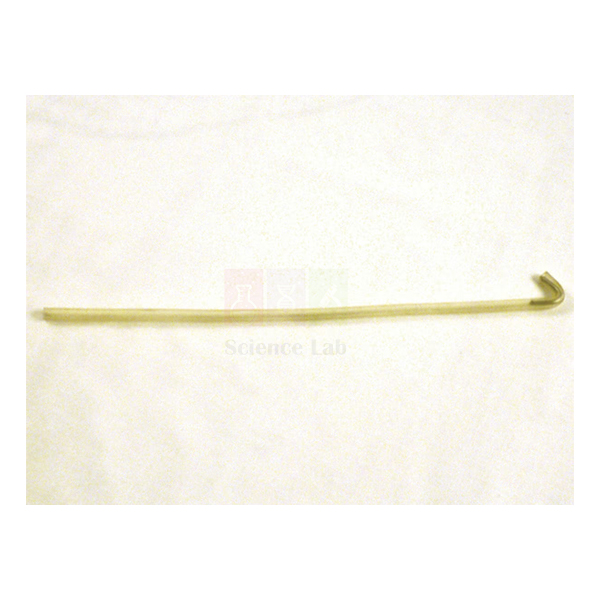
Silicone Tube
Silicone Tube (Product Code: SLE/CH/175) is a 25cm length of silicone tubing formed with a U bend, used as a connecting part in the Microscience system for small-scale student practicals. Laboratory assistants order it to replace tubes that have become worn, stained or lost, keeping each Microscience kit complete for the next class. It is one of the lab equipment spare parts supplied by Jain Scientific Equipments Pvt Ltd (ScienceLab), Ambala.
Key Details
| Parameter | Detail |
|---|---|
| Material | Silicone |
| Form | Tube with U bend |
| Length | 25cm |
| Used for | Microscience system |
Typical Use
In microscale chemistry, reactions are carried out in small plastic apparatus, and flexible tubing links one part of the set-up to another so that gases or liquids can pass between them. Silicone is well suited to this job because it stays soft and flexible, tolerates warm conditions better than many ordinary rubbers and does not react with most classroom reagents. The ready-made U bend lets the tube turn back on itself without kinking, which keeps the passage open in a compact arrangement on the bench.
Fit the tube by easing it over the connector with a slight twist rather than forcing it, and check each joint before starting a reaction. After the practical, rinse the tube through with clean water, shake out the drops and let it dry fully before packing it back into the kit. Replace any tube that has become sticky, cracked or permanently stained. Schools that keep a small stock of such lab equipment accessories in India find it easier to run every Microscience workstation at full strength.
Supplier
Jain Scientific Equipments Private Limited, which trades as ScienceLab and is based in Ambala, Haryana, supplies this replacement tube as part of its support for schools using microscale chemistry equipment. You can read about the company on our company profile.
Related Chemistry Lab Equipment
Useful companions when maintaining or expanding Microscience kits:
- Silicone Oil — the 50ml Microscience spare that is often reordered at the same time.
- Titration Kit, Student, Microscience — a self-contained microscale kit in the same system.
- Water Monitoring Kit, Microscience — extends Microscience work into water quality testing.
- Microscience Work Station, Biology, Physics and Chemistry — a combined station for running microscale practicals across subjects.
Browse more items in our Chemistry Lab Equipment category.
Frequently Asked Questions
How long is the Silicone Tube?
It is 25cm long and is supplied with a U bend.
Will it fit my Microscience kit?
It is listed for use with the Microscience system. Internal and external diameters are not stated in our product details, so if you want to match an existing tube exactly, send us its details through our contact page.
Why does the tube have a U bend?
The pre-formed bend lets the tube change direction in a small space without kinking, keeping the connection open during a practical.
How should the tube be cleaned?
Rinse it through with clean water straight after use, adding a little mild detergent if needed, then let it dry completely before storage.
When should it be replaced?
Replace it when it cracks, becomes sticky, stays stained after cleaning or no longer grips its connector firmly.
Can I buy several tubes for a class set of kits?
Yes. State how many tubes you need and we will quote for delivery within India or to international markets.
Request a Quote
To order the Silicone Tube, send the required quantity through our contact page or add it to the enquiry cart together with other Microscience spares.
Last updated: 24 September 2026
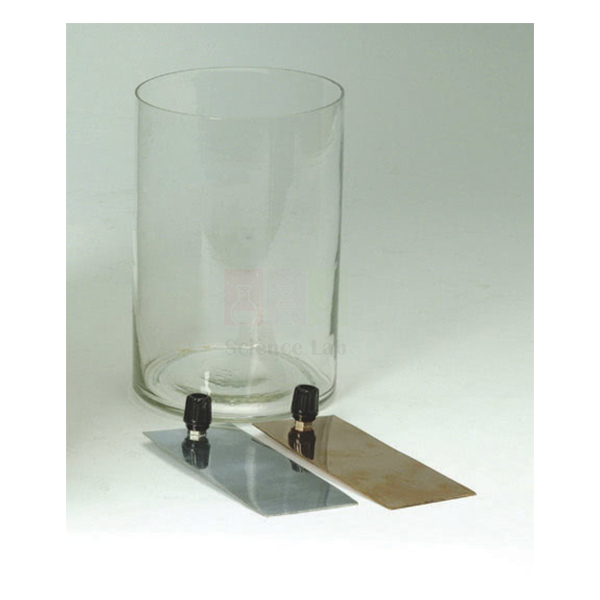
Simple Cell Kit
Simple Cell Kit (Product Code: SLE/CH/176) consists of a 150mm high x 100mm diameter glass jar complete with zinc and copper plates, giving students everything needed to assemble a basic voltaic cell and see chemical energy turned into electricity. It is widely used in school chemistry and physics lessons on cells, reactivity and current, and serves as a straightforward electrochemical cell kit for school laboratories. The kit is manufactured by Jain Scientific Equipments Pvt Ltd (ScienceLab), Ambala.
Specifications
| Parameter | Detail |
|---|---|
| Container | Glass jar |
| Jar size | 150mm high x 100mm diameter |
| Electrodes | Zinc plate and copper plate |
| Purpose | Making simple cells |
Typical Use
The teacher half-fills the jar with a suitable electrolyte, and students stand the zinc and copper plates in it so they do not touch. When the plates are joined through a voltmeter or a small bulb, a reading appears because zinc, the more reactive metal, gives up electrons more readily than copper. This single set-up covers several syllabus points at once: the reactivity series, oxidation at one electrode and reduction at the other, and the idea that a cell needs two different conductors in an electrolyte.
Leaving the circuit connected for a few minutes shows the classic weakness of the simple cell. Bubbles collect on the copper plate and the output falls, which introduces polarisation and explains why improved designs such as the Daniell cell were developed. Afterwards, empty the jar, rinse the jar and plates with water and dry them; lightly clean the zinc with fine abrasive paper before the next class so that fresh metal is exposed.
Manufacturer
Jain Scientific Equipments Private Limited produces this kit under its ScienceLab brand in Ambala, Haryana, where the company makes chemistry and physics apparatus for schools, colleges and technical institutes. Find out more on our company profile.
Related Chemistry Lab Equipment
Items that complete the circuit or take the cell topic further:
- Daniell Cell — the improved design students meet after seeing polarisation in the simple cell.
- Digital Voltmeter — for reading the cell’s output as it changes.
- Connecting Wire — links the zinc and copper plates to the meter or load.
- Zinc Plate — a spare electrode, since zinc is gradually consumed in use.
- Electrodes, Copper — extra copper electrodes for further cell experiments.
View all apparatus in our Chemistry Lab Equipment category.
Frequently Asked Questions
What comes in the Simple Cell Kit?
A glass jar measuring 150mm high x 100mm diameter, plus a zinc plate and a copper plate.
Is the electrolyte included?
No electrolyte is listed in the kit. The school prepares it according to its practical guide, and acids must be diluted and handled with eye protection.
What voltage will the cell produce?
The output depends on the electrolyte, the condition of the plates and the meter used, so we do not quote a fixed figure; measuring it is part of the experiment.
Why does the reading drop after a while?
Gas bubbles build up on the copper plate and reduce the current, an effect called polarisation. Removing the plates and wiping the copper restores the output for a short time.
Can I order replacement plates?
Please ask through our contact page for spare zinc and copper plates to suit this jar.
What warranty applies?
Warranty terms are confirmed with each quotation. Include the quantity and delivery location in your enquiry; we supply schools across India and international markets.
Request a Quote
To buy the Simple Cell Kit for your laboratory, send your requirement through our contact page or add it to the enquiry cart with meters and leads for a single quotation.
Last updated: 24 September 2026
Simple Gas Preparation Kit
Simple Gas Preparation Kit (Product Code: SLE/CH/177) is a compact set for producing gases that can be collected over water, such as oxygen, hydrogen and carbon dioxide, in school chemistry practicals. Its plastic tank does double duty as the water trough during the experiment and, with its lid, as a storage box for every other component afterwards. For schools looking for tidy gas collection apparatus in India, the kit is manufactured by Jain Scientific Equipments Pvt Ltd (ScienceLab), Ambala.
Specifications
| Parameter | Detail |
|---|---|
| Purpose | Producing gases collected over water, e.g. oxygen, hydrogen and carbon dioxide |
| Trough and storage | Plastic tank with lid, which forms a storage box for the other components |
| Collection tubes | 5 test tubes, 150 x 24mm, with stoppers |
| Gas generator parts | Test tube with side arm and one-hole stopper; thistle funnel |
| Other components | Test tube stand, special gas chimney shelf, delivery tube and tubing connector |
Typical Use
The tank is filled with water and the gas chimney shelf is placed inside so that a water-filled test tube can stand inverted over it. Reactants go into the side-arm test tube, and the gas produced travels through the delivery tube and tubing connector, bubbling up through the shelf to displace water from the collecting tube. Once a tube is full, it is stoppered under water, lifted out and placed in the test tube stand, and the next tube is set up, so a group can collect several samples in one run.
Collected samples lend themselves to the standard identification tests: a glowing splint for oxygen, a lighted splint for hydrogen and limewater for carbon dioxide. The thistle funnel is useful when liquid reagent must be added to the generator during the reaction. Reagents are not part of the kit, so prepare them according to your practical guide and wear eye protection. When the lesson ends, rinse and dry the parts and pack them back into the tank, which keeps the set complete for the next class.
Manufacturer
ScienceLab kits such as this are produced by Jain Scientific Equipments Private Limited in Ambala, Haryana, a company focused on practical teaching apparatus for chemistry, physics and biology departments. The company profile describes the business in more detail.
Related Chemistry Lab Equipment
These items expand the kit or offer alternative ways of generating and storing gases:
- Gas Jar, Glass — for collecting larger samples than a test tube holds.
- Gas Jar Cover — seals a gas jar once it has been filled over water.
- Simple Kipps Appliances — an alternative generator for producing gas on demand.
- Delivery Tube — a spare to keep the set working if the original is damaged.
- Test Tube with Side Arm — an additional generator tube for a second group.
Browse further apparatus in our Chemistry Lab Equipment category.
Frequently Asked Questions
What is included in the Simple Gas Preparation Kit?
A plastic tank with lid, a test tube stand, 5 test tubes of 150 x 24mm with stoppers, a thistle funnel, a test tube with side arm and one-hole stopper, a special gas chimney shelf, a delivery tube and a tubing connector.
Which gases can be prepared with it?
Gases that can be collected over water, for example oxygen, hydrogen and carbon dioxide. Carbon dioxide dissolves slightly in water, so collect it promptly.
Are chemicals supplied with the kit?
No chemicals are listed. Schools use their own reagents, prepared as their practical manual directs.
How is the kit stored?
All components fit inside the plastic tank, and the lid closes it into a storage box, which makes the kit easy to shelve and to check for missing parts.
Can lost or broken parts be replaced individually?
Tell us which component you need through our contact page and we will confirm availability.
What should a school include when requesting a quotation?
The number of kits, the delivery address and any spare parts required. We supply schools and colleges in India and international markets.
Request a Quote
For pricing on the Simple Gas Preparation Kit, contact us through the contact page or add the kit to the enquiry cart with gas jars and covers for a combined quote.
Last updated: 24 September 2026
Titration Kit, Student, Microscience
Titration Kit, Student, Microscience (Product Code: SLE/CH/178) is a self-contained MicroTitration kit designed for accurate and efficient titrations in secondary school experiments. Working at microscale, each student or pair can carry out a full titration with small volumes of solution, and results compare very well with traditional Class B glassware. It is a practical titration kit for school laboratories in India, manufactured by Jain Scientific Equipments Pvt Ltd (ScienceLab), Ambala.
Specifications
| Parameter | Detail |
|---|---|
| Type | Self-contained microscale (MicroTitration) student kit |
| Intended use | Accurate and efficient titrations in secondary school experiments |
| Accuracy | Up to 2 decimal points |
| Reproducibility | Reproducibility coefficients of 0.98 achieved |
| Comparison with glassware | Results compare very well with traditional Class B glassware |
| Construction | Durable and easy to maintain |
Typical Use
The kit is built for the core volumetric analysis practical in secondary chemistry: finding the concentration of an acid or alkali by neutralising it against a standard solution with an indicator. Because the volumes are small, every learner can run their own titration instead of watching a demonstration, reagent use and waste drop sharply, and spills are far less hazardous than with a full-size burette. That makes it a sensible volumetric analysis kit for crowded classes or schools with limited bench space.
For good results, rinse each part with the solution it will hold, expel any air bubbles before starting, add titrant slowly near the end point and repeat until two readings agree closely. The stated reproducibility means students can be asked to judge concordance themselves, which builds real analytical habits. After use, rinse all parts with clean water, allow them to dry and return them to the kit so it stays complete for the next group.
Manufacturer
ScienceLab is the brand of Jain Scientific Equipments Private Limited, an Ambala, Haryana company that makes teaching apparatus for school and college laboratories. The company is incorporated under CIN U29309HR2020PTC087597 and manufactures at its licensed factory at 449, HSIIDC Industrial Area, Saha, Ambala (Factory Licence AMB-ONLINE-CHD-J-414). Read more on our company profile.
Related Chemistry Lab Equipment
Items from the same microscale approach, plus a conventional option for comparison:
- Comboplate, Microscience — for spotting indicator tests and small-scale reactions before titrating.
- Basic Microscience Kit, Student — broadens a titration unit into general microscale chemistry.
- Advanced Microscience Kit, Student — for senior classes ready for more demanding microscale work.
- Burette — traditional glassware for comparing microscale and full-scale results.
- Silicone Tube — a spare tube listed for the Microscience system.
Explore the full range in our Chemistry Lab Equipment category.
Frequently Asked Questions
How accurate is the Microscience titration kit?
It gives accuracy up to 2 decimal points, with reproducibility coefficients of 0.98 achieved, and its results compare very well with traditional Class B glassware.
Does it need any other apparatus?
It is a self-contained kit, so the titration itself can be run with the kit alone. Solutions and indicators are prepared by the school.
What parts are in the kit?
An itemised parts list is not given in our product details. Please request it through our contact page if you need it for a purchase file.
Is a calibration certificate available?
Please discuss any calibration documentation you require with us before ordering; we will tell you what can be provided.
How should the kit be maintained?
The kit is durable and easy to maintain: rinse every part with clean water after use, let it dry and store it in the kit so nothing goes missing.
Can you supply a class set?
Yes. We quote for class sets and institutional orders across India and international markets; state the number of kits and delivery location.
Request a Quote
For a quotation on the Titration Kit, Student, Microscience, contact us through the contact page or add it to the enquiry cart together with other Microscience items.
Last updated: 24 September 2026
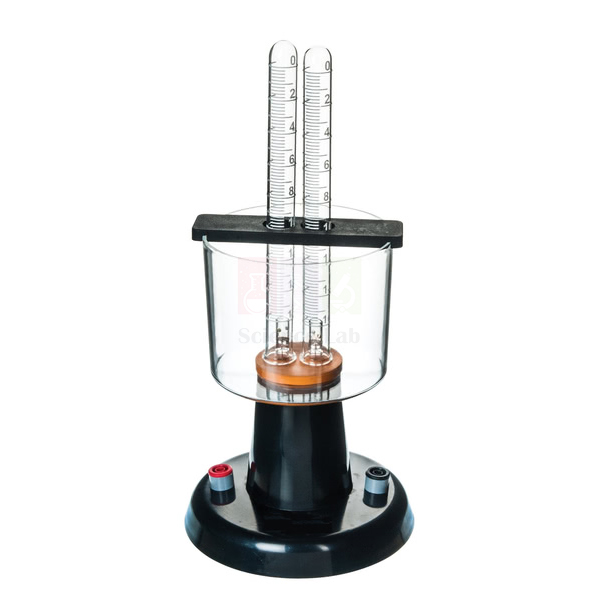
Voltameter
Voltameter (Product Code: SLE/CH/179) is a compact electrolysis unit with platinum electrodes and two graduated test tubes of 10ml capacity, mounted on a base with terminals for connection to a direct-current supply. Teachers use it to split water into its gases and let students compare the volumes collected at each electrode, making it a dependable piece of electrolysis apparatus for Indian school and college laboratories. It is manufactured by Jain Scientific Equipments Pvt Ltd (ScienceLab), Ambala.
Specifications
| Parameter | Detail |
|---|---|
| Electrodes | Platinum |
| Gas collection | Two graduated test tubes |
| Tube capacity | 10ml each |
| Mounting | Mounted on base with terminals |
Typical Use
For the classic electrolysis of water, water made conductive by a little dilute acid is placed around the electrodes, the two graduated tubes are filled completely and inverted over the platinum electrodes, and a low-voltage DC supply is connected to the terminals. Bubbles rise at both electrodes almost at once, and after a few minutes students can read the volumes directly from the graduations: the tube over the negative electrode collects hydrogen at roughly twice the volume of oxygen gathered over the positive electrode.
Platinum is used because it is inert and is not eaten away during electrolysis, so the only products are the gases themselves and the electrodes last for many sessions. The unit also supports simple quantitative work, such as showing that the volume of gas grows with the time the current flows. Switch off the supply before either tube empties completely, confirm the gases with a glowing or lighted splint away from the supply, and rinse the apparatus with clean water after the lesson without touching or bending the electrodes.
Manufacturer
This voltameter is made by Jain Scientific Equipments Private Limited, the Ambala, Haryana manufacturer that trades as ScienceLab and builds electrochemistry and general science apparatus for educational laboratories. More about the company is available on our company profile.
Related Chemistry Lab Equipment
Useful items for powering the voltameter or extending electrolysis work:
- Power Supply Variable — a DC source that lets students vary the current and compare gas output.
- Connecting Wire — to link the terminals to the power supply.
- Hoffman Voltameter — a larger alternative for demonstrations to a whole class.
- Voltameter, Copper — for studying electrolysis through the mass of copper deposited.
See more in our Chemistry Lab Equipment category.
Frequently Asked Questions
What are the electrodes made of?
Platinum, which stays unchanged during electrolysis and gives clean gas collection.
How much gas can each tube hold?
Each of the two graduated test tubes has a capacity of 10ml, so volumes can be read directly without a separate measuring cylinder.
Is a power supply included?
No power supply is listed. Connect a low-voltage DC source to the terminals on the base; ask us if you would like one quoted with the voltameter.
How is this different from a Hoffman voltameter?
This unit uses two graduated test tubes over electrodes mounted on a base, making it compact for student benches, whereas a Hoffman voltameter is a larger all-glass apparatus often used for class demonstrations.
How should the platinum electrodes be looked after?
Rinse them with clean water after use, avoid touching or bending them and never scrape them with abrasives.
Is a calibration certificate or warranty provided?
Please discuss documentation and warranty terms with us through our contact page; they are confirmed with each quotation.
Request a Quote
To order the Voltameter for your laboratory in India or abroad, send your requirement through our contact page or add it to the enquiry cart along with a power supply and leads.
Last updated: 24 September 2026
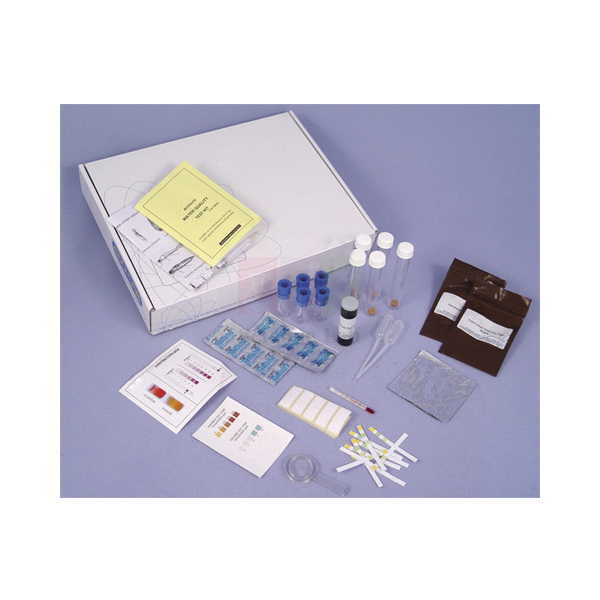
Water Monitoring Kit, Microscience
Water Monitoring Kit, Microscience (Product Code: SLE/CH/180) gives students a simple and safe way to carry out basic water quality tests, with enough equipment for most of the chemical tests on ten different water samples. Its written material is aimed at surface water from rivers and dams, and it helps learners decide whether a source is in good, fair or bad condition and what could be done to improve it. A hands-on environmental science kit for schools, it is manufactured by Jain Scientific Equipments Pvt Ltd (ScienceLab), Ambala.
Specifications
| Parameter | Detail |
|---|---|
| Type | Microscience basic water quality testing kit |
| Sample capacity | Equipment for most of the chemical tests on ten different water samples |
| Written material | Applies to surface water from rivers and dams; some tests can also be done on ground water |
| Residual chlorine test | Applies to treated water only |
| Outcome | Classifies the water tested as good, fair or bad condition |
| Nature of results | Rough qualitative guide for educational purposes only; samples require confirmatory testing at a recognised reference centre |
Typical Use
The kit works best as a project that takes students out of the classroom. Groups collect samples from a nearby river, pond, dam or borewell, label each one with the place, date and time, and bring them back to run the chemical tests using the microscale equipment. Because the kit covers ten different samples, a class can compare upstream and downstream points, or a natural source against treated tap water, where the residual chlorine test becomes meaningful.
Once the results are recorded, students rate each source as good, fair or bad and suggest practical actions, from reducing waste dumping to improving local treatment, which links chemistry to the lives of the people who depend on that water. Teachers should stress that the kit gives a rough qualitative guide only and that any real concern must be confirmed by a recognised reference centre. Wear gloves when handling untreated water, keep samples cool and covered until testing, and wash hands afterwards.
Manufacturer
Jain Scientific Equipments Private Limited makes this kit in Ambala, Haryana, under the ScienceLab name, as part of its range of microscale and environmental science equipment for schools and colleges. The company profile explains who we are and how we support institutions.
Related Chemistry Lab Equipment
Pair the kit with these items for sampling, follow-up study and further analysis:
- Water Sampler — collects samples from below the surface of a river or dam.
- Bottle, Polyethylene, Widemouthed — convenient containers for carrying samples back to school.
- Environmental Chemistry: Water Treatment & Filtration — lets students try improving the water they have tested.
- Titration Kit, Student, Microscience — adds quantitative microscale analysis to the project.
More options are available in our Chemistry Lab Equipment category.
Frequently Asked Questions
How many water samples can be tested with one kit?
There is enough equipment to conduct most of the chemical tests on ten different water samples.
Which types of water is it suitable for?
The written material applies to surface water from rivers and dams, and some tests can also be done on ground water. The residual chlorine test applies to treated water only.
Can the results be used to declare water safe to drink?
No. Results are a rough qualitative guide for educational purposes only, and samples require confirmatory testing at a recognised reference centre.
Which individual tests does the kit cover?
Apart from residual chlorine, the individual tests are not itemised in our product details. Please ask through our contact page for the full test list.
Can consumables be replenished after ten samples?
Tell us what has been used up and we will advise on replacement items and quantities.
Do you supply schools outside India?
Yes. We supply institutions in India and international markets; include the delivery country and number of kits in your enquiry.
Request a Quote
To request pricing for the Water Monitoring Kit, Microscience, use our contact page or add it to the enquiry cart with sampling bottles and other field-work items.
Last updated: 24 September 2026
Absorption Tube
Absorption Tube (Product Code: SLE/CH/181) is a U-form tube in heavy walled, clear borosilicate glass, 125mm long and 15mm in diameter, used to hold a solid absorbent or drying agent through which a gas stream is passed. Chemistry teachers and laboratory technicians use it to dry gases and to trap water vapour or carbon dioxide in analysis experiments. Part of our borosilicate glassware for Indian school and college laboratories, it is manufactured by Jain Scientific Equipments Pvt Ltd (ScienceLab), Ambala.
Specifications
| Parameter | Detail |
|---|---|
| Material | Heavy walled borosilicate glass |
| Form | U-form |
| Colour | Clear |
| Length | 125mm |
| Diameter | 15mm |
| Properties | Heat resistant; chemical resistant |
Typical Use
The tube is packed with granules of a suitable absorbent, with a loose plug of glass wool at each end to keep the solid in place, and both limbs are closed with stoppers carrying short glass tubes. Clamped upright, it sits in the gas line between a generator and the point of collection or measurement, so the gas has to pass through the whole length of the packing. The U shape doubles the contact path in a small footprint, and the clear glass lets students see when the absorbent near the inlet is becoming spent.
In quantitative work the filled tube can be weighed before and after the gas passes, and the gain in mass gives the amount of water or carbon dioxide absorbed. Heavy walls make the tube robust enough for repeated packing and cleaning, and the borosilicate glass copes with warm gases and reactive absorbents. As with all chemistry lab glassware in India’s busy teaching labs, avoid sudden temperature changes, and empty, rinse and dry the tube after each use so old absorbent does not cake inside.
Manufacturer
ScienceLab glassware like this absorption tube comes from Jain Scientific Equipments Private Limited, a laboratory apparatus company in Ambala, Haryana, serving teaching and training laboratories. Background on the company is available on our company profile.
Related Chemistry Lab Equipment
Items used with the absorption tube in a typical gas drying set-up:
- Absorption Tube with Side Arms — the variant with side arms for direct tubing connections.
- Calcium Chloride Tube, Borosilicate Glass — a straight drying tube for protecting apparatus from moisture.
- Calcium Chloride — a common drying agent for packing the tube.
- Rubber Tubing — links the tube into the gas line.
- Universal Clamp — holds the tube steady on a retort stand.
Find more glassware and apparatus in our Chemistry Lab Equipment category.
Frequently Asked Questions
What are the dimensions of the Absorption Tube?
It is 125mm long with a diameter of 15mm.
What glass is it made from?
Heavy walled, clear borosilicate glass that is heat resistant and chemical resistant.
Are stoppers supplied with the tube?
Stoppers are not listed with this item. Tell us through our contact page if you would like suitable stoppers quoted.
Which absorbent should I use?
It depends on the gas. Anhydrous calcium chloride is a common choice for drying many gases but is not suitable for ammonia, so check your practical guide before packing.
How is it different from the side-arm version?
This is the plain U-form tube, closed with stoppers at the limbs; the side-arm version has side arms of about 6mm diameter for connecting tubing directly.
Can laboratories order it in quantity?
Yes. We supply glassware in institutional quantities to customers in India and international markets; include the quantity required in your enquiry.
Request a Quote
For the Absorption Tube, send the quantity and delivery details through our contact page or add it to the enquiry cart with tubing, clamps and drying agent.
Last updated: 24 September 2026
Absorption Tube with Side Arms
Absorption Tube with Side Arms (Product Code: SLE/CH/182) is a heavy walled, clear borosilicate glass U-tube fitted with side arms of approximately 6mm diameter, so it can be plugged straight into a gas train with flexible tubing. It is used by chemistry departments and analytical teaching labs to dry a gas or absorb a component such as water vapour or carbon dioxide while the gas flows continuously through the packing. This piece of borosilicate laboratory glassware in India is manufactured by Jain Scientific Equipments Pvt Ltd (ScienceLab), Ambala.
Specifications
| Parameter | Detail |
|---|---|
| Material | Heavy walled borosilicate glass |
| Form | U-form with side arms |
| Side arm diameter | Approximately 6mm |
| Colour | Clear |
| Properties | Heat resistant; chemical resistant |
Typical Use
With side arms, the gas connections and the filling openings are separate. The absorbent is poured in through the top of each limb, held with a small plug of glass wool and sealed with solid stoppers, while the incoming and outgoing gas lines slide onto the side arms. When the packing is spent, the stoppers come out for refilling without disturbing the tubing, which saves time when a gas train has several stages such as washing, drying and absorption in sequence.
This layout suits combustion and absorption experiments, where one tube collects water and a second collects carbon dioxide, and each is weighed before and after to find the mass absorbed. The heavy walls stand up to repeated handling, and the transparent glass lets the operator watch the absorbent change as it works through the tube. Support the tube with a clamp rather than letting it hang on the tubing, and slide tubing onto the side arms gently with a little water as a lubricant to avoid strain on the glass.
Manufacturer
Jain Scientific Equipments Private Limited, trading as ScienceLab, produces laboratory glassware and teaching apparatus in Ambala, Haryana for schools, colleges and technical institutes. Visit our company profile for an overview of the company.
Related Chemistry Lab Equipment
Other items that commonly sit in the same gas train:
- Absorption Tube — the plain U-form version, 125mm long and 15mm in diameter.
- Absorption Tower Calcium Chloride — a larger drying column for higher gas flows.
- Gas Washing Bottle — scrubs the gas with a liquid before it reaches the solid absorbent.
- Glass Combustion Tube — where a sample is burned before its products are absorbed.
- Three Prong Swivel Clamp — supports the tube at the right angle on a stand.
Explore more in our Chemistry Lab Equipment category.
Frequently Asked Questions
What size are the side arms?
They are approximately 6mm in diameter. Choose flexible tubing whose bore grips that size snugly.
What is the overall length of the tube?
An overall length is not stated in our product details. Please ask through our contact page if the tube must fit a particular set-up.
Why choose side arms instead of a plain U-tube?
Side arms keep the gas connections separate from the filling openings, so the absorbent can be changed without dismantling the tubing.
Is the glass suitable for warm gases and reactive absorbents?
Yes. It is heavy walled borosilicate glass that is heat resistant and chemical resistant; still avoid sudden temperature shocks.
Are stoppers included?
Stoppers are not listed with this tube. We can quote suitable ones on request.
What should a laboratory include in a quotation request?
The quantity, any accessories wanted and the delivery address. We supply institutions in India and international markets.
Request a Quote
To price the Absorption Tube with Side Arms, contact us via the contact page or add it to the enquiry cart with the rest of your gas-train glassware.
Last updated: 24 September 2026
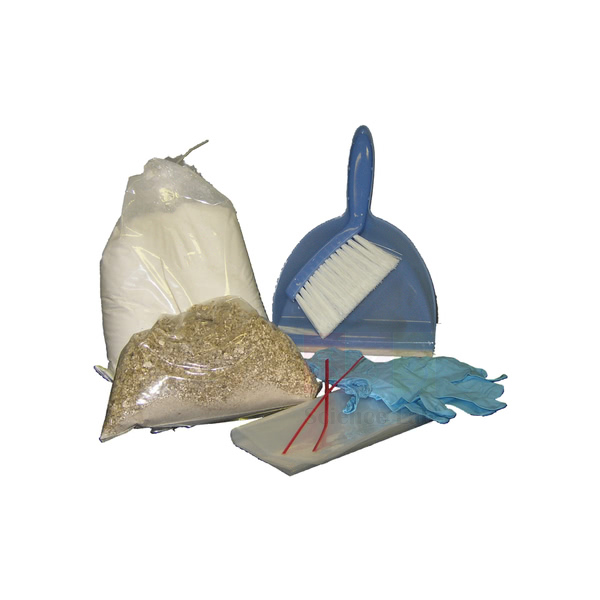
Acid Spill Clean Up Kit
Acid Spill Clean Up Kit (Product Code: SLE/CH/183) brings together what a laboratory needs to deal with a spilled acid quickly: a neutralising mixture with litmus powder, vermiculite absorbent, vinyl gloves, a dustpan and brush, and bags, ties and tags for packing the waste. Kept beside the acid store or fume cupboard, it lets teachers and technicians respond within moments instead of hunting for materials. An essential safety item among chemistry lab equipment for schools in India, it is supplied by Jain Scientific Equipments Pvt Ltd (ScienceLab), Ambala.
Specifications
| Parameter | Detail |
|---|---|
| Neutraliser | 1 bag neutralising mixture (Calcium Hydroxide, Sodium Carbonate, Calcium Carbonate & Litmus Powder) |
| Absorbent | 1 bag vermiculite absorbant |
| Hand protection | 2 vinyl exam gloves |
| Collection tools | 1 dustpan and brush |
| Waste packaging | 4 empty 225 x 400mm polybags, 4 twist ties, 4 blank shipping tags |
| Documentation | Instruction sheet/MSDS |
Typical Use
When an acid is spilled, clear people away from the area, put on the vinyl gloves along with eye protection, and read the instruction sheet if anyone is unsure of the steps. Work the neutralising mixture over the spill from the edges towards the centre so the liquid is not spread further. The litmus powder in the mixture gives a visible colour cue as the acid is neutralised, and more mixture can be added until the whole area shows the change. Vermiculite then soaks up the remaining liquid so it can be swept rather than mopped.
Use the dustpan and brush to transfer the treated material into one of the polybags, close it with a twist tie and write the contents and date on a blank tag before passing it on for disposal in line with your institution’s waste procedures. Four bags, ties and tags allow the waste to be divided into manageable loads. After any use, restock the consumed items so the kit is ready for the next incident, and include it in routine safety checks alongside eyewash and first aid provisions, supporting good waste disposal practice in the lab.
Supplier
Jain Scientific Equipments Private Limited, operating as ScienceLab from Ambala, Haryana, supplies this spill kit as part of the safety range it provides to school and college laboratories. For vendor registration, procurement teams can note the company’s GSTIN 06AAECJ8618A1ZT and its DGFT Importer-Exporter Code AAECJ8618A, under which overseas orders are dispatched. Further details are on our company profile.
Related Chemistry Lab Equipment
Complete your spill-response and acid-handling provisions with these items:
- Caustic Spill Clean Up Kit — for alkali spills, which need a different neutraliser.
- Solvent Spill Clean Up Kit — for organic solvent spills in the same laboratory.
- Acid Storage Cabinet Vertical — safe storage that reduces the chance of spills in the first place.
- Safety Goggles — eye protection to wear while treating a spill.
- Acid Proof Aprons, Lab Coat, Pants, Shoe Covers and Sleeves — body protection for staff handling acids.
Browse more safety and laboratory items in our Chemistry Lab Equipment category.
Frequently Asked Questions
What is inside the Acid Spill Clean Up Kit?
An instruction sheet/MSDS, 2 vinyl exam gloves, 4 blank shipping tags, 4 empty 225 x 400mm polybags, 4 twist ties, 1 dustpan and brush, 1 bag of vermiculite absorbent and 1 bag of neutralising mixture.
What does the neutralising mixture contain?
Calcium hydroxide, sodium carbonate, calcium carbonate and litmus powder; the litmus helps show when the acid has been neutralised.
Can it be used for alkali or solvent spills?
No. It is intended for acid spills. Use the caustic spill kit for alkalis and the solvent spill kit for organic solvents.
How large a spill can one kit treat?
A treatment capacity is not stated in our product details. Ask us through our contact page, and consider keeping more than one kit where large volumes of acid are stored.
Are refill materials available after the kit is used?
The dustpan and brush can be cleaned and reused, but the gloves, absorbent and neutraliser must be replaced. Contact us to discuss refills or a replacement kit.
Can you supply kits for several laboratories?
Yes. We supply institutions across India and international markets; tell us how many kits and delivery points you need.
Request a Quote
To equip your laboratory with the Acid Spill Clean Up Kit, send your requirement through our contact page or add it to the enquiry cart alongside caustic and solvent spill kits for a complete quotation.
Last updated: 24 September 2026
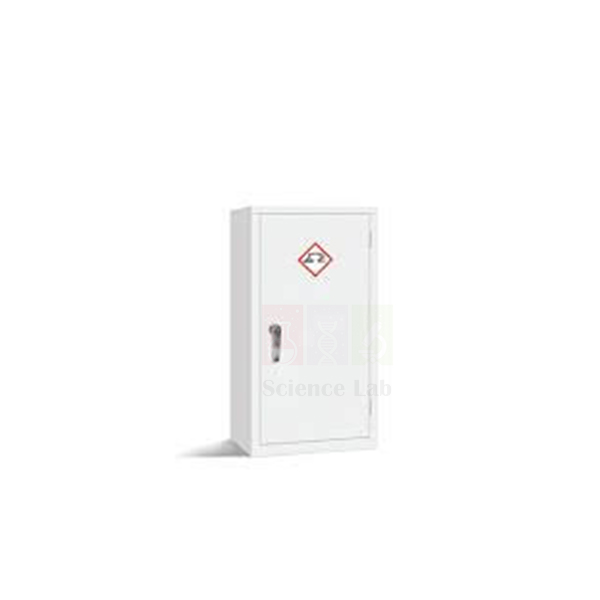
Acid Storage Cabinet Vertical
Acid Storage Cabinet Vertical (Product Code: SLE/CH/184) is an upright, robustly built cabinet for keeping bottles of acid locked away in one place in a school, college or research chemistry laboratory. Reinforced doors, a 3 point locking system and a leak proof sump let laboratory staff control who can reach corrosive stock and keep drips inside the unit instead of on the floor. It works as a dedicated chemistry reagent cabinet for acids and is made by Jain Scientific Equipments Pvt Ltd (ScienceLab), Ambala.
Specifications
| Parameter | Detail |
|---|---|
| Type | Vertical acid storage cabinet |
| Construction | Robust construction with reinforced doors |
| Finish | Powder coated paint finish |
| Door handle | Chrome |
| Locking | 3 point locking system |
| Spill containment | Leak proof sump, 30 Ltr |
| Shelves | 1 |
| Dimensions (H x W x D) | 710 x 915 x 457 mm |
Typical Use
Most chemistry departments place this cabinet in the preparation room, close to where dilute acids are made up before practical classes. Stock bottles stand on the single shelf and on the base, so if a cap loosens or a bottle cracks, the liquid runs into the 30 litre sump rather than across the room. Because the doors lock at three points, the laboratory in-charge can keep concentrated acids out of reach of students between lessons, which makes it a sensible lab storage cabinet for Indian school and college prep rooms.
Good practice is to store acids apart from alkalis and flammable solvents, label the shelf edge with what belongs there, and look into the sump during routine checks. If liquid has collected, neutralise and clean it out according to your laboratory safety procedure before returning the bottles. The 710 mm height and 457 mm depth give a compact footprint, so measure the space you have in mind before ordering.
Manufacturer
This cabinet is produced by Jain Scientific Equipments Private Limited, the Ambala, Haryana company that trades under the ScienceLab name and builds apparatus and storage for teaching laboratories. Background on the company, its facilities and the range it offers is available on the ScienceLab company profile.
Related Chemistry Lab Equipment
Items often ordered together with a vertical acid cabinet when a prep room is being organised:
- Acids Storage Cabinet — a two-door white metal alternative, also with a leak proof sump.
- Hazardous Storage Cabinet Horizontal — for hazardous chemicals that should be kept apart from acids.
- Acid Spill Clean Up Kit — for acid spills that happen outside the cabinet, for example on the bench.
- Safety Goggles — eye protection while decanting from stock bottles.
More storage and handling items are listed in the Chemistry Lab Equipment category.
Frequently Asked Questions
What size is the Acid Storage Cabinet Vertical?
It measures 710 mm high, 915 mm wide and 457 mm deep (H x W x D) and has one shelf above a 30 Ltr leak proof sump.
What does the leak proof sump do?
It catches liquid that escapes from a leaking or broken bottle so the spill stays inside the cabinet. It should be inspected regularly and cleaned out safely whenever anything has collected in it.
Can acids and alkalis share this cabinet?
It is better not to. Follow your institution’s chemical storage rules and the safety data sheet for each chemical; many laboratories keep acids and alkalis in separate cabinets.
Is this cabinet meant for flammable solvents?
It is described for acid storage. If you also need storage for flammables or other hazardous chemicals, tell us your requirement through the contact page and we will advise on the options in our range.
What warranty applies?
Warranty terms are confirmed in writing with your quotation. Please ask through the contact page if you need them before placing an order.
What should an institutional enquiry include?
The quantity, delivery address, whether you want this vertical model or the two-door version, and any tender or purchase-order format your institution uses.
Do you supply outside India?
Yes. ScienceLab supplies institutions across India and in international markets; packing and shipping arrangements are agreed when the quotation is prepared.
Request a Quote
For a quotation on the Acid Storage Cabinet Vertical, send your requirement through our contact page, or add it to the enquiry cart with any other laboratory items you need.
Last updated: 24 September 2026
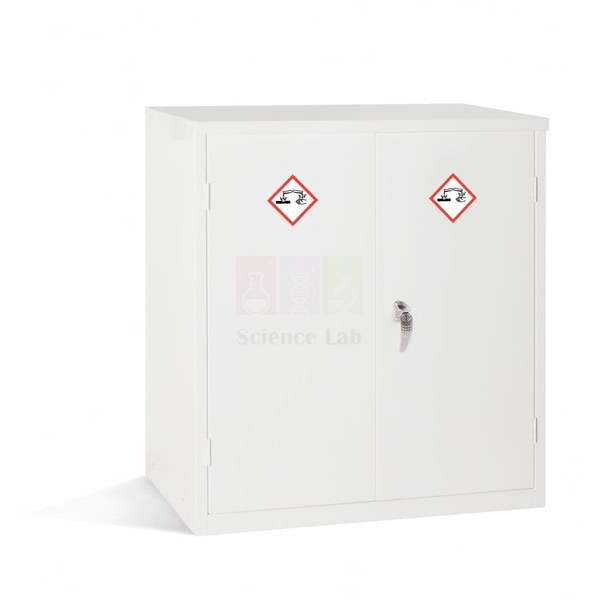
Acids Storage Cabinet
Acids Storage Cabinet (Product Code: SLE/CH/185) is a white, rectangular metal cabinet with two doors, built to hold a laboratory’s stock of acids in a stable, enclosed space. Its leak proof sump keeps any spillage contained within the cabinet, which protects floors, neighbouring furniture and the people working nearby. Laboratory managers use it as a practical piece of laboratory furniture for chemistry prep rooms in schools, colleges and testing labs. It is made by Jain Scientific Equipments Pvt Ltd (ScienceLab), Ambala.
Specifications
| Parameter | Detail |
|---|---|
| Material | Metal |
| Shape | Rectangular |
| Colour | White |
| Number of doors | 2 |
| Spill containment | Leak proof sump inside the cabinet |
| Design | Robust metal body designed for good structural stability |
Typical Use
The two-door layout gives wide access to the interior, so stock bottles at the back can be reached and lifted out without moving everything in front of them. Teachers and lab assistants typically group acids by type inside the cabinet, keep the labels facing forward, and close the doors after every use so fumes and accidental knocks are kept to a minimum. Because the sump sits at the base, a slow leak shows up as liquid in the sump rather than as corrosion on the floor, which gives staff an early warning to replace a damaged bottle. It is one of the basic pieces of chemistry lab equipment for schools in India that are setting up or upgrading a preparation room.
Place the cabinet on a level floor away from heat sources and direct sunlight, and keep alkalis, oxidisers and flammable liquids in separate storage. The white finish makes stains and residues easy to spot, so wipe the inside down during routine housekeeping.
Manufacturer
ScienceLab is the brand used by Jain Scientific Equipments Private Limited, a private limited company in Ambala, Haryana that designs and makes equipment and storage for educational and research laboratories. You can read about the company on its profile page.
Related Chemistry Lab Equipment
Other items that help complete safe chemical storage and spill response in the same room:
- Acid Storage Cabinet Vertical — a single-shelf vertical model with 3 point locking and a 30 Ltr sump.
- Hazardous Storage Cabinet Vertical Two Door — separate storage for hazardous chemicals that should not sit with acids.
- Caustic Spill Clean Up Kit — for alkali spills, since alkalis are stored away from this cabinet.
- Spill Pack — general spill response kept close to the storage area.
- Apron, PVC — body protection while moving acid bottles.
Browse the Chemistry Lab Equipment category for further apparatus and storage.
Frequently Asked Questions
How many doors does the Acids Storage Cabinet have?
Two. The double-door front gives wide access for loading and removing bottles.
What are the internal dimensions and shelf arrangement?
Exact dimensions and shelving are not listed on this page. Please ask through the contact page and we will confirm them with your quotation.
How is a spillage contained?
The cabinet has a leak proof sump that holds spilled liquid inside the cabinet, so it can be neutralised and cleaned up without spreading.
How is this different from the Acid Storage Cabinet Vertical?
This model is a white, two-door metal cabinet; the vertical model is an upright, single-shelf cabinet with 3 point locking and its own sump; its dimensions are given on its product page. Choose based on the space and access you need.
How should the cabinet be cleaned?
Empty the affected area, neutralise any acid residue following your lab safety procedure, then wipe the surfaces and sump with water and a mild detergent and dry them before restocking.
Can you supply several cabinets for a school group or tender?
Yes. Share the quantity, delivery locations and tender terms, and we will prepare a combined quotation for institutions in India or international markets.
Request a Quote
To get a price for the Acids Storage Cabinet, write to us via the contact page or place it in the enquiry cart along with the rest of your laboratory list.
Last updated: 24 September 2026
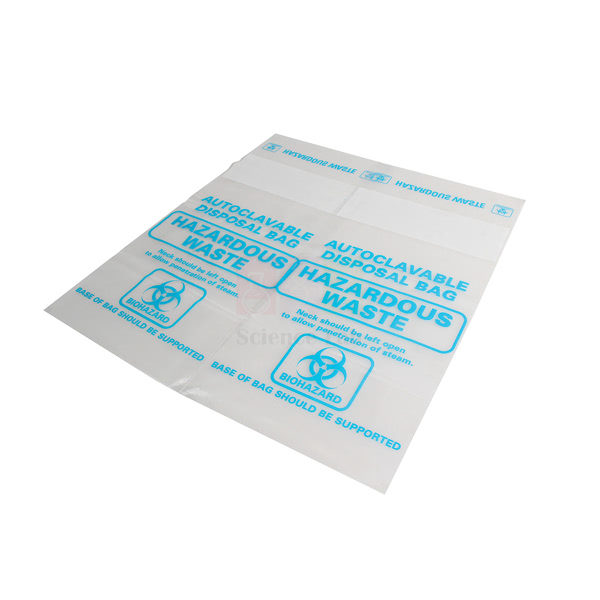
Autoclave Bag Disposable
Autoclave Bag Disposable (Product Code: SLE/CH/186) is a single-use, high temperature bag for collecting contaminated laboratory waste and sterilising it in an autoclave before disposal. Made from heavy gauge polypropylene, each 400 x 600 mm bag can go through autoclave cycles up to 132 °C and carries blue biohazard markings so everyone in the lab recognises it as biological waste. Microbiology, biology and clinical teaching labs use it for used culture plates, swabs and tips, and it is a routine item of disposable lab equipment supplied by Jain Scientific Equipments Pvt Ltd (ScienceLab), Ambala.
Specifications
| Parameter | Detail |
|---|---|
| Material | Heavy gauge polypropylene |
| Type | High temperature autoclave bag, disposable |
| Dimensions | 400 x 600 mm |
| Maximum autoclave temperature | Up to 132 °C (270 °F) |
| Markings | Blue biohazard markings |
| Write-on area | White panel on each bag for notes |
| Pack size | 200 bags |
Typical Use
At the end of a microbiology practical, students drop used Petri dishes, cotton swabs, disposable loops and gloves into one of these bags, usually held open in a bin or autoclave basket on the bench. The technician writes the date, lab room and batch on the white panel, closes the neck loosely so steam can get in, and loads the bag into the autoclave. After the cycle and cooling, the treated waste goes out through the institution’s normal waste disposal route. The 400 x 600 mm size suits a bench-side bin or a small to medium autoclave chamber.
Stand the bag in a rigid tray or basket during the cycle so it cannot sag against the chamber wall, never overfill it, and keep needles or broken glass in a separate puncture-proof container. Stay within the 132 °C limit stated for the bag.
Supplier
These bags are supplied by Jain Scientific Equipments Private Limited, which trades as ScienceLab from Ambala in Haryana and provides consumables alongside the apparatus it offers to teaching and research laboratories. The company profile explains more about the business.
Related Chemistry Lab Equipment
Items used in the same sterilise-and-dispose workflow:
- Autoclave Bag — the larger 610 x 810 mm bag for bigger loads and chambers.
- Autoclave Tape — sterilisation indicator tape for marking each loaded bag.
- Autoclave Basket — holds the bag upright inside the chamber.
- Autoclave Stainless Steel — an autoclave for running the sterilisation cycle.
- Gloves W/o Powder Nitrile Disposable — hand protection while handling contaminated waste.
See the Chemistry Lab Equipment category for more laboratory consumables and accessories.
Frequently Asked Questions
How many bags are in a pack?
Each pack contains 200 disposable bags of 400 x 600 mm.
What temperature can the bags withstand?
They are autoclavable up to 132 °C (270 °F). Do not use them in cycles above that temperature.
Can a bag be reused after autoclaving?
No. They are disposable bags meant for one cycle, after which the treated waste and bag are discarded together.
What should be written on the white panel?
Most labs note the date, room or course, and the person responsible, so each bag can be traced through the sterilisation record. Use a marker that stays legible after autoclaving.
Which size should I choose, this or the Autoclave Bag?
This bag is 400 x 600 mm; the Autoclave Bag listing is a larger size. Match the bag to your bin and to the usable depth of your autoclave chamber.
Can you supply regular bulk quantities?
Yes. Tell us your expected monthly or annual usage through the contact page and we will quote for delivery in India or to international markets.
Request a Quote
Request pricing for the Autoclave Bag Disposable through the contact page, or add packs to the enquiry cart with your other microbiology consumables.
Last updated: 24 September 2026
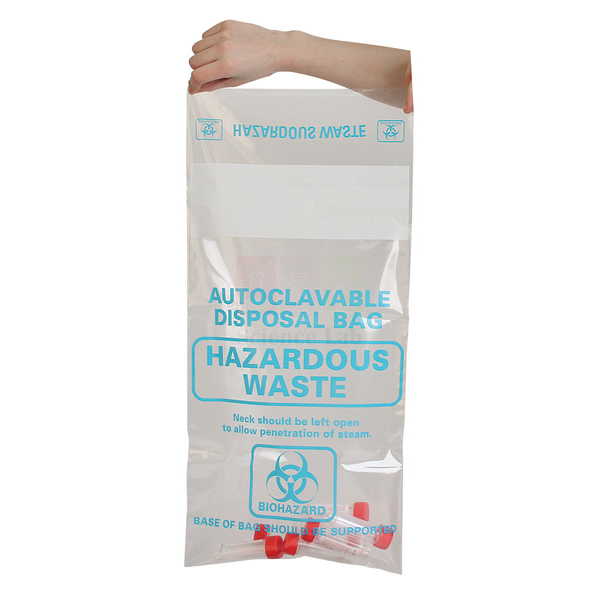
Autoclave Bag
Autoclave Bag (Product Code: SLE/CH/187) is the large-format, 610 x 810 mm version of ScienceLab’s high temperature waste bag, intended for departments that collect contaminated material from several benches and sterilise it in one load. The bag is made from heavy gauge polypropylene, is autoclavable up to 132 °C (270 °F), and is printed with blue biohazard markings. It suits colleges, hospitals’ teaching labs and research groups across India that run an autoclave sterilizer daily, and it is supplied by Jain Scientific Equipments Pvt Ltd (ScienceLab), Ambala.
Specifications
| Parameter | Detail |
|---|---|
| Dimensions | 610 x 810 mm |
| Material | Heavy gauge polypropylene |
| Temperature rating | Autoclavable up to 132 °C (270 °F) |
| Markings | Blue biohazard markings |
| Labelling | White panel for writing notes directly on the bag |
| Use | Disposable |
| Pack | Pack of 200 |
Typical Use
Where waste from a whole practical session or a research group is gathered in one place, a 610 x 810 mm bag lines a larger collection bin at the end of the room. Once the day’s culture plates, pipette tips and contaminated paper towels are in, a technician records the source and date on the white panel, marks the bag with indicator tape and carries it to the autoclave in a secondary tray. Treating one large bag per cycle instead of several small ones keeps sterilisation records simple and makes the autoclave part of a clear waste disposal lab routine.
Before buying, check that a filled bag will fit the chamber of your autoclave with room for steam to circulate. Fill to about two-thirds, avoid pressing air out tightly, and let the load cool fully before the bag is moved to general disposal. Keep sharps in rigid containers rather than in the bag.
Supplier
Jain Scientific Equipments Private Limited, which operates under the ScienceLab name from Ambala, Haryana, supplies this bag as part of the consumables it provides with its laboratory apparatus. For purchase departments that need vendor registration details, the company’s GSTIN is 06AAECJ8618A1ZT and its Legal Entity Identifier (LEI) is 3358004HRD1JIVXKYX49. Further background is on the company profile.
Related Chemistry Lab Equipment
Useful items for the same collection and sterilisation cycle:
- Autoclave Bag Disposable — the smaller 400 x 600 mm bag for bench-side bins.
- Autoclave Tape — indicator tape to show that a bag has been through a cycle.
- Electric Autoclave — for sterilising the filled bags.
- Classic Standard Autoclave — another autoclave option for departmental waste.
- Petri Dish, Triple Vent — the kind of culture ware that ends up in the bag after a practical.
For other consumables and apparatus, visit the Chemistry Lab Equipment category.
Frequently Asked Questions
What size is the Autoclave Bag?
610 x 810 mm, which is the larger of the two autoclave bag sizes listed by ScienceLab.
Will it fit my autoclave?
That depends on your chamber. Compare the usable depth and diameter of the chamber with a loosely filled 610 x 810 mm bag; for smaller chambers the smaller Autoclave Bag Disposable may be the better choice.
Why are the markings blue?
The blue biohazard print identifies the contents as biological waste at a glance, so staff handle the bag with care before and after the cycle.
How should the bag be closed for autoclaving?
Close the neck loosely, for example with a loose fold or tie, so steam can penetrate the load. Seal it fully only after the cycle, if your disposal procedure requires it.
Can I get vendor registration documents for our purchase file?
Yes. GSTIN and LEI details are given above, and other documents your institution needs can be requested through the contact page.
Do you ship packs of 200 in larger quantities?
Yes. Let us know how many packs you need and the delivery location in India or abroad, and we will include packing and freight in the quotation.
Request a Quote
Send your requirement for the Autoclave Bag via our contact page, or collect it with other items in the enquiry cart and submit one enquiry.
Last updated: 24 September 2026
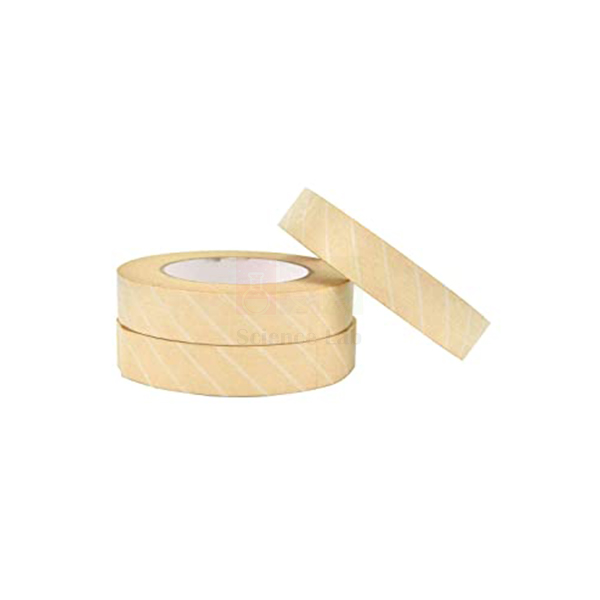
Autoclave Tape
Autoclave Tape (Product Code: SLE/CH/188) is a self-adhesive sterilisation indicator tape made of semicreped paper, used to seal and mark items before they go into an autoclave so that processed and unprocessed loads can be told apart at a glance. Each reel is 50 m long and 25 mm wide, the tape stays affixed for 18 months, and it sticks to plastic, metal, fabric, paper and cardboard. It is a small but constant item of microbiology lab equipment in teaching, clinical and research laboratories, supplied by Jain Scientific Equipments Pvt Ltd (ScienceLab), Ambala.
Specifications
| Parameter | Detail |
|---|---|
| Type | Self-adhesive sterilisation indicator tape |
| Material | Semicreped paper |
| Reel size | 50 m x 25 mm |
| Adhesion life | Remains affixed for 18 months |
| Suitable surfaces | Plastic, metal, fabrics, paper, cardboard |
Typical Use
Technicians tear off a strip to close a wrapped instrument pack, to hold foil over the mouth of a flask of culture medium, or to mark a filled waste bag before loading the autoclave. After the cycle, the indicator markings show which items have been exposed to the sterilisation process, so nobody mistakes a fresh bundle of media bottles for one still waiting to be processed. Because the tape grips cloth wraps, glass, metal trays and cardboard alike, a single reel covers most of the jobs in a prep room, and labs usually order it together with their other lab consumables.
Apply the tape to a clean, dry surface and press it down firmly along its length. The semicreped paper stretches slightly, which helps it follow the curve of a bottle neck or the fold of a wrap. Keep spare reels in a cool, dry cupboard away from steam lines.
Supplier
Autoclave Tape is supplied by Jain Scientific Equipments Private Limited, an Ambala, Haryana company whose trading name is ScienceLab and which equips school, college and research laboratories with apparatus and day-to-day supplies. Read more on the about the company page.
Related Chemistry Lab Equipment
Items the tape is most often used with:
- Autoclave Bag Disposable — 400 x 600 mm waste bags that are marked with tape before a cycle.
- Autoclave Bag — the larger 610 x 810 mm waste bag.
- Autoclave Basket — for loading taped items into the chamber.
- Portable Autoclave Single Drum — a compact autoclave for school and college labs.
- Petri Dish Glass With Lid — glassware commonly bundled and taped for sterilisation.
The Chemistry Lab Equipment category lists more accessories for the prep room.
Frequently Asked Questions
How much tape is on one reel?
Each reel holds 50 m of 25 mm wide tape.
Does a changed indicator mean the item is sterile?
No. Indicator tape shows that an item has been through the sterilisation process; it does not by itself prove sterility. Follow your laboratory’s validation procedure for confirming autoclave performance.
How long will the tape stay stuck?
The tape is listed to remain affixed for 18 months once applied.
What surfaces can it be used on?
Plastic, metal, fabrics, paper and cardboard. Surfaces should be clean and dry for good adhesion.
Can I write on the tape?
It is made of semicreped paper. If you plan to write dates or initials on it, test your pen or marker on a strip first to see how it survives a cycle.
Is a data sheet or test report available?
Please ask through the contact page and we will tell you what documentation can be provided with your order.
Can you supply reels in bulk?
Yes. Share your annual usage and delivery location, in India or abroad, and we will quote accordingly.
Request a Quote
Ask for a quotation on Autoclave Tape using the contact page, or add reels to the enquiry cart together with autoclave bags and other supplies.
Last updated: 24 September 2026

Bags, Grip-Seal
Bags, Grip-Seal (Product Code: SLE/CH/189) are small, resealable laboratory bags measuring 100 x 140 mm, each printed with 3 white writing strips so the contents can be identified without a separate label. They are made from LDPE (low density polyethylene) with good clarity, so samples stay visible through the bag. Science departments, field-study groups and research labs use them to store and sort dry samples, weighed portions and small parts, and they come in packs of 1000 as part of the lab consumables range supplied by Jain Scientific Equipments Pvt Ltd (ScienceLab), Ambala.
Specifications
| Parameter | Detail |
|---|---|
| Type | Grip-seal (press-to-close) bag for laboratory use |
| Material | LDPE (Low Density Polyethylene), high clarity |
| Dimensions | 100 x 140 mm |
| Writing area | 3 white writing strips on each bag |
| Pack size | 1000 bags |
Typical Use
On a soil or ecology field trip, each student group can drop a sample into its own bag, press the seal shut and fill in the three strips with site number, date and collector name. Back in the lab, the same bags hold pre-weighed portions of salts for a practical, seeds for a germination trial, rock chips for identification, or spare screws and fittings from apparatus. The clear LDPE lets a teacher check the contents without opening the bag, which keeps moisture out and cuts down on spills. Like other lab plastic ware used in bulk, a pack of 1000 lasts a department through many classes.
Write on the strips before filling if possible, using a permanent marker, and squeeze out excess air before sealing. These bags are meant for dry or solid material; keep liquids and corrosive chemicals in proper bottles or specimen containers, and store unused bags away from direct sunlight and heat.
Supplier
Grip-seal bags are supplied by Jain Scientific Equipments Private Limited, known in the market as ScienceLab, from its base in Ambala, Haryana, alongside the teaching-laboratory apparatus the company produces. Company details are on the ScienceLab profile.
Related Chemistry Lab Equipment
Items that fit the same sampling, weighing and storage routine:
- Bag Resealable Small Plastic — another resealable bag option for small items.
- Specimen Container, PP — a rigid container for samples that need more protection than a bag.
- Spatula, Spoon End — for transferring powders and granules into the bags.
- Weighting Tray — for weighing portions before they are bagged.
- Storage Boxes – Rock – Mineral Specimens — for organising bagged rock and mineral samples.
More consumables are listed under Chemistry Lab Equipment.
Frequently Asked Questions
What size are the grip-seal bags?
Each bag measures 100 x 140 mm.
How many bags come in a pack?
A pack contains 1000 bags.
What are the white strips for?
There are 3 white writing strips on each bag for sample number, date, name or any other notes, so no extra label is needed.
What material are they made from?
LDPE (low density polyethylene), chosen for its clarity so contents can be seen without opening the bag.
Can they be autoclaved or used for hot samples?
They are not described for autoclaving or heat. For sterilising waste, use the polypropylene autoclave bags in our range.
Are other sizes available?
This listing covers the 100 x 140 mm bag. For other sizes, ask through the contact page and we will tell you what can be supplied.
Can you supply several packs for a school group or export order?
Yes. Give us the number of packs and the delivery location in India or overseas, and we will quote.
Request a Quote
To order Bags, Grip-Seal, contact us through the contact page, or add the packs you need to the enquiry cart.
Last updated: 24 September 2026
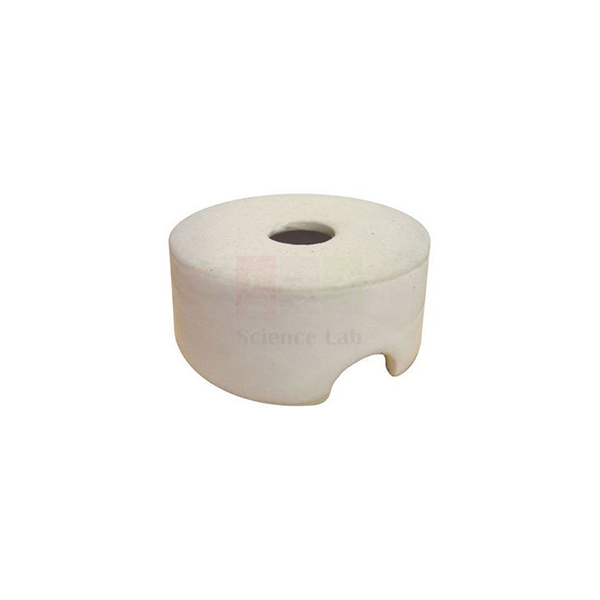
Beehive Shelves
Beehive Shelves (Product Code: SLE/CH/191) are small white porcelain stands, 75 mm in diameter, that sit under water in a pneumatic trough and support an inverted gas jar while a gas is collected over water. Glazed both inside and out, they resist staining and are easy to rinse clean between experiments. Chemistry teachers in schools and colleges rely on them as a standard part of gas collection apparatus for preparing oxygen, hydrogen and carbon dioxide in class. They are made by Jain Scientific Equipments Pvt Ltd (ScienceLab), Ambala.
Specifications
| Parameter | Detail |
|---|---|
| Material | Porcelain |
| Glazing | Glazed both inside and out |
| Colour | White |
| Diameter | 75 mm |
| Application | For use in pneumatic troughs for gas collection |
Typical Use
To collect a gas by downward displacement of water, fill the pneumatic trough, place the beehive shelf on its floor so it is covered with water, and lead the delivery tube from the reaction flask in through the opening at the side of the shelf. A gas jar filled completely with water is then inverted over the top of the shelf. As the reaction runs, bubbles rise through the shelf into the jar and push the water out; when the jar is full of gas, a cover is slid under its mouth before it is lifted away. This simple arrangement is a staple of junior science lab equipment because students can watch the gas displace the water.
Let the first few bubbles escape before placing the jar, since they are mostly air from the apparatus. After the lesson, rinse the shelf in clean water and dry it; the glazed surface does not hold residues. Porcelain can chip if dropped into a trough, so lower it in by hand.
Manufacturer
Jain Scientific Equipments Private Limited, trading as ScienceLab, is based in Ambala, Haryana and supplies apparatus for chemistry, physics and biology teaching labs. The company is incorporated under CIN U29309HR2020PTC087597 and manufactures at its licensed factory at 449, HSIIDC Industrial Area, Saha, Ambala (Factory Licence AMB-ONLINE-CHD-J-414). See the company profile for more.
Related Chemistry Lab Equipment
The rest of a gas-collection-over-water set-up:
- Pneumatic Trough — the water trough in which the beehive shelf stands.
- Gas Jar, Glass — the jar inverted over the shelf to collect the gas.
- Gas Jar Cover — closes the jar before it is lifted out of the water.
- Delivery Tube — carries gas from the generating flask into the shelf.
- Beehive Shelf, Porcelain — a separately listed porcelain beehive shelf you can compare.
Find more apparatus in the Chemistry Lab Equipment category.
Frequently Asked Questions
What diameter are the Beehive Shelves?
75 mm.
What are they made of?
White porcelain, glazed both inside and out, which keeps them smooth and easy to clean.
Will they fit my pneumatic trough and gas jars?
They are intended for use in pneumatic troughs. Check that your trough is deep enough to cover the shelf with water and that your gas jar mouth sits comfortably over a 75 mm shelf.
Which gases can be collected with them?
Gases that are not very soluble in water, such as oxygen and hydrogen, are commonly collected over water in school practicals. Very soluble gases need a different collection method.
How many should a school order?
Usually one per pneumatic trough, plus a few spares in case of breakage. Tell us how many student stations you have and we can suggest quantities.
What warranty and delivery terms apply?
These are stated in the quotation. Ask through the contact page for delivery within India or to international markets.
Request a Quote
Request a quotation for Beehive Shelves via the contact page, or add them to the enquiry cart with troughs, gas jars and delivery tubes to price the full set-up.
Last updated: 24 September 2026
Bench-Armour Interlocking Bench Mat
Bench-Armour Interlocking Bench Mat (Product Code: SLE/CH/192) is a 250 x 250 mm heat proof mat that protects laboratory benches from hot apparatus, offered as a long lasting alternative to the old asbestos sheet bench mats still found in many labs. The interlocking design lets several mats be joined into a larger protected area around a heating station. Schools and colleges place it under a tripod stand and wire gauze during Bunsen burner work, and also use it to line trays that hold glassware. It is supplied by Jain Scientific Equipments Pvt Ltd (ScienceLab), Ambala.
Specifications
| Parameter | Detail |
|---|---|
| Type | Interlocking heat proof bench mat |
| Dimensions | 250 x 250 mm |
| Shape | Rectangular |
| Key property | Heat proof and long lasting; alternative to asbestos sheet bench mats |
| Secondary use | Lining storage trays – the matting stops glass sliding and prevents damage to glassware |
Typical Use
In a heating practical, each student station gets a mat on which the Bunsen burner and tripod stand, so a hot base, a dropped gauze or a spill from a boiling tube lands on the mat and not on the laminate or wooden bench top. Where a teacher needs a wider protected zone, for instance for a demonstration with two burners or a water bath, several mats can be interlocked side by side. Replacing ageing asbestos sheet mats with these is one of the simpler lab equipment accessories upgrades a school can make, because it removes an outdated material from everyday handling.
Off the bench, the same mat laid in the bottom of a storage tray or drawer keeps beakers, flasks and test tubes from sliding into each other when the tray is carried. Let the mat cool before stacking or storing it, and wipe it with a damp cloth to remove chemical splashes.
Supplier
This bench mat is supplied by Jain Scientific Equipments Private Limited, the company behind the ScienceLab name, located in Ambala, Haryana and serving teaching and research laboratories with apparatus and accessories. Visit the company profile to learn more.
Related Chemistry Lab Equipment
Heating-station items that are used on top of this mat:
- Bunsen Burner — the heat source the mat protects the bench from.
- Tripod, Stainless Steel — supports beakers and dishes over the flame.
- Gauze Wire, Ceramic Centre — spreads heat evenly under glassware on the tripod.
- Bunsen Burner Kit — a class set of burners, gauzes, bench mats and tripods.
- Beaker Tongs — for lifting hot beakers off the tripod onto the mat.
Explore the full Chemistry Lab Equipment range.
Frequently Asked Questions
What size is the bench mat?
Each mat measures 250 x 250 mm.
Does it contain asbestos?
It is offered as an alternative to regular asbestos sheet bench mats. For the exact material composition, please ask through the contact page.
What maximum temperature can it take?
The mat is described as heat proof, but a specific temperature rating is not listed here. Contact us if your application involves very high temperatures and we will confirm suitability.
Can several mats be joined together?
Yes, it is an interlocking mat, so pieces can be connected to cover a larger working area.
Is it only for heating work?
No. It can also line storage trays, where the matting stops glassware sliding and helps prevent breakage.
How many should be ordered for a class?
Most schools order one per heating station plus spares. Share your number of student benches and we will quote for the quantity.
Request a Quote
For pricing on the Bench-Armour Interlocking Bench Mat, contact us through the contact page, or add it to the enquiry cart with burners and tripods for a combined quote.
Last updated: 24 September 2026
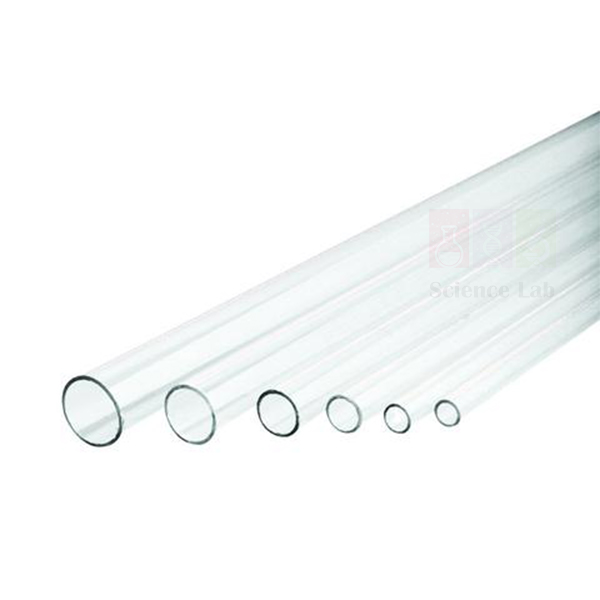
Borosilicate Glass Tubing
Borosilicate Glass Tubing (Product Code: SLE/CH/193) is clear, light-wall tubing made from borosilicate glass 3.3, the heat and chemical resistant glass used for most laboratory apparatus. Teachers, lab technicians and glassblowing students cut and shape it into delivery tubes, connectors and bends for gas preparation, distillation and other set-ups. Made from the same material as the borosilicate glassware found in labs across India, it copes with flame work and with contact with common reagents. It comes in packs of 30 and is supplied by Jain Scientific Equipments Pvt Ltd (ScienceLab), Ambala.
Specifications
| Parameter | Detail |
|---|---|
| Material | Borosilicate glass 3.3 |
| Wall | Light wall |
| Colour | Clear |
| Properties | Heat resistant, chemical resistant |
| Listed size | 6 mm (please confirm the diameter and piece length for your order when you enquire) |
| Pack size | 30 pieces |
Typical Use
A technician preparing for a gas practical scores the tubing with a tubing cutter, snaps it cleanly, fire-polishes the ends so they will not cut hands or stoppers, and then softens a section in a hot flame to bend it into a right angle or U-shape. The finished piece is pushed through a bored rubber or cork stopper to make a delivery tube, or joined to rubber tubing to connect apparatus. College students also use straight lengths to practise basic glassblowing and to draw capillaries. Keeping a pack of blanks on the shelf means a broken fitting can be replaced on the spot, which is why tubing sits alongside the rest of the chemistry lab glassware in most Indian prep rooms.
Borosilicate glass needs a hotter flame than soda glass to soften, so allow extra heating time when bending. When pushing tubing into a stopper, wet or lubricate the glass, hold it close to the stopper and protect your hand with a cloth. Let worked glass cool slowly on a heat proof mat.
Supplier
Borosilicate Glass Tubing is supplied by Jain Scientific Equipments Private Limited, whose trading name is ScienceLab; the company is based in Ambala, Haryana and provides glassware, apparatus and consumables to educational laboratories. More information is on the company profile page.
Related Chemistry Lab Equipment
Tools and fittings used when working with glass tubing:
- Glass Tubing Cutter — for scoring the tubing before breaking it to length.
- Soda Glass Tubing 6mm — a soda glass alternative that softens at a lower temperature.
- Rubber stoppers with holes of different diameters — for mounting the finished tubes in flasks.
- Rubber Tubing — for flexible joints between glass pieces.
- Delivery Tube — a ready-made option when you do not want to shape your own.
See more glassware and accessories in Chemistry Lab Equipment.
Frequently Asked Questions
What glass is the tubing made from?
Borosilicate glass 3.3, which is heat resistant and chemical resistant.
How many pieces are in a pack?
30.
What does the 6 mm size refer to?
The listing gives 6 mm as the size. Please confirm the outside diameter and piece length you need through the contact page so we quote exactly the right tubing.
Can it be bent with an ordinary Bunsen burner?
Borosilicate glass needs more heat than soda glass. A hot, well-adjusted flame and patience are needed; for frequent bending, many labs prefer a higher-temperature burner.
Is light-wall tubing suitable for vacuum work?
Light-wall tubing is intended for general connections and gas delivery. For vacuum or pressure applications, discuss your set-up with us before ordering.
Can you supply larger quantities for colleges or export?
Yes. Tell us how many packs you need and where they should be delivered, in India or abroad, and we will include suitable protective packing.
Request a Quote
Send an enquiry for Borosilicate Glass Tubing through the contact page, or place it in the enquiry cart with cutters and stoppers.
Last updated: 24 September 2026
717.jpg)
Buchner Bungs (Black)
Buchner Bungs (Black) (Product Code: SLE/CH/190) are black, 32 x 24 mm bungs that seat a Buchner funnel in the neck of a filter flask and form the seal needed for suction filtration. They save the job of boring a large hole through a rubber stopper to take the funnel stem, and they give a consistent fit each time the apparatus is assembled. Chemistry teachers and technicians use them in practicals where crystals or precipitates are filtered under reduced pressure. They come in packs of 10 and are supplied by Jain Scientific Equipments Pvt Ltd (ScienceLab), Ambala.
Specifications
| Parameter | Detail |
|---|---|
| Colour | Black |
| Dimensions | 32 x 24 mm |
| Function | Seal between the filter flask and the Buchner funnel |
| Use | For Buchner funnels, as an alternative to boring a large hole in a rubber bung |
| Pack size | 10 |
Typical Use
To set up suction filtration, clamp the filter flask, fit a bung into its neck, and push the stem of the Buchner funnel through the bung until it sits firmly. With a filter paper laid flat and wetted in the funnel and the side arm connected to a filter pump, the bung holds the vacuum so liquid is drawn quickly through the paper and the solid is left as a dry cake. Students preparing salts, recrystallising aspirin or collecting a precipitate all rely on that seal, so a leaking joint is usually the first thing to check if filtration is slow. A pack of ten lets each practical group keep its own, and spares are a handy part of the chemistry consumables a prep room keeps on the shelf.
Choose a bung that sits partly inside the flask neck rather than being forced right in. Rinse after use to remove solvent and residue, dry at room temperature, and store away from heat and sunlight.
Supplier
Buchner Bungs are supplied by Jain Scientific Equipments Private Limited, which does business as ScienceLab from Ambala, Haryana, providing educational and research labs with glassware, apparatus and the small fittings that go with them. The company profile gives an overview.
Related Chemistry Lab Equipment
The other parts of a suction filtration set-up:
- Buchner Funnel, 90 mm, Porcelain — the classic porcelain funnel the bung holds.
- Buchner Funnel, 90 mm, Polypropylene — a lighter plastic alternative.
- Conical Filter Flask — the side-arm flask the bung seals into.
- Filter Paper — laid in the funnel to retain the solid.
- Filter Pump, Borosilicate Glass — provides the suction through the flask side arm.
Browse the Chemistry Lab Equipment category for more filtration items.
Frequently Asked Questions
What size are the Buchner Bungs?
They measure 32 x 24 mm.
How many are in a pack?
They are supplied in packs of 10.
Will they fit my filter flask and funnel?
Compare the 32 x 24 mm size with the inside of your flask neck and the stem of your Buchner funnel. If you are unsure, send us the flask and funnel details through the contact page and we will advise.
Why use these instead of a bored rubber bung?
Boring a large, clean hole through a rubber bung is slow and often uneven. These bungs are made for the purpose, so the funnel seats and seals without any cutting.
How should they be cleaned?
Rinse them with water after each use, remove any solvent residue, and let them dry naturally before storing.
Can you supply them with a full filtration set for a school?
Yes. Add funnels, flasks, filter paper and pumps to your enquiry and we will quote everything together for delivery in India or abroad.
Request a Quote
Request a price for Buchner Bungs (Black) using the contact page, or add them to the enquiry cart alongside the rest of your filtration apparatus.
Last updated: 24 September 2026
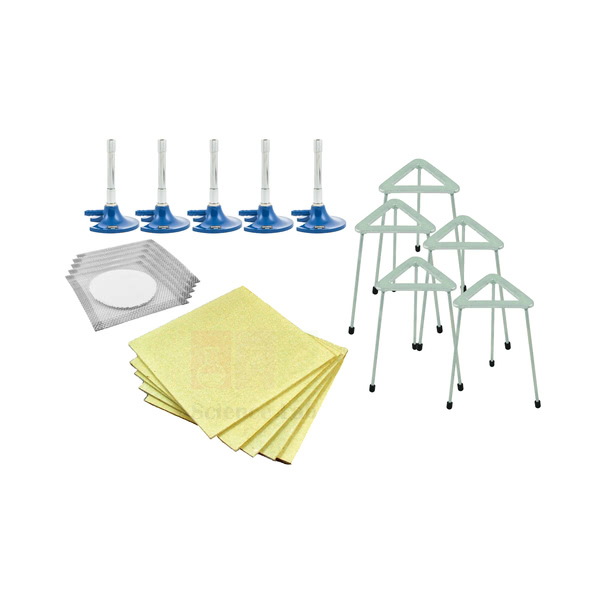
Bunsen Burner Kit
Bunsen Burner Kit (Product Code: SLE/CH/197) brings together a class set of the basic heating equipment needed to start simple chemistry experiments: five natural gas Bunsen burners, five ceramic centre wire gauzes, five bench mats and five cast iron tripods. With matching items for five workstations in one order, it is a quick way to equip a new room or replace worn pieces for Bunsen burner work in Indian schools. It is made by Jain Scientific Equipments Pvt Ltd (ScienceLab), Ambala.
Specifications
| Parameter | Detail |
|---|---|
| Kit type | Class set of essential heating equipment for basic chemistry experiments |
| Bunsen burners | 5 x natural gas Bunsen burner, 145 mm height |
| Wire gauzes | 5 x ceramic centre gauze wire, 150 x 150 |
| Bench mats | 5 x bench mat, 230 x 230 mm |
| Tripods | 5 x cast iron tripod, 200 x 125 mm |
Typical Use
Each of the five stations is laid out the same way: the bench mat goes down first, the tripod stands on it, the ceramic centre gauze rests on top of the tripod, and the burner sits underneath, connected to the gas tap. Students can then heat water in a beaker, evaporate a salt solution in a dish, or warm a boiling tube held in a clamp, with every group using identical apparatus so results and timings are comparable. Because the tripod stand and wire gauze are matched to the burner, teachers spend less time finding parts that fit and more time on the experiment itself.
Before lighting, check the gas tubing for cracks and close the air hole; open it gradually once the burner is lit to get a blue flame. Let tripods and gauzes cool on the mats before packing them away, and replace a gauze if its ceramic centre becomes damaged.
Manufacturer
The kit comes from Jain Scientific Equipments Private Limited, a manufacturer of teaching-laboratory apparatus in Ambala, Haryana that sells under the ScienceLab brand to schools and colleges. Learn about the company on its profile page.
Related Chemistry Lab Equipment
Items that complete or extend a heating station:
- Bunsen Burner Tubing — to connect each burner to the gas supply.
- Bench-Armour Interlocking Bench Mat — interlocking 250 x 250 mm mats for extra bench protection.
- Gauze Wire — spare gauzes for replacing worn ones.
- Crucible & Beaker Tongs — for moving hot containers safely.
- Safety Goggles — eye protection for every student at the station.
Further burners and heating accessories are in the Chemistry Lab Equipment category.
Frequently Asked Questions
What is included in the Bunsen Burner Kit?
5 natural gas Bunsen burners (145 mm height), 5 ceramic centre wire gauzes (150 x 150), 5 bench mats (230 x 230 mm) and 5 cast iron tripods (200 x 125 mm).
How many students does one kit serve?
It equips five workstations. For larger classes, order one kit per five stations or ask us to quote the exact number of sets.
Can the burners run on LPG?
They are listed as natural gas burners. If your lab uses LPG, tell us through the contact page before ordering so we can advise on a suitable burner.
Is gas tubing included?
Tubing is not listed in the kit contents. Bunsen Burner Tubing can be ordered separately.
Can individual items be bought as spares?
Many are listed on their own, such as burners, gauzes and tripods. Send a list of the spares you need and we will quote them.
What warranty applies?
Warranty terms are given with the quotation; please ask if you need them for your purchase file.
Request a Quote
To price one or more Bunsen Burner Kits, use the contact page, or add the kit to the enquiry cart with tubing and safety items.
Last updated: 24 September 2026

Burette Clamp, Die Cast – Double Clamp
Burette Clamp, Die Cast – Double Clamp (Product Code: SLE/GBu/11) is a die-cast retort clamp with a built-in boss head and two spring loaded burette jaws, so a single fitting mounts two burettes side by side on a retort stand rod. The jaws are furnished with rubber grips that close quickly around the glass and hold it steady without scratching, and the metal surfaces carry a high quality finish. Chemistry teachers and analysts looking for a dependable burette clamp for India’s school and college titration benches use it for volumetric analysis practicals. It is supplied as a pack of 10 and made by Jain Scientific Equipments Pvt Ltd (ScienceLab), Ambala.
Specifications
| Parameter | Detail |
|---|---|
| Type | Die-cast retort clamp with double burette clamp |
| Boss head | Built-in |
| Jaws | Spring loaded, furnished with rubber grips for quick and stable clamping |
| Finish | High quality finish to metal surfaces |
| Supplied as | Pack of 10 |
Typical Use
Slide the built-in boss head onto the rod of a retort stand and tighten it at a height that leaves room for a conical flask on the base. Squeeze a spring loaded jaw open, set the burette in it, and let go: the rubber grips close on the glass and hold it upright. With two jaws on one clamp, students can run an acid burette and an alkali burette side by side for back titrations, or two partners can titrate at the same stand, which halves the number of stands needed on a crowded bench. Whichever retort or burette stand your lab uses, check that each burette hangs vertically before taking the first reading.
Keep the rubber grips clean and free of reagents, as spilled acid or alkali can harden them over time. Wipe the metal after practicals and store clamps dry. The pack of 10 is enough to equip a typical titration class with spares.
Manufacturer
Jain Scientific Equipments Private Limited makes this clamp. The company works under the ScienceLab name from Ambala, Haryana, producing stands, clamps and other apparatus for chemistry and physics teaching. Details are on the ScienceLab profile page.
Related Chemistry Lab Equipment
Items that make up a titration station with this clamp:
- Burette Clamp, Die Cast – Single Clamp — the single-jaw version for one burette per stand.
- Retort Stand — the base and rod the clamp’s boss head fixes to.
- Burette, Class-B, with PTFE Key Stopcock — a burette to hold in each jaw.
- Conical Flask — receives the titrant under the burette tip.
- Burette Brush — for cleaning burettes between practicals.
More stands and clamps are listed under Chemistry Lab Equipment.
Frequently Asked Questions
How many clamps are in a pack?
The clamp is supplied as a pack of 10.
Do I need a separate boss head?
No. The boss head is built into the die-cast clamp, so it fixes straight onto a retort stand rod.
How many burettes does it hold?
Two, one in each spring loaded jaw.
What rod diameter and burette sizes does it accept?
These dimensions are not listed here. Send us your stand rod size and burette capacity through the contact page and we will confirm the fit.
Will the jaws scratch glass burettes?
The jaws are furnished with rubber grips, which hold the glass firmly while protecting its surface.
What warranty and delivery terms apply to tender orders?
Terms are set out in the quotation. Share your tender quantities and delivery points in India or abroad and we will respond with a full offer.
Request a Quote
For a quotation on the double burette clamp, reach us through the contact page, or add packs to the enquiry cart with stands and burettes.
Last updated: 24 September 2026
Caustic Spill Clean Up Kit
Caustic Spill Clean Up Kit (Product Code: SLE/CH/194) is a ready-packed kit for neutralising, absorbing and bagging spills of caustic (alkaline) solutions such as sodium hydroxide in a laboratory. It holds a neutralising mixture of anhydrous citric acid with litmus powder, vermiculite absorbent, gloves, a dustpan and brush, polybags with twist ties and tags, and an instruction sheet/MSDS. Keeping one within reach is a basic part of any school lab setup in India where alkalis are handled by students or technicians. It is supplied by Jain Scientific Equipments Pvt Ltd (ScienceLab), Ambala.
Key Details
| Parameter | Detail |
|---|---|
| Type | Spill clean up kit for caustic (alkaline) spills |
| Documentation | Instruction sheet / MSDS |
| Gloves | 2 vinyl exam gloves |
| Collection tools | 1 dustpan and brush |
| Absorbent | 1 bag vermiculite absorbent |
| Neutraliser | 1 bag neutralising mixture (citric acid, anhydrous & litmus powder) |
| Waste bags | 4 empty polybags, 225 x 400 mm |
| Closures | 4 twist ties |
| Labels | 4 blank shipping tags |
Typical Use
When an alkali solution is knocked over, the first step is to keep students back and read the instruction sheet. The person dealing with it puts on the vinyl gloves and scatters the neutralising mixture from the outer edge of the spill towards the centre; the citric acid reacts with the alkali, and the litmus powder gives a visible colour guide to how far neutralisation has gone. Vermiculite is then spread over the treated area to soak up the liquid, and the residue is swept with the dustpan and brush into a polybag, closed with a twist tie and labelled on a blank tag with the date and contents before disposal according to your institution’s rules.
Store the kit next to the chemistry reagent cabinet or wherever alkalis are kept, check after every use which items need replacing, and keep eye protection with it. For acid or solvent spills, use the kit made for that hazard.
Supplier
This spill kit is supplied by Jain Scientific Equipments Private Limited, an Ambala, Haryana business trading as ScienceLab that equips educational and research laboratories with apparatus, safety items and consumables. Find out more on the company profile.
Related Chemistry Lab Equipment
Other spill-response and protective items for the same laboratory:
- Acid Spill Clean Up Kit — the matching kit for acid spills.
- Solvent Spill Clean Up Kit — for organic solvent spills.
- Spill Pack — additional general spill response material.
- Eye Wash Station — for immediate rinsing if alkali splashes reach the eyes.
- Gloves - Protective — spare hand protection for clean-up work.
The Chemistry Lab Equipment category lists further safety and storage items.
Frequently Asked Questions
What does the Caustic Spill Clean Up Kit contain?
An instruction sheet/MSDS, 2 vinyl exam gloves, 1 dustpan and brush, 1 bag vermiculite absorbent, 1 bag neutralising mixture (citric acid, anhydrous & litmus powder), 4 empty 225 x 400 mm polybags, 4 twist ties and 4 blank shipping tags.
Can it be used for acid spills?
No. The citric acid neutraliser is meant for caustic (alkaline) spills. Use an acid spill kit for acids.
What is the litmus powder for?
It is mixed with the citric acid so the person cleaning up can see the colour change that shows the alkali is being neutralised.
How large a spill can one kit handle?
A treatable spill volume is not listed. For planning, tell us the size of containers you use through the contact page and we will suggest how many kits to keep.
Can the kit be refilled after use?
Please ask us about replacement contents when you enquire; availability of individual refills is confirmed with the quotation.
Do you supply kits for several labs or for export?
Yes. We quote for multiple kits for schools, colleges and industry in India and international markets.
Request a Quote
To obtain a price for the Caustic Spill Clean Up Kit, write to us via the contact page or add it to the enquiry cart with your other safety supplies.
Last updated: 24 September 2026
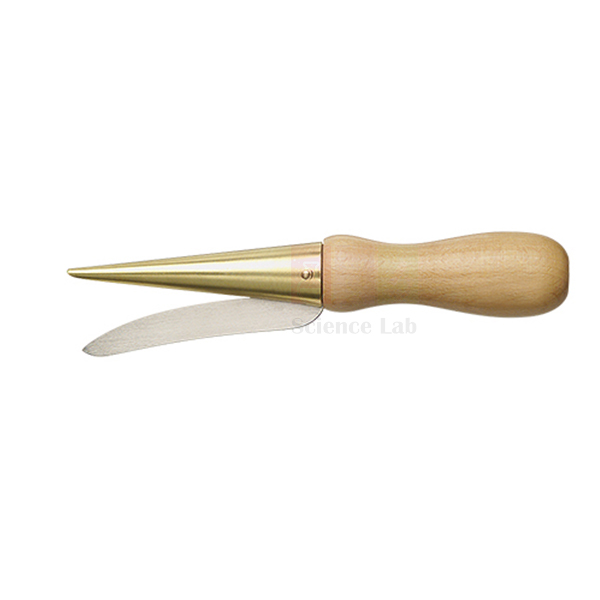
Cork Borer Sharpener
Cork Borer Sharpener (Product Code: SLE/CH/195) restores a clean cutting edge to blunt cork borers so they bore neat holes again instead of tearing corks and bungs. It consists of a plated metal cone on a polished wooden handle, with a hinged cutter blade: the borer is placed over the cone and the edge is cut to the correct angle simply by depressing the blade with thumb pressure. It handles borers from 4 to 27 mm in diameter, which covers the usual sizes used to fit glass tubes and thermometers into cork or rubber stopper lab fittings. It is made by Jain Scientific Equipments Pvt Ltd (ScienceLab), Ambala.
Specifications
| Parameter | Detail |
|---|---|
| Cone | Plated metal |
| Handle | Polished wood |
| Cutter | Hinged cutter blade, slotted to accept cutting blades |
| Sharpening action | Edge cut to the correct angle by depressing the blade with thumb pressure |
| Borer diameter range | 4–27 mm |
Typical Use
Over a term of practicals, cork borers are pushed through hundreds of corks and bungs and their thin edges roll over or nick, so the next hole comes out ragged and the glass tube will not seal. To sharpen one, the technician slips the borer over the cone until its edge rests against the blade, then turns the borer steadily while pressing the hinged blade down with a thumb. The blade shaves the edge back to the correct angle all the way round in a few turns. Doing this at the start of each term is a simple piece of lab equipment maintenance that saves buying new borers and makes boring stoppers much safer for students.
Clean off wax or rubber residue before sharpening, use light, even pressure rather than force, and remove any fine burr from the inside of the borer afterwards. Keep the sharpener dry and wipe the cone to protect its plated finish.
Manufacturer
Made by Jain Scientific Equipments Private Limited, the Ambala, Haryana company known to its school and college customers as ScienceLab, which produces tools and apparatus for everyday laboratory work. The company profile has more background.
Related Chemistry Lab Equipment
Items used with a cork borer and its sharpener:
- Cork Drills — boring tools that need a sharp edge to cut cleanly.
- Cork Stoppers — assorted corks to bore for tubes and thermometers.
- Rubber Cork — rubber stoppers that are bored the same way.
- Rubber stoppers with holes of different diameters — pre-bored stoppers when there is no time to bore.
- Delivery Tube — the glass tube typically fitted through a bored stopper.
See more tools in Chemistry Lab Equipment.
Frequently Asked Questions
Which cork borers can it sharpen?
Borers from 4 to 27 mm in diameter.
How does the sharpening work?
The borer sits on the plated metal cone and is turned while the hinged cutter blade is pressed down with the thumb, cutting the edge to the correct angle.
Are cork borers included?
No, this listing is for the sharpener only. Borers can be quoted separately on request.
Can the cutter blade be replaced?
The hinged cutter is slotted to accept cutting blades. Ask through the contact page about replacement blades when you order.
How often should borers be sharpened?
Whenever holes start to come out ragged or the borer needs extra force; many labs sharpen the whole set before each term.
What should our purchase enquiry include?
The quantity, the delivery address in India or abroad, and any other stopper-boring items you want quoted at the same time.
Request a Quote
Ask for pricing on the Cork Borer Sharpener through the contact page, or add it to the enquiry cart together with corks and stoppers.
Last updated: 24 September 2026
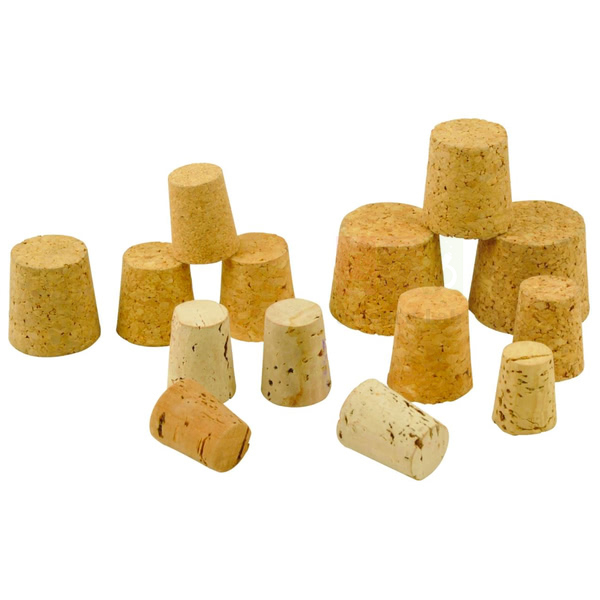
Cork Stoppers
Cork Stoppers (Product Code: SLE/CH/196) are brown, wood-material stoppers supplied in an assorted pack of 144, for closing test tubes, boiling tubes, bottles and flasks in the laboratory. Because the sizes are mixed, a single pack lets a teacher find a snug stopper for most of the glassware on the shelf, from a narrow test tube to the neck of a conical flask in school practicals across India. Corks are also easy to bore, so they are widely used to hold a thermometer or glass tube in place. They are supplied by Jain Scientific Equipments Pvt Ltd (ScienceLab), Ambala.
Specifications
| Parameter | Detail |
|---|---|
| Material | Wood |
| Colour | Brown |
| Sizes | Assorted |
| Pack size | 144 stoppers |
Typical Use
In a lower-secondary classroom, corks close test tubes of seeds in germination investigations, seal boiling tubes of water when students compare heating and cooling, and stopper small bottles of dry solids. For apparatus building, a technician bores a cork with a sharp cork borer, pushes a thermometer or delivery tube through, and fits it into a flask to make a simple gas generator or a boiling point set-up. Having an assorted pack on hand means the right size is usually already in the drawer, and a split cork is one of the easiest lab consumables to swap out mid-lesson.
Pick a cork that enters about a third to half of its length into the neck before it grips. Wet the cork slightly before boring, bore from the narrow end, and ease glass through with a twisting motion while protecting your hand. Store corks in a dry container so they do not shrink or go mouldy.
Supplier
Cork Stoppers are supplied by Jain Scientific Equipments Private Limited, which trades as ScienceLab and is located in Ambala, Haryana, serving teaching laboratories with apparatus as well as everyday consumables. More about the company appears on its profile page.
Related Chemistry Lab Equipment
Items used with cork stoppers in class and in apparatus building:
- Cork Borer Sharpener — keeps borers sharp so holes in corks come out clean.
- Cork Drills — for boring holes to take tubes and thermometers.
- Rubber Stoppers without Holes Of Different Diameters — a rubber alternative where a tighter seal is needed.
- Boiling Tube — commonly closed with a cork during practicals.
- Conical Flask — another vessel regularly fitted with a bored cork.
Browse the Chemistry Lab Equipment category for more stoppers and fittings.
Frequently Asked Questions
How many stoppers are in a pack?
Each pack contains 144 assorted cork stoppers.
Which sizes are included?
The pack is an assortment; the exact size mix is not listed here. If you need particular neck sizes, send them through the contact page and we will confirm what can be supplied.
Can holes be bored in them?
Yes. Corks bore easily with a sharp cork borer, which is why they are often used to mount thermometers and glass tubing.
When is a rubber stopper a better choice?
For airtight or vacuum joints, or where liquids would soak into the cork, a rubber stopper usually performs better. Corks suit general closures and easily bored fittings.
How should corks be stored?
In a closed, dry container away from heat, so they keep their shape and do not absorb moisture.
Do you supply larger quantities?
Yes. Tell us how many packs of 144 you need and the delivery location in India or abroad for a quotation.
Request a Quote
To order Cork Stoppers, send an enquiry through the contact page, or add packs to the enquiry cart with borers and glassware.
Last updated: 24 September 2026
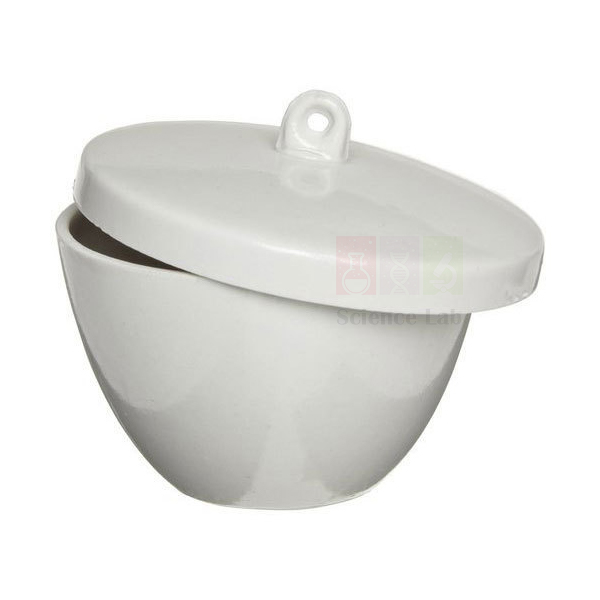
Crucible with lid
Crucible with lid (Product Code: SLE/CH/198) is a small white porcelain vessel with a matching cover, used to hold solids while they are heated strongly, ignited or dried to constant mass. Chemistry teachers, college demonstrators and analytical lab staff use it for gravimetric exercises, and it is made by Jain Scientific Equipments Pvt Ltd (ScienceLab) in Ambala as part of its chemistry lab equipment in India.
Specifications
| Parameter | Detail |
|---|---|
| Material | Porcelain |
| Colour | White |
| Capacity | 30ml |
| Glazing | Glazed inside and outside, except the base |
| Chemical behaviour | Chemical resistant |
| Supplied with | Lid |
Typical Use
In school and college practicals this crucible is used to find the water of crystallisation in a hydrated salt, to burn magnesium ribbon and record the gain in mass as the oxide forms, and to ash small organic samples. It sits in a pipe clay triangle on a tripod over a burner; the lid is held slightly ajar when air is needed for combustion and closed to reduce loss of material through spitting. Heat, cool and weigh the empty crucible and lid first so the tare mass is known, then repeat the heating and weighing of the sample until the mass stops changing.
Handle the hot crucible only with tongs, let it cool on a heat-resistant mat or in a desiccator before weighing, and never pour cold liquid into a hot crucible, because a sudden temperature change can crack porcelain. When planning a school laboratory setup in India, departments usually order crucibles in class quantities so that every group can run its own heating-to-constant-mass experiment.
Manufacturer
This crucible comes from Jain Scientific Equipments Private Limited, the company that trades as ScienceLab from Ambala, Haryana, and makes and supplies laboratory apparatus for schools, colleges and research labs. Purchase departments that need vendor registration details can note GSTIN 06AAECJ8618A1ZT and LEI 3358004HRD1JIVXKYX49. Read more on our company profile.
Related Chemistry Lab Equipment
A crucible is one part of a complete heating and weighing setup. These items are used with it in the same practical:
- Crucible Tong — for lifting the hot crucible and lid without touching them.
- Clay Pipe Triangle — cradles the crucible securely above the flame.
- Tripod Stand 200mm — supports the triangle at a working height over the burner.
- Bunsen Burner — the heat source for ignition and drying.
- Vacuum Desiccator — lets the crucible cool without picking up moisture before it is weighed.
See the full Chemistry Lab Equipment range for more apparatus.
Frequently Asked Questions
What is the capacity of this crucible?
It holds 30ml. This size suits the small sample masses used in school and undergraduate gravimetric work.
Is the lid included?
Yes. Each crucible is supplied with its lid, which helps control air access and reduces sample loss during heating.
Which surfaces are glazed?
The crucible is glazed inside and outside except the base. The glazed porcelain is chemical resistant and easy to wipe clean between experiments.
What maximum temperature is it rated for?
We have not published a temperature rating for this item. Please share your application through our contact page and we will advise before you order.
How should the crucible be cleaned?
Let it cool completely, then remove residues with water or a suitable dilute acid and dry it thoroughly. Heat it empty to constant mass before the next gravimetric run.
What should an institutional quotation request include?
Send the product code SLE/CH/198, the number of crucibles, delivery address and any tender reference. Adding tongs, triangles and tripods to the same enquiry gives one combined quote.
Do you supply in bulk or for export?
Yes. We supply schools, colleges and distributors in India and international markets; tell us the quantity and destination so we can plan packing and shipping.
Request a Quote
To order the Crucible with lid, send your requirement through our contact page, or add it to the enquiry cart with other items for a single quotation.
Last updated: 24 September 2026
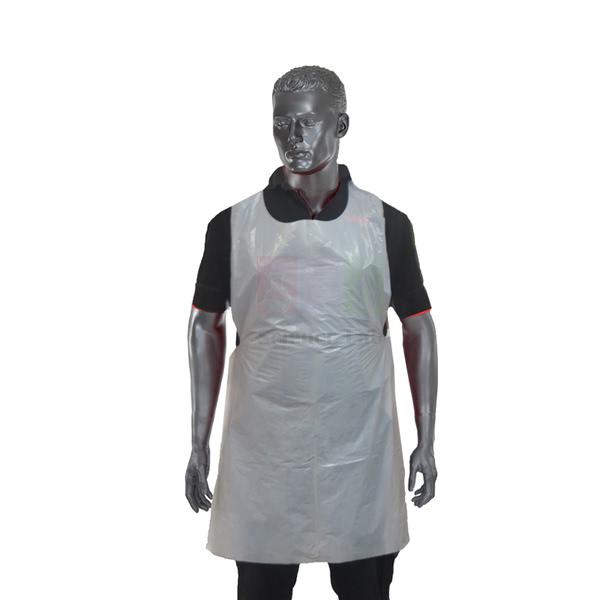
Disposable Polythene Apron
Disposable Polythene Apron (Product Code: SLE/SLC/12) is a single-use white polythene apron that protects clothing from splashes, stains and contamination during practical work, and is then thrown away instead of being laundered. It suits school and college chemistry and biology labs, clinical teaching rooms, food practicals and visitor areas, and is supplied by Jain Scientific Equipments Pvt Ltd (ScienceLab), Ambala, a laboratory equipment supplier in India.
Specifications
| Parameter | Detail |
|---|---|
| Material | Polythene (polyethylene) |
| Colour | White |
| Type | Disposable, single use |
| Fastening | Halter neck and waist ties |
| Pack size | Pack of 100 aprons |
| Supplied as | Flat packed |
Typical Use
Hand one apron to each student at the start of a wet practical, such as dilutions, staining, dissections or titrations, and collect used aprons in a waste bin at the end so nothing contaminated leaves the room. The halter neck loops over the head and the waist ties are knotted behind, so the apron can be put on over everyday clothing in a few seconds. Because each apron is used once, there is no washing schedule to manage and no risk of passing residues from one class to the next.
A key part of infection control is how the aprons are stored before use: keep the flat packs closed in a clean, dry cupboard so the aprons do not gather dust, which can become a breeding ground for bacteria. For departments stocking school chemistry lab equipment in India, a pack of 100 covers several class sessions and sits neatly on a shelf.
Supplier
ScienceLab is the trading name of Jain Scientific Equipments Private Limited, an Ambala, Haryana company that supplies protective wear and consumables alongside the laboratory apparatus it makes for teaching institutions. These aprons are supplied items; details about the company are on our company profile.
Related Laboratory Equipment
Complete the personal protection kit for your practical classes with these items:
- Gloves W/o Powder Nitrile Disposable — single-use hand protection to pair with the apron.
- Safety Goggles — eye protection for splash-prone work.
- Economy Polyethylene Lab Apron — an alternative polyethylene apron option.
- Transparent Plastic Laboratory Apron — a transparent plastic alternative for labs that prefer it.
- Disposable Isolation Gown — fuller single-use coverage including the arms.
More apparatus is listed under Chemistry Lab Equipment.
Frequently Asked Questions
How many aprons are in one pack?
Each pack contains 100 disposable polythene aprons, supplied flat packed.
How is the apron fastened?
It has a halter neck that goes over the head and waist ties, so it can be put on and removed quickly without help.
Can the aprons be washed and reused?
No. They are designed for single use; dispose of each apron after the session, following your institution’s waste rules for anything contaminated.
Are they suitable for handling corrosive chemicals?
They give light splash protection for routine practicals. For concentrated acids or alkalis, please ask us about heavier protective clothing through our contact page.
How should unused aprons be stored?
Keep them in the closed flat pack in a clean, dry place so they do not collect dust before use.
Can you supply larger quantities for a school or hospital?
Yes. Tell us how many packs you need and the delivery location; we supply institutions across India and international markets.
Request a Quote
For prices and availability of the Disposable Polythene Apron, write to us via the contact page or add the item to your enquiry cart.
Last updated: 24 September 2026

Floor Sticker, Arrow
Floor Sticker, Arrow (Product Code: SLE/CH/199) is a social distancing floor sticker printed with a direction arrow, used to show people which way to walk along corridors, into laboratories and through queues. Facilities managers, school administrators and lab supervisors use it to set up one-way routes that keep people apart, and it is supplied by Jain Scientific Equipments Pvt Ltd (ScienceLab), Ambala, a school laboratory equipment supplier in India.
Key Details
| Parameter | Detail |
|---|---|
| Type | Social distancing floor sticker with arrow |
| Purpose | Marking the direction of movement on floors |
| Supplied as | Box of 10 stickers |
| Suitable for | Schools, universities, retail and industrial premises |
Typical Use
Place arrows at regular points along a corridor or aisle to create a one-way loop, so that students entering a practical room do not meet those leaving it. In a laboratory the arrows can lead people past shared stations, such as balances or a fume cupboard, in a fixed order, which reduces crowding at the busiest points. Shops, canteens and factory floors use the same approach to guide queues towards a counter and out through a separate exit.
Before applying, sweep and wipe the floor so it is clean, dry and free of dust or polish residue, then press each sticker down firmly from the centre outwards. Check the route by walking it once, and replace any sticker that lifts at the edges. Because they arrive in a box of 10, schools can mark several routes at once while keeping spare stickers from the same lot of lab consumables for later repairs.
Supplier
These floor stickers are supplied by Jain Scientific Equipments Private Limited, known by its trading name ScienceLab and located in Ambala, Haryana. Alongside the teaching apparatus it produces, the company sources site safety and signage items so that institutions can order them in one enquiry. See our company profile for background.
Related Laboratory Equipment
These items are often ordered together when planning safe movement around a school or lab building:
- Floor Sticker, Safe Distance — marks standing points in queues along the route the arrows set.
- Hazard Warning Tape — floor marking tape for lanes and boundary lines.
- Thermometer, Infra Red, Hand Held — for non-contact temperature checks at entry points.
- Mask Surgical Tie Strap Disposable — disposable face masks for staff and visitors.
Browse more items under Chemistry Lab Equipment.
Frequently Asked Questions
How many stickers come in one box?
Each box contains 10 arrow floor stickers.
What are the sticker dimensions and material?
Dimensions and material are not listed for this item. Please ask through our contact page and we will confirm them before you order.
Where can the arrows be used?
They are intended for schools, universities, retail and industrial premises, typically on corridor, aisle and queue floors.
Can they be combined with safe distance stickers?
Yes. Arrows show the direction of travel, while safe distance stickers mark where each person should stand, so the two work well on the same route.
How do I get the stickers to stay in place?
Apply them to a clean, dry floor and press firmly. Avoid areas that are mopped very frequently or stay wet, where any adhesive label will lift sooner.
Can you supply several boxes for a whole campus?
Yes. Tell us how many boxes you need and the delivery address; we supply institutions in India and international markets.
Request a Quote
Ask for a quotation for the Floor Sticker, Arrow through our contact page, or add it to the enquiry cart with any other items you need.
Last updated: 24 September 2026

Floor Sticker, Safe Distance
Floor Sticker, Safe Distance (Product Code: SLE/CH/200) is a social distancing floor sticker that marks the spot where a person should stand while waiting, so that queues keep a gap between people. It is used at lab entrances, preparation-room hatches, reception counters, canteens and exam hall doors, and is supplied by Jain Scientific Equipments Pvt Ltd (ScienceLab), Ambala, together with other educational laboratory equipment in India.
Key Details
| Parameter | Detail |
|---|---|
| Type | Social distancing floor sticker, safe distance marking |
| Purpose | Showing standing positions in queues and waiting areas |
| Supplied as | Box of 10 stickers |
| Suitable for | Schools, universities, retail and industrial premises |
Typical Use
Decide the gap your institution wants between people, measure it along the floor with a tape, and fix one sticker at each standing point leading up to the counter or doorway. Students collecting apparatus from a store window, patients waiting at a college health room or customers at a till can then see at a glance where to stop. Placing the first sticker a clear step back from the counter also gives the person being served some room.
Lay the stickers on a swept, dry floor and press them down firmly; in high-traffic spots, check them weekly and replace any that are worn. Schools doing a school lab renovation in India often add the stickers at the same time as new benches, so that queue points for shared instruments are planned into the new layout from the start.
Supplier
Jain Scientific Equipments Private Limited supplies these stickers under its ScienceLab trading name from Ambala, Haryana, as part of the safety and site items it offers with its laboratory range. For vendor registration, the company’s GSTIN is 06AAECJ8618A1ZT and its LEI is 3358004HRD1JIVXKYX49. Company background is on our profile page.
Related Laboratory Equipment
These products help complete a safe-distancing layout around queue points:
- Floor Sticker, Arrow — points the queue in one direction towards the counter and away from it.
- Hazard Warning Tape — draws a boundary line in front of a counter or restricted area.
- Gloves W/o Powder Nitrile Disposable — for staff handing out apparatus or samples at the counter.
- Thermometer, Infra Red, Hand Held — for checking temperatures as people reach the front of the queue.
More products are listed in Chemistry Lab Equipment.
Frequently Asked Questions
What is included in one order unit?
One box of 10 safe distance floor stickers.
What spacing should I leave between stickers?
Follow the distance set by your institution or local guidance. The stickers mark the positions; the spacing is decided when you install them.
What size are the stickers?
The size is not stated for this item. Please contact us through the contact page for the current dimensions and print design.
Are they suitable outdoors?
They are listed for schools, universities, retail and industrial premises. For outdoor or wet areas, ask us first so we can advise whether they are appropriate.
How many boxes do I need?
Count the standing points in each queue and divide by 10; ordering one extra box keeps spares for replacements.
What details should a purchase order include?
Quote the product code SLE/CH/200, the number of boxes, billing and delivery addresses and any tender or indent number.
Request a Quote
To receive a quotation for the Floor Sticker, Safe Distance, contact us via the enquiry form or add it to the enquiry cart.
Last updated: 24 September 2026
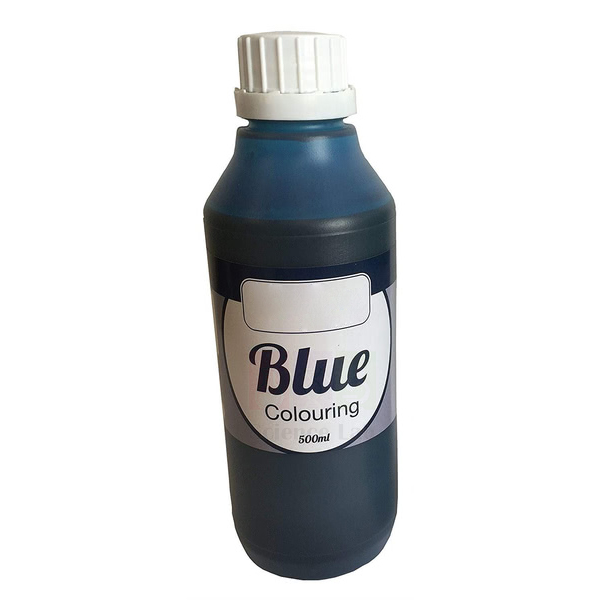
Food Colouring Blue
Food Colouring Blue (Product Code: SLE/CH/201) is a blue colouring liquid used in science lessons to make the movement of water and other clear liquids visible. Despite its name it is not for food use and is intended for educational purposes only. Teachers use it for convection, capillary and mixing demonstrations, and it is supplied by Jain Scientific Equipments Pvt Ltd (ScienceLab), Ambala, a chemistry consumables supplier in India.
Specifications
| Parameter | Detail |
|---|---|
| Colour | Blue |
| Capacity | 500ml |
| Intended use | Educational purposes only |
| Food use | Not for food use |
Typical Use
A single drop of blue colouring placed at the bottom corner of a beaker of water, gently heated from below, traces a clear loop as warm water rises and cooler water sinks, which makes convection easy for a whole class to see. The same tinted water drawn up narrow glass tubes of different bores shows capillary rise, and a strip of paper towel dipped into blue water shows liquid creeping upwards through fibres. Blue is also a strong contrast colour against white paper and clear glassware, so readings of liquid levels in tubes and cylinders are easier to take.
Use it diluted: a few drops colour a full beaker, so a 500ml pack lasts across many practical sessions. Keep the bottle clearly labelled as not for food use, store it away from the kitchen or canteen, and wear an apron, since concentrated colouring can stain skin, benches and clothing. Paired with physics lab equipment in India such as convection apparatus, it turns an abstract idea into a visible flow pattern.
Supplier
This product is supplied by Jain Scientific Equipments Private Limited, which operates under the ScienceLab name in Ambala, Haryana, and provides demonstration consumables together with its own teaching apparatus. Learn more on our company profile.
Related Laboratory Equipment
Items that are commonly used with blue colouring in the same demonstrations:
- Apparatus Convection In Liquid — the colouring reveals the circulation path inside the apparatus.
- Capillary Tube Set — tinted water shows the different rise in each tube.
- Dropper Bottle, 10 ml — for dispensing measured drops to student groups.
- Glass Beaker — clear vessel for heating and observing coloured water.
- Food Colouring Red — a second colour for mixing and comparison experiments.
Find further items under Chemistry Lab Equipment.
Frequently Asked Questions
Can this colouring be added to food or drinks?
No. It is marked not for food use and is intended for educational purposes only.
How much colouring is in one pack?
The pack capacity is 500ml.
How much should I use in a demonstration?
Only a few drops are normally needed to colour a beaker of water clearly; add more slowly until the colour is strong enough to see from the back of the room.
Will it stain glassware?
Rinse glassware with water soon after use. Concentrated colouring left to dry can mark surfaces and fabrics, so wipe spills promptly.
Is a safety data sheet available?
Please request any safety or composition documents through our contact page and we will share what is available for this item.
Can schools order several packs together?
Yes. We supply schools and distributors across India and international markets; state the number of packs and whether you also need the red colour.
Request a Quote
For a quotation on Food Colouring Blue, send your requirement through the contact page or place it in the enquiry cart.
Last updated: 24 September 2026
Food Colouring Red
Food Colouring Red (Product Code: SLE/CH/202) is a red colouring liquid for classroom experiments where students need to watch a liquid spread, rise or separate into layers. It is not for food use and is sold for educational purposes only. Biology and general science teachers rely on it for diffusion and plant transport practicals, and it is supplied by Jain Scientific Equipments Pvt Ltd (ScienceLab), Ambala, alongside school biology lab equipment in India.
Specifications
| Parameter | Detail |
|---|---|
| Colour | Red |
| Capacity | 500ml |
| Food use | Not for food use |
| Intended use | Educational purposes only |
Typical Use
For a diffusion comparison, students add one drop of red colouring to a beaker of cold water and one to a beaker of warm water, then time how long each takes to spread evenly; the faster spread in warm water links particle movement to temperature. In plant biology lessons, a leafy stem or white flower stood in red-tinted water shows the route water takes up the stem, and a thin cross-section cut after a few hours reveals coloured vascular tissue. Red also helps in density work, where one of several salt or sugar solutions is tinted so that the layers stand out in a measuring cylinder.
Stir with a glass rod rather than shaking, so the colour mixes without trapping bubbles. Label every working solution clearly and keep the stock bottle away from food areas. A department buying from a lab consumables supplier in India can share one 500ml pack between several classes, because only small amounts are needed for each experiment.
Supplier
Food Colouring Red is a supplied consumable from Jain Scientific Equipments Private Limited, the Ambala, Haryana company behind the ScienceLab brand, which offers such teaching materials with its laboratory apparatus range. Our company profile has further details.
Related Laboratory Equipment
These items support the diffusion, plant transport and density experiments described above:
- Visualising Osmosis & Diffusion Investigation — a structured investigation that benefits from coloured solutions.
- Glass Measuring Cylinder — for building and viewing layered density columns.
- Stirring Rod, Glass — mixes the colouring evenly without contaminating it.
- Wash Bottle LDPE with Narrow Mouth — for rinsing glassware straight after use.
- Food Colouring Blue — a contrasting colour for two-colour comparisons.
Explore more in Chemistry Lab Equipment.
Frequently Asked Questions
Is this product safe to use in food?
No. Although called food colouring, it is labelled not for food use and should only be used for educational purposes.
What volume does the pack hold?
Each pack holds 500ml.
Which experiments suit red rather than blue?
Red shows up well in plant stems and against green leaves, so many teachers choose it for water transport work, while either colour works for diffusion and density demonstrations.
How should the colouring be stored?
Keep the bottle closed, upright and labelled, in a cool cupboard away from direct sunlight and away from any food preparation area.
Can you share composition or safety information?
Please ask through our contact page; we will send the information available for this item.
What should I include when requesting a quotation?
Mention the product code SLE/CH/202, the number of packs, your institution name and the delivery location in India or abroad.
Request a Quote
Request pricing for Food Colouring Red through the contact page, or add it to the enquiry cart with your other consumables.
Last updated: 24 September 2026
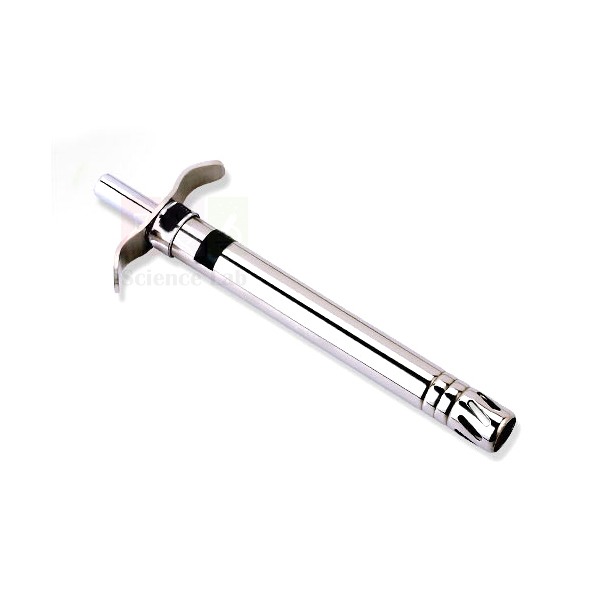
Gas Lighter, Piezo
Gas Lighter, Piezo (Product Code: SLE/CH/204) is a hand-held igniter that produces sparks when its handle is squeezed, letting students and technicians light a gas burner without matches. It needs no battery and is suitable for igniting the common fuel gases used on laboratory burners, which makes it a routine item on school and college chemistry benches. It is made by Jain Scientific Equipments Pvt Ltd (ScienceLab), Ambala, a school science lab equipment manufacturer.
Specifications
| Parameter | Detail |
|---|---|
| Ignition method | Piezo spark, produced by squeezing the handle |
| Power source | No battery required |
| Suitable for | Igniting the common fuel gases |
Typical Use
To light a Bunsen burner, close the air hole, hold the lighter tip just above the top of the barrel, open the gas tap and squeeze the handle; the spark ignites the gas and a yellow safety flame appears, after which the air hole can be opened for a hotter blue flame. Because the lighter makes sparks rather than its own flame, there are no loose matches or burnt splints on the bench, and nothing to discard afterwards.
Keep the spark tip clean and dry, since soot or moisture can weaken the spark, and hang the lighter on a hook or place it in a drawer after use so it is not left near a hot burner. For a new lab setup in a school, one lighter per bench or per pair of burners keeps practical sessions moving without students queuing for a light.
Manufacturer
ScienceLab is the brand name used by Jain Scientific Equipments Private Limited, a laboratory apparatus maker based in Ambala, Haryana. The company is a registered MSME with major activity manufacturing (Udyam UDYAM-HR-01-0003714), and its export shipments are handled under Importer-Exporter Code AAECJ8618A (DGFT). Visit our company profile to learn more.
Related Chemistry Lab Equipment
Burners, tubing and alternative igniters that are used with this lighter:
- Bunsen Burner — the standard bench burner this lighter is used to ignite.
- Micro Burner — a smaller burner for gentle, localised heating.
- Bunsen Burner Tubing — connects the burner to the gas tap.
- Gas Lighter, Piezo Electric — another piezo igniter listed in our Burners range.
- Butane Lighter — a flame-producing alternative where a naked flame is needed.
See the complete Chemistry Lab Equipment range.
Frequently Asked Questions
Does the lighter need batteries or refilling?
No battery is required. It produces sparks mechanically when the handle is squeezed and does not carry its own fuel.
Which gases can it ignite?
It is suitable for the common fuel gases supplied to laboratory burners. If your lab uses an unusual gas, please check with us through the contact page.
Why is there no flame when I squeeze it?
The lighter makes a spark only; a flame appears when that spark meets flowing gas. Make sure the gas tap is open and the tip is held at the burner mouth.
What if the spark becomes weak?
Wipe the tip to remove soot or moisture and let it dry. If the spark does not return, contact us for advice.
Is a warranty offered?
Warranty terms are confirmed with each quotation; please ask when you enquire.
Can you supply lighters for a whole laboratory or for export?
Yes. Send the quantity and destination, and we will quote for delivery within India or to international markets.
Request a Quote
Enquire about the Gas Lighter, Piezo through our contact page, or add it to the enquiry cart together with burners and tubing.
Last updated: 24 September 2026
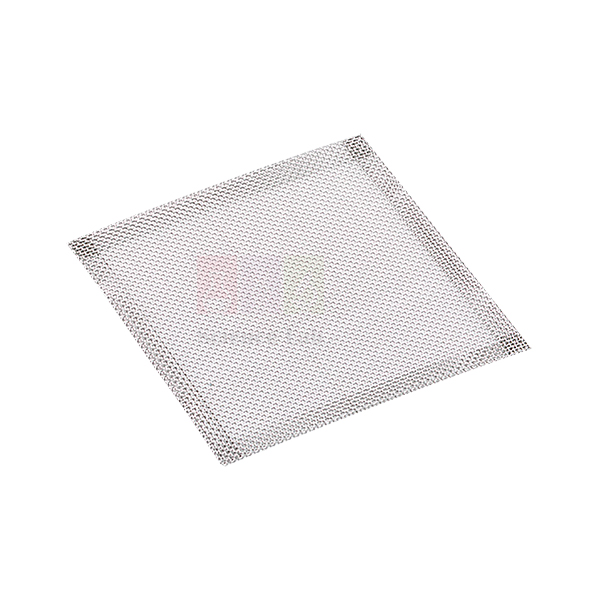
Gauze Wire
Gauze Wire (Product Code: SLE/CH/205) is a pack of plain wire gauze squares, without ceramic centres, that sit on a tripod between a burner flame and a beaker or flask. The mesh spreads the heat across the base of the vessel and gives it a flat, stable support. It is standard chemistry lab equipment for schools in India and colleges, and is made by Jain Scientific Equipments Pvt Ltd (ScienceLab), Ambala.
Specifications
| Parameter | Detail |
|---|---|
| Type | Plain gauze wire squares, without ceramic centres |
| Pattern | Plain |
| Dimensions | 150 x 150 |
| Pack size | Pack of 10 |
Typical Use
Lay a square flat on top of a tripod, place the beaker or conical flask in the middle, and position the Bunsen burner underneath. The wire mesh stops the flame touching the glass directly at one small spot, so water baths, solutions and crystallisation mixtures heat more evenly and the glass is less likely to crack. Plain gauze also lets students watch the flame through the mesh, which helps when teaching how to adjust a burner from a yellow to a blue flame.
Allow the gauze to cool before handling, as the wire stays hot well after the burner is turned off, and move it with tongs if it must be lifted during a practical. Replace squares that have sagged, rusted or developed holes, because a distorted mesh can tip a vessel. A pack of 10 equips several benches, which suits a class working in small groups.
Manufacturer
Jain Scientific Equipments Private Limited, trading as ScienceLab, manufactures laboratory apparatus in Ambala, Haryana, for schools, colleges and distributors. Our company profile describes the business and its range.
Related Chemistry Lab Equipment
The gauze is one layer of a standard heating setup; these items complete it:
- Tripod Stand 200mm — the stand on which the gauze square rests.
- Bunsen Burner — heat source placed below the tripod.
- Glass Beaker — the vessel most often heated on the gauze.
- Beaker Tongs — for removing a hot beaker from the gauze.
- Gauze Wire, Ceramic Centre — the ceramic-centred alternative for more diffused heating.
Find more heating apparatus in Chemistry Lab Equipment.
Frequently Asked Questions
How many squares are in a pack?
Each pack contains 10 plain gauze wire squares.
What size are the squares?
They are listed as 150 x 150 squares. If you need to confirm fit on your tripods, share the tripod top size through our contact page.
What is the difference between plain and ceramic centre gauze?
Plain gauze is an open wire mesh throughout. Ceramic centre gauze has a heat-spreading ceramic patch in the middle; choose it if you want the flame kept further from direct contact with the glass.
Can I heat a vessel without gauze?
Glassware should not normally sit directly over a naked flame. The gauze provides even heat and a flat support, which reduces the risk of cracking and tipping.
How long does a gauze square last?
It depends on how often and how strongly it is heated. Inspect squares regularly and replace any that are bent, holed or corroded.
What should I send for a bulk or export quotation?
The product code SLE/CH/205, number of packs, delivery address and any tender reference. We supply within India and to international markets.
Request a Quote
Get a quotation for the Gauze Wire from our contact page, or add it to the enquiry cart with tripods and burners.
Last updated: 24 September 2026
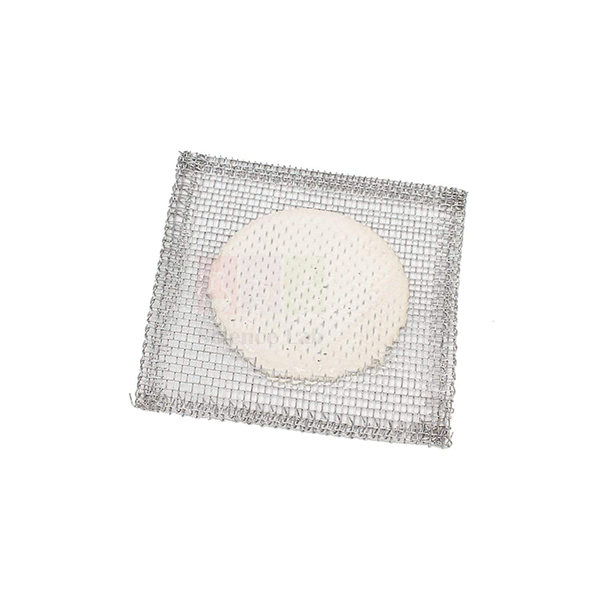
Gauze Wire, Ceramic Centre
Gauze Wire, Ceramic Centre (Product Code: SLE/CH/206) is a square wire gauze with a ceramic-coated centre that spreads burner heat over a wider area before it reaches the glass. It is offered in 125mm or 150mm sizes and is 100% asbestos free, which makes it a safer wire gauze for lab use in India’s schools and colleges than older asbestos-centred types. It is made by Jain Scientific Equipments Pvt Ltd (ScienceLab), Ambala.
Specifications
| Parameter | Detail |
|---|---|
| Type | Ceramic centred wire gauze |
| Shape | Square |
| Sizes available | 125mm or 150mm |
| Asbestos content | 100% asbestos free |
Typical Use
The ceramic centre is placed directly above the burner flame on a tripod, and the flask, beaker or evaporating basin sits on top of it. Because the ceramic diffuses the heat, liquids warm more gently and evenly, which is useful when evaporating a salt solution to the point of crystallisation or when heating borosilicate laboratory glassware that should not be exposed to a concentrated hot spot. It is also a good choice for younger classes, since the flame is less likely to lick around the base of the vessel.
Match the gauze size to the top of your tripod: the 125mm square suits smaller tripods and micro burners, while the 150mm square gives a wider platform for larger beakers. Let the gauze cool fully before storing it, never plunge a hot gauze into water, and avoid knocking the ceramic centre against hard surfaces, as a chipped or cracked centre spreads heat less evenly and should be replaced.
Manufacturer
This gauze is manufactured by Jain Scientific Equipments Private Limited, whose ScienceLab brand covers teaching apparatus produced in Ambala, Haryana, for institutions in India and abroad. You can read about the company on its profile page.
Related Chemistry Lab Equipment
Use the ceramic centre gauze with the following apparatus:
- Tripod, Stainless Steel — a corrosion-resistant stand to carry the gauze.
- Micro Burner — a small flame suited to gentle heating through the ceramic.
- Porcelain Dish (China Dish) — for evaporating solutions to form crystals.
- Conical Flask — a common vessel for heating reaction mixtures on the gauze.
- Gauze Wire — the plain mesh version without a ceramic centre.
Browse the full Chemistry Lab Equipment category.
Frequently Asked Questions
Which sizes can I order?
The gauze is available in 125mm or 150mm square sizes. State the size you need on your enquiry.
Does the ceramic centre contain asbestos?
No. These gauze wires are 100% asbestos free.
When should I choose ceramic centre gauze over plain gauze?
Choose it when you want gentler, more evenly spread heating, for example during evaporation or when heating thin-walled glassware. Plain gauze heats faster and lets students see the flame.
How many pieces come in one pack?
The pack quantity is not listed for this item. Please confirm it with us through our contact page when you request a quotation.
How do I care for the ceramic centre?
Cool it slowly in air, store it flat and avoid dropping it. Replace the gauze if the centre cracks, flakes or the wire becomes distorted.
Do you supply larger quantities for schools and distributors?
Yes. We supply institutions and resellers across India and international markets; include both sizes in one enquiry if you need a mix.
Request a Quote
Send your requirement for the Gauze Wire, Ceramic Centre through our contact page or add it to the enquiry cart.
Last updated: 24 September 2026
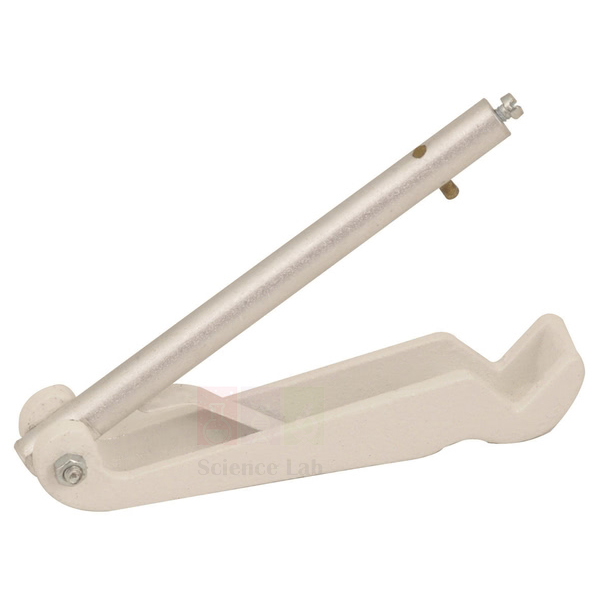
Glass Tubing Cutter
Glass Tubing Cutter (Product Code: SLE/CH/207) is a hand tool for scoring glass tubing cleanly so that it can be snapped to length for delivery tubes, bends and connectors. It is suitable for both soda and borosilicate glass tubing and has a diamond scribing point on a spring arm set into an aluminium alloy body with a V groove. Lab technicians and teachers who prepare chemistry lab glassware in India use it in place of a file, and it is made by Jain Scientific Equipments Pvt Ltd (ScienceLab), Ambala.
Specifications
| Parameter | Detail |
|---|---|
| Suitable tubing | Soda glass and borosilicate glass tubing |
| Cutting element | Diamond scribing point |
| Point mounting | Spring arm |
| Body | Aluminium alloy with V groove |
Typical Use
Mark the length you need, lay the tube in the V groove so it is held steady, and let the spring arm press the diamond point onto the glass. A single firm stroke or a short turn of the tube produces a fine score line. Wrap the tube in a cloth, place both thumbs behind the score and bend gently away from it; the glass should break cleanly at the line. Finish by rotating each cut end in a Bunsen flame until the sharp edge rounds off, which makes it safe to push into rubber tubing or a bung.
Always wear eye protection when scoring and snapping glass, work over a tray to catch fragments, and dispose of offcuts in a glass waste container rather than a general bin. Cut tubing prepared this way is typically used to build delivery tubes for gas collection apparatus, water traps and simple distillation setups in teaching labs.
Manufacturer
ScienceLab tools and apparatus come from Jain Scientific Equipments Private Limited, a manufacturer located in Ambala, Haryana, that serves schools, colleges, laboratories and trade buyers. The company profile gives an overview of the business.
Related Chemistry Lab Equipment
These items are used with the cutter when preparing and fitting glass tubing:
- Borosilicate Glass Tubing — heat-resistant tubing that the cutter can score.
- Soda Glass Tubing 6mm — soda glass stock for bending and cutting practice.
- Rubber Tubing — joins the cut glass pieces into a working apparatus.
- Bunsen Burner — for fire-polishing the cut ends and bending tubing.
- Safety Goggles — eye protection while scoring and snapping glass.
More glass-working and chemistry items are in Chemistry Lab Equipment.
Frequently Asked Questions
Which types of glass tubing can it cut?
It is suitable for soda glass and borosilicate glass tubing.
What does the cutting?
A diamond scribing point on a spring arm scores the glass; the tube is then snapped by hand along the score line.
What is the V groove for?
The V groove in the aluminium alloy body holds the round tube steady and centred under the diamond point, giving a straighter score.
What range of tube diameters does it accept?
A diameter range is not listed for this item. Please tell us the outside diameter of your tubing through our contact page and we will confirm suitability.
How do I keep the diamond point in good condition?
Use light, even pressure, avoid dragging the point over metal or stone, and store the cutter in a drawer where the tip is not knocked.
Is a warranty provided?
Warranty terms are stated on the quotation. Ask us when you enquire, especially for institutional or export orders.
Request a Quote
Request a price for the Glass Tubing Cutter via the contact page, or add it to the enquiry cart along with glass tubing.
Last updated: 24 September 2026
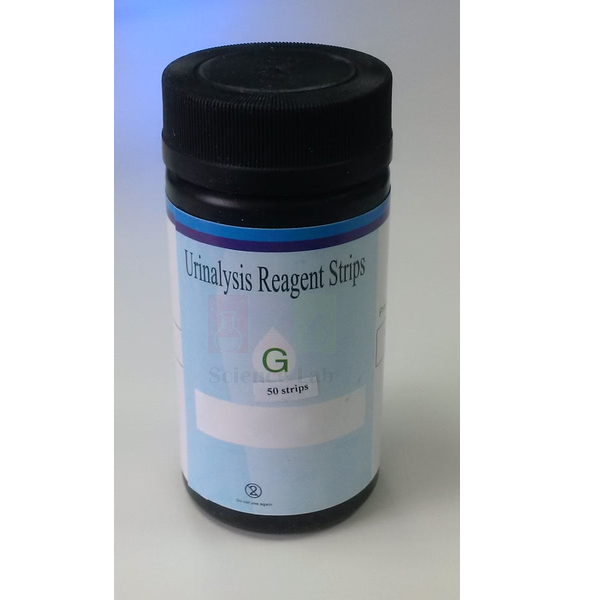
Glucose Test Strips
Glucose Test Strips (Product Code: SLE/CH/208) are reagent strips used to give a semi-quantitative test for glucose in urine, in biology, health education and chemistry teaching labs. The test pad changes colour and the shade indicates roughly how much glucose is present, rather than a simple yes or no; each pack holds 50 strips. They are supplied by Jain Scientific Equipments Pvt Ltd (ScienceLab), Ambala, India, a biology lab equipment supplier in India.
Specifications
| Parameter | Detail |
|---|---|
| Test type | Semi-quantitative |
| Analyte | Glucose |
| Sample | Urine |
| Pack size | Pack of 50 strips |
| Shelf life | Depends on the reagent, its grade and storage conditions; ask us for the expiry date of the batch you are quoted |
| Product code | SLE/CH/208 |
| Supplied by | Jain Scientific Equipments Pvt Ltd (ScienceLab), Ambala, India |
What Are Glucose Test Strips Used For?
In school and college practicals they show how glucose in urine is screened. Teachers often prepare simulated urine samples containing different amounts of dissolved glucose so students can test them safely; each group dips a strip briefly into a sample in a test tube, removes the excess liquid against the rim, waits for the reading time and compares the pad colour following the reading instructions. Ranking the samples from lowest to highest glucose opens a discussion of kidney function, blood sugar control and why glucose in urine is something doctors investigate.
Running the same samples through Benedict’s test alongside the strips lets students compare a quick strip reading with a heated chemical test, which works well in health education lessons. Keep the container tightly closed in a cool, dry place, take out only the strips needed and avoid touching the test pads. Classroom results are for learning only; any medical decision should rely on testing by qualified health professionals.
Supplier
Glucose Test Strips are supplied by Jain Scientific Equipments Private Limited, which trades as ScienceLab from Ambala, Haryana, India, and sources teaching consumables for schools, colleges and distributors. They can be quoted on the same order as Benedict’s reagent, test tubes and racks for a complete glucose practical. More about us is on the company profile.
Related Laboratory Equipment
Items used with the strips in a glucose testing practical:
- Benedicts Reagent (Test Of Glucose) — a classic chemical test to compare with strip results
- Container Sample 50 ml — for holding and labelling each prepared sample
- Test Tube — a narrow vessel for dipping a strip into a small volume of sample
- Test Tube Racks — keeps the sample tubes upright and in order
- Gloves W/o Powder Nitrile Disposable — hand protection when handling samples
Browse Chemistry Lab Equipment for more items.
Frequently Asked Questions
How many strips are in a pack?
Each pack of Glucose Test Strips contains 50 strips, so order packs according to the number of groups and samples you plan to test, allowing a few extra strips for repeats and teacher demonstrations.
What does semi-quantitative mean?
Semi-quantitative means the Glucose Test Strips give an approximate glucose level by colour, grouping results into ranges, rather than an exact concentration value of the kind an instrument would measure.
Can the strips test for anything other than glucose?
Glucose Test Strips are listed as a test for glucose in urine only. If you need to test other substances in your practical, ask us through the contact page about suitable reagents from our range.
What is the shelf life of the strips?
The shelf life of Glucose Test Strips depends on the reagent, its grade and storage conditions; ask us for the expiry date of the batch you are quoted, and plan to use opened containers without long delays.
How should opened packs be stored?
Close the Glucose Test Strips container immediately after taking out a strip and keep it in a cool, dry place away from moisture and direct light, taking care never to touch the test pads.
Are the strips intended for medical diagnosis?
Glucose Test Strips on this page are offered for teaching and demonstrating urine glucose testing. Classroom results are for learning only, and any medical decision should rely on testing by qualified health professionals.
Who supplies Glucose Test Strips?
Jain Scientific Equipments Private Limited (ScienceLab), Ambala, Haryana, India, supplies Glucose Test Strips to schools, colleges and distributors in India and international markets; state the number of packs and your delivery location for a quotation.
Request a Quote
For a quotation on Glucose Test Strips, contact us through the contact page or add them to the enquiry cart with the other items for your practical.
Last updated: 24 September 2026
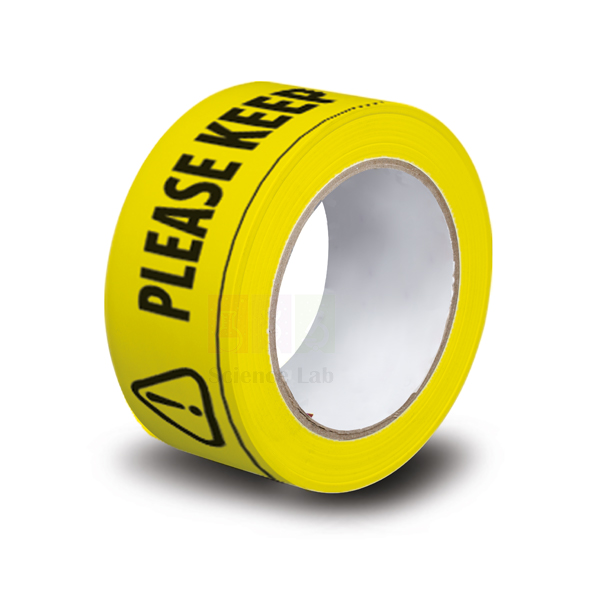
Hazard Warning Tape
Hazard Warning Tape (Product Code: SLE/CH/209) is a floor marking tape used for social distancing, laying out walkways, queue lines and keep-back zones that people can follow without signs or supervision. It comes in bulk, as a box of 36 rolls of 50 m each, and is intended for schools, universities, retail and industrial premises. It is supplied by Jain Scientific Equipments Pvt Ltd (ScienceLab), Ambala, for institutions planning a school laboratory setup in India or re-marking existing buildings.
Key Details
| Parameter | Detail |
|---|---|
| Type | Social distancing floor marking tape |
| Roll length | 50 m per roll |
| Supplied as | Box of 36 rolls |
| Suitable for | Schools, universities, retail and industrial premises |
Typical Use
Run parallel lines of tape to divide a wide corridor into two lanes, mark a stop line in front of a counter or preparation-room hatch, or outline a keep-clear area around a fume cupboard, electrical panel or emergency exit. In exam halls and assembly areas the tape can mark seat positions or rows so that spacing stays consistent every time the room is set up. With 36 rolls in a box, a campus can mark several buildings in one go and keep rolls in reserve for repairs.
For a neat, long-lasting line, sweep and degrease the floor, let it dry, then unroll a short length at a time and press it down while keeping it straight against a chalk line or straight edge. Cut the ends square rather than tearing them, and avoid laying tape across expansion joints or areas that stay wet, where it will lift early. Walk the marked route once to check it makes sense before opening the space to users.
Supplier
Jain Scientific Equipments Private Limited, which trades as ScienceLab and is based in Ambala, Haryana, supplies this tape as part of the site safety products it offers with its laboratory apparatus. The company profile has more information.
Related Laboratory Equipment
Pair the tape with these items to complete floor and hazard marking:
- Floor Sticker, Safe Distance — marks individual standing points along a taped queue lane.
- Floor Sticker, Arrow — shows the direction of travel within taped lanes.
- Hazard Warning Tape: Flammable — symbol tape for marking shelves or cabinets holding flammable materials.
- Hazard Warning Tape: Biohazard — symbol tape for areas where biological waste is handled.
More products are available in Chemistry Lab Equipment.
Frequently Asked Questions
How much tape is in one box?
A box holds 36 rolls, and each roll is 50 m long.
What colour and width is the tape?
Colour and width are not listed for this item. Please confirm them through our contact page before ordering.
Can I buy fewer rolls than a full box?
The tape is supplied as a box of 36 rolls. If you need a smaller quantity, ask us and we will tell you what we can offer.
Where is it meant to be used?
It is intended for floor marking in schools, universities, retail spaces and industrial premises.
How do I remove old tape when the layout changes?
Lift one end and peel slowly at a low angle; any adhesive left behind can usually be cleaned with a suitable floor cleaner. Test on a small area first.
What should an institutional quotation request include?
Give the product code SLE/CH/209, number of boxes, delivery address in India or abroad, and any purchase or tender reference.
Request a Quote
Ask for a quotation for the Hazard Warning Tape through our contact page or add it to the enquiry cart.
Last updated: 24 September 2026
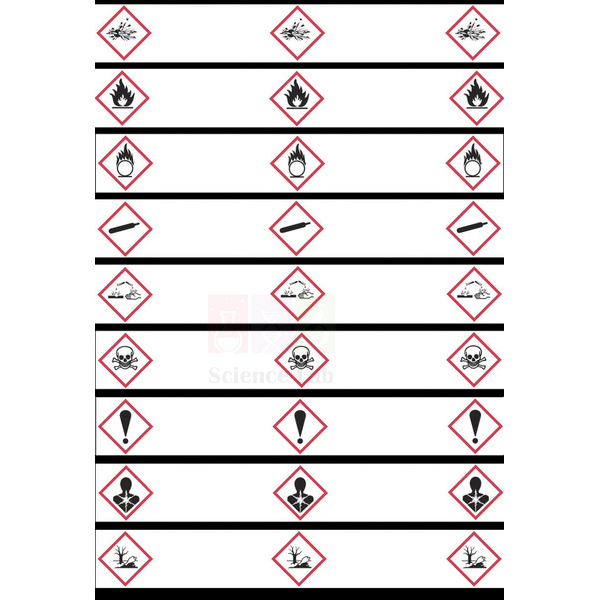
Hazard Warning Tape: Biohazard
Hazard Warning Tape: Biohazard (Product Code: SLE/CH/210) is a self-adhesive vinyl labelling tape printed with the biohazard warning pictogram, used to mark containers, shelves, cupboards, bins and equipment that hold biological material. The white tape is hard wearing, 25 mm wide and supplied as a 66 m roll, so one roll labels a large number of items. Microbiology, biotechnology and clinical teaching labs use it alongside other microbiology lab equipment in India, and it is supplied by Jain Scientific Equipments Pvt Ltd (ScienceLab), Ambala.
Specifications
| Parameter | Detail |
|---|---|
| Warning symbol | Biohazard pictogram |
| Material | Hard wearing, self-adhesive vinyl |
| Tape colour | White |
| Print layout | Pictogram repeated every 75 mm, with a blank area between symbols |
| Width | 25 mm |
| Roll length | 66 m |
Typical Use
Cut a length of tape covering one or two symbols and apply it to the lid and side of a culture waste container, the door of an incubator or a refrigerator holding cultures, or the edge of a shelf reserved for contaminated items. Because the pictogram repeats every 75 mm with a blank gap in between, the tape can be cut in the gap without slicing through a symbol, and each piece carries a complete warning. The white background keeps the symbol easy to see on dark or metal surfaces.
Apply the tape to clean, dry, grease-free surfaces and smooth it down from one end to avoid trapped air. Consistent biohazard labelling is part of good lab waste disposal practice: students and cleaning staff can recognise at a glance which containers must go for decontamination rather than into general waste. Replace labels that become worn, and remove old tape when a container is taken out of biohazard service.
Supplier
This tape is supplied by Jain Scientific Equipments Private Limited, the incorporated company behind the ScienceLab name, based in Ambala, Haryana. For vendor registration, its details are CIN U29309HR2020PTC087597 and GSTIN 06AAECJ8618A1ZT. See our company profile for more.
Related Laboratory Equipment
Items used with biohazard tape in the handling and disposal of biological waste:
- Biohazard Bag — collects contaminated waste in the area the tape marks out.
- Autoclave Bag Disposable — for sterilising waste before it leaves the lab.
- Autoclave Tape — shows that a bag or pack has been through the autoclave.
- Hazard Warning Tape: Corrosive — matching symbol tape for areas holding corrosive chemicals.
Explore more items in Chemistry Lab Equipment.
Frequently Asked Questions
How much tape is on a roll?
Each roll carries 66 m of 25 mm wide tape.
How often is the symbol printed?
The biohazard pictogram repeats every 75 mm, with a blank area between symbols.
Is the tape suitable for curved surfaces such as bins and bottles?
The vinyl tape is self-adhesive and hard wearing. For tightly curved or very cold surfaces, test a short piece first, and contact us if you need advice.
Will it survive autoclaving?
Autoclave resistance is not stated for this tape. For items that go into the autoclave, use autoclave tape and ask us through the contact page about suitability.
Can I order other hazard symbols?
Yes. Separate hazard warning tapes are listed for other hazard types, including corrosive, explosive, flammable and irritant.
Do you supply in quantity for institutions or export?
Yes. Tell us how many rolls you need and where they should be delivered; we serve buyers in India and international markets.
Request a Quote
For pricing on the Hazard Warning Tape: Biohazard, contact us through our contact page or add it to the enquiry cart.
Last updated: 24 September 2026
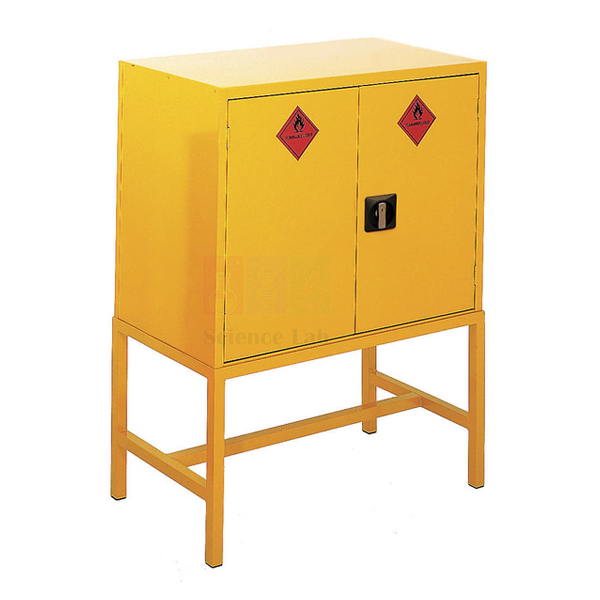
Hazardous Storage Cabinet Horizontal
Hazardous Storage Cabinet Horizontal (Product Code: SLE/CH/211) is a robust metal chemical storage cabinet of horizontal layout with 2 doors, built to give good structural stability and to hold any spillage inside its leak proof sump instead of letting it spread across the floor. School chemistry departments, college prep rooms and industrial labs use it to keep hazardous reagents in one controlled place, and it is made by Jain Scientific Equipments Pvt Ltd (ScienceLab), Ambala, as part of its lab storage cabinet range in India.
Specifications
| Parameter | Detail |
|---|---|
| Construction | Robust metal |
| Type | Horizontal |
| Number of doors | 2 |
| Spill containment | Leak proof sump that contains spillages within the cabinet |
| Design aim | Good structural stability |
Typical Use
A horizontal cabinet is wider than it is tall, so bottles stand at an easy reach height and heavy containers do not have to be lifted onto high shelves. Technicians typically group chemicals by hazard class inside, keeping incompatible substances such as acids and alkalis apart, and label the doors so staff know what is stored before opening them. If a bottle leaks or breaks, the liquid runs into the sump at the base, where it can be absorbed and cleaned up without reaching the floor or other stock.
Place the cabinet on a level floor away from heat sources and exits, check the sump regularly and clear any residue promptly, and keep an up-to-date list of contents on or near the doors. As a piece of chemistry reagent cabinet storage within a school laboratory, it works best alongside a spill kit and clear hazard labelling, so that any incident can be handled quickly.
Manufacturer
The cabinet is manufactured by Jain Scientific Equipments Private Limited, an Ambala, Haryana company that uses the trading name ScienceLab and builds laboratory equipment and furniture for education and industry. Our company profile explains more about the business.
Related Chemistry Lab Equipment
These items support safe chemical storage and spill response around the cabinet:
- Hazardous Storage Cabinet Vertical — a vertical alternative where floor space is limited.
- Acid Storage Cabinet Vertical — a dedicated cabinet to keep acids separate from other stock.
- Spill Pack — absorbent materials for clearing leaks from the sump or floor.
- Acid Spill Clean Up Kit — for dealing with acid leaks from stored bottles.
- Hazard Warning Tape: Flammable — symbol tape to label doors and shelves by hazard.
See all items in Chemistry Lab Equipment.
Frequently Asked Questions
How many doors does the cabinet have?
It has 2 doors, in a horizontal layout.
What happens if a bottle leaks inside?
The leak proof sump at the base contains spillages within the cabinet, so they can be cleaned up without spreading into the room.
What are the external dimensions and shelf arrangement?
Dimensions and shelf details are not listed here. Please ask through our contact page and we will share them with the quotation.
Is it suitable for flammable solvents?
Fire resistance is not stated for this cabinet. Tell us which chemicals you plan to store and we will advise whether this model or another storage option suits them.
Can the doors be locked?
Locking arrangements are not stated for this item; please confirm with us before ordering if lockable doors are required.
Do you deliver cabinets outside India?
Yes, we supply institutions in India and international markets. Share the quantity and destination so we can quote for packing and freight.
Request a Quote
Request a quotation for the Hazardous Storage Cabinet Horizontal through our contact page or add it to the enquiry cart.
Last updated: 24 September 2026
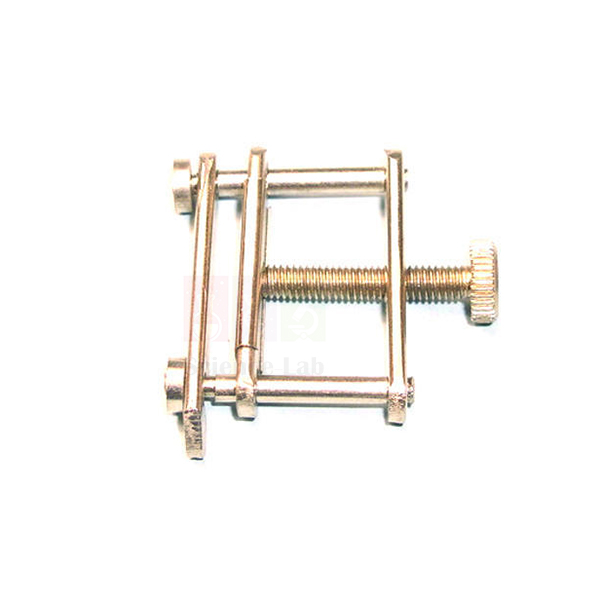
Hoffman Clips
Hoffman Clips (Product Code: SLE/CH/212) are screw-adjusted tubing clamps used to squeeze rubber or flexible tubing so that the flow of liquid or gas through it can be reduced gradually or stopped completely. These clips are nickel-plated brass, with a projecting plate that stops the end of the screw from damaging the tubing and a hinged bottom bar that lets you fit or remove the clip without reaching an end of the tube. They are made by Jain Scientific Equipments Pvt Ltd (ScienceLab), Ambala, a chemistry lab instruments supplier and manufacturer.
Specifications
| Parameter | Detail |
|---|---|
| Material | Brass |
| Finish | Nickel coated (nickel-plated) |
| Tubing protection | Projecting plate prevents damage to tubing by the end of the screw |
| Fitting | Hinged bottom bar for direct fitting and removal without access to the ends of the tube |
| Pack size | Pack of 10 |
Typical Use
Swing the hinged bar open, slip the clip over the tubing at the point you want to control, close the bar, and turn the screw to press the tubing flat. A few turns give fine control of the drip rate from an aspirator or reservoir, while fully tightening the screw seals the line so a gas generator or siphon can be left standing. Because the clip opens from the side, it can be added to tubing that is already connected at both ends, for example between a Kipp generator in a lab and its delivery tube, without dismantling the apparatus.
Release the screw after use so the tubing does not take a permanent set, and inspect rubber tubing regularly for cracks where the clip presses. The nickel-plated finish helps the brass resist tarnish in a chemistry lab; wipe clips dry after contact with liquids and store them together in a drawer, where a pack of 10 keeps enough on hand for several setups.
Manufacturer
Hoffman Clips are produced by Jain Scientific Equipments Private Limited, the Ambala, Haryana manufacturer that sells under the ScienceLab name to schools, colleges, laboratories and trade partners. For company details, see our profile page.
Related Chemistry Lab Equipment
Tubing and alternative clamps that are used with Hoffman clips:
- Rubber Tubing — the flexible tubing the clip is designed to regulate.
- Silicone Tube — soft tubing that can also be controlled with the clip.
- Aspirator Polythene — a reservoir whose outlet tubing is often fitted with a flow clip.
- Hoffman Screw Clip — another screw clip listed in our range.
- Elastic Clamps for Rubber Pipes (Mohr Clamp) — a spring-type pinch clamp for simple on/off use.
Browse the full Chemistry Lab Equipment range.
Frequently Asked Questions
How many clips are in a pack?
Each pack contains 10 Hoffman clips.
What are the clips made of?
They are brass with a nickel-coated finish.
Can I fit a clip without disconnecting the tubing?
Yes. The hinged bottom bar opens so the clip can be placed on or taken off the tube without access to either end.
Will the screw cut into the tubing?
No. A projecting plate sits between the screw end and the tube, spreading the pressure and preventing damage to the tubing.
What tubing sizes does it fit?
The maximum tubing diameter is not listed. Send us your tubing outside diameter through our contact page and we will confirm the fit.
What should a school include in a quotation request?
The product code SLE/CH/212, number of packs, delivery address and any tender reference; we quote for buyers in India and international markets.
Request a Quote
Send an enquiry for Hoffman Clips through our contact page, or add them to the enquiry cart together with tubing.
Last updated: 24 September 2026
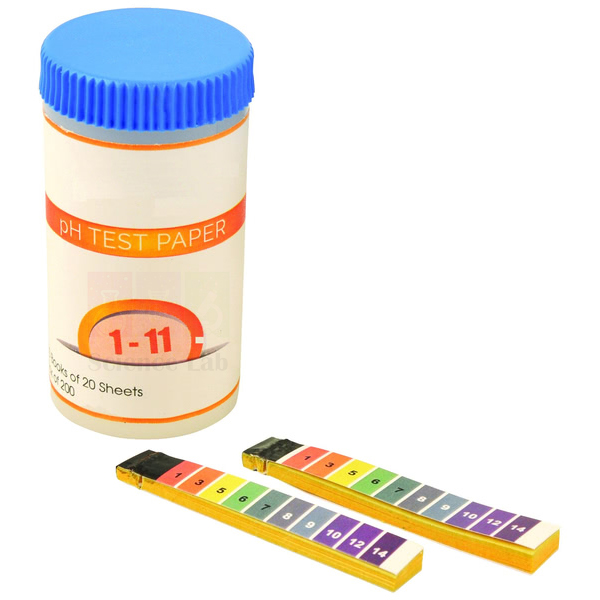
Paper, Universal
Paper, Universal (Product Code: SLE/CH/213) is a universal indicator paper covering pH 1 to 11. Unlike litmus, which only says acid or alkali, it turns a different colour at different points of the scale, so students can estimate how acidic or alkaline a solution is in a few seconds. It comes as a plastic case of 10 books, each holding 20 leaves, which suits school practical classes, college chemistry and biology labs, and quick checks on water or soil extracts. Schools and colleges sourcing pH indicator paper in India can order it from Jain Scientific Equipments Pvt Ltd (ScienceLab), Ambala, which supplies it alongside its own laboratory equipment.
Specifications
| Parameter | Detail |
|---|---|
| Product type | Universal indicator paper |
| pH range | 1 – 11 |
| Packing | Plastic case containing 10 books |
| Leaves per book | 20 |
| Supplied as | Laboratory consumable |
Typical Use
In a classroom, a teacher can hand each group a single book and ask them to test vinegar, lemon juice, soap solution, tap water and a soil extract, then arrange the samples in order from most acidic to most alkaline. The paper is also handy for checking that a neutralisation is complete, for showing that some salt solutions are not neutral, and for rough pH checks in plant and microbiology practicals. Because it is one of the most frequently reordered chemistry consumables, many labs keep a case in each practical room.
For a clean reading, tear off one leaf, place a drop of the sample on it with a glass rod rather than dipping the whole leaf, and compare the colour with the pH colour reference straight away, before the strip dries. Since the scale stops at pH 11, strongly alkaline solutions such as dilute sodium hydroxide will simply show the top colour; for those, a full-range paper is the better choice. Keep the case closed between uses so the books are not exposed to acid or ammonia fumes.
Supplier
This indicator paper is supplied, not manufactured, by Jain Scientific Equipments Private Limited, the Ambala, Haryana company that trades under the ScienceLab name. Schools and colleges can order it together with the glassware and apparatus the company makes, so one enquiry covers a full practical set-up. Read more about the business on the ScienceLab company profile.
Related Chemistry Lab Equipment
These items are commonly used in the same acid–base practicals:
- Paper, Universal, pH 1-14 — the full-scale version for samples that are strongly alkaline.
- pH Indicator Dispenser — a continuous strip you tear to length, useful at a shared bench.
- Red Litmus Paper — a quick first screen for alkalis before estimating pH.
- Blue Litmus Paper — the matching first screen for acids.
- Stirring Rod, Glass — transfers a single drop to the leaf so the rest of the book stays dry.
See the full range of Chemistry Lab Equipment from ScienceLab.
Frequently Asked Questions
What pH range does this paper cover?
It covers pH 1 to 11. If your samples include strong alkalis above that range, choose the full-scale pH 1-14 paper listed above.
How much paper is in one case?
One plastic case holds 10 books, and each book contains 20 leaves, so a single case can be split between several student groups.
How do I read the result?
Wet the leaf with a drop of the sample and compare its colour with the pH colour reference immediately. If you need to know the format of the colour reference supplied with current stock, please ask us through the contact page.
Can it replace a pH meter?
For approximate readings in teaching labs, yes. Where a precise numerical value is required, for example in research or quality testing, a calibrated pH meter is the right tool.
How should the books be stored?
Keep them closed inside the plastic case, in a dry place away from sunlight and chemical fumes, and handle leaves with dry fingers or forceps to avoid false colours.
Do you supply larger quantities for institutions or export?
Yes. We supply schools, colleges and distributors across India and international markets. Share the product code SLE/CH/213, the number of cases and the delivery location, and we will prepare a quotation.
Request a Quote
To order Paper, Universal, send your quantity and delivery details through our contact page, or add the item to the enquiry cart along with any other apparatus you need, and ScienceLab will reply with a consolidated quotation.
Last updated: 24 September 2026
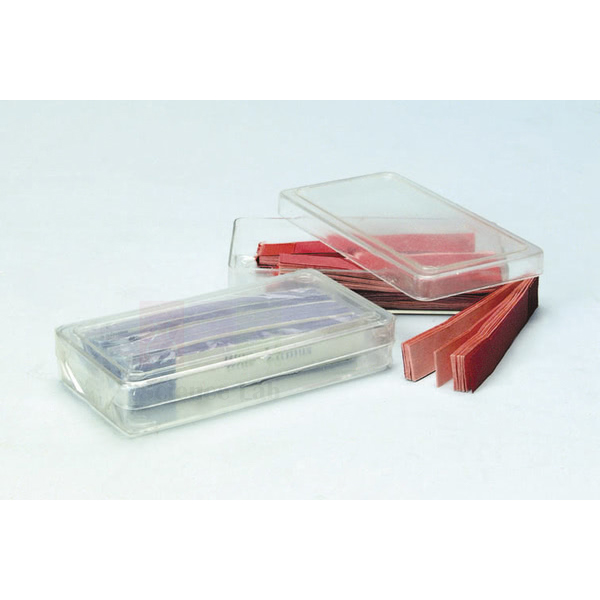
Paper, Universal, pH 1-14
Paper, Universal, pH 1-14 (Product Code: SLE/CH/214) is a full-range universal indicator paper used to estimate the pH of solutions across the entire 1–14 scale, in school and college chemistry labs. Because both ends of the scale are covered, it suits lessons comparing strong and weak acids and alkalis, and it comes as a plastic case of 10 books with 20 leaves each. It is supplied by Jain Scientific Equipments Pvt Ltd (ScienceLab), Ambala, India, as pH indicator paper for India and international markets.
Specifications
| Parameter | Detail |
|---|---|
| Product type | Universal indicator paper, full range |
| pH range | 1 – 14 |
| Packing | Plastic case of 10 books |
| Leaves per book | 20 |
| Shelf life | Depends on the indicator, its grade and storage conditions; ask us for the expiry date of the batch you are quoted |
| Product code | SLE/CH/214 |
| Supplied by | Jain Scientific Equipments Pvt Ltd (ScienceLab), Ambala, India |
What Is Universal pH 1-14 Paper Used For?
A common exercise is to test equal-strength solutions of hydrochloric acid, acetic acid, ammonia solution and sodium hydroxide side by side, so students see that strong and weak acids (or alkalis) give clearly different colours even at the same concentration. The paper is equally useful for following how pH changes as an acid is progressively diluted, for checking the pH of salt solutions, and for confirming that waste is close to neutral before disposal.
Place a drop of sample on a leaf resting on a clean spotting tile or watch glass, then match the colour against the pH colour reference at once. Use only dilute solutions with students, and have them wear goggles and gloves when strong acids or alkalis are on the bench. Leaves that have touched a sample should be discarded, not returned to the book.
What to Specify When Ordering
- The pH range you need: this pH 1-14 paper, or the pH 1-11 Paper, Universal when no strongly alkaline samples are tested
- The number of plastic cases, each holding 10 books of 20 leaves
- Any other acid–base consumables, such as litmus paper or universal indicator solution, to add to the same quotation
Supplier
ScienceLab is the trading name of Jain Scientific Equipments Private Limited in Ambala, Haryana, India. The company supplies consumables such as this full-range indicator paper so that schools and colleges can source their pH testing materials, reagents and lab apparatus from one vendor. Company background is available on the profile page.
Related Chemistry Lab Equipment
Useful companions for pH investigations with this paper:
- Paper, Universal — the pH 1-11 paper, adequate when no strongly alkaline samples are tested
- Universal Indicator Sol — the solution form, for colouring a whole beaker during demonstrations
- Waterproof pH Meter — for a numerical value when paper readings need confirming
- Acids, Bases And The pH Scale — a class activity kit built around the same topic
- Spotting Tiles, Plastic — holds several samples side by side while students test them
Browse more Chemistry Lab Equipment for acid–base practicals.
Frequently Asked Questions
How is this different from the plain Paper, Universal?
Paper, Universal, pH 1-14 reads the full pH 1–14 scale, while the plain Paper, Universal in our range covers pH 1-11. Choose the pH 1-14 paper whenever strongly alkaline solutions are part of the practical.
What does one case contain?
Each plastic case of Paper, Universal, pH 1-14 contains 10 books with 20 leaves in every book, so one book can be handed to each group while the rest of the case stays closed and dry.
Can a leaf be used more than once?
No. Once a leaf of Paper, Universal, pH 1-14 has changed colour it should be discarded, because reusing it mixes colours from different samples and gives unreliable readings.
What is the shelf life of the paper?
The shelf life of Paper, Universal, pH 1-14 depends on the indicator, its grade and storage conditions; ask us for the expiry date of the batch you are quoted, and keep the case closed in a cool, dry place.
What should an institutional quotation request include?
For Paper, Universal, pH 1-14, give the product code SLE/CH/214, the number of cases, billing and delivery addresses, and any other consumables you want on the same order, so everything can be quoted together.
Who supplies Paper, Universal, pH 1-14?
Jain Scientific Equipments Private Limited (ScienceLab), Ambala, Haryana, India, supplies Paper, Universal, pH 1-14 to schools, colleges and distributors in India and international markets; tell us the destination and quantity so we can advise on packing and dispatch.
Request a Quote
For prices and availability of Paper, Universal, pH 1-14, write to us via the contact page or place it in the enquiry cart with the rest of your consumables list.
Last updated: 24 September 2026
Parafilm
Parafilm (Product Code: SLE/CH/215) is a two-way stretch sealing film used to close the mouths of flasks, test tubes, beakers and dishes when a stopper or lid is not practical. Pulled gently in both directions, it clings around irregular shapes and surfaces and forms a snug seal against evaporation and dust. The film is 100mm wide and 38m long, free from plasticisers and non-toxic, which makes it a routine item among lab consumables in chemistry, biology and microbiology labs at schools, colleges and research institutes. It is supplied by Jain Scientific Equipments Pvt Ltd (ScienceLab), Ambala, India.
Specifications
| Parameter | Detail |
|---|---|
| Type | Two-way stretch sealing film |
| Width | 100mm |
| Length | 38m |
| Stretch | Up to 200% |
| Melting temperature | 60°C |
| Composition notes | Free from plasticisers; non-toxic |
| Chemical resistance | Resists polar substances such as saline solutions, inorganic acid and alkaline solutions for up to 48 hours; resistant to most lower alcohols |
| Not suitable with | Many common solvents, such as diethyl ether and carbon tetrachloride, in which it is unstable |
| Handling | Clings around irregular shapes and surfaces |
Typical Use
Technicians use the film to cover conical flasks holding prepared solutions or broth, to seal test tubes before they are shaken, to wrap the rim of culture plates during incubation, and to close a measuring cylinder so it can be inverted for mixing. In microbiology lab work it is also used to keep plates and small containers from drying out while they are stored. Because it stretches up to 200%, a small square is usually enough for a flask neck, which keeps usage economical.
Cut a piece a little larger than the opening, stretch it across, then wrap and press it down the sides so it grips. Keep it away from heat: with a melting temperature of 60°C it is not for hot plates, ovens or autoclaves. Its resistance to salt, acid and alkaline solutions is rated for up to 48 hours, so for longer storage switch to a proper stopper or cap, and never rely on it with diethyl ether, carbon tetrachloride or similar solvents.
Supplier
ScienceLab, the brand of Jain Scientific Equipments Private Limited in Ambala, Haryana, supplies this sealing film as a consumable rather than manufacturing it. Labs can add it to orders for the glassware and apparatus the company produces, which simplifies purchasing for a whole department. Learn more on our company profile.
Related Laboratory Equipment
Containers this film is most often stretched over:
- Conical Flask — its narrow neck takes a small piece of film for storage or shaking.
- Petri Dish, Triple Vent — a strip around the rim limits drying of agar plates.
- Glass Measuring Cylinder — sealed with film, it can be inverted to mix a solution.
- Glass Beaker — film gives a quick short-term cover against dust and evaporation.
More bench essentials are listed under Chemistry Lab Equipment.
Frequently Asked Questions
What width and length of film is supplied?
The film is 100mm wide and 38m long.
Can it be used on containers holding organic solvents?
Only with care. It resists most lower alcohols, but it is unstable in many common solvents such as diethyl ether and carbon tetrachloride, so use a glass stopper or screw cap for those.
Can sealed containers be heated or autoclaved?
No. The film melts at 60°C, so remove it before any heating or sterilisation step.
How long will it hold against acids, alkalis and salt solutions?
It is resistant to saline, inorganic acid and alkaline solutions for up to 48 hours. For longer storage, a permanent closure is recommended.
Does it contain plasticisers?
No. It is free from plasticisers and non-toxic.
Can you supply it in quantity to a department or distributor?
Yes. ScienceLab supplies institutions and trade buyers in India and international markets. Send the product code SLE/CH/215 and the quantity through the contact page for a quotation.
Request a Quote
Ask for pricing on Parafilm through our contact page, or add it to the enquiry cart together with the flasks and dishes you are ordering.
Last updated: 24 September 2026
Pestle & Mortar, Unglazed
Pestle & Mortar, Unglazed (Product Code: SLE/CH/216) is a white porcelain grinding set used to crush crystals and lumps into a fine, even powder in school and college laboratories. Its grinding surface is left unglazed, giving the slight roughness needed for efficient grinding, and the porcelain is chemical resistant, so it can be used with a wide range of laboratory solids. It is supplied by Jain Scientific Equipments Pvt Ltd (ScienceLab), Ambala, India, as part of its chemistry lab equipment range.
Specifications
| Parameter | Detail |
|---|---|
| Material | Porcelain |
| Colour | White |
| Grinding surface | Unglazed |
| Chemical resistance | Chemical resistant |
| Application | Laboratory grinding and mixing of solids |
| Product code | SLE/CH/216 |
| Supplied by | Jain Scientific Equipments Pvt Ltd (ScienceLab), Ambala, India |
What Is an Unglazed Pestle and Mortar Used For?
In school chemistry, students crush salt crystals before dissolving them or heating them in a dry test tube, a routine step in salt analysis practicals. College labs use it to powder samples for melting-point work and to blend solids before a reaction, pharmacy students grind tablets and mix powders during dosage-form practicals, and biology classes grind leaves with a little sand and solvent to extract plant pigments. That breadth is why it appears on almost every lab equipment list for school chemistry in India.
Work with small portions: press and rotate the pestle against the bowl rather than pounding, and scrape the powder back to the centre now and then. Because an unglazed surface can hold traces of earlier samples, rinse and brush it straight after use; grinding a little clean sand before washing helps lift stubborn residue. Many labs keep separate sets for coloured or toxic materials to avoid cross-contamination.
Supplier
This pestle and mortar is supplied by Jain Scientific Equipments Private Limited, which trades as ScienceLab from Ambala, Haryana, India, to schools, colleges and distributors. For vendor registration, the supplying company is Jain Scientific Equipments Private Limited (GSTIN 06AAECJ8618A1ZT, LEI 3358004HRD1JIVXKYX49). More about the company is on the ScienceLab profile page.
Related Laboratory Equipment
Items that complete the grind-weigh-transfer routine:
- Spatula, Spoon End — scoops the ground powder cleanly out of the bowl
- Weighing Paper — for weighing out the powdered sample
- Balance Triple Beam — measures the quantity needed for the next step
- Powder Funnel — moves the powder into a flask or tube without spills
- Pestle And Mortar — another pestle and mortar listing to compare if you need an alternative
Explore all Chemistry Lab Equipment from ScienceLab.
Frequently Asked Questions
What material is the Pestle & Mortar, Unglazed?
The Pestle & Mortar, Unglazed is white porcelain, with the inside grinding surface left unglazed for better grip on the sample; the porcelain is chemical resistant for routine work with laboratory salts and solids.
Why choose an unglazed surface over a glazed one?
An unglazed surface, as on the Pestle & Mortar, Unglazed, adds friction, so crystals break down to a fine powder with less effort. A glazed surface is easier to wipe clean but grinds less efficiently.
Which sizes are available?
Size details for the Pestle & Mortar, Unglazed are not listed on this page. Tell us the bowl diameter or capacity you need through our contact page and we will confirm what can be supplied before quoting.
How should it be cleaned?
Rinse and brush the Pestle & Mortar, Unglazed straight after use; for residue that stays in the unglazed surface, grind a little clean sand, then wash and dry the set fully before the next sample.
Is it resistant to chemicals?
Yes. The Pestle & Mortar, Unglazed is chemical-resistant porcelain, suitable for routine grinding of laboratory salts and solids; keep separate sets for coloured or toxic materials to avoid cross-contamination between samples.
Who supplies the Pestle & Mortar, Unglazed?
Jain Scientific Equipments Private Limited (ScienceLab), Ambala, Haryana, India, supplies the Pestle & Mortar, Unglazed to schools, colleges and distributors in India and international markets; include product code SLE/CH/216, quantity and delivery location.
Request a Quote
Request a price for the Pestle & Mortar, Unglazed through our contact page, or collect it in the enquiry cart with the balances and spatulas for your lab.
Last updated: 24 September 2026
Petri Dish Rack
Petri Dish Rack (Product Code: SLE/CH/217) is a clear acrylic rack with white polycarbonate posts that holds 60 Petri dishes of 90 mm diameter in neat stacks. Because the acrylic lets you see the plates from every side, cultures can be checked during incubation without lifting each dish out, and the rack is equally useful while inoculating plates and when storing them afterwards. It is a practical piece of microbiology lab equipment for school biology rooms, college and university labs, and hospital or food-testing labs, and is manufactured by Jain Scientific Equipments Pvt Ltd (ScienceLab), Ambala, India.
Specifications
| Parameter | Detail |
|---|---|
| Capacity | 60 Petri dishes |
| Dish size accommodated | 90 mm diameter |
| Body material | Clear acrylic |
| Posts | White polycarbonate |
| Visibility | Plates visible from all sides |
| Used during | Inoculation, incubation and storage |
Typical Use
During a class practical, freshly poured or streaked plates go straight into the rack so each student's work stays in order and the bench stays clear. The loaded rack can then be placed in a bacteriological incubator, and the next day the class can compare colony growth through the transparent sides before opening any dish. After the practical, the same rack keeps prepared or finished plates together on a shelf or in a cold store until they are examined or discarded.
Label each plate on its base before racking so the writing stays visible, and follow your usual practice of incubating agar plates lid-down. Clean the rack with mild detergent and water or a suitable surface disinfectant; avoid strong solvents and autoclave cycles, which are not suited to acrylic.
Manufacturer
The rack is made by Jain Scientific Equipments Private Limited, a laboratory equipment company in Ambala, Haryana that trades as ScienceLab and serves teaching and testing labs. You can read about the company's work on the about-us profile.
Related Laboratory Equipment
Other items used in the same plating and incubation workflow:
- Petri Dish, Triple Vent — sterile 90 mm dishes that match the rack's dish size.
- Petri Dish Glass With Lid — reusable glass dishes; check the diameter when ordering.
- Laboratory Incubator With Visibility Door — for incubating the racked plates.
- Glass Spirit Lamp — provides a flame for aseptic inoculation at the bench.
- Autoclave Bag — for collecting used plates before sterilisation and disposal.
For more racks and bench accessories, visit Chemistry Lab Equipment.
Frequently Asked Questions
How many dishes does the rack hold?
It holds 60 Petri dishes of 90 mm diameter.
Will it take dishes of other sizes?
It is designed for 90 mm dishes. For a different dish size, send us the diameter via the contact page before ordering.
Will it fit inside my incubator?
External dimensions are not listed here. Share your incubator's internal size with us and we will confirm the fit.
Can the rack be autoclaved?
No. Clean the acrylic with mild detergent or a surface disinfectant instead.
Why is clear acrylic useful here?
It lets you see the plates from all sides, so growth can be checked during incubation without disturbing the stack.
What information do you need for a lab or tender quotation?
Quote the product code SLE/CH/217, the number of racks, the delivery address and any documents your purchase process requires. Warranty terms are confirmed with the quotation.
Do you supply export orders?
Yes, ScienceLab supplies buyers across India and international markets.
Request a Quote
To price the Petri Dish Rack for your lab, use our contact page or add it to the enquiry cart along with dishes and incubation accessories.
Last updated: 24 September 2026
Petri Dish, Triple Vent
Petri Dish, Triple Vent (Product Code: SLE/CH/219) is a sterile, clear polystyrene Petri dish measuring 90mm x 15mm, made for work with micro-organisms and culture media. The triple-vent lid design allows limited air exchange between lid and base, and the mirror finish gives high clarity for viewing and counting colonies. The dishes can be used with plate pourers, are chemical resistant and are intended for in vitro use only. This plastic Petri dish is used in school biology practicals, college microbiology courses and food, water and clinical testing labs, and is supplied by Jain Scientific Equipments Pvt Ltd (ScienceLab), Ambala, India.
Specifications
| Parameter | Detail |
|---|---|
| Type | Triple vent Petri dish |
| Material | Polystyrene |
| Colour | Clear |
| Dimensions | 90mm x 15mm |
| Finish | Mirror finish for high clarity |
| Condition | Sterile |
| Chemical resistance | Chemical resistant |
| Compatibility | Can be used with plate pourers |
| Intended use | In vitro use only; micro-organisms and media |
Typical Use
These dishes are poured with nutrient agar or selective media for streak-plate isolation, pour-plate and spread-plate counts, antibiotic-disc sensitivity demonstrations and environmental sampling such as exposing an open plate to classroom air. Because they arrive sterile, a teacher can move straight to agar plate preparation without first washing and sterilising glassware, and labs with plate pourers can fill them in batches.
Open the packaging only when you are ready to pour, keep lids on except when inoculating, and pour close to a flame or inside a clean cabinet. Once the agar has set, incubate the plates lid-down so condensation does not drip onto the surface. After use, collect plates in an autoclave bag and sterilise them before disposal; polystyrene dishes are meant for single use and are not re-sterilised for reuse.
Supplier
ScienceLab supplies these sterile dishes as a consumable alongside the lab apparatus it makes. The business is registered as Jain Scientific Equipments Private Limited and operates from Ambala in Haryana; see the company profile for more.
Related Laboratory Equipment
Pair these dishes with the following items for a complete plating set-up:
- Petri Dish Rack — stacks 90 mm plates for inoculation, incubation and storage.
- Parafilm — seals the rim so plates dry out less in storage.
- Incubator 30L, upto 80C — a compact incubator for growing cultures.
- Autoclave Bag Disposable — for collecting used plates before sterilisation.
- Bunsen Burner — the flame that keeps the pouring and streaking area aseptic.
Further consumables and apparatus are listed in Chemistry Lab Equipment.
Frequently Asked Questions
What size are the dishes?
Each dish measures 90mm x 15mm.
Are they supplied sterile?
Yes, the dishes are sterile and ready for pouring media.
What does triple vent mean?
The lid is vented at three points so a little air can pass between lid and base, which helps cultures that need some gas exchange.
Can they be used with an automatic plate pourer?
Yes, they can be used with plate pourers.
How many dishes are in a pack?
Pack quantity is not listed on this page. Please ask through the contact page and we will confirm the current packing.
Are they suitable for clinical diagnosis on patients?
They are marked for in vitro use only, meaning laboratory work with cultures and media, not for use on or in the body.
Can you supply regular bulk quantities?
Yes. We supply schools, colleges, testing labs and distributors in India and international markets; send the product code SLE/CH/219 and the monthly or annual quantity you expect.
Request a Quote
Get a quotation for Petri Dish, Triple Vent via our contact page, or place it in the enquiry cart with your racks and media-handling items.
Last updated: 24 September 2026
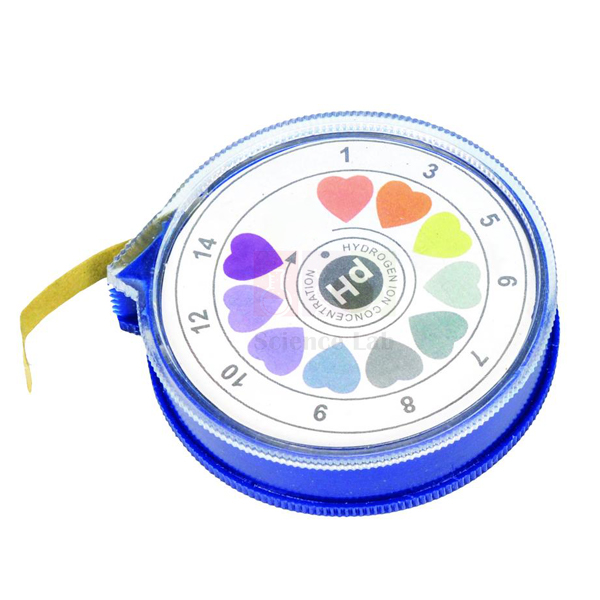
pH Indicator Dispenser
pH Indicator Dispenser (Product Code: SLE/CH/218) is pH indicator paper packed as a continuous test strip inside a plastic dispenser. The dispenser holds 5 metres of 8mm wide strip covering pH 1–14, and a colour chart provided on its side means the reference scale is always with the paper. Users pull out only the length they need, which reduces waste and keeps the remaining strip clean and dry. It suits school and college chemistry benches, biology and environmental science field work, and quick checks in water and soil testing, and is supplied by Jain Scientific Equipments Pvt Ltd (ScienceLab), Ambala, India.
Specifications
| Parameter | Detail |
|---|---|
| Product type | Indicator paper in plastic dispenser |
| pH range | 1 – 14 |
| Strip length | 5 metres |
| Strip width | 8mm |
| Colour reference | Colour chart provided on the side of the dispenser |
| Supplied as | Laboratory consumable |
Typical Use
The dispenser format works well where one supply is shared around a room or carried outdoors. On a field trip, students can test pond, tap and rain water or a soil suspension and read the result against the chart on the dispenser itself, with no separate card to lose. At the bench, a technician can keep one dispenser beside the neutralisation or waste-treatment area and tear off a short piece whenever a check is needed. As with all chemistry consumables, having the colour chart attached makes readings more consistent between users.
Pull out a short length, tear it off with dry fingers, and touch it with a drop of sample rather than dipping the end still attached to the dispenser. Hold the wetted strip beside the side chart in good light and read it straight away. Close the dispenser after use and keep it away from damp and acid or ammonia vapours so the remaining strip stays usable.
Supplier
This dispenser is one of the consumables ScienceLab supplies to complement the apparatus it manufactures. ScienceLab is the brand name of Jain Scientific Equipments Private Limited, located in Ambala, Haryana. Visit the profile page for background on the company.
Related Chemistry Lab Equipment
Items that support pH checks with this strip:
- Paper, Universal, pH 1-14 — the same range in book form for handing out to groups.
- Blue Litmus Paper — a simple acid test for younger classes.
- Plastic Microchemistry Pipets — put a single drop of sample on the strip.
- pH mV and Temperature Meter — for numerical readings when strip results need confirming.
Find more consumables and apparatus in Chemistry Lab Equipment.
Frequently Asked Questions
How much strip is in one dispenser?
Each dispenser contains 5 metres of test strip, 8mm wide.
What pH range does it read?
The strip covers pH 1–14.
Is a colour chart included?
Yes. The colour chart is provided on the side of the dispenser, so the reference travels with the strip.
Should I choose the dispenser or indicator paper books?
The dispenser suits a shared bench or field use where you tear off lengths as needed; books are easier to distribute one per group in a class practical.
Can the dispenser be refilled?
Refill availability is not listed here. Please ask through the contact page and we will advise.
What do you need to prepare a school or college quotation?
The product code SLE/CH/218, the number of dispensers, the billing name and the delivery address. We supply institutions in India and international markets.
Request a Quote
Send an enquiry for the pH Indicator Dispenser through our contact page, or add it to the enquiry cart with other indicator papers and pH equipment.
Last updated: 24 September 2026
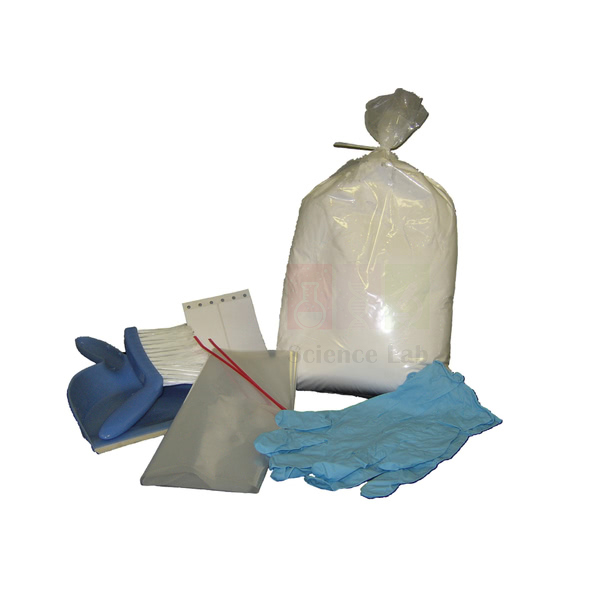
Solvent Spill Clean Up Kit
Solvent Spill Clean Up Kit (Product Code: SLE/CH/220) brings together what a lab needs to absorb, collect and bag a small solvent spill in one pack. The core of the kit is 1100g of diatomaceous earth, a fine mineral absorbent, packed in a polybag, backed up by vinyl exam gloves, a dust pan and brush, empty polybags, twist ties, blank shipping tags and an instruction sheet/MSDS. It is intended for chemistry teaching labs, preparation rooms, research labs and stores where organic solvents are handled, and it is supplied by Jain Scientific Equipments Pvt Ltd (ScienceLab), Ambala, India, as part of its range of lab consumables.
Specifications
| Parameter | Detail |
|---|---|
| Absorbent | 1100g diatomaceous earth in a 225 x 400mm polybag |
| Collection bags | 2 empty polybags, 225 x 400mm |
| Hand protection | 2 vinyl exam gloves |
| Collection tools | 1 dust pan and brush |
| Closures and labels | 2 twist ties, 2 blank shipping tags |
| Documentation | Instruction sheet/MSDS |
| Supplied as | Spill response consumable kit |
Typical Use
When a bottle of ethanol, acetone or another laboratory solvent is knocked over, the priority is to warn others, put out nearby flames, switch off heat sources and ventilate the room. The responder then puts on the vinyl gloves and pours diatomaceous earth around the edge of the spill first and then over the centre, so the liquid is contained while it soaks in. Once it has been absorbed, the dust pan and brush sweep the material into one of the empty polybags, which is closed with a twist tie and labelled on a blank shipping tag with the solvent name and date.
Keep the kit stored close to where solvents are dispensed, read the instruction sheet/MSDS during staff induction rather than for the first time during an incident, and hand the sealed bags over for lab waste disposal in line with your institution's rules. After use, check what has been consumed and restock before the next practical session.
Supplier
Jain Scientific Equipments Private Limited, which operates as ScienceLab from Ambala in Haryana, supplies this kit so laboratories can source safety consumables along with the teaching apparatus the company builds. Details of the company are on the ScienceLab profile.
Related Chemistry Lab Equipment
Complete your lab's spill response and hazard-marking set with:
- Acid Spill Clean Up Kit — the matching kit for acid spills.
- Caustic Spill Clean Up Kit — for alkali and caustic solution spills.
- Spill Pack — a multi-container absorbent pack with soda ash for general spill cover.
- Safety Goggles — eye protection, which the kit itself does not include.
- Hazard Warning Tape: Flammable — marks solvent storage areas and cordons off a spill zone.
See more safety and bench items in Chemistry Lab Equipment.
Frequently Asked Questions
What exactly is in the kit?
Instruction sheet/MSDS, 2 twist ties, 2 blank shipping tags, 2 vinyl exam gloves, 2 empty 225 x 400mm polybags, 1 dust pan and brush, and 1100g diatomaceous earth in a 225 x 400mm polybag.
How large a spill can one kit handle?
A rated spill volume is not stated for this kit. The absorbent supplied is 1100g of diatomaceous earth; for help sizing kits to your storage volumes, please contact us.
Should I use it for acid or caustic spills?
It is made up for solvent spills. For acids or caustic solutions, the dedicated acid and caustic kits listed above are the better match.
Is eye protection included?
No. The kit includes vinyl exam gloves only, so keep safety goggles beside it.
Can I buy refill components separately?
Refill availability is not listed here. Ask through the contact page and we will advise.
What should a school or tender enquiry include?
Quote the product code SLE/CH/220, the number of kits and the delivery location. We supply institutions in India and international markets.
Request a Quote
To equip your labs with the Solvent Spill Clean Up Kit, contact us through the contact page or add it to the enquiry cart with the acid and caustic kits for a complete set.
Last updated: 24 September 2026
Spatula Palette Knife
Spatula Palette Knife (Product Code: SLE/CH/221) is a palette-knife style spatula with a flexible blade and parallel sides, set in a wooden handle. The flexible blade bends slightly under pressure, so it can spread, fold and scrape material across a flat surface in a way a rigid scoop spatula cannot. It is used for working pastes and ointments, lifting crystals or precipitate from filter paper and mixing small quantities of powder on a tile. As part of lab equipment for colleges and schools, it is manufactured by Jain Scientific Equipments Pvt Ltd (ScienceLab), Ambala, India.
Key Details
| Parameter | Detail |
|---|---|
| Type | Palette knife spatula |
| Blade | Flexible, with parallel sides |
| Handle | Wooden |
| Purpose | Spreading, mixing, scraping and lifting pastes, powders and crystals |
| Suitable for | Chemistry, pharmacy and biology teaching labs |
Typical Use
In pharmaceutics practicals, students use a palette knife to work an ointment base and powder together on a slab until the mixture is smooth, the classic technique of spatulation taught in pharmacy lab equipment sets. Chemistry students use it to lift crystals off a filter paper after recrystallisation, to scrape a dried precipitate together, or to fold two powders together on a tile before heating. Its thin, flexible edge also clears material from the curved inside of a mortar.
Hold the knife at a low angle and use the flat of the blade rather than the tip, so pressure is spread evenly and the blade keeps its shape. Wipe it clean straight after use and dry it fully. Since the handle is wood, avoid soaking the knife or leaving it in hot water, and do not use the blade to prise open lids, which can bend a flexible blade permanently.
Manufacturer
ScienceLab is the brand used by Jain Scientific Equipments Private Limited, which produces hand tools and apparatus for teaching laboratories at its base in Ambala, Haryana. Our company profile explains more about how we work.
Related Chemistry Lab Equipment
Tools and materials often used alongside a palette knife:
- Spatula, Chattaway — a rigid stainless option for measuring out small portions of solid.
- Spatula, Polypropylene — a non-metal choice for materials that should not touch metal.
- Pestle & Mortor, Unglazed — the knife helps recover powder from the bowl after grinding.
- Filter Paper — crystals and precipitates collected on it are lifted off with the flexible blade.
For the complete range, open Chemistry Lab Equipment.
Frequently Asked Questions
How is a palette knife different from an ordinary lab spatula?
Its blade is flexible with parallel sides, so it spreads and scrapes across flat surfaces; ordinary spatulas are stiffer and mainly used to scoop and transfer solids.
What is the blade made of?
The blade material is not listed on this page. Please ask through the contact page if you need it confirmed, for example for use with reactive chemicals.
What length is the blade?
Dimensions are not listed here; we can confirm them with your quotation.
Can it be autoclaved or left to soak?
Not recommended, because the handle is wooden. Wipe the blade clean and dry it after each use.
Is it suitable for pharmacy practicals?
Yes. The flexible blade is well suited to mixing ointments and pastes on a slab.
Can you supply sets for a whole class or for export?
Yes. We supply institutions and distributors in India and international markets; include the product code SLE/CH/221 and your quantity when you enquire.
Request a Quote
Ask for a price on the Spatula Palette Knife through our contact page, or add it to the enquiry cart together with other spatulas for your practical kits.
Last updated: 24 September 2026
Spatula, 140mm
Spatula, 140mm (Product Code: SLE/CH/222) is a 140mm stainless steel laboratory spatula with a round bent end at one side and a scoop end at the other. The scoop end carries a small portion of powder or crystals from a reagent bottle, while the bent end is handy for scraping, stirring or breaking up caked solids. Its silver stainless steel finish is easy to wipe clean, making it an everyday tool at the chemical balance or digital weighing balance in school, college and industrial labs. It is manufactured by Jain Scientific Equipments Pvt Ltd (ScienceLab), Ambala, India.
Specifications
| Parameter | Detail |
|---|---|
| Material | Stainless steel |
| Colour | Silver |
| Length | 140mm |
| End 1 | Round bent end |
| End 2 | Scoop end |
Typical Use
A typical task is weighing out a salt to make up a standard solution: the student tares a weighing boat, uses the scoop end to add solid a little at a time, and taps the spatula gently to add the last few crystals until the target mass is reached. The round bent end is useful for loosening a reagent that has caked inside its bottle, for stirring a small quantity of mixture in a beaker, or for scraping residue from the sides of an evaporating basin.
To avoid cross-contamination, wipe and dry the spatula each time you change chemicals, or keep a dedicated spatula for each frequently used reagent. Never return unused solid to the stock bottle from the spatula; place it in a labelled container instead. Wash with detergent and water after the session and store dry.
Manufacturer
This spatula is made by Jain Scientific Equipments Private Limited, the company behind the ScienceLab name in Ambala, Haryana. The company is incorporated under CIN U29309HR2020PTC087597 and manufactures at its licensed factory at 449, HSIIDC Industrial Area, Saha, Ambala (Factory Licence AMB-ONLINE-CHD-J-414). Company details are on the profile page.
Related Chemistry Lab Equipment
Items used with this spatula when weighing and transferring solids:
- Plastic Weighing Boats — receive the solid on the balance pan.
- Balance Double Beam — for weighing the portions the spatula delivers.
- Bottle Reagent, W.M. Glass — wide-mouth bottles that the spatula can reach into easily.
- Spatula, Spoon End — a longer spoon-form alternative sold in packs for class sets.
- Spatula, Trulla — for moving larger quantities of material.
More options are available under Chemistry Lab Equipment.
Frequently Asked Questions
How long is this spatula?
It is 140mm long.
What shape are the two ends?
One end is round and bent; the other is a scoop end for carrying powders and crystals.
What material is it made from?
Stainless steel with a silver finish.
Is it sold singly or in packs?
Pack quantity is not listed on this page. Tell us how many you need through the contact page and we will quote accordingly.
How do I stop contamination between chemicals?
Clean and dry the spatula every time you switch reagents, or assign one spatula to each commonly used chemical.
What do you need for an institutional or export quotation?
The product code SLE/CH/222, quantity, delivery address and any vendor documents your purchase team requires. We supply buyers in India and international markets.
Request a Quote
For pricing on the Spatula, 140mm, reach us through the contact page, or add it to the enquiry cart with your weighing accessories.
Last updated: 24 September 2026
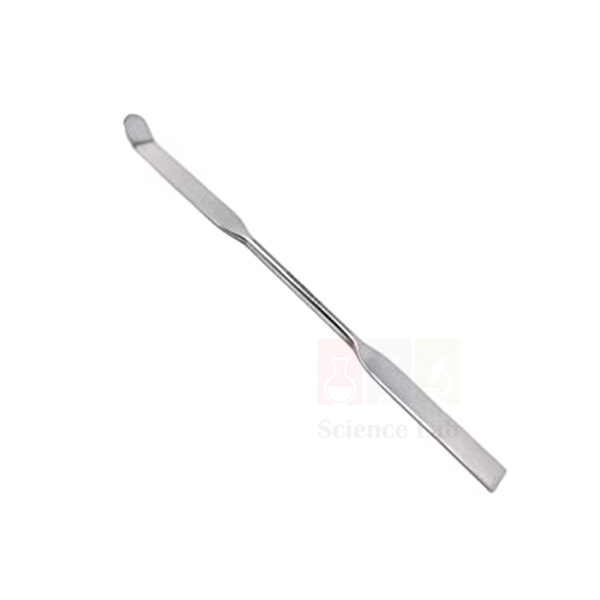
Spatula, Chattaway
Spatula, Chattaway (Product Code: SLE/CH/223) is a Chattaway-type stainless steel spatula with one flat end and the other end canted up. At 14.5cm long, 1.2 cm wide and weighing 15gms, it is slim and light enough to reach into test tubes and small bottles, and the upturned end holds a small heap of powder securely while it is carried. The polished finish sheds residue easily, which suits precise work with small amounts of solid, such as the pinch of salt used in qualitative salt analysis. It is manufactured by Jain Scientific Equipments Pvt Ltd (ScienceLab), Ambala, India, for school, college and research labs.
Specifications
| Parameter | Detail |
|---|---|
| Type | Chattaway |
| Material | Stainless steel |
| Ends | One end flat, the other end canted up |
| Finish | Polished |
| Length | 14.5cm |
| Width | 1.2 cm |
| Weight | 15gms |
Typical Use
In a salt analysis practical, the canted end picks up just enough of the unknown salt to drop into a dry test tube for a heating test, or into a small beaker to prepare the original solution. The narrow blade also transfers solid into a crucible for ignition, loads a little sample onto weighing paper on an analytical balance, and pushes material into the neck of a small flask. Because it is so light, students get a better feel for small quantities, which helps them avoid overloading tubes.
Use the flat end to level off a heap or scrape residue from a watch glass, and the canted end to carry. Clean the spatula immediately after each use, since traces of one salt can give false results in the next test, and dry it before it goes back in the drawer. Its polished stainless steel surface makes this quick.
Manufacturer
Jain Scientific Equipments Private Limited produces this Chattaway spatula and markets it under its ScienceLab brand from Ambala, Haryana, alongside a wide catalogue of chemistry lab equipment. Find out more on the company profile page.
Related Chemistry Lab Equipment
Useful companions for small-quantity solid handling:
- Test Tube Holder — holds the tube while a salt sample is heated.
- Crucible with lid — receives small solid portions for ignition.
- Weighing Paper — a surface for weighing the portions the spatula delivers.
- Spatula, 140mm — a scoop-end spatula for slightly larger portions.
- Spatula Palette Knife — a flexible blade for spreading and scraping.
Browse the rest of our Chemistry Lab Equipment.
Frequently Asked Questions
What are the dimensions?
It is 14.5cm long and 1.2 cm wide, and it weighs 15gms.
What makes a Chattaway spatula different?
It has one flat end and one end canted up, and its narrow blade is designed for taking small quantities from bottles and into test tubes.
Is the finish suitable for analytical work?
Yes. It is polished stainless steel, which is easy to clean between samples.
How many come in a pack?
Pack quantity is not stated on this page. Let us know your requirement through the contact page and we will confirm the packing.
Is there a warranty?
Warranty terms are provided with each quotation; ask us if you need them documented for your purchase file.
Can you supply class quantities or export orders?
Yes, ScienceLab supplies institutions in India and international markets. Include the product code SLE/CH/223 with the quantity you need.
Request a Quote
Request a quotation for the Spatula, Chattaway through the contact page, or add it to the enquiry cart with the rest of your salt analysis apparatus.
Last updated: 24 September 2026
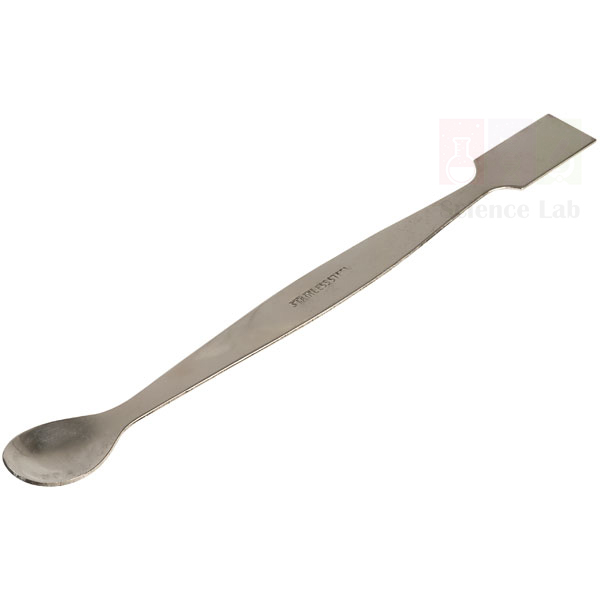
Spatula, Spoon End
Spatula, Spoon End (Product Code: SLE/CH/224) is a well-finished, polished stainless steel spatula, 150mm long, with a flat blade at one end and a small spoon at the other. The spoon holds a rounded portion of powder or crystals without spilling, while the flat end scrapes and levels. Supplied in packs of 10, it is convenient for equipping every group at a practical bench, especially for solubility experiments and crystallisation practicals in schools and colleges. It is manufactured by Jain Scientific Equipments Pvt Ltd (ScienceLab), Ambala, India.
Specifications
| Parameter | Detail |
|---|---|
| Type | Spoon end |
| Material | Stainless steel |
| Colour | Silver |
| Ends | One end flat, the other end spoon form |
| Finish | Well finished and polished |
| Length | 150mm |
| Pack | Pack of 10 |
Typical Use
In a solubility investigation, students add solute to water one spoonful at a time, stirring after each addition until no more dissolves, then compare how many spoonfuls different salts needed. The same spoon end is used to add copper sulphate or alum to hot water when growing crystals, to transfer powdered samples into a boiling tube, and to measure out reactants for simple displacement or neutralisation reactions. The flat end is handy for scraping crystals from the side of a beaker.
For quantitative work, treat the spoon as a transfer tool rather than a measure and weigh the solid on a balance. Issue one spatula per reagent to each group, which a pack of 10 makes easy, and ask students to wipe and dry the spoon before it is used in a different container. Wash in warm soapy water at the end of the session and store dry.
Manufacturer
ScienceLab spatulas are made by Jain Scientific Equipments Private Limited, a manufacturer of teaching-lab apparatus located in Ambala, Haryana, which supplies class-size packs like this one to schools and colleges. See our profile for company information.
Related Chemistry Lab Equipment
Other items that belong in the same weighing and transfer workflow:
- Plastic Weighing Boats — hold the spooned solid on the balance.
- Balance Triple Beam — turns a spoonful into a measured mass.
- Powder Funnel — guides the powder into narrow-necked flasks.
- Spatula, Trulla — double trowel scoops for bulkier transfers.
- Spoon Spatula — another spoon-type spatula to compare.
View all items in Chemistry Lab Equipment.
Frequently Asked Questions
How many spatulas are in a pack?
Each pack contains 10 spatulas.
How long is each spatula?
Each one is 150mm long.
Can the spoon be used as a fixed measure?
Only as a rough guide. The spoon volume is not specified, so weigh the solid whenever an accurate quantity is needed.
What is the material and finish?
Stainless steel, well finished and polished, silver in colour.
How should the spatulas be cleaned?
Wash in warm soapy water, rinse and dry thoroughly; wipe between reagents during a practical to prevent cross-contamination.
We are equipping several labs. What should our enquiry include?
The product code SLE/CH/224, the number of packs, delivery addresses for each site and your billing details. We supply institutions in India and international markets through the contact page.
Request a Quote
Send your requirement for the Spatula, Spoon End via the contact page, or add packs to the enquiry cart with the balances and weighing boats for your practical rooms.
Last updated: 24 September 2026
Spatula, Trulla
Spatula, Trulla (Product Code: SLE/CH/225) is a double-ended stainless steel spatula with a trowel-shaped scoop at each end, designed for handling large quantities of material. It measures 175mm in length with 15mm wide scoops, and its silver stainless steel finish cleans easily between uses. Where a narrow spatula would need many trips, the trowel scoops move granular solids, soil or powders from a stock container in a few passes, which makes it a practical addition to any educational lab equipment list for preparation rooms and practical benches. It is sold in packs of 10 and manufactured by Jain Scientific Equipments Pvt Ltd (ScienceLab), Ambala, India.
Specifications
| Parameter | Detail |
|---|---|
| Type | Trulla, double ended |
| Material | Stainless steel |
| Colour | Silver |
| Scoops | Trowel-shaped, at both ends |
| Length | 175mm |
| Width | 15mm |
| Pack | Pack of 10 |
Typical Use
Lab assistants reach for a trulla when refilling student reagent jars from a bulk container, portioning out sand, marble chips or soil for a class, or loading a larger mass of solid onto a balance for a stock solution. In environmental and agriculture practicals, it serves as a small trowel for moving soil samples into sieves, beakers or sample bags, and in pharmacy and food labs it handles granules and bulk powders. When planning a new school lab setup, a pack for the preparation room saves time every week.
Use one end for dry solids and keep the other for a second material if you need to switch quickly, then clean both ends before the next job. Pour from the side of the trowel into a funnel for narrow-necked containers. Wash, rinse and dry the spatulas after use, especially after salts that can mark stainless steel if left on the surface.
Manufacturer
Jain Scientific Equipments Private Limited manufactures laboratory apparatus in Ambala, Haryana under the ScienceLab name. It is a registered MSME enterprise (Udyam UDYAM-HR-01-0003714), and export consignments are shipped under Importer-Exporter Code AAECJ8618A issued by the DGFT. Read more on the ScienceLab company profile.
Related Chemistry Lab Equipment
Items that pair with a trulla when handling bulk solids:
- Powder Funnel — channels scooped material into bottles and flasks.
- Chemical Balance — for weighing out larger portions.
- Bottle Reagent, W.M. Glass Amber Colour — wide-mouth storage the trowel scoop fits into.
- Spatula, Spoon End — a smaller spoon form for student portions.
- Spatula, 140mm — a compact scoop spatula for the balance bench.
Discover more in Chemistry Lab Equipment.
Frequently Asked Questions
What is a trulla spatula used for?
Moving larger quantities of solid material. Both ends carry trowel-shaped scoops, so it transfers more per pass than a narrow spatula.
What are the length and scoop width?
It is 175mm long, and the scoops are 15mm wide.
How many are in a pack?
Ten spatulas per pack.
Is it suitable for soil and granular samples?
Yes. The trowel shape suits soil, sand, granules and coarse powders as well as fine chemicals.
How do I look after stainless steel spatulas?
Clean off chemicals soon after use, wash in soapy water, rinse and dry fully before storage.
Can you supply against a purchase order or for export?
Yes. Send the product code SLE/CH/225, number of packs and delivery details through the contact page; we supply buyers in India and international markets.
Request a Quote
Get a price for the Spatula, Trulla through our contact page, or add packs to the enquiry cart with funnels and storage bottles for your preparation room.
Last updated: 24 September 2026
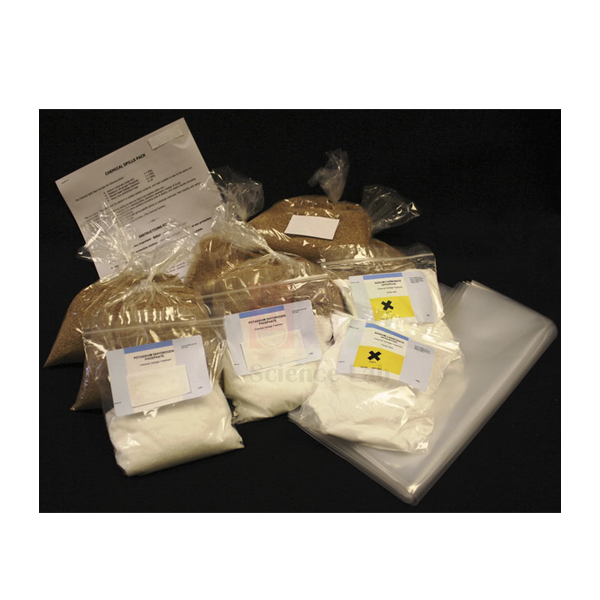
Spill Pack
Spill Pack (Product Code: SLE/CH/226) is a laboratory spill response pack made up of six containers of absorbent, each holding enough material to absorb a spillage of up to 500 cm³, the maximum volume recommended for storage in a laboratory. Ten stout polythene bags are included to collect and contain treated spillage before disposal, and two packets of soda ash allow absorbed acid spills to be neutralised and made safe. Full instructions come with the pack. It is a sensible safety stock for school chemistry labs, college preparation rooms and chemical stores, and it is supplied by Jain Scientific Equipments Pvt Ltd (ScienceLab), Ambala, India.
Specifications
| Parameter | Detail |
|---|---|
| Absorbent containers | 6 |
| Capacity per container | Absorbs a spillage of up to 500 cm³ |
| Absorbent | Kieselguhr, mineral absorbent |
| Neutraliser | Sodium carbonate (soda ash), two packets, for absorbed acid spills |
| Also contains | Potassium dihydrogen phosphate |
| Collection bags | 10 x heavy duty polythene bags |
| Documentation | Full instructions provided |
Typical Use
If a bottle of dilute acid breaks during a practical, the teacher clears the area, puts on gloves and eye protection, and covers the liquid with the contents of one absorbent container. When the kieselguhr has soaked up the spill, it is scooped into a heavy duty polythene bag, and for an acid spill the soda ash is then used, as the instructions describe, to neutralise the collected material before disposal. With six containers, one pack can cover more than one incident before it needs restocking, which makes it a practical safety companion to the chemistry lab equipment in a teaching block.
Store the pack near the chemical store or the main prep bench, where staff can reach it quickly, and go through the full instructions with technicians before it is needed. The potassium dihydrogen phosphate supplied in the pack should be used only as the instructions direct. Replace used containers and bags promptly, and dispose of bagged waste by the route your institution has approved.
Supplier
ScienceLab, the trading name of Jain Scientific Equipments Private Limited in Ambala, Haryana, supplies the Spill Pack as a safety consumable alongside the apparatus it manufactures. Vendor registration details for tender and purchase files: GSTIN 06AAECJ8618A1ZT; LEI 3358004HRD1JIVXKYX49. Visit the company profile for more about ScienceLab.
Related Laboratory Equipment
Protective equipment and storage that complete a spill-ready lab:
- Gloves W/o Powder Nitrile Disposable — hand protection while the absorbent is applied and bagged.
- Premium Safety Spectacles — eye protection for anyone dealing with the spill.
- Acid Spill Clean Up Kit — a dedicated kit for labs that mainly handle acids.
- Solvent Spill Clean Up Kit — for organic solvent spills.
- Acids Storage Cabinet — safer storage that reduces the chance of spills.
Explore further items in Chemistry Lab Equipment.
Frequently Asked Questions
How large a spill can the pack handle?
Each of the six containers holds enough absorbent for a spillage of up to 500 cm³.
What is included?
Six containers of absorbent (kieselguhr, a mineral absorbent), sodium carbonate (soda ash) in two packets, potassium dihydrogen phosphate, 10 heavy duty polythene bags and full instructions.
Why is soda ash included?
It neutralises acid spills after they have been absorbed and collected, so the waste is safer to dispose of.
Are gloves or goggles included?
No protective equipment is listed in the pack contents, so keep gloves and eye protection alongside it.
Can individual items be reordered?
Please ask through the contact page about replacement containers or bags.
Do you supply packs for multiple schools or export?
Yes. Share the product code SLE/CH/226, quantity and delivery locations; ScienceLab supplies institutions in India and international markets.
Request a Quote
For a quotation on the Spill Pack, contact us through the contact page or add it to the enquiry cart together with gloves and safety spectacles.
Last updated: 24 September 2026
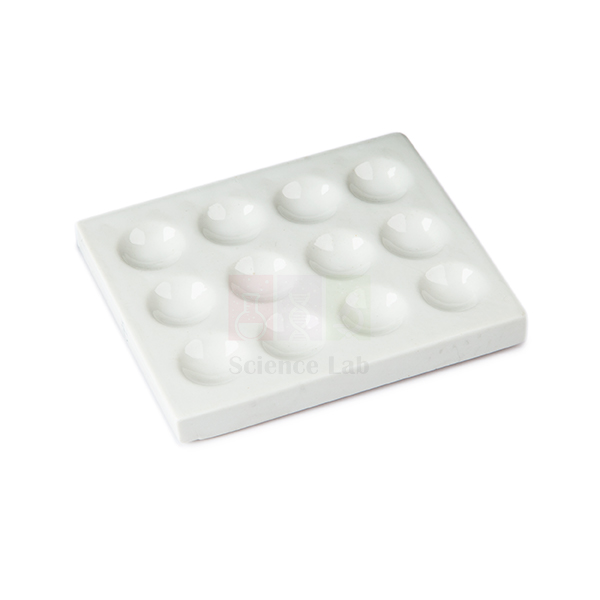
Spotting Tiles, Plastic
Spotting Tiles, Plastic (Product Code: SLE/CH/227) are white high-density polyethylene tiles, each moulded with 12 cavities that hold approximately 1.5ml with a top diameter of 21mm. The white surface makes small colour changes easy to see, so a few drops of reagent in each well are enough for spot tests, indicator comparisons and drop-scale reactions. Using drops instead of test tubes cuts chemical use and washing-up, which is why spotting tiles appear in almost every chemistry teaching kit for schools and colleges. They come in packs of 10 and are manufactured by Jain Scientific Equipments Pvt Ltd (ScienceLab), Ambala, India.
Specifications
| Parameter | Detail |
|---|---|
| Material | Polyethylene (high-density) |
| Colour | White |
| Number of cavities | 12 |
| Well volume | 1.5ml approx. |
| Top diameter of well | 21mm |
| Pack | Pack of 10 |
Typical Use
A class can place a drop of each test solution in a row of wells and add universal indicator to all of them, producing a colour series from acidic to alkaline on one tile. The same layout suits testing for starch with iodine, comparing the reaction of metals with dilute acid on a drop scale, or running confirmatory ion tests in a salt analysis sequence. With 12 wells per tile, a group can run a full set of samples alongside a control, and a pack of 10 tiles covers ten groups at once in a school chemistry lab.
Label the rows and columns on a sheet placed under the tile so results can be recorded, and add reagents with a dropper or microchemistry pipet to keep volumes small. Rinse the tile with water straight after use and clean the wells with a soft brush. Keep the tiles away from flames and hot plates, and do not place hot glassware on them.
Manufacturer
Spotting tiles in this range are produced by Jain Scientific Equipments Private Limited, the Ambala, Haryana manufacturer that sells its teaching apparatus as ScienceLab to schools, colleges and distributors. More about us is on the ScienceLab profile.
Related Chemistry Lab Equipment
Items used with spotting tiles in drop-scale chemistry:
- Plastic Microchemistry Pipets — deliver single drops into each well.
- Dropping Bottle — keeps reagents ready for dispensing drop by drop.
- Micro Test Plates — an alternative multi-well format for small-volume tests.
- Paper, Universal, pH 1-14 — checks the pH of solutions held in the wells.
- Universal pH Indicator — for colour-series comparisons across a row of wells.
For the complete catalogue, see Chemistry Lab Equipment.
Frequently Asked Questions
How many wells does each tile have?
Each tile has 12 cavities.
What volume does a well hold?
About 1.5ml per well, with a top diameter of 21mm.
How many tiles are in a pack?
There are 10 tiles in a pack.
Why white plastic rather than porcelain?
The white polyethylene gives the same clear background for colour changes, and plastic tiles are light and less likely to chip if dropped on a student bench.
Can the tiles be heated?
No. They are polyethylene, so keep them away from flames and hot plates and use them for room-temperature spot tests.
Which chemicals can be used in the wells?
They are intended for small quantities of typical school and college reagents. If you plan to use concentrated acids or organic solvents, please check with us through the contact page first.
Do you supply tiles in bulk for institutions or export?
Yes. Quote the product code SLE/CH/227 and the number of packs; we supply India and international markets.
Request a Quote
Request pricing for Spotting Tiles, Plastic through our contact page, or add packs to the enquiry cart with droppers and indicators for your practical sessions.
Last updated: 24 September 2026
Steppa-Stoppa Large
Steppa-Stoppa Large (Product Code: SLE/CH/228) is a tapered, one-size-fits-many stopper made to replace the assortment of standard rubber stoppers most laboratories keep in a drawer. Moulded from blended polymer with an incremental taper, a single stopper closes any opening that falls between its narrow base and its wide upper end, so teachers and technicians no longer have to hunt for the right numbered bung. It is supplied by Jain Scientific Equipments Pvt Ltd (ScienceLab), Ambala, as part of its school chemistry lab equipment in India and for institutions overseas.
Specifications
| Parameter | Detail |
|---|---|
| Product type | Tapered stopper designed to replace standard rubber stoppers |
| Material | Blended polymer |
| Profile | Incremental taper to suit most applications, removing the need for multiple sized rubber stoppers |
| Dimensions | 20mm (base) x 48mm (top) x 52mm (length) |
| Sterilisation | Autoclavable |
| Pack size | Box of 10 stoppers |
| Accessory provided | Microfiber drying cloth (the stoppers grip most firmly when dry) |
| Size in this listing | Large (the stopper is also offered in a small size) |
Typical Use
In a teaching laboratory the large Steppa-Stoppa earns its place on conical flasks, wide tubes and reagent bottles that need closing between the steps of a practical — keeping a prepared solution covered overnight, stopping a flask of indicator from evaporating, or sealing a culture vessel before it goes into the autoclave. Because one tapered stopper covers a spread of neck sizes, a single box can serve a whole bench group, and stock-taking becomes far simpler than tracking a dozen rubber stopper sizes. It sits comfortably in a set of everyday lab equipment accessories alongside tongs, holders and racks.
Push the stopper into the opening with a slight twist until it seats, and do not force it further once it grips. Wipe both the stopper and the vessel neck with the microfiber cloth first, because the polymer holds most securely on a dry surface. As with any stopper, never close a vessel that is being heated or is still producing gas, and let autoclaved stoppers cool and dry before they go back into use.
Supplier
Steppa-Stoppa Large is supplied by Jain Scientific Equipments Private Limited, a company in Ambala, Haryana, that trades under the ScienceLab name. Alongside the laboratory apparatus it manufactures, the company sources practical bench accessories such as these stoppers, so that schools and colleges can complete a laboratory order through a single supplier. Read more about the business on our company profile.
Related Chemistry Lab Equipment
Items used with this stopper in the same practical or storage routine:
- Conical Flask — a common vessel for the stopper to close when solutions are stored between lessons
- Test Tube — wider tubes can be closed with the taper while samples wait for the next step
- Rubber Cork — the conventional option when a bored stopper is needed for tubing or a thermometer
- Autoclave Basket — keeps stoppers and small glassware together during sterilisation
See the complete Chemistry Lab Equipment range for more bench essentials.
Frequently Asked Questions
What is included in one box?
Ten large Steppa-Stoppa stoppers. A microfiber drying cloth is provided with the stoppers so they can be kept dry for a firm grip.
What size of opening does the large stopper fit?
It fits openings that fall along its taper, from 20mm at the base to 48mm at the wide end over a 52mm length. For narrower necks, ask us about the small size, which also comes in a box of 10.
Can the stoppers be autoclaved?
Yes. They are autoclavable, which suits microbiology and sterile-work sessions; allow them to cool and dry fully before refitting.
Is there a version with a hole for a delivery tube or thermometer?
A bored version is not listed for this product. For apparatus that needs glass tubing through the stopper, a bored rubber cork is the usual choice; contact us if you would like advice.
Why does a stopper sometimes slip out?
Moisture is the usual cause. The stoppers grip most firmly when dry, so wipe the stopper and the neck of the vessel with the drying cloth before fitting.
What should an institutional quotation request include?
List the number of boxes, whether you also need the small size, and your delivery location. We supply schools, colleges and distributors in India and international markets; send the details through our contact page.
Request a Quote
For pricing and availability, contact our team or add Steppa-Stoppa Large to the enquiry cart together with the rest of your laboratory list.
Last updated: 24 September 2026
Stirring Rod, Glass
Stirring Rod, Glass (Product Code: SLE/CH/229) is a clear, 30cm glass rod for mixing solutions, dissolving solids and guiding liquids during transfer in chemistry practicals. Its 7mm diameter gives a sturdy feel in the hand for everyday bench work, and the glass is both heat resistant and chemical resistant. The rod is manufactured by Jain Scientific Equipments Pvt Ltd (ScienceLab), Ambala, and belongs to its range of chemistry lab glassware in India for schools, colleges and teaching laboratories abroad.
Specifications
| Parameter | Detail |
|---|---|
| Material | Glass |
| Function | Stirring; dual purpose |
| Diameter | 7mm |
| Length | 30cm |
| Colour | Clear |
| Heat resistance | Heat resistant |
| Chemical resistance | Chemical resistant |
Typical Use
Students reach for a glass stirring rod whenever a solid has to be dissolved, a precipitate broken up or a mixture kept uniform — preparing salt solutions, growing crystals, mixing reagents before a titration or stirring during a neutralisation. The 30cm length reaches the bottom of tall beakers and measuring cylinders while keeping fingers clear of the liquid. The same rod doubles as a pouring guide: held against the lip of a beaker, it lets a liquid run down its surface into a funnel without splashing, which is the standard technique taught for filtration and decanting. A drop taken on the tip can also be touched onto indicator paper to check pH.
Stir with a gentle circular motion rather than striking the walls of the vessel, which protects both the rod and the beaker from chipping. Rinse the rod with distilled water between reagents so one solution does not contaminate the next, and lay a hot rod on a clean, dry surface to cool instead of plunging it into cold water. These simple habits keep the rod in service for many terms and are worth building into any school chemistry lab equipment routine.
Manufacturer
This glass stirring rod is produced by Jain Scientific Equipments Private Limited, better known to schools and colleges by its trading name, ScienceLab. From its base in Ambala, Haryana, the company makes and supplies apparatus for teaching laboratories, from basic glassware to complete practical setups. Background on the company is available on our company profile page.
Related Chemistry Lab Equipment
Apparatus that is normally on the bench with a stirring rod:
- Glass Beaker — the vessel in which most dissolving and mixing is done
- Glass Funnel — receives liquid poured down the rod during filtration
- Filter Paper — completes the filtration setup with the funnel and rod
- Red Litmus Paper — test a solution by touching the rod tip to the paper
- Stirring Rod, Polypropylene — a plastic alternative where glass breakage is a concern
More glassware and bench apparatus is listed in our Chemistry Lab Equipment category.
Frequently Asked Questions
What are the dimensions of the rod?
It is 30cm long with a 7mm diameter, in clear glass.
Can it be used in hot solutions?
Yes. The glass is heat resistant, so it can stir warm or boiling solutions on a hot plate or over a burner. Avoid sudden temperature shocks, such as moving a hot rod straight into cold water.
Is the rod made of borosilicate glass?
The listing specifies heat-resistant, chemical-resistant glass; the exact glass grade is not stated here. Contact us if your purchase specification requires a particular glass type.
Are there any chemicals it should not be used with?
Glass in general is attacked by hydrofluoric acid and, slowly, by hot concentrated alkalis. For those, a polypropylene rod is the safer choice.
How should the rod be cleaned?
Rinse it straight after use with tap water and then distilled water, use a little laboratory detergent for stubborn residues, and leave it to dry on a rack or clean cloth.
How are rods supplied for a full class?
Pack quantities are not listed on this page, so quantities are quoted to your requirement. We supply schools, colleges and distributors across India and international markets — send us your list.
Request a Quote
To order glass stirring rods, contact us with the quantity required, or place them in the enquiry cart with the other items on your laboratory list.
Last updated: 24 September 2026
823.jpg)
Test Tube Holder (Peg Type)
Test Tube Holder (Peg Type) (Product Code: SLE/CH/230) is a wooden holder built like a large clothes peg: a spring keeps its jaws closed on a test tube, so a student can hold the tube over a flame without gripping the hot glass. At 180mm long it keeps the hand a safe distance from the burner during heating and flame tests, and it accepts tubes from 11 to 19mm in diameter. The holder is manufactured by Jain Scientific Equipments Pvt Ltd (ScienceLab), Ambala, and is one of the most frequently used items of school chemistry lab equipment in India.
Specifications
| Parameter | Detail |
|---|---|
| Type | Peg-type holder with spring for closing jaws |
| Material | Wood |
| Length | 180mm |
| Tube diameter accepted | 11–19mm |
| Operation | Squeeze to open the jaws; the spring closes them on the tube |
Typical Use
The peg-type holder is the everyday choice for heating small quantities of solid or liquid in a standard test tube — decomposing a carbonate to test for carbon dioxide, warming a food sample with a reagent, or driving water out of a hydrated salt. Students squeeze the peg, slide the tube in near its mouth and let go; the spring then holds the tube on its own, leaving the other hand free for the burner or a gas test. Because wood is a poor conductor of heat, the holder stays comfortable in the hand even after several minutes over the flame.
Hold the tube at a slant, point the open end away from everyone, and move it gently through the flame so the contents heat evenly. Keep the wooden jaws above the flame rather than in it, since wood can scorch. The 11–19mm range covers the narrower tubes used in most school practicals; for wider tubes, choose the metal holder listed below. Having one holder per student is a simple step in any school laboratory setup that reduces burns and dropped glassware.
Manufacturer
ScienceLab is the trading name of Jain Scientific Equipments Private Limited, an Ambala, Haryana manufacturer of teaching-laboratory apparatus, and this peg-type holder is one of the simple, high-use items it produces for practical classes. Visit the company profile to learn more about the company and its work.
Related Chemistry Lab Equipment
Other items needed for heating in test tubes:
- Test Tube — the glassware this holder is designed to grip
- Bunsen Burner — the usual heat source for test tube reactions
- Glass Spirit Lamp — a flame source for rooms without a gas supply
- Test Tube Racks — somewhere safe to stand tubes before and after heating
- Test Tube Holder, Metal — a spring-clip holder sized for wider tubes
Browse our Chemistry Lab Equipment category for racks, stands and burners.
Frequently Asked Questions
Which test tube sizes does it hold?
Tubes of 11–19mm diameter. Tubes outside that range will either slip or will not open the jaws far enough.
How long is the holder, and what is it made of?
It is 180mm long and made of wood, with a spring that closes the jaws.
Can it be used for boiling tubes?
Only if the tube's outside diameter is within 11–19mm. Wider boiling tubes need the metal test tube holder.
Will the wood burn?
Wood can scorch if the jaws are pushed into the flame. Heat the lower part of the tube only and keep the holder above the flame, and it will last for many practicals.
Is it suitable for younger students?
Yes, it is widely used in secondary school practicals under supervision. The spring grip means students do not need to squeeze continuously to hold the tube.
What warranty applies?
Warranty terms for this item are not listed on this page; contact us and we will confirm them with your quotation.
Request a Quote
Class sets and institutional quantities can be quoted on request. Get in touch or add this holder to the enquiry cart; we supply across India and international markets.
Last updated: 24 September 2026
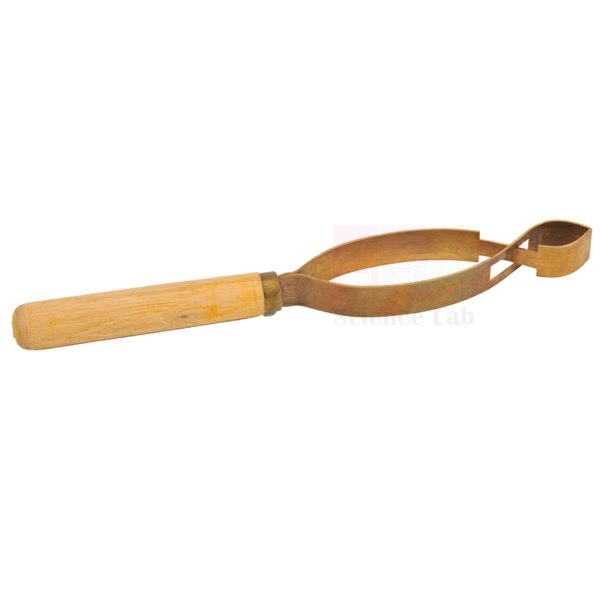
Test Tube Holder, Metal
Test Tube Holder, Metal (Product Code: SLE/CH/231) grips tubes of 15–25mm diameter in a strong metal spring clip, carried on a strip of metal that is set into a wooden handle. Its wider jaw range makes it the holder to reach for when heating larger test tubes and boiling tubes whose diameter falls within that span, while the wooden grip keeps the hand comfortable. It is manufactured by Jain Scientific Equipments Pvt Ltd (ScienceLab), Ambala, for chemistry and biology practicals, and is part of the chemistry lab equipment it supplies in India and abroad.
Specifications
| Parameter | Detail |
|---|---|
| Type | Test tube holder with strong spring clip |
| Clip material | Metal |
| Handle material | Wooden |
| Construction | Spring clip on a strip of metal fixed in the wooden handle |
| Tube diameter accepted | 15–25mm |
Typical Use
This holder is used where the tube is too wide for a small wooden peg: heating a larger volume of liquid in a boiling tube, preparing a gas from a solid mixture, or lifting tubes in and out of a hot water bath during food tests and enzyme experiments. The strong spring clip closes firmly on the glass, so a heavier, fuller tube stays put while it is tilted over the flame. Metal jaws also avoid the scorching that wooden jaws can suffer when they drift too close to the burner.
Squeeze the clip, slide the tube in close to its mouth and release. Hold the holder only by the wooden handle, because the metal strip can warm up near a flame, and point the open end of the tube away from yourself and others. Let the clip cool before storing it with other apparatus. For schools buying from a school laboratory equipment supplier in India, pairing this holder with the peg-type version covers both narrow and wide tubes on the same bench.
Manufacturer
The holder is made by Jain Scientific Equipments Private Limited, which sells under the ScienceLab brand from Ambala, Haryana. The company is a registered MSME enterprise (Udyam UDYAM-HR-01-0003714), and its export consignments move under Importer-Exporter Code AAECJ8618A issued by the DGFT. Find out more on our company profile.
Related Chemistry Lab Equipment
Apparatus that works alongside a metal test tube holder:
- Test Tube with Side Arm — a borosilicate tube whose diameter falls within this holder's range
- Burner Bunsen With Stopcock — an adjustable flame for heating the tube
- Test Tube Stand (Wire Pattern) — rests hot tubes safely after heating
- Brush Test Tube — cleans residues once the tube has cooled
- Test Tube Holder (Peg Type) — a lighter wooden holder for narrower tubes
For the full selection of holders, stands and burners, visit our Chemistry Lab Equipment page.
Frequently Asked Questions
What diameter of tube does it accept?
Tubes from 15 to 25mm in diameter, which covers wider test tubes and many boiling tubes.
How does it differ from the wooden peg-type holder?
This model uses a strong metal spring clip on a metal strip in a wooden handle and takes wider tubes. The peg-type holder is all wood and is sized for narrower tubes.
Does the metal part get hot?
It can warm up if held close to the flame. Keep the clip above the flame, hold only the wooden handle, and allow it to cool before putting it away.
Can it be used with a water bath?
Yes, lifting tubes in and out of a hot water bath is a common use. Avoid dipping the wooden handle in the water.
How should it be looked after?
Wipe off any spilt chemicals promptly, dry the clip after use and store it in a dry drawer so the spring keeps its grip.
Can you supply larger quantities or export orders?
Yes. We supply schools, colleges and distributors in India and international markets; contact us with quantities and the destination for a quotation.
Request a Quote
Ask for pricing through our contact form, or add the metal test tube holder to the enquiry cart along with the rest of your order.
Last updated: 24 September 2026
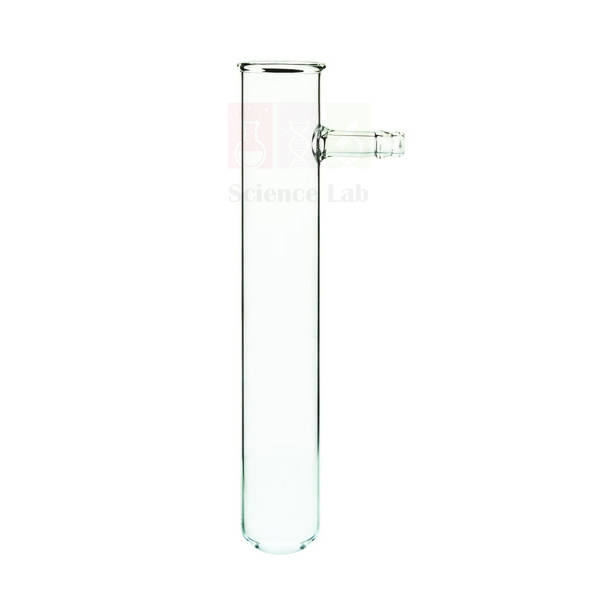
Test Tube with Side Arm
Test Tube with Side Arm (Product Code: SLE/CH/232) is a clear borosilicate glass 3.3 tube measuring 150x24mm, fitted with a side arm so that gas or vapour can leave through connected tubing while the mouth of the tube is stoppered. Teachers use it for small-scale gas preparation and collection, and as a compact vessel for suction filtration. It is manufactured by Jain Scientific Equipments Pvt Ltd (ScienceLab), Ambala, as part of its borosilicate laboratory glassware in India for schools, colleges and overseas institutions.
Specifications
| Parameter | Detail |
|---|---|
| Material | Borosilicate glass 3.3 |
| Colour | Clear |
| Dimensions | 150x24mm |
| Feature | With side arm for connecting tubing |
| Heat resistance | Heat resistant |
| Chemical resistance | Chemical resistant |
Typical Use
The side arm turns an ordinary tube into a small gas generator. With reactants in the tube and a stopper in the mouth, a length of tubing from the side arm carries the gas to a gas jar, an inverted tube over water, or a tube of limewater — a neat way to prepare hydrogen from a metal and dilute acid or carbon dioxide from marble chips. The same tube can serve as a miniature filter flask: connect the side arm to a filter pump, seat a small funnel in a stopper, and fine precipitates can be drawn dry quickly on the bench. Because the glass is borosilicate 3.3, it can also be warmed gently to speed up a reaction.
Clamp the tube to a retort stand instead of holding it when gas is being generated, and check that the delivery path is open before any heating. Wet the end of the rubber or silicone tubing and push it onto the side arm with a gentle twist rather than forcing it, which is the moment glass side arms are most often snapped. Clear, heat-resistant glassware of this kind is a practical choice for any chemistry lab glassware store in India that supports gas and filtration experiments.
Manufacturer
Jain Scientific Equipments Private Limited manufactures this side arm test tube and trades as ScienceLab from Ambala in Haryana, supplying teaching and research laboratories with apparatus for practical science. The company profile gives an overview of the business.
Related Chemistry Lab Equipment
Items that complete a gas-generation or filtration setup with this tube:
- Rubber Cork — closes the mouth of the tube so gas leaves only through the side arm
- Silicone Tube — flexible tubing to connect the side arm
- Gas Jar, Glass — collects the gas produced in the tube
- Filter Pump, Borosilicate Glass — provides suction when the tube is used for filtration
- Universal Clamp — holds the tube securely on a retort stand
Explore more glassware and supports in the Chemistry Lab Equipment category.
Frequently Asked Questions
What size is the tube?
It measures 150x24mm and is made from clear borosilicate glass 3.3.
Can it be heated over a burner?
Yes, the borosilicate glass is heat resistant. Heat gently and evenly, and never heat the tube with the mouth stoppered and the side arm blocked.
Is a stopper included?
A stopper is not listed as part of this item. Choose a rubber cork to suit the tube mouth, or ask us to match one for you.
Can it be used for vacuum filtration?
Yes, it works as a small filter flask with a filter pump. Inspect the glass for chips or cracks before applying suction.
How do I clean the side arm?
Rinse water through the side arm straight after use, then wash the main tube with a test tube brush and detergent and rinse with distilled water.
How are these tubes supplied?
Pack quantities are not listed here, so orders are quoted to your requirement for schools, colleges and distributors in India and international markets. Contact us for details.
Request a Quote
Send your quantity through our contact page, or add the Test Tube with Side Arm to the enquiry cart with your other glassware.
Last updated: 24 September 2026
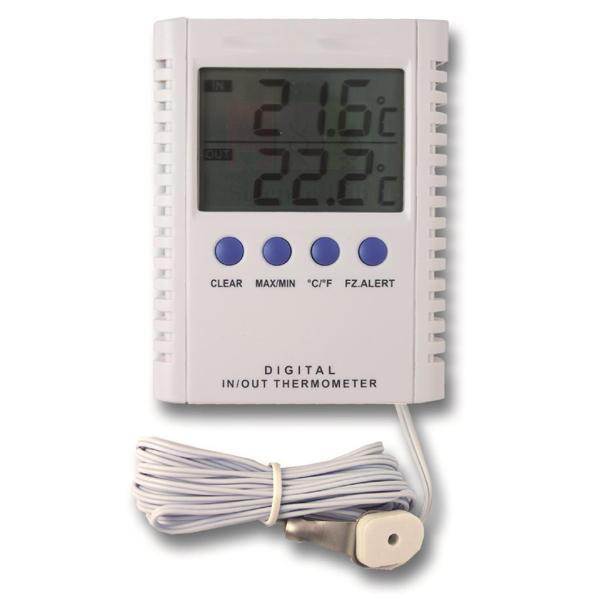
Thermometer, Electronic, Max/Min
Thermometer, Electronic, Max/Min (Product Code: SLE/CH/233) is a digital thermometer with memory that keeps the highest and lowest temperatures reached, so a class can see how warm or cold it became overnight or over a weekend without anyone watching the reading. It shows temperature to 0.1°C on a large, clear display, covers 0° to 50°C indoors and -50° to 70°C outdoors, and includes a freeze alert. It is manufactured by Jain Scientific Equipments Pvt Ltd (ScienceLab), Ambala, and is a versatile item of school laboratory equipment in India for chemistry, geography and environmental science lessons.
Specifications
| Parameter | Detail |
|---|---|
| Type | Electronic maximum/minimum thermometer with memory |
| Resolution | 0.1°C |
| Indoor range | 0° to 50°C |
| Outdoor range | -50° to 70°C |
| Display | Large, clear digital display; instant reading |
| Alert | Freeze alert function |
| Mounting | Complete with stand and hanging slot |
| Size | 100 x 75 x 18mm |
| Power | 2 x 1.5V batteries (supplied) |
Typical Use
The memory function is what makes this thermometer useful in teaching. Students can log the daily maximum and minimum for a weather project, compare conditions inside and outside the classroom, or monitor a germination tray, greenhouse corner or chemical store room between visits. The freeze alert helps protect plants, water-based solutions and specimens on cold nights, and the separate indoor and outdoor ranges let one unit serve both a classroom and an outdoor study area.
Reset the stored values at the same time each day so readings are comparable, and position the unit out of direct sunlight and away from heaters, which would otherwise exaggerate the maximum. Stand it on a bench using the built-in stand or hang it on a wall through the hanging slot. As a compact digital instrument it fits neatly alongside other chemistry lab equipment in India used for environmental and data-logging activities.
Manufacturer
ScienceLab is the brand under which Jain Scientific Equipments Private Limited of Ambala, Haryana, manufactures and supplies laboratory and classroom instruments. For institutional and tender buyers who need to register a vendor, the company's details are GSTIN 06AAECJ8618A1ZT and LEI 3358004HRD1JIVXKYX49. The company profile has further background.
Related Chemistry Lab Equipment
Instruments that pair with a max/min thermometer in weather and environment studies:
- Window Thermometer, Large — shows the outdoor temperature at a glance through a classroom window
- Digital Hygrometer - Thermometer — adds humidity to the temperature record
- Thermometer, Infra Red, Hand Held — measures surface temperatures without contact
- Indoor/Outdoor Thermometer — an alternative for comparing inside and outside readings
Other measuring apparatus is available in our Chemistry Lab Equipment range.
Frequently Asked Questions
What does the max/min function do?
The thermometer's memory stores the highest and lowest temperatures reached since the values were last cleared, so you can read the extremes later.
What ranges and resolution does it offer?
Indoor 0° to 50°C and outdoor -50° to 70°C, with 0.1°C resolution on the digital display.
Are batteries included?
Yes, 2 x 1.5V batteries are supplied with the thermometer.
What is the freeze alert for?
It warns of freezing conditions, which is useful when plants, solutions or specimens could be damaged by frost. The exact trigger point is not listed here; contact us if you need it.
Can the whole unit be left outdoors?
Weather protection for the unit is not stated in our product details, so please check with us before planning a permanent outdoor installation.
Is a calibration certificate available?
Calibration certificate availability should be discussed with us before ordering; send your requirement and we will advise.
What does an institutional quotation need?
The quantity, delivery address and any vendor-registration forms your institution uses. We supply across India and international markets.
Request a Quote
For pricing, contact us or add this max/min thermometer to the enquiry cart and submit your full list in one go.
Last updated: 24 September 2026
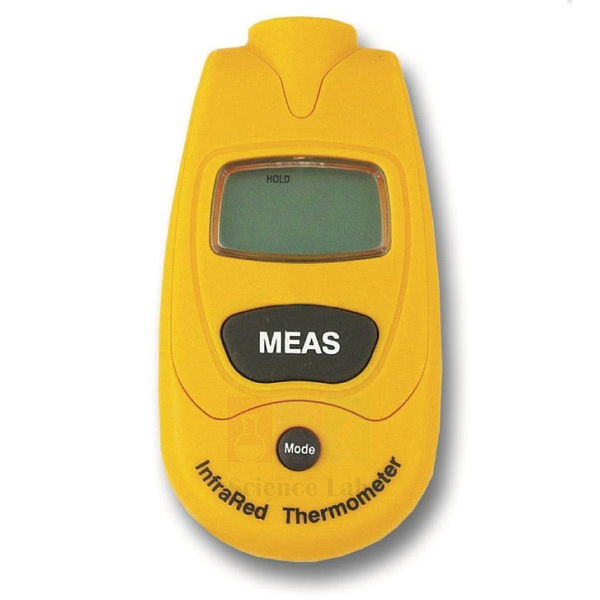
Thermometer, Infra Red, Hand Held
Thermometer, Infra Red, Hand Held (Product Code: SLE/CH/234) measures surface temperature from a distance, which makes it a safe choice whenever the object is too hot, moving or hazardous to touch — a hot plate, the side of a heated beaker or a running motor. It covers -35 to 230°C, with the display switchable between °C and °F, and reads in 0.1°C divisions. The instrument is manufactured by Jain Scientific Equipments Pvt Ltd (ScienceLab), Ambala, and is a compact addition to the laboratory instruments it supplies to schools, colleges and workshops in India and abroad.
Specifications
| Parameter | Detail |
|---|---|
| Type | Hand-held, non-contact infrared thermometer |
| Temperature range | -35 to 230°C (°C/°F switchable) |
| Accuracy | ±2% or ±2.0°C (±2.0°F) |
| Emissivity | 0.95 fixed |
| Wavelength | 5 to 14 µm |
| Divisions | 0.1°C |
| Distance to spot ratio | 1:1 |
| LCD dimensions | 14mm x 24mm |
| Product dimensions | 75mm x 40mm x 20mm |
| Supplied with | Wrist strap, clip-out stamp and storage pouch |
Typical Use
Teachers use a hand-held infrared thermometer to check a hot plate, water bath or heating block before students handle it, and to follow a cooling curve without disturbing the surface being measured. In physics and chemistry lessons it brings heat-transfer experiments to life: students can compare how quickly dark and shiny cans lose heat, see which insulating material keeps a container warmest, or map the temperature along a metal bar heated at one end. It is equally handy for checking the walls of a refrigerator or incubator and the casing of a motor in a technical workshop.
With a distance to spot ratio of 1:1, the measured spot is roughly as wide as the distance to the target, so hold the thermometer close to small objects. The fixed 0.95 emissivity suits most painted, matte, plastic and organic surfaces; bare shiny metal reads low, so cover a small patch with matte tape or paint for a truer value. Glass is opaque at these wavelengths, so aiming at a beaker gives the temperature of the glass wall, not the liquid inside — a useful teaching point for any class using analytical lab instruments.
Manufacturer
The infrared thermometer is offered under the ScienceLab name by Jain Scientific Equipments Private Limited, a manufacturer of teaching and laboratory apparatus based in Ambala, Haryana. Schools, colleges and training institutes can read more about the company on our company profile.
Related Chemistry Lab Equipment
Instruments that complement non-contact temperature measurement:
- Immersion Thermometer — measures the temperature inside a liquid, which an infrared unit cannot do
- Hot Plate Magnetic Stirrer — a heated surface whose temperature is often checked with this instrument
- Thermometer, Electronic, Max/Min — records the highest and lowest air temperatures over time
- Micro Burner — a small heat source for heat-transfer demonstrations
See the wider Chemistry Lab Equipment range for more measuring and heating apparatus.
Frequently Asked Questions
What comes with the thermometer?
It is supplied with a wrist strap, clip-out stamp and storage pouch. Battery details are not listed here; contact us to confirm before ordering.
How accurate is it?
The stated accuracy is ±2% or ±2.0°C (±2.0°F), with readings shown in 0.1°C divisions.
How far away can I measure from?
Any distance works, but the 1:1 distance to spot ratio means the area measured grows as you step back. For small targets, hold the thermometer close so the spot stays on the object.
Can it measure the temperature of a liquid in a beaker?
Only the surface it can see. Through glass it reads the glass wall; for the liquid itself, use an immersion thermometer or measure the open liquid surface.
Why do shiny metal surfaces give low readings?
Emissivity is fixed at 0.95, which matches most non-metallic surfaces. Polished metal emits less infrared, so a matte patch gives a more reliable reading.
Is a calibration certificate available?
Please discuss calibration certificate availability with us at the enquiry stage via our contact page.
Do you supply multiple units for a department?
Yes. Institutional and distributor orders for India and international markets are quoted on request.
Request a Quote
To request pricing, contact our sales team or add the hand-held infrared thermometer to the enquiry cart.
Last updated: 24 September 2026
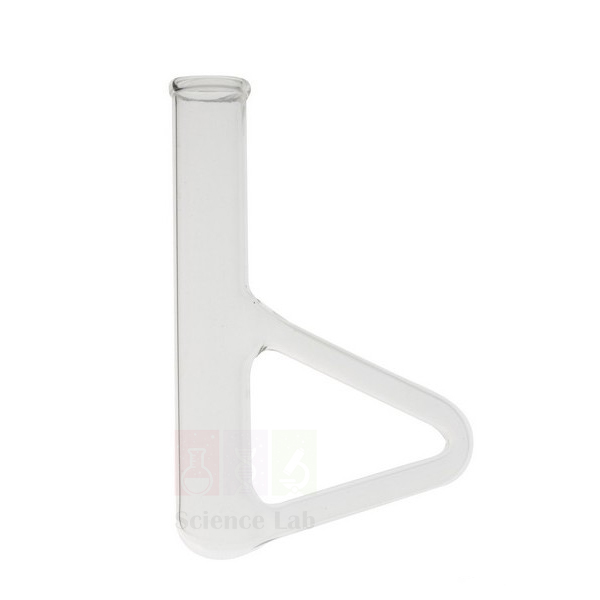
Thiele Tube
The Thiele Tube (Product Code: SLE/CH/235) is a clear borosilicate glass tube, 25mm in diameter and 150mm long, used for determining the melting point of organic compounds. In the classic Thiele design, heat applied to the side loop sets up convection currents in the bath liquid, giving the slow, even warming that a sharp melting-point reading needs without a stirrer. It is manufactured by Jain Scientific Equipments Pvt Ltd (ScienceLab), Ambala, for organic chemistry practicals in colleges, universities and pharmacy laboratories, and forms part of its chemistry lab glassware in India and for export.
Specifications
| Parameter | Detail |
|---|---|
| Material | Borosilicate glass |
| Colour | Clear |
| Diameter of tube | 25mm |
| Length | 150mm |
| Heat resistance | Heat resistant |
| Chemical resistance | Chemical resistant |
| Application | Determining the melting point of organic compounds |
Typical Use
For a melting-point determination, the tube is clamped by its neck to a retort stand and filled with a high-boiling bath liquid, such as liquid paraffin or silicone oil, to just above the upper junction of the side loop. A little of the powdered sample is packed into a capillary sealed at one end, the capillary is fixed to a thermometer so the sample sits beside the bulb, and the thermometer is lowered into the tube through a notched cork. Gentle heating of the side loop with a small flame then circulates the oil around the thermometer, and students record the range from the first droplet of liquid to a completely clear melt. A pure compound melts sharply, while impurities lower and broaden the range, which is why the Thiele tube remains a staple for identity and purity checks.
Slow the heating as the expected melting point approaches so the thermometer keeps pace with the sample. If a rubber ring is used to hold the capillary, keep it above the oil level where it will not soften. Let the bath cool completely before emptying or moving the tube. Well-kept borosilicate laboratory glassware of this kind gives consistent results over many practical sessions.
Manufacturer
The Thiele Tube is made by Jain Scientific Equipments Private Limited, known in laboratories as ScienceLab. The company operates from Ambala, Haryana, producing glassware and apparatus for chemistry teaching and routine analytical work. Our company profile has more about its background.
Related Chemistry Lab Equipment
Everything else needed for a Thiele tube melting-point setup:
- Capillary Tube — holds the packed sample beside the thermometer bulb
- Laboratory Thermometer — reads the bath temperature as the sample melts
- Micro Burner — a small, controllable flame for heating the side loop
- Three Prong Swivel Clamp — secures the tube to a retort stand
- Apparatus Melting Point — an alternative apparatus for melting-point work
Find more organic chemistry apparatus in our Chemistry Lab Equipment category.
Frequently Asked Questions
What are the dimensions of the tube?
The tube is 25mm in diameter and 150mm long, made from clear borosilicate glass.
Which liquid should be used in the bath?
The bath liquid is not supplied. Liquid paraffin or silicone oil is commonly chosen because it stays stable well above the melting points being measured; select one suited to your compounds.
Is a thermometer or capillary included?
No, the listing covers the glass tube only. Thermometers and capillaries are available separately from our range.
Can the tube be heated with a direct flame?
Yes, the borosilicate glass is heat resistant. Apply a small flame to the side loop, not the main column, and heat gradually.
How is the tube cleaned after use?
Allow it to cool, drain the oil into a labelled container, then wash with warm water and detergent (or a suitable solvent for stubborn oil), rinse and dry.
Can you quote for a full organic chemistry lab?
Yes. Send the list of apparatus and quantities through our contact page; we supply institutions in India and international markets.
Request a Quote
Contact us for pricing, or add the Thiele Tube to the enquiry cart along with capillaries and thermometers.
Last updated: 24 September 2026
Tool Bag
Tool Bag (Product Code: SLE/CH/236) is a heavy-duty, water resistant canvas bag for carrying the hand tools, spare parts and small apparatus that laboratory technicians and teachers move between rooms, workshops and field sites. It closes with a heavy-duty zip, has wrap-around strap handles and measures 460 x 180 x 195 mm. The bag is manufactured by Jain Scientific Equipments Pvt Ltd (ScienceLab), Ambala, and is a practical support item for lab equipment maintenance in India's schools, colleges and technical institutes.
Specifications
| Parameter | Detail |
|---|---|
| Material | Heavy-duty water resistant canvas |
| Closure | Heavy-duty zip |
| Handles | Wrap-around strap handles |
| Dimensions | 460 x 180 x 195 mm |
| Packing | Packed in a polythene bag with display card |
Typical Use
A laboratory technician's day involves tightening boss heads and clamps, replacing fuses and leads, checking electrical apparatus with a multimeter and fixing loose fittings on benches. Keeping those tools together in one zipped canvas bag means they travel to the physics, chemistry and biology rooms as a set, rather than being borrowed and lost. The same bag is useful for field trips, carrying thermometers, sample bags, tape measures and notebooks to a pond or garden study, and for vocational and technical courses where each group needs its own tool set.
The water resistant canvas shrugs off splashes and light rain, but it is not designed to hold liquids, so keep chemicals in their own sealed containers. Avoid overfilling so the heavy-duty zip closes without strain, brush out dust and metal filings regularly, and let the bag air-dry if it gets wet. As part of a new school laboratory setup, one or two tool bags per department make routine upkeep far quicker.
Manufacturer
ScienceLab is the trade name of Jain Scientific Equipments Private Limited (CIN U29309HR2020PTC087597), an Ambala, Haryana company that manufactures at its licensed factory at 449, HSIIDC Industrial Area, Saha, Ambala (Factory Licence AMB-ONLINE-CHD-J-414). Our company profile describes the business in more detail.
Related Chemistry Lab Equipment
Tools and accessories that are commonly carried in or used alongside this bag:
- Tool Kit — the hand tools a technician keeps in the bag
- Digital Multimeter — for checking leads, fuses and electrical apparatus
- Fiberglass Tape Measure — measuring during bench layout or field work
- Hazard Warning Tape — marks off an area while maintenance is under way
- Box, Metal, Lockable, for Storage — a rigid, lockable option for storing tools and parts
More laboratory support items are listed in our Chemistry Lab Equipment category.
Frequently Asked Questions
How big is the bag?
It measures 460 x 180 x 195 mm, enough for a set of hand tools, a meter and small spares.
Is it waterproof?
It is made from water resistant canvas, which protects the contents from splashes and light rain. It is not intended to be submerged or to carry liquids.
Are tools included?
No, the product is the bag itself. Tools can be ordered separately, for example our Tool Kit.
How is the bag packed?
Each bag is packed in a polythene bag with a display card, which keeps it clean in storage and makes it easy for stores and distributors to display.
How should the canvas be cleaned?
Empty the bag, brush out dust, spot-clean marks with mild soap and water, and leave it open to dry in the air.
Can bags be printed with an institution's name?
Custom printing is not listed for this product. Contact us to discuss your requirement along with quantities.
Request a Quote
We supply schools, institutes and distributors in India and international markets. Contact us for a quotation or add the Tool Bag to the enquiry cart.
Last updated: 24 September 2026
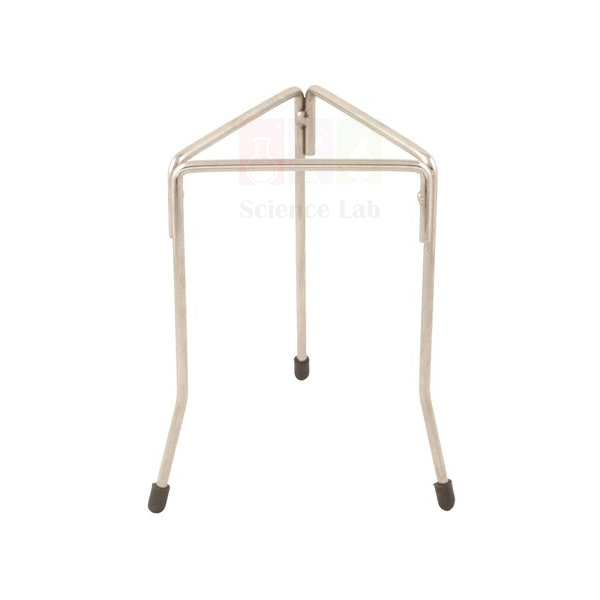
Tripod, Stainless Steel
Tripod, Stainless Steel (Product Code: SLE/CH/237) is a 200mm tall heating stand with a triangular stainless steel top of 125mm side length, steel legs and rubber feet. Placed over a Bunsen burner or spirit lamp, it supports a wire gauze with a beaker or flask, or a pipeclay triangle holding a crucible, at a steady working height. It is manufactured by Jain Scientific Equipments Pvt Ltd (ScienceLab), Ambala, and is a basic item of chemistry lab equipment in India for school and college practical benches.
Specifications
| Parameter | Detail |
|---|---|
| Material | Stainless steel |
| Top | Triangular, stainless steel |
| Side length of top | 125mm |
| Height | 200mm |
| Legs | Steel |
| Feet | Rubber |
| Colour | Silver |
Typical Use
The tripod is the base of most heating setups in a school laboratory. With a wire gauze on top it carries a beaker of water for a water bath, a flask being brought to the boil, or an evaporating dish concentrating a salt solution for crystallisation. With a pipeclay triangle in place of the gauze it holds a crucible for strong heating — burning magnesium ribbon, driving water from hydrated copper sulfate or finding the mass of a residue. The stainless steel construction resists the rust that plain steel tripods develop after repeated spills and heating, and the rubber feet help keep the tripod steady on the bench.
Check that your burner fits under the 200mm top with the flame just reaching the gauze, and stand the tripod on a heat-resistant mat. The metal stays hot long after the burner is turned off, so move it only once it has cooled or use tongs, and keep the rubber feet well clear of the flame. Crystallising a salt in an evaporating dish and heating a crucible, with crucible tongs close at hand, are standard school practicals built around this stand.
Manufacturer
This tripod comes from Jain Scientific Equipments Private Limited, the Ambala, Haryana company behind the ScienceLab brand, which produces heating supports, stands and bench apparatus for chemistry teaching. Visit our company profile to find out more.
Related Chemistry Lab Equipment
Items that make up a complete heating station with the tripod:
- Gauze Wire, Ceramic Centre — sits on the tripod top to spread heat under beakers and flasks
- Pipeclay Triangle — supports a crucible on the tripod for strong heating
- Bunsen Burner — the heat source placed underneath
- Crucible with lid — for heating solids on the pipeclay triangle
- Crucible Tong — lifts hot crucibles and dishes off the tripod
Complete the bench with more items from our Chemistry Lab Equipment range.
Frequently Asked Questions
How tall is the tripod and how big is the top?
It is 200mm tall with a triangular stainless steel top of 125mm side length.
Why choose stainless steel?
Stainless steel resists corrosion from spills and repeated heating, and it wipes clean easily, so the tripod keeps its appearance over years of use.
Is a wire gauze included?
No, the gauze and pipeclay triangle are sold separately. See the related items above.
Which burners fit underneath?
Any burner that fits under a 200mm top with the flame reaching the gauze. If you are unsure about a particular burner, ask us before ordering.
Can the rubber feet take heat?
The rubber feet are there for grip on the bench. Keep the burner flame under the centre of the top so it does not reach the feet.
Do you supply tripods for a whole laboratory?
Yes, class sets for schools and colleges in India and international markets are quoted on request via our contact page.
Request a Quote
For prices on single units or class sets, contact us or add the stainless steel tripod to the enquiry cart.
Last updated: 24 September 2026
Wicks For Glass Spirit Burner
Wicks For Glass Spirit Burner (Product Code: SLE/CH/238) are replacement wicks that can be used with the Methylated Spirit Burner, packed ten to a pack so that a laboratory can keep every burner on the bench lighting cleanly through the school year. A fresh wick draws fuel evenly and gives a steady, clean flame, while a charred or shortened one produces a weak, smoky flame that slows down practical work. The wicks are supplied by Jain Scientific Equipments Pvt Ltd (ScienceLab), Ambala, as part of its range as a chemistry consumables supplier in India and for institutions abroad.
Key Details
| Parameter | Detail |
|---|---|
| Type | Replacement burner wicks |
| For use with | Methylated Spirit Burner (glass spirit burner) |
| Supplied as | Pack of 10 |
| Suitable for | School, college and teaching laboratories that use spirit burners for flame heating |
Typical Use
Spirit burners are the heat source of choice in rooms without a gas supply, in primary and middle-school science, and wherever a small, gentle flame is enough — warming a test tube, heating a small beaker on a tripod or running a simple heat-transfer demonstration. Over time the exposed end of the wick chars and shortens, and it eventually stops drawing fuel properly. Replacing it takes a minute: remove the cap and the wick holder, thread a new wick through the holder so that a short, even length stands above it, let the lower end soak in methylated spirit before lighting, and trim any frayed strands.
Only refill or re-wick a burner when the flame is out and the glass has cooled, keep the cap on when the burner is not in use to stop the fuel evaporating, and never let a wick burn dry. Keeping a pack of spare wicks with the lab consumables means a burner can be returned to service in the same lesson instead of being set aside.
Supplier
These wicks are supplied by Jain Scientific Equipments Private Limited, the company behind ScienceLab in Ambala, Haryana. The company keeps spares and consumables alongside its laboratory apparatus, so burners, lamps and other bench equipment can stay in service between larger orders. More information is on our company profile.
Related Chemistry Lab Equipment
Items used with a spirit burner in the same heating setup:
- Methylated Spirit — the fuel the wick draws up to the flame
- Glass Spirit Lamp — a glass-bodied spirit lamp; ask us to confirm wick fit before ordering
- Tripod, Stainless Steel — supports a beaker or dish above the flame
- Gauze Wire — spreads the flame's heat evenly under glassware
- Test Tube Holder (Peg Type) — holds a test tube safely over the spirit flame
Find burners, supports and other consumables in our Chemistry Lab Equipment category.
Frequently Asked Questions
How many wicks are in a pack?
Each pack contains 10 wicks.
Which burner do these wicks fit?
They can be used with the Methylated Spirit Burner. Wick dimensions are not listed here, so for any other burner or lamp please send us the wick holder details before ordering.
When should a wick be replaced?
Replace it when the exposed end is heavily charred or hardened, when it no longer reaches the fuel, or when the flame becomes small, uneven or smoky.
Can a wick be trimmed instead of replaced?
Yes, trimming away a lightly charred tip often restores an even flame. Once the wick is too short to reach the fuel, fit a new one.
Is fuel included?
No, the pack contains wicks only. Methylated spirit is available separately.
Can you supply wicks for several laboratories at once?
Yes. Multiple packs for schools, colleges and distributors in India and international markets are quoted on request.
Request a Quote
To order spare wicks, contact us with the number of packs, or add them to the enquiry cart with your other consumables.
Last updated: 24 September 2026
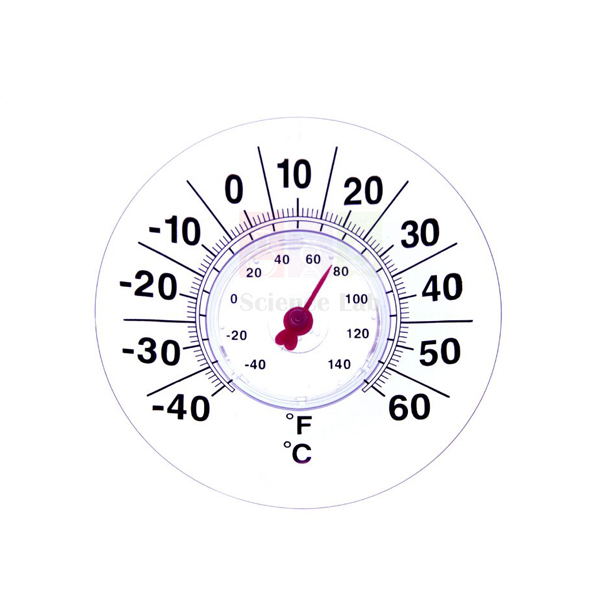
Window Thermometer, Large
Window Thermometer, Large (Product Code: SLE/CH/239) is a clear, flexible and virtually transparent thermometer, 80mm in diameter, that fixes to a window or glass door so the temperature on the other side of the glass can be read from inside the room. A centre suction attachment and electro-static technology hold it firmly in place, and its range of -50°C to 50°C covers everyday outdoor conditions. It is manufactured by Jain Scientific Equipments Pvt Ltd (ScienceLab), Ambala, and is a simple, visual piece of educational laboratory equipment in India for classrooms and school weather projects.
Specifications
| Parameter | Detail |
|---|---|
| Type | Clear, flexible, virtually transparent window thermometer |
| Fixing | Centre suction attachment; adheres to windows or glass doors using electro-static technology |
| Range | -50°C to 50°C |
| Diameter | 80mm |
| Stand-off from glass | Stands up to 20mm from the window |
| Design feature | Allows air to circulate around the thermometer to stop exaggerated readings caused by heat radiation through the glass |
Typical Use
Fixed to the outer face of a classroom window, the thermometer lets students take the outdoor temperature at the start of every lesson without leaving the room, building a daily weather log for geography, environmental studies or a science club. Placed beside an indoor thermometer, it makes the difference between inside and outside conditions obvious, which leads naturally into discussions of insulation, heat loss through glass and seasonal change. Its transparent body keeps the view through the window largely clear, so it can stay in place all year.
Because it stands up to 20mm off the glass, air moves around the thermometer and it is not simply reading the warmth of the pane itself. Choose a window that is shaded for most of the day and away from air-conditioner outlets or heater vents, and clean the glass before fixing for a secure hold. As a simple window-mounted instrument it pairs well with digital loggers when students compare instrument types.
Manufacturer
ScienceLab products such as this window thermometer are made by Jain Scientific Equipments Private Limited of Ambala, Haryana, which supplies schools, colleges and teaching laboratories under the ScienceLab trading name. The company profile gives an overview of the company.
Related Chemistry Lab Equipment
Instruments used together with a window thermometer in weather and temperature studies:
- Thermometer, Electronic, Max/Min — records the day's highest and lowest temperatures
- Digital Hygrometer - Thermometer — adds humidity readings to the weather log
- Psychrometer (with Thermometer) — a wet-and-dry method for measuring humidity
- Indoor/Outdoor Thermometer — compares inside and outside temperatures on one instrument
Browse the full Chemistry Lab Equipment range for more measuring instruments.
Frequently Asked Questions
What temperature range does it cover?
It reads from -50°C to 50°C.
How does it stay on the window?
It has a centre suction attachment and adheres to windows or glass doors using electro-static technology. Clean, dry glass gives the firmest hold.
Why does it stand away from the glass?
Standing up to 20mm from the window lets air circulate around the thermometer, which stops exaggerated readings caused by heat radiation through the glass.
How large is it?
The thermometer is 80mm in diameter, and its clear, flexible body sits close to the glass without blocking much of the view.
Which side of the window should it go on?
To read outdoor temperature from inside, fix it to the outside of the glass. Pick a window out of direct sun for the most representative readings.
How should it be cleaned?
Wipe it with a soft, damp cloth. Avoid solvents and abrasive cleaners, which can cloud the clear body.
Can schools order several units?
Yes. We quote for schools, colleges and distributors in India and international markets — contact us with your quantity.
Request a Quote
Ask for pricing through our contact page, or add the Window Thermometer, Large to the enquiry cart.
Last updated: 24 September 2026
Hazard Warning Tape: Corrosive
Hazard Warning Tape: Corrosive (Product Code: SLE/CH/240) is a white self-adhesive vinyl tape printed with the corrosive hazard pictogram, used to mark the shelves, cupboards, trays and bench areas where acids, alkalis and other corrosive substances are stored or handled. The pictogram repeats every 75 mm with a blank area between symbols, on a tape 25 mm wide that comes as a 66 m roll. It is supplied by Jain Scientific Equipments Pvt Ltd (ScienceLab), Ambala, alongside the chemistry lab equipment and safety items it provides to schools, colleges and laboratories in India and abroad.
Specifications
| Parameter | Detail |
|---|---|
| Hazard shown | Corrosive pictogram |
| Material | Self-adhesive vinyl tape |
| Colour | White |
| Print pattern | Pictogram repeated every 75 mm, with a blank area between symbols |
| Width | 25 mm |
| Supplied as | 66 m roll |
Typical Use
Corrosive substances can burn skin and eyes and eat into metal fittings, so the places they live in a laboratory need to be obvious to everyone. Laboratory staff run this tape along the shelf edges of an acid or alkali cupboard, around the rim of trays that hold concentrated reagents, on the lids of waste acid and alkali containers, and across the front of the bench area reserved for dilutions. A single strip tells a student, cleaner or visitor at a glance that goggles and gloves are needed before anything is touched, and it helps new staff find the corrosive store quickly when setting up a practical.
Apply the tape to a clean, dry, grease-free surface and press it down firmly along its length, starting from one end to avoid trapped air. Mark the location of the spill kit with the same tape so it is easy to find in a hurry. The tape adds a visual warning to a well-organised lab storage cabinet; it does not replace the individual label that every chemical container must carry.
Supplier
Jain Scientific Equipments Private Limited, trading as ScienceLab from Ambala, Haryana, supplies this tape together with the storage and safety items laboratories order with their apparatus. Vendor registration details for the company are GSTIN 06AAECJ8618A1ZT and DGFT Importer-Exporter Code AAECJ8618A, under which it ships internationally. See our company profile for more.
Related Chemistry Lab Equipment
Safety and storage items used where corrosive chemicals are kept:
- Acid Storage Cabinet Vertical — dedicated storage whose shelves and doors this tape can mark
- Acid Spill Clean Up Kit — response kit for acid spills in the marked area
- Caustic Spill Clean Up Kit — the matching kit for alkali spills
- Acid Proof Aprons, Lab Coat, Pants, Shoe Covers and Sleeves — protective clothing for work with corrosives
- Safety Goggles — eye protection the warning reminds users to wear
Other safety and bench items are listed in our Chemistry Lab Equipment category.
Frequently Asked Questions
How much tape is on one roll?
Each roll holds 66 m of tape, 25 mm wide.
How often does the corrosive symbol appear?
The pictogram is printed every 75 mm, with a blank area between each symbol.
Which surfaces does it stick to?
As a self-adhesive vinyl tape it is intended for clean, dry, smooth surfaces such as shelf edges, cabinet doors, trays and container lids. Test a short piece first on rough or textured surfaces.
Does the tape replace labels on chemical bottles?
No. It marks storage and work areas; each container still needs its own label identifying the contents and hazards.
Will acid splashes damage the tape?
The chemical resistance of the tape is not listed in our product details, so wipe any splashes off promptly and contact us if you need more information.
Are other hazard designs available?
Yes, the range also includes Flammable, Explosive, Irritant and Biohazard versions.
Request a Quote
Rolls can be ordered singly or with other hazard designs. Contact us for pricing or add this tape to the enquiry cart; we supply across India and international markets.
Last updated: 24 September 2026
Hazard Warning Tape: Explosive
Hazard Warning Tape: Explosive (Product Code: SLE/CH/241) carries the explosive hazard pictogram on white self-adhesive vinyl, giving laboratories a quick way to flag locked cupboards, containers and restricted zones linked to substances with an explosion risk. It is also used to outline the keep-back boundary around a demonstration bench. The tape is 25 mm wide, the symbol repeats every 75 mm with a blank area between, and each roll is 66 m long. It is supplied by Jain Scientific Equipments Pvt Ltd (ScienceLab), Ambala, as one of the lab equipment accessories it offers to schools, colleges and research laboratories.
Specifications
| Parameter | Detail |
|---|---|
| Hazard shown | Explosive pictogram |
| Tape type | Self-adhesive vinyl |
| Background colour | White |
| Symbol spacing | Every 75 mm, blank area between symbols |
| Width | 25 mm |
| Roll length | 66 m |
Typical Use
Few substances in a teaching laboratory carry an explosion risk, which is exactly why their storage must stand out from everything else. Technicians use this tape to border the door and shelf of the locked cupboard set aside for such materials, and to mark the containers and trays that belong to it, so nothing is moved into general storage by mistake. During teacher-only demonstrations that involve a small, controlled bang or a rapid reaction, a strip across the bench or floor shows students exactly how far back to stand, reinforcing the safety screen and goggles.
For boundaries, lay the tape in one continuous run so the repeated symbol is visible from every side of the demonstration area. On cupboards and trays, clean and dry the surface first so the vinyl adheres properly. Clear hazard marking of this kind is a simple part of any school laboratory setup and helps visiting inspectors, cleaners and substitute teachers understand the room without a briefing.
Supplier
The tape is supplied by ScienceLab, the trading name of Jain Scientific Equipments Private Limited in Ambala, Haryana. Besides the apparatus it manufactures, the company provides safety signage and marking supplies so that a laboratory can be equipped and labelled from a single order. Our company profile tells you more.
Related Chemistry Lab Equipment
Safety items used where explosion risks are managed:
- Safety Screen — stands between the demonstration and the class inside the marked zone
- Safety Goggles — eye protection for everyone near the demonstration
- Box, Metal, Lockable, for Storage — lockable storage that can carry the warning tape
- Laboratory Safety Chart — explains hazard symbols to students on the wall
- Hazard Warning Tape: Corrosive — the same tape format for acid and alkali storage
For more safety and bench apparatus, visit the Chemistry Lab Equipment category.
Frequently Asked Questions
What are the roll dimensions?
The tape is 25 mm wide and each roll is 66 m long.
Can it mark an exclusion zone for a demonstration?
Yes. Lay it across the bench or floor to show where students must stay behind, and use it together with a safety screen and eye protection.
Does marking a cupboard make it suitable for storing explosive materials?
No. The tape identifies the hazard only; how such materials are stored must follow your institution's safety rules and any local regulations.
How is the symbol laid out on the tape?
The explosive pictogram repeats every 75 mm on a white background, with a blank area between symbols.
Will it leave residue when removed?
Removal behaviour is not listed in our product details and depends on the surface and how long the tape has been in place. Try a small piece first, or ask us before use on sensitive finishes.
Can I order it together with other hazard tapes?
Yes. Mixed orders of hazard tapes for schools, colleges and distributors in India and international markets are quoted together.
Request a Quote
Tell us how many rolls you need through our contact page, or add the explosive warning tape to the enquiry cart.
Last updated: 24 September 2026
Hazard Warning Tape: Flammable
Hazard Warning Tape: Flammable (Product Code: SLE/CH/242) is printed with the flammable hazard pictogram and used to highlight solvent cupboards, spirit and fuel stores, and the bench areas where flammable liquids are poured near burners. Made from white self-adhesive vinyl, it is 25 mm wide, repeats the symbol every 75 mm with a blank area between, and is sold as a 66 m roll — enough to mark several storage units and work zones. It is supplied by Jain Scientific Equipments Pvt Ltd (ScienceLab), Ambala, as part of the lab consumables it provides to institutions in India and international markets.
Specifications
| Parameter | Detail |
|---|---|
| Hazard shown | Flammable pictogram |
| Construction | Self-adhesive vinyl tape, white |
| Repeat | Pictogram every 75 mm with a blank area between symbols |
| Width | 25 mm |
| Supplied as | 66 m roll |
Typical Use
Flammable liquids such as ethanol, methylated spirit and organic solvents are among the most commonly used hazardous materials in school and college laboratories, and they are often in use in the same room as open flames. Staff apply this tape along the doors and shelf edges of the solvent cupboard, around the station where spirit burners are refilled, and across the front of the bench or fume cupboard area where solvents are dispensed for chromatography or extraction. The repeated symbol reminds students to extinguish burners nearby before opening a bottle and to return the solvent to its marked store straight after use.
Fix the tape to cool, clean surfaces only — never on or near a hot plate, burner or heater — and press it down firmly so edges do not lift. Store spare rolls in a cool, dry place away from direct sunlight to keep the adhesive in good condition. Clear marking of solvent storage belongs in every chemistry lab equipment plan in India alongside spill kits and good ventilation.
Supplier
ScienceLab, the brand of Jain Scientific Equipments Private Limited in Ambala, Haryana, supplies this flammable warning tape to laboratories that want their safety marking to arrive with the rest of their equipment. You can read about the company on our company profile.
Related Chemistry Lab Equipment
Items used where flammable liquids are stored and handled:
- Solvent Spill Clean Up Kit — for dealing with a spill inside the marked area
- Methylated Spirit — a common flammable liquid whose store the tape can mark
- Fume Cupboard, Ductless — a ventilated work area for dispensing volatile solvents
- Spill Pack — general spill response to keep near the solvent store
- Hazard Warning Tape: Explosive — the matching tape for explosion-risk storage
Explore more safety and bench items in our Chemistry Lab Equipment range.
Frequently Asked Questions
What length and width is the roll?
A 66 m roll of tape that is 25 mm wide.
How far apart are the flammable symbols?
They are printed every 75 mm on white vinyl, separated by a blank area.
Is the tape itself fire resistant?
Fire resistance is not listed for this tape, so apply it only to cool surfaces away from burners and heaters. Contact us if you need further details.
Can it be used on a fume cupboard?
It can mark the outer frame or the bench in front of the cupboard, provided the surface is clean, dry and not heated.
How should spare rolls be stored?
Keep them in a cool, dry cupboard out of direct sunlight so the adhesive stays effective.
What should I include in a quotation request?
The number of rolls, any other hazard designs you need, and the delivery location. We supply schools, colleges and distributors across India and international markets.
Request a Quote
Contact us for a price on the flammable hazard tape, or add it to the enquiry cart with your safety and storage items.
Last updated: 24 September 2026
Hazard Warning Tape: Irritant
Hazard Warning Tape: Irritant (Product Code: SLE/CH/243) is a self-adhesive vinyl marking tape printed with the irritant hazard pictogram. It is used to flag shelves, cupboards, bench zones and containers where substances that can irritate the skin, eyes or airways are stored or handled, so that students and staff notice the hazard before they reach for anything. Chemistry teachers, lab technicians and stores staff in schools, colleges and institutional labs use it as a quick, visible warning. It is supplied by Jain Scientific Equipments Pvt Ltd (ScienceLab), Ambala, India, which serves institutions looking for a single lab consumables supplier in India alongside their apparatus orders.
Specifications
| Parameter | Detail |
|---|---|
| Type | Self-adhesive vinyl hazard warning tape |
| Hazard symbol | Irritant pictogram |
| Tape colour | White, printed with the pictogram |
| Width | 25 mm |
| Roll length | 66 m |
| Print pattern | Pictogram repeated every 75 mm, with a blank area between symbols |
| Supplied as | Roll |
Typical Use
In a school or college preparation room the tape is typically run along the front edge of reagent shelves, around the doors of storage cupboards and across the lids of waste or stock containers that hold irritant materials. Because the symbol repeats every 75 mm, even a short strip cut from the roll carries at least one complete pictogram, which makes it practical for small bottles and trays as well as long shelf fronts. The blank space between symbols can take a short handwritten note, such as a shelf reference, where your lab procedure calls for one.
When planning a school lab setup in India, many laboratories colour-code storage by hazard type, and this irritant tape fits that approach next to the corrosive and flammable versions. For good adhesion, apply it to a clean, dry and grease-free surface and press it down firmly along its length; replace any strip that has faded or started to lift. The tape is a visual reminder only — it supplements, and never replaces, the original container labels and safety data sheets supplied with each chemical.
Supplier
This tape comes from Jain Scientific Equipments Private Limited, the Ambala, Haryana company that trades under the ScienceLab name. Safety consumables such as marking tapes are supplied together with the laboratory apparatus the company makes, so a lab can order its warning materials and equipment in one enquiry. You can read more about the company on the ScienceLab company profile.
Related Chemistry Lab Equipment
Labs that mark irritant storage usually need the following items for the same storage and safety set-up:
- Hazard Warning Tape: Corrosive — marks acid and alkali shelves that often sit beside irritant stock.
- Hazard Warning Tape: Flammable — identifies solvent storage in the same preparation room.
- Hazard Warning Tape — general caution marking for benches, floors and restricted areas.
- Hazardous Storage Cabinet Horizontal — a dedicated cabinet whose doors and shelf edges can carry the tape.
- Safety Goggles — eye protection for anyone handling irritant substances.
See the complete Chemistry Lab Equipment range for more storage, safety and bench items.
Frequently Asked Questions
How wide is the tape and how much is on each roll?
The tape is 25 mm wide and each roll holds 66 m, enough to mark a large number of shelf fronts and containers.
How often is the irritant symbol printed?
The pictogram repeats every 75 mm, with a blank area between neighbouring symbols, so short cut pieces still show a full warning.
Which surfaces can it be applied to?
It is a self-adhesive vinyl tape meant for clean, dry, smooth surfaces such as shelf edges, cabinet doors and container sides. On curved, textured or cold surfaces, test a short length first.
Can this tape replace the label on a chemical bottle?
No. It adds a clear visual warning to storage areas and containers, but the original product label and safety data sheet must stay in place.
Can I order it with other hazard tapes?
Yes. Corrosive, flammable, explosive, biohazard and general hazard tapes are listed in the same range and can go into one quotation request.
What should an institutional quotation request include?
Give the number of rolls, any other items you need and the delivery location through our contact page, and we will reply with a quotation.
Do you supply outside India?
Yes. ScienceLab supplies institutions in India and international markets; share your destination when you enquire so shipping can be planned.
Request a Quote
To order Hazard Warning Tape: Irritant, send your roll quantity through the contact page, or add it to the enquiry cart with any other laboratory items you need.
Last updated: 24 September 2026
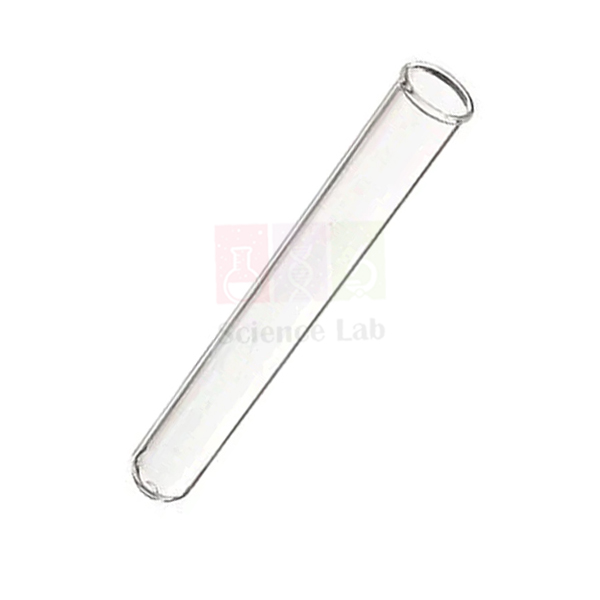
Test Tube
Test Tube (Product Code: MSRC1062) is a 16 x 150 mm rimmed tube made of clear, heat-proof borosilicate glass 5.1, used for holding, mixing and gently heating small quantities of liquids and solids during practical work. Students carry out colour-change tests, small reactions and precipitation checks in it, while teachers and technicians use it for sample handling and quick trials. Schools, colleges and testing labs that buy borosilicate laboratory glassware in India can order it from Jain Scientific Equipments Pvt Ltd (ScienceLab), Ambala, India.
Specifications
| Parameter | Detail |
|---|---|
| Model | SCL162 |
| Material | Heat-proof borosilicate glass 5.1 |
| Size | 16 x 150 mm |
| Wall thickness | 1.0 mm |
| Mouth | With rim |
| Colour | Clear |
| Properties | Heat proof, chemical resistant |
| Application | General laboratory use |
Typical Use
In school and college chemistry this tube is the everyday vessel for qualitative analysis: adding a few drops of reagent to a salt solution, watching for a precipitate or colour change, warming a mixture to speed up a reaction or testing a gas given off at the mouth. Biology classes use the same tube for food tests and enzyme activities. Its clear glass lets a whole class see the result, and the rim gives a firm lip for pouring and for a holder to grip.
As with all chemistry lab glassware for India’s schools, safe technique matters: fill only a small part of the tube when heating, hold it with a test tube holder at an angle, keep the mouth pointed away from people, and move it gently through the flame rather than holding it in one spot. After use, rinse promptly, scrub with a test tube brush and leave it upside down on a drying rack so no residue dries inside.
Manufacturer
ScienceLab is the brand of Jain Scientific Equipments Private Limited, a company based in Ambala, Haryana that makes and supplies apparatus for teaching and testing laboratories. It is incorporated under CIN U29309HR2020PTC087597 and manufactures at its licensed factory at 449, HSIIDC Industrial Area, Saha, Ambala (Factory Licence AMB-ONLINE-CHD-J-414). The company profile gives more background.
Related Chemistry Lab Equipment
These items are used with test tubes in the same practical, from heating to washing up:
- Test Tube Racks — keep a set of tubes upright while reagents are added.
- Test Tube Holder — grips the tube safely when it is warmed in a flame.
- Bunsen Burner — the usual heat source for test tube reactions.
- Brush Test Tube — cleans residue from the bottom of the tube.
- Test Tube Rack With Drying Pegs — lets washed tubes drain and dry inverted.
More glassware and bench apparatus is listed under Chemistry Lab Equipment.
Frequently Asked Questions
What are the dimensions of this test tube?
It measures 16 x 150 mm with a wall thickness of 1.0 mm, and it has a rim at the mouth.
Can it be heated directly over a burner?
Yes. It is made of heat-proof borosilicate glass 5.1. Warm it gradually, keep it moving in the flame and avoid putting a hot tube onto a cold wet surface.
Is it resistant to laboratory chemicals?
It is chemical resistant for routine acids, salts and indicators used in teaching labs. Like all glass, it should not be used with hydrofluoric acid, and hot concentrated alkalis will slowly etch it.
How should the tubes be cleaned and stored?
Rinse soon after use, scrub with a test tube brush and a mild detergent, rinse with clean water and dry the tubes upside down on a rack or drying pegs.
How are the tubes packed and sold?
Pack quantities are confirmed at the time of quotation. Tell us how many tubes you need through the contact page.
Can you supply larger quantities for schools or overseas buyers?
Yes. ScienceLab supplies institutions in India and international markets; include the quantity and delivery destination in your enquiry.
Request a Quote
For a quotation on the 16 x 150 mm Test Tube, write to us through the contact page or place it in the enquiry cart together with racks, holders and other glassware.
Last updated: 24 September 2026
Fusion Tube
Fusion Tube (Product Code: MSRC1066) is a short, rimless tube of heat-proof borosilicate glass 3.3, 75 mm long, used for strongly heating very small amounts of a substance. In organic chemistry practicals it is the standard vessel for the sodium fusion (Lassaigne’s) test and, paired with a capillary, for boiling point determination of small liquid samples. Senior school, college and university chemistry labs buy it in quantity, and it is supplied by Jain Scientific Equipments Pvt Ltd (ScienceLab), Ambala, India, a chemistry consumables supplier in India that also provides the burners and holders used with it.
Specifications
| Parameter | Detail |
|---|---|
| Model | SCL166 |
| Material | Heat-proof borosilicate glass 3.3 |
| Mouth | Without rim |
| Outer diameter | 8 mm |
| Length | 75 mm |
| Colour | Clear |
| Properties | Heat proof, chemical resistant |
| Application | Laboratory use |
Typical Use
For the Lassaigne’s test, a small piece of sodium and a little of the organic compound are heated in the fusion tube until it glows red, and the hot tube is then plunged into distilled water in a dish so that it cracks and releases the fused mass. The filtered extract is tested for nitrogen, sulphur and halogens. Because the tube is deliberately broken, each determination uses a fresh one, so labs normally keep a good stock on hand. This step involves reactive sodium and must be done under teacher supervision with eye protection.
For boiling point work, a few drops of the liquid are placed in the fusion tube, a capillary sealed at one end is dropped in open end down, and the assembly is tied to a thermometer and heated in a Thiele tube or melting point apparatus. The small bore keeps sample use low and gives even heating. Many labs order these tubes from the same lab glassware supplier in India as their test tubes and capillaries, so the sizes are consistent from batch to batch.
Supplier
Fusion tubes are part of the glass consumables that Jain Scientific Equipments Private Limited supplies under its ScienceLab trading name from Ambala, Haryana. Ordering them together with burners, holders and thermometers from one source keeps a practical kit complete. Company details are on the ScienceLab profile page.
Related Chemistry Lab Equipment
These items are used alongside fusion tubes in sodium fusion and boiling point experiments:
- Capillary Tube — sealed at one end and inverted in the fusion tube for boiling point readings.
- Thiele Tube — gives even heating of the fusion tube and thermometer assembly.
- Bunsen Burner — supplies the strong flame needed for sodium fusion.
- Test Tube Holder, Metal — holds the small tube securely while it is red hot.
- Test Tube — used for the follow-up tests on the sodium fusion extract.
Browse all Chemistry Lab Equipment for further glassware and heating apparatus.
Frequently Asked Questions
What size is the fusion tube?
It is 75 mm long with an 8 mm outer diameter and has no rim at the mouth.
What glass is it made from?
Heat-proof borosilicate glass 3.3, which tolerates direct flame heating and is chemical resistant. The glass is clear, so the contents stay visible while heating.
Can the tubes be reused?
In the sodium fusion test the tube is broken on purpose, so it is single use. Tubes used for boiling point work can be cleaned and reused if they are intact and free from residue.
Is this the same as a capillary tube?
No. The fusion tube holds the sample; a much narrower capillary tube is placed inside it for boiling point determination. Both are listed separately.
How many tubes come in a pack?
Pack quantities are confirmed with each quotation. Please state the number of tubes you need through our contact page.
Do you ship to institutions outside India?
Yes. Fusion tubes are supplied to buyers in India and international markets; mention your destination so packing for fragile glassware can be arranged.
Request a Quote
To buy Fusion Tubes for your practical sessions, send the quantity through the contact page or add them to the enquiry cart with capillaries, holders and other items.
Last updated: 24 September 2026
Capillary Tube
Capillary Tube (Product Code: MSRC1073) is a fine-bore glass tube, 100 mm long with a diameter of 1.3-1.6 mm, used where only a tiny quantity of sample is needed. Its main job in teaching and quality-control labs is melting point determination of solid organic compounds, and it is also used for boiling point checks and for spotting samples in chromatography. Chemistry departments, pharmacy colleges and testing labs order it in bulk from Jain Scientific Equipments Pvt Ltd (ScienceLab), Ambala, India, which supplies it as a chemistry lab instruments supplier alongside the matching melting point apparatus.
Specifications
| Parameter | Detail |
|---|---|
| Model | SCL173 |
| Material | Glass |
| Length | 100 mm |
| Diameter | 1.3-1.6 mm |
| Colour | Clear |
| Properties | Heat resistant, chemical resistant |
| Application | Laboratory use |
Typical Use
To find a melting point, one end of the capillary is sealed in a small flame if it is open, the dry powdered sample is tapped into the tube to a short, compact column, and the tube is placed in a melting point apparatus or tied beside the bulb of a thermometer in a Thiele tube. The clear glass lets the student see the exact moment the solid starts to liquefy and when it has fully melted, which is how purity is judged in organic preparations. Keep the sample column short and well packed for a sharp reading.
The same tubes are handy for applying small, tight spots of solution in a paper chromatography kit for school practicals, and a capillary sealed at one end sits inside a fusion tube for boiling point work. Because the sample usually stays fused inside after a melting point run, capillaries are treated as consumables and replaced after each determination; store unused tubes in a closed container so dust does not enter the bore.
Supplier
Jain Scientific Equipments Private Limited, which trades as ScienceLab from Ambala in Haryana, supplies these capillaries as part of its glass consumables range for teaching and testing labs. Buyers can combine them in one order with melting point apparatus and thermometers. Visit the company profile to learn more about ScienceLab.
Related Chemistry Lab Equipment
These products are used with capillary tubes for melting and boiling point determination:
- Apparatus Melting Point — heats the filled capillary for melting point readings.
- Digital Melting Point Apparatus — an electrically heated option with a digital temperature display.
- Thiele Tube — the traditional oil-bath method using a thermometer and capillary.
- Fusion Tube — holds the liquid sample when a capillary is used for boiling point work.
- Capillary Tube Set — an alternative listing for labs that need a set of capillaries.
For more glassware and consumables, see the Chemistry Lab Equipment category.
Frequently Asked Questions
What are the length and bore of these capillaries?
Each tube is 100 mm long with a diameter of 1.3-1.6 mm, in clear glass.
Are they open at both ends or sealed at one end?
Please confirm the end finish you need when you enquire. A tube that is open at both ends can easily be sealed at one end in a small burner flame before filling.
Will they fit my melting point apparatus?
Most apparatus state the capillary diameter they accept. Compare it with the 1.3-1.6 mm size here, or send us the model details through the contact page and we will check.
Can a capillary be reused?
For melting points, no — the sample remains fused in the tube, so use a fresh capillary for each reading. This is why labs buy them in larger quantities.
Are they suitable for heating and chemical contact?
Yes. The glass is heat resistant and chemical resistant for normal melting point, boiling point and spotting work.
Can you supply bulk or export orders?
Yes. ScienceLab supplies institutions in India and international markets. Share the quantity and destination for a quotation.
Request a Quote
Send your Capillary Tube requirement through the contact page, or add it to the enquiry cart with a melting point apparatus or other items for a combined quotation.
Last updated: 24 September 2026
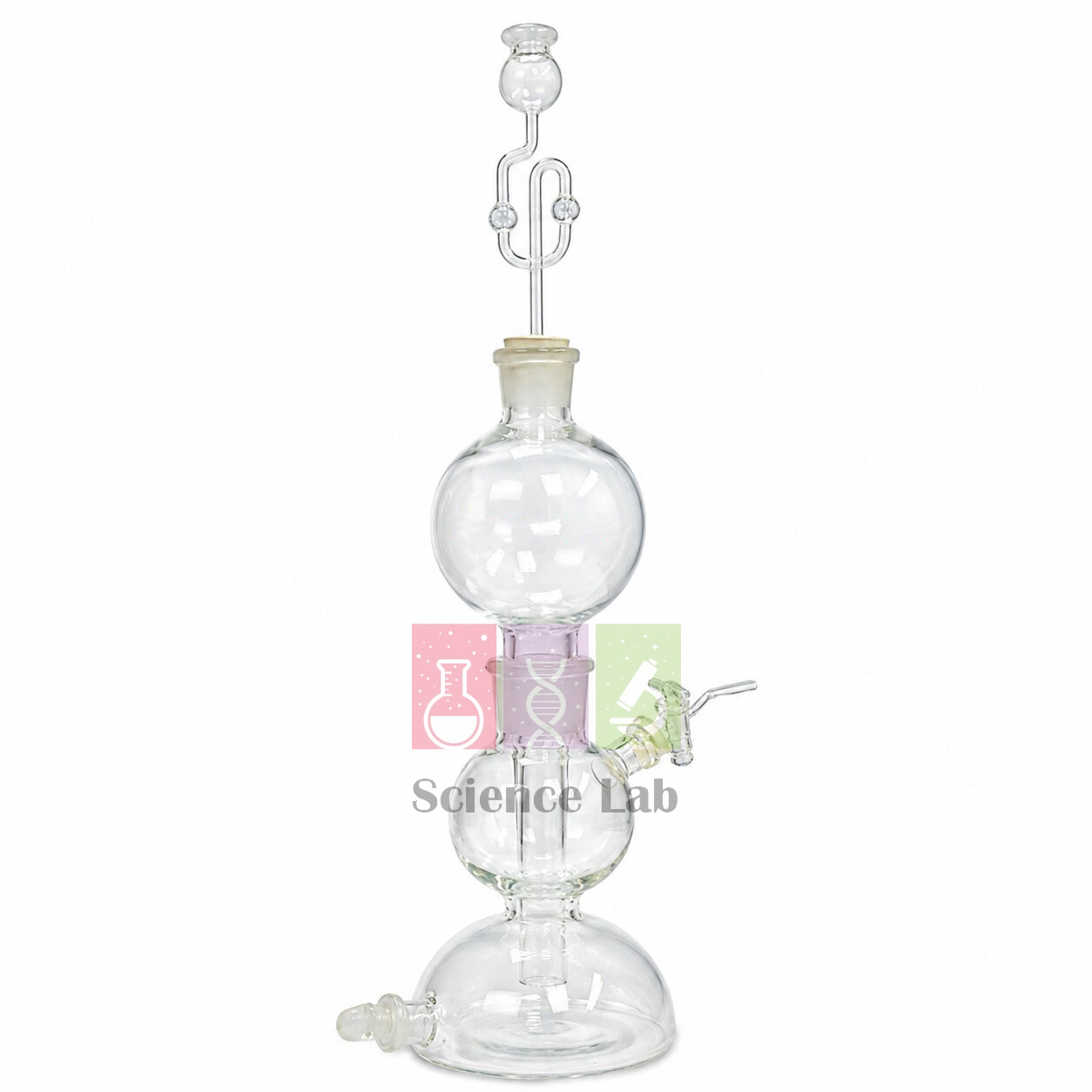
Kipps Apparatus
Kipps Apparatus (Product Code: 102/My-26) is a classic-type Kipp gas generator that produces gases such as carbon dioxide, hydrogen sulphide and hydrogen by the action of an acid, mainly hydrochloric acid, on a solid, without any heating. It lets a chemistry teacher or lab assistant draw gas on demand for a whole practical session and stop the reaction simply by closing the outlet. Schools and colleges setting up a Kipp generator in their India lab or abroad can source this 250 ml apparatus made by Jain Scientific Equipments Pvt Ltd (ScienceLab), Ambala, India.
Specifications
| Parameter | Detail |
|---|---|
| Type | Kipp’s apparatus, classic type |
| Construction | Two main parts: an upper glass pot ending in the shape of a funnel, and a lower part made of two joined glass flasks |
| Volume | 250 ml |
| Device height | 300 to 350 mm |
| Gases produced | Carbon dioxide (CO2), hydrogen sulphide (H2S), hydrogen (H2) and similar gases |
| Reagents used | An acid (mainly hydrochloric acid, HCl) acting on a solid such as granular calcium carbonate (CaCO3), iron sulphide (FeS) or granular zinc (Zn) |
| Heating | Not required |
Typical Use
The solid reagent is placed in the upper of the two joined flasks and acid is poured in through the funnel of the top pot, from where it fills the lowest flask and rises to meet the solid. Gas forms as soon as the two are in contact. When the outlet is closed, the gas pressure pushes the acid back down and away from the solid, so the reaction stops by itself; opening the outlet again restarts it. This makes the apparatus ideal for demonstrations such as preparing carbon dioxide from marble chips, hydrogen from zinc, or hydrogen sulphide for qualitative salt analysis.
The outlet is usually connected through rubber tubing to a delivery tube and gas jar, the standard gas collection apparatus in India’s school and college labs. Use granular or lump solids rather than powder so they stay in place, add acid slowly, and run hydrogen sulphide preparation only in a fume cupboard because the gas is toxic. Keep flames away when generating hydrogen. After the session, drain the spent acid safely, rinse all parts with water and let the glassware dry before storage.
Manufacturer
This generator is part of the chemistry apparatus range of Jain Scientific Equipments Private Limited, which operates as ScienceLab from Ambala, Haryana, and makes equipment for school, college and university laboratories. For background on the company, its facilities and its range, see the ScienceLab company profile.
Related Chemistry Lab Equipment
Pair the Kipps Apparatus with these items to generate, clean and collect gas in one set-up:
- Simple Kipps Appliances — a small-scale version that students can operate at their own bench.
- Gas Jar, Glass — collects the gas for tests on its properties.
- Delivery Tube — carries gas from the generator outlet to the collecting vessel.
- Gas Washing Bottle — washes or dries the gas before it is collected.
- Rubber Tubing — flexible connection between the outlet and the rest of the train.
The full Chemistry Lab Equipment category lists more gas preparation and glassware items.
Frequently Asked Questions
Which gases can this apparatus produce?
Gases formed by an acid reacting with a solid without heat, such as carbon dioxide from calcium carbonate, hydrogen from zinc and hydrogen sulphide from iron sulphide, usually with hydrochloric acid.
What is its size?
The apparatus has a volume of 250 ml and a height of 300 to 350 mm, which suits a demonstration bench or fume cupboard.
Does it need a burner or hot plate?
No. The reaction runs at room temperature, so no heating is needed.
Are the acid and solid reagents included?
This listing covers the glass apparatus. If you also need chemicals, list them in your enquiry on the contact page and we will advise.
Is it suitable for school students?
It is best run by a teacher or trained assistant as a demonstration. For hands-on student work, the smaller Simple Kipps Appliances uses much less material.
How should it be cleaned after use?
Drain the acid into a suitable waste container, remove leftover solid, rinse all parts thoroughly with water and let them dry before reassembly or storage.
Can you quote for several units or for export?
Yes. ScienceLab supplies institutions in India and international markets; include the number of units and the delivery location in your request.
Request a Quote
To order the Kipps Apparatus, contact us through the contact page or add it to the enquiry cart along with gas jars, tubing and other items.
Last updated: 24 September 2026
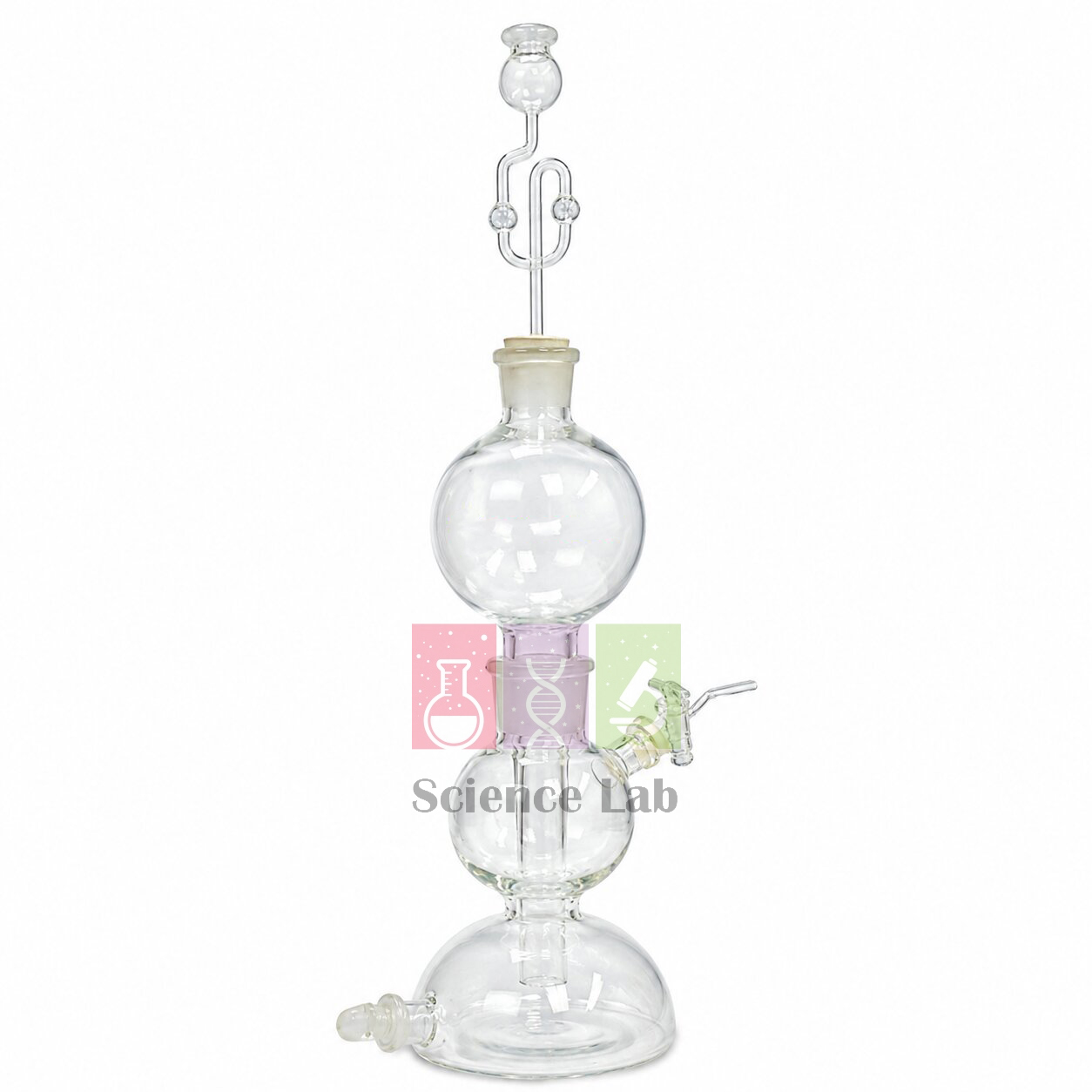
Simple Kipps Appliances
Simple Kipps Appliances (Product Code: 105/My-26) is a compact, 6 ml gas generator built on the same working principle as the classic Kipp’s apparatus, scaled down so that students can prepare a gas at their own bench. It runs on very small amounts of reagents, which keeps each experiment economical, and its simple construction is designed to keep risk as low as possible. It is a practical addition to a chemistry teaching kit for India’s secondary schools and junior colleges, made by Jain Scientific Equipments Pvt Ltd (ScienceLab), Ambala, India.
Specifications
| Parameter | Detail |
|---|---|
| Type | Simple Kipp’s apparatus, based on the principles of the classic Kipp apparatus |
| Volume | 6 ml |
| Components | Test tube with a side tube and tapered body; simple safety tube; glass tube; Hoffman screw clamp |
| Handling | Size and shape allow convenient, simple and manoeuvrable use |
| Safety | Construction designed to avoid risk in use as far as possible |
| Suitable for | Teachers and students |
| Operation | Works with small amounts of substances, making it economical |
Typical Use
A small quantity of the solid reagent goes into the tapered side-tube test tube, the safety tube and glass tube are fitted, and a little dilute acid is added so that gas is released through the side tube. The Hoffman screw clamp on the outlet controls the flow: tightening it stops the gas leaving, the pressure builds and pushes the liquid away from the solid so the reaction slows and stops, and loosening it starts the flow again. Students can therefore see the self-regulating Kipp principle in their own hands rather than only in a teacher demonstration.
Because it uses only a few millilitres of acid, the apparatus suits class practicals where many groups work at once, and it reduces the volume of spent solution to dispose of. As useful chemistry lab equipment for schools in India, it works well for simple gas tests such as bubbling the gas through a test reagent or holding a glowing or burning splint at the outlet. Students should wear eye protection, add acid slowly, and rinse all parts with water after each session.
Manufacturer
Simple Kipps Appliances is produced under the ScienceLab name by Jain Scientific Equipments Private Limited of Ambala, Haryana. The company is a registered MSME whose major activity is manufacturing (Udyam UDYAM-HR-01-0003714), and its export shipments are handled under Importer-Exporter Code AAECJ8618A issued by the DGFT. Read more on the company profile.
Related Chemistry Lab Equipment
These items support the same small-scale gas preparation practical:
- Kipps Apparatus — the full-size classic generator for teacher demonstrations.
- Screw Pipe Clamp (Hoffman Clamp) — a spare clamp for controlling the gas outlet.
- Simple Gas Preparation Kit — extends the lesson to other gas preparation methods.
- Test Tube Racks — hold the side-tube test tube steady during the experiment.
- Safety Goggles — eye protection for students handling acid.
Explore more items in Chemistry Lab Equipment.
Frequently Asked Questions
What parts make up the apparatus?
A test tube with a side tube and tapered body, a simple safety tube, a glass tube and a Hoffman screw clamp.
What is its capacity?
It is a 6 ml apparatus, so each run needs only small amounts of acid and solid.
How is it different from the classic Kipps Apparatus?
It follows the same self-regulating principle but is much smaller and simpler to handle, so students as well as teachers can use it.
Which gases can students prepare with it?
Gases that form when a dilute acid reacts with a solid at room temperature. Choose reagents according to your syllabus and carry out any toxic gas preparation in a fume cupboard.
Are chemicals supplied with it?
The listing describes the apparatus only. If you need reagents as well, mention them in your enquiry through the contact page.
Can we order class sets?
Yes. Tell us the number of sets and delivery location; ScienceLab supplies schools in India and international markets.
Request a Quote
For a quotation on Simple Kipps Appliances, use the contact page or add the item to the enquiry cart with any accessories you need.
Last updated: 24 September 2026