- Physics Lab Equipment
- Chemistry Lab Equipment
- Biology Lab Equipment
- Anatomical Lab Equipment
- Learning
- Educational Lab Equipment
- Magnets
- Agriculture
- Astronomy
- Earth Science
- Geography Lab Equipment
- Safety Lab Coat
- Laboratory
- Meteorological
- Electricity & Magnetism
- Heat
- School Lab Equipment
- Lab Glassware
- Science Lab Equipment
- Tvet Lab Equipment
- Robotics Kits Supplier and Manufacturer for Schools India
- Math Lab Equipment Manufacturers and Exporters in Ambala
- STEM Kits Manufacturers and Supplier India
- Engineering Lab Equipment
- Hospital Lab Equipment
- Water, Sanitation & Hygiene Supplies
- Cold Chain, Solar & Communication Equipment
- Nutrition
The Agriculture range covers seed and grain testing instruments: an electronic seed counter that counts seeds into exact, programmed lots and a digital moisture meter for food grains, pulses, oil seeds and vegetable seeds. Agriculture colleges and universities, seed-testing laboratories and grain-storage training centres use them in seed quality and post-harvest practicals. The seed counter and the moisture meter are supplied by ScienceLab, Ambala.
Agriculture instruments by test
| Group | What it covers | Example products |
|---|---|---|
| Seed counting | A microcontroller-based counter for seeds of 1 to 15 mm, with a membrane keyboard and an adjustable knob that keeps the seeds moving in a single row. | Seed Counter |
| Grain and seed moisture | A compact pressure-type meter that reads the water content of grains, pulses and seeds on a setting for each of around 15 commodities and stores its readings. | Digital Moisture Meter |
Setting up a seed and grain testing bench
A seed quality practical usually runs in the same order: draw a representative sample, check its moisture, count lots for testing, then germinate them. The Digital Moisture Meter gives a quick reading, while the Oven, 43 litre or the Moisture Analyser, 200g gives a slower reference on the same sample. The Seed Counter then prepares replicate lots, which go on glass Petri dishes into the Laboratory Incubator With Visibility Door.
Before each reading, check that the moisture meter is set to the crop being tested. Check the first lot of each new seed type on the counter against a hand count, and keep both instruments clean and dry. Hold seed samples in sealed, labelled containers so their moisture does not change before testing.
Frequently Asked Questions About Agriculture
Can one moisture meter serve a class testing several crops?
Yes, as long as the setting changes with the crop. The Digital Moisture Meter gives values for around 15 commodities, each with its own setting. Give each bench one crop, write the commodity beside every reading, and swap benches rather than changing the setting partway through a sample.
How should a grain sample be taken for a moisture reading?
Draw several small portions from different points in the bag or bin and mix them, so the sample stands for the whole lot. Pick out chaff, stones and broken material, which throw readings off. Fill and press each sample into the meter the same way, take more than one reading and record the average.
When is a quick meter reading enough, and when is oven drying needed?
Use the meter for fast checks across many samples, such as sorting lots or surveying a store, after letting cold or warm grain reach room temperature. Use oven drying with the Oven, 43 litre and a balance, or the Moisture Analyser, 200g, to check a figure by weighing, because a meter is an indirect method that depends on the right commodity setting.
Why are seeds counted into fixed lots for testing?
Results are compared per seed, so every lot must hold the same known number. Germination is reported as a share of the seeds sown on paper towel, sand or filter paper, and seed weight as the mass of a fixed count. The Seed Counter counts up to 999999 seeds into a programmed lot, which saves students hand-counting time.
Which seeds and grains can the two instruments handle?
On the Digital Moisture Meter, students can test food grains, pulses, oil seeds or vegetable seeds by picking the matching commodity; anything outside its list is checked by oven drying instead. The Seed Counter takes seeds from 1 to 15 mm. Seeds smaller or larger than that are counted by hand, or estimated from the mass of a counted sample.
What else does a seed testing practical need?
Most practicals also need germination dishes, an incubator, a balance and a way to split samples. These sit in other ranges: Petri Dish Glass With Lid under clinical laboratory items, Electronic Balances under measuring, and the Riffle Sample Divider under civil engineering equipment.
Ranges that support agriculture practicals
- Botany: plant biology apparatus such as seed identification and seed enzyme kits, a hydroponic tray and potometers.
- Civil Engineering Lab Equipment: soil, aggregate and cement testing, including test sieves, soil augers and the riffle sample divider.
- Laboratory Instruments: ovens, incubators, moisture analysers and other bench instruments used beside the seed and grain tests.
- Balances: physical, chemical and electronic balances for seed weight and oven-drying moisture work.
- Laboratory Equipment: the general laboratory range, including a kit for demonstrating seed respiration during germination.
To request a quotation or a catalogue for this range, send the product names, codes and quantities through our contact page or add the items to your enquiry cart.
Last updated: 15 November 2026
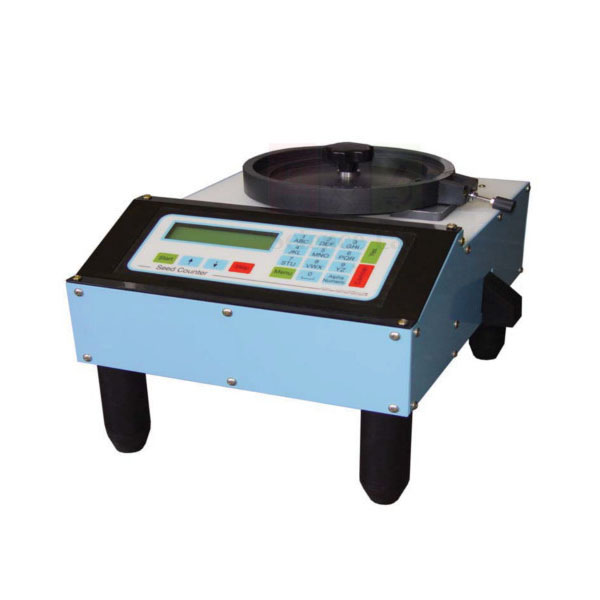
Seed Counter
The Seed Counter is a microcontroller-based electronic counter that delivers seeds in exact, programmed lots. The operator keys the required number into a membrane keyboard, sets an adjustable knob so the seeds move in a single row, and starts the run with one button. It handles seeds from 1 to 15 mm and counts up to 999999 in a lot.
Seed Counter specifications
| Parameter | Detail |
|---|---|
| Type | Electronic seed counter with programmed tallying |
| Control | Microcontroller based |
| Keyboard | Membrane keyboard |
| Maximum count | Up to 999999 seeds in a lot |
| Seed size range | 1 to 15 mm |
| Seed alignment | Adjustable knob keeps the seeds in a single row |
| Count control | Slow start and slow stop |
| Product code | SLE/AG/15 |
| Minimum order | 10 units |
| Dispatch | Usually within 7 to 10 working days |
| Supplied by | ScienceLab (Jain Scientific Equipments Pvt Ltd), Ambala, India |
Seed testing practicals with the Seed Counter
Germination test. Program the counter for the number of seeds in one replicate and count four equal lots from the same sample. Lay them on moist paper in Petri dishes, hold them in a laboratory incubator and count the normal seedlings at the end of the test period.
Thousand-seed weight. Count several lots of one thousand seeds, weigh each lot and take the mean. Read the moisture of the same sample on the Digital Moisture Meter at the same time, because seed weight rises and falls with its water content.
Respiration in germinating seeds. Count two identical lots for the seed respiration kit and boil one as the control. Any difference in gas given off then comes from the living seeds and not from unequal seed numbers.
Sowing trials and packeting. Prepare counted lots for each plot or row of a field trial, so that plant stands can be compared fairly. The same routine fills seed packets with a fixed number of seeds.
Frequently Asked Questions About the Seed Counter
Why does the final count sometimes differ from the preset number?
Usually two seeds passed the counting point side by side, or dust and chaff were counted as seeds. Reset the knob so the seeds travel in a single row, clean the sample before pouring it in, and let slow stop finish the lot before you remove the container.
Where should the Seed Counter be placed?
On a firm, level bench away from direct sunlight, damp and dust. A table that shakes or tilts breaks up the single row of seeds and can upset the count. Cover the counter when it is not in use.
How do I find the thousand-seed weight with the counter?
Program a lot of one thousand seeds, weigh it on a laboratory balance and repeat for several replicate lots. The mean is the thousand-seed weight, which is used to set sowing rates and to express germination results per unit weight of seed.
How do replicate lots make a germination test more reliable?
Several equal lots from one sample let you check whether the results agree. If one replicate differs sharply from the rest, the sample was poorly mixed or test conditions varied, and the test should be repeated. The counter prepares equal lots in minutes.
What should I do when changing to a different seed type?
Empty every seed left from the previous lot, then reset the adjustable knob for the new size within the 1 to 15 mm range. Run a short trial lot and count it by hand to confirm the setting before preparing test lots.
How should the counter be cleaned?
Switch off and unplug first. Brush out dust, husk and broken seed from the feed path and the counting point, and wipe the outside with a dry cloth. Dust left inside can be registered as seeds and spoil the next count.
Seed testing and germination equipment
- Digital Moisture Meter
- Laboratory Incubator With Visibility Door
- Petri Dish (Complete)
- Kit for Demonstrating Seed Respiration in Germination
- Seed Identification Kit
To request a quotation, send the product name, code and quantity through our contact page or add the item to your enquiry cart.
Last updated: 14 November 2026
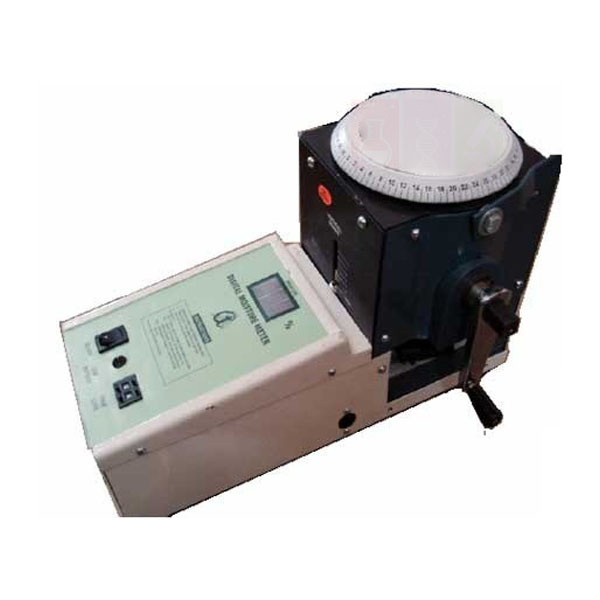
Digital Moisture Meter
The Digital Moisture Meter is a compact electronic tester for the water content of food grains, pulses, oil seeds and vegetable seeds. It works on the pressure principle, gives moisture values for around 15 commodities and keeps readings in its memory, so a class can log a series of samples during one practical.
Digital Moisture Meter specifications
| Parameter | Detail |
|---|---|
| Measures | Moisture content of agricultural produce |
| Operating principle | Pressure |
| Commodities | Around 15 |
| Suitable for | Food grains, pulses, oil seeds and vegetable seeds |
| Readout | Digital |
| Data storage | High data storage capacity |
| Design | Compact |
| Product code | SLE/AG/16 |
| Minimum order | 10 units |
| Dispatch | Usually within 7 to 10 working days |
| Supplied by | ScienceLab (Jain Scientific Equipments Pvt Ltd), Ambala, India |
Grain and seed practicals with the moisture meter
Drying curve. Read a freshly harvested sample, then dry it in a laboratory oven at a low setting. At fixed intervals, cool a sub-sample in a closed container and read it on the meter. Plotting moisture against drying time shows how quickly each crop gives up water.
Rapid test against a reference. Split one lot with a riffle sample divider so both portions match. Test one portion on the meter and the other on a moisture analyser, then discuss why the two values differ.
Moisture and germination. Record the moisture of each seed lot, count replicate lots on the Seed Counter and set them out in Petri dishes to germinate. Students then relate the moisture at storage to the germination count.
Store-room survey. Students draw samples from bags at the top, middle and bottom of a stack and log each reading in the meter. Comparing the stored values shows where damp grain collects and which bags need drying first.
Frequently Asked Questions About the Digital Moisture Meter
Why must the right commodity be selected before each test?
Each grain and seed packs and holds water differently, so the meter needs the setting for that crop. Reading wheat on a pulse setting gives a wrong value. Check the selected commodity every time the sample type changes.
Does the temperature of the sample affect the reading?
Yes. Grain taken straight from a dryer or a cold store can read differently from grain at room temperature. Let the sample settle in a closed container before testing, and follow the meter's own instructions on temperature correction.
How do students compare the meter with the oven method?
Divide one sample in two. Read one portion on the meter, then weigh, oven-dry and reweigh the other. Moisture on a wet basis is the weight lost divided by the fresh weight, times a hundred. The gap between the two figures shows how close the rapid test comes.
Why does pressing each sample the same way matter?
The meter works on the pressure principle, so a loosely filled chamber and a tightly packed one can give different values for the same grain. Fill to the same level and apply pressure the same way every time to keep readings comparable.
Why is moisture checked before grain or seed goes into storage?
Damp produce heats up, grows moulds and attracts insects in storage, and seed loses its ability to germinate sooner. Each crop has a moisture level below which it keeps well, so a reading shows whether a lot needs more drying first.
How should the meter be cleaned between commodities?
Empty the sample chamber after every test and brush out dust, husk and broken grain. Wipe away any oil left by oil seeds before testing a dry cereal. Store the meter in a dry place, away from damp store rooms.
Grain and seed testing equipment
To request a quotation, send the product name, code and quantity through our contact page or add the item to your enquiry cart.
Last updated: 14 November 2026