- Physics Lab Equipment
- Chemistry Lab Equipment
- Biology Lab Equipment
- Anatomical Lab Equipment
- Learning
- Educational Lab Equipment
- Magnets
- Agriculture
- Astronomy
- Earth Science
- Geography Lab Equipment
- Safety Lab Coat
- Laboratory
- Meteorological
- Electricity & Magnetism
- Heat
- School Lab Equipment
- Lab Glassware
- Science Lab Equipment
- Tvet Lab Equipment
- Robotics Kits Supplier and Manufacturer for Schools India
- Math Lab Equipment Manufacturers and Exporters in Ambala
- STEM Kits Manufacturers and Supplier India
- Engineering Lab Equipment
- Hospital Lab Equipment
- Water, Sanitation & Hygiene Supplies
- Cold Chain, Solar & Communication Equipment
- Nutrition
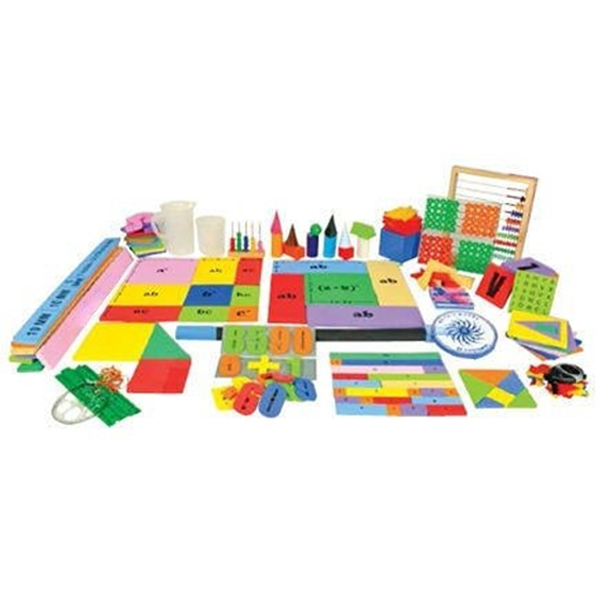
Math lab equipment on this hub is set out by lab station, from a number bench and a graphs table to sets, shape, fractions and measuring stations. Schools, teacher-training colleges and institutes use it to plan a new maths lab, and its two sub-ranges add concept kits and bulk kit lists. The station equipment in the table is made by ScienceLab in Ambala.
Maths lab equipment by lab station
| Group | What it covers | Example products |
|---|---|---|
| Number and place value bench | A spike abacus with whole-number and decimal places side by side, and foam-tile boards on which pupils lay out multiplication by place value and division as equal groups. | Decimal Abacus, Place Value Board Multiplication, Division Board |
| Graphs and signed numbers | An enlarged write-and-wipe grid, a four-quadrant board game played with counters and dice, and a dice game for adding and subtracting integers. | Graph Board, Coordinate Board, Integer Board Game |
| Sets and factors | Foldable rings for sorting objects into sets and Venn diagrams, and a tile board whose rectangular arrays show every factor pair of a number. | Sorting Ring, Factor Board |
| Shape and space | Double-sided pin boards for band shapes, snap-together sticks for polygons and the triangle inequality, and large clear solids for counting faces, edges and vertices. | 5 Assorted Geoboards, Geo Geometry Sticks, Transparent 3D Solid Set |
| Fractions corner | Foam circles that show a whole and every family from halves to tenths, equilateral triangles in three colours for fraction designs, and dice for roll-and-compare games. | Non Magnetic Fraction Disc, Designer Fraction, Fraction Dice |
| Measuring and chance | A folding metric stick, a bucket balance with plastic and metal weights for mass and volume, and clear acrylic dice in three sizes for probability games. | Folding Meter Stick, Balance Rocker Bucket, Transparent Dice |
Maths kit pages under this hub
- Stem Math Kits Supplier and Manufacturer: kits chosen by the single concept students discover, such as identities, circles, cone volume or chance.
- Bulk Math Kits Manufacturer and Exporter for Schools: teaching kits, class packs, per-student items and board instruments, set out by how a large order counts them.
Setting up a maths lab room, station by station
Lay the room out as stations rather than one long shelf. A number bench holds the Decimal Abacus and the tile boards, a graphs table the Graph Board and Coordinate Board, and a shape table the geoboards, sticks and solids. Groups then rotate between stations, and each table keeps its own items together, which makes the end-of-lesson check quick.
Begin with the stations the syllabus uses most, then add one-concept kits from the STEM maths kits page and plan quantities for several schools on the bulk kits page. A teacher's box such as the Senior Maths Kit can seed a new room while single items are added term by term.
Keep foam tiles and fraction circles flat and dry, and wipe the write-and-wipe board with a soft cloth after each class. Store dice and counters in lidded tubs. The Balance Rocker Bucket has a built-in compartment for its weights, so return them there before the balance goes back on the rack.
Frequently Asked Questions About Math Lab Equipment Manufacturers and Exporters in Ambala
What does a maths lab room need besides the equipment itself?
A demonstration table for the teacher, seating at allotted places, racks or a lockable almirah for kits, and a board that is half plain and half graph. A display board for charts helps too. The Graph Board adds an enlarged write-and-wipe grid on which the teacher plots points and students then mark their own.
How should maths lab equipment be labelled and kept in order?
Label each rack, box and tub with the item name and product code, and keep a stock list in the lab file. Check boards, dice and tile sets after every class, and look over the folding stick's hinges and the geoboard pins each term. Replace a worn piece before it spoils a group's results.
Should a class start with fraction circles or fraction triangles?
Start with circles. The Non Magnetic Fraction Disc shows halves to tenths of the same whole, so pupils compare unit fractions by size. The Designer Fraction triangles come next, when pupils read the colours of a finished design as fractions of the pattern. The Fraction Dice suit games once the idea is secure.
What can students learn on a geoboard besides naming shapes?
Perimeter, area and angles. Students count unit lengths around a band shape for perimeter and count whole and half squares inside it for area. Turning the 5 Assorted Geoboards over gives a second pin arrangement, so the same shape can be compared on two grids. Right, acute and obtuse angles show clearly between stretched bands.
What goes into a maths lab record entry?
Each entry has the aim, the materials used, the method, the observations, the result and a neatly drawn, labelled diagram. Write the observations from your own group's work rather than copying a model answer, fill in the index page, and have the teacher sign each entry once it is complete.
What do examiners ask in a maths lab viva?
They ask the maths principle behind the activity, the sources of error and a real-life use. For a coordinate activity, expect to explain why the signs change from one quadrant to the next. For a measuring task, name errors such as a slack band or a scale read at an angle.
Maths and lab pages to use with this hub
- Maths Lab Equipment: the catalogue page that lists every maths lab item with its code, arranged by topic rather than by lab station.
- Science Lab Equipment Manufacturer and Supplier Ambala: the science counterpart, which sets out a complete physics, chemistry and biology lab order line by line.
- STEM Kits Manufacturers and Supplier India: STEM kits arranged by school stage, for schools fitting out a STEM room beside the maths lab.
- Primary: primary maths kits from the learning section, such as Dienes blocks and a fraction kit, for younger classes.
- Educational Kits: boxed teaching kits, including a maths teaching kit in a metal box, for schools without a separate lab room.
Supplier
Jain Scientific Equipments Pvt Ltd sends the station equipment on this hub out from Ambala, Haryana, under its ScienceLab name. A school fitting out a maths room often adds student drawing tools such as the Geometry Set and the Calculator Simple/Hand, which ScienceLab supplies alongside. Lab lists like these go to schools, teacher-training colleges and dealers in 110 countries. See the ScienceLab company profile.
To request a quotation or a catalogue for this range, send the product names, codes and quantities through our contact page or add the items to your enquiry cart.
Last updated: 16 November 2026