- Physics Lab Equipment
- Chemistry Lab Equipment
- Biology Lab Equipment
- Anatomical Lab Equipment
- Learning
- Educational Lab Equipment
- Magnets
- Agriculture
- Astronomy
- Earth Science
- Geography Lab Equipment
- Safety Lab Coat
- Laboratory
- Meteorological
- Electricity & Magnetism
- Heat
- School Lab Equipment
- Lab Glassware
- Science Lab Equipment
- Tvet Lab Equipment
- Robotics Kits Supplier and Manufacturer for Schools India
- Math Lab Equipment Manufacturers and Exporters in Ambala
- STEM Kits Manufacturers and Supplier India
- Engineering Lab Equipment
- Hospital Lab Equipment
- Water, Sanitation & Hygiene Supplies
- Cold Chain, Solar & Communication Equipment
- Nutrition
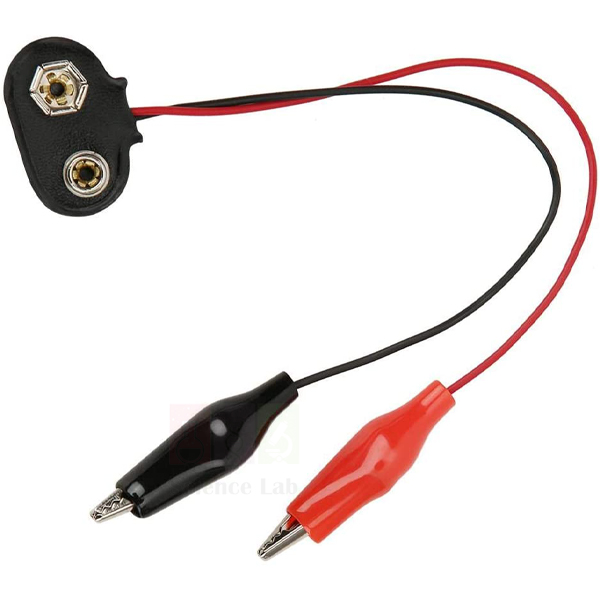
Battery Snap with Crocodile Clip
Battery Snap with Crocodile Clip (Product Code: SLE/PHY/22) is a battery connector with crocodile clips attached, used to link a battery quickly to circuit components in school science and physics lessons. Because the clips grip terminals, wires and component legs directly, students can build and change circuits on the desk without screwdrivers or soldering. It is supplied by Jain Scientific Equipments Pvt Ltd (ScienceLab), Ambala, a physics instruments supplier in India, and is a handy part of any hands-on science kit for primary school and middle-school classes.
Key Details
| Parameter | Detail |
|---|---|
| Type | Battery snap (battery connector) |
| Connection ends | Crocodile clips attached |
| Purpose | Easy connection of a battery to a circuit |
| Product code | SLE/PHY/22 |
| Supplied by | Jain Scientific Equipments Pvt Ltd (ScienceLab), Ambala, India |
What Is the Battery Snap with Crocodile Clip Used For?
Young students often struggle with small terminal screws, and loose connections are the most common reason a first circuit fails. With this connector the battery snaps on at one end and the crocodile clips at the other bite straight onto a bulb holder terminal, a switch, a buzzer lead or a bare wire. A circuit can be built, tested and rearranged in seconds, which keeps attention on the science rather than the wiring.
Teachers use it for series and parallel circuit activities, for testing which materials conduct electricity, and for quick demonstrations at the front of the class. Clip only onto metal parts, check that the jaws close firmly, and never let the two crocodile clips touch each other while the battery is connected. Disconnect the battery after the lesson so it stays fresh for the next class.
Supplier
Jain Scientific Equipments Private Limited, trading as ScienceLab, supplies the Battery Snap with Crocodile Clip from Ambala, Haryana, India. It is a sourced component that the company packs and dispatches alongside its wider range of physics and circuit items, so schools, colleges, dealers and importers can combine it with the rest of their order. For the battery type it fits, or for large class quantities, please ask us. Learn more on the company profile.
Related Physics Lab Equipment
To build complete circuits around this connector, schools usually add:
- Battery Clip, PP3 — a standard PP3 clip with 150 mm leads for boards and terminal blocks.
- Crocodile Clips & Leads — extra clip leads to extend the circuit to more components.
- MES Bulb Holder — holds a small bulb so students can see the circuit working.
- Knife Switch – Single Pole — an easy-to-see switch for opening and closing the circuit.
Find more under Physics Lab Equipment.
Frequently Asked Questions
What is the Battery Snap with Crocodile Clip used for?
The Battery Snap with Crocodile Clip connects a battery to circuit components through crocodile clips attached to the connector. Students clip it directly onto terminals, wires or component legs, making circuits quick to build and change without tools or soldering.
Why choose crocodile clips instead of plain leads?
Crocodile clips on the Battery Snap with Crocodile Clip grip a terminal or wire firmly with one squeeze, so connections are fast and secure even for young students. Plain leads need screw terminals or soldering, which take longer and are harder for beginners.
Which battery does the Battery Snap with Crocodile Clip fit?
The Battery Snap with Crocodile Clip is a snap-type battery connector. To confirm the battery type it fits for your planned experiments, ask ScienceLab through the contact page before ordering, and mention the batteries or holders your lab already uses.
How should students use the crocodile clip battery snap safely?
When using the Battery Snap with Crocodile Clip, attach the clips only to metal parts of the circuit, keep the two clips apart while a battery is connected, and remove the battery after the lesson. This prevents short circuits, warm wires and flat batteries.
Who supplies the Battery Snap with Crocodile Clip?
Jain Scientific Equipments Pvt Ltd (ScienceLab), Ambala, Haryana, India, supplies the Battery Snap with Crocodile Clip to schools, colleges, dealers and importers in India and international markets, together with other circuit parts on one order.
How do I get a quotation for SLE/PHY/22?
For a quotation on the Battery Snap with Crocodile Clip, code SLE/PHY/22, send the number required, your delivery location and any other circuit items you need through the ScienceLab contact page, or add everything to the enquiry cart.
Request a Quote
Place the Battery Snap with Crocodile Clip in the enquiry cart or ask for a quotation through the contact page, listing the quantity for your classes.
Last updated: 24 September 2026