- Physics Lab Equipment
- Chemistry Lab Equipment
- Biology Lab Equipment
- Anatomical Lab Equipment
- Learning
- Educational Lab Equipment
- Magnets
- Agriculture
- Astronomy
- Earth Science
- Geography Lab Equipment
- Safety Lab Coat
- Laboratory
- Meteorological
- Electricity & Magnetism
- Heat
- School Lab Equipment
- Lab Glassware
- Science Lab Equipment
- Tvet Lab Equipment
- Robotics Kits Supplier and Manufacturer for Schools India
- Math Lab Equipment Manufacturers and Exporters in Ambala
- STEM Kits Manufacturers and Supplier India
- Engineering Lab Equipment
- Hospital Lab Equipment
- Water, Sanitation & Hygiene Supplies
- Cold Chain, Solar & Communication Equipment
- Nutrition
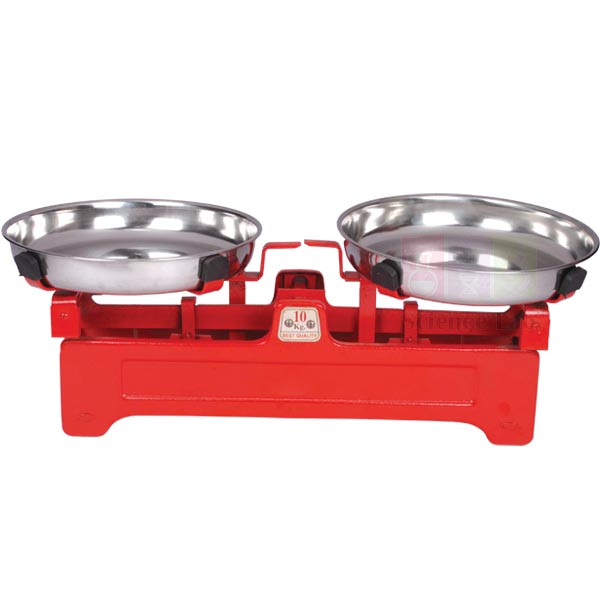
Beranger Balance
The Beranger Balance compares the masses of two objects, or weighs one object against standard masses, in school science and mathematics lessons. Its beam pivots on a central knife edge, a pointer shows when the two pans are level, and a heavy base keeps it steady while pupils load the pans.
Beranger balance details
| Parameter | Detail |
|---|---|
| Type | Beranger-pattern two-pan balance |
| Pans | Two |
| Base | Heavy base |
| Beam | Pivots on a central knife edge |
| Indicator | Pointer |
| Purpose | Comparing masses and weighing objects against standard masses |
| Standard masses | Not listed as part of the balance |
| Product code | SLE/LB/02 |
| Minimum order | 10 units |
| Dispatch | Usually within 7 to 10 working days |
| Manufacturer | ScienceLab (Jain Scientific Equipments Pvt Ltd), Ambala, India |
Comparison and weighing activities on the two-pan balance
Heavier or lighter. Give each pair a tray of classroom objects, such as a pencil case, an apple and a ball of clay. Pupils predict which of two objects is heavier, load one on each pan and record whether they were right. Repeated pairings let them put the whole set in order of mass.
Weighing against standard masses. Place an object on one pan and add pieces from a mass weighing set on tray to the other pan, starting with the heavy pieces, until the pointer rests at the centre. Add up the pieces on the pan to find the mass. Lift the small pieces with forceps so they stay clean.
Equal shares of sand or seeds. Stand an empty plastic weighing boat on each pan and check that the pointer still rests at the centre, so the boats cancel out. Pour sand into one boat, then fill the other until the beam is level. The two portions now have equal mass, which turns halving and doubling into a practical maths task.
Moments and equal arms. After weighing, compare the Beranger Balance with a demonstration lever. On the lever, a small load far from the pivot can balance a large load near it. On the balance the arms are fixed and equal, so only equal loads bring the pointer to the centre.
Frequently Asked Questions About the Beranger Balance
Is the bigger object always the heavier one?
No. A large ball of cotton wool can rise against a small stone, because mass depends on the material as well as the size. Ask pupils to predict first, then load one object on each pan. The pan that sinks holds the greater mass, whatever the objects look like.
Why can the pan holding more items still be the lighter side?
Pupils often count objects instead of comparing mass. Five plastic counters may rise against two marbles. The beam responds only to the total mass on each pan, so the side with more pieces is not always heavier. Let pupils test their own counts to see this.
How is an unbalanced pair brought level?
Add small standard masses or cubes to the higher pan one at a time. If that pan drops too far, take the last piece off and try a smaller one. When the pointer settles at the centre, the masses added equal the difference between the two loads.
What should be checked if the pointer is off centre with both pans empty?
Check that the table is level and firm, that both pans sit fully in place and are clean, and that nothing touches the beam. Dust on the knife edge can also stop the beam settling. If the pointer is still off centre, correct it as the supplied operating instructions describe.
Why does a level beam show that the two loads are equal?
The beam pivots at its centre, so the two arms are the same length. Each load turns the beam with a moment equal to its weight times the arm length. With equal arms, the moments match only when the loads match, and the pointer then rests at the centre.
Masses, balances and weighing boats for comparison lessons
- Mass Set, Brass, 1000g
- Mass Weighing Set on Tray
- Roberval Balance
- Plastic Weighing Boats
- Balance Simple Beam
To request a quotation, send the product name, code and quantity through our contact page or add the item to your enquiry cart.
Last updated: 14 November 2026