- Physics Lab Equipment
- Chemistry Lab Equipment
- Biology Lab Equipment
- Anatomical Lab Equipment
- Learning
- Educational Lab Equipment
- Magnets
- Agriculture
- Astronomy
- Earth Science
- Geography Lab Equipment
- Safety Lab Coat
- Laboratory
- Meteorological
- Electricity & Magnetism
- Heat
- School Lab Equipment
- Lab Glassware
- Science Lab Equipment
- Tvet Lab Equipment
- Robotics Kits Supplier and Manufacturer for Schools India
- Math Lab Equipment Manufacturers and Exporters in Ambala
- STEM Kits Manufacturers and Supplier India
- Engineering Lab Equipment
- Hospital Lab Equipment
- Water, Sanitation & Hygiene Supplies
- Cold Chain, Solar & Communication Equipment
- Nutrition
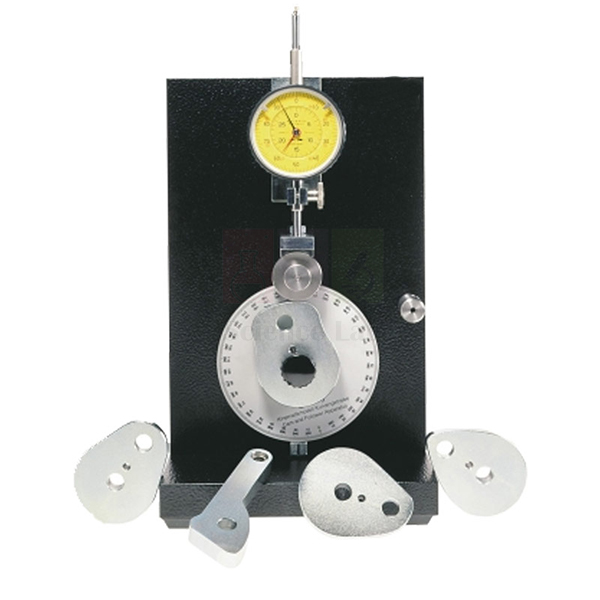
Cam Mechanism
Cam Mechanism (Product Code: SLE/MCE/75) is a bench-top demonstration unit used to show how a rotating cam converts uniform rotation into non-uniform follower motion, with or without dwell, in theory of machines laboratories. Students fit one of four cam shapes and one of three engaging members, then read the follower stroke on a 0–30 mm dial gauge against the cam angle on a 360° scale. It is made by Jain Scientific Equipments Pvt Ltd (ScienceLab), an OEM manufacturer, at its own factory in Ambala, India.
Specifications
| Parameter | Detail |
|---|---|
| Cam shapes | 4: circular arc, tangent, hollow, asymmetric |
| Engaging members | 3: roller plunger, flat plunger, cam follower |
| Angular scale | 0–360°, graduation 1°, for the angle of rotation |
| Dial gauge for the stroke | 0–30 mm, graduation 0.01 mm |
| Changeover | Cam and engaging member exchanged without tools |
| Dimensions | 300 x 300 x 400 mm |
| Weight | 8 kg |
| Product code | SLE/MCE/75 |
| Manufacturer | Jain Scientific Equipments Pvt Ltd (ScienceLab) — OEM |
| Country of origin | India (made in Ambala, Haryana) |
What Is the Cam Mechanism Used For?
A cam is a shaped disc that pushes a follower through a planned motion as it turns, as in engine valve gear and automatic machinery. On this unit, students set the cam to successive positions on the angular scale and record the stroke on the dial gauge, building a displacement diagram of follower lift against cam angle. Repeating the test with the circular arc, tangent, hollow and asymmetric cams shows how the profile shapes the rise, dwell and return of the follower.
Swapping between the roller plunger, flat plunger and cam follower needs no tools, so the class can compare how each engaging member traces the same profile within one session. From the displacement readings, advanced students can estimate follower velocity and acceleration by differentiating the curve, a standard exercise in a kinematics of machines course. Keep the dial gauge plunger clean and square to the follower to make full use of its 0.01 mm graduation.
OEM Manufacturer
The Cam Mechanism is an OEM product of ScienceLab. Jain Scientific Equipments Private Limited, trading under the ScienceLab name, manufactures it at its own licensed factory at Saha, Ambala, Haryana, India, and sells it factory-direct to engineering colleges, polytechnics, ITIs, dealers and importers.
Because the maker handles each order, questions about extra cams, spare engaging members or repeat orders for more benches can be raised with us directly. The ScienceLab company profile explains more about the company as an engineering lab equipment manufacturer.
Related Theory of Machines Equipment
Mechanisms that are usually taught alongside cams in a kinematics laboratory:
- Cam Analysis Machine — a further machine for studying cam and follower behaviour.
- Four Bar Chain Apparatus — the basic linkage studied next to cams in motion conversion.
- Gear Trainer Demonstrator — gear drives for comparison with cam-driven motion.
- Internal Gear Pinion Drive — another hands-on power transmission demonstration.
Explore the wider Theory of Machines category for more mechanism trainers.
Frequently Asked Questions
Which cam shapes come with the Cam Mechanism?
The Cam Mechanism has four cam shapes: circular arc, tangent, hollow and asymmetric. Using all four on the same unit lets students compare the follower displacement that each profile produces and relate the curve to the shape of the cam.
What followers can be used on the Cam Mechanism?
The Cam Mechanism accepts three engaging members: a roller plunger, a flat plunger and a cam follower. Both the cam and the engaging member can be exchanged without tools, so changeovers between tests take very little class time.
How are readings taken on the Cam Mechanism?
On the Cam Mechanism, the follower stroke is read on a dial gauge with a 0–30 mm range and 0.01 mm graduation, while the cam rotation is read on an angular scale from 0 to 360° with 1° graduation.
How large is the Cam Mechanism?
The Cam Mechanism measures 300 x 300 x 400 mm and weighs 8 kg. It is a bench-top unit, so it can be set up on an ordinary laboratory bench without a dedicated frame or floor space.
Who manufactures the Cam Mechanism?
The Cam Mechanism is manufactured by Jain Scientific Equipments Pvt Ltd (ScienceLab), the OEM, at its own licensed factory at Saha, Ambala, Haryana, India. Quotations come directly from the manufacturer, not from an intermediary.
Is a calibration certificate available for the Cam Mechanism dial gauge?
Calibration paperwork for the Cam Mechanism dial gauge is not stated in the product listing. If your department needs a calibration certificate, mention it in your enquiry so that availability can be discussed with us before you order.
Can the Cam Mechanism be supplied for several laboratories?
Yes, the Cam Mechanism can be quoted in multiple units for colleges, training institutes and dealers in India and international markets. Send the quantity and destination through the contact page for a consolidated quotation.
Request a Quote
Request a price for the Cam Mechanism (SLE/MCE/75) through our contact page or by adding it to the enquiry cart. Quotations are sent directly by the manufacturer in Ambala.
Last updated: 24 September 2026