- Physics Lab Equipment
- Chemistry Lab Equipment
- Biology Lab Equipment
- Anatomical Lab Equipment
- Learning
- Educational Lab Equipment
- Magnets
- Agriculture
- Astronomy
- Earth Science
- Geography Lab Equipment
- Safety Lab Coat
- Laboratory
- Meteorological
- Electricity & Magnetism
- Heat
- School Lab Equipment
- Lab Glassware
- Science Lab Equipment
- Tvet Lab Equipment
- Robotics Kits Supplier and Manufacturer for Schools India
- Math Lab Equipment Manufacturers and Exporters in Ambala
- STEM Kits Manufacturers and Supplier India
- Engineering Lab Equipment
- Hospital Lab Equipment
- Water, Sanitation & Hygiene Supplies
- Cold Chain, Solar & Communication Equipment
- Nutrition
Autoclave Lab Equipment covers steam sterilisers for culture media, glassware and instruments, from aluminium pressure-cooker type vessels to stainless steel benchtop units, along with a basket for the wash-up area. School and college biology labs, microbiology teaching rooms and small testing labs run them before and after practical sessions. The electric, gas, stainless steel and portable autoclaves and the basket are made by ScienceLab in Ambala, while the two benchtop units are supplied by ScienceLab, Ambala.
Autoclaves by heat source and build
| Group | What it covers | Example products |
|---|---|---|
| Aluminium pressure-type autoclaves | Aluminium vessels worked at 15 psi, heated by a 2 kW element or on a gas ring, with a pressure gauge and a double pressure-relief valve on the lid. | Electric Autoclave, Gas Autoclave |
| Stainless steel and portable autoclaves | A stainless steel vessel with no welded joints inside that runs on charcoal, kerosene, gas or electricity, and a portable single-drum unit in thick stainless steel. | Autoclave Stainless Steel, Portable Autoclave Single Drum |
| Benchtop electric autoclaves | A 15 litre Stainless Steel 316 unit with thermostatic control, and a 12 litre one-touch model with an interlock lid. Both work at 121°C. | Autoclave, Stainless Steel, 15 Litre, Classic Standard Autoclave |
| Wash-up basket | A white rectangular basket of autoclavable polypropylene, 400 x 400 x 100 mm, for draining and carrying washed labware. | Draining Basket |
Choosing and running a teaching-lab autoclave
Start from the heat source and the daily load. A lab on mains power usually takes the Electric Autoclave, and a lab on natural or bottled gas the Gas Autoclave. Where the supply is uncertain, the stainless steel autoclave runs on charcoal, kerosene, gas or electricity. A department that prepares media every day may prefer a thermostatically controlled benchtop unit such as the 15 litre Stainless Steel 316 autoclave. The portable single-drum unit suits a prep room shared between subjects.
Before every run, check the water level against the supplied operating instructions and seat the gasket evenly. Pack the load loosely in an autoclave basket and loosen the caps on bottles so steam can reach the contents. Tighten lid bolts a little at a time in opposite pairs. Let steam drive the air out of the chamber, as the instructions describe, before pressure builds. Start timing only when the gauge shows the working pressure; if the pressure drops during the hold, bring it back up and restart the timing.
Never open an autoclave while it is under pressure. Switch off and wait until all pressure has gone and the vessel has cooled; where a gauge is fitted, it should read zero. Lift the lid away from your face. Wear heat-resistant gloves and goggles to unload, and let bottles of liquid stand before moving them, because hot liquid can boil up when disturbed. Wash used culture glassware only after it has been through a run, and stand it upside down in the Draining Basket.
Frequently Asked Questions About Autoclave Lab Equipment
How do you choose between the electric, gas and multi-fuel autoclaves?
Choose by the heat source your lab can rely on and the load you run. The Electric Autoclave has a 2 kW heater, the Gas Autoclave sits on natural or bottled gas, and the Autoclave Stainless Steel works on charcoal, kerosene, gas or electricity. The two benchtop units are electric and suit regular media work.
How should media and glassware be loaded into an autoclave?
Loosely, so steam can reach every surface. Stand flasks and bottles upright in a basket with their caps loosened or plugged with cotton wool, and leave gaps between items. Large volumes of media take longer to heat through than small ones, so keep each run to similar volumes and follow your lab's timing for the biggest container.
How can culture media be autoclaved without spoiling them?
Give media the time their recipe or label sets and no longer. Held hot for too long, broths can darken and agar may set soft. Unload bottles once the lid can be opened, stand them upright to cool, and avoid melting one batch again and again for later lessons.
Can plastic labware go through these autoclaves?
Only plastic marked as autoclavable, such as polypropylene, and only when its own label or page says so. Polystyrene Petri dishes and other unmarked plastics soften and warp in steam, so keep them out of media and glassware runs. Check each new plastic item before its first cycle, and leave sealed containers out of every load.
Do all the autoclaves in this range open the same way?
No. The Gas Autoclave closes with bolts and nuts and the 15 litre benchtop unit with six wing nuts; loosen either in opposite pairs only after the heat is off and all pressure has gone. On the Classic Standard Autoclave there is nothing to loosen, because its interlock lid opens only after the chamber has cooled. Open the other vessels as their operating instructions describe.
What is the difference between chemical and biological indicators?
A chemical indicator, such as autoclave tape or an indicator strip, changes colour when it meets steam heat and is read as the load comes out. A biological indicator holds heat-resistant bacterial spores and is incubated after the run; no growth shows the spores were killed. Tape marks each load, while spore tests check the cycle at intervals the lab's protocol sets.
Ranges that work alongside an autoclave
- Laboratory: the parent range to open when one microbiology prep room also needs water baths, centrifuges, burners and stands beside its autoclave.
- Clinical Laboratory: clinical lab items for blood collection, haematology, ELISA and biosafety, including an incubator for grown cultures.
- Laboratory Instruments: instruments such as a spectrophotometer, colorimeter, DO meter, fume cupboards and an incubator for culture work.
- Glassware Flasks: conical, round-bottom, distillation, filter, iodine and culture flasks that hold media through a sterilising run.
- Gloves & Face Masks: examination gloves, heat-handling and chemical gloves and surgical masks for loading, unloading and wash-up work.
- Water Bath: water baths that hold melted media and reagents at a steady temperature after they leave the autoclave.
Supplier
School and college microbiology prep rooms choose among these sterilisers in the ScienceLab catalogue of Jain Scientific Equipments Pvt Ltd, Ambala. Labs setting up a sterilising bench often add the perforated stainless steel Autoclave Basket and the Petri Dish Glass With Lid for poured plates, both supplied by ScienceLab. See the ScienceLab company profile.
To request a quotation or a catalogue for this range, send the product names, codes and quantities through our contact page or add the items to your enquiry cart.
Last updated: 15 November 2026

Electric Autoclave
This electrically heated steam autoclave follows the pressure-cooker pattern and handles media, glassware and instruments in teaching laboratories. The aluminium body and lid are each formed without seams, and a 2 kW heater raises steam to a working pressure of 15 psi. The lid carries a pressure gauge, for following each stage of the run, and a double safety valve.
Electric autoclave specifications
| Parameter | Detail |
|---|---|
| Type | Electrically heated steam autoclave |
| Heater | 2 kW |
| Working pressure | 15 psi |
| Body and lid | Aluminium, formed without seams |
| Lid fittings | Pressure gauge and double safety valve |
| Product code | SLE/LA/01 |
| Minimum order | 10 units |
| Dispatch | Usually within 7 to 10 working days |
| Manufacturer | ScienceLab (Jain Scientific Equipments Pvt Ltd), Ambala, India |
Teaching practicals with the electric autoclave
Boiling versus autoclaving. Seed three tubes of nutrient broth with the same hay infusion, using an inoculation loop. Keep one as a control, boil the second in a water bath for ten minutes and hold the third at 15 psi in the autoclave. After incubation, the control turns cloudy, and cloudiness in the boiled tube shows that heat-resistant spores survived boiling.
Plotting a pressure curve. With a load of water-filled flasks in an autoclave basket, one student reads the gauge every minute from switch-on, through venting and the hold at 15 psi, to the return to zero. The plotted curve shows how long heating up and cooling down take compared with the hold itself.
Clearing culture waste. At the end of the session, used plates go into an autoclave bag with its neck left open. The bag runs through a full cycle at 15 psi before it is sealed and sent for disposal.
Frequently Asked Questions About the Electric Autoclave
When should the sterilising time start?
Only once the air has been vented and the gauge has climbed to 15 psi. The heating-up time does not count towards it. Watch the needle during the hold: if it falls below 15 psi, bring the pressure back up and start the timing again from zero.
Why is 15 psi used for steam sterilising?
At about 15 psi above atmospheric pressure, pure steam is roughly twenty degrees hotter than boiling water, which is the long-standing figure for moist-heat sterilising. The gauge only stands in for temperature if all the air was driven out first, since trapped air lowers the steam temperature at the same pressure.
What does the double safety valve do?
It gives the steam two routes out if the pressure climbs past the working level. Before every run, check that the valve moves freely and is clear of scale or dried media. Never block, weight or tie it down to make pressure build faster.
Why is steam escaping and the gauge not rising?
Usually the lid is not closed evenly, the rim is dirty, or the vent was left open after the air was purged. Switch off, let the vessel cool and lose its pressure, then clean the rim and close the lid again. Also check that enough water is left in the base.
How should the aluminium vessel be cleaned?
Empty it after each day's use, wash it with mild detergent and dry it fully. Avoid washing soda and strong alkaline cleaners, which attack aluminium and leave it pitted. Wipe the gauge face and valve with a damp cloth, never by dunking the lid in water.
How should students be trained before using the autoclave?
Start with a cold, empty unit. Show how the lid closes, where the vent and valve are, and how to read the gauge. Let each student run one supervised cycle with water-filled flasks, and keep a logbook of who ran each load and for how long.
Sterilizers and items for the sterilising bench
- Gas Autoclave
- Autoclave Stainless Steel
- Autoclave, Stainless Steel, 15 Litre
- Autoclave Basket
- Autoclave Tape
- Autoclave Bag Disposable
To request a quotation, send the product name, code and quantity through our contact page or add the item to your enquiry cart.
Last updated: 14 November 2026
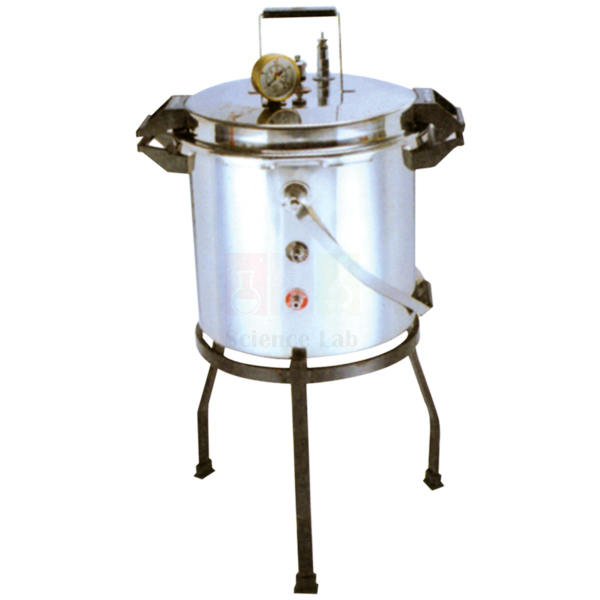
Autoclave Stainless Steel
This pressure sterilizer is built for laboratories that have no fixed heat source. Its stainless steel body is formed in one piece, with no welded joints inside, and it runs on charcoal, kerosene, gas or electricity. The vessel measures 350 mm across and 300–325 mm high, and the lid seals on a thermally insulated, vulcanized polychloroprene gasket.
Stainless steel any-fuel autoclave specifications
| Parameter | Detail |
|---|---|
| Construction | Stainless steel sterilizer, body formed without seams |
| Gasket | Thermally insulated, vulcanized polychloroprene (synthetic rubber) |
| Heat source | Any fuel: charcoal, kerosene, gas or electricity |
| Size | 350 mm (diameter) × 300–325 mm (height) |
| Capacity | 30 litres |
| Fittings | Pressure gauge, safety valve and vent |
| Handling | Designed for easy handling |
| Product code | SLE/LA/02 |
| Minimum order | 10 units |
| Dispatch | Usually within 7 to 10 working days |
| Manufacturer | ScienceLab (Jain Scientific Equipments Pvt Ltd), Ambala, India |
Sterilising tasks for school and field biology labs
Preparing dissection instruments. Wrap scalpels and forceps in paper, seal each pack with autoclave tape and stand the packs in an autoclave basket above the water. After the run, the stripes on the tape show which packs went through the cycle, so used and processed packs are not mixed up.
Nutrient broth for a field microbiology class. Fill test tubes or conical flasks with broth and plug them with cotton wool. Heat the vessel on whatever the site has, from a kerosene stove to a gas ring, and let it cool fully before the tubes are lifted out for inoculation.
Decontaminating used cultures. Collect used plates in an autoclave bag and leave the neck loose so steam can reach the contents. Run a full cycle, let the vessel cool, and only then send the bag for disposal.
Frequently Asked Questions About the Autoclave Stainless Steel
Can the autoclave be used on a charcoal or kerosene stove?
Yes. It works on charcoal, kerosene, gas or electricity. Stand it level on a stove that is steady under the full, water-filled vessel. Raise the heat gradually, and on charcoal keep the fire even, because surges and drops in heat make the pressure rise and fall.
Why must there always be water in the vessel?
The steam that does the sterilising comes from that water. Heated dry, the base overheats and the gasket can be damaged. Check the level before every run, top it up with clean water, and never leave the vessel on the heat after the water has boiled away.
Why does an autoclave work better than boiling?
Boiling at normal pressure stops at the boiling point of water, which some bacterial spores survive. Sealed under pressure, the steam gets hotter. When it condenses on cooler items it gives up its heat quickly, and moist heat at that temperature, held long enough, kills spores as well as active cells.
When can the lid be opened after a run?
Only after the heat is off and all pressure has gone. Let the vessel cool on its own and never force or prise the lid. Wait until the pressure gauge reads zero, open the vent to let out any remaining steam, then lift the lid with the far edge first, so steam rises away from your face.
How should the polychloroprene gasket be looked after?
Wipe the gasket after each run, let it dry and keep it free of grit and grease. Before closing, check that it sits evenly all round. Replace a gasket that is cracked, flattened or hard, since steam will leak past it and pressure will not build.
What are the main steps of a sterilising run?
Add water, load items loosely in a basket above it and close the lid evenly. Heat with the vent open until a steady flow of steam has driven the air out, then close the vent and watch the pressure gauge. Hold the run for the time your protocol sets, then remove the heat and let it cool fully before opening.
Sterilizers and sterilising consumables
- Electric Autoclave
- Gas Autoclave
- Autoclave, Stainless Steel, 15 Litre
- Autoclave Basket
- Autoclave Tape
- Autoclave Bag
To request a quotation, send the product name, code and quantity through our contact page or add the item to your enquiry cart.
Last updated: 15 November 2026
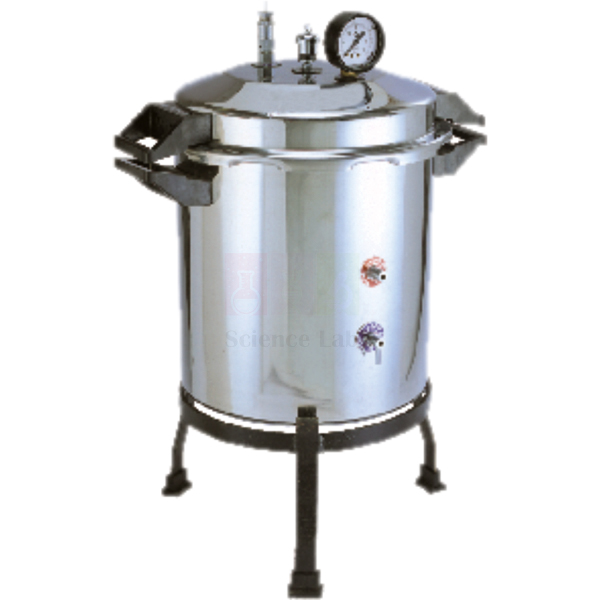
Portable Autoclave Single Drum
This portable steam sterilizer has a single drum formed in one piece from thick stainless steel, with no inner seams to hold residue. School, college and small testing labs use it to sterilise glassware, metal instruments and culture media, and to treat used cultures before washing. It is simple to run and economical to use.
Portable single drum autoclave details
| Parameter | Detail |
|---|---|
| Type | Portable autoclave, single-drum design |
| Drum | Formed in one piece from thick stainless steel, no inner joints |
| Operation | Very simple to operate |
| Running | Economical to use |
| Purpose | Steam sterilisation for routine laboratory work |
| Product code | SLE/LA/03 |
| Minimum order | 10 units |
| Dispatch | Usually within 7 to 10 working days |
| Manufacturer | ScienceLab (Jain Scientific Equipments Pvt Ltd), Ambala, India |
Sterilising work in a school microbiology lab
Plate pouring practical. Make up nutrient agar in a conical flask with screw cap or in McCartney bottles, with each cap backed off half a turn. Wrap glass Petri dishes in paper, put a strip of autoclave tape on each bundle and run everything through one cycle. Pour the plates once the agar has cooled enough to hold the flask comfortably.
Making used cultures safe. Collect spent plates and tubes in an autoclave bag, leave the neck loosely closed so steam can get in, and stand the bag in an autoclave basket inside the drum. After the cycle and full cooling, the treated waste goes for disposal and reusable glass goes for washing.
Instruments for dissection. Wrap forceps and the blades from a student dissecting set in paper, mark each pack with tape and add them to the next load. Students then compare packs that went through the cycle with packs that did not, which opens a talk on what a heat indicator can and cannot show.
Frequently Asked Questions About the Portable Autoclave Single Drum
Why should bottle caps be loosened before autoclaving?
Steam has to reach the liquid, and air inside a sealed bottle expands as it heats. A tight cap can hold the contents below sterilising temperature, or the pressure can crack the bottle or force media out. Back each cap off slightly and tighten it only after the load has cooled.
How much water goes into the drum, and what if it runs low?
Fill to the level given in the supplied instructions and check it before every cycle. Too little water can boil away before the holding time ends. The load then heats in dry air instead of steam, and a drum left empty on the heat can be damaged.
Why must the air be driven out before the pressure rises?
Air mixed with steam gives a lower temperature at the same pressure, and pockets of trapped air stay cooler than the steam around them. Let steam push the air out first, as the instructions describe, so the whole load reaches temperature. Packing the drum loosely also helps the steam move between items.
Does autoclave tape that has changed colour mean the load is sterile?
No. The stripes show only that the outside of the pack met steam heat. They say nothing about how long the centre of a dense load stayed hot. Labs that need proof of a cycle use biological indicators, which carry bacterial spores and are incubated after the run.
Which items should not go into the portable autoclave?
Leave out sealed containers, flammable solvents and anything that melts or breaks down in moist heat, such as many ordinary plastics. Heat-sensitive solutions such as antibiotic stocks are passed through a sterilising filter instead, and dry glassware can also be treated in a hot-air oven.
Why do media sometimes boil over or lose volume during a cycle?
Usually the pressure fell too quickly at the end of the run, so the hot liquid boiled up. Switch off and let the vessel cool until the pressure has fallen on its own. Never force the lid or open it under pressure, and leave headspace in every flask and bottle.
Autoclave accessories and other sterilizers
- Autoclave Tape
- Autoclave Bag
- Autoclave Bag Disposable
- Autoclave Basket
- Electric Autoclave
- Gas Autoclave
To request a quotation, send the product name, code and quantity through our contact page or add the item to your enquiry cart.
Last updated: 14 November 2026
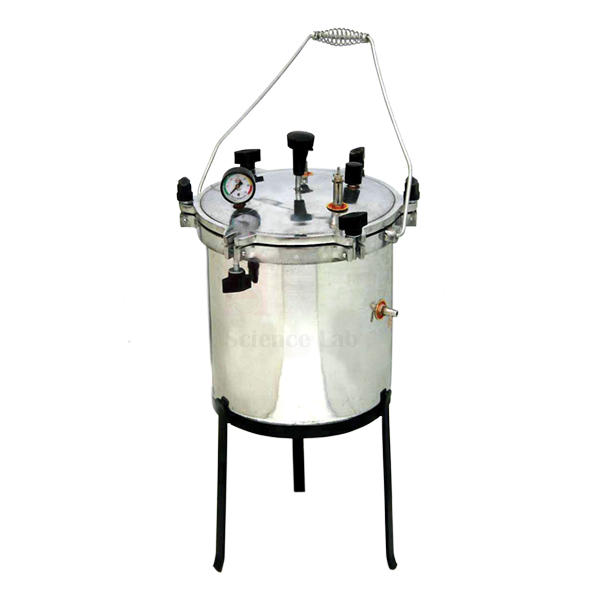
Gas Autoclave
This gas-heated autoclave serves teaching laboratories that run on natural or bottled gas. The aluminium body and lid, each formed without seams, close on a rubber gasket and are pulled airtight with tightening bolts and nuts. A pressure gauge and a double safety valve on the lid allow work at 15 psi over an ordinary gas ring or burner.
Gas autoclave specifications
| Parameter | Detail |
|---|---|
| Body and lid | Aluminium, formed without seams |
| Working pressure | 15 psi |
| Lid fittings | Pressure gauge and double safety valve |
| Sealing | Rubber gasket; lid and body made airtight with tightening bolts and nuts |
| Heat source | Natural gas or bottled gas |
| Product code | SLE/LA/04 |
| Minimum order | 10 units |
| Dispatch | Usually within 7 to 10 working days |
| Manufacturer | ScienceLab (Jain Scientific Equipments Pvt Ltd), Ambala, India |
Gas-heated sterilising practicals
Dilution blanks for a viable-count practical. Fill McCartney bottles with distilled water, loosen the caps and stand them in an autoclave basket above the water. After a hold at 15 psi and full cooling, tighten the caps. The blanks are then ready for a serial dilution of a yeast or bacterial culture.
Running a cycle on a gas ring. Light the burner with a piezo gas lighter, bring the vessel up to 15 psi on a strong flame, then turn the flame down until the gauge holds steady. One student keeps the time while another records the gauge reading at intervals through the hold.
Lid-closing drill on a cold unit. Before the first live run, each student seats the rubber gasket, sets the lid level and tightens the bolts in opposite pairs. A partner checks that the gap between lid and body is even all round before the bolts are released again.
Frequently Asked Questions About the Gas Autoclave
How should the lid bolts be tightened?
Set the lid level on the body with the gasket seated, then run every nut down finger-tight. Tighten them a little at a time in opposite pairs, so the lid stays level and the gasket presses evenly. Counting the turns on each nut helps you close the lid the same way every run.
Should the rubber gasket be greased?
Not unless the operating instructions say so. Keep it clean and dry instead, because oils and petroleum jelly can soften some rubbers. If the lid still leaks after the gasket has been cleaned and reseated, the gasket is worn and should be replaced.
How is a steady 15 psi held on a gas burner?
Bring the vessel up on a strong flame, then turn the gas down once the gauge reaches 15 psi. If the safety valve keeps releasing steam, the flame is still too high. If the needle drifts down, raise the flame slightly, and keep it centred under the base.
Is a pressure-cooker type autoclave enough for school microbiology?
For typical school loads, yes: media bottles, racks of tubes and used plates. What matters is reaching 15 psi with the air driven out and holding it for the set time. Because it runs on natural or bottled gas, it also suits rooms with no heavy electrical supply.
Why does the lid sometimes stick after the vessel has cooled?
As the steam inside condenses, the pressure can fall below that of the room and hold the lid down. Let air back in by the method the operating instructions give, then loosen the nuts in opposite pairs. Never lever the lid off with a tool.
What regular checks do the gauge and valves need?
Before each run, check that the gauge reads zero when cold and that the double safety valve moves freely. At set intervals, have a competent person examine the vessel, gauge and valves, and keep a written record of each check. Replace a gauge that no longer returns to zero.
Sterilizers and gas-bench accessories
- Electric Autoclave
- Autoclave Stainless Steel
- Gas Lighter, Piezo Electric
- Autoclave Basket
- Autoclave Bag Disposable
- Autoclave Tape
To request a quotation, send the product name, code and quantity through our contact page or add the item to your enquiry cart.
Last updated: 14 November 2026

Autoclave, Stainless Steel, 15 Litre
This benchtop autoclave is built in Stainless Steel 316, with a 15 litre chamber heated by a 2.0 kW internal element under electronic thermostatic control. It works at 121°C and suits instruments, glassware, media and waste, including destructive sterilisation of spent cultures. The lid lifts off completely and locks with six wing nuts, and a condensing vacuum after the sterilising period helps loads dry.
15 litre SS 316 autoclave specifications
| Parameter | Detail |
|---|---|
| Capacity and chamber | 15 litres; internal 280 mm (D) × 245 mm (H) |
| Material | Stainless Steel 316, polished exterior for easier cleaning |
| Overall size and weight | 370 × 390 × 485 mm; net weight 19 kg |
| Heating | Internal electric element with electronic thermostatic control, 230 V, 2.0 kW |
| Pressure | Design and S W pressure 1.3 bar (18 psi); H T pressure 2.0 bar (30 psi) |
| Temperature | Design 0–125°C; standard and maximum working temperature 121°C |
| Lid | Removable for full-width access; six wing nuts and six locking lugs hold it shut while the vessel is under pressure |
| Supplied with | Inner liner for holding items to be sterilised |
| Drying | Condensing vacuum drawn after the sterilising period |
| Product code | SLE/LA/05 |
| Minimum order | 10 units |
| Dispatch | Usually within 7 to 10 working days |
| Supplied by | ScienceLab (Jain Scientific Equipments Pvt Ltd), Ambala, India |
Sterilising routines with the 15 litre autoclave
Destructive sterilisation of spent cultures. At the end of a practical, students drop used triple-vent Petri dishes into an autoclave bag that stands in the inner liner. The bag goes through a full 121°C cycle before any of the waste leaves the laboratory.
Dressings and drapes for a nursing skills room. Wrap each pack loosely, mark it with autoclave tape and stand the packs on edge in the liner so steam passes between them. The condensing vacuum drawn after the sterilising period helps the packs come out dry enough to store.
Reusable glass plates. Wash glass Petri dishes with lids, wrap them in paper in small stacks and run them through a cycle. Leave them to dry and cool in their wrapping, so they stay covered until agar is poured.
Frequently Asked Questions About the Autoclave, Stainless Steel, 15 Litre
What is the condensing vacuum at the end of the cycle for?
It helps the load dry. After the sterilising period, the vessel draws a condensing vacuum that pulls moisture out of porous items. Wrapped packs, dressings and drapes would otherwise stay damp after a steam cycle and could not be stored.
How should a bag of waste be loaded for destructive sterilisation?
Stand the bag upright in the inner liner and close its neck loosely so steam can get in. Fill it no more than about three-quarters. Dense or tightly packed waste heats slowly in the middle, so give large loads a longer time at temperature than a light load.
Which items should never go into the autoclave?
Sealed or tightly capped containers, which can burst as pressure builds. Also keep out flammable solvents, bleach and other chlorine-based or corrosive chemicals, which can give off fumes or attack the stainless steel. Check that plastics are marked as autoclavable before loading them.
What water should be used in the chamber?
Distilled or deionised water, where it is available. Hard tap water leaves scale on the internal element and chamber walls, and scale slows heating. Drain the water after the day's last cycle and refill with fresh water before the next session.
How are the wing nuts tightened and released?
Close the lid, then tighten the six wing nuts by hand in opposite pairs, so the lid seats evenly on all six lugs. After the cycle, switch off and leave the vessel to cool until all pressure has gone before loosening any nut.
How should the chamber and the outer body be cleaned?
Empty and wipe the chamber after use with water and a mild detergent, then rinse and dry it. Avoid bleach and chloride cleaners, which can pit stainless steel. The polished SS 316 exterior only needs a damp cloth.
Autoclaves and sterilising consumables
- Classic Standard Autoclave
- Electric Autoclave
- Autoclave Stainless Steel
- Autoclave Bag
- Autoclave Tape
- Autoclave Basket
To request a quotation, send the product name, code and quantity through our contact page or add the item to your enquiry cart.
Last updated: 14 November 2026

Classic Standard Autoclave
Built around culture media for school and college biology rooms, this 12 litre autoclave sterilises at 121°C and 1.05 bar, with a minimum sterilising time of 22 minutes. One button starts the cycle. Its interlock lid stays shut until the inside has cooled, and at 4.3 kg the unit is light enough to move between rooms.
12 litre media autoclave specifications
| Parameter | Detail |
|---|---|
| Capacity and chamber | 12 litres; 210 mm diameter × 318 mm height |
| Cycle | 121°C at 1.05 bar operating pressure; minimum sterilising time 22 minutes |
| Maximum load | 4 kg unwrapped; instruments up to 290 mm long |
| Overall size | 340 mm wide × 420 mm high (max) |
| Net weight | 4.3 kg (max) |
| Electrical | 230 V, 1500 W, 50–60 Hz |
| Controls | One-touch button operation |
| Lid | Interlock lid; cannot be opened until the internal temperature has fallen |
| Product code | SLE/LA/06 |
| Minimum order | 10 units |
| Dispatch | Usually within 7 to 10 working days |
| Supplied by | ScienceLab (Jain Scientific Equipments Pvt Ltd), Ambala, India |
Media preparation practicals with the 12 litre autoclave
Agar plates for a streak-plate practical. Make up nutrient agar in screw-cap conical flasks, loosen the caps and press the button to start the cycle. When the lid releases and the flask can be held comfortably, pour the agar into triple-vent Petri dishes beside a Bunsen burner and let the plates set.
Broth for a growth-curve exercise. Sterilise nutrient broth in a baffled culture flask with its cap loosened. Once it has cooled, inoculate it with an inoculation loop, then incubate and shake it, taking samples at set times.
Clearing up after the class. Collect used plates in a disposable autoclave bag, keep the load within 4 kg, and run a cycle before the bag goes out as waste.
Frequently Asked Questions About the Classic Standard Autoclave
Why does the lid stay locked after the cycle ends?
The interlock holds the lid until the temperature inside has fallen. Agar and broth can still be above their boiling point just after a cycle. Opening then would let them boil up and spill, or crack the glass. Wait for the lock to release on its own and never force the lid.
Is the 22 minute cycle long enough for large volumes of agar?
Not always. The 22 minutes is a minimum sterilising time, and a large volume in one flask takes longer to reach 121°C in the middle. Split media into several smaller bottles or flasks, which heat through faster and are easier for students to pour.
How long should sterilised agar cool before pouring?
Until the flask can be held in a bare hand for a few seconds, while the agar is still liquid. Poured too hot, it fogs the lids with condensation that drips onto the plates. Left too long, it starts to set in the flask and pours in lumps.
How can scalds be avoided when unloading hot media?
Wear heat-resistant gloves, lift each flask straight up and keep it upright. Do not shake or swirl hot agar, which can boil up suddenly. Keep students back from the bench while the chamber is emptied, and unload only after the lid has released by itself.
How much can one load hold?
Up to 4 kg unwrapped, and instruments up to 290 mm long, in a chamber 210 mm across and 318 mm high. Leave space between flasks so steam reaches each one, rather than packing the full 12 litres tight.
Can surplus autoclaved agar be kept for another lesson?
Yes. Tighten the caps once the bottles have cooled and store them away from dust. Before the next lesson, melt the agar in a water bath rather than over a flame. Keep poured plates upside down in a sealed bag in a refrigerator.
Media flasks, plates and sterilising items
- Baffled Culture Flask
- Petri Dish, Triple Vent
- Petri Dish Rack
- Autoclave Bag Disposable
- Autoclave, Stainless Steel, 15 Litre
To request a quotation, send the product name, code and quantity through our contact page or add the item to your enquiry cart.
Last updated: 14 November 2026

Draining Basket
This white polypropylene draining basket, 400 × 400 × 100 mm, is used for draining, holding and carrying washed labware in wash-up areas and prep rooms. The polypropylene is chemical resistant and can be autoclaved. Its shallow square shape keeps beakers, flasks and cylinders within easy reach, and the white base shows up leftover residue and chipped rims.
Polypropylene draining basket specifications
| Parameter | Detail |
|---|---|
| Material | Polypropylene, autoclavable |
| Chemical resistance | Chemical resistant |
| Colour | White |
| Shape | Square |
| Dimensions | 400 × 400 × 100 mm |
| Product code | SLE/LA/07 |
| Minimum order | 10 units |
| Dispatch | Usually within 7 to 10 working days |
| Manufacturer | ScienceLab (Jain Scientific Equipments Pvt Ltd), Ambala, India |
Wash-up routines with the draining basket
End-of-practical wash-up. Students scrub glass beakers and measuring cylinders with a beaker brush, rinse them in distilled water and stand them mouth down in the basket. Once drained, beakers can go to a drying oven, while measuring cylinders air dry on a draining rack.
Checking the wash. Before the basket is emptied, a technician lifts each item against the white base and looks for a broken water film, a residue ring or a chipped rim. Anything that fails goes back to the sink, and chipped glass is set aside.
Keeping two streams apart. Mark one set of baskets for washed items and another for items waiting to be decontaminated. Items in the second set are sterilised before washing, and that basket is then autoclaved or disinfected before it goes back into use.
Frequently Asked Questions About the Draining Basket
Can the draining basket be autoclaved?
Yes. It is made of autoclavable polypropylene. The plastic softens a little while hot, so do not stack heavy items on it during a cycle, and let it cool before loading glass. Check first that your chamber is larger than the 400 × 400 mm footprint.
How long does a polypropylene basket last with repeated autoclaving?
It takes many cycles, but heat slowly ages the plastic. Look for cracks at the corners, warping, a chalky surface or brittleness when flexed. Retire a basket that shows any of these, because a cracked corner can give way under a load of wet glass.
How can I tell whether glassware in the basket is really clean?
Watch how the last rinse drains. On clean glass, water runs off as an even, unbroken film. Droplets or beads that cling to the wall show grease or residue left behind, so wash that item again before it is used.
Should washed glassware be wiped dry before it goes in the basket?
No. Paper towels and cloths leave fibres on the glass. Stand items mouth down so the water runs out, let them drain in the basket and then air dry them on a rack or in an oven.
Which chemicals does the polypropylene stand up to?
Polypropylene resists most dilute acids, alkalis, salt solutions and alcohols at room temperature, which covers routine rinsing and disinfecting. Strong oxidising acids and chlorinated or aromatic solvents can attack it, so rinse such residues off the glassware before it goes in the basket.
How should the basket itself be cleaned?
Wash it with warm water and a laboratory detergent, rinse it well and let it dry. Use a soft brush or sponge, since scouring pads scratch polypropylene and the scratches hold dirt. Autoclave or disinfect it after it has held contaminated items.
Racks and baskets for washing and drying labware
- Draining Rack
- Containers for Draining Dishes
- Polyprop Test Tube Basket
- Autoclave Basket
- Drying Rack Glass & Plastic Ware
To request a quotation, send the product name, code and quantity through our contact page or add the item to your enquiry cart.
Last updated: 15 November 2026