- Physics Lab Equipment
- Chemistry Lab Equipment
- Biology Lab Equipment
- Anatomical Lab Equipment
- Learning
- Educational Lab Equipment
- Magnets
- Agriculture
- Astronomy
- Earth Science
- Geography Lab Equipment
- Safety Lab Coat
- Laboratory
- Meteorological
- Electricity & Magnetism
- Heat
- School Lab Equipment
- Lab Glassware
- Science Lab Equipment
- Tvet Lab Equipment
- Robotics Kits Supplier and Manufacturer for Schools India
- Math Lab Equipment Manufacturers and Exporters in Ambala
- STEM Kits Manufacturers and Supplier India
- Engineering Lab Equipment
- Hospital Lab Equipment
- Water, Sanitation & Hygiene Supplies
- Cold Chain, Solar & Communication Equipment
- Nutrition
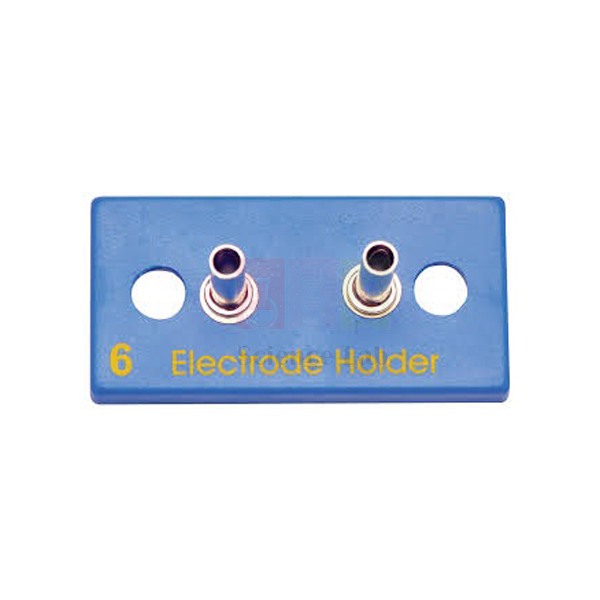
Circuits Kit Electrode Holder
Circuits Kit Electrode Holder (Product Code: SLE/PHY/34) is a panel-mounted electrode holder used as a spare component for the Circuits Kit, letting students bring a liquid into a simple circuit to test whether it conducts, in school science and physics labs. It suits lessons on conduction through solutions and introductory electrolysis. It is made by Jain Scientific Equipments Pvt Ltd (ScienceLab), an OEM manufacturer, at its own factory in Ambala, and fits into a wider range of school physics lab equipment in India.
Key Details
| Parameter | Detail |
|---|---|
| Component | Electrode holder |
| Kit | Spare component for the Circuits Kit |
| Mounting | Sturdy panel |
| Advantage | Easier handling during experiments and tidy storage |
| Product code | SLE/PHY/34 |
| Manufacturer | Jain Scientific Equipments Pvt Ltd (ScienceLab) — OEM |
| Country of origin | India (made in Ambala, Haryana) |
What Is the Circuits Kit Electrode Holder Used For?
The electrode holder extends circuit work from solid conductors to liquids. With electrodes held apart in a beaker of tap water, salt solution, sugar solution or dilute acid, and a lamp or buzzer in the same loop, students can see which liquids allow current to pass. The same arrangement introduces electrolysis, where gas bubbles or deposits form at the electrodes as the current flows.
Keep the electrodes from touching each other, rinse them with clean water between liquids so results are not contaminated, and dry the panel before it goes back into storage. Only use dilute solutions appropriate to the age group, with eye protection when acids or salts are involved.
OEM Manufacturer
Jain Scientific Equipments Private Limited, whose trading name is ScienceLab, manufactures this electrode holder as the OEM at its own licensed factory at Saha, Ambala, Haryana, India. Buying from the original manufacturer lets schools and distributors keep their circuits kits complete with spares from the same source.
Dealers, importers and institutions can ask us about matching spares and repeat orders, and quotations are issued by the manufacturer itself. Read about the company on our company profile.
Related Physics Lab Equipment
Useful additions for conduction-in-liquids and electrolysis lessons:
- Electrodes, Copper — electrodes for electrolysis work; confirm the fit with us.
- Electrode Rod Holders — an alternative style of holder for rod electrodes.
- Electrode Foil Holders — holders designed for foil electrodes.
- Circuits Kit Bulb Holder — a lamp that shows when the liquid conducts.
- Electricity Circuits Kit — a complete kit for simple circuits; ask us which spares match it.
Explore the Physics Lab Equipment category for more electricity apparatus.
Frequently Asked Questions
What is the Circuits Kit Electrode Holder used for?
The Circuits Kit Electrode Holder is used to hold electrodes in a liquid so that the liquid becomes part of a simple circuit. It supports lessons testing which solutions conduct electricity and introductory electrolysis demonstrations.
Are electrodes included with the Circuits Kit Electrode Holder?
The Circuits Kit Electrode Holder listing describes the panel-mounted holder and does not say that electrodes are included. Tell us which electrodes you need through the contact page and we will confirm them in the quotation.
How is the Circuits Kit Electrode Holder mounted?
The Circuits Kit Electrode Holder is mounted on a sturdy panel, like the other Circuits Kit components. The panel makes it easier to handle during experiments and allows it to be stored neatly with the rest of the kit.
Who manufactures the Circuits Kit Electrode Holder?
The Circuits Kit Electrode Holder is made by the OEM, Jain Scientific Equipments Pvt Ltd (ScienceLab), at its own licensed factory in Saha, Ambala, Haryana, India. Spares and repeat orders are handled directly by the manufacturer.
Is the Circuits Kit Electrode Holder safe for school use?
The Circuits Kit Electrode Holder is intended for supervised school practicals. Use low-voltage cells, dilute solutions suited to the age group and eye protection, and rinse the electrodes after each liquid so the holder stays clean for the next class.
Can the Circuits Kit Electrode Holder be ordered in bulk for export?
Yes, the Circuits Kit Electrode Holder can be ordered in bulk by schools, dealers and importers in India and international markets. Share the quantity and delivery location in your enquiry for a quotation from the manufacturer.
Request a Quote
To obtain a quote for the Circuits Kit Electrode Holder, reach us through the contact page or add it to the enquiry cart. The manufacturer will reply with a quotation directly.
Last updated: 24 September 2026