- Physics Lab Equipment
- Chemistry Lab Equipment
- Biology Lab Equipment
- Anatomical Lab Equipment
- Learning
- Educational Lab Equipment
- Magnets
- Agriculture
- Astronomy
- Earth Science
- Geography Lab Equipment
- Safety Lab Coat
- Laboratory
- Meteorological
- Electricity & Magnetism
- Heat
- School Lab Equipment
- Lab Glassware
- Science Lab Equipment
- Tvet Lab Equipment
- Robotics Kits Supplier and Manufacturer for Schools India
- Math Lab Equipment Manufacturers and Exporters in Ambala
- STEM Kits Manufacturers and Supplier India
- Engineering Lab Equipment
- Hospital Lab Equipment
- Water, Sanitation & Hygiene Supplies
- Cold Chain, Solar & Communication Equipment
- Nutrition
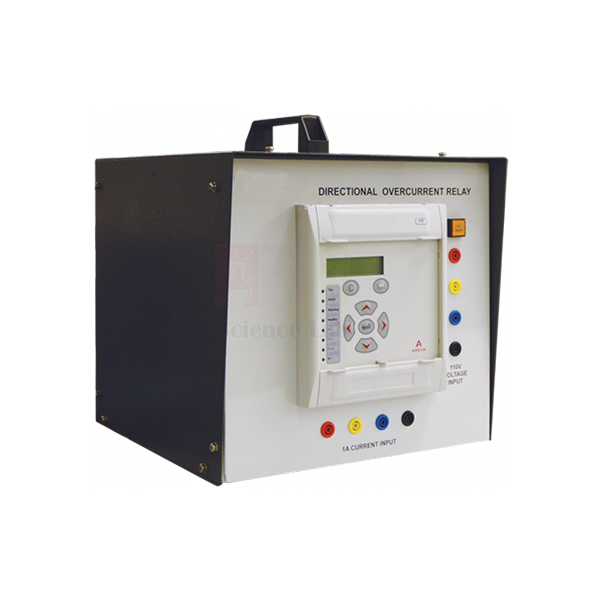
Directional/Non-Directional Overcurrent Relay
Directional/Non-Directional Overcurrent Relay (Product Code: SLE/EPS/13) is a programmable protection relay module used to teach overcurrent and earth fault protection, including IDMT time characteristics, in power system protection laboratories. It offers three independent overcurrent stages — the first selectable from 12 IDMT curves — plus voltage, undercurrent, thermal and negative phase sequence functions. It is supplied by Jain Scientific Equipments Pvt Ltd (ScienceLab), Ambala, India, a lab instruments supplier in India for engineering institutes.
Specifications
| Parameter | Detail |
|---|---|
| Overcurrent stages | Three independent stages of directional/non-directional phase overcurrent |
| Stage characteristics | First stage: any of 12 IDMT curves; remaining two stages: direct time characteristic |
| Earth fault | Directional/non-directional earth fault |
| Voltage and current functions | Undercurrent, undervoltage and overvoltage |
| Other protection | Thermal overload protection; negative phase sequence overcurrent |
| Blocking | Selectable blocking |
| Records | Creates fault and disturbance records |
| Enclosure | Robust enclosure with carrying handle |
| Mounting and connection | Mounts on the desk area of the Protection and Relay Test Set; connects by multi-core cable and safety leads |
| Programming | Keypad and display on the module, or Micom S1 software on a suitable computer |
| Product code | SLE/EPS/13 |
| Supplied by | Jain Scientific Equipments Pvt Ltd (ScienceLab), Ambala, India |
What Is the Directional Overcurrent Relay Used For?
Overcurrent protection is usually the first relay topic in a power systems course, and this module covers it in depth. Students select one of the 12 IDMT curves for the first stage, set the two direct time stages above it, and observe how the relay operates faster as fault current rises — the basis of grading relays along a feeder. Switching stages between directional and non-directional operation shows why fault direction matters on networks fed from more than one end.
Supporting functions are covered too: earth fault, negative phase sequence overcurrent, thermal overload, undercurrent, undervoltage and overvoltage. Most tests use a single relay: a fault circuit is set up on the Protection and Relay Test Set, the module is programmed by keypad or with Micom S1 software on a suitable computer, then connected with the multi-core cable and safety leads. Fault and disturbance records show what happened during each test.
What to Specify When Ordering
- Whether you already have the Protection and Relay Test Set the module mounts on.
- Whether you will program it from a computer using Micom S1 software.
- Number of modules — most tests are performed with a single relay.
Supplier
ScienceLab, the trading name of Jain Scientific Equipments Private Limited in Ambala, Haryana, India, supplies the Directional/Non-Directional Overcurrent Relay to engineering colleges, polytechnics and training institutes, alongside the other protection relays in its power systems range, for customers in India and international markets.
Please raise any questions about the relay model or the Micom S1 software when you enquire. You can read about the company on the ScienceLab profile page.
Related Power & Energy Systems Trainers
Relays and trainers that build on overcurrent protection practicals:
- Overcurrent And Earth Fault Relay — further overcurrent and earth fault protection studies.
- Distance Protection Relay — phase and ground distance protection up to five zones.
- Differential Protection Relay — three-phase differential protection characteristics.
- Circuit Breaker Trainer — fuse breaking-time behaviour to compare with IDMT curves.
Explore the complete Power & Energy Systems Trainers range.
Frequently Asked Questions
How many overcurrent stages does the Directional/Non-Directional Overcurrent Relay have?
The Directional/Non-Directional Overcurrent Relay (SLE/EPS/13) has three independent stages of directional/non-directional phase overcurrent. The first stage may be set to any of 12 IDMT curves, and the remaining two stages have a direct time characteristic.
Which other protection functions are included?
In addition to phase overcurrent, the Directional/Non-Directional Overcurrent Relay provides directional/non-directional earth fault, negative phase sequence overcurrent, thermal overload protection, undercurrent, undervoltage, overvoltage, selectable blocking, and creation of fault and disturbance records.
How does the relay connect to the Protection and Relay Test Set?
The Directional/Non-Directional Overcurrent Relay mounts on the desk area of the Protection and Relay Test Set and connects to it using a multi-core cable and safety leads. Its robust enclosure has a carrying handle for moving it between test sets.
How is the Directional/Non-Directional Overcurrent Relay programmed?
Program the Directional/Non-Directional Overcurrent Relay with the keypad and display on the module, or with Micom S1 software and a suitable computer. Once the settings are entered, the module is connected to the fault circuits and tests can be performed.
Do the tests need more than one relay?
Most tests with the Directional/Non-Directional Overcurrent Relay are performed using a single relay. If you plan grading or coordination exercises between several relays, mention this when requesting a quotation so ScienceLab can advise on quantities.
Who supplies the Directional/Non-Directional Overcurrent Relay?
The Directional/Non-Directional Overcurrent Relay is supplied by Jain Scientific Equipments Pvt Ltd (ScienceLab), Ambala, Haryana, India, to colleges, institutes and dealers in India and international markets. Enquiries go through our contact page.
Request a Quote
For a Directional/Non-Directional Overcurrent Relay (SLE/EPS/13) quotation, use the contact page or add the module to the enquiry cart along with your other protection lab items.
Last updated: 24 September 2026