- Physics Lab Equipment
- Chemistry Lab Equipment
- Biology Lab Equipment
- Anatomical Lab Equipment
- Learning
- Educational Lab Equipment
- Magnets
- Agriculture
- Astronomy
- Earth Science
- Geography Lab Equipment
- Safety Lab Coat
- Laboratory
- Meteorological
- Electricity & Magnetism
- Heat
- School Lab Equipment
- Lab Glassware
- Science Lab Equipment
- Tvet Lab Equipment
- Robotics Kits Supplier and Manufacturer for Schools India
- Math Lab Equipment Manufacturers and Exporters in Ambala
- STEM Kits Manufacturers and Supplier India
- Engineering Lab Equipment
- Hospital Lab Equipment
- Water, Sanitation & Hygiene Supplies
- Cold Chain, Solar & Communication Equipment
- Nutrition
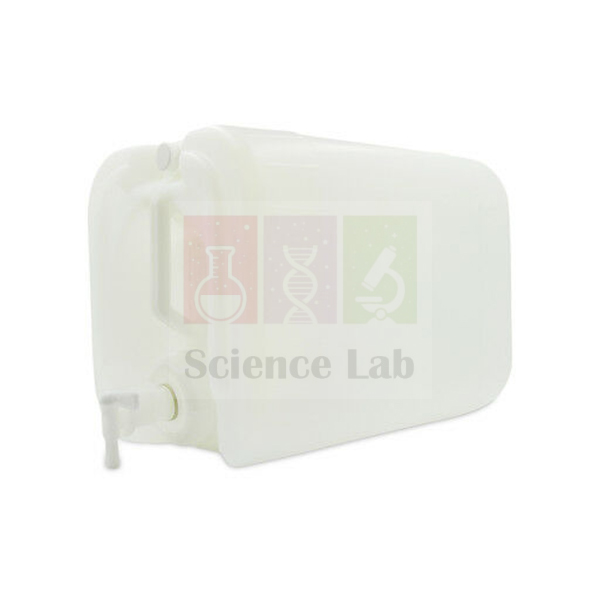
Dispensing Jug
Dispensing Jug (Product Code: SLE/P/09) is a high-density polyethylene jug with a quarter-turn spigot, used to store and dispense water, wash solutions and other liquids at the bench or sink in teaching and routine laboratories. Staff find it easy to handle thanks to its rounded corners, sturdy handle and bottom grip, and it measures 25 × 25 × 38 cm. It is supplied by Jain Scientific Equipments Pvt Ltd (ScienceLab), Ambala, India, as practical lab equipment for colleges and schools in India.
Specifications
| Parameter | Detail |
|---|---|
| Jug material | High-density polyethylene (HDPE) |
| Design | Rounded corners, sturdy handle, bottom grip for easier pouring |
| Jug dimensions | 25 × 25 × 38 cm (9 4/5 × 9 4/5 × 15 in H) |
| Spigot | Thread-mounted, low-density polyethylene (LDPE), opens with a quarter turn |
| Spigot projection | Extends 108 mm (4 1/4 in) from the jug |
| Outlet tube | 35 mm (1 2/5 in) long, 16 mm (3/5 in) diameter |
| Fill opening | Screw-capped, 52 mm (2 in) diameter |
| Side opening | Screw-capped, 26 mm (1 in) diameter |
| Product code | SLE/P/09 |
| Supplied by | Jain Scientific Equipments Pvt Ltd (ScienceLab), Ambala, India |
What Is a Dispensing Jug Used For?
A dispensing jug sits on a shelf or bench edge and delivers liquid on demand, so nobody has to lift and tip a heavy container. Labs use it for distilled water beside the titration benches, soap or detergent solution at the wash-up sink, diluted disinfectant, and rinse water in field or mobile labs. A quarter turn of the spigot starts or stops the flow, and the short outlet tube directs the stream neatly into a beaker, bottle or wash bottle.
Fill it through the 52 mm screw-capped opening, using a funnel if the source is a carboy. Loosening a cap slightly lets air in and keeps the flow from the spigot steady. Place the jug so the spigot overhangs the bench edge, and use the bottom grip together with the handle whenever the full jug has to be poured or moved.
Supplier
The Dispensing Jug is supplied by Jain Scientific Equipments Private Limited, which trades as ScienceLab from Ambala, Haryana, as part of its Scientific Lab Plasticware range. Schools, colleges, hospital and industrial labs, dealers and importers in India and international markets can order it on its own or with carboys and bottles. Learn about the company on the ScienceLab profile page.
Related Scientific Lab Plasticware
These containers and bottles fit the same dispensing workflow:
- Polypropylene Carboys — larger stopcock containers for central storage of the same liquids.
- Aspirator with stopcock — an alternative bottle-style dispenser with a stopcock.
- Measuring Jug, Polypropylene — for pouring a measured volume rather than dispensing from a spigot.
- Widemouthed Wash Bottles — refilled from the jug’s spigot for use at the bench.
Explore the Scientific Lab Plasticware category for more.
Frequently Asked Questions
What is the capacity of the Dispensing Jug?
The Dispensing Jug (SLE/P/09) listing gives its size, 25 × 25 × 38 cm, but does not state a rated capacity. Please ask us through the contact page for the nominal volume before ordering, so you can plan how often it will need refilling.
How does the spigot on the Dispensing Jug work?
The Dispensing Jug has a thread-mounted low-density polyethylene spigot that opens and closes with a quarter turn. The spigot extends 108 mm from the jug, and its outlet tube is 35 mm long and 16 mm in diameter, which gives a neat, directed stream.
What are the two openings on the Dispensing Jug for?
The Dispensing Jug has a screw-capped fill opening of 52 mm diameter for filling and cleaning, plus a screw-capped side opening of 26 mm diameter. Keeping both caps on protects the contents, and loosening one slightly helps air enter so the spigot flows steadily.
What is the Dispensing Jug made of?
The body of the Dispensing Jug is moulded from high-density polyethylene and the spigot from low-density polyethylene. Both suit water, detergent and most aqueous lab solutions; if you intend to store organic solvents, ask us to confirm compatibility first.
Who supplies the Dispensing Jug, and can I order several?
The Dispensing Jug is supplied by Jain Scientific Equipments Pvt Ltd (ScienceLab), Ambala, India. Single jugs and bulk quantities can be quoted for schools, colleges, laboratories, dealers and importers in India and international markets.
Request a Quote
Request a Dispensing Jug quotation through the contact page with your quantity and delivery location, or add it to the enquiry cart with carboys and bottles for a combined price.
Last updated: 24 September 2026