- Physics Lab Equipment
- Chemistry Lab Equipment
- Biology Lab Equipment
- Anatomical Lab Equipment
- Learning
- Educational Lab Equipment
- Magnets
- Agriculture
- Astronomy
- Earth Science
- Geography Lab Equipment
- Safety Lab Coat
- Laboratory
- Meteorological
- Electricity & Magnetism
- Heat
- School Lab Equipment
- Lab Glassware
- Science Lab Equipment
- Tvet Lab Equipment
- Robotics Kits Supplier and Manufacturer for Schools India
- Math Lab Equipment Manufacturers and Exporters in Ambala
- STEM Kits Manufacturers and Supplier India
- Engineering Lab Equipment
- Hospital Lab Equipment
- Water, Sanitation & Hygiene Supplies
- Cold Chain, Solar & Communication Equipment
- Nutrition
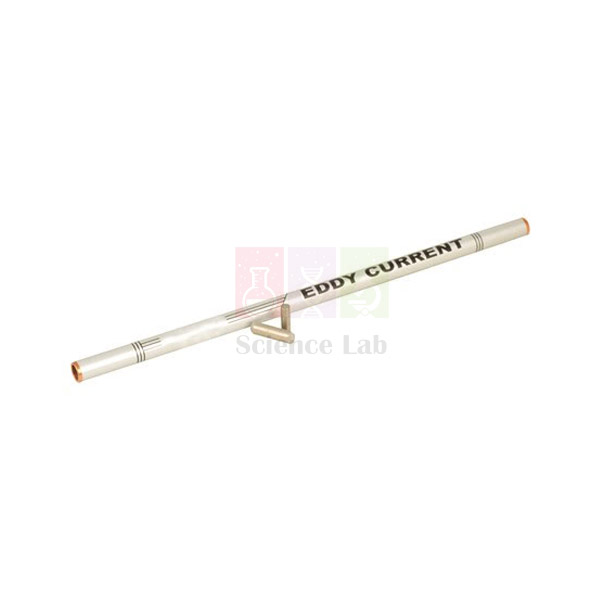
Eddy Current Unit
Eddy Current Unit (Product Code: SLE/PHY/97) is a copper-tube demonstration used to introduce eddy currents and electromagnetic braking in school and college physics. Two test masses, one of steel and one a neodymium magnet, are dropped down a 33 cm copper tube, and students see the magnet fall more slowly than the steel mass. It is manufactured by Jain Scientific Equipments Pvt Ltd (ScienceLab), an OEM manufacturer, at its own factory in Ambala, India.
Specifications
| Parameter | Detail |
|---|---|
| Tube | Copper, 33 cm |
| Test masses | Two, included: one steel, one neodymium magnet |
| Observation | The magnetic mass falls more slowly than the steel mass |
| Principle | Eddy currents induced in the tube oppose the falling magnet's motion |
| Product code | SLE/PHY/97 |
| Manufacturer | Jain Scientific Equipments Pvt Ltd (ScienceLab) — OEM |
| Country of origin | India (made in Ambala, Haryana) |
What Is the Eddy Current Unit Used For?
As the neodymium magnet falls, its moving field induces circulating eddy currents in the copper walls, and these currents produce their own field that opposes the downward motion. The steel mass is not a magnet, so it induces no such currents and simply falls freely, which turns the two drops into a fair test with a striking difference. Teachers use the result to connect Lenz's law with real applications such as magnetic braking, making this one of the simplest physics demonstration kits for showing induction without meters.
Hold the tube upright over a soft surface or catch the masses at the bottom, and time each drop with a stopwatch if students are to compare results in numbers. Keep the neodymium magnet away from the steel mass, electronic devices and fingers, because strong magnets can snap together sharply.
What to Specify When Ordering
- Number of units, for a teacher demonstration or for several student groups.
- Whether spare test masses (steel or neodymium magnet) are needed.
- Delivery location for packing and freight.
OEM Manufacturer
Jain Scientific Equipments Private Limited, which trades as ScienceLab, is the OEM of this eddy current apparatus and makes it at its own factory at Saha, Ambala, Haryana. Physics departments, dealers and importers can order it directly from the manufacturer, and if a test mass goes missing a replacement can be requested from the same source. Company background is on the profile page.
Related Physics Lab Equipment
Further induction and magnetism apparatus for the same topic:
- Eddy Current Unit 120 mm — an aluminium-disc eddy current demonstration driven by a hand-wheel unit.
- Lenz's Law – Open & closed loop — closed and split loops showing induced current opposing a moving magnet.
- Neodymium Magnets — strong magnets for further induction experiments.
- Adjustable Magnet — a magnet unit supplied with an eddy current pendulum demonstration.
- Search Coil — a hand-held coil for investigating changing magnetic fields with a meter or oscilloscope.
Explore more apparatus in Physics Lab Equipment.
Frequently Asked Questions
How does the Eddy Current Unit work?
In the Eddy Current Unit, a neodymium magnet falling through a copper tube induces eddy currents in the tube walls. Those currents create a magnetic field that opposes the magnet's downward motion, so it falls more slowly than the steel test mass.
What is included with the Eddy Current Unit?
The Eddy Current Unit includes a 33 cm copper tube and its test masses: one steel mass and one neodymium magnet. Together they let students compare an ordinary fall with a magnetically braked fall through the same tube.
Why does the Eddy Current Unit include a steel mass?
The steel mass in the Eddy Current Unit acts as the control. Because it is not a magnet, it induces no eddy currents and falls freely, so the slower fall of the neodymium magnet can be attributed to induced currents.
How should the neodymium magnet be handled?
The neodymium magnet in the Eddy Current Unit is strong, so handle it with care: keep it away from electronic devices and other magnets, and avoid trapping fingers. Younger pupils should use the unit under teacher supervision.
Who manufactures the Eddy Current Unit?
The Eddy Current Unit is manufactured by Jain Scientific Equipments Pvt Ltd (ScienceLab) as the OEM at its own factory in Ambala, Haryana, India, and is supplied direct to schools, colleges, dealers and importers.
What does a quotation for the Eddy Current Unit need?
A quotation for the Eddy Current Unit needs the quantity, whether spare test masses are required and the delivery destination. Orders are accepted from institutions and distributors in India and international markets through the contact page.
Request a Quote
Request a price for the Eddy Current Unit through the contact page, or place it in the enquiry cart with any magnets or other apparatus you need. The manufacturer sends the quotation directly.
Last updated: 24 September 2026