- Physics Lab Equipment
- Chemistry Lab Equipment
- Biology Lab Equipment
- Anatomical Lab Equipment
- Learning
- Educational Lab Equipment
- Magnets
- Agriculture
- Astronomy
- Earth Science
- Geography Lab Equipment
- Safety Lab Coat
- Laboratory
- Meteorological
- Electricity & Magnetism
- Heat
- School Lab Equipment
- Lab Glassware
- Science Lab Equipment
- Tvet Lab Equipment
- Robotics Kits Supplier and Manufacturer for Schools India
- Math Lab Equipment Manufacturers and Exporters in Ambala
- STEM Kits Manufacturers and Supplier India
- Engineering Lab Equipment
- Hospital Lab Equipment
- Water, Sanitation & Hygiene Supplies
- Cold Chain, Solar & Communication Equipment
- Nutrition
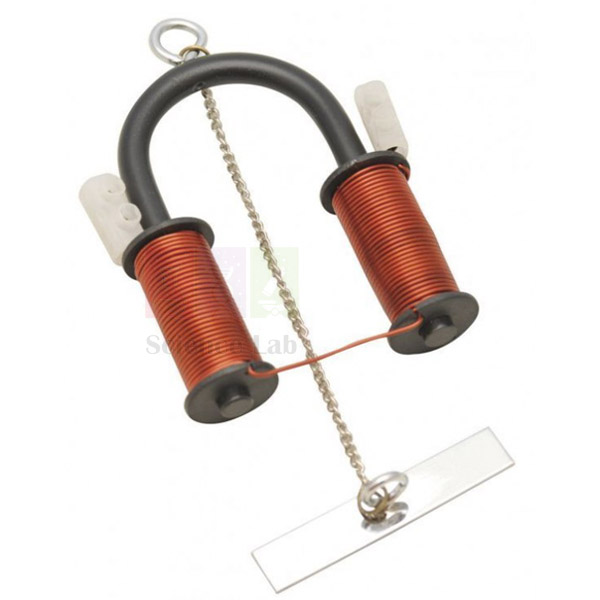
Electromagnet with Keeper
Electromagnet with Keeper (Product Code: SLE/PHY/95) is a U-shaped electromagnet used to demonstrate the magnetic effect of an electric current in school and college physics labs. Its circular-section core is wound with insulated copper wire, carries an armature with a hook for hanging loads and runs from 4-6 volts DC, so students can switch a magnetic pull on and off at will. It is manufactured by Jain Scientific Equipments Pvt Ltd (ScienceLab), an OEM manufacturer, at its own factory in Ambala, India.
Specifications
| Parameter | Detail |
|---|---|
| Core | U-shaped, circular section |
| Winding | Insulated copper wire |
| Connections | Barrel connections |
| Operating supply | 4-6 volts DC |
| Size (as listed) | 110 x 9 mm (diameter) |
| Fittings | Armature with carrying hook |
| Supplied with | Keeper |
| Product code | SLE/PHY/95 |
| Manufacturer | Jain Scientific Equipments Pvt Ltd (ScienceLab) — OEM |
| Country of origin | India (made in Ambala, Haryana) |
What Is the Electromagnet with Keeper Used For?
With the supply connected, the armature is pulled firmly onto the pole faces, and loads hung from the carrying hook show how strong the magnetic force is; switch off and the armature drops away. Students can compare the lifting effect at different voltages within the 4-6 V DC range, or reverse the current and use a plotting compass to see the poles swap. It is a classic electromagnetic kit item for school practicals on the magnetic effects of current.
Store the electromagnet with its keeper across the poles and away from loose steel items. Do not exceed the stated DC supply, and switch off between readings so the winding does not get warm.
What to Specify When Ordering
- Number of electromagnets needed for your class or demonstration bench.
- A DC supply that can provide 4-6 volts, if your lab does not already have one.
- Masses or hangers for load tests, which should be requested separately.
- Delivery location for packing and freight.
OEM Manufacturer
Jain Scientific Equipments Private Limited, trading as ScienceLab, manufactures this electromagnet as the OEM at its own licensed factory at Saha, Ambala, Haryana. Buying from the factory gives physics departments, dealers and importers a direct line to the maker for quotations and repeat orders, and you can ask us about a replacement keeper at any time. The company holds Udyam registration UDYAM-HR-01-0003714 as an MSME, and its Importer-Exporter Code AAECJ8618A (DGFT) covers shipments outside India. Visit the company profile for more.
Related Physics Lab Equipment
Other electromagnetism apparatus and accessories for these practicals:
- U-Shaped Electromagnet — a U-core electromagnet with two enamelled copper coils that slide onto the core arms.
- Electromagnet for Demo — a two-coil U-shaped electromagnet for teacher demonstrations.
- Electromagnet Kit — a student kit for building an electromagnet from coils and a U-shaped core.
- Power Supply, Stepped — an AC/DC bench supply for powering the electromagnet.
- Compass Plotting (Clear) — a plotting compass for identifying the electromagnet's poles.
Find more in Physics Lab Equipment and Magnets.
Frequently Asked Questions
What voltage does the Electromagnet with Keeper need?
The Electromagnet with Keeper is designed for use with 4-6 volts DC. A low-voltage DC bench supply or suitable cells can power it; stay within this range so the insulated copper winding does not overheat.
What size is the Electromagnet with Keeper?
The Electromagnet with Keeper is listed as 110 x 9 mm (diameter), with a U-shaped core of circular section. If you need full overall dimensions for a particular set-up, ask us through the contact page before ordering.
What is included with the Electromagnet with Keeper?
The Electromagnet with Keeper comes complete with its keeper, and the U-shaped wound core is fitted with an armature and carrying hook. Barrel connections are provided on the electromagnet for attaching the supply leads.
How is the electromagnet connected to a supply?
Connect the Electromagnet with Keeper to a 4-6 volts DC supply through its barrel connections. Switching the supply on energises the copper winding and pulls the armature onto the core; switching off releases it again.
Who manufactures the Electromagnet with Keeper?
The Electromagnet with Keeper is manufactured by Jain Scientific Equipments Pvt Ltd (ScienceLab) as the OEM at its own factory in Ambala, Haryana, India, and is supplied direct to schools, colleges, dealers and importers.
Can the electromagnet be ordered in quantity for export?
Yes. The Electromagnet with Keeper can be quoted for a single laboratory or for institutional and export orders across India and international markets. Include the quantity, any power supplies required and the destination in your enquiry.
Request a Quote
Send the number of Electromagnets with Keeper you need, together with any supply or accessory items, through the contact page, or add them to the enquiry cart. Quotations are prepared by the manufacturer itself.
Last updated: 24 September 2026