- Physics Lab Equipment
- Chemistry Lab Equipment
- Biology Lab Equipment
- Anatomical Lab Equipment
- Learning
- Educational Lab Equipment
- Magnets
- Agriculture
- Astronomy
- Earth Science
- Geography Lab Equipment
- Safety Lab Coat
- Laboratory
- Meteorological
- Electricity & Magnetism
- Heat
- School Lab Equipment
- Lab Glassware
- Science Lab Equipment
- Tvet Lab Equipment
- Robotics Kits Supplier and Manufacturer for Schools India
- Math Lab Equipment Manufacturers and Exporters in Ambala
- STEM Kits Manufacturers and Supplier India
- Engineering Lab Equipment
- Hospital Lab Equipment
- Water, Sanitation & Hygiene Supplies
- Cold Chain, Solar & Communication Equipment
- Nutrition
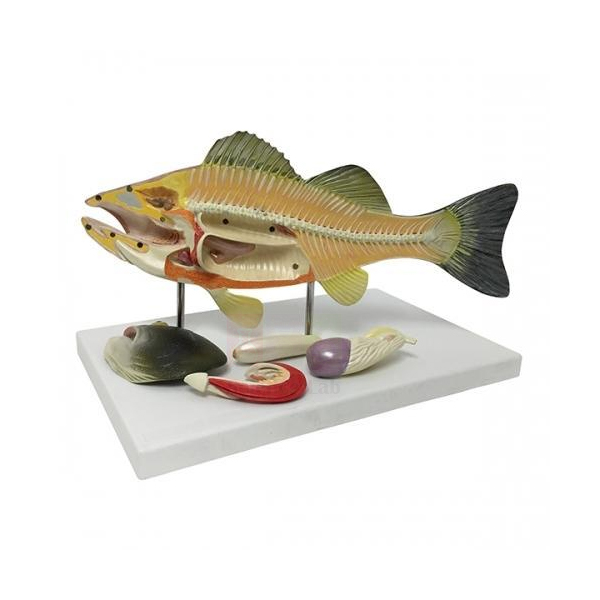
Fish Dissection Model
The Fish Dissection Model is a life-size longitudinal dissection of a bony fish, built in 5 parts on a base. Magnets hold the removable components in place, and a numbered key identifies 24 structures, so students can work through the anatomy organ by organ. Without the base it measures 45 x 21 x 7 cm.
Fish Dissection Model specifications
| Parameter | Detail |
|---|---|
| Subject | Bony fish, longitudinal dissection |
| Scale | Life size |
| Construction | 5 parts |
| Size without base | 45 x 21 x 7 cm |
| Fixing of parts | Removable components held by magnets |
| Mounting | On a base |
| Key | Numbered key with 24 identified structures |
| Product code | SLE/A/121 |
| Minimum order | 10 units |
| Dispatch | Usually within 7 to 10 working days |
| Manufacturer | ScienceLab (Jain Scientific Equipments Pvt Ltd), Ambala, India |
Dissection practicals with the Fish Dissection Model
Station practical. Set the model at one station with a blank outline drawing. Students lift out each magnet-held part in turn, find its number on the key and label the outline, then refit every part before the next group arrives.
Rehearsal for a real dissection. The teacher demonstrates on the model first, showing where each organ sits below the body wall. Students then open a fish in a dissection pan with pad using the tools from a dissection set, cutting shallowly so the gut is not damaged.
Head-to-tail layout. The dissection runs along the length of the body, so students list the organs in order from the gills back to the vent. They then find the same organs in a preserved fish dissection and note how the layout fits the outer body shape.
Fish and frog compared. Place the model beside the Frog Dissection Model and compare gills with lungs, the number of heart chambers and the arrangement of the kidneys.
Frequently Asked Questions About the Fish Dissection Model
How does blood flow through a fish's heart?
A fish has a single circulation and a heart with one atrium and one ventricle. Blood returning from the body enters the heart, which pumps it forward to the gills. There it picks up oxygen and flows straight on to the organs, passing through the heart only once on each circuit.
Why do the gills have so many thin filaments?
The filaments, carried on bony gill arches, give a very large, thin surface where oxygen passes from water into blood. Water flows over them opposite to the direction of blood flow, which keeps the exchange efficient. Gill rakers on the inner edge of each arch strain food particles.
What do the liver, kidney and heart do, and where are they found?
The heart sits low in the body just behind the gills and pumps blood. The liver, usually the biggest organ in the body cavity, stores food reserves and makes bile. The kidney is a dark strip along the backbone; it filters the blood and helps control water balance.
Can the length of the intestine tell us what a fish eats?
Broadly, yes. Plant-eating and mud-feeding fish tend to have a long, coiled intestine that gives tough food more time to digest, while predatory fish have a shorter gut and a large stomach. Mouth position and teeth add further clues about diet.
How should students use the model before dissecting a real fish?
Name the external features first, then remove the magnetic parts in order and note where each organ lies. Knowing that the gut sits just under the body wall helps students make shallow cuts and keep organs intact when they open a real specimen.
How can the numbered key be used for assessment?
Cover the key and point to numbered structures for a quick oral test, or ask each group to label a blank outline as they remove the parts. Students should record every step with a labelled drawing, just as they would in a written dissection record.
Dissection models and equipment
- Bony Fish Model
- Fish Dissection
- Frog Dissection Model
- Dissection Pan, Pad & Cover
- Dissection Set
- Dissection Microscope
To request a quotation, send the product name, code and quantity through our contact page or add the item to your enquiry cart.
Last updated: 14 November 2026