- Physics Lab Equipment
- Chemistry Lab Equipment
- Biology Lab Equipment
- Anatomical Lab Equipment
- Learning
- Educational Lab Equipment
- Magnets
- Agriculture
- Astronomy
- Earth Science
- Geography Lab Equipment
- Safety Lab Coat
- Laboratory
- Meteorological
- Electricity & Magnetism
- Heat
- School Lab Equipment
- Lab Glassware
- Science Lab Equipment
- Tvet Lab Equipment
- Robotics Kits Supplier and Manufacturer for Schools India
- Math Lab Equipment Manufacturers and Exporters in Ambala
- STEM Kits Manufacturers and Supplier India
- Engineering Lab Equipment
- Hospital Lab Equipment
- Water, Sanitation & Hygiene Supplies
- Cold Chain, Solar & Communication Equipment
- Nutrition
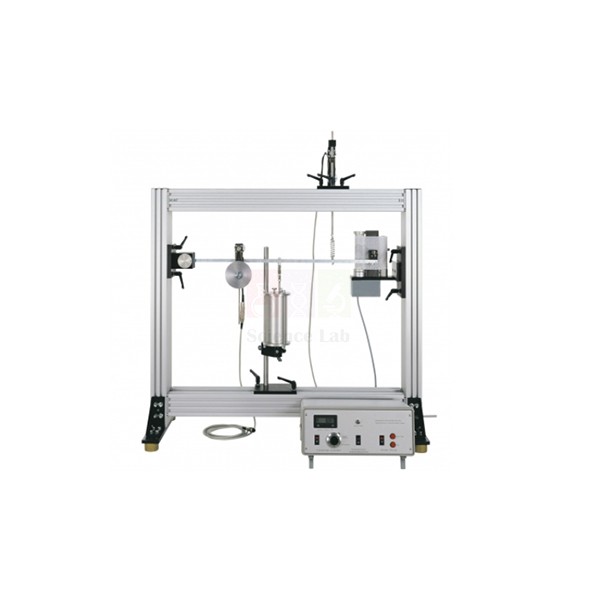
Free and Forced Vibration Apparatus
Free and Forced Vibration Apparatus (Product Code: SLE/MCE/76) is a vibration trainer used to study free, damped and forced mechanical vibration of a bar-type oscillator in mechanical engineering laboratories. Its electronically controlled exciter runs from 0 to 50 Hz, an oil-filled hydraulic damper gives adjustable damping, and a mechanical drum recorder traces each response on paper. It is made by Jain Scientific Equipments Pvt Ltd (ScienceLab), an OEM manufacturer, at its own factory in Ambala, India.
Specifications
| Parameter | Detail |
|---|---|
| Topics | Fundamentals of mechanical vibration theory: free, damped and forced |
| Bar-type oscillator (L x W x H) | 700 x 25 x 12 mm, 1.6 kg |
| Coil springs | 0.75 N/mm, 1.5 N/mm, 3.0 N/mm |
| Exciter frequency | 0–50 Hz, electronically controlled; set and displayed on a control unit |
| Imbalance exciter | Imbalance 0–1000 mmg |
| Displacement exciter | Stroke 20 mm |
| Damper | Oil hydraulic, oil-filled; damper constant 5–15 Ns/m, adjustable damping level |
| Drum recorder | Mechanical; feed 20 mm/s; paper width 100 mm |
| Data acquisition | Optional unit for displaying and analysing measured values on a PC |
| Dimensions | 1200 x 600 x 1400 mm |
| Weight | 125 kg |
| Power supply | 230 V, 50 Hz, 1 phase; or 230 V, 60 Hz, 1 phase; or 120 V, 60 Hz, 1 phase |
| Product code | SLE/MCE/76 |
| Manufacturer | Jain Scientific Equipments Pvt Ltd (ScienceLab) — OEM |
| Country of origin | India (made in Ambala, Haryana) |
What Is the Free and Forced Vibration Apparatus Used For?
The bar-type oscillator works together with interchangeable coil springs and, depending on the experiment, is left to vibrate freely, slowed by the oil damper, or driven by one of the two exciters. In free vibration tests, students displace the bar, release it and use the drum recorder trace to find the natural frequency; with the damper connected, the decay of successive peaks gives the logarithmic decrement and damping ratio. Changing between the 0.75, 1.5 and 3.0 N/mm springs shows how stiffness shifts the natural frequency.
For forced vibration, the control unit sets the excitation frequency up to 50 Hz, driving the bar through either the imbalance exciter (0–1000 mmg) or the displacement exciter (20 mm stroke). Stepping through the range and recording amplitude reveals resonance, and repeating the sweep at several damper settings shows how damping flattens the resonance peak. This makes the unit core engineering lab equipment for dynamics of machinery courses in India; let the exciter settle at each frequency before taking a trace.
What to Specify When Ordering
- Power supply version: 230 V 50 Hz, 230 V 60 Hz or 120 V 60 Hz, single phase
- Whether the optional data acquisition unit for PC display and analysis is required
- Spare 100 mm recorder paper for the drum recorder, if needed (ask us)
- Quantity and delivery location in India or abroad
OEM Manufacturer
This vibration trainer is manufactured by ScienceLab as the OEM. Jain Scientific Equipments Private Limited, whose trading name is ScienceLab, produces it at its own licensed factory at Saha, Ambala, Haryana, India, and quotes it directly to universities, engineering colleges, dealers and importers.
With the manufacturer as your single point of contact, questions on the power supply version, the optional data acquisition unit, or spares for the recorder and damper are answered by the people who build the unit. Visit the company profile for more about ScienceLab.
Related Theory of Machines Equipment
Apparatus that complements this trainer in a vibrations and dynamics laboratory:
- Free And Forced Vibrations — a further apparatus on the same topic for additional student groups.
- Damper Kit — for additional damping experiments.
- Vibration Of Spiral Spring Apparatus — torsional free vibration of a spiral spring.
- Free Vibrations Test Frame — a test frame for free vibration experiments.
The Theory of Machines category lists further vibration, balancing and mechanism equipment.
Frequently Asked Questions
What types of vibration can be studied on the Free and Forced Vibration Apparatus?
The Free and Forced Vibration Apparatus covers the fundamentals of mechanical vibration theory: free vibration, damped vibration using an adjustable oil hydraulic damper, and forced vibration driven by an electronically controlled exciter from 0 to 50 Hz.
Which springs does the Free and Forced Vibration Apparatus use?
The Free and Forced Vibration Apparatus lists three coil springs rated 0.75 N/mm, 1.5 N/mm and 3.0 N/mm. Changing the spring changes the natural frequency of the bar-type oscillator, which measures 700 x 25 x 12 mm and weighs 1.6 kg.
How are results recorded on the Free and Forced Vibration Apparatus?
The Free and Forced Vibration Apparatus records vibrations on a mechanical drum recorder with 20 mm/s feed and 100 mm paper width. An optional data acquisition unit lets measured values be displayed and analysed on a PC; ask us whether to include it in your quotation.
What power supply does the Free and Forced Vibration Apparatus need?
The Free and Forced Vibration Apparatus runs on single-phase power in one of three versions: 230 V 50 Hz, 230 V 60 Hz or 120 V 60 Hz. State your mains supply when ordering so that the matching version is quoted.
How much space does the Free and Forced Vibration Apparatus need?
The Free and Forced Vibration Apparatus measures 1200 x 600 x 1400 mm and weighs 125 kg. Plan a fixed position near a power outlet with enough room around it for a group of students to watch the recorder.
Who manufactures the Free and Forced Vibration Apparatus?
The Free and Forced Vibration Apparatus is manufactured by Jain Scientific Equipments Pvt Ltd (ScienceLab), the OEM, at its own licensed factory at Saha, Ambala, Haryana, India. Buyers deal with the manufacturer directly for quotations and spares.
Request a Quote
For a quotation on the Free and Forced Vibration Apparatus (SLE/MCE/76), tell us your power supply version, quantity and delivery location through the contact page, or add it to the enquiry cart. The quote comes direct from the manufacturer.
Last updated: 24 September 2026