- Physics Lab Equipment
- Chemistry Lab Equipment
- Biology Lab Equipment
- Anatomical Lab Equipment
- Learning
- Educational Lab Equipment
- Magnets
- Agriculture
- Astronomy
- Earth Science
- Geography Lab Equipment
- Safety Lab Coat
- Laboratory
- Meteorological
- Electricity & Magnetism
- Heat
- School Lab Equipment
- Lab Glassware
- Science Lab Equipment
- Tvet Lab Equipment
- Robotics Kits Supplier and Manufacturer for Schools India
- Math Lab Equipment Manufacturers and Exporters in Ambala
- STEM Kits Manufacturers and Supplier India
- Engineering Lab Equipment
- Hospital Lab Equipment
- Water, Sanitation & Hygiene Supplies
- Cold Chain, Solar & Communication Equipment
- Nutrition
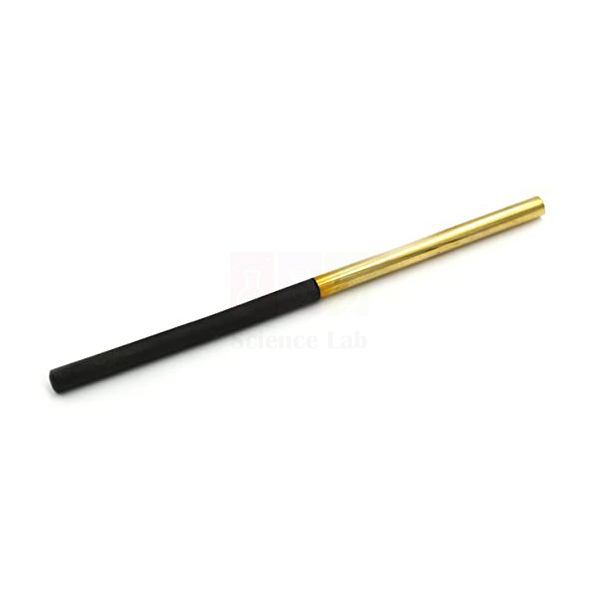
Friction Rod, Brass/Ebonite
Friction Rod, Brass/Ebonite (Product Code: SLE/PHY/178) is a charging rod used for various experiments involving static electricity in school and college physics labs. Listed in brass/ebonite and measuring 300 x 12 mm, it is rubbed with a cloth to build up charge that can then be passed to an electroscope or used to attract light objects. It is made by Jain Scientific Equipments Pvt Ltd (ScienceLab), an OEM manufacturer, at its own factory in Ambala, India.
Specifications
| Parameter | Detail |
|---|---|
| Material | Brass/Ebonite |
| Dimensions | 300 x 12 mm |
| Use | Friction rod for various experiments involving static electricity |
| Product code | SLE/PHY/178 |
| Manufacturer | Jain Scientific Equipments Pvt Ltd (ScienceLab) — OEM |
| Country of origin | India (made in Ambala, Haryana) |
What Is the Brass/Ebonite Friction Rod Used For?
Ebonite, a hard rubber, is a traditional material for static demonstrations because it charges readily when rubbed, while brass is a conductor. Having both materials lets teachers discuss why an insulator holds charge where it was rubbed, whereas a conductor held in the hand loses its charge to earth — a key idea in school physics lab equipment courses across India.
Rub the rod briskly with a dry cloth, then bring it near an electroscope plate or a suspended pith ball. Wipe the rod after handling, since skin oils and moisture reduce charging, and store it somewhere dry. If your experiment depends on how the brass and ebonite portions are arranged, confirm this with us when you request a quotation.
OEM Manufacturer
ScienceLab is the brand of Jain Scientific Equipments Private Limited, the OEM manufacturer of this friction rod. The company makes its electrostatics apparatus at its own licensed factory in Saha, Ambala, Haryana, and deals directly with schools, colleges, dealers and importers, so any question about materials or repeat quantities goes to the maker rather than a reseller. Company details are on our profile page.
Related Physics Lab Equipment
Pair the rod with a rubbing cloth, other rod materials and a charge detector:
- Friction Cloth, Cotton — 300 x 300 mm cloth for rubbing the rod.
- Friction Rod, Glass/Brass, 300mm — companion rod for comparing the charge on a different material.
- Electroscope, Needle — reads the charge as a deflection angle on a graduated scale.
- Electroscope in Flask, Gold Leaf — simple detector for showing that the rod is charged.
Browse the rest of our Physics Lab Equipment.
Frequently Asked Questions
What are the dimensions of the Friction Rod, Brass/Ebonite?
The Friction Rod, Brass/Ebonite measures 300 x 12 mm, a length that is easy to hold at one end while rubbing the other and bringing it close to an electroscope plate or pith ball.
What material is the Friction Rod, Brass/Ebonite?
The Friction Rod, Brass/Ebonite is listed in brass/ebonite. If your experiment depends on how the brass and ebonite sections are arranged, please confirm the construction with us through the contact page before ordering.
What experiments use the Friction Rod, Brass/Ebonite?
The Friction Rod, Brass/Ebonite is used for various experiments involving static electricity, such as charging an electroscope by contact or induction, attracting light objects and showing repulsion between like charges with a suspended pith ball.
What should the Friction Rod, Brass/Ebonite be rubbed with?
Rub the Friction Rod, Brass/Ebonite with a clean, dry cloth such as our cotton friction cloth. Keeping both rod and cloth dry and grease-free gives a stronger, more dependable charge in classroom conditions.
Who manufactures the Friction Rod, Brass/Ebonite?
The Friction Rod, Brass/Ebonite is manufactured by Jain Scientific Equipments Pvt Ltd (ScienceLab), an OEM, at its own factory in Ambala, Haryana, India, and supplied factory-direct in single or class quantities.
What does a quotation for the Friction Rod, Brass/Ebonite need?
For a Friction Rod, Brass/Ebonite quotation, send product code SLE/PHY/178, the number of rods and your delivery location in India or international markets via the contact page or the enquiry cart.
Request a Quote
Use our contact page or the enquiry cart to request the Friction Rod, Brass/Ebonite in the quantity you need. The quotation is issued by the manufacturer.
Last updated: 24 September 2026