- Physics Lab Equipment
- Chemistry Lab Equipment
- Biology Lab Equipment
- Anatomical Lab Equipment
- Learning
- Educational Lab Equipment
- Magnets
- Agriculture
- Astronomy
- Earth Science
- Geography Lab Equipment
- Safety Lab Coat
- Laboratory
- Meteorological
- Electricity & Magnetism
- Heat
- School Lab Equipment
- Lab Glassware
- Science Lab Equipment
- Tvet Lab Equipment
- Robotics Kits Supplier and Manufacturer for Schools India
- Math Lab Equipment Manufacturers and Exporters in Ambala
- STEM Kits Manufacturers and Supplier India
- Engineering Lab Equipment
- Hospital Lab Equipment
- Water, Sanitation & Hygiene Supplies
- Cold Chain, Solar & Communication Equipment
- Nutrition
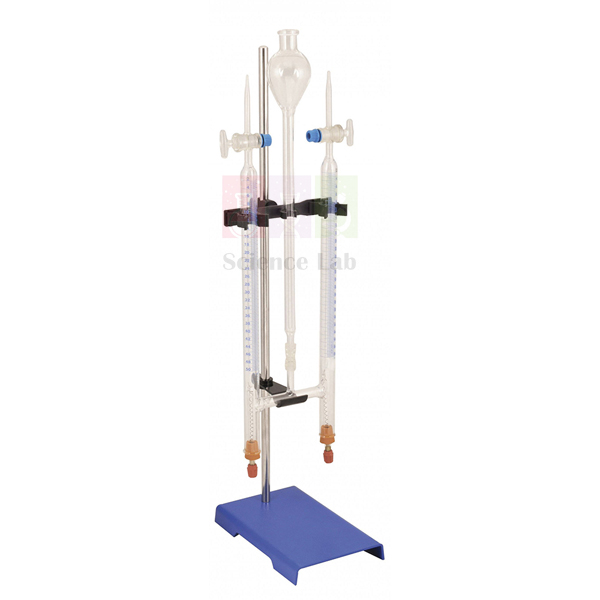
Hoffman Voltameter
Hoffman Voltameter (Product Code: SLE/CH/59) is a borosilicate glass electrolysis apparatus used to demonstrate the decomposition of water, to determine chemical composition by electrolysis, and to evaluate the electrochemical equivalent of hydrogen. Two connected limbs, each graduated for 50 cm³, rise from a central reservoir tube with a funnel-shaped bulb, and each limb has a stopcock at the top for drawing off and testing the collected gas. It comes with one pair of platinum electrodes and one pair of carbon electrodes. Schools, colleges and teacher-training labs use it as the standard electrolysis apparatus in India, and it is made by Jain Scientific Equipments Pvt Ltd (ScienceLab), Ambala.
Specifications
| Parameter | Detail |
|---|---|
| Material | Borosilicate glass |
| Limbs | Two connected limbs, graduated for 50 cm³ capacity, each with a stopcock at the top |
| Reservoir | Integral reservoir tube with funnel-shaped bulb; capacity 200 cm³ |
| Electrodes supplied | One pair platinum electrodes; one pair carbon electrodes |
| Platinum electrodes | For electrolysis of water |
| Carbon electrodes | For electrolysis of ammonia or hydrochloric acid |
| Overall dimensions | 700 x 85 mm (height x width) |
| Stand | Not included (supplied without stand) |
Typical Use
For the electrolysis of water, the platinum electrodes are fitted and the apparatus is clamped upright. With both stopcocks open, water made conducting with a little dilute acid is poured into the funnel bulb until the limbs are full; the stopcocks are then closed and a low-voltage DC supply is connected. Gas collects at the top of each limb, and students can read the volumes on the graduations and see that the hydrogen volume is about twice the oxygen volume. Opening a stopcock lets them test each gas with a lighted or glowing splint. Recording the current and time alongside the volume of hydrogen allows the electrochemical equivalent of hydrogen to be worked out.
For the electrolysis of hydrochloric acid or ammonia solution, the carbon electrodes are used in place of platinum. Carry out these runs in a well-ventilated room or fume cupboard, keep flames away from collected hydrogen except during the controlled splint test, and rinse the glassware thoroughly with water afterwards. This apparatus is a mainstay of borosilicate laboratory glassware in India for chemistry and physics departments alike.
Manufacturer
Jain Scientific Equipments Private Limited, which trades as ScienceLab, is based in Ambala, Haryana, and makes glass apparatus, electrical demonstration equipment and other teaching aids for institutions in India and international markets. Company details are on the company profile.
Related Chemistry Lab Equipment
Items needed to run electrolysis experiments with this voltameter:
- Hoffman Voltameter Stand — a metal stand with support clamp, needed because the voltameter is supplied without one.
- Power Supply, Smoothed — a stepped low-voltage supply with DC output to drive the electrolysis.
- Digital Ammeter — measures the DC current for electrochemical equivalent calculations.
- Voltameter — a simpler base-mounted voltameter with graduated test tubes for junior classes.
Browse the Chemistry Lab Equipment category for more.
Frequently Asked Questions
Which electrodes are included?
One pair of platinum electrodes and one pair of carbon electrodes. Platinum is used for the electrolysis of water, carbon for ammonia or hydrochloric acid.
Is a stand supplied?
No, the voltameter is supplied without a stand. The Hoffman Voltameter Stand listed above can be ordered with it.
How much gas can each limb collect?
Each limb is graduated for 50 cm³, and the reservoir holds 200 cm³ of electrolyte.
How tall is the apparatus?
Overall dimensions are 700 x 85 mm (height x width), so check the clearance in your fume cupboard or under shelves.
What power supply do I need?
A low-voltage DC source. The voltage and current you need depend on the electrolyte; ask us through the contact page if you would like a matching power supply quoted.
How should the glassware be cared for?
Rinse with distilled water after each use, keep stopcocks clean and lightly greased if they are ground glass, and store the apparatus supported upright or packed flat so the limbs are not stressed.
Can you supply this with a stand and power supply for export?
Yes. We supply India and international markets and can quote the voltameter, stand and accessories together with suitable glassware packing.
Request a Quote
Ask for pricing through the contact page, or add the Hoffman Voltameter to the enquiry cart with its stand and power supply.
Last updated: 24 September 2026