- Physics Lab Equipment
- Chemistry Lab Equipment
- Biology Lab Equipment
- Anatomical Lab Equipment
- Learning
- Educational Lab Equipment
- Magnets
- Agriculture
- Astronomy
- Earth Science
- Geography Lab Equipment
- Safety Lab Coat
- Laboratory
- Meteorological
- Electricity & Magnetism
- Heat
- School Lab Equipment
- Lab Glassware
- Science Lab Equipment
- Tvet Lab Equipment
- Robotics Kits Supplier and Manufacturer for Schools India
- Math Lab Equipment Manufacturers and Exporters in Ambala
- STEM Kits Manufacturers and Supplier India
- Engineering Lab Equipment
- Hospital Lab Equipment
- Water, Sanitation & Hygiene Supplies
- Cold Chain, Solar & Communication Equipment
- Nutrition
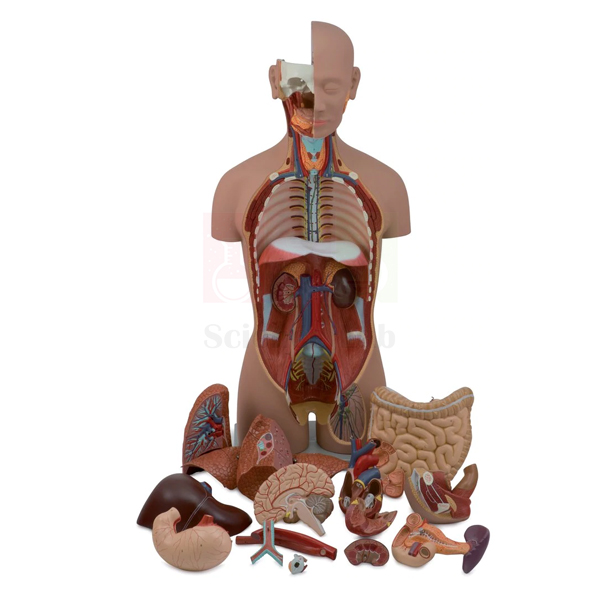
Human Sexless Torso Model
A dissectible torso without reproductive organs that comes apart into 16 parts, so one model carries a class through the nervous, respiratory, circulatory, digestive and urinary systems. It shows a longitudinally sectioned half brain, an eyeball, both lungs, a 2-part heart, the main abdominal organs, a sectioned kidney with its ureter and the urinary bladder, with open dissections at the neck and thigh.
Sexless torso parts and dimensions
| Parameter | Detail |
|---|---|
| Dissectible parts | 16 |
| Reproductive organs | Not included (sexless torso) |
| Open dissections | Neck and thigh |
| Head | Half brain, sectioned longitudinally; eyeball |
| Chest | Both lungs; 2-part heart; descending thoracic aorta and oesophagus |
| Abdomen | Stomach; pancreas and duodenum; liver; small and large intestines in one piece with removable caecum |
| Urinary structures | Half of one kidney, sectioned in the frontal plane; kidney with ureter and urinary bladder |
| Base | Reinforced polymer |
| Size | 90 × 33 × 23 cm |
| Product code | SLE/A/24 |
| Minimum order | 10 units |
| Dispatch | Usually within 7 to 10 working days |
| Manufacturer | ScienceLab (Jain Scientific Equipments Pvt Ltd), Ambala, India |
Teaching body systems with the sexless torso
Chest layer by layer. Lift out both lungs to expose the heart, then open the 2-part heart and trace the aorta and oesophagus down behind it. A separate lungs with heart and larynx model or a larger human heart model can then be passed round for closer study of the chambers.
The digestive route. Remove the stomach, then the liver, then the pancreas and duodenum, and finally the intestines with the caecum. Students follow food from the oesophagus to the large intestine, then compare the torso stomach with a stomach on a stand that shows the wall in more detail.
Urinary system lesson. Take out the sectioned half kidney to show the inside of the organ, then follow the ureter from the kidney down to the bladder. A kidney model enlarges the same organ, and the kidney, nephron and glomerulus set takes the class down to the filtering unit.
Identify and replace test. Lay the removed parts on a tray, ask each student to name one part and its body system, and have them fit it back in place. Small groups can rehearse the same drill on a desk-sized micro sexless torso while the full model stays on the demonstration bench.
Frequently Asked Questions About the Human Sexless Torso Model
In what order should the parts be taken out?
Work from the front surface inwards: lungs first, then the 2-part heart, then the stomach, liver, pancreas with duodenum and finally the intestines with the caecum. Each organ lifted out exposes the one behind it, so the class sees position as well as shape.
Does this torso have an open back or removable vertebrae?
The listed parts do not include an open back or loose vertebrae; the open dissections are at the neck and thigh. Where back anatomy or reproductive organs are needed, the Deluxe Human Male and Female Torso Model is the usual step up.
How can students remember so many structures on one model?
Learn the torso system by system rather than as a list of names. Start with where each system sits in the body, then add the organs nested inside it. Naming each part and its system aloud as it comes out of the torso helps fix the layout in memory.
Why pick a sexless torso for a core biology course?
Without reproductive organs the model keeps attention on the major body systems: breathing, circulation, digestion, excretion and the nervous system. That makes it a common core model for human biology in secondary schools, nursing schools and paramedical institutes.
How should the torso be kept between classes?
Count the parts back to 16 and refit every one before the model is put away, so nothing goes missing. Return it to the same place each time, keep it covered against dust and sunlight, and wipe parts with a soft, slightly damp cloth.
Torsos and organ models for body-systems lessons
- Human Micro Sexless Torso Model
- Deluxe Human Male and Female Torso Model
- 3B Human Sexless Torso Model
- Human Kidney Model
- Human Lungs with Heart and Larynx Model
To request a quotation, send the product name, code and quantity through our contact page or add the item to your enquiry cart.
Last updated: 14 November 2026