- Physics Lab Equipment
- Chemistry Lab Equipment
- Biology Lab Equipment
- Anatomical Lab Equipment
- Learning
- Educational Lab Equipment
- Magnets
- Agriculture
- Astronomy
- Earth Science
- Geography Lab Equipment
- Safety Lab Coat
- Laboratory
- Meteorological
- Electricity & Magnetism
- Heat
- School Lab Equipment
- Lab Glassware
- Science Lab Equipment
- Tvet Lab Equipment
- Robotics Kits Supplier and Manufacturer for Schools India
- Math Lab Equipment Manufacturers and Exporters in Ambala
- STEM Kits Manufacturers and Supplier India
- Engineering Lab Equipment
- Hospital Lab Equipment
- Water, Sanitation & Hygiene Supplies
- Cold Chain, Solar & Communication Equipment
- Nutrition
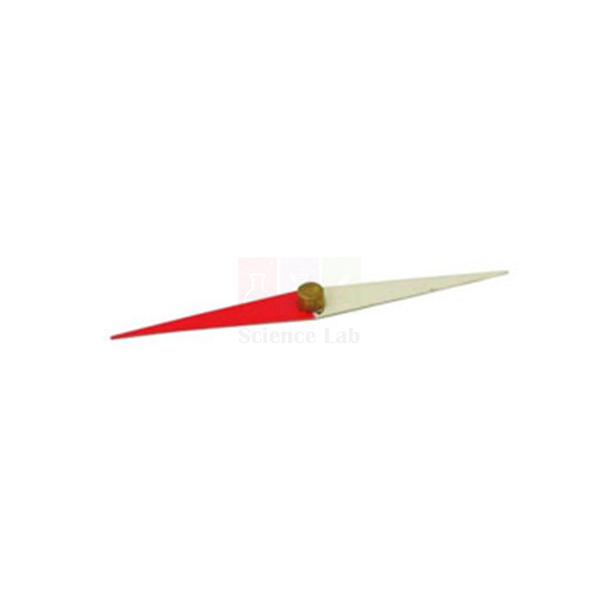
Magnetic Needle Jewel Bearing
Magnetic Needle Jewel Bearing (Product Code: SLE/PHY/237) is a pivoted carbon steel magnetic needle used to show the direction of magnetic fields, from the Earth's field to the field around a magnet or a current-carrying wire, in school physics lessons. This 50 mm needle turns on a jewel pivot bearing, which lets it swing freely with very little friction. It is made by Jain Scientific Equipments Pvt Ltd (ScienceLab), an OEM manufacturer and physics instruments supplier in India, at its own factory in Ambala.
Specifications
| Parameter | Detail |
|---|---|
| Needle material | Carbon steel |
| Length | 50 mm |
| Bearing | Jewel pivot bearing |
| Bearing options in this range | Jewel or brass pivot bearing |
| Product code | SLE/PHY/237 |
| Manufacturer | Jain Scientific Equipments Pvt Ltd (ScienceLab) — OEM |
| Country of origin | India (made in Ambala, Haryana) |
What Is the Jewel Bearing Magnetic Needle Used For?
A freely pivoted magnetic needle always lines up with the magnetic field where it sits. Students use it to find north and south, to trace the curved field around a bar magnet by moving the needle step by step and marking its direction, and to repeat Oersted's classic observation that a needle swings when current flows in a nearby wire.
The jewel bearing is the point of choosing this version: because the pivot has so little friction, the needle responds to weak fields and comes to rest in a true direction rather than sticking. Store it away from strong magnets so its own magnetism is not disturbed, keep it dry, and handle it by the needle rather than pressing on the pivot. It sits well among the physics lab instruments India's schools use for magnetism practicals.
What to Specify When Ordering
- The bearing and length you need: this 50 mm jewel-bearing needle or the longer brass-bearing version.
- The number of needles per class or per practical group.
- Whether magnets, plotting compasses or field demonstrators should be quoted with them.
OEM Manufacturer
This magnetic needle is made by Jain Scientific Equipments Private Limited, trading as ScienceLab, which is the OEM (original equipment manufacturer) and produces it at its own licensed factory at Saha, Ambala, Haryana. Buying from the maker means schools, colleges, laboratory dealers and importers in India and international markets receive factory-direct pricing and can place repeat orders for the same pattern of needle. Ask us about replacement needles when you need them. The ScienceLab company profile has more about the company.
Related Physics Lab Equipment
Magnetism apparatus to use with the needle:
- Magnetic Needle, Brass — a longer needle on a brass pivot bearing.
- Plotting Compass, Single Glass Face — small compasses for plotting field lines as a group.
- Steel Horseshoe Magnet — a strong field source for needle experiments.
- Magnet Set — magnets and iron filings for comparing field strength and shape.
Find more items in Physics Lab Equipment.
Frequently Asked Questions
What length is the Magnetic Needle Jewel Bearing?
The Magnetic Needle Jewel Bearing is 50 mm long. It is a carbon steel needle mounted on a jewel pivot bearing, sized for bench experiments where students trace magnetic field directions around magnets and wires.
What is the advantage of a jewel bearing on a magnetic needle?
A jewel bearing gives the Magnetic Needle Jewel Bearing a very low-friction pivot, so the needle turns freely, responds to weak fields and settles in a true direction. That makes it useful where small deflections, such as those near a current-carrying wire, need to be seen clearly.
What experiments can be done with the Magnetic Needle Jewel Bearing?
The Magnetic Needle Jewel Bearing can be used to find north and south, plot the magnetic field around bar and horseshoe magnets, and show the deflection caused by an electric current in a nearby conductor, which introduces electromagnetism.
How should the Magnetic Needle Jewel Bearing be stored?
Store the Magnetic Needle Jewel Bearing away from strong magnets, in a dry place, and protect the pivot from knocks. Strong fields can weaken or reverse the needle's magnetism, and moisture can mark carbon steel over time.
Who manufactures the Magnetic Needle Jewel Bearing?
The Magnetic Needle Jewel Bearing is manufactured by Jain Scientific Equipments Pvt Ltd (ScienceLab), the OEM, at its own licensed factory at Saha, Ambala, Haryana, India. Quotations and repeat orders are handled directly by the manufacturer.
Can the Magnetic Needle Jewel Bearing be ordered in class sets?
Yes, the Magnetic Needle Jewel Bearing can be quoted in class-set quantities for schools, institutions, dealers and importers. Send the quantity and delivery location through the contact page and we will reply with a factory-direct price.
Request a Quote
To order the Magnetic Needle Jewel Bearing (SLE/PHY/237), contact the manufacturer through the ScienceLab contact page or add it to the enquiry cart.
Last updated: 24 September 2026