- Physics Lab Equipment
- Chemistry Lab Equipment
- Biology Lab Equipment
- Anatomical Lab Equipment
- Learning
- Educational Lab Equipment
- Magnets
- Agriculture
- Astronomy
- Earth Science
- Geography Lab Equipment
- Safety Lab Coat
- Laboratory
- Meteorological
- Electricity & Magnetism
- Heat
- School Lab Equipment
- Lab Glassware
- Science Lab Equipment
- Tvet Lab Equipment
- Robotics Kits Supplier and Manufacturer for Schools India
- Math Lab Equipment Manufacturers and Exporters in Ambala
- STEM Kits Manufacturers and Supplier India
- Engineering Lab Equipment
- Hospital Lab Equipment
- Water, Sanitation & Hygiene Supplies
- Cold Chain, Solar & Communication Equipment
- Nutrition
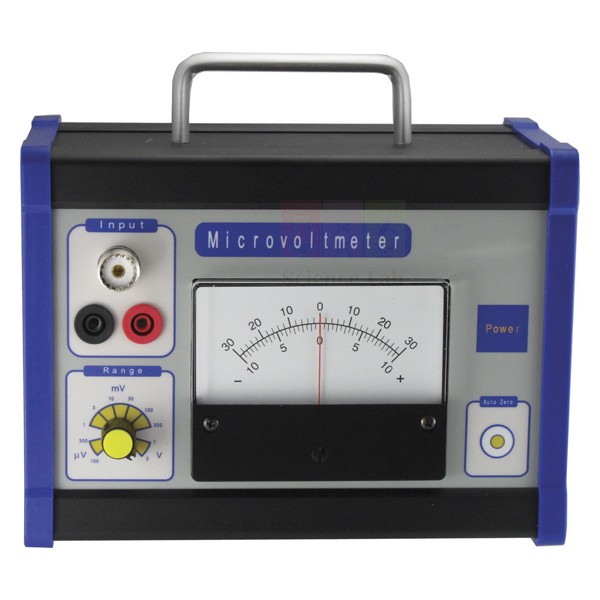
Micro Voltmeter
Micro Voltmeter (Product Code: SLE/PHY/245) is a battery-powered, high-sensitivity voltmeter used to measure very small potential differences in school and college physics laboratories, as an effective and robust replacement for a spot galvanometer. It offers nine ranges starting at 100 µV, a large moving coil meter with push-button auto-zero, and 4 mm or UHF inputs. It is supplied to laboratories by Jain Scientific Equipments Pvt Ltd (ScienceLab), Ambala, a physics instruments supplier in India.
Specifications
| Parameter | Detail |
|---|---|
| Instrument type | Microvoltmeter with a large moving coil meter |
| Measurement ranges | 9 ranges, starting at 100 µV (ask us for the complete range list) |
| Zeroing | Auto-zero by membrane button switch |
| Input impedance | 10 MΩ per volt, maximum 30 MΩ |
| Inputs | 4 mm sockets, or UHF socket for very low voltages where a shielded lead is preferred; 4 mm socket for the negative input |
| Power | PP3 9 V battery |
| Dimensions | 208 x 155 x 115 mm (W x H x D); height including handle 187 mm |
| Replaces | Spot galvanometer |
| Product code | SLE/PHY/245 |
| Supplied by | Jain Scientific Equipments Pvt Ltd (ScienceLab), Ambala, India |
What Is the Micro Voltmeter Used For?
The Micro Voltmeter measures potential differences far too small for an ordinary school voltmeter, such as the output of a thermocouple, the voltage across a low resistance or the small emf induced when a magnet moves near a coil. Its input resistance is considerably better than that of a spot galvanometer, so it draws very little current from the circuit and disturbs the experiment less.
Where schools in India once relied on a galvanometer, the meter also serves as a sensitive null detector for Wheatstone bridge and potentiometer experiments. Press the membrane button to auto-zero before each set of readings, begin on a less sensitive range and step down, and use the UHF socket with a shielded lead at the lowest voltages to reduce pick-up. Remove the PP3 battery if the meter is to be stored for a long time.
What to Specify When Ordering
- The number of meters needed for demonstration or student benches.
- Whether 4 mm leads or a shielded lead for the UHF socket should be quoted, as leads are not listed.
- The full-scale values your experiments need, so the nine ranges can be confirmed for you.
- Whether spare PP3 9 V batteries should be added to the order.
Supplier
ScienceLab is the trading name of Jain Scientific Equipments Private Limited, based in Ambala, Haryana, India. The company supplies the Micro Voltmeter within its electrical measurement range for schools, colleges and institutional buyers in India and international markets, so a laboratory can order sensitive meters together with its other physics apparatus. For vendor registration and export paperwork, the supplying company's details are IEC AAECJ8618A (DGFT) and GSTIN 06AAECJ8618A1ZT. More background is on the ScienceLab company profile.
Related Physics Lab Equipment
These items create the small voltages the meter is built to measure, or connect it to the circuit:
- Thermoelectric Effects Apparatus — produces small thermoelectric emfs for measurement.
- Wheatstone Bridge Four Gap — a bridge experiment where the meter acts as the null detector.
- Potentiometer — needs a sensitive indicator to find the balance point.
- Galvanometer 50-0-50mV — a centre-zero meter for less sensitive work.
- Banana Plug Connectors Leads — connecting leads for the input sockets.
Browse more meters and electrical apparatus in the Physics Lab Equipment category.
Frequently Asked Questions
What can the Micro Voltmeter measure?
The Micro Voltmeter measures very small potential differences on nine ranges, starting at 100 µV. Typical uses are thermocouple outputs, induced emfs and voltages across low resistances; ask ScienceLab for the complete range list if your experiment needs a particular full-scale value.
Why use the Micro Voltmeter instead of a spot galvanometer?
The Micro Voltmeter is a robust replacement for a spot galvanometer: its input resistance of 10 MΩ per volt is considerably better than a spot galvanometer's, and its large moving coil meter auto-zeros at the press of a membrane button.
How is the Micro Voltmeter powered?
The Micro Voltmeter runs from a PP3 9 V battery, so it needs no mains connection on the bench and moves easily between laboratories. Check the battery before a practical and remove it if the meter will be stored for a long period.
What inputs does the Micro Voltmeter have?
The Micro Voltmeter accepts signals through 4 mm sockets or, for very low voltages where a shielded lead is preferred, through a UHF socket. A 4 mm socket is provided for the negative input, so either connection method completes the circuit.
Who supplies the Micro Voltmeter?
The Micro Voltmeter is supplied by Jain Scientific Equipments Pvt Ltd (ScienceLab) of Ambala, Haryana, India, to schools, colleges, dealers and institutional buyers in India and international markets. Contact ScienceLab for availability, documentation and a quotation.
Is a calibration certificate available for the Micro Voltmeter?
Whether a calibration certificate can accompany the Micro Voltmeter should be discussed with ScienceLab before you order. Send your requirement through the contact page and the team will confirm what documentation is available for this instrument.
How big is the Micro Voltmeter?
The Micro Voltmeter case measures 208 x 155 x 115 mm (W x H x D), and its height including the handle is 187 mm, so it sits on a laboratory bench next to the experiment without taking much space.
Request a Quote
For a Micro Voltmeter (SLE/PHY/245) quotation, send the quantity and any leads or batteries you need through the ScienceLab contact page, or add the meter to the enquiry cart.
Last updated: 24 September 2026