- Physics Lab Equipment
- Chemistry Lab Equipment
- Biology Lab Equipment
- Anatomical Lab Equipment
- Learning
- Educational Lab Equipment
- Magnets
- Agriculture
- Astronomy
- Earth Science
- Geography Lab Equipment
- Safety Lab Coat
- Laboratory
- Meteorological
- Electricity & Magnetism
- Heat
- School Lab Equipment
- Lab Glassware
- Science Lab Equipment
- Tvet Lab Equipment
- Robotics Kits Supplier and Manufacturer for Schools India
- Math Lab Equipment Manufacturers and Exporters in Ambala
- STEM Kits Manufacturers and Supplier India
- Engineering Lab Equipment
- Hospital Lab Equipment
- Water, Sanitation & Hygiene Supplies
- Cold Chain, Solar & Communication Equipment
- Nutrition
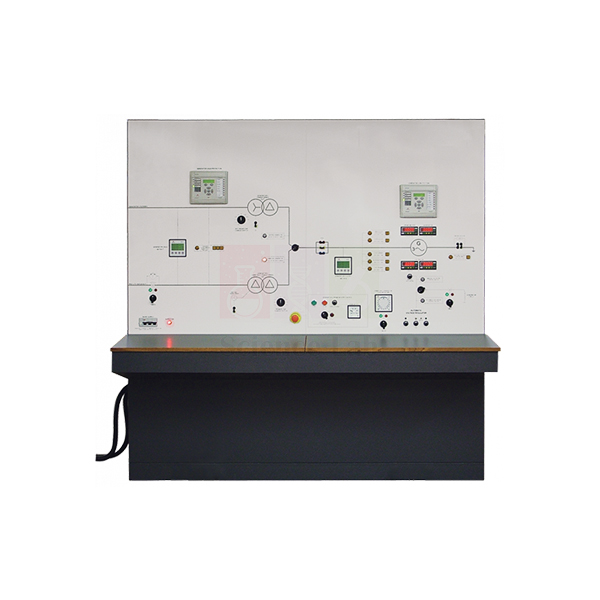
Power System Simulator Generator
Power System Simulator Generator (Product Code: SLE/EPS/04) is a motor-driven generator console used to simulate a central power station feeding a transmission network in power systems laboratories. Electrical engineering students and trainees use it to study excitation control, prime mover speed and generator protection, with relays that operate real circuit-breakers — a core item of lab equipment for technical institutes. It is built by Jain Scientific Equipments Pvt Ltd (ScienceLab), an OEM manufacturer, at its own factory in Ambala, India.
Key Details
| Parameter | Detail |
|---|---|
| Machine set | Motor and generator set: two coupled machines mounted in the base of the control console |
| Motor speed control | Vector drive |
| Generator output control | Manual excitation or different types of automatic excitation |
| Metering | Digital meters showing the conditions of the prime mover and generator |
| Circuit-breakers | Include hand-operated switches and lamps that show whether each breaker is open or closed |
| Protection relays | Set by students from their control panels; operate the circuit-breakers around the second generator |
| Computer link | Relay sockets for connection to a suitable computer for more detailed programming, if needed |
| System connection | Links to the Power System Trainer at the higher voltage (transmission) level to simulate central generation |
| Product code | SLE/EPS/04 |
| Manufacturer | Jain Scientific Equipments Pvt Ltd (ScienceLab) — OEM |
| Country of origin | India (made in Ambala, Haryana) |
What Is the Power System Simulator Generator Used For?
The simulator represents a second generating source — the kind of large central station, such as a main power station, that feeds the grid at transmission voltage. Linked to the Power System Trainer at that level, it lets students compare manual and automatic excitation control of generator output, vary motor speed through the vector drive and read prime mover and generator conditions on the digital meters.
Protection is the second half of the syllabus it supports. Students set the relays from their control panels, create the conditions that make a relay trip the circuit-breakers around the generator, and confirm the result from the breaker lamps. This shows how actual generators are protected and why different protection methods exist. For deeper work, the relays can be linked to a suitable computer for more detailed programming.
What to Specify When Ordering
- Whether you already have the Power System Trainer that the simulator links to at transmission level, or need both.
- Whether relay programming from a computer is planned, so the computer link can be discussed.
- The mains supply available in your laboratory.
- Quantity and delivery location (within India or export).
OEM Manufacturer
ScienceLab, the trading name of Jain Scientific Equipments Private Limited, is the OEM (original equipment manufacturer) of the Power System Simulator Generator. The console is made and assembled at the company’s own licensed factory in Saha, Ambala, Haryana, India, and dispatched factory-direct to universities, polytechnics, TVET lab equipment buyers, dealers and importers.
Because you deal with the manufacturer, questions about the relays, meters or replacement parts go straight to the people who build the unit — ask us. Company background is on the ScienceLab profile page.
Related Power & Energy Systems Trainers
Items often combined with the Power System Simulator Generator in a power systems lab:
- Modular Power System — hub that powers modules and links their test circuits and emergency stops.
- Power Factor Load Bank — predictable resistive, inductive and capacitive loads for power systems experiments.
- Overcurrent And Earth Fault Relay — further protection relay studies.
- Differential Protection Relay — three-phase differential protection characteristics.
- Three-phase Mobile Transformer — transformer theory and three-phase connections.
Explore more Power & Energy Systems Trainers for generation, protection and load studies.
Frequently Asked Questions
What is the Power System Simulator Generator?
The Power System Simulator Generator (SLE/EPS/04) is a control console with two coupled machines, a motor and a generator, mounted in its base. It links to the Power System Trainer at transmission level to simulate central generation, such as a main power station.
How is the generator output controlled?
On the Power System Simulator Generator, generator output is controlled by manual excitation or by different types of automatic excitation, while a vector drive controls the speed of the driving motor. Digital meters show the prime mover and generator conditions throughout the test.
How does the Power System Simulator Generator teach generator protection?
Students set its relays from their control panels. The relays operate the circuit-breakers around the second generator, and lamps show whether each breaker is open or closed, demonstrating how actual generators are protected and the different ways they are protected.
Can the relays be programmed from a computer?
Yes. The relays on the Power System Simulator Generator include sockets for linking to a suitable computer for more detailed programming, if needed. Ask ScienceLab through the contact page about the connection details before you order.
Who manufactures the Power System Simulator Generator?
Jain Scientific Equipments Pvt Ltd (ScienceLab) manufactures the Power System Simulator Generator as the OEM at its own licensed factory in Saha, Ambala, Haryana, India. Buyers deal directly with the manufacturer for quotations, repeat orders and spare-part enquiries.
What should a quotation request include?
For a Power System Simulator Generator quotation, tell ScienceLab the quantity, your mains supply, whether you also need the Power System Trainer it links to, and whether computer programming of the relays is planned. Supply covers India and international markets.
Request a Quote
Send your Power System Simulator Generator (SLE/EPS/04) enquiry through the contact page or place it in the enquiry cart. Prices are quoted direct by the manufacturer, with no trader in between.
Last updated: 24 September 2026