- Physics Lab Equipment
- Chemistry Lab Equipment
- Biology Lab Equipment
- Anatomical Lab Equipment
- Learning
- Educational Lab Equipment
- Magnets
- Agriculture
- Astronomy
- Earth Science
- Geography Lab Equipment
- Safety Lab Coat
- Laboratory
- Meteorological
- Electricity & Magnetism
- Heat
- School Lab Equipment
- Lab Glassware
- Science Lab Equipment
- Tvet Lab Equipment
- Robotics Kits Supplier and Manufacturer for Schools India
- Math Lab Equipment Manufacturers and Exporters in Ambala
- STEM Kits Manufacturers and Supplier India
- Engineering Lab Equipment
- Hospital Lab Equipment
- Water, Sanitation & Hygiene Supplies
- Cold Chain, Solar & Communication Equipment
- Nutrition
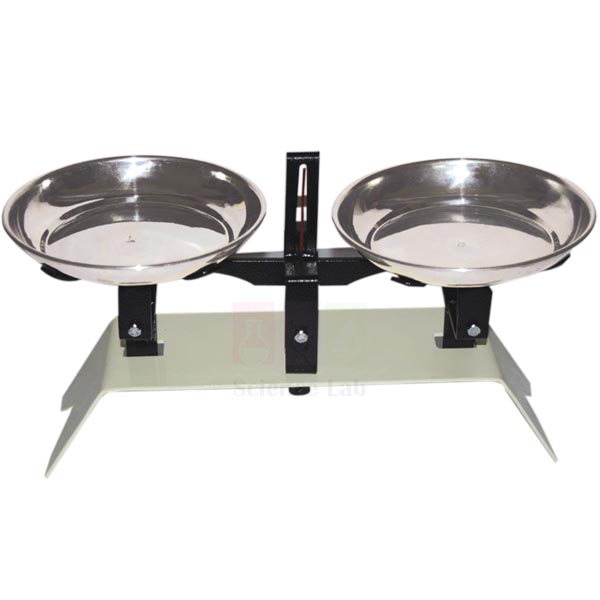
Roberval Balance
The Roberval Balance gives primary and middle school pupils their first hands-on weighing: an object goes on one pan and standard masses on the other until both sides level. It is a simple model with a steel plate body and metal pans, and its parallel linkage keeps both pans upright as they rise and fall.
Roberval balance construction
| Parameter | Detail |
|---|---|
| Type | Roberval balance, simple model |
| Pans | Two, metal |
| Body | Steel plate |
| Purpose | Comparing masses and weighing against standard masses |
| Product code | SLE/LB/03 |
| Minimum order | 10 units |
| Dispatch | Usually within 7 to 10 working days |
| Manufacturer | ScienceLab (Jain Scientific Equipments Pvt Ltd), Ambala, India |
Classroom mass lessons on the Roberval balance
Roberval's paradox. Put two equal pieces from a mass weighing set on tray on the pans, one at the centre of its pan and the other at the far edge. The balance stays level. Ask pupils to predict what will happen before each move, then trace the parallel linkage together to see why the pans stay upright.
Weighing in cubes first. Balance a toy, an apple or a shoe against linking cubes and record each mass as a number of cubes. Some groups use cubes and others use counters, and the class discusses why their numbers do not agree before switching to gram masses.
Does shape change mass? Roll a ball of modelling clay and balance it against masses. Then squash it flat or break it into pieces and put every piece back on the same pan. The pans still level, which shows young pupils that changing shape does not change mass.
Frequently Asked Questions About the Roberval Balance
How small a difference can pupils detect on this balance?
Sensitivity is not listed for this simple model, so test it. Balance two equal loads, then add the smallest mass you have to one pan. If that pan clearly goes down, the balance shows a difference that small; if not, record results only to the nearest larger mass.
Why does it not matter where the object sits on its pan?
Each pan is carried on an upright part held vertical by the parallel linkage. Wherever the load rests on the pan, its weight reaches the beam at the same distance from the pivot, so the turning effect on the beam stays the same. A hanging-pan balance avoids the problem by hanging each pan from one fixed point.
Is this balance suited to weighing chemicals for a practical?
It is a simple model for comparing masses and first weighing lessons, not for fine reagent weighing. When a practical needs small, exact amounts of a chemical, use a chemical or electronic balance, and keep this one for everyday objects and early mass work.
How should wet sand, soil or water be weighed?
Never put it straight onto the metal pans. Place two identical containers, one on each pan, so their masses cancel, then add the material to one and masses to the other. Wipe and dry the pans after any spill so they do not rust or stain.
Why start with cubes or counters before gram masses?
Young pupils first need the idea that a heavier object needs more units to balance it, and cubes they can count build that idea. When groups using different objects get different numbers, the need for one agreed unit, the gram, becomes clear.
How should the balance be stored between lessons?
Take off all loads, wipe the pans and keep the balance on a level shelf in a dry cupboard, since damp can rust the steel plate body. Carry it by the body rather than the pans so the linkage is not bent.
Two-pan balances, masses and weighing aids for primary classes
- Beranger Balance
- Double Beam Balance
- Mass Weighing Set on Tray
- Mass Set, Brass, 250g
- Linking Cubes
- Weighing Paper
To request a quotation, send the product name, code and quantity through our contact page or add the item to your enquiry cart.
Last updated: 15 November 2026