- Physics Lab Equipment
- Chemistry Lab Equipment
- Biology Lab Equipment
- Anatomical Lab Equipment
- Learning
- Educational Lab Equipment
- Magnets
- Agriculture
- Astronomy
- Earth Science
- Geography Lab Equipment
- Safety Lab Coat
- Laboratory
- Meteorological
- Electricity & Magnetism
- Heat
- School Lab Equipment
- Lab Glassware
- Science Lab Equipment
- Tvet Lab Equipment
- Robotics Kits Supplier and Manufacturer for Schools India
- Math Lab Equipment Manufacturers and Exporters in Ambala
- STEM Kits Manufacturers and Supplier India
- Engineering Lab Equipment
- Hospital Lab Equipment
- Water, Sanitation & Hygiene Supplies
- Cold Chain, Solar & Communication Equipment
- Nutrition
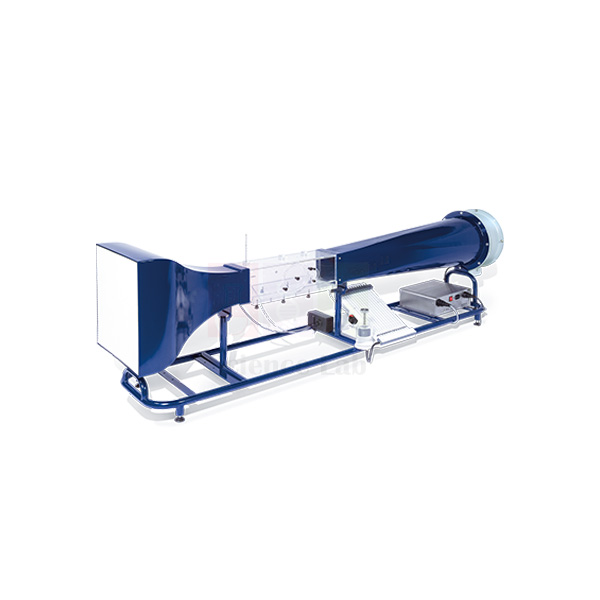
Subsonic Wind Tunnel
Subsonic Wind Tunnel (Product Code: SLE/MCE/36) is a low-speed, draw-through wind tunnel used to measure lift, drag and pressure distribution on test models in aerodynamics and fluid mechanics laboratories. Engineering colleges and polytechnics choose it for its transparent 150 x 150 mm working section, a 9.4:1 contraction ratio and computer-controlled air flow, making it a practical piece of engineering lab equipment for student groups. It is made by Jain Scientific Equipments Pvt Ltd (ScienceLab), an OEM manufacturer, at its own factory in Ambala, India.
Specifications
| Parameter | Detail |
|---|---|
| Working section | Square, nominally 150 x 150 mm (6 in nominal), length 455 mm; transparent for visibility |
| Air flow | Computer controlled; air drawn through the working section by a variable-speed fan at the discharge end |
| Inlet | Honeycomb flow straightener |
| Contraction ratio | 9.4:1 |
| Pressure measurement | 0–160 mm H2O; 16 channels 0–178 mm H2O (differential) |
| Lift force | 3.4 N at model |
| Drag force | 3.4 N at model |
| Model inclination | ±45° |
| Tube | Length 320 mm; inclination 30° |
| Cylinder | Diameter 30 mm; tapping spacing 20° |
| Throat section | Throat width 100 mm; upstream/downstream width 150 mm |
| Chord length / thickness | 61.5 mm / 9.2 mm |
| Large models | 50 mm |
| Golf ball and small sphere | 43 mm |
| Power | 220–240 V, 1 phase, 50 Hz, 10 A |
| Dimensions | 2200 x 600 x 700 mm |
| Weight | 220 kg |
| Product code | SLE/MCE/36 |
| Manufacturer | Jain Scientific Equipments Pvt Ltd (ScienceLab) — OEM |
| Country of origin | India (made in Ambala, Haryana) |
What Is the Subsonic Wind Tunnel Used For?
Students mount a model in the working section, set the fan speed from the computer and record the forces and pressures it produces. Typical exercises include plotting lift and drag against angle of attack for an aerofoil across the ±45° inclination range, reading the pressure distribution around a tapped cylinder on the 16 differential pressure channels, and comparing the drag of a golf ball with a small smooth sphere of the same 43 mm size to show how surface roughness changes the flow.
Because the fan sits at the discharge end, air enters through the honeycomb straightener and 9.4:1 contraction with little disturbance, giving a steady flow for repeatable readings. Let the speed settle before each reading, keep the lift and drag loads within 3.4 N at the model, and allow floor space for a 2200 mm long, 220 kg unit.
What to Specify When Ordering
- The set of models you need (aerofoil, cylinder, spheres, large models); ask us which are included as standard.
- Whether a computer for the air-flow control should be quoted or you will provide one.
- A 220–240 V, 50 Hz single-phase supply rated for 10 A at the installation point.
- Number of tunnels for your laboratory.
OEM Manufacturer
Jain Scientific Equipments Private Limited, which trades as ScienceLab, is the original equipment manufacturer of the Subsonic Wind Tunnel. The tunnel is built and assembled at the company's own licensed factory at 449, HSIIDC Industrial Area, Saha, Ambala, Haryana, India, and is not bought in from a trader.
Aeronautical and mechanical engineering departments, dealers and importers therefore deal directly with the maker for quotations, technical questions and spare models or replacement parts — just ask us. Read more on the company profile.
Related Aerodynamics Lab Equipment
These units build a complete aerodynamics teaching lab around the subsonic tunnel:
- Flow Visualisation Wind Tunnel — makes the streamlines around models visible with smoke.
- Flight Demonstration Wind Tunnel — shows lift, stall and stability on a free-moving model aircraft.
- Modular Air Flow Bench — a compact base unit for smaller air-flow experiment modules.
- Flow Visualisation smoke tunnel — a smoke generator and duct set for flow-pattern studies.
See all Aerodynamics Lab Equipment.
Frequently Asked Questions
What size is the working section of the Subsonic Wind Tunnel?
The Subsonic Wind Tunnel has a square working section of nominally 150 x 150 mm (6 inch nominal) and 455 mm length. It is transparent, so students can watch the model while lift, drag and pressure readings are being taken.
What can be measured on the Subsonic Wind Tunnel?
The Subsonic Wind Tunnel measures lift and drag forces of 3.4 N at the model, pressures over 0–160 mm H2O and 16 differential channels over 0–178 mm H2O, with model inclination of ±45° for angle-of-attack studies.
Which models can be tested in the Subsonic Wind Tunnel?
The Subsonic Wind Tunnel is designed for a wide range of aerodynamics and air-flow models, including a 30 mm cylinder, a 61.5 mm chord section, 50 mm large models and a 43 mm golf ball and small sphere. Ask us which models are supplied as standard.
What power and space does the Subsonic Wind Tunnel need?
The Subsonic Wind Tunnel runs on 220–240 V, single phase, 50 Hz, 10 A. It measures 2200 x 600 x 700 mm and weighs 220 kg, so plan a firm floor area with clear access around the working section.
Who manufactures the Subsonic Wind Tunnel?
The Subsonic Wind Tunnel is manufactured by Jain Scientific Equipments Pvt Ltd (ScienceLab), the OEM, at its own licensed factory in Saha, Ambala, Haryana, India. It is supplied factory-direct to institutions, dealers and importers in India and international markets.
Is a calibration certificate available for the Subsonic Wind Tunnel?
A calibration certificate for the Subsonic Wind Tunnel's force and pressure measurement is not listed as standard. If your department needs one, please discuss the requirement with us through the contact page before placing the order.
Request a Quote
Quotations for the Subsonic Wind Tunnel come straight from the manufacturer. Send your requirement via the contact page or add the tunnel to the enquiry cart.
Last updated: 24 September 2026