- Physics Lab Equipment
- Chemistry Lab Equipment
- Biology Lab Equipment
- Anatomical Lab Equipment
- Learning
- Educational Lab Equipment
- Magnets
- Agriculture
- Astronomy
- Earth Science
- Geography Lab Equipment
- Safety Lab Coat
- Laboratory
- Meteorological
- Electricity & Magnetism
- Heat
- School Lab Equipment
- Lab Glassware
- Science Lab Equipment
- Tvet Lab Equipment
- Robotics Kits Supplier and Manufacturer for Schools India
- Math Lab Equipment Manufacturers and Exporters in Ambala
- STEM Kits Manufacturers and Supplier India
- Engineering Lab Equipment
- Hospital Lab Equipment
- Water, Sanitation & Hygiene Supplies
- Cold Chain, Solar & Communication Equipment
- Nutrition
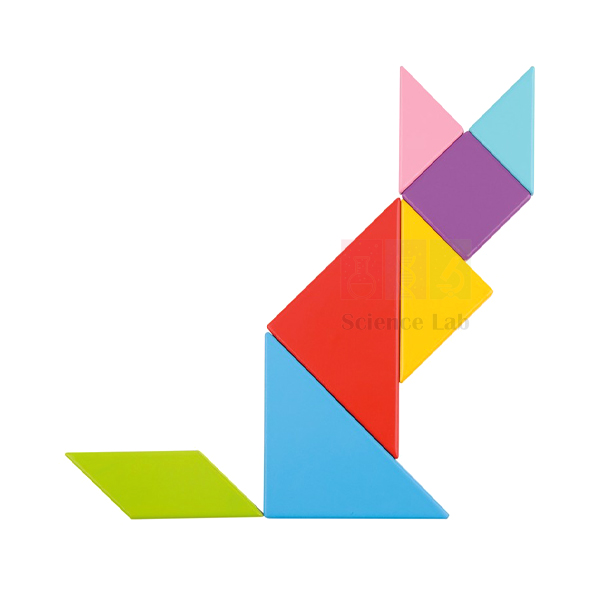
Tangram
Tangram (Product Code: SLE/PP/06) is a seven-piece dissection puzzle used to develop shape sense and spatial reasoning in pre-primary and primary classrooms, and later to explore 2D shapes, areas and types of triangles. The set comes with a booklet of twin tangrams, convex shapes and picture designs grouped by subject, plus two introductory sheets for young children. It is supplied by Jain Scientific Equipments Pvt Ltd (ScienceLab), Ambala, India, for activity-based maths corners in India and abroad.
Key Details
| Parameter | Detail |
|---|---|
| Pieces | 7 tangram pieces |
| Booklet | Twin tangrams, convex shapes and usual pictures classified according to subject |
| Introductory material | Two sheets for introducing tangram to young children |
| Early concepts | Shape sense; spatial sense through puzzles with pre-existing designs |
| Later concepts | Exploring 2D shapes; relationships between the areas of different shapes; types of triangles |
| Product code | SLE/PP/06 |
| Supplied by | Jain Scientific Equipments Pvt Ltd (ScienceLab), Ambala, India |
What Is a Tangram Used For?
Young children start with the introductory sheets, laying each piece over a matching outline so that shape and position both have to agree. Once that is easy, they move to the booklet pictures, where only the silhouette is shown and pieces must be turned and flipped until they fit. This trial-and-adjust process is exactly how spatial sense develops at the pre-primary stage.
In later classes the same pieces become a geometry tool. Pupils find that smaller pieces can exactly cover a larger one, which shows relationships between areas without any formula, and they name and compare the triangles in the set. The convex-shape challenges and twin tangrams in the booklet stretch older learners, and tracing a finished design onto paper gives a record for the class display.
Supplier
Tangram sets are supplied by Jain Scientific Equipments Private Limited, the company behind the ScienceLab name, from Ambala, Haryana. Kindergartens, primary and middle schools, teacher-education institutes and dealers in India and international markets buy them for maths labs and activity corners, often with pattern blocks and geoboards. The ScienceLab profile gives further company information.
Related Pre-Primary Learning Aids
These shape and space aids follow on naturally from tangram work:
- 2D Shapes — flat shapes for naming and sorting.
- Brights Pattern Blocks — more shape puzzles and tiling designs.
- Geoboard — making shapes and exploring area with bands.
- Attribute Blocks Desk Set — sorting shapes by their attributes.
- Geometric Shapes Building Set — building shapes for later geometry lessons.
Explore the Pre-Primary range for other early-years learning aids.
Frequently Asked Questions
How many pieces are in the Tangram?
The Tangram has 7 pieces, the classic set of triangles in three sizes, a square and a parallelogram. Together they can be arranged into the shapes and pictures shown in the booklet that comes with the set.
What comes with the Tangram besides the pieces?
Besides its 7 pieces, the Tangram comes with a booklet showing twin tangrams, convex shapes and usual pictures classified by subject, plus two sheets designed to introduce tangram play to young children.
What age group can use the Tangram?
The Tangram description gives no fixed age range; it serves young children through its introductory sheets and older pupils through area and triangle work. Ask us through the contact page if you need advice for a particular class level.
How does the Tangram help with geometry?
The Tangram helps with geometry by letting pupils explore 2D shapes, compare the areas of different pieces and identify types of triangles. Fitting smaller pieces over larger ones shows area relationships without needing formulas.
Who supplies the Tangram?
The Tangram is supplied by Jain Scientific Equipments Pvt Ltd (ScienceLab), Ambala, Haryana, India. It is available to kindergartens, schools, teacher-training institutes and dealers in India and international markets, alone or with other shape aids.
Is the material of the Tangram pieces specified?
The material of the Tangram pieces is not stated in its description. Please ask us through the contact page, and the quotation will confirm the material along with the booklet and sheets included in the set.
Request a Quote
Send the number of Tangram sets you need through the contact page, or keep them in the enquiry cart with other shape aids to request one quote.
Last updated: 24 September 2026