- Physics Lab Equipment
- Chemistry Lab Equipment
- Biology Lab Equipment
- Anatomical Lab Equipment
- Learning
- Educational Lab Equipment
- Magnets
- Agriculture
- Astronomy
- Earth Science
- Geography Lab Equipment
- Safety Lab Coat
- Laboratory
- Meteorological
- Electricity & Magnetism
- Heat
- School Lab Equipment
- Lab Glassware
- Science Lab Equipment
- Tvet Lab Equipment
- Robotics Kits Supplier and Manufacturer for Schools India
- Math Lab Equipment Manufacturers and Exporters in Ambala
- STEM Kits Manufacturers and Supplier India
- Engineering Lab Equipment
- Hospital Lab Equipment
- Water, Sanitation & Hygiene Supplies
- Cold Chain, Solar & Communication Equipment
- Nutrition
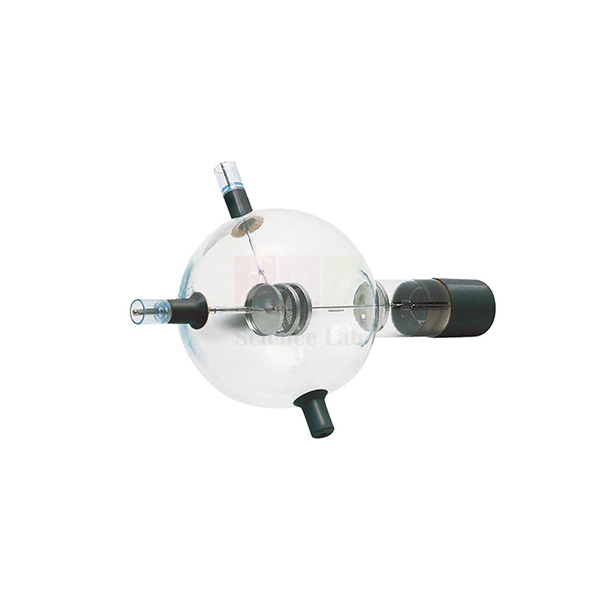
Teltron Diode D
Teltron Diode D (Product Code: SLE/PHY/304) is a thermionic diode tube from the Teltron D range used to demonstrate thermionic emission and the one-way flow of electrons in college and senior school physics laboratories. The D range is the original Teltron series, with the electrical connections fixed on the tube itself, and a diode of this kind is the classic vacuum tube characteristics experiment. It is supplied by Jain Scientific Equipments Pvt Ltd (ScienceLab), Ambala, India.
Key Details
| Parameter | Detail |
|---|---|
| Product type | Thermionic diode demonstration tube |
| Range | Teltron D range (connections fixed on the tube) |
| Brand | Teltron (third-party brand) |
| Operating data | Heater and anode ratings confirmed on the specification sheet sent with your quotation |
| Product code | SLE/PHY/304 |
| Supplied by | Jain Scientific Equipments Pvt Ltd (ScienceLab), Ambala, India |
What Is the Teltron Diode D Used For?
Inside a thermionic diode, a heated cathode releases electrons into the vacuum. They reach the anode only when it is positive with respect to the cathode, so current flows in one direction and not the other. This is the principle behind early valve rectifiers, and it lets students see the link between thermionic emission and rectification in a single piece of apparatus.
In a typical practical, the class varies the anode voltage in steps, records the anode current, and plots the characteristic curve to see how the current rises and then levels off. The tube is fragile evacuated glass, so a teacher or technician should mount it, make the connections to its fixed D-range terminals and switch the supplies on and off.
Supplier
Teltron is a third-party brand. Jain Scientific Equipments Private Limited, which trades as ScienceLab, supplies the Teltron Diode D from Ambala, Haryana, India, sourcing it for colleges, universities and schools that teach thermionic emission. We confirm the current specification and the holder and supplies the tube needs as part of every quotation. More about the company is on our company profile.
Related Physics Lab Equipment
Items that complete a thermionic diode practical or offer an alternative:
- Teltron Diode S — the S-range diode, whose connections sit on the stand.
- Teltron Tube Holder D — mounting for Teltron D-range tubes.
- EHT Power Supply — high-voltage supply listed for use with Teltron tubes.
- Digital Voltmeter/Ammeter With Shunts — for reading voltage and current during the characteristic-curve experiment.
- Semiconductor Diode — the solid-state counterpart for comparison lessons.
Browse all items in Physics Lab Equipment.
Frequently Asked Questions
What does the Teltron Diode D demonstrate?
The Teltron Diode D demonstrates thermionic emission from a heated cathode and the one-way conduction of electrons to a positive anode. Students use it to plot the current-voltage characteristic of a vacuum diode and to understand how valve rectification works.
How does the Teltron Diode D differ from the Teltron Diode S?
The Teltron Diode D belongs to the original Teltron D range, where the connections are fixed on the tube. The Diode S belongs to the newer S range, where the connections are on the stand, so each needs its own matching holder.
What are the technical specifications of the Teltron Diode D?
Please ask us for the current specification sheet of the Teltron Diode D, including heater and anode ratings. We confirm these figures with your quotation instead of printing unverified values on this page, so you can check them against your power supplies.
What other equipment does the Teltron Diode D need?
The Teltron Diode D is normally mounted in a Teltron D-range holder and connected to suitable heater and anode supplies, with meters to read voltage and current. Tell us what your lab already owns and we will confirm the complete set-up.
Is the Teltron Diode D made by ScienceLab?
No. Teltron is a third-party brand, and the Teltron Diode D is supplied, not manufactured, by Jain Scientific Equipments Pvt Ltd (ScienceLab) of Ambala, India. We source it for institutions and confirm its specification with each quotation.
Can students operate the Teltron Diode D themselves?
Students can take readings from the Teltron Diode D, but a teacher or technician should set it up, make the connections and switch the supplies. The tube is evacuated glass and is operated from high-voltage equipment, so careful handling is essential.
Request a Quote
For a quotation on the Teltron Diode D, tell us the quantity and which holders, supplies and meters you already have through our contact page, or add it to the enquiry cart.
Last updated: 24 September 2026