- Physics Lab Equipment
- Chemistry Lab Equipment
- Biology Lab Equipment
- Anatomical Lab Equipment
- Learning
- Educational Lab Equipment
- Magnets
- Agriculture
- Astronomy
- Earth Science
- Geography Lab Equipment
- Safety Lab Coat
- Laboratory
- Meteorological
- Electricity & Magnetism
- Heat
- School Lab Equipment
- Lab Glassware
- Science Lab Equipment
- Tvet Lab Equipment
- Robotics Kits Supplier and Manufacturer for Schools India
- Math Lab Equipment Manufacturers and Exporters in Ambala
- STEM Kits Manufacturers and Supplier India
- Engineering Lab Equipment
- Hospital Lab Equipment
- Water, Sanitation & Hygiene Supplies
- Cold Chain, Solar & Communication Equipment
- Nutrition
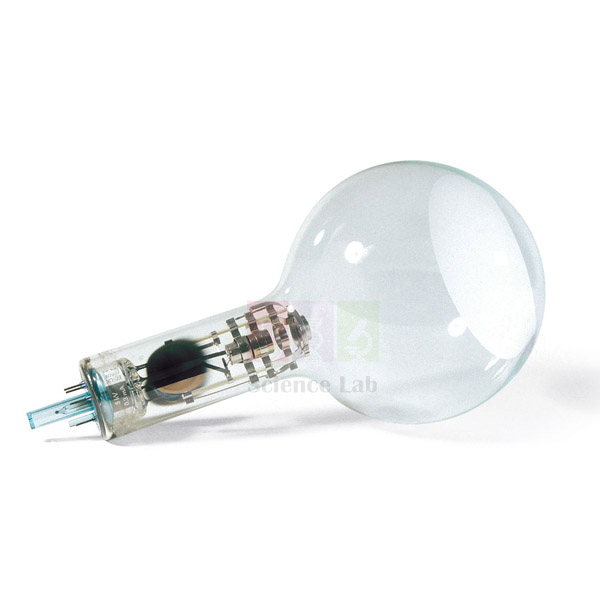
Teltron Electron Diffraction Tube S
Teltron Electron Diffraction Tube S (Product Code: SLE/PHY/54) is a highly evacuated Teltron S-series electron tube used to make electron interference visible as Debye–Scherrer rings on a fluorescent screen in physics laboratories. Students measure the rings produced by a polycrystalline graphite lattice and use the lattice spacing to find the electron wavelength at anode voltages up to 5 kV. It is supplied by Jain Scientific Equipments Pvt Ltd (ScienceLab), Ambala, India.
Specifications
| Parameter | Detail |
|---|---|
| Series | Teltron S series |
| Diffracting lattice | Polycrystalline graphite (Debye–Scherrer diffraction) |
| Lattice constant d10 | 0.213 nm |
| Lattice constant d11 | 0.123 nm |
| Max. anode voltage | 5 kV |
| Anode current | Approx. 0.1 mA at 4 kV |
| Max. filament voltage | 6.3 V AC |
| Documentation | Instructions included |
| Product code | SLE/PHY/54 |
| Supplied by | Jain Scientific Equipments Pvt Ltd (ScienceLab), Ambala, India |
What Is the Electron Diffraction Tube S Used For?
In the lab, the Teltron Electron Diffraction Tube S turns an abstract idea — electrons behaving as waves — into bright rings that students can measure. The inner and outer rings correspond to the two graphite lattice plane spacings, d10 = 0.213 nm and d11 = 0.123 nm, so each ring gives its own estimate of the electron wavelength.
A typical run records ring diameters at a series of anode voltages and then compares the measured wavelength with the de Broglie value calculated from each voltage. For departments buying from a physics instruments supplier in India, the tube slots into an existing S-series set-up and needs a filament supply of up to 6.3 V AC plus a high-voltage anode supply.
What to Specify When Ordering
- Whether you need the Teltron Tube Holder S to mount the tube.
- A power supply covering 6.3 V AC filament and up to 5 kV anode voltage.
- Number of tubes for demonstration or student groups.
Supplier
ScienceLab, the brand name of Jain Scientific Equipments Private Limited, supplies the Teltron Electron Diffraction Tube S to physics departments from Ambala, Haryana, India. Teltron is a third-party brand; the company sources the tube and can match it with the S-series holder and a high-voltage supply on one quotation. Find out more on our profile page.
Related Physics Lab Equipment
These items help you run the diffraction experiment with the Teltron Electron Diffraction Tube S:
- Teltron Tube Holder S — S-series stand with a fuse that protects tubes from excessive voltage.
- EHT Power Supply — adjustable 5 kV output with an auxiliary heater output.
- Teltron Dual Beam Tube S — S-series tube showing the electron's particle behaviour through e/m.
- Teltron Electron Diffraction Tube D — the D-series version of the same experiment.
Discover more in Physics Lab Equipment.
Frequently Asked Questions
How are the rings measured with the Teltron Electron Diffraction Tube S?
Students measure the diameters of the diffraction rings on the fluorescent screen of the Teltron Electron Diffraction Tube S, halve them to get the radii, and repeat at several anode voltages to see how the electron wavelength changes.
Which lattice spacings are used with the Teltron Electron Diffraction Tube S?
Calculations with the Teltron Electron Diffraction Tube S use the graphite lattice constants d10 = 0.213 nm and d11 = 0.123 nm, which correspond to the two diffraction rings seen on the screen.
What are the electrical limits of the Teltron Electron Diffraction Tube S?
The Teltron Electron Diffraction Tube S has a maximum filament voltage of 6.3 V AC and a maximum anode voltage of 5 kV, with an anode current of approx. 0.1 mA at 4 kV. Staying within these limits protects the tube.
Which holder is used with the Teltron Electron Diffraction Tube S?
Teltron S-series tubes are mounted on the Teltron Tube Holder S, which is listed as a separate product. Tell us whether your lab already has one when you request a quotation for the Teltron Electron Diffraction Tube S.
Who supplies the Teltron Electron Diffraction Tube S?
The Teltron Electron Diffraction Tube S is supplied by Jain Scientific Equipments Pvt Ltd (ScienceLab), Ambala, India. Teltron is a third-party brand, and the company sources the tube for teaching laboratories in India and international markets.
What should a Teltron Electron Diffraction Tube S enquiry include?
For the Teltron Electron Diffraction Tube S, state the quantity, whether you need the Tube Holder S and a high-voltage supply, and the delivery destination. Send the details through the contact page or add the items to the enquiry cart.
Request a Quote
For Teltron Electron Diffraction Tube S pricing, contact us through the contact page, or add the tube and S-series accessories to the enquiry cart.
Last updated: 24 September 2026