- Physics Lab Equipment
- Chemistry Lab Equipment
- Biology Lab Equipment
- Anatomical Lab Equipment
- Learning
- Educational Lab Equipment
- Magnets
- Agriculture
- Astronomy
- Earth Science
- Geography Lab Equipment
- Safety Lab Coat
- Laboratory
- Meteorological
- Electricity & Magnetism
- Heat
- School Lab Equipment
- Lab Glassware
- Science Lab Equipment
- Tvet Lab Equipment
- Robotics Kits Supplier and Manufacturer for Schools India
- Math Lab Equipment Manufacturers and Exporters in Ambala
- STEM Kits Manufacturers and Supplier India
- Engineering Lab Equipment
- Hospital Lab Equipment
- Water, Sanitation & Hygiene Supplies
- Cold Chain, Solar & Communication Equipment
- Nutrition
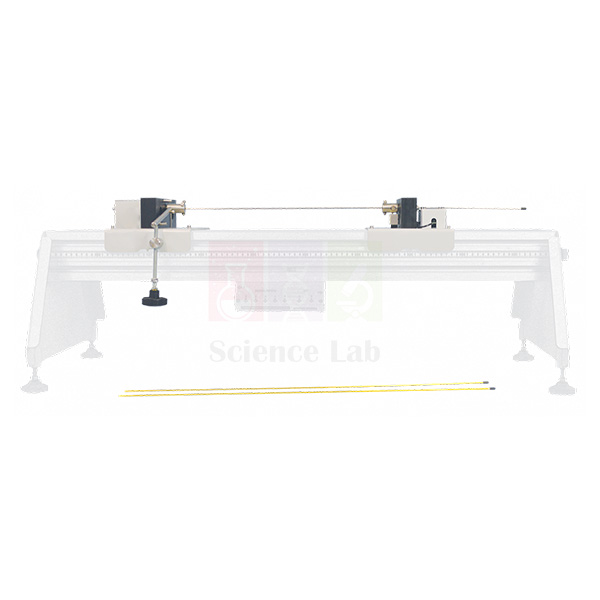
Torsion of Circular Sections
Torsion of Circular Sections (Product Code: SLE/EG/15) twists circular rods and a tube held between two chucks, so students can relate applied torque to angle of twist. One chuck, fitted with a precision potentiometer, applies and measures the angular deflection; the other is connected to a load cell that measures the resulting torque. Manufactured by Jain Scientific Equipments Pvt Ltd (ScienceLab) of Ambala, it serves mechanical and civil engineering laboratories studying shafts and torsional stiffness.
Key Details
| Parameter | Detail |
|---|---|
| Type | Torsion experiment for solid rods and a hollow tube |
| Twisting chuck | Applies angular deflection to the specimen; includes a precision potentiometer to measure it |
| Reaction chuck | Connected to a load cell that measures the resulting torque |
| Specimens | A set of rods of different metals and a tube |
| Comparisons | Elastic properties, dimensions and polar second moment of area (‘J’ value) |
| Effective length | Can be varied to show its effect on deflection for a given torque |
| Data connection | Potentiometer and load cell connect to the USB interface hub of the Structures Platform for computer display and data acquisition |
Typical Use
Students clamp a rod, turn the potentiometer chuck through a series of angles and record the torque at each step, building a torque-against-twist graph whose slope gives the torsional stiffness of that specimen. Using the rod dimensions and the textbook torsion equation, they predict the same relationship and compare the calculated line with the measured one, then work out the shear modulus of each metal.
Changing the effective length shows that, for the same torque, a longer rod twists further. Comparing a solid rod with the tube shows how the polar second moment of area, not simply the amount of material, controls stiffness — the reason many drive shafts are hollow. With both sensors logged through the Structures Platform, the torque-twist line builds up on screen as the test runs, which makes this module useful mechanics lab equipment for lectures on shaft design.
Manufacturer
The apparatus comes from Jain Scientific Equipments Private Limited, which trades as ScienceLab and is based in Ambala, Haryana. The company is incorporated under CIN U29309HR2020PTC087597 and manufactures at its licensed factory at 449, HSIIDC Industrial Area, Saha, Ambala (Factory Licence AMB-ONLINE-CHD-J-414). More about us is in the company profile.
Related Laboratory Equipment
Equipment that pairs well with torsion testing:
- Stiffness - Bending and Torsion — an alternative from our materials testing range comparing bending and torsional stiffness
- Structures Platform — the USB interface hub that logs the potentiometer and load cell
- Caliper Vernier (Metal) — for measuring rod and tube diameters when calculating the ‘J’ value
- Deflection of Beams and Cantilevers — the bending counterpart, comparing elastic properties of metal beams
- Euler Buckling of Struts — another elastic-behaviour practical that logs through the same platform hub
Find the rest of the series in General Products.
Frequently Asked Questions
Which specimens are supplied?
A set of rods of different metals and a tube. For the specific metals and specimen dimensions, please contact us for the datasheet.
How is the angle of twist measured?
By a precision potentiometer built into the chuck that applies the angular deflection.
How is torque measured?
The opposite chuck is connected to a load cell, which measures the torque that results from the applied twist.
Why is a tube included as well as solid rods?
It lets students compare a hollow section with solid ones through the polar second moment of area (‘J’ value), showing how section shape affects torsional stiffness.
Is a Vernier caliper part of this module?
A caliper is not listed for this module. If you need one to measure rod and tube diameters, see Caliper Vernier (Metal) or ask us to add it to your quotation.
What warranty is offered?
Warranty terms are stated in each quotation; contact us for current terms.
Request a Quote
Send your quantity and delivery location through our contact page, or add this torsion module to the enquiry cart, and we will reply with pricing.
Last updated: 24 September 2026