- Physics Lab Equipment
- Chemistry Lab Equipment
- Biology Lab Equipment
- Anatomical Lab Equipment
- Learning
- Educational Lab Equipment
- Magnets
- Agriculture
- Astronomy
- Earth Science
- Geography Lab Equipment
- Safety Lab Coat
- Laboratory
- Meteorological
- Electricity & Magnetism
- Heat
- School Lab Equipment
- Lab Glassware
- Science Lab Equipment
- Tvet Lab Equipment
- Robotics Kits Supplier and Manufacturer for Schools India
- Math Lab Equipment Manufacturers and Exporters in Ambala
- STEM Kits Manufacturers and Supplier India
- Engineering Lab Equipment
- Hospital Lab Equipment
- Water, Sanitation & Hygiene Supplies
- Cold Chain, Solar & Communication Equipment
- Nutrition
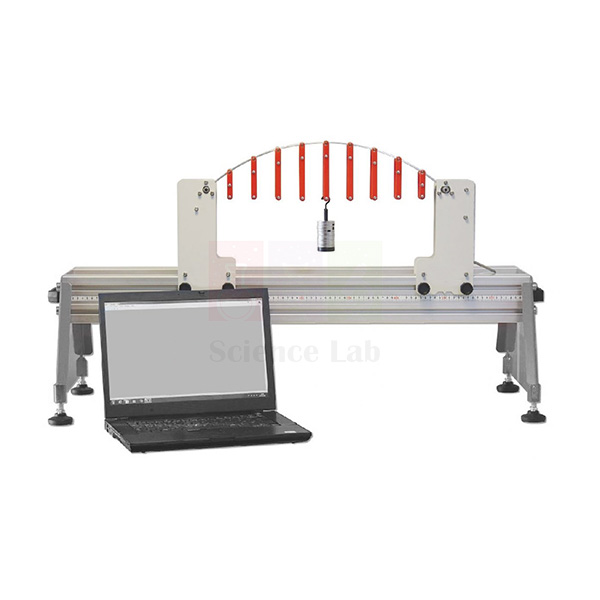
Two Pinned Arch
Two Pinned Arch (Product Code: SLE/EG/13) lets students load an arch held between two supports and measure the horizontal reaction that the arch develops at its base. One support is a pin that allows rotation only; the other is a roller that would slide sideways, but a load cell prevents that translation and reads the horizontal force instead. Manufactured by Jain Scientific Equipments Pvt Ltd (ScienceLab) in Ambala, it is a structures practical for civil engineering courses, polytechnics and other technical institutes.
Key Details
| Parameter | Detail |
|---|---|
| Type | Two-pinned arch experiment |
| Supports | One pinned support (rotational movement only) and one roller support (translational movement) |
| Horizontal reaction | Measured by a load cell that prevents the roller support from translating |
| Loading | Loads applied on hangers suspended from the arch |
| Distributed load | Additional masses for applying a uniformly distributed load (UDL) across the span |
| Positioning | Pointers on each support work with the scale on the platform |
| Data connection | Load cell connects to the USB interface hub of the Structures Platform for computer display and data acquisition |
| Learning outcomes | Predicting reaction forces, drawing influence lines and bending moment diagrams |
Typical Use
Students set the supports using the pointers against the platform scale, hang a load at one position and record the horizontal reaction from the load cell. Moving the same load step by step across the arch, and plotting the reaction for each position, builds the influence line for horizontal thrust — a curve students can check against the values given by textbook arch equations.
In a second run the extra masses are spread along the span as a uniformly distributed load, and the reaction is compared with the result for a single point load. From the measured reactions students then draw bending moment diagrams for the arch and see how the horizontal thrust reduces bending compared with a simply supported beam of the same span. Because a two-pinned arch is statically indeterminate, the experiment shows clearly why a measured reaction is so useful, making it a valued piece of mechanics lab equipment for structural analysis teaching.
Manufacturer
ScienceLab is the trading name of Jain Scientific Equipments Private Limited, a maker of engineering teaching apparatus based in Ambala, Haryana. The company profile describes our wider range and how we work with colleges.
Related Laboratory Equipment
Useful companions when teaching arches and reactions:
- Structures Platform — carries the scale used by the support pointers and the USB hub that logs the load cell
- Bending Moments In a Beam — introduces influence lines on a beam before students move on to the arch
- Frame Deflections And Reactions — another experiment built around support reactions, this time in a frame
- Simple Suspension Bridge — a contrasting long-span structure where cable tension, rather than arch thrust, carries the load
Browse the complete General Products section for more structures apparatus.
Frequently Asked Questions
Which reaction does the load cell measure?
The horizontal reaction. The load cell restrains the roller support, so the force needed to stop it moving is read as the horizontal reaction caused by the load.
Can a distributed load be applied, not just point loads?
Yes. Additional masses are included so a uniformly distributed load can be spread across the span and the result compared with a single point load.
How are the supports positioned accurately?
Each support has pointers that line up with the scale on the platform, so spans and load positions can be set and repeated.
What analysis do students carry out?
They predict the reaction forces with textbook equations, compare them with the measured values, and use the results to create influence lines and bending moment diagrams.
What warranty applies?
Warranty terms are confirmed with each quotation — please contact us for the current terms.
Can we order several sets for a teaching laboratory?
Yes. We quote multiple sets for institutions in India and international markets; add the item to your enquiry cart with the quantity and delivery location.
Request a Quote
For a price on the Two Pinned Arch, alone or with the Structures Platform, contact us or use the enquiry cart.
Last updated: 24 September 2026