- Physics Lab Equipment
- Chemistry Lab Equipment
- Biology Lab Equipment
- Anatomical Lab Equipment
- Learning
- Educational Lab Equipment
- Magnets
- Agriculture
- Astronomy
- Earth Science
- Geography Lab Equipment
- Safety Lab Coat
- Laboratory
- Meteorological
- Electricity & Magnetism
- Heat
- School Lab Equipment
- Lab Glassware
- Science Lab Equipment
- Tvet Lab Equipment
- Robotics Kits Supplier and Manufacturer for Schools India
- Math Lab Equipment Manufacturers and Exporters in Ambala
- STEM Kits Manufacturers and Supplier India
- Engineering Lab Equipment
- Hospital Lab Equipment
- Water, Sanitation & Hygiene Supplies
- Cold Chain, Solar & Communication Equipment
- Nutrition
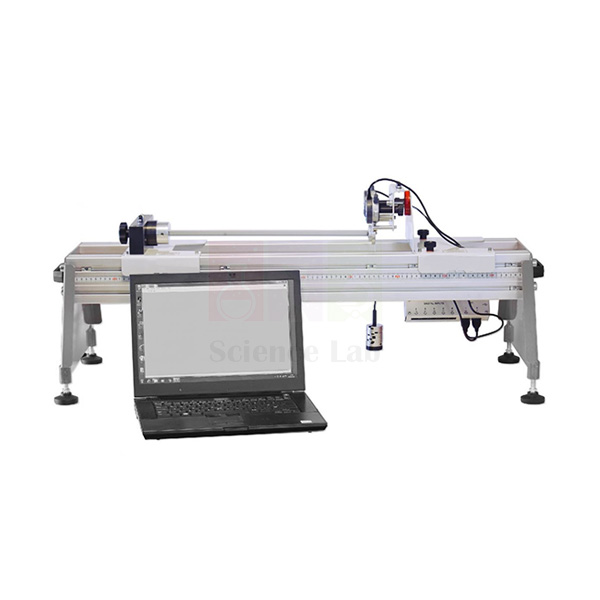
Unsymmetrical Bending and Shear Centre
Unsymmetrical Bending and Shear Centre (Product Code: SLE/EG/14) is a two-part cantilever experiment on how beams behave when a load does not act along a principal axis. In one set-up a chuck clamps a ‘U’ section beam and a plate at its free end takes offset loads that twist the section, so students can locate its shear centre; in the other, a beam is held so it can rotate on its own axis and loads are applied at various angles. It is manufactured by Jain Scientific Equipments Pvt Ltd (ScienceLab), Ambala, for advanced strength of materials teaching in engineering colleges.
Key Details
| Parameter | Detail |
|---|---|
| Type | Shear centre and symmetrical / non-symmetrical bending experiment |
| Shear centre set-up | Chuck clamps a ‘U’ section beam; a plate clamped to the free end allows various offset loads to twist the beam |
| Bending set-up | Chuck clamps a beam while allowing rotation on its axis, so loads can be applied at various angles |
| Deflection measurement | A pair of precision indicators measures the deflections produced by loads at the free end |
| Indicator display | Indicators have their own displays and can also connect to the USB interface hub of the Structures Platform for computer display and data acquisition |
| Included tool | Vernier caliper for accurate measurement of the beam cross-sections |
| Analysis | Comparison with arbitrary section axes and textbook beam equations; Mohr’s circle to find the experimental principal second moments of area and the position of the principal axes |
Typical Use
For the shear centre test, students hang loads at a series of offsets on the end plate of the ‘U’ section and watch the two indicators. The offset at which the section deflects without twisting marks the shear centre — a point that lies outside the channel itself, which explains why channel sections used as purlins or rails tend to twist unless they are loaded through it.
In the unsymmetrical bending tests the beam is turned in its chuck so the same load acts at a range of angles to the section. The deflections read by the indicators are compared with those expected for the arbitrary section axes and with values from textbook beam equations, and students plot their results on a Mohr’s circle to find the experimental principal second moments of area and the orientation of the principal axes. Dimensions taken with the included Vernier caliper feed every calculation. It is a demanding final-year practical and a worthwhile addition to engineering lab equipment in India for structural design courses.
Manufacturer
Jain Scientific Equipments Private Limited manufactures this apparatus under its ScienceLab trading name in Ambala, Haryana, as part of a series of structures experiments. Background on the business is available in our company profile.
Related Laboratory Equipment
Apparatus that supports the same topic, from first beam tests to logging results:
- Unsymmetrical Cantilever — an alternative unsymmetrical bending experiment from our materials testing range
- Bending Stress In a Beam — stresses in the simpler symmetrical case, for comparison
- Deflection of Beams and Cantilevers — builds cantilever deflection skills before sections are loaded off-axis
- Structures Platform — USB interface hub for computer display of the two deflection indicators
- Caliper Vernier (Metal) — an extra caliper when several groups measure sections at once
More structures modules are listed under General Products.
Frequently Asked Questions
What is the shear centre, and how does this apparatus find it?
It is the point through which a load must pass for a section to bend without twisting. The plate on the free end of the ‘U’ section lets students apply loads at different offsets and find the position where twisting stops.
How are the deflections measured?
By a pair of precision indicators at the free end of the beam, each with its own display.
Do the indicators need a computer?
No. They can be read directly; connecting them to the USB interface hub of the Structures Platform is optional and adds computer display and data acquisition.
Is a Vernier caliper included?
Yes, a Vernier caliper is included for measuring the beam cross-sections.
Which syllabus topics does it support?
Unsymmetrical bending, principal second moments of area and principal axes, Mohr’s circle for sections, and the shear centre of an open channel section.
Is a calibration certificate available for the indicators?
Please discuss calibration certificate availability with us at the enquiry stage through our contact page.
What details should we send for a quotation?
Quantity, whether you also need the Structures Platform, and the delivery location in India or overseas. Use the enquiry cart or contact form.
Request a Quote
Planning an advanced structures lab? Contact us for pricing on this apparatus or add it to your enquiry cart.
Last updated: 24 September 2026