- Physics Lab Equipment
- Chemistry Lab Equipment
- Biology Lab Equipment
- Anatomical Lab Equipment
- Learning
- Educational Lab Equipment
- Magnets
- Agriculture
- Astronomy
- Earth Science
- Geography Lab Equipment
- Safety Lab Coat
- Laboratory
- Meteorological
- Electricity & Magnetism
- Heat
- School Lab Equipment
- Lab Glassware
- Science Lab Equipment
- Tvet Lab Equipment
- Robotics Kits Supplier and Manufacturer for Schools India
- Math Lab Equipment Manufacturers and Exporters in Ambala
- STEM Kits Manufacturers and Supplier India
- Engineering Lab Equipment
- Hospital Lab Equipment
- Water, Sanitation & Hygiene Supplies
- Cold Chain, Solar & Communication Equipment
- Nutrition
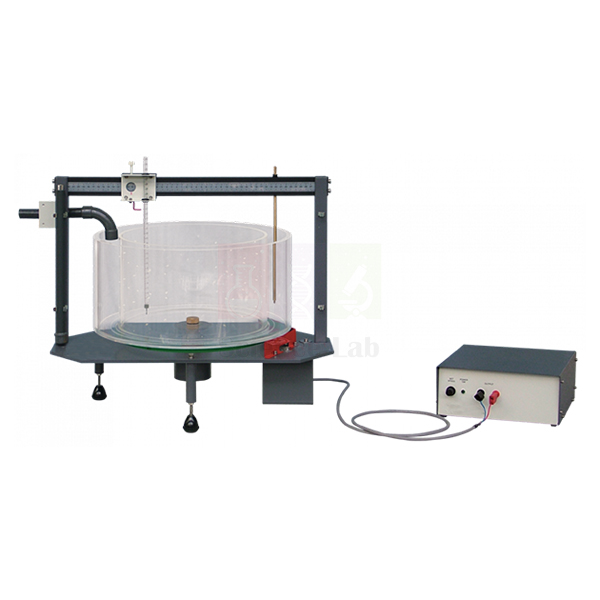
Vortex Apparatus
Vortex Apparatus (Product Code: SLE/EFM/27) is a rotating-vessel apparatus used to create a forced vortex in water and measure the shape of its free surface in engineering college and polytechnic fluid mechanics labs. A low-voltage, variable-speed motor spins the vessel about its vertical axis, and a traverse probe with a linear scale on each axis maps the surface point by point. It is manufactured by Jain Scientific Equipments Pvt Ltd (ScienceLab), an OEM manufacturer, at its own factory in Ambala, India.
Key Details
| Parameter | Detail |
|---|---|
| Type | Forced vortex apparatus with a rotating water vessel |
| Drive | Low-voltage, variable-speed motor rotating the vessel about its vertical axis |
| Speed control | Separate speed-control unit, sited away from the main apparatus |
| Water fill | Water added to the rotating vessel until it is about half full |
| Surface measurement | Traverse probe moving horizontally and vertically, with a linear scale on each axis |
| Total head measurement | Traverse probe can be replaced by a Pitot tube to measure the distribution of total head |
| Product code | SLE/EFM/27 |
| Manufacturer | Jain Scientific Equipments Pvt Ltd (ScienceLab) — OEM |
| Country of origin | India (made in Ambala, Haryana) |
What Is the Vortex Apparatus Used For?
Students start the vessel turning, add water until it is roughly half full and watch a forced vortex develop: the surface falls rapidly towards the centre and produces an air core. After a few minutes of steady rotation the vortex becomes constant, and only then are readings taken, stepping the traverse probe across the radius and recording surface height against radial position from the two scales. Repeating the traverse at different motor speeds shows how the profile deepens as rotation increases, and the results can be compared with the parabolic shape predicted by forced-vortex theory.
For a second set of readings the traverse probe is swapped for a Pitot tube, so the class can plot how total head varies across the vessel. Because the speed-control unit sits away from the vessel, the instructor can adjust rotation without disturbing the water, which suits group demonstrations as well as individual lab reports. It is practical engineering lab equipment in India for hydraulics and fluid mechanics syllabi at degree and diploma level.
OEM Manufacturer
ScienceLab is the trading name of Jain Scientific Equipments Private Limited, the OEM (original equipment manufacturer) of this vortex apparatus, which it builds at its own licensed factory at Saha, Ambala, Haryana, India. Engineering colleges, polytechnics, dealers and importers therefore deal with the maker itself rather than a trader: technical questions, replacement parts and repeat orders are handled at source, so just ask us. Learn more about the company on our company profile.
Related Fluid Mechanics Equipment
Other items that complement vortex experiments in the same hydraulics lab:
- Bernoulli's Theorem — builds on the total-head idea with a Venturi tube and manometer panel.
- Cavitation In Venturi — links pressure, velocity and flow in a visible demonstration.
- Pressure Measurement Bench — grounds students in manometer and gauge readings before head measurements.
- Stopwatch, Digital — times how long the vortex takes to settle before readings are taken.
The complete Fluid Mechanics category lists our pumps, flumes and flow apparatus.
Frequently Asked Questions
How is the speed of the Vortex Apparatus controlled?
The Vortex Apparatus uses a separate speed-control unit, sited away from the main apparatus, to drive its low-voltage, variable-speed motor. Keeping the controller apart lets the instructor change the rotation speed without disturbing the water surface being measured.
How do students measure the surface profile?
Students use the traverse probe of the Vortex Apparatus, which moves both horizontally and vertically. Each axis has a linear scale, so the height of the water surface can be recorded at known radial positions and plotted as a profile.
Can the Vortex Apparatus measure total head?
Yes. On the Vortex Apparatus the traverse probe can be replaced by a Pitot tube to measure the distribution of total head across the vessel. Please ask us to confirm whether a Pitot tube is included in your supply.
What are the vessel size and motor voltage?
The current Vortex Apparatus listing describes the motor only as low-voltage and variable-speed and does not state the vessel dimensions. Ask us through the contact page for the datasheet of the unit you are quoted before planning bench space.
How long before readings can be taken?
After water is added to the rotating vessel of the Vortex Apparatus, allow a few minutes of steady rotation. Once the forced vortex becomes constant and the surface stops changing shape, students can traverse the profile and record readings.
Who manufactures the Vortex Apparatus?
The Vortex Apparatus is manufactured by Jain Scientific Equipments Pvt Ltd (ScienceLab), the OEM, at its own licensed factory at Saha, Ambala, Haryana, India. Quotations, replacement-part enquiries and repeat orders are handled directly by the manufacturer.
Can you supply overseas institutions?
Yes. The Vortex Apparatus is supplied to colleges and training centres in India and international markets. Send the product code SLE/EFM/27, the quantity and the destination, and export packing and shipping are agreed at the quotation stage.
Request a Quote
To get a price for the Vortex Apparatus straight from its manufacturer, write to us via the contact form or place it in your enquiry cart with the quantity you need.
Last updated: 24 September 2026