- Physics Lab Equipment
- Chemistry Lab Equipment
- Biology Lab Equipment
- Anatomical Lab Equipment
- Learning
- Educational Lab Equipment
- Magnets
- Agriculture
- Astronomy
- Earth Science
- Geography Lab Equipment
- Safety Lab Coat
- Laboratory
- Meteorological
- Electricity & Magnetism
- Heat
- School Lab Equipment
- Lab Glassware
- Science Lab Equipment
- Tvet Lab Equipment
- Robotics Kits Supplier and Manufacturer for Schools India
- Math Lab Equipment Manufacturers and Exporters in Ambala
- STEM Kits Manufacturers and Supplier India
- Engineering Lab Equipment
- Hospital Lab Equipment
- Water, Sanitation & Hygiene Supplies
- Cold Chain, Solar & Communication Equipment
- Nutrition
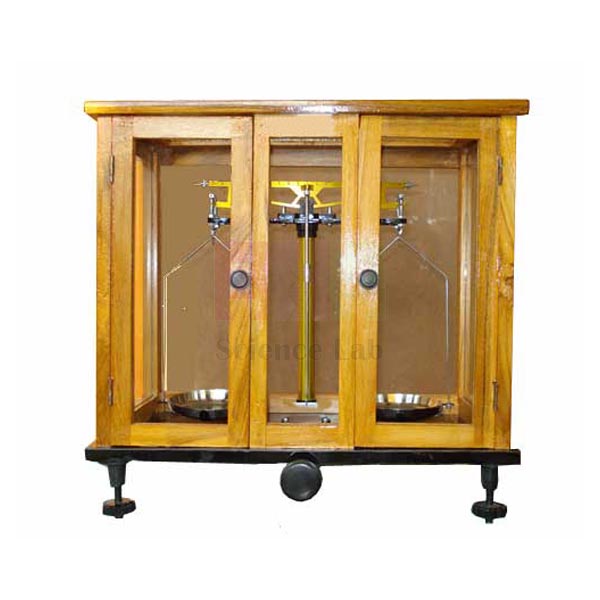
Analytical Balance
The Analytical Balance is a mechanical beam balance for exact weighings in quantitative analysis, with a capacity of 200 g and a sensitivity of 0.1 mg. A rider moved along its short triangular beam supplies the last fraction of a milligram, and a fully glazed wooden case shields the stirrup-hung pans from draughts and dust.
Analytical beam balance specifications
| Parameter | Detail |
|---|---|
| Capacity | 200 g |
| Sensitivity | 0.1 mg |
| Beam | Short triangular beam with rider scale |
| Knife edges | Agate; relieved by extended beam supports when at rest |
| Pans | Removable, suspended by stirrups from double hooks |
| Pillar | Highly finished |
| Complete with | Rider slide and levelling screws |
| Case | Polished wooden case, fully glazed |
| Product code | SLE/LB/07 |
| Minimum order | 10 units |
| Dispatch | Usually within 7 to 10 working days |
| Manufacturer | ScienceLab (Jain Scientific Equipments Pvt Ltd), Ambala, India |
Quantitative analysis on the analytical balance
Gravimetric estimation of sulphate. Precipitate barium sulphate from the sample solution with barium chloride, filter it, and ignite paper and precipitate in a weighed crucible with lid. Cool the crucible in a vacuum desiccator before every weighing, and repeat heating, cooling and weighing until two results agree.
Standard solution of oxalic acid. Weigh the oxalic acid by difference from a stoppered weighing bottle: weigh the bottle with the crystals, tip a portion into a funnel standing in a volumetric flask, then weigh the bottle again. Dissolve, make up to the mark and work out the exact concentration from the mass delivered.
Sensitivity under load. Find the rest point of the empty balance from the pointer's swings, move the rider by one division and find the new rest point. Repeat with equal masses from the analytical balance mass set on both pans at two or more loads within the capacity, and plot how the sensitivity changes with load.
Frequently Asked Questions About the Analytical Balance
How is the rider used to finish a weighing?
Add masses to the right pan until the next smaller piece would overshoot. Then lift the rider with the rider slide, set it on the beam and move it along the rider scale until the pointer swings evenly about the zero point. Its position gives the remaining milligrams and fractions, which are added to the pan total.
How is the sensitivity of the balance checked?
Find the rest point of the pointer, add a small known mass, usually by moving the rider, and find the new rest point. The shift in scale divisions per milligram is the sensitivity. Check it with empty pans and again under load, because a beam balance usually becomes less sensitive as the load increases.
How should a hygroscopic sample be weighed?
Store it in a desiccator and weigh it inside a closed weighing bottle, never on an open pan or paper. Weigh the bottle with the sample, tip out the portion needed and weigh the bottle again. Because the bottle stays closed on the pan, the sample has little chance to take up moisture while it is weighed.
Does air buoyancy affect a result at 0.1 mg?
It can. Air pushes up on the sample and on the masses in proportion to their volumes, so a bulky, low-density sample appears slightly lighter than it really is. In most student gravimetric work the error is small, but exact work corrects the reading to its value in vacuum.
What checks come before the first weighing of a session?
Level the case with the levelling screws and brush any dust from the pans. Close the case, release the beam supports and note where the pointer's swings centre, which gives the zero point. Raise the beam supports again before anything is placed on a pan.
Weighing and gravimetric apparatus
- Analytical Balance Mass Set
- Analytical Weight Box
- Balance Anti-Vibration Table
- Chemical Balance
- Vacuum Desiccator
- Crucible with lid
To request a quotation, send the product name, code and quantity through our contact page or add the item to your enquiry cart.
Last updated: 14 November 2026