- Physics Lab Equipment
- Chemistry Lab Equipment
- Biology Lab Equipment
- Anatomical Lab Equipment
- Learning
- Educational Lab Equipment
- Magnets
- Agriculture
- Astronomy
- Earth Science
- Geography Lab Equipment
- Safety Lab Coat
- Laboratory
- Meteorological
- Electricity & Magnetism
- Heat
- School Lab Equipment
- Lab Glassware
- Science Lab Equipment
- Tvet Lab Equipment
- Robotics Kits Supplier and Manufacturer for Schools India
- Math Lab Equipment Manufacturers and Exporters in Ambala
- STEM Kits Manufacturers and Supplier India
- Engineering Lab Equipment
- Hospital Lab Equipment
- Water, Sanitation & Hygiene Supplies
- Cold Chain, Solar & Communication Equipment
- Nutrition
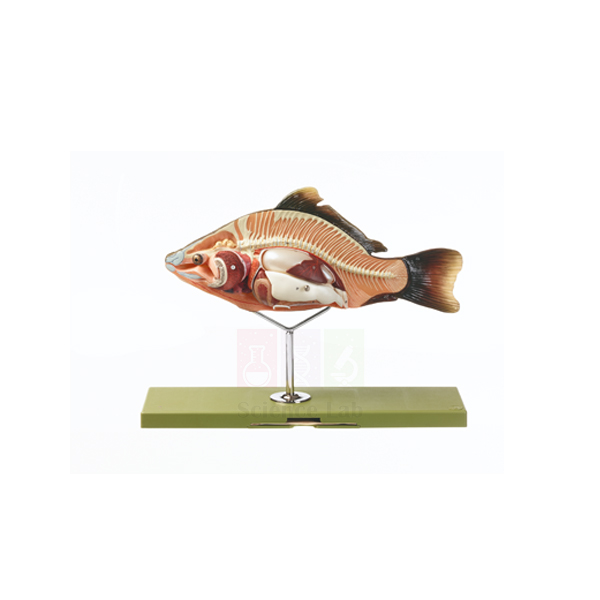
Bony Fish Model
The Bony Fish Model is a life-size carp replica with external features on one side and internal organs on the other. It measures 35 x 49 x 16 cm and separates into 4 parts, since the air bladder, intestines and testicles lift out of the body. School biology, fisheries courses and college zoology use it to introduce fish structure.
Bony Fish Model specifications
| Parameter | Detail |
|---|---|
| Species represented | Carp, life-size replica |
| Size | 35 x 49 x 16 cm |
| Construction | Separates into 4 parts |
| Removable organs | Air bladder, intestines, testicles |
| Views | External features on one side, internal features on the other |
| Product code | SLE/A/117 |
| Minimum order | 10 units |
| Dispatch | Usually within 7 to 10 working days |
| Manufacturer | ScienceLab (Jain Scientific Equipments Pvt Ltd), Ambala, India |
Fish biology lessons with the carp model
Outside before inside. With the external side facing the class, students name the fins, gill cover and scales and say what each does. Fisheries students then lay a real fish on the mini fish measuring board and record its total length, using the model as the guide to body regions.
Buoyancy and the air bladder. Lift the air bladder out and ask how a fish could rise or sink by changing the gas inside it. Live fish caught with a fish dip net and held in a tank show the result: they hover in place with hardly any tail movement.
Digestion and reproduction. Remove the intestines to follow food from the mouth to the vent, then take out the testicles and discuss how carp release eggs and sperm into the water.
Two models, two jobs. Groups who finish early move to the Fish Dissection Model, a longitudinal dissection with magnet-held parts and a numbered key. They list the organs that each model shows and the other does not.
Frequently Asked Questions About the Bony Fish Model
What does the air bladder do in a bony fish?
It is a gas-filled sac that lets the fish adjust its buoyancy and hold a chosen depth without swimming all the time. Lifting it out of the model shows how much of the body cavity it fills. In carp a duct joins the bladder to the gut, so the fish can gulp or release air.
What do the gill cover, scales and lateral line do?
The gill cover, or operculum, is a bony flap that protects the gills and helps pump water over them. Scales overlap like roof tiles to guard the skin. The lateral line is a row of sense organs along each flank that detects movement and pressure changes in the water.
What does each fin do?
The tail fin drives the fish forward. The dorsal and anal fins keep it upright and stop it rolling. The paired pectoral and pelvic fins steer, brake and help it hover, working with the air bladder to hold a steady position in the water.
How does a bony fish like the carp differ from a cartilaginous fish?
Bony fish, class Osteichthyes, have a skeleton of bone, gills under an operculum, an air bladder and thin overlapping scales. Cartilaginous fish, class Chondrichthyes, such as sharks and rays, have a cartilage skeleton, open gill slits, no air bladder and tooth-like placoid scales.
What do the removable testicles tell students about reproduction in carp?
They show that the model represents a male fish. Carp, like most bony fish, use external fertilisation: the female sheds eggs into the water and the male releases sperm over them. Sharks differ, because males use claspers for internal fertilisation.
What kind of tail does a carp have?
A homocercal tail, with upper and lower lobes of about equal size and the backbone ending at the base of the fin. Sharks have a heterocercal tail, in which the backbone runs up into a larger upper lobe. The difference is a common classification question.
Fish biology models and fisheries items
To request a quotation, send the product name, code and quantity through our contact page or add the item to your enquiry cart.
Last updated: 14 November 2026