- Physics Lab Equipment
- Chemistry Lab Equipment
- Biology Lab Equipment
- Anatomical Lab Equipment
- Learning
- Educational Lab Equipment
- Magnets
- Agriculture
- Astronomy
- Earth Science
- Geography Lab Equipment
- Safety Lab Coat
- Laboratory
- Meteorological
- Electricity & Magnetism
- Heat
- School Lab Equipment
- Lab Glassware
- Science Lab Equipment
- Tvet Lab Equipment
- Robotics Kits Supplier and Manufacturer for Schools India
- Math Lab Equipment Manufacturers and Exporters in Ambala
- STEM Kits Manufacturers and Supplier India
- Engineering Lab Equipment
- Hospital Lab Equipment
- Water, Sanitation & Hygiene Supplies
- Cold Chain, Solar & Communication Equipment
- Nutrition
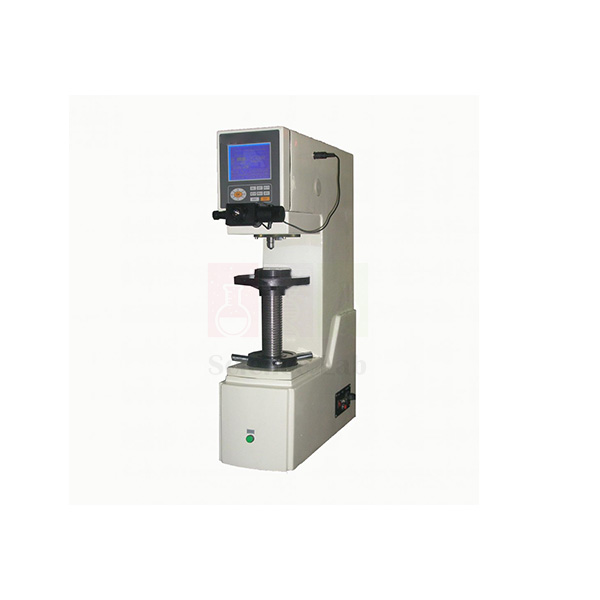
Brinell Hardness Tester
Brinell Hardness Tester (Product Code: SLE/MCE/16) is a digital hardness testing instrument used to measure the Brinell hardness of metals in materials testing, metallurgy and workshop laboratories. Engineering colleges and quality-control labs use it for a fully automatic load, hold and unload cycle across 8–650 HBW, with test loads chosen on a keyboard and results shown on a large LCD screen. It is supplied by Jain Scientific Equipments Pvt Ltd (ScienceLab), Ambala, India.
Specifications
| Parameter | Detail |
|---|---|
| Measuring range | 8–650 HBW |
| Test cycle | Fully automatic load application, holding and unloading |
| Load selection and display | Keyboard with large LCD screen showing indenter, load and other test information |
| Load dwell time | 2 to 99 s, can be set and stored |
| Ball indenters | Tungsten carbide, 10 mm, 5 mm and 2.5 mm |
| Reading | Direct digital reading |
| Microscope magnification | 20X |
| Microscope resolution | 0.005 mm |
| Maximum measurable height | 230 mm |
| Maximum measurable depth | 140 mm |
| Standard blocks | 125–350 HBW10/3000 and 125–350 HBW10/1000 |
| Weight advantage | About 50% lighter than a traditional dead-weight type tester |
| Power supply | 220/110 V, 50/60 Hz, 4 A |
| Dimensions (L x W x H) | 530 x 260 x 750 mm |
| Weight | 110 kg |
| Product code | SLE/MCE/16 |
| Supplied by | Jain Scientific Equipments Pvt Ltd (ScienceLab), Ambala, India |
What Is the Brinell Hardness Tester Used For?
In the Brinell method a hard ball is pressed into the metal under a set load, and the diameter of the round impression, measured through the 20X microscope, gives the hardness number. Because this tester applies, holds and removes the load automatically, the operator no longer influences the result, which greatly improves reproducibility from one student or shift to the next. Three ball sizes let the laboratory match the indenter and load to soft non-ferrous alloys, castings or steels.
For good readings, prepare a flat, clean test surface, keep each impression well away from the edge and from earlier dents, and check the tester on a standard block at the start of a session. A tester of this kind is a staple for polytechnics and quality departments, and ScienceLab works as a laboratory instruments supplier in India for such buyers.
What to Specify When Ordering
- Which ball indenters you need: 10 mm, 5 mm and/or 2.5 mm
- The largest parts you will test, against the 230 mm height and 140 mm depth limits
- Your mains supply: 220 V or 110 V, 50 Hz or 60 Hz
- Quantity and delivery destination
Supplier
The Brinell Hardness Tester is supplied by Jain Scientific Equipments Private Limited, which trades as ScienceLab from Ambala, Haryana. For vendor registration, the supplying company's details are CIN U29309HR2020PTC087597 and GSTIN 06AAECJ8618A1ZT.
The company sources the tester and handles quotations, packing and shipping for engineering colleges, testing laboratories, dealers and importers. For later questions about indenters or standard blocks, ask us. Read more on the ScienceLab profile page.
Related Materials Testing and Properties Equipment
These items fit around Brinell testing in a materials laboratory:
- Brinell Indenter — a steel-ball indenter with hand-held magnifier for introducing the Brinell principle.
- Vickers Hardness Tester — an alternative hardness method for comparison.
- Universal Hardness Tester — an option when several hardness methods are needed.
- Single Disc Polishing Machine — prepares a flat, smooth test surface.
- Cut Off Wheel Machine — sections samples to fit under the indenter.
See all items in Materials Testing and Properties.
Frequently Asked Questions
What is the measuring range of the Brinell Hardness Tester?
The Brinell Hardness Tester measures from 8 to 650 HBW with direct digital reading. It uses tungsten carbide ball indenters of 10 mm, 5 mm and 2.5 mm, and a 20X microscope with 0.005 mm resolution to read the impression.
How does the automatic cycle of the Brinell Hardness Tester help?
The Brinell Hardness Tester applies, holds and removes the load fully automatically, with a dwell time settable from 2 to 99 s. Removing operator influence in this way greatly improves the reproducibility of results between users.
What is the largest specimen the Brinell Hardness Tester can take?
The Brinell Hardness Tester accepts specimens up to 230 mm high, with a maximum measurable depth of 140 mm. If your parts are larger or irregular, send us their dimensions before ordering so suitability can be checked.
What power supply and space does the Brinell Hardness Tester need?
The Brinell Hardness Tester runs on 220/110 V, 50/60 Hz at 4 A. It measures 530 x 260 x 750 mm and weighs 110 kg, about 50% less than a traditional dead-weight type tester, so it still needs a sturdy bench.
Who supplies the Brinell Hardness Tester?
The Brinell Hardness Tester is supplied by Jain Scientific Equipments Pvt Ltd (ScienceLab) of Ambala, Haryana, India. The company quotes and dispatches it to institutions, laboratories, dealers and importers in India and international markets.
Is a calibration certificate available for the Brinell Hardness Tester?
Standard blocks of 125–350 HBW10/3000 and 125–350 HBW10/1000 are listed with the Brinell Hardness Tester. Availability of a calibration certificate should be discussed with us; raise it through the contact page when you request a quote.
Request a Quote
Send your Brinell Hardness Tester requirement through the ScienceLab contact page or place it in the enquiry cart. State the indenters you need, your mains supply and the delivery location.
Last updated: 24 September 2026