- Physics Lab Equipment
- Chemistry Lab Equipment
- Biology Lab Equipment
- Anatomical Lab Equipment
- Learning
- Educational Lab Equipment
- Magnets
- Agriculture
- Astronomy
- Earth Science
- Geography Lab Equipment
- Safety Lab Coat
- Laboratory
- Meteorological
- Electricity & Magnetism
- Heat
- School Lab Equipment
- Lab Glassware
- Science Lab Equipment
- Tvet Lab Equipment
- Robotics Kits Supplier and Manufacturer for Schools India
- Math Lab Equipment Manufacturers and Exporters in Ambala
- STEM Kits Manufacturers and Supplier India
- Engineering Lab Equipment
- Hospital Lab Equipment
- Water, Sanitation & Hygiene Supplies
- Cold Chain, Solar & Communication Equipment
- Nutrition
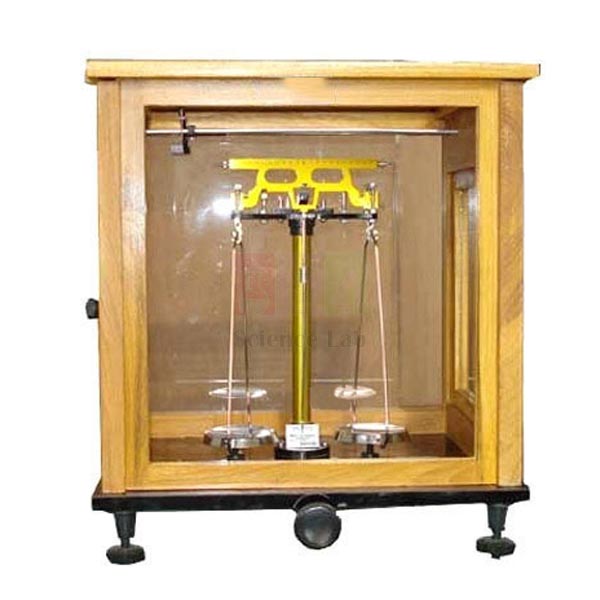
Chemical Balance
The Chemical Balance weighs reagents, primary standards and precipitates for quantitative chemistry practicals, with a capacity of 200 g and a sensitivity of 0.5 mg. Its beam is engraved with a rider scale for a 10 mg rider and swings on agate bearings and knife edges, mounted on a wooden board inside a polished wooden case.
Chemical balance specifications
| Parameter | Detail |
|---|---|
| Capacity | 200 g |
| Sensitivity | 0.5 mg |
| Beam | Engraved with a rider scale, for use with a 10 mg rider |
| Adjustment | Balancing nuts |
| Bearings | Agate bearings and knife edges |
| Mounting | Fitted on a wooden board |
| Case | Polished wooden case |
| Weight box and rider | Weight box not listed as part of the balance; packing of a rider not stated |
| Product code | SLE/LB/06 |
| Minimum order | 10 units |
| Dispatch | Usually within 7 to 10 working days |
| Manufacturer | ScienceLab (Jain Scientific Equipments Pvt Ltd), Ambala, India |
Chemistry practicals on the chemical balance
Standard solution of Mohr's salt. Put masses equal to a clean watch glass plus the required sample on the right pan. Add ferrous ammonium sulphate crystals to the glass until the beam swings equally to each side, using the rider for the last milligrams. Wash the crystals into a volumetric flask with dilute sulphuric acid, make up to the mark and titrate it against potassium permanganate.
Solubility of potassium nitrate. Weigh a dry porcelain dish, pour in a little saturated potassium nitrate solution at a measured temperature and weigh again. Evaporate it to dryness on a water bath, let the dish cool and weigh it once more. The masses give the salt and the water that held it, so solubility follows as grams of salt per hundred grams of water.
Volume of one burette drop. Weigh a small, dry stoppered flask, run a counted number of water drops into it from a burette and weigh it again. Dividing the gain by the number of drops gives the mass, and so roughly the volume, of one drop. Students then see why a single extra drop at the end point matters in a titration.
Frequently Asked Questions About the Chemical Balance
How does a chemical balance differ from a physical balance?
Both are equal-arm beam balances, but the chemical balance is built for finer work. This one senses 0.5 mg, carries a rider scale for the last milligrams and sits in a closed wooden case against draughts. A physical balance reads more coarsely and suits physics practicals such as density and mass.
What does a sensitivity of 0.5 mg mean in practice?
It is the smallest change in load that shifts the beam's rest point clearly. Report weighings no finer than the nearest half milligram. The real uncertainty of a result is larger, because the masses used, the rider setting and the reading of the rest point all add to it.
What happens if more than 200 g is placed on the pans?
The 200 g capacity covers the container as well as the sample. Overloading bends the beam slightly and presses the knife edges into the agate, which blunts them and lowers the sensitivity over time. Weigh heavy flasks or large samples on a coarser balance instead.
Why is a sample never placed directly on the pan?
Chemicals can corrode or stain the pan and change its mass, which shifts every later weighing. Loose crystals also spill onto the bearings and the floor of the case. Use weighing paper or a watch glass, and weigh the container first so its mass can be taken away.
Why does the beam come to rest at a different point each time?
Grains of chemical or dust on the knife edges or agate bearings are a common cause, along with draughts through an open case and a beam jolted while loading. Clean with a soft brush, close the case and let the beam settle each time. Never file or hone a knife edge yourself; a worn edge needs proper servicing.
What is the difference between accuracy and precision when weighing?
Precision is how closely repeat weighings of one object agree with each other. Accuracy is how close they come to the true mass. A balance can repeat well and still read high if the masses or the rider are off, so check it from time to time with a known mass.
Weighing accessories and a finer balance for chemistry practicals
To request a quotation, send the product name, code and quantity through our contact page or add the item to your enquiry cart.
Last updated: 14 November 2026