- Physics Lab Equipment
- Chemistry Lab Equipment
- Biology Lab Equipment
- Anatomical Lab Equipment
- Learning
- Educational Lab Equipment
- Magnets
- Agriculture
- Astronomy
- Earth Science
- Geography Lab Equipment
- Safety Lab Coat
- Laboratory
- Meteorological
- Electricity & Magnetism
- Heat
- School Lab Equipment
- Lab Glassware
- Science Lab Equipment
- Tvet Lab Equipment
- Robotics Kits Supplier and Manufacturer for Schools India
- Math Lab Equipment Manufacturers and Exporters in Ambala
- STEM Kits Manufacturers and Supplier India
- Engineering Lab Equipment
- Hospital Lab Equipment
- Water, Sanitation & Hygiene Supplies
- Cold Chain, Solar & Communication Equipment
- Nutrition
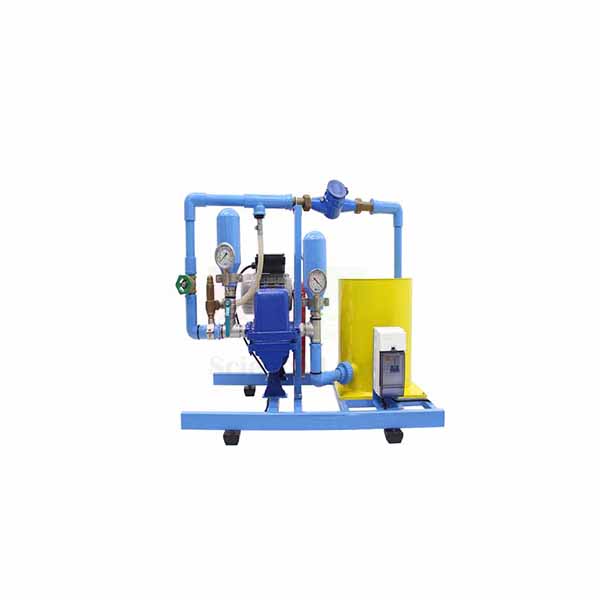
Computerized Reciprocating Pump Test Apparatus
Computerized Reciprocating Pump Test Apparatus (Product Code: SLE/MCE/49) is a piston pump test unit used to record p-V diagrams and pump characteristics on a PC in fluid mechanics and hydraulic machines laboratories. A variable-speed piston pump runs in a transparent housing on a closed water circuit, with an air vessel, a crank angle sensor and pressure sensors in the cylinder and at the outlet. It is made by Jain Scientific Equipments Pvt Ltd (ScienceLab), an OEM manufacturer, at its own factory in Ambala, India.
Specifications
| Parameter | Detail |
|---|---|
| Pump | Piston pump in a transparent housing, variable speed via frequency converter |
| Piston pump speed | 30 to 180 rpm |
| Maximum flow rate | 135 L/h |
| Maximum head | 40 m |
| Drive motor power | 180 W |
| Gear transmission ratio | 1:7.5 |
| Water circuit | Closed circuit with water tank and air vessel to damp pressure pulsation |
| Flow and head adjustment | Needle valve and overflow valve |
| Cylinder pressure | 0 to 5 bar |
| Outlet pressure | 0 to 5 bar |
| Crank angle | 0 to 360°, angle sensor on the piston rod |
| Flow rate measurement | 0.2 to 6 L/min |
| Data acquisition | Microprocessor-based measuring technique in a protective housing; values sent to a PC via USB and analysed with the software included |
| Power supply | 230 V, 50 Hz, 1 phase (230 V, 60 Hz, 1 phase and 120 V, 60 Hz, 1 phase also listed) |
| Dimensions | 670 x 590 x 740 mm |
| Weight | Approx. 49 kg |
| Product code | SLE/MCE/49 |
| Manufacturer | Jain Scientific Equipments Pvt Ltd (ScienceLab) — OEM |
| Country of origin | India (made in Ambala, Haryana) |
What Is the Reciprocating Pump Test Apparatus Used For?
Reciprocating pumps deliver high pressure at low flow — think of pressure washers, dosing systems and boiler feed — but their output comes in pulses. This apparatus makes the full pumping cycle measurable: the angle sensor on the piston rod gives the cylinder volume at every instant, and the cylinder pressure sensor records the matching pressure, so the software can draw the intake and discharge strokes as a p-V diagram.
Students watch the piston through the transparent housing, then use the needle and overflow valves to set different flow rates and heads and compare how the diagram changes. Comparing the pulsating cylinder pressure with the outlet pressure trace shows how the air vessel smooths the delivery. The USB link and included software make it a straightforward piece of computer-linked engineering lab equipment in India for both lab classes and project reports.
What to Specify When Ordering
- Mains supply: 230 V, 50 Hz is standard; 230 V, 60 Hz and 120 V, 60 Hz single-phase versions are also listed.
- Whether a PC should be supplied to run the included software, or your laboratory will provide one with a USB port.
- Quantity of units and the delivery location.
OEM Manufacturer
Jain Scientific Equipments Private Limited, the company behind the ScienceLab name, is the OEM (original equipment manufacturer) of the Computerized Reciprocating Pump Test Apparatus. It is registered as a private limited company under CIN U29309HR2020PTC087597, and the apparatus is assembled at premises covered by Factory Licence AMB-ONLINE-CHD-J-414 at 449, HSIIDC Industrial Area, Saha, Ambala, Haryana.
For buyers this means one accountable source: the maker quotes the unit, dispatches it and deals with any later need for sensors, seals or software help — simply ask us. Universities, polytechnics, dealers and importers in India and international markets are served factory-direct; see the ScienceLab company profile.
Related Fluid Mechanics Equipment
Pump trainers that pair well with p-V studies of a piston pump:
- Computerized Gear Pump Test Rig — a rotary positive displacement pump with a much smoother output.
- Multi Pump Test Rig — a three-head stroke-adjustable pump for flow and counter pressure tests.
- Submersible Pump Test Rig — a rotodynamic pump for contrasting head-flow behaviour.
- Variable Speed Series And Parallel Pumps — centrifugal pumps in single, series and parallel operation.
The Fluid Mechanics category has the rest of the pump and turbine range.
Frequently Asked Questions
How does the Computerized Reciprocating Pump Test Apparatus produce a p-V diagram?
The Computerized Reciprocating Pump Test Apparatus measures piston rod position with an angle sensor to find cylinder volume, and cylinder pressure with a separate sensor. Both are sent to a PC via USB, where the included software plots the p-V diagram.
What is the air vessel for?
On the Computerized Reciprocating Pump Test Apparatus, the air vessel damps the pulsating pressure curve produced by the piston pump. Comparing outlet pressure readings with this damping in action shows students why air vessels are fitted to reciprocating pump installations.
What are the pump's performance figures?
The Computerized Reciprocating Pump Test Apparatus has a piston pump speed of 30 to 180 rpm, a maximum flow rate of 135 L/h and a maximum head of 40 m, driven by a 180 W motor through a 1:7.5 gear transmission.
What are the measuring ranges?
The Computerized Reciprocating Pump Test Apparatus measures cylinder pressure from 0 to 5 bar, outlet pressure from 0 to 5 bar, crank angle from 0 to 360° and flow rate from 0.2 to 6 L/min.
Is software included?
Yes. The Computerized Reciprocating Pump Test Apparatus is supplied with software for analysing the measured values sent over USB. Whether a PC is included should be confirmed at quotation through the contact page.
Who manufactures the Computerized Reciprocating Pump Test Apparatus?
The Computerized Reciprocating Pump Test Apparatus is manufactured by Jain Scientific Equipments Pvt Ltd (ScienceLab), the OEM, at its own factory in Ambala, Haryana, India, and it is supplied factory-direct to institutions, dealers and importers.
Request a Quote
Send an enquiry for the Computerized Reciprocating Pump Test Apparatus (SLE/MCE/49) via the contact page, or add it to the enquiry cart with your preferred power supply. Quotations come directly from the manufacturer.
Last updated: 24 September 2026