- Physics Lab Equipment
- Chemistry Lab Equipment
- Biology Lab Equipment
- Anatomical Lab Equipment
- Learning
- Educational Lab Equipment
- Magnets
- Agriculture
- Astronomy
- Earth Science
- Geography Lab Equipment
- Safety Lab Coat
- Laboratory
- Meteorological
- Electricity & Magnetism
- Heat
- School Lab Equipment
- Lab Glassware
- Science Lab Equipment
- Tvet Lab Equipment
- Robotics Kits Supplier and Manufacturer for Schools India
- Math Lab Equipment Manufacturers and Exporters in Ambala
- STEM Kits Manufacturers and Supplier India
- Engineering Lab Equipment
- Hospital Lab Equipment
- Water, Sanitation & Hygiene Supplies
- Cold Chain, Solar & Communication Equipment
- Nutrition
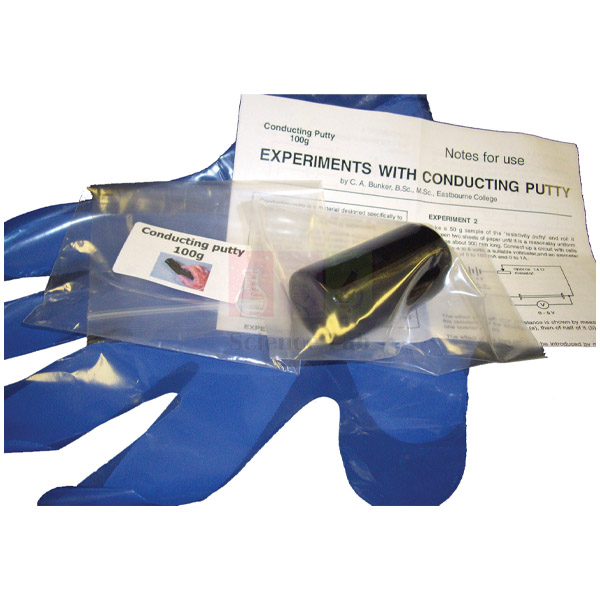
Conductive Putty
Conductive Putty (Product Code: SLE/PHY/38) is a mouldable conducting material used to teach resistivity and how the length and cross-sectional area of a conductor affect its resistance, in school and college physics labs. It comes as roughly 100 g of putty formed into a 60 mm long, 20 mm diameter cylinder of approximately 20 Ω that can be re-moulded to new shapes. It is supplied by Jain Scientific Equipments Pvt Ltd (ScienceLab), Ambala, India, as a hands-on addition to an Ohm's law experiment kit.
Specifications
| Parameter | Detail |
|---|---|
| Quantity | Approx. 100 g |
| Form supplied | Cylinder, 60 mm long and 20 mm in diameter |
| Resistance of cylinder | Approximately 20 Ω |
| Connection | Can readily be connected into an electrical circuit |
| Adjustability | Length and diameter changed by re-moulding the putty |
| Teaching use | Resistivity; effect of length and cross-sectional area on resistance |
| Product code | SLE/PHY/38 |
| Supplied by | Jain Scientific Equipments Pvt Ltd (ScienceLab), Ambala, India |
What Is Conductive Putty Used For?
Conductive putty turns the resistivity equation into something students can shape with their hands. Starting from the supplied cylinder, they measure its resistance, then roll it longer and thinner and measure again, or keep the length fixed and change the diameter. Plotting resistance against length, and against the inverse of cross-sectional area, shows the two relationships clearly and lets them estimate the material's resistivity.
For consistent readings, press the connecting probes or plates into the ends of the putty to the same depth each time, measure length and diameter carefully after every re-moulding, and keep the current small so the putty does not warm up. Work on a clean surface so dust and fibres are not folded into the material, and store it covered between lessons.
Supplier
Conductive Putty is supplied by Jain Scientific Equipments Private Limited, which trades as ScienceLab, from Ambala, Haryana, India. The company sources it for schools, colleges, dealers and importers and can include it in the same quotation as meters, leads and other resistance apparatus.
For details of pack quantities or combined orders, ask us, and see our company profile for more about ScienceLab.
Related Physics Lab Equipment
Tools and materials for a resistivity investigation with conductive putty:
- Standard Digital Multimeter — measures the putty's resistance after each change of shape.
- Caliper Vernier (Metal) — measures the diameter and length of the re-moulded putty.
- Crocodile Clips & Leads — connect the putty into the circuit.
- Conductive Paper — another conducting material for field and resistance work.
More items are in the Physics Lab Equipment category.
Frequently Asked Questions
How much Conductive Putty is supplied?
Conductive Putty is supplied as approximately 100 g, in the form of a cylinder 60 mm long and 20 mm in diameter. That starting shape has a resistance of approximately 20 ohms before students re-mould it.
What does Conductive Putty teach?
Conductive Putty is a teaching aid for resistivity and for the relationship between a conductor's length, its cross-sectional area and its resistance, because students can change both dimensions simply by re-moulding the putty and measuring again.
How is Conductive Putty connected into a circuit?
Conductive Putty can readily be connected into an electrical circuit by pressing leads, probes or contact plates into its ends. Keep the contact depth the same for each reading so that changes in resistance come from the shape, not the connections.
Who supplies Conductive Putty?
Conductive Putty is supplied by Jain Scientific Equipments Pvt Ltd (ScienceLab), Ambala, Haryana, India, to schools, colleges, dealers and importers, and can be quoted together with meters and leads for a complete resistivity practical.
How should Conductive Putty be stored?
Store Conductive Putty covered or in a closed container, away from heat and dust, so it stays clean and workable between lessons. For questions about keeping it for longer periods, please ask us through the contact page.
Can Conductive Putty be ordered in bulk or for export?
Yes, Conductive Putty can be ordered in class quantities by schools, dealers and importers, and ScienceLab supplies India and international markets. State the quantity and delivery location in your enquiry to receive a quotation.
Request a Quote
Request a quote for Conductive Putty through our contact page, or add it to the enquiry cart along with meters and leads for the same practical.
Last updated: 24 September 2026