- Physics Lab Equipment
- Chemistry Lab Equipment
- Biology Lab Equipment
- Anatomical Lab Equipment
- Learning
- Educational Lab Equipment
- Magnets
- Agriculture
- Astronomy
- Earth Science
- Geography Lab Equipment
- Safety Lab Coat
- Laboratory
- Meteorological
- Electricity & Magnetism
- Heat
- School Lab Equipment
- Lab Glassware
- Science Lab Equipment
- Tvet Lab Equipment
- Robotics Kits Supplier and Manufacturer for Schools India
- Math Lab Equipment Manufacturers and Exporters in Ambala
- STEM Kits Manufacturers and Supplier India
- Engineering Lab Equipment
- Hospital Lab Equipment
- Water, Sanitation & Hygiene Supplies
- Cold Chain, Solar & Communication Equipment
- Nutrition
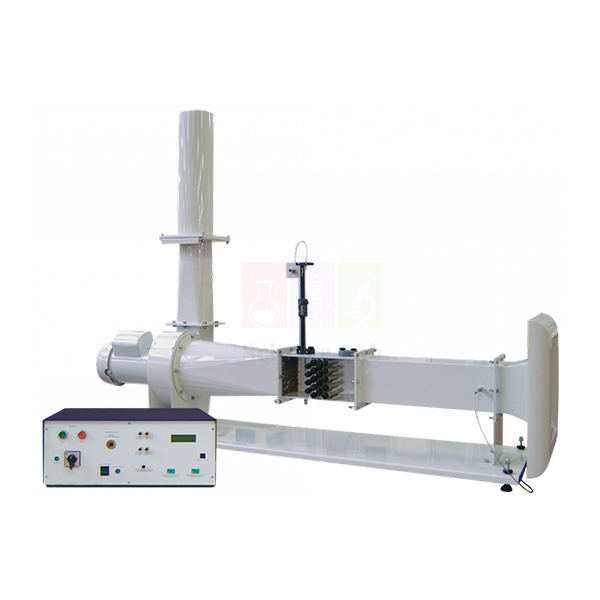
Cross Flow Heat Exchangers
Cross Flow Heat Exchangers (Product Code: SLE/EA/29) is a horizontal wind tunnel apparatus used to measure forced-convection heat transfer from a cylinder in a bank of rods in engineering heat transfer laboratories. Students replace any one rod of the working-section matrix with a copper element of known thermal capacity and a built-in thermocouple, then monitor how quickly it cools in the air flow. It is made by Jain Scientific Equipments Pvt Ltd (ScienceLab), an OEM supplying lab equipment for technical institutes, at its own factory in Ambala, India.
Specifications
| Parameter | Detail |
|---|---|
| Configuration | Horizontal wind tunnel |
| Tunnel sections | Contraction cone, working section, diffuser, constant speed fan and exhaust with silencer |
| Air flow control | Variable slide valve |
| Working section | Series of rods arranged in a matrix at right angles to the air flow; any one rod can be removed |
| Test element | Cylindrical copper element of known thermal capacity with a built-in thermocouple |
| Inlet air temperature | Second thermocouple at the wind tunnel inlet |
| Air velocity | Pitot traverse measuring velocity at any vertical point, before or after the rods |
| Pressure tappings | Two static pressure tappings in the base of the working section, one before and one after the rods |
| Product code | SLE/EA/29 |
| Manufacturer | Jain Scientific Equipments Pvt Ltd (ScienceLab) — OEM |
| Country of origin | India (made in Ambala, Haryana) |
What Is the Cross Flow Heat Exchanger Used For?
In a cross flow heat exchanger one fluid passes at right angles to tubes carrying the other, and this apparatus models the air side of that arrangement with a rod bank inside a wind tunnel. Students place the copper element in the rod matrix, set the air flow with the slide valve and log the element temperature as it cools, while the inlet thermocouple gives the temperature of the incoming air. Because the element's thermal capacity is known, its rate of cooling gives the forced-convection heat transfer rate quickly, without a long wait for steady conditions.
Moving the element to different positions in the matrix shows how upstream rods disturb the flow and change heat transfer deeper in the bank. The pitot traverse maps air velocity at any height before or after the rods, and the two static pressure tappings give the pressure difference across the bank, so students can relate heat transfer to flow and pressure loss. It gives mechanical and chemical engineering departments a practical link between heat transfer theory and measurement, alongside our other engineering lab equipment in India.
OEM Manufacturer
Jain Scientific Equipments Private Limited, trading as ScienceLab, is the OEM (original equipment manufacturer) of the Cross Flow Heat Exchangers apparatus and produces it at its own licensed factory at Saha, Ambala, Haryana, India. Because the wind tunnel, rod matrix and copper test element come from one manufacturer, questions about extra copper elements, replacement rods or repeat orders can be settled directly with the maker — just ask us. Universities, polytechnics, dealers and importers receive factory-direct quotations. More about the company is on the ScienceLab profile page.
Related Thermodynamics & Heat Transfer Lab Equipment
Buyers equipping a heat exchanger laboratory often add these items.
- Water To Air Heat Exchangers — a water-to-air exchanger with thermocouples on both fluid streams, for comparing a full exchanger with the single-element test.
- Parallel and Counter Flow Heat Exchanger — lets students compare parallel and counter flow arrangements with cross flow.
- Free and Force Convection Apparatus — convection from heating elements of different geometries in an air duct.
- Flow Visualisation Wind Tunnel — shows air flow patterns, complementing the pitot traverse readings.
View all items in the Thermodynamics & Heat Transfer Lab Equipment category.
Frequently Asked Questions
How does the Cross Flow Heat Exchangers apparatus measure heat transfer?
The Cross Flow Heat Exchangers apparatus measures heat transfer by monitoring how quickly a copper element of known thermal capacity, fitted with a built-in thermocouple, cools in the air flow; a second thermocouple at the tunnel inlet records the air temperature for the calculation.
Can the copper element be tested at different positions in the Cross Flow Heat Exchangers apparatus?
Yes. Students can remove any one rod from the matrix in the Cross Flow Heat Exchangers working section and replace it with the cylindrical copper element, so heat transfer can be compared at different positions within the rod bank.
How is air velocity controlled and measured in the Cross Flow Heat Exchangers apparatus?
On the Cross Flow Heat Exchangers apparatus a variable slide valve controls the air flow from the constant speed fan, and a pitot traverse measures air velocity at any vertical point in the working section, before or after the rods.
Can students measure the pressure drop across the rods?
Yes. The base of the Cross Flow Heat Exchangers working section has two static pressure tappings, one before the rods and one after, which let students measure the static pressure difference across the rod bank.
Who manufactures the Cross Flow Heat Exchangers apparatus?
Jain Scientific Equipments Pvt Ltd (ScienceLab) is the OEM that manufactures the Cross Flow Heat Exchangers apparatus at its own licensed factory at Saha, Ambala, Haryana, India; engineering colleges, dealers and importers buy it factory-direct.
Is a calibration certificate available for the Cross Flow Heat Exchangers apparatus?
Calibration-certificate availability for the Cross Flow Heat Exchangers apparatus, including its thermocouples, should be discussed with us before you place an order. Reach us through the contact page and we will clarify what documentation can come with the quotation.
Is the Cross Flow Heat Exchangers apparatus available for export?
Yes, the Cross Flow Heat Exchangers apparatus is offered to buyers in India and international markets. Include product code SLE/EA/29, the number of units and the delivery destination in your enquiry so the manufacturer can prepare an accurate quotation.
Request a Quote
Request a Cross Flow Heat Exchangers quotation straight from the manufacturer through the contact page, or save the item to your enquiry cart while you plan the rest of your heat transfer lab.
Last updated: 24 September 2026