- Physics Lab Equipment
- Chemistry Lab Equipment
- Biology Lab Equipment
- Anatomical Lab Equipment
- Learning
- Educational Lab Equipment
- Magnets
- Agriculture
- Astronomy
- Earth Science
- Geography Lab Equipment
- Safety Lab Coat
- Laboratory
- Meteorological
- Electricity & Magnetism
- Heat
- School Lab Equipment
- Lab Glassware
- Science Lab Equipment
- Tvet Lab Equipment
- Robotics Kits Supplier and Manufacturer for Schools India
- Math Lab Equipment Manufacturers and Exporters in Ambala
- STEM Kits Manufacturers and Supplier India
- Engineering Lab Equipment
- Hospital Lab Equipment
- Water, Sanitation & Hygiene Supplies
- Cold Chain, Solar & Communication Equipment
- Nutrition
Thermodynamics & heat transfer lab equipment is the apparatus that mechanical and chemical engineering colleges, polytechnics and technical institutes use for thermal-engineering practicals: heat exchangers, conduction, convection and radiation, boiling and condensation, refrigeration and air conditioning, compressors and the gas laws. Jain Scientific Equipments Pvt Ltd (ScienceLab), Ambala is the OEM that manufactures this engineering lab equipment at its own licensed factory in Ambala. The range lists 35 products, from bench-top gas-law units to computerized test benches that send readings to a PC.
What Does the Thermodynamics & Heat Transfer Range Include?
| Topic | What it covers | Example products |
|---|---|---|
| Heat exchangers | Parallel, counter and cross flow; shell-and-tube, plate, concentric-tube, jacketed-vessel and water-to-air designs | Plate Heat Exchanger, Concentric Tube Heat Exchanger, Jacketed Vessel and Coil, Water To Air Heat Exchangers |
| Conduction | Radial conduction, fins and extended surfaces, insulating powders, liquids and gases | Heat Transfer (base unit, supplied), Radial Heat Conduction Experiment, Computerized Thermal Conductivity of Powder |
| Convection and radiation | Free and forced convection, emissivity, radiation isolated under vacuum, transient heating of test shapes | Computerized Emissivity Measurement Apparatus, Emissivity Natural Convection And Radiation, Unsteady State Heat Transfer |
| Boiling, condensation and steam | Boiling regimes, film-wise and dropwise condensation, saturated steam, dryness fraction and a small steam plant | Filmwise And Dropwise Condensation And Boiling, Thermal Power Plant with Steam Engine Trainer |
| Refrigeration and air conditioning | Absorption refrigeration, ice plant, air treatment, cooling towers, refrigerant charging and compressor construction | Computerized ICE Plant Trainer (supplied), Computerized Cooling Tower Test Bench, Gas Charging Trainer |
| Compressors and blowers | Rotary and two-stage air compression, radial blower performance | Rotary Air Compressor Test Bench, Air Blower Test Setup |
| Gas laws and temperature measurement | Pressure, volume and temperature of air; thermometer calibration | Boyle’s Law, Gay-Lussac’s Law, Temperature Measurement and Calibration Apparatus |
Featured Thermodynamics & Heat Transfer Lab Equipment
| Product | Product Code | Typical Use |
|---|---|---|
| Parallel and Counter Flow Heat Exchanger | SLE/MCE/74 | Parallel versus counter flow and the heat transfer coefficient, with data-acquisition software |
| Shell and Tube Heat Exchanger | SLE/EA/14 | Studying the baffled shell-and-tube design widely used in industry |
| Computerized Boiling Heat Transfer Apparatus | SLE/MCE/70 | Observing evaporation at a heated cylinder, with readings sent to a PC |
| Free and Force Convection Apparatus | SLE/MCE/73 | Heat transfer from heating elements of four geometries in an air duct |
| Air Conditioning System Trainer | SLE/MCE/82 | Cooling, heating and humidifying air against sensible and latent loads |
| Vapour Absorption Refrigeration Trainer | SLE/MCE/84 | Heat-driven refrigeration with an ammonia-water working medium |
| Two Stage Compressor Test Set | SLE/EA/09 | Single-stage, two-stage and intercooled compressor performance |
| Saturated Steam The Marcet Boiler | SLE/EA/21 | Saturated steam pressure versus temperature |
OEM Manufacturing & Supply
ScienceLab (Jain Scientific Equipments Private Limited) is the OEM for this thermal-engineering range and manufactures most of it at its own licensed factory at 449, HSIIDC Industrial Area, Saha, Ambala, Haryana; two items, the Computerized ICE Plant Trainer and the Heat Transfer base unit, are supplied rather than made at the factory. Engineering colleges, polytechnics, TVET institutes, dealers, tender buyers and importers in India and international markets buy factory-direct, with quotations straight from the manufacturer. The company is a registered MSME (Udyam UDYAM-HR-01-0003714), and its production site holds Factory Licence AMB-ONLINE-CHD-J-414.
Related Ranges
- Engineering Lab Equipment – the parent hub.
- Heat – school physics apparatus such as Leslie's Cube and Thermal Conductivity Bars for first heat lessons; this range serves degree and diploma thermal labs.
- Fluid Mechanics – pumps, turbines and pipe flow for the same thermal-fluids lab.
- Aerodynamics Lab Equipment – wind tunnels and nozzles for air-flow studies.
- Automotive Training Equipment – engine test benches, an exhaust gas calorimeter and a gas turbine.
- Power & Energy Systems Trainers – includes solar thermal collectors.
Frequently Asked Questions
What does the Thermodynamics & Heat Transfer Lab Equipment range include?
The Thermodynamics & Heat Transfer Lab Equipment range lists 35 products: heat exchangers, conduction, convection and radiation experiments, boiling and steam apparatus, refrigeration and air-conditioning trainers, compressor and blower benches, and gas-law units.
How is this range different from the Heat category?
Thermodynamics and heat transfer lab equipment is built for engineering heat-transfer, thermodynamics and refrigeration labs, with instrumented benches and measured flows. The Heat category holds simpler school physics apparatus for first lessons on conduction, convection and radiation.
Who manufactures ScienceLab thermodynamics and heat transfer apparatus?
Jain Scientific Equipments Private Limited, trading as ScienceLab, manufactures most of its thermodynamics and heat transfer apparatus at its licensed factory in Saha, Ambala, and supplies the Computerized ICE Plant Trainer and the Heat Transfer base unit. It quotes directly to institutions, dealers and importers.
Can a complete heat transfer lab be ordered together?
Yes. Thermodynamics and heat transfer lab equipment can be quoted as one lab, for example the Heat Transfer base unit with the Radial Heat Conduction Experiment and Extended Surface Heat Transfer modules that connect to it, plus heat exchangers.
What should a quotation request include?
A quotation request for thermodynamics and heat transfer lab equipment should list product codes (for example SLE/EA/14), quantities, the delivery destination and any tender specification, so the offer matches your laboratory plan.
Request a Quote or Catalogue
Send your experiment list through the contact page, or add products to the enquiry cart and submit it for a quotation or catalogue.
Last updated: 24 September 2026
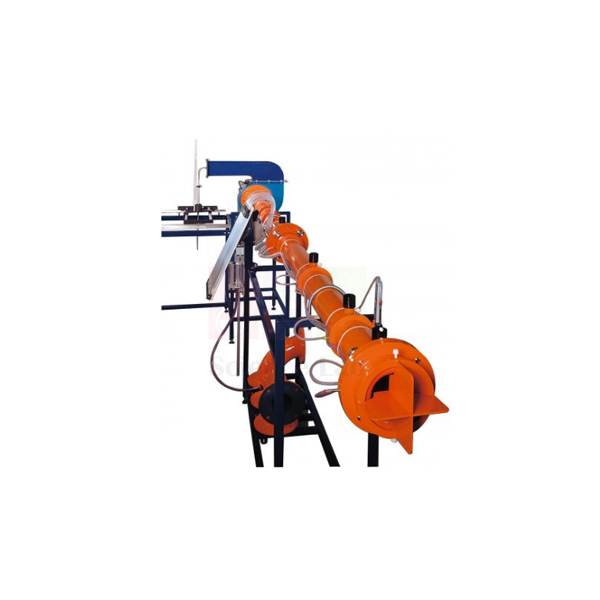
Air Blower Test Setup
Air Blower Test Setup (Product Code: SLE/MCE/57) is a radial-fan test rig used to measure the flow rate, pressure head and performance of an air blower in mechanical engineering and fluid machinery laboratories. As engineering lab equipment for colleges and polytechnics, it stands out for measuring airflow four ways — venturi nozzle, orifice plate, inlet cone and travelling pitot tube — against twin inclined water manometers. It is made by Jain Scientific Equipments Pvt Ltd (ScienceLab), an OEM manufacturer, at its own factory in Ambala, India.
Specifications
| Parameter | Detail |
|---|---|
| Fan type | Radial fan: air is drawn in axially to the drive shaft, deflected by 90° by the rotating rotor and discharged radially |
| Maximum flow rate (unchoked) | Over 12 m³/min |
| Maximum head (fully choked) | Over 80 mm water |
| Inlet duct | With flow straightener |
| Outlet duct | With flow straightener and damper |
| Airflow measurement | Venturi nozzle, orifice plate, inlet cone and travelling pitot tube using an inclined water manometer |
| Differential pressure measurement | Twin inclined water manometers, 0–450 mm with 1 mm graduation; multiple slope 1:10, 1:5, 1:2 and 1:1 |
| Accessories | Thermometer and barometer |
| Power supply | 220 V, single phase, 50 Hz |
| Product code | SLE/MCE/57 |
| Manufacturer | Jain Scientific Equipments Pvt Ltd (ScienceLab) — OEM |
| Country of origin | India (made in Ambala, Haryana) |
What Is the Air Blower Test Setup Used For?
Students run the blower at a series of damper settings, from fully open to fully choked, and record volume flow and pressure at each point to plot the fan characteristic (head against flow). The rig spans an unchoked flow of over 12 m³/min and a fully choked head of over 80 mm of water, so the whole curve can be drawn in one practical. Because the same airflow can be read on the venturi nozzle, orifice plate, inlet cone and travelling pitot tube, it also doubles as a lesson in comparing flow-measurement devices.
The thermometer and barometer let students correct air density for room conditions before calculating flow. Choose the manometer slope (1:10 down to 1:1) to suit the size of the reading, level the manometers before each run and let the fan settle after every damper change. Radial fans of this kind move gases where pressure differences are moderate, which makes the setup a good fit for ventilation and air-handling topics.
What to Specify When Ordering
- Number of test setups needed for the fluid machinery or thermal laboratory
- Confirmation that a 220 V, 50 Hz single-phase supply is available at the installation point
- The syllabus experiments you plan to run, so the quotation can confirm the measuring devices included
OEM Manufacturer
Jain Scientific Equipments Private Limited, which trades as ScienceLab, is the original equipment manufacturer (OEM) of the Air Blower Test Setup. The rig is made at the company’s own licensed factory at Saha, Ambala, Haryana, rather than sourced from a trader, and goes factory-direct to engineering colleges, polytechnics, dealers and importers in India and international markets.
For institutional vendor registration, the company’s GST registration is GSTIN 06AAECJ8618A1ZT and its global Legal Entity Identifier is LEI 3358004HRD1JIVXKYX49. Replacement parts or repeat orders? Ask us — the manufacturer handles them itself. Company details are on the ScienceLab profile page.
Related Thermodynamics & Heat Transfer Lab Equipment
Air-machine and airflow practicals often continue on these rigs from the same range:
- Rotary Air Compressor Test Bench — contrasts a positive-displacement rotary compressor with the blower’s low-pressure fan
- Two Stage Compressor Test Set — extends the study to staged compression and intercooling
- Free and Force Convection Apparatus — uses a fan-driven air duct to study heat transfer from heated surfaces
- Computerized Cooling Tower Test Bench — another rig where fan airflow is measured through an orifice
Browse the full Thermodynamics & Heat Transfer Lab Equipment category for compressors, heat exchangers and refrigeration trainers.
Frequently Asked Questions
What flow rate and head does the Air Blower Test Setup reach?
The Air Blower Test Setup delivers a maximum flow rate of over 12 m³/min with the outlet unchoked and a maximum head of over 80 mm of water when fully choked, giving students a wide range of operating points for the fan curve.
How is airflow measured on the Air Blower Test Setup?
Airflow on the Air Blower Test Setup can be measured with a venturi nozzle, an orifice plate, an inlet cone and a travelling pitot tube read on an inclined water manometer, so the methods can be compared against each other in one session.
What range do the manometers of the Air Blower Test Setup cover?
The Air Blower Test Setup uses twin inclined water manometers with a 0–450 mm scale and 1 mm graduation. Their multiple slope settings of 1:10, 1:5, 1:2 and 1:1 magnify small pressure differences for easier reading.
What power supply does the Air Blower Test Setup need?
The Air Blower Test Setup runs on a 220 V, 50 Hz single-phase supply. If your laboratory uses a different voltage or frequency, mention it in your enquiry so the requirement can be discussed before a quotation is issued.
Who manufactures the Air Blower Test Setup?
The Air Blower Test Setup is manufactured by Jain Scientific Equipments Pvt Ltd (ScienceLab), the OEM, at its own factory in Saha, Ambala, Haryana, India. Quotations, spares enquiries and repeat orders are handled directly by the manufacturer.
Is a calibration certificate available for the Air Blower Test Setup?
Calibration-certificate availability for the Air Blower Test Setup and its manometers should be discussed with us when you request a quotation. Please mention the documentation your institution needs through our contact page.
Do you supply the Air Blower Test Setup in bulk or for export?
Yes. The Air Blower Test Setup is supplied to engineering colleges, polytechnics, training institutes and dealers across India and international markets. For bulk or export orders, share the quantity and destination so we can prepare the quotation.
Request a Quote
To request a quotation for the Air Blower Test Setup, send your quantity and delivery location through the contact page or add the item to the enquiry cart. Quotations come directly from the manufacturer in Ambala.
Last updated: 24 September 2026
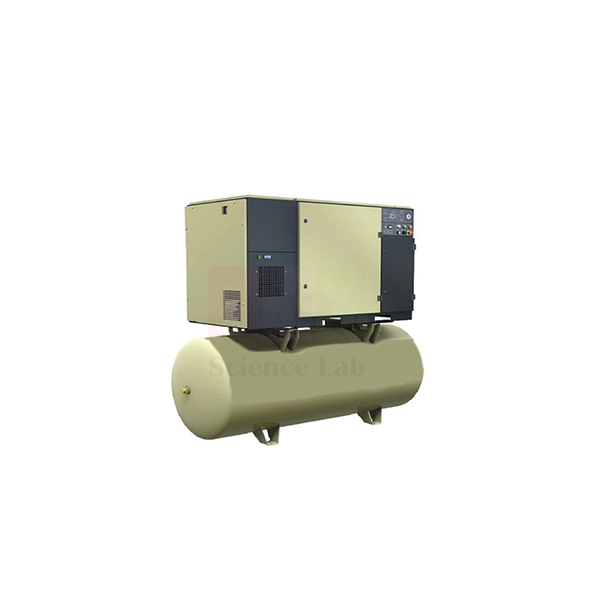
Rotary Air Compressor Test Bench
Rotary Air Compressor Test Bench (Product Code: SLE/MCE/58) is a laboratory test rig built around a rotary vane compressor, used to determine volumetric efficiency, power consumption and free air discharge in thermal engineering practicals. Mechanical engineering departments pick this technical educational equipment because intake airflow, discharge pressure and electrical input are all measured on one bench, with data acquisition software and USB transfer to a PC included. It is made by Jain Scientific Equipments Pvt Ltd (ScienceLab), an OEM manufacturer, at its own factory in Ambala, India.
Specifications
| Parameter | Detail |
|---|---|
| Compressor | Rotary vane compressor driven by a 3 HP motor |
| Air intake measurement | Calibrated orifice meter with water manometer |
| Discharge pressure | Measured by a pressure gauge |
| Power input | Measured by an energy meter |
| Delivery control | Control valve on the delivery side |
| Timing | Stop clock |
| Other measured values | Air throughput and electrical power consumption; pressures and temperatures recorded by sensors |
| Display | Measured values shown on digital displays |
| Data acquisition | Software included; measured values can be transmitted directly to a PC via USB |
| Safety devices | Pressure relief valves and pressure switches |
| Dimensions | 1500 × 1500 × 1250 mm |
| Weight | 320 kg (approx.) |
| Product code | SLE/MCE/58 |
| Manufacturer | Jain Scientific Equipments Pvt Ltd (ScienceLab) — OEM |
| Country of origin | India (made in Ambala, Haryana) |
What Is the Rotary Air Compressor Test Bench Used For?
The bench lets students run a rotary vane compressor at several delivery pressures, set with the control valve, and calculate volumetric efficiency, input power and free air delivered at each one. Intake air is measured with the calibrated orifice meter and water manometer, discharge pressure is read on the gauge, and the energy meter together with the stop clock gives the electrical input over a timed run.
Logging readings to a PC over USB with the included data acquisition software makes it quicker to plot efficiency and power against delivery pressure. Before each session, confirm that the pressure relief valves and pressure switches are working, allow the compressor to settle after every valve change, and clear any air bubbles from the manometer lines so intake readings stay accurate.
What to Specify When Ordering
- Number of benches, and floor space for a 1500 × 1500 × 1250 mm unit weighing about 320 kg
- The electrical supply available at the bench location for the 3 HP motor, so it can be confirmed in the quotation
- Whether you will connect your own PC by USB for the included data acquisition software
OEM Manufacturer
ScienceLab is the trading name of Jain Scientific Equipments Private Limited, the OEM for the Rotary Air Compressor Test Bench. The bench is manufactured at the company’s licensed factory at Saha, Ambala, Haryana, and supplied from there to universities, engineering colleges, dealers and importers without a trading intermediary.
When you need replacement parts or additional benches later, ask us and the manufacturer will respond itself. Learn more about the company on the ScienceLab profile.
Related Thermodynamics & Heat Transfer Lab Equipment
Compressor and air-machine laboratories usually pair this bench with the following:
- Two Stage Compressor Test Set — reciprocating two-stage machine with intercooling for comparison with the single rotary vane unit
- Air Blower Test Setup — a low-pressure radial fan for contrasting fans with compressors
- Cut Section Model Of Rotary Hermetic Compressor — shows the inside of another rotary compressor design
- Modular Air Flow Bench — for extending airflow measurement into aerodynamics experiments
See the complete Thermodynamics & Heat Transfer Lab Equipment category for more thermal and air-machine trainers.
Frequently Asked Questions
What can students measure on the Rotary Air Compressor Test Bench?
On the Rotary Air Compressor Test Bench students measure intake airflow, discharge pressure, electrical power input, air throughput, pressures and temperatures, then calculate volumetric efficiency, power consumption and free air discharge of the rotary vane compressor.
What drives the compressor on the Rotary Air Compressor Test Bench?
The Rotary Air Compressor Test Bench uses a rotary vane compressor driven by a 3 HP motor. Delivery pressure is varied with a control valve on the delivery side, and the input power is measured with an energy meter.
Is software included with the Rotary Air Compressor Test Bench?
Yes. Data acquisition software is included with the Rotary Air Compressor Test Bench, and measured values can be transmitted directly to a PC via USB while also appearing on the bench’s digital displays.
What safety devices are fitted to the Rotary Air Compressor Test Bench?
The Rotary Air Compressor Test Bench is equipped with pressure relief valves and pressure switches. Staff should confirm both are working before each practical session, as they protect students and the compressor if delivery pressure rises too far.
How large and heavy is the Rotary Air Compressor Test Bench?
The Rotary Air Compressor Test Bench measures 1500 × 1500 × 1250 mm and weighs about 320 kg, so plan floor space, door access and handling equipment before delivery to the laboratory.
Who manufactures the Rotary Air Compressor Test Bench?
Jain Scientific Equipments Pvt Ltd (ScienceLab) manufactures the Rotary Air Compressor Test Bench as the OEM at its own factory in Saha, Ambala, Haryana, India, and quotes directly to institutions, dealers and importers.
Can a calibration certificate be supplied with the Rotary Air Compressor Test Bench?
Whether a calibration certificate can accompany the Rotary Air Compressor Test Bench or its orifice meter should be discussed with us at the enquiry stage. Tell us your documentation needs through the contact page.
Request a Quote
For a quotation on the Rotary Air Compressor Test Bench, share the number of benches and your delivery location via the contact page, or place it in the enquiry cart. You will receive the quote straight from the manufacturer.
Last updated: 24 September 2026
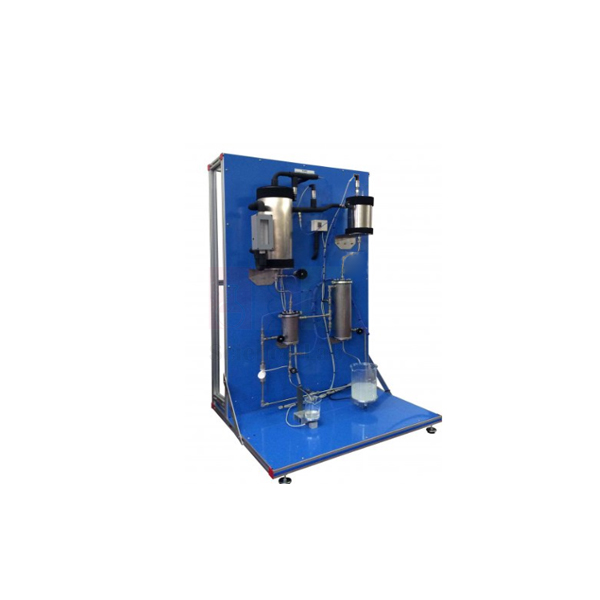
Separating & Throttling Calorimeter with mini boiler Test Bench
Separating & Throttling Calorimeter with mini boiler Test Bench (Product Code: SLE/MCE/59) is a steam-quality test bench, part of ScienceLab’s engineering lab equipment range, used to determine the vapour content (dryness fraction) of wet steam in thermodynamics laboratories. Students use it to find how much liquid a steam sample carries, with a downstream throttling calorimeter covering vapour contents from x = 0.95 to x = 1. It is made by Jain Scientific Equipments Pvt Ltd (ScienceLab), an OEM manufacturer, at its own factory in Ambala, India.
Specifications
| Parameter | Detail |
|---|---|
| Measuring principle | Separating calorimeter and downstream throttling calorimeter, used together to determine vapour content |
| Throttling calorimeter range | Vapour content x = 0.95 to 1 |
| Condensate collection | Water-cooled condenser; liquefied vapour collected in a measuring cup |
| Sensors | Pressure and temperature measured before and after depressurisation |
| Temperature | 240 °C |
| Pressure | 10 bar |
| Safety valve | 10 bar |
| Measuring range – temperature | 0–400 °C |
| Measuring range – inlet pressure | 0–16 bar |
| Measuring range – outlet pressure | −150 to 100 mbar |
| Dimensions | 800 × 800 × 1700 mm |
| Weight | 110 kg (approx.) |
| Power supply options | 230 V, 50 Hz, 1 phase; 230 V, 60 Hz, 1 phase; or 120 V, 60 Hz, 1 phase |
| Product code | SLE/MCE/59 |
| Manufacturer | Jain Scientific Equipments Pvt Ltd (ScienceLab) — OEM |
| Country of origin | India (made in Ambala, Haryana) |
What Is the Throttling Calorimeter Test Bench Used For?
Vapour content x is the ratio of vapour mass to total mass: x = 0 means the medium is completely liquid, x = 1 means dry saturated vapour, and any value in between describes wet vapour with a variable liquid content. On this bench the mini boiler supplies steam, the separating calorimeter removes part of the liquid, and the remaining vapour is depressurised, liquefied in the water-cooled condenser and collected in a measuring cup. The two collected quantities give the vapour mass and total mass from which x is calculated.
Pressure and temperature readings before and after throttling let students find the vapour content on the h-s (Mollier) diagram and cross-check the mass-based result. The same devices are used in steam power plants, downstream of steam turbines or at steam boilers upstream of the superheater, so the practical links classroom theory with plant measurement. Let the boiler reach steady conditions before sampling and measure the condensate carefully, because small errors strongly affect the calculated dryness fraction.
What to Specify When Ordering
- Power supply version: 230 V/50 Hz, 230 V/60 Hz or 120 V/60 Hz, single phase
- Floor space and headroom for an 800 × 800 × 1700 mm bench of about 110 kg
- Cooling-water availability for the water-cooled condenser
- Number of benches required for the laboratory
OEM Manufacturer
This calorimeter bench is an OEM product of Jain Scientific Equipments Private Limited, the company behind the ScienceLab name. It is manufactured at the company’s own licensed factory in Saha, Ambala, Haryana, India, so engineering colleges, dealers and importers deal directly with the maker rather than a reseller.
Questions about spares or a second bench are answered by the manufacturer itself — just ask us. More about the company is on the ScienceLab profile.
Related Thermodynamics & Heat Transfer Lab Equipment
Steam and phase-change practicals often combine this bench with these units:
- Saturated Steam The Marcet Boiler — shows the pressure–temperature relationship of saturated steam
- Thermal Power Plant with Steam Engine Trainer — places steam quality in the context of a complete steam cycle
- Film wise And Dropwise Condensation And Boiling — studies the condensation process used in the calorimeter’s condenser
- Temperature Measurement and Calibration Apparatus — for checking temperature sensors before steam tests
The Thermodynamics & Heat Transfer Lab Equipment category lists the full range of steam, heat transfer and refrigeration apparatus.
Frequently Asked Questions
What does the Separating & Throttling Calorimeter with mini boiler Test Bench measure?
The Separating & Throttling Calorimeter with mini boiler Test Bench measures the vapour content, or dryness fraction, of wet steam. Separated liquid, condensed vapour and pressure–temperature readings before and after throttling are used to calculate x.
What vapour-content range does the throttling calorimeter cover?
The downstream throttling calorimeter on the Separating & Throttling Calorimeter with mini boiler Test Bench determines vapour contents between x = 0.95 and x = 1; the separating calorimeter handles the liquid removal that comes before the throttling stage.
What are the measuring ranges of this calorimeter test bench?
The Separating & Throttling Calorimeter with mini boiler Test Bench measures temperature from 0 to 400 °C, inlet pressure from 0 to 16 bar and outlet pressure from −150 to 100 mbar. The listed temperature is 240 °C, and the safety valve is listed at 10 bar.
Which power supplies are available for the calorimeter test bench?
The Separating & Throttling Calorimeter with mini boiler Test Bench is listed for 230 V 50 Hz, 230 V 60 Hz or 120 V 60 Hz single-phase supply. State your laboratory supply when you enquire so the correct version is quoted.
Who manufactures the Separating & Throttling Calorimeter with mini boiler Test Bench?
Jain Scientific Equipments Pvt Ltd (ScienceLab) is the OEM of the Separating & Throttling Calorimeter with mini boiler Test Bench and builds it at its own factory at Saha, Ambala, India. Quotations and after-sales questions come straight from the manufacturer.
Is a calibration certificate available for the bench’s sensors?
Calibration-certificate availability for the temperature and pressure sensors on the Separating & Throttling Calorimeter with mini boiler Test Bench should be discussed with us before ordering. Send your documentation requirements through the contact page.
What information does a quotation for this test bench need?
To quote the Separating & Throttling Calorimeter with mini boiler Test Bench, we need the quantity, the power supply version, the delivery location and whether the order is for India or international markets.
Request a Quote
Ask for a quotation on the Separating & Throttling Calorimeter with mini boiler Test Bench through the contact page, or add it to the enquiry cart together with other laboratory items. Your quotation is prepared directly by the manufacturer.
Last updated: 24 September 2026
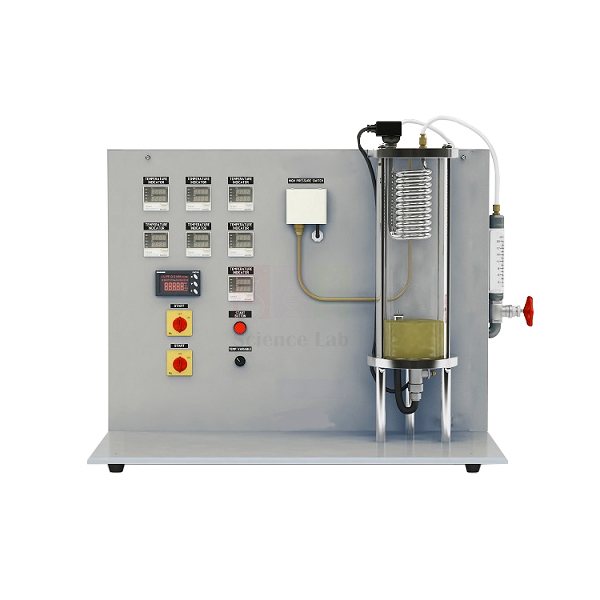
Computerized Boiling Heat Transfer Apparatus
Computerized Boiling Heat Transfer Apparatus (Product Code: SLE/MCE/70) is a bench unit used to observe and measure boiling heat transfer on a heated surface in engineering heat transfer laboratories. Colleges choose this engineering educational equipment in India because its transparent process tank shows evaporation on a heated cylinder that models a fire tube, while sensor data can be sent to a PC via USB. It is made by Jain Scientific Equipments Pvt Ltd (ScienceLab), an OEM manufacturer, at its own factory in Ambala, India.
Specifications
| Parameter | Detail |
|---|---|
| Process tank | Transparent, for clear observation of evaporation at the heated cylinder; tank 10 L |
| Heated cylinder | Model of a fire tube heated from the inside |
| Heater power | 250 W, continuously adjustable |
| Heater surface area | 0.001875 m² |
| Diameter | 80 mm |
| Surface area | 0.0578 m² |
| Cooler | Copper coil; integrated water-cooled condenser for a continuous boiling process |
| Working liquid | Special liquid that evaporates at low temperatures |
| Safety valve | Opens at 2.2 bar |
| Measuring range – pressure | 0–4 bar absolute |
| Measuring range – flow rate | 0.05–1.8 L/min |
| Measuring range – temperature (thermocouple) | 0–200 °C |
| Display and data | Digital displays; values can be transmitted directly to a PC via USB |
| Power supply | 230 V, 50/60 Hz, 1 phase or 120 V, 60 Hz, 1 phase |
| Dimensions | 900 × 450 × 820 mm (approx.) |
| Weight | 60 kg (approx.) |
| Product code | SLE/MCE/70 |
| Manufacturer | Jain Scientific Equipments Pvt Ltd (ScienceLab) — OEM |
| Country of origin | India (made in Ambala, Haryana) |
What Is the Boiling Heat Transfer Apparatus Used For?
Students raise the heater power in steps and watch through the transparent tank as the low-boiling special liquid begins to form bubbles on the heated cylinder. At each setting they record heater power and the temperature difference between the heated surface and the liquid, then plot a boiling curve and estimate heat transfer coefficients. Because the cylinder represents a fire tube heated from inside, the results connect directly to boiler design topics.
The integrated water-cooled condenser turns the vapour back into liquid, so boiling can continue for as long as the experiment needs. Pressure, flow rate and thermocouple temperatures are recorded together, which also lets students explore how boiling temperature follows system pressure. Make sure cooling water is flowing before switching on the heater, and keep the safety valve (opening at 2.2 bar) unobstructed.
What to Specify When Ordering
- Power supply version: 230 V 50/60 Hz or 120 V 60 Hz, single phase
- Cooling-water availability at the bench for the condenser
- Whether a PC is available at the bench for USB data transfer
- Number of units for the heat transfer laboratory
OEM Manufacturer
As the original equipment manufacturer, Jain Scientific Equipments Private Limited — known to customers as ScienceLab — produces the Computerized Boiling Heat Transfer Apparatus at its licensed factory in Saha, Ambala, Haryana. Institutions buy it factory-direct, and dealers or importers receive quotations from the maker itself rather than through a trading chain.
For replacement parts or repeat units, ask us and the manufacturing team will reply. Read about the company on the ScienceLab company profile.
Related Thermodynamics & Heat Transfer Lab Equipment
Phase-change and steam experiments continue naturally on these units:
- Film wise And Dropwise Condensation And Boiling — the companion study of condensation modes alongside boiling
- Saturated Steam The Marcet Boiler — relates saturation pressure and temperature
- Separating & Throttling Calorimeter with mini boiler Test Bench — measures the quality of steam produced by boiling
- Temperature Measurement and Calibration Apparatus — for checking thermocouples used in heat transfer work
Explore the whole Thermodynamics & Heat Transfer Lab Equipment category for conduction, convection and radiation apparatus.
Frequently Asked Questions
What can be observed with the Computerized Boiling Heat Transfer Apparatus?
The Computerized Boiling Heat Transfer Apparatus lets students watch evaporation on a heated cylinder through a transparent process tank. The cylinder models a fire tube heated from inside, and a special liquid that boils at low temperatures makes the process visible at modest heater power.
How much heater power does the Computerized Boiling Heat Transfer Apparatus have?
The Computerized Boiling Heat Transfer Apparatus has a 250 W heater that is continuously adjustable, so heat input can be raised in small steps to record how the boiling process changes with heat flux.
Can data from the Computerized Boiling Heat Transfer Apparatus be logged on a PC?
Yes. Measured values on the Computerized Boiling Heat Transfer Apparatus appear on digital displays and can also be transmitted directly to a PC via USB, which makes recording and plotting of results much quicker.
What are the measuring ranges of the Computerized Boiling Heat Transfer Apparatus?
The Computerized Boiling Heat Transfer Apparatus measures pressure from 0 to 4 bar absolute, flow rate from 0.05 to 1.8 L/min and thermocouple temperature from 0 to 200 °C. Its safety valve opens at 2.2 bar.
How big is the Computerized Boiling Heat Transfer Apparatus?
The Computerized Boiling Heat Transfer Apparatus measures about 900 × 450 × 820 mm and weighs about 60 kg, so it can sit on a sturdy laboratory bench close to cooling water and a power outlet.
Who manufactures the Computerized Boiling Heat Transfer Apparatus?
The Computerized Boiling Heat Transfer Apparatus is made by Jain Scientific Equipments Pvt Ltd (ScienceLab), the OEM, at its own factory in Ambala, Haryana, India. Institutions and importers buy directly from the manufacturer.
Is the Computerized Boiling Heat Transfer Apparatus available for export?
Yes. The Computerized Boiling Heat Transfer Apparatus is supplied to engineering institutions in India and international markets, with 230 V and 120 V single-phase versions listed. Share your destination and supply voltage when requesting a quotation.
Request a Quote
Send your enquiry for the Computerized Boiling Heat Transfer Apparatus through the contact page or collect it with other items in the enquiry cart. The quotation will come straight from the manufacturer.
Last updated: 24 September 2026
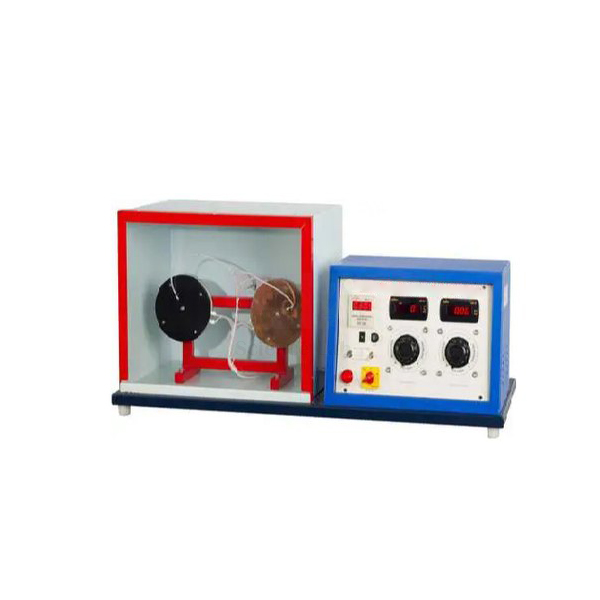
Computerized Emissivity Measurement Apparatus
Computerized Emissivity Measurement Apparatus (Product Code: SLE/MCE/71) is a thermal radiation experiment unit used to compare how strongly different metal surfaces emit heat in heat transfer and thermal engineering laboratories. Colleges looking for a radiation experiment kit at degree level choose it for its 20 mm aluminium, steel and copper samples with different finishes, heated by a 150 W halogen lamp focused through a parabolic reflector. It is made by Jain Scientific Equipments Pvt Ltd (ScienceLab), an OEM manufacturer, at its own factory in Ambala, India.
Specifications
| Parameter | Detail |
|---|---|
| Heat source | Continuously adjustable halogen lamp with parabolic reflector; electrical power 150 W |
| Maximum temperature | Approx. 560 °C |
| Sample position | On a thermocouple at the focal point of the reflector |
| Radiation detector | Thermopile mounted on a moveable carriage for measurements at different distances |
| Aluminium samples, Ø 20 mm | 1 × matt anodised on both sides; 1 × nickel-plated; 1 × heavily oxidised |
| Steel samples, Ø 20 mm | 1 × heavily oxidised; 1 × painted on both sides; 1 × matt anodised with one painted side |
| Copper samples | Ø 20 mm |
| Measuring range – temperature | 0–780 °C |
| Measuring range – radiation intensity | 0–1250 W/m² |
| Dimensions | 700 × 450 × 400 mm |
| Weight | Approx. 20 kg |
| Power supply options | 230 V, 50 Hz, 1 phase; 230 V, 60 Hz, 1 phase; or 120 V, 60 Hz, 1 phase |
| Product code | SLE/MCE/71 |
| Manufacturer | Jain Scientific Equipments Pvt Ltd (ScienceLab) — OEM |
| Country of origin | India (made in Ambala, Haryana) |
What Is the Emissivity Measurement Apparatus Used For?
Heat radiation is one of the three basic forms of heat transfer; unlike conduction and convection it travels as electromagnetic waves and can even cross a vacuum. In this apparatus a metallic sample sits on a thermocouple at the focal point of the reflector, is heated by the concentrated halogen beam, and the radiation it gives off is picked up by a thermopile. Comparing readings for anodised, nickel-plated, oxidised and painted samples at the same temperature shows students clearly how surface finish controls emissivity.
Moving the thermopile carriage to different distances lets the class examine how measured radiation intensity changes with distance from the sample. For consistent results, let each sample reach a steady temperature before reading, keep the thermopile face clean, and change hot samples only with tongs after the lamp has been switched off.
What to Specify When Ordering
- Power supply version: 230 V 50 Hz, 230 V 60 Hz or 120 V 60 Hz, single phase
- Whether extra aluminium, steel or copper samples are wanted for parallel student groups
- Number of units for the heat transfer laboratory
OEM Manufacturer
Jain Scientific Equipments Private Limited, which trades under the ScienceLab name, is the OEM of this emissivity apparatus. It manufactures the unit at its own licensed factory at Saha, Ambala, in Haryana, and sells it directly to universities, polytechnic institutes, laboratory dealers and importers.
Because you deal with the manufacturer, questions about replacement samples, halogen lamps or extra units go straight to the people who build it — simply ask us. Background on the company is available on the ScienceLab profile page.
Related Thermodynamics & Heat Transfer Lab Equipment
To cover all three modes of heat transfer, laboratories often add these units:
- Emissivity Natural Convection And Radiation — looks at radiation together with natural convection losses
- Free and Force Convection Apparatus — the convection counterpart, with four selectable heating elements
- Computerized Thermal Conductivity of Powder — the conduction counterpart, using concentric spheres
- Temperature Measurement and Calibration Apparatus — for checking thermocouples before radiation tests
Visit the Thermodynamics & Heat Transfer Lab Equipment category for the full list of heat transfer trainers.
Frequently Asked Questions
What samples come with the Computerized Emissivity Measurement Apparatus?
The Computerized Emissivity Measurement Apparatus lists 20 mm diameter samples: aluminium (matt anodised on both sides, nickel-plated, heavily oxidised), steel (heavily oxidised, painted on both sides, matt anodised with one painted side) and copper samples.
How is the sample heated in the Computerized Emissivity Measurement Apparatus?
In the Computerized Emissivity Measurement Apparatus, a continuously adjustable 150 W halogen lamp and a parabolic reflector concentrate light onto the sample at the focal point, with a listed maximum temperature of about 560 °C.
How is radiation measured on the Computerized Emissivity Measurement Apparatus?
The Computerized Emissivity Measurement Apparatus uses a thermopile on a moveable carriage to measure the radiation emitted by the sample over 0–1250 W/m², while a thermocouple under the sample reads its temperature over 0–780 °C.
Can the Computerized Emissivity Measurement Apparatus show the effect of distance?
Yes. Because the thermopile of the Computerized Emissivity Measurement Apparatus is mounted on a moveable carriage, radiation can be measured at different distances from the sample to study how intensity changes with distance.
Who manufactures the Computerized Emissivity Measurement Apparatus?
The Computerized Emissivity Measurement Apparatus is manufactured by Jain Scientific Equipments Pvt Ltd (ScienceLab), which is the OEM, at its own factory in Saha, Ambala, Haryana, India, and is quoted directly to buyers.
Is a calibration certificate available for the thermopile?
For the Computerized Emissivity Measurement Apparatus, whether a calibration certificate can be provided for the thermopile or thermocouple should be discussed with us before you order; please state your requirement on the contact page.
What details are needed to quote the Computerized Emissivity Measurement Apparatus?
A quotation for the Computerized Emissivity Measurement Apparatus needs the number of units, the power supply version, the delivery address or port, and any extra samples you want. Send them through the contact page or the enquiry cart.
Request a Quote
Request your quotation for the Computerized Emissivity Measurement Apparatus on the contact page, or add it to the enquiry cart if you are listing several items. Quotes are issued directly by the manufacturer in Ambala.
Last updated: 24 September 2026
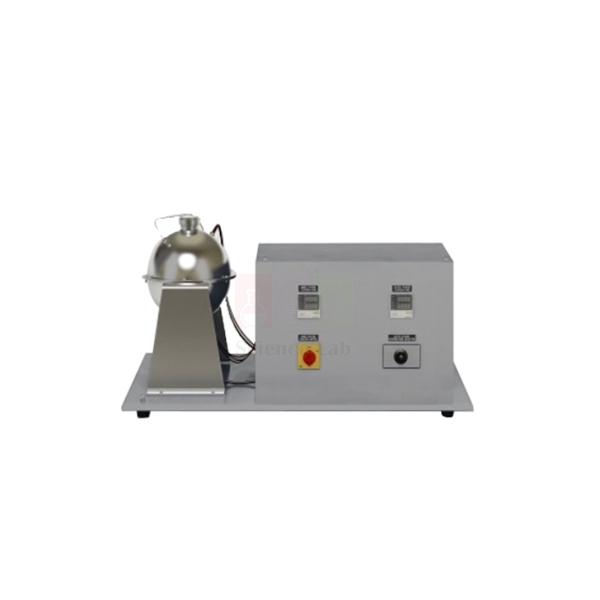
Computerized Thermal Conductivity of Powder
Computerized Thermal Conductivity of Powder (Product Code: SLE/MCE/72) is a concentric-sphere apparatus used to determine the thermal conductivity of an insulating powder in heat transfer laboratories. As lab equipment for technical institutes, it lets mechanical and chemical engineering students measure radial heat flow between a 50 mm and a 100 mm radius copper sphere using ten embedded thermocouples. It is made by Jain Scientific Equipments Pvt Ltd (ScienceLab), an OEM manufacturer, at its own factory in Ambala, India.
Specifications
| Parameter | Detail |
|---|---|
| Construction | Two thin-wall concentric copper spheres with insulating powder packed between the shells |
| Radius of inner copper sphere | 50 mm |
| Radius of outer copper sphere | 100 mm |
| Heater | Mica type: nichrome wire wound on mica sheet, housed in the inner sphere |
| Heating power | 350 W |
| Temperature limitation | 95 °C |
| Thermocouples | 4 embedded on the inner sphere and 6 on the outer sphere (10 in total) |
| Heater supply and measurement | Supplied through a dimmer stat; measured by voltmeter and ammeter |
| Test medium | Commercially available insulating powder packed between the two spheres (confirm the powder type with your quotation) |
| Measuring range – temperature | 2 × 0–325 °C |
| Measuring range – heating power | 0–450 W |
| Power supply options | 230 V, 50 Hz, 1 phase; 230 V, 60 Hz, 1 phase; or 120 V, 60 Hz, 1 phase |
| Product code | SLE/MCE/72 |
| Manufacturer | Jain Scientific Equipments Pvt Ltd (ScienceLab) — OEM |
| Country of origin | India (made in Ambala, Haryana) |
What Is the Thermal Conductivity of Powder Apparatus Used For?
Heat produced by the coil inside the inner sphere can only escape outwards through the powder layer, so once temperatures are steady the electrical input (from the voltmeter and ammeter readings) equals the heat conducted through the insulation. Using the average inner and outer surface temperatures from the ten thermocouples and the two sphere radii, students calculate the powder’s thermal conductivity from the steady-state equation for a spherical shell.
The experiment is a practical way to compare insulating materials of the kind used on pipes, furnaces and cold stores. Raise the dimmer stat gradually, record all ten thermocouples only after the readings stop drifting, and respect the 95 °C temperature limitation. Repeating the test at two or three power settings is a simple check that the conductivity value is consistent.
What to Specify When Ordering
- Power supply version: 230 V 50 Hz, 230 V 60 Hz or 120 V 60 Hz, single phase
- The insulating powder you want to test, so the filling can be confirmed in the quotation
- The computerised data logging you expect, so the arrangement can be confirmed before ordering
- Number of units required
OEM Manufacturer
Jain Scientific Equipments Private Limited is the original equipment manufacturer of this concentric-sphere apparatus and sells it under its trading name, ScienceLab. The unit is manufactured at the company’s own licensed factory at Saha, Ambala, Haryana, India, and supplied direct to engineering colleges, research laboratories, dealers and importers.
Need a replacement heater or thermocouple later? Ask us — as the maker, we deal with such requests ourselves. The ScienceLab profile has more about the company.
Related Thermodynamics & Heat Transfer Lab Equipment
Conduction studies usually extend to these related set-ups:
- Radial Heat Conduction Experiment — radial conduction in a different geometry for comparison
- Conductivity Of Liquid And Gases — extends conductivity measurement to fluids
- Unsteady State Heat Transfer — adds transient conduction to the steady-state method
- Apparatus Heat/Thermal Conductivity — a simpler conduction demonstration for introductory classes
Find more conduction, convection and radiation units in the Thermodynamics & Heat Transfer Lab Equipment category.
Frequently Asked Questions
How does the Computerized Thermal Conductivity of Powder apparatus work?
The Computerized Thermal Conductivity of Powder apparatus heats an inner copper sphere with a mica-type heater; heat flows radially through insulating powder packed between it and an outer sphere, and ten thermocouples record the temperature drop used to calculate conductivity.
What are the sphere sizes of the Computerized Thermal Conductivity of Powder apparatus?
The Computerized Thermal Conductivity of Powder apparatus uses thin-wall concentric copper spheres with radii of 50 mm (inner) and 100 mm (outer), so the powder forms a 50 mm thick spherical layer between them.
What heater does the Computerized Thermal Conductivity of Powder apparatus use?
The heater of the Computerized Thermal Conductivity of Powder apparatus is a mica type made of nichrome wire wound on mica sheet, rated 350 W, with a 95 °C temperature limitation and a 0–450 W power measuring range.
Which insulating powder is used in the Computerized Thermal Conductivity of Powder apparatus?
The Computerized Thermal Conductivity of Powder apparatus uses a commercially available insulating powder packed between the two spheres. Please confirm the powder type with us when you request a quotation, especially if you plan to test your own material.
Who manufactures the Computerized Thermal Conductivity of Powder apparatus?
Jain Scientific Equipments Pvt Ltd (ScienceLab) manufactures the Computerized Thermal Conductivity of Powder apparatus as the OEM at its own factory in Ambala, Haryana, India, and supplies it directly to institutions, dealers and importers.
Can a calibration certificate be provided for the instruments?
Please discuss calibration-certificate availability for the thermocouples, voltmeter and ammeter of the Computerized Thermal Conductivity of Powder apparatus with us before ordering, and list your requirement on the contact page so it is covered in the quotation.
Request a Quote
Tell us the quantity and delivery location for the Computerized Thermal Conductivity of Powder apparatus through the contact page, or add it to the enquiry cart. Every quotation is issued by the manufacturer itself.
Last updated: 24 September 2026
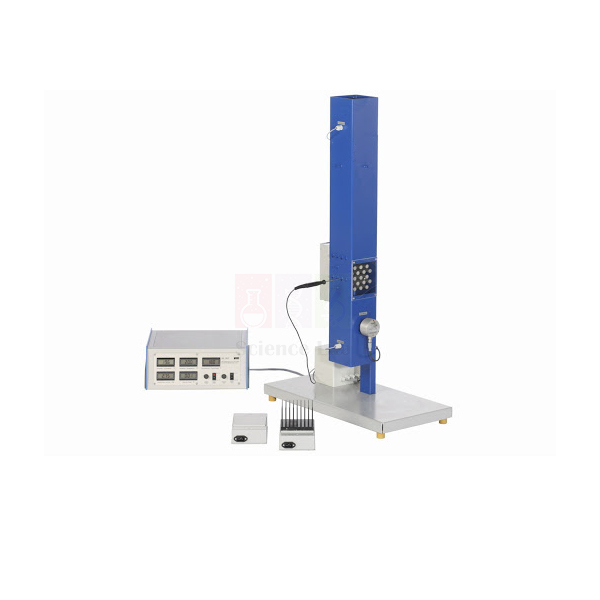
Free and Force Convection Apparatus
Free and Force Convection Apparatus (Product Code: SLE/MCE/73) is an air-duct experiment unit used to study natural (free) and forced convection heat transfer from heated surfaces in heat transfer laboratories. Among engineering lab equipment in India it is distinguished by four selectable heating elements of different geometries — a plate, two cylinders and a 23-tube element — tested in a 120 × 120 mm duct with an axial fan. It is made by Jain Scientific Equipments Pvt Ltd (ScienceLab), an OEM manufacturer, at its own factory in Ambala, India.
Specifications
| Parameter | Detail |
|---|---|
| Air duct flow cross-section | 120 × 120 mm |
| Height | Approx. 0.6 m |
| Heating elements | Four, with different geometries; designed to release heat only at their surface; temperature limitation 90 °C |
| Tube element | 23 tubes; heating power 20 W; heat transfer area 0.001 m² |
| Cylinder (surface temperature measured) | Heating power 20 W; heat transfer area 0.0112 m² |
| Plate | Heating power 40 W; heat transfer area 2 × 0.01 m² |
| Cylinder | Heating power 40 W; heat transfer area 0.0112 m² |
| Axial fan | Max. flow rate 500 m³/h; max. pressure difference approx. 950 Pa |
| Sensors | Temperature at the inlet and outlet of the air duct; air velocity for determining airflow rate |
| Instrumentation | Microprocessor-based, protected in the housing; heating power and flow rate adjusted and displayed via the software |
| Software | System operation, data acquisition and educational software; PC connection via USB |
| Measuring range – air velocity | 0–10 m/s |
| Measuring range – temperature | 4 × 0–325 °C |
| Measuring range – heating power | 0–50 W |
| Power consumption | 90 W |
| Dimensions | 800 × 600 × 800 mm |
| Weight | Approx. 30 kg |
| Power supply options | 230 V, 50 Hz, 1 phase; 230 V, 60 Hz, 1 phase; or 120 V, 60 Hz, 1 phase |
| Product code | SLE/MCE/73 |
| Manufacturer | Jain Scientific Equipments Pvt Ltd (ScienceLab) — OEM |
| Country of origin | India (made in Ambala, Haryana) |
What Is the Free and Force Convection Apparatus Used For?
Air flows past the selected heating element and absorbs heat from its surface. With the fan off, air moves past the element by buoyancy alone (free convection); with the fan running, forced convection takes over and heat transfer rises with air velocity. Students record inlet and outlet air temperatures, element surface temperature, air velocity and heating power, then calculate heat transfer coefficients for each geometry and compare them with textbook correlations.
Because the elements release heat only at their surface and the unit is compact, they heat up quickly and each run is short, so a class can test several geometries in one session. Fit one element at a time, let temperatures settle at every fan setting, and keep element temperatures within the 90 °C limitation. Logging through the USB software keeps a complete record for the lab report.
What to Specify When Ordering
- Power supply version: 230 V 50 Hz, 230 V 60 Hz or 120 V 60 Hz, single phase
- A PC at the bench for the USB operating, data-acquisition and educational software
- Number of units, based on how many student groups will run convection practicals
OEM Manufacturer
Jain Scientific Equipments Private Limited (CIN U29309HR2020PTC087597), trading as ScienceLab, is the OEM that manufactures the Free and Force Convection Apparatus. Production takes place at its licensed factory at 449, HSIIDC Industrial Area, Saha, Ambala, Haryana, which operates under Factory Licence AMB-ONLINE-CHD-J-414.
Buying from the manufacturer means engineering colleges, dealers and importers get quotations, technical answers and spares enquiries from one source — ask us for anything you need. See the company profile for more.
Related Thermodynamics & Heat Transfer Lab Equipment
Convection practicals are often taught alongside these units:
- Emissivity Natural Convection And Radiation — separates natural convection from radiation losses
- Extended Surface Heat Transfer — shows how fins and extended surfaces increase heat transfer
- Computerized Emissivity Measurement Apparatus — covers radiation, the third mode of heat transfer
- Convection in Air Apparatus — a simpler convection demonstration for school physics
For the complete range, open the Thermodynamics & Heat Transfer Lab Equipment category.
Frequently Asked Questions
What heating elements come with the Free and Force Convection Apparatus?
The Free and Force Convection Apparatus has four selectable heating elements with different geometries: an element with 23 tubes (20 W), a cylinder with surface temperature measurement (20 W), a plate (40 W) and a second cylinder (40 W).
What airflow can the fan of the Free and Force Convection Apparatus provide?
The axial fan of the Free and Force Convection Apparatus delivers a maximum flow rate of 500 m³/h and a maximum pressure difference of about 950 Pa, while air velocity in the duct is measured over 0–10 m/s.
Is software included with the Free and Force Convection Apparatus?
Yes. The Free and Force Convection Apparatus includes software for system operation, data acquisition and educational use, connected to a PC via USB; heating power and flow rate are adjusted and displayed through it.
How long does an experiment on the Free and Force Convection Apparatus take?
The Free and Force Convection Apparatus is compact and its elements release heat only at their surface, so they heat up rapidly and experiment times are short — useful when several student groups share one unit.
Who manufactures the Free and Force Convection Apparatus?
The Free and Force Convection Apparatus is manufactured by Jain Scientific Equipments Pvt Ltd (ScienceLab), the OEM, at its licensed factory in Saha, Ambala, Haryana, India. Quotations and repeat orders are handled by the manufacturer directly.
What power does the Free and Force Convection Apparatus need?
The Free and Force Convection Apparatus consumes 90 W and is listed for 230 V 50 Hz, 230 V 60 Hz or 120 V 60 Hz single-phase supply. Mention your laboratory supply when requesting a quotation.
Can the Free and Force Convection Apparatus be ordered in bulk or for export?
Yes. The Free and Force Convection Apparatus is supplied to universities, polytechnics and dealers in India and international markets. For several units, share the quantity, supply voltage and destination so one consolidated quotation can be prepared.
Request a Quote
To get a quotation for the Free and Force Convection Apparatus, write to us through the contact page or add it to the enquiry cart. The quote is prepared by the manufacturer, not a reseller.
Last updated: 24 September 2026
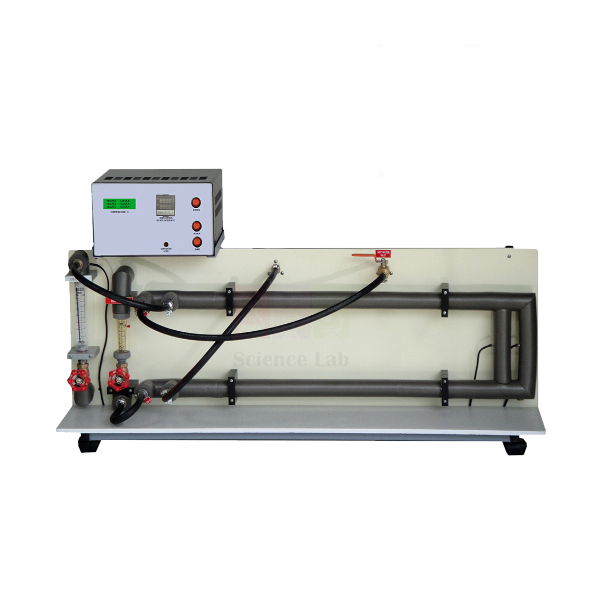
Parallel and Counter Flow Heat Exchanger
Parallel and Counter Flow Heat Exchanger (Product Code: SLE/MCE/74) is a concentric-tube heat exchanger trainer used to compare parallel-flow and counter-flow operation and to determine the heat transfer coefficient in heat transfer laboratories. As engineering educational equipment for colleges and research laboratories, it combines two insulated stainless steel tube sections with a 3000 W heated hot-water tank, hot- and cold-water flow meters and data acquisition software. It is made by Jain Scientific Equipments Pvt Ltd (ScienceLab), an OEM manufacturer, at its own factory in Ambala, India.
Specifications
| Parameter | Detail |
|---|---|
| Construction | 2 sections of insulated concentric stainless steel tubes |
| Flow arrangements | Parallel flow and counter flow |
| Hot water supply | Hot water tank and pump; heater 3000 W |
| Temperature control unit | 1 |
| Stirrer | 0–500 rpm |
| Flow meters | Hot water and cold water |
| Temperature measurement | 6 measuring points; measuring range 0–325 °C |
| Measuring range – heating power | 0–3000 W |
| Software functions | Educational software, data acquisition and system operation |
| Dimensions | 1200 × 600 × 800 mm |
| Weight | 40 kg |
| Power supply options | 230 V, 50 Hz, 1 phase; 230 V, 60 Hz, 1 phase; or 120 V, 60 Hz, 1 phase |
| Product code | SLE/MCE/74 |
| Manufacturer | Jain Scientific Equipments Pvt Ltd (ScienceLab) — OEM |
| Country of origin | India (made in Ambala, Haryana) |
What Is the Parallel and Counter Flow Heat Exchanger Used For?
In parallel flow the hot and cold streams enter at the same end and their temperatures converge along the tube; in counter flow they enter at opposite ends, so the cold outlet can approach the hot inlet temperature more closely. Switching between the two on the same exchanger lets students measure inlet and outlet temperatures of both streams, calculate the log-mean temperature difference, heat duty and heat transfer coefficient, and see for themselves why counter flow is usually more effective.
Changing the hot and cold water flow rates, and the hot water temperature through the temperature control unit, shows the effects of flow rate and temperature difference on performance. Let the hot water tank reach its set temperature before the first reading, keep both flows steady during each run, and use the data acquisition software to build a complete record for effectiveness calculations.
What to Specify When Ordering
- Power supply version: 230 V 50 Hz, 230 V 60 Hz or 120 V 60 Hz, single phase (note the 3000 W heater)
- Cold-water supply and drain available at the bench
- A PC for the educational, data-acquisition and operating software
- Number of units required
OEM Manufacturer
Jain Scientific Equipments Private Limited, trading as ScienceLab, is the OEM behind the Parallel and Counter Flow Heat Exchanger. The trainer is built at the company’s own licensed factory in Saha, Ambala, Haryana, India, and dispatched factory-direct to engineering colleges, research laboratories, laboratory dealers and importers.
As an engineering lab equipment manufacturer, the company answers spares and repeat-order queries itself — just ask us. Company background is on the profile page.
Related Thermodynamics & Heat Transfer Lab Equipment
Heat exchanger laboratories usually compare several designs; these complete the set:
- Concentric Tube Heat Exchanger — another concentric-tube design for cross-checking results
- Shell and Tube Heat Exchanger — the multi-tube configuration common in process plants
- Plate Heat Exchanger — a compact plate design for comparison of performance
- Cross Flow Heat Exchangers — the third basic flow arrangement after parallel and counter flow
All heat exchanger trainers are listed in the Thermodynamics & Heat Transfer Lab Equipment category.
Frequently Asked Questions
Can the Parallel and Counter Flow Heat Exchanger run in both flow modes?
Yes. The Parallel and Counter Flow Heat Exchanger demonstrates heat transfer under both parallel flow and counter flow, so students can compare temperature profiles, heat duty and heat transfer coefficient for the two arrangements on one unit.
What is the Parallel and Counter Flow Heat Exchanger built from?
The Parallel and Counter Flow Heat Exchanger is built from two sections of insulated concentric stainless steel tubes, supplied with hot water from a tank heated by a 3000 W heater and circulated by a pump.
What instruments does the Parallel and Counter Flow Heat Exchanger have?
The Parallel and Counter Flow Heat Exchanger has six temperature measuring points, hot- and cold-water flow meters, one temperature control unit and software for education, data acquisition and system operation.
How large is the Parallel and Counter Flow Heat Exchanger?
The Parallel and Counter Flow Heat Exchanger measures 1200 × 600 × 800 mm and weighs 40 kg, so it can be placed on a laboratory bench or table close to a water supply and drain.
Who manufactures the Parallel and Counter Flow Heat Exchanger?
Jain Scientific Equipments Pvt Ltd (ScienceLab) is the OEM of the Parallel and Counter Flow Heat Exchanger and makes it at its own factory in Ambala, Haryana, India; quotations come directly from the manufacturer.
Is a calibration certificate available for the sensors?
Calibration-certificate availability for the temperature sensors and flow meters of the Parallel and Counter Flow Heat Exchanger should be discussed with us at the enquiry stage. Please list your documentation needs on the contact page.
What should a quotation request for this heat exchanger include?
For a Parallel and Counter Flow Heat Exchanger quotation, tell us the number of units, your power supply (230 V 50 Hz, 230 V 60 Hz or 120 V 60 Hz) and the delivery location in India or abroad.
Request a Quote
Use the contact page to request a quotation for the Parallel and Counter Flow Heat Exchanger, or save it in the enquiry cart while you build a full laboratory list. Quotes are sent by the manufacturer directly.
Last updated: 24 September 2026
Air Conditioning System Trainer
Air Conditioning System Trainer (Product Code: SLE/MCE/82) is a refrigeration and air-handling training unit used to study cooling, heating, humidification and room loads in HVAC and thermal engineering laboratories. Polytechnics and engineering colleges choose this TVET lab equipment because an air duct with fan, air cooler, humidifier, flaps, air heater and sensors serves a chamber with adjustable wet and dry cooling loads. It is made by Jain Scientific Equipments Pvt Ltd (ScienceLab), an OEM manufacturer, at its own factory in Ambala, India.
Specifications
| Parameter | Detail |
|---|---|
| Air duct | With fan, air cooler, humidifier, flaps, air heater and sensors |
| Chamber | Wet (latent) and dry (sensible) heat source as cooling load |
| Cooling-load heaters | 2 heaters in the chamber; power output 0–250 W each, freely adjustable |
| Humidifier heating power | 400 W |
| Air heater power | 360 W |
| Refrigeration capacity | 320 W at +5/40 °C |
| Power consumption | 140 W at −10 °C |
| W × H | 155 × 155 mm |
| Refrigerant | A refrigerant currently available on the market; filling volume 1.2 kg; CO2-equivalent 0.8 t |
| Measuring range – temperature | 0–50 °C |
| Measuring range – relative humidity | 10–90% |
| Measuring range – power consumption | 0–600 W (condensing unit) |
| Measuring range – refrigerant flow rate | 1.5–23.5 L/h |
| Measuring range – air velocity | 0–2.5 m/s |
| Measuring range – cooling-load power | 2 × 0–300 W |
| Measuring range – refrigerant pressure | −1 to 9 bar / −1 to 24 bar |
| Power supply options | 230 V, 50 Hz, 1 phase or 230 V, 60 Hz, 1 phase |
| Product code | SLE/MCE/82 |
| Manufacturer | Jain Scientific Equipments Pvt Ltd (ScienceLab) — OEM |
| Country of origin | India (made in Ambala, Haryana) |
What Is the Air Conditioning System Trainer Used For?
Students follow the air through each stage of the duct — cooling on the air cooler, reheating on the air heater and adding moisture with the humidifier — and plot every change on a psychrometric chart from the temperature and relative-humidity readings. The chamber’s dry (sensible) and wet (latent) heat sources act as the room load, so the effect of heat and moisture gains on the conditioned space can be simulated and balanced.
On the refrigeration side, refrigerant pressures, refrigerant flow and condensing-unit power are measured, allowing students to work out cooling capacity and coefficient of performance for different load settings. Set the flaps and the cooling-load heaters for the chosen case before starting, and give the system time to stabilise before each set of readings.
What to Specify When Ordering
- Power supply version: 230 V 50 Hz or 230 V 60 Hz, single phase
- The refrigerant type acceptable in your country, since the trainer uses a refrigerant currently available on the market
- Number of trainers for the HVAC or refrigeration laboratory
OEM Manufacturer
The Air Conditioning System Trainer is manufactured by Jain Scientific Equipments Private Limited — the company that trades as ScienceLab — in its role as OEM. Production is carried out at the company’s licensed factory at Saha, Ambala, Haryana, and trainers are shipped factory-direct to technical institutes, colleges, dealers and importers.
Dealing with the maker keeps quotations, technical queries and later spares requests in one place; ask us whenever you need help. Company information is on the ScienceLab profile.
Related Thermodynamics & Heat Transfer Lab Equipment
HVAC and refrigeration courses typically build on this trainer with:
- Vapour Absorption Refrigeration Trainer — a heat-driven refrigeration cycle for comparison
- Gas Charging Trainer — practice in evacuating and charging refrigerant
- Computerized Cooling Tower Test Bench — evaporative cooling and humid-air processes
- Cut Section Model Of Rotary Hermetic Compressor — shows the inside of a small refrigeration compressor
Browse the Thermodynamics & Heat Transfer Lab Equipment category for more refrigeration and air-conditioning trainers.
Frequently Asked Questions
What processes can be studied on the Air Conditioning System Trainer?
The Air Conditioning System Trainer covers cooling, reheating, humidification and the handling of sensible and latent loads: its air duct holds a fan, air cooler, humidifier, flaps, air heater and sensors, and feeds a chamber with wet and dry heat sources.
What is the refrigeration capacity of the Air Conditioning System Trainer?
The Air Conditioning System Trainer has a listed refrigeration capacity of 320 W at +5/40 °C and a power consumption of 140 W at −10 °C, with a refrigerant filling volume of 1.2 kg.
Which refrigerant does the Air Conditioning System Trainer use?
The Air Conditioning System Trainer uses a refrigerant that is currently available on the market, with a 1.2 kg fill and a CO2-equivalent of 0.8 t. Please confirm which refrigerant is acceptable in your country when requesting a quotation.
How are cooling loads applied in the Air Conditioning System Trainer?
The chamber of the Air Conditioning System Trainer has two heaters as cooling load, each freely adjustable from 0 to 250 W, plus a wet (latent) heat source, so students can set different room-load conditions.
What does the Air Conditioning System Trainer measure?
The Air Conditioning System Trainer measures temperature 0–50 °C, relative humidity 10–90%, air velocity 0–2.5 m/s, refrigerant flow 1.5–23.5 L/h, condensing-unit power 0–600 W and refrigerant pressure −1 to 9 bar and −1 to 24 bar.
Who manufactures the Air Conditioning System Trainer?
Jain Scientific Equipments Pvt Ltd (ScienceLab), the OEM, manufactures the Air Conditioning System Trainer at its own factory in Saha, Ambala, Haryana, India, and supplies it directly to institutions, dealers and importers.
Is the Air Conditioning System Trainer suitable for vocational courses?
Yes. The Air Conditioning System Trainer suits polytechnic, TVET and engineering HVAC courses because students work with a real refrigeration circuit and air duct, measuring the same quantities a technician checks in the field.
Request a Quote
For a quotation on the Air Conditioning System Trainer, contact us through the contact page or add the trainer to the enquiry cart. Quotations are issued by the manufacturer directly.
Last updated: 24 September 2026
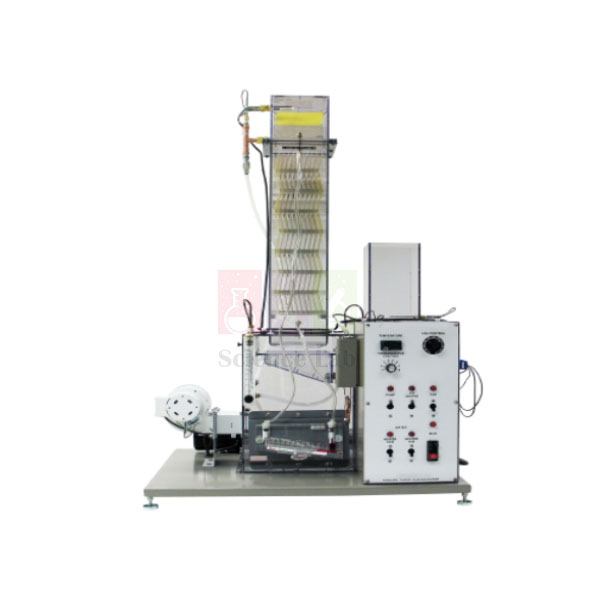
Computerized Cooling Tower Test Bench
Computerized Cooling Tower Test Bench (Product Code: SLE/MCE/83) is a fan-driven cooling tower model used to study the evaporative cooling of water by air in thermal and chemical engineering laboratories. Colleges add this engineering lab equipment because its 150 × 150 mm cooling column holds a wet deck with a specific surface of 110 m²/m³, and a three-stage heater (500, 1000 or 1500 W) sets the heat load. It is made by Jain Scientific Equipments Pvt Ltd (ScienceLab), an OEM manufacturer, at its own factory in Ambala, India.
Specifications
| Parameter | Detail |
|---|---|
| Cooling column cross-section | 150 × 150 mm |
| Wet deck specific surface | 110 m²/m³ |
| Airflow measurement | Volumetric airflow via orifice, Ø 80 mm |
| Heater | Adjustable in three stages: 500 W, 1000 W, 1500 W |
| Thermostat | Switches off at 50 °C |
| Fan | Power consumption 250 W; max. pressure difference 430 Pa; max. volumetric flow rate 13 m³/min |
| Pump | Max. head 70 m; max. flow rate 100 L/h |
| Tank for additional water | 4.2 L |
| Measuring range – differential pressure (air) | 0–1000 Pa |
| Measuring range – flow rate (water) | 12–360 L/h |
| Measuring range – temperature | 2 × 0–50 °C and 3 × 0–100 °C |
| Measuring range – relative humidity | 10–100% |
| Dimensions | 1200 × 600 × 1600 mm |
| Weight | Approx. 125 kg |
| Power supply options | 230 V, 50 Hz, 1 phase or 230 V, 60 Hz, 1 phase |
| Product code | SLE/MCE/83 |
| Manufacturer | Jain Scientific Equipments Pvt Ltd (ScienceLab) — OEM |
| Country of origin | India (made in Ambala, Haryana) |
What Is the Cooling Tower Test Bench Used For?
Warm water from the heated circuit is pumped to the column and spreads over the wet deck while air from the fan passes through it; part of the water evaporates and cools the rest. By measuring water and air temperatures, relative humidity, water flow and airflow through the 80 mm orifice, students calculate the cooling range, the approach to wet-bulb temperature, the heat removed and the water lost by evaporation.
Switching the heater between 500, 1000 and 1500 W and changing air and water flows shows how heat load and air-to-water ratio affect performance — the same questions faced in power-station and HVAC cooling towers. Keep the 4.2 L additional-water tank topped up, since evaporated water must be replaced, and remember that the thermostat switches the heater off at 50 °C.
What to Specify When Ordering
- Power supply version: 230 V 50 Hz or 230 V 60 Hz, single phase
- Floor space and headroom for a 1200 × 600 × 1600 mm bench of about 125 kg
- Water filling and draining arrangements at the installation point
- The computerised data-logging arrangement you expect, so it can be confirmed in the quotation
OEM Manufacturer
Jain Scientific Equipments Private Limited, the legal company behind the ScienceLab brand, is the OEM of the Computerized Cooling Tower Test Bench. Each bench is manufactured at the company’s own licensed factory in Saha, Ambala, Haryana, India, and delivered factory-direct to engineering colleges, polytechnics, dealers and importers.
If you later need wet-deck packing, a spare pump or another bench, ask us — enquiries go straight to the manufacturer. More on the company is on the ScienceLab profile.
Related Thermodynamics & Heat Transfer Lab Equipment
Cooling and humid-air practicals often extend to these units:
- Air Conditioning System Trainer — psychrometric processes of humid air in an air-handling duct
- Water To Air Heat Exchangers — cooling water with air without evaporation, for comparison
- Cross Flow Heat Exchangers — another arrangement for heat transfer between two streams
- Air Blower Test Setup — for studying the fan side of air-moving equipment
The Thermodynamics & Heat Transfer Lab Equipment category includes the full range of thermal trainers.
Frequently Asked Questions
What is the wet deck specification of the Computerized Cooling Tower Test Bench?
The Computerized Cooling Tower Test Bench has a cooling column of 150 × 150 mm cross-section whose wet deck offers a specific surface of 110 m²/m³, giving a large contact area between the water and the air.
How is heat load varied on the Computerized Cooling Tower Test Bench?
Heat load on the Computerized Cooling Tower Test Bench is set with a heater adjustable in three stages of 500 W, 1000 W and 1500 W; a thermostat switches it off at 50 °C.
What do the fan and pump of the Computerized Cooling Tower Test Bench deliver?
The fan of the Computerized Cooling Tower Test Bench consumes 250 W, with a maximum volumetric flow of 13 m³/min and a maximum pressure difference of 430 Pa; the pump offers a maximum head of 70 m and a maximum flow of 100 L/h.
What are the measuring ranges of the Computerized Cooling Tower Test Bench?
The Computerized Cooling Tower Test Bench measures air differential pressure 0–1000 Pa, water flow 12–360 L/h, temperature with two sensors at 0–50 °C and three at 0–100 °C, and relative humidity 10–100%.
Who manufactures the Computerized Cooling Tower Test Bench?
The Computerized Cooling Tower Test Bench is manufactured by Jain Scientific Equipments Pvt Ltd (ScienceLab) as the OEM at its own factory in Ambala, Haryana, India. Quotations and spares enquiries are answered directly by the maker.
How is data logged on the Computerized Cooling Tower Test Bench?
Please confirm the data-logging arrangement of the Computerized Cooling Tower Test Bench with us before ordering, as the listed specification covers its sensors and measuring ranges; tell us whether you need PC recording via the contact page.
How much space does the Computerized Cooling Tower Test Bench need?
The Computerized Cooling Tower Test Bench measures 1200 × 600 × 1600 mm and weighs about 125 kg, so check door widths and floor space, and provide water filling and draining near the installation point.
Request a Quote
Request a quotation for the Computerized Cooling Tower Test Bench through our contact page, or add it to the enquiry cart alongside other thermal trainers. The manufacturer quotes you directly.
Last updated: 24 September 2026
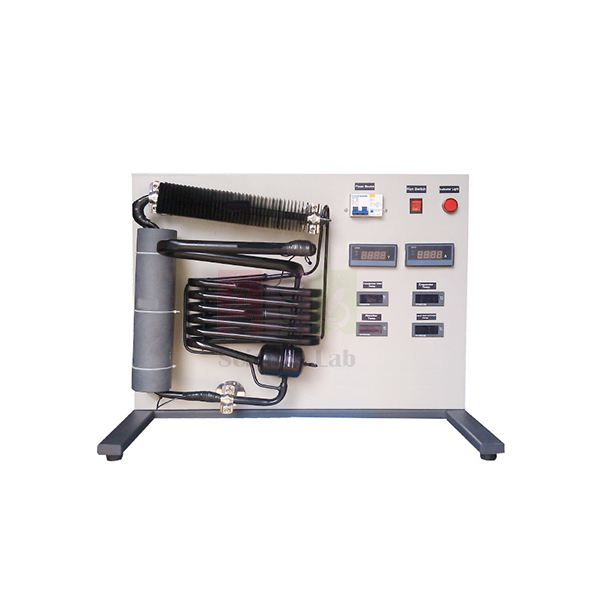
Vapour Absorption Refrigeration Trainer
Vapour Absorption Refrigeration Trainer (Product Code: SLE/MCE/84) is a heat-driven refrigeration training unit used to show how an absorption system produces cooling from thermal energy instead of a mechanical compressor, in refrigeration and air-conditioning laboratories. This engineering educational equipment in India works with an ammonia-water solution and hydrogen as auxiliary gas, driven by a 125 W electric heater, with an adjustable 50 W evaporator heater as the cooling load. It is made by Jain Scientific Equipments Pvt Ltd (ScienceLab), an OEM manufacturer, at its own factory in Ambala, India.
Specifications
| Parameter | Detail |
|---|---|
| Working medium | Ammonia-water solution |
| Auxiliary gas | Hydrogen |
| Electric heater | 125 W |
| Evaporator heater | 50 W, adjustable |
| Measuring range – temperature | 4 × −80 to 180 °C |
| Measuring range – power | 0–150 W |
| Dimensions | 800 × 750 × 1200 mm |
| Weight | Approx. 85 kg |
| Power supply options | 230 V, 50 Hz, 1 phase or 230 V, 60 Hz, 1 phase |
| Product code | SLE/MCE/84 |
| Manufacturer | Jain Scientific Equipments Pvt Ltd (ScienceLab) — OEM |
| Country of origin | India (made in Ambala, Haryana) |
What Is the Vapour Absorption Refrigeration Trainer Used For?
Absorption refrigeration systems run on thermal energy — for example industrial waste heat or heat from solar collectors — and small mobile units such as camping refrigerators or hotel minibars generate that heat electrically or with a gas burner. The trainer demonstrates the principle behind them: a liquid evaporates at low temperature when its pressure is reduced, and the ammonia vapour is taken up by water and driven out again by heat rather than being compressed. In process plants the same idea lets waste heat be used for cooling.
Students record temperatures at four points together with the heater powers, then load the evaporator with the adjustable heater to find the cooling effect and compare it with the heat input to estimate the coefficient of performance. Because an absorption system takes time to reach steady operation, switch the 125 W heater on well before the practical and take readings only once temperatures have settled.
What to Specify When Ordering
- Power supply version: 230 V 50 Hz or 230 V 60 Hz, single phase
- Destination, since shipping a unit charged with ammonia-water solution and hydrogen may need to be discussed
- Number of trainers for the refrigeration laboratory
OEM Manufacturer
ScienceLab is how Jain Scientific Equipments Private Limited trades, and the company is the OEM of the Vapour Absorption Refrigeration Trainer. The trainer is manufactured at its licensed factory in Saha, Ambala, Haryana, India, and sold factory-direct to engineering colleges, polytechnics, laboratory dealers and importers — not through intermediaries.
For later questions about servicing, spares or additional units, ask us and the manufacturing team will answer. The company profile gives more background.
Related Thermodynamics & Heat Transfer Lab Equipment
Refrigeration laboratories usually teach absorption alongside these trainers:
- Air Conditioning System Trainer — a compressor-driven system for comparing the two refrigeration principles
- Computerized ICE Plant Trainer — vapour-compression refrigeration applied to ice making
- Flat Plate Solar Thermal Energy Collector — solar heat, one of the energy sources absorption systems can use
- Gas Charging Trainer — refrigerant handling practice on compression systems
See all refrigeration and heat transfer trainers in the Thermodynamics & Heat Transfer Lab Equipment category.
Frequently Asked Questions
How does the Vapour Absorption Refrigeration Trainer cool without a compressor?
The Vapour Absorption Refrigeration Trainer uses heat instead of a compressor: a 125 W electric heater drives the ammonia-water solution cycle, with hydrogen as auxiliary gas, so ammonia evaporates at low temperature and produces cooling in the evaporator.
What working fluids does the Vapour Absorption Refrigeration Trainer use?
The Vapour Absorption Refrigeration Trainer works with an ammonia-water solution as working medium and hydrogen as auxiliary gas. Keep the unit upright and follow standard ammonia safety practice, as ammonia is hazardous if it is ever released.
What does the Vapour Absorption Refrigeration Trainer measure?
The Vapour Absorption Refrigeration Trainer measures temperature at four points over −80 to 180 °C and power over 0–150 W, which covers the 125 W heater and the adjustable 50 W evaporator heater used as cooling load.
Where is the principle of the Vapour Absorption Refrigeration Trainer used in practice?
The principle shown by the Vapour Absorption Refrigeration Trainer is used where heat is readily available — industrial waste heat or solar collectors — and in small mobile units such as camping refrigerators and hotel minibars heated electrically or by gas.
Who manufactures the Vapour Absorption Refrigeration Trainer?
Jain Scientific Equipments Pvt Ltd (ScienceLab) manufactures the Vapour Absorption Refrigeration Trainer as the OEM at its own factory in Saha, Ambala, Haryana, India, and quotes it directly to colleges, dealers and importers.
What size and power supply does the Vapour Absorption Refrigeration Trainer need?
The Vapour Absorption Refrigeration Trainer measures 800 × 750 × 1200 mm, weighs about 85 kg and runs on a 230 V single-phase supply at 50 Hz or 60 Hz, so a floor or sturdy bench position is needed.
Request a Quote
To receive a quotation for the Vapour Absorption Refrigeration Trainer, send your details through the contact page or add it to the enquiry cart. The quotation comes to you from the manufacturer.
Last updated: 24 September 2026
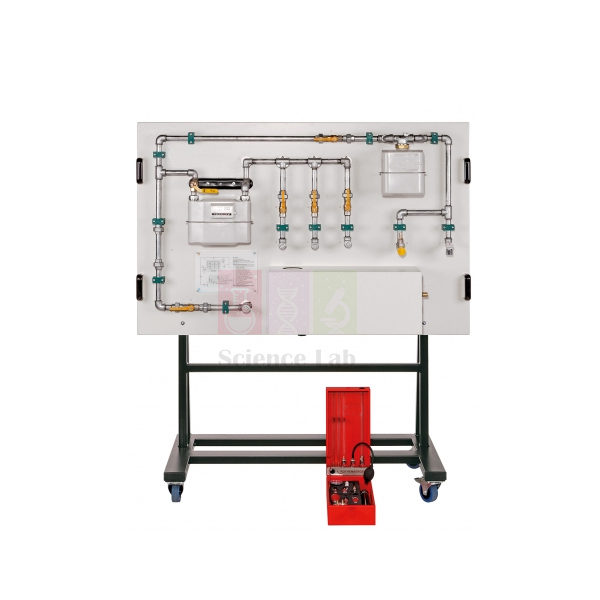
Gas Charging Trainer
Gas Charging Trainer (Product Code: SLE/MCE/85) is a refrigeration service training unit used to practise evacuating a system and charging it with refrigerant in HVAC workshops and technician training laboratories. As vocational training lab equipment, it comes with a vacuum pump, a filling cylinder for 1000 g of R134a and manometers with an R134a temperature scale, so trainees handle the same tasks met in field service. It is made by Jain Scientific Equipments Pvt Ltd (ScienceLab), an OEM manufacturer, at its own factory in Ambala, India.
Specifications
| Parameter | Detail |
|---|---|
| Construction | Bench-top unit |
| Evacuation | Vacuum pump with vacuum gauge |
| Refrigerant filling | Filling cylinder, 1000 g R134a |
| Gauges | Manometer for intake pressure; manometer for intake and delivery pressure with temperature scale for R134a |
| Connections | For intake and delivery pressure |
| Measuring range – intake pressure | −1 to 10 bar |
| Measuring range – delivery pressure | −1 to 30 bar |
| Measuring range – vacuum | 0–1000 mbar |
| Measuring range – cylinder | −1 to 25 bar |
| Dimensions | 1000 × 700 × 1400 mm |
| Weight | 110 kg |
| Power supply options | 230 V, 50 Hz, 1 phase or 230 V, 60 Hz, 1 phase |
| Product code | SLE/MCE/85 |
| Manufacturer | Jain Scientific Equipments Pvt Ltd (ScienceLab) — OEM |
| Country of origin | India (made in Ambala, Haryana) |
What Is the Gas Charging Trainer Used For?
Service technicians must be able to evacuate a refrigeration circuit, confirm the vacuum and then add the correct refrigerant charge. On this trainer students connect service lines to the intake and delivery connections, pull a vacuum with the pump while watching the vacuum gauge (0–1000 mbar), and then charge R134a from the filling cylinder while reading the intake and delivery manometers.
The R134a temperature scale on the manometer lets trainees convert pressure readings into saturation temperatures and judge whether a system is under- or over-charged. Always wear safety glasses and gloves when handling refrigerant, close the cylinder valve after charging, and never vent R134a to atmosphere.
What to Specify When Ordering
- Power supply version: 230 V 50 Hz or 230 V 60 Hz, single phase
- Confirmation that R134a is the refrigerant your course uses, as the cylinder and gauge scale are for R134a
- Number of trainers, based on how many trainees practise at a time
OEM Manufacturer
ScienceLab is the trading name of Jain Scientific Equipments Private Limited, incorporated under CIN U29309HR2020PTC087597 and the OEM of the Gas Charging Trainer. Each trainer is manufactured at the company’s licensed factory in Saha, Ambala (Factory Licence AMB-ONLINE-CHD-J-414), and supplied direct to ITIs, polytechnics, engineering colleges, dealers and importers.
For extra filling cylinders, gauges or repeat orders, ask us — the manufacturer handles such requests itself. Read more on the ScienceLab profile.
Related Thermodynamics & Heat Transfer Lab Equipment
Refrigeration service courses combine this trainer with:
- Air Conditioning System Trainer — a complete refrigerant circuit with air-handling duct
- Computerized ICE Plant Trainer — a hermetic-compressor system with pressure and temperature transmitters
- Cut Section Model Of Rotary Hermetic Compressor — shows the compressor type used in many small systems
- Vapour Absorption Refrigeration Trainer — a heat-driven cycle for broader refrigeration theory
Explore the Thermodynamics & Heat Transfer Lab Equipment category for the complete refrigeration range.
Frequently Asked Questions
What is included with the Gas Charging Trainer?
The Gas Charging Trainer includes a vacuum pump, a filling cylinder for 1000 g of R134a, a vacuum gauge, a manometer for intake pressure and a manometer for intake and delivery pressure with an R134a temperature scale, plus service connections.
Which refrigerant is the Gas Charging Trainer set up for?
The Gas Charging Trainer is set up for R134a: its filling cylinder holds 1000 g of R134a and its manometer carries an R134a temperature scale. Ask us before ordering if your course uses a different refrigerant.
What pressure ranges does the Gas Charging Trainer read?
The Gas Charging Trainer reads intake pressure from −1 to 10 bar, delivery pressure from −1 to 30 bar, vacuum from 0 to 1000 mbar and cylinder pressure from −1 to 25 bar, covering evacuation and charging.
How big is the Gas Charging Trainer?
The Gas Charging Trainer is a bench-top unit of 1000 × 700 × 1400 mm weighing 110 kg, so plan a sturdy bench and handling help for installation, with a 230 V single-phase supply at 50 Hz or 60 Hz.
Who manufactures the Gas Charging Trainer?
Jain Scientific Equipments Pvt Ltd (ScienceLab) is the OEM of the Gas Charging Trainer and manufactures it at its licensed factory in Ambala, Haryana, India; institutes and dealers get quotations directly from the manufacturer.
Who is the Gas Charging Trainer designed for?
The Gas Charging Trainer suits ITIs, polytechnics, engineering colleges and HVAC service training centres that want students to practise refrigerant evacuation and charging safely before working on customer equipment.
Request a Quote
Ask for a Gas Charging Trainer quotation on the contact page, or add it to the enquiry cart with the rest of your workshop list. The manufacturer prepares and sends the quote.
Last updated: 24 September 2026
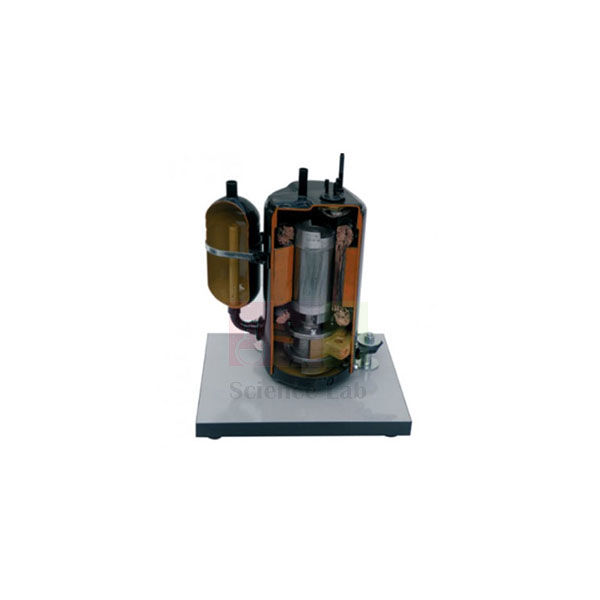
Cut Section Model Of Rotary Hermetic Compressor
Cut Section Model Of Rotary Hermetic Compressor (Product Code: SLE/MCE/86) is a sectioned teaching model used to show the internal parts and working principle of a rotary hermetic compressor in refrigeration and air-conditioning classrooms. Instructors value this lab equipment for technical institutes because the cut-away exposes the stationary cylinder, the roller on the shaft’s eccentric and the spring-loaded sealing blade that separates suction from discharge. It is made by Jain Scientific Equipments Pvt Ltd (ScienceLab), an OEM manufacturer, at its own factory in Ambala, India.
Specifications
| Parameter | Detail |
|---|---|
| Model type | Cut-section model of a rotary hermetic compressor |
| Main parts shown | Stationary cylinder, roller and shaft; the shaft carries an eccentric on which the roller is mounted |
| Sealing blade | Set into a slot in the cylinder and kept in contact with the roller by a spring; moves in and out of the slot to follow the rotor |
| Function shown | Blade separates the suction and discharge parts; the rotating roller always touches the cylinder wall |
| Dimensions | 500 × 400 × 500 mm (approx.) |
| Weight | 35 kg (approx.) |
| Product code | SLE/MCE/86 |
| Manufacturer | Jain Scientific Equipments Pvt Ltd (ScienceLab) — OEM |
| Country of origin | India (made in Ambala, Haryana) |
What Is the Rotary Compressor Cut Section Model Used For?
The model lets students trace a compression cycle step by step. As the shaft turns, the roller mounted on its eccentric rolls around the inside of the stationary cylinder, always touching the wall, while the blade slides in and out of its slot to follow it. The space between roller and cylinder is divided by the blade into a suction side and a discharge side, so gas drawn in on one side is squeezed and pushed out on the other — which is why the part is often called a sealing blade.
Rotary compressors of this type are widely used in room air conditioners and small refrigeration units, so the model helps refrigeration mechanics, diploma and degree students understand the machine before they meet it sealed inside a real system. It works well on the front bench during lectures and alongside working refrigeration trainers in the laboratory.
OEM Manufacturer
Jain Scientific Equipments Private Limited, trading as ScienceLab, is the OEM that makes the Cut Section Model Of Rotary Hermetic Compressor. The model is produced at the company’s own licensed factory in Saha, Ambala, Haryana, India, and supplied factory-direct to ITIs, polytechnics, engineering colleges, dealers and importers.
Orders for additional models, or questions about other sectioned refrigeration components, go straight to the manufacturer — just ask us. See the ScienceLab company profile for more.
Related Thermodynamics & Heat Transfer Lab Equipment
To move from the model to working systems, laboratories often add:
- Gas Charging Trainer — hands-on refrigerant evacuation and charging
- Air Conditioning System Trainer — a working refrigeration circuit with an air-handling duct
- Rotary Air Compressor Test Bench — a rotary vane compressor tested for efficiency and power
- Cut Section Model Of Four Stroke Petrol Engine — another sectioned model for mechanical classrooms
Find more refrigeration trainers and thermal apparatus in the Thermodynamics & Heat Transfer Lab Equipment category.
Frequently Asked Questions
What parts does the Cut Section Model Of Rotary Hermetic Compressor show?
The Cut Section Model Of Rotary Hermetic Compressor shows the stationary cylinder, the roller, the shaft with its eccentric and the spring-loaded blade set into the cylinder slot, which separates the suction and discharge sides.
Why is the blade in the rotary hermetic compressor called a sealing blade?
In the Cut Section Model Of Rotary Hermetic Compressor, the blade is pressed against the roller by a spring and divides the suction side from the discharge side; because it seals these two spaces from each other, it is often called a sealing blade.
How large is the Cut Section Model Of Rotary Hermetic Compressor?
The Cut Section Model Of Rotary Hermetic Compressor measures about 500 × 400 × 500 mm and weighs about 35 kg, a size that suits demonstration from the front bench of a classroom or workshop.
Is the Cut Section Model Of Rotary Hermetic Compressor a working compressor?
No. The Cut Section Model Of Rotary Hermetic Compressor is a sectioned teaching model for showing internal construction; for refrigerant circuit practice, pair it with a working unit such as the Gas Charging Trainer or Air Conditioning System Trainer.
Who manufactures the Cut Section Model Of Rotary Hermetic Compressor?
Jain Scientific Equipments Pvt Ltd (ScienceLab) is the OEM of the Cut Section Model Of Rotary Hermetic Compressor and makes it at its own factory at Saha, Ambala, Haryana, India, supplying institutions, dealers and importers directly.
What does a quotation for the Cut Section Model Of Rotary Hermetic Compressor need?
To quote the Cut Section Model Of Rotary Hermetic Compressor, we need the quantity, the delivery location in India or abroad, and any other refrigeration models or trainers you are sourcing for the same laboratory.
Request a Quote
Send a quotation request for the Cut Section Model Of Rotary Hermetic Compressor via the contact page, or add it to the enquiry cart. You will be quoted directly by the manufacturer.
Last updated: 24 September 2026
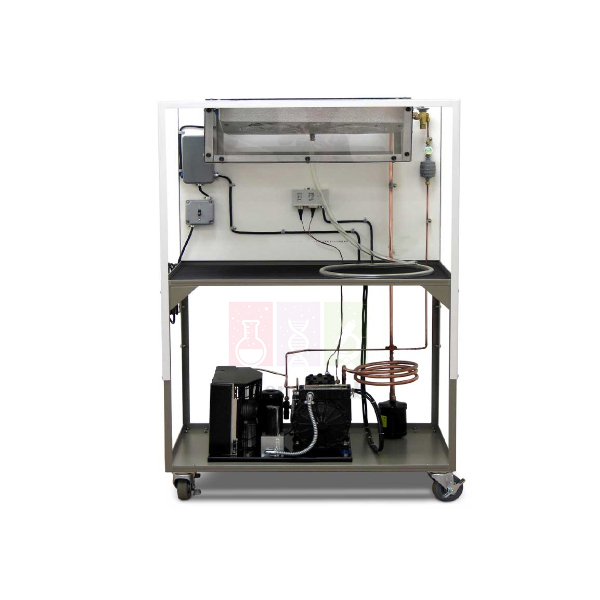
Computerized ICE Plant Trainer
Computerized ICE Plant Trainer (Product Code: SLE/MCE/87) is a vapour-compression refrigeration trainer used to demonstrate ice making and measure refrigeration performance in refrigeration and air-conditioning laboratories. Engineering colleges and technical institutes use it for its hermetically sealed Kirloskar-make compressor, stainless steel tank and evaporator, and two pressure plus six temperature transmitters. It is supplied by Jain Scientific Equipments Pvt Ltd (ScienceLab), a laboratory equipment supplier in Ambala, India.
Specifications
| Parameter | Detail |
|---|---|
| Compressor | Hermetically sealed compressor, Kirloskar make |
| Condenser | Air cooled, compatible with the compressor |
| Condenser cooling fan | Compatible capacity, with permanently lubricated motor |
| Expansion device | Capillary tube of compatible capacity |
| Evaporator | Stainless steel, insulated with ceramic wool/PUF |
| Tank | Inner tank fabricated from stainless steel |
| Pressure measurement | Pressure transmitters – 2 nos. |
| Temperature measurement | Temperature transmitters – 6 nos. |
| Energy measurement | Energy meter |
| Safety controls | Overload and over-current protectors for the compressor; time delay circuit |
| Dimensions | 1400 × 800 × 1200 mm (approx.) |
| Weight | 165 kg (approx.) |
| Power supply options | 230 V, 50 Hz, 1 phase or 230 V, 60 Hz, 1 phase |
| Product code | SLE/MCE/87 |
| Supplied by | Jain Scientific Equipments Pvt Ltd (ScienceLab), Ambala, India |
What Is the ICE Plant Trainer Used For?
The trainer runs a complete vapour-compression cycle: the hermetic compressor raises the refrigerant pressure, the air-cooled condenser rejects heat, the capillary tube drops the pressure, and the stainless steel evaporator absorbs heat from the water in the tank until it freezes. Students record the two pressures and six temperatures, plus energy use from the energy meter, to draw the cycle on a pressure–enthalpy chart and work out refrigeration effect and coefficient of performance.
Timing how long a known quantity of water takes to freeze gives a practical measure of ice-making capacity to compare with the calculated values. Allow the time delay circuit to complete before restarting the compressor after a stop, and keep the condenser and its fan free of dust so readings stay stable from session to session.
What to Specify When Ordering
- Power supply version: 230 V 50 Hz or 230 V 60 Hz, single phase
- Floor space for a unit of about 1400 × 800 × 1200 mm and 165 kg
- The PC software and data-logging arrangement you expect, so it can be confirmed in the quotation
- Number of trainers required
Supplier
Jain Scientific Equipments Private Limited trades as ScienceLab and supplies the Computerized ICE Plant Trainer from Ambala, Haryana, to engineering colleges, polytechnics, dealers and importers in India and international markets. Because the trainer is built around a Kirloskar-make hermetic compressor, please confirm compressor details and current model availability with us when you enquire.
Company information is on the ScienceLab profile page.
Related Thermodynamics & Heat Transfer Lab Equipment
Refrigeration laboratories often pair the ice plant with these trainers:
- Vapour Absorption Refrigeration Trainer — a heat-driven alternative to compressor refrigeration
- Air Conditioning System Trainer — applies the refrigeration cycle to conditioning room air
- Gas Charging Trainer — practice in evacuating and charging refrigerant circuits
- Cut Section Model Of Rotary Hermetic Compressor — shows what is inside a hermetic compressor
The Thermodynamics & Heat Transfer Lab Equipment category lists the complete refrigeration and heat transfer range.
Frequently Asked Questions
What compressor does the Computerized ICE Plant Trainer use?
The Computerized ICE Plant Trainer uses a hermetically sealed compressor of Kirloskar make, with overload and over-current protectors and a time delay circuit, paired with an air-cooled condenser and a capillary-tube expansion device.
What does the Computerized ICE Plant Trainer measure?
The Computerized ICE Plant Trainer has two pressure transmitters, six temperature transmitters and an energy meter, giving the data needed to plot the refrigeration cycle and calculate the coefficient of performance.
What are the tank and evaporator of the Computerized ICE Plant Trainer made of?
On the Computerized ICE Plant Trainer, the inner tank is fabricated from stainless steel and the evaporator is also stainless steel, insulated with ceramic wool/PUF to limit heat gain from the surroundings.
What size and power supply does the Computerized ICE Plant Trainer need?
The Computerized ICE Plant Trainer measures about 1400 × 800 × 1200 mm, weighs about 165 kg and runs on a 230 V single-phase supply at 50 Hz or 60 Hz.
Who supplies the Computerized ICE Plant Trainer?
The Computerized ICE Plant Trainer is supplied by Jain Scientific Equipments Pvt Ltd (ScienceLab), Ambala, Haryana, India, to institutions, dealers and importers. Its compressor is a Kirloskar-make hermetic unit, so confirm component details with us at quotation stage.
How is data logged on the Computerized ICE Plant Trainer?
The Computerized ICE Plant Trainer uses pressure and temperature transmitters; please confirm the PC software and data-logging arrangement with us before ordering, and mention your requirement on the contact page so it is covered in the quotation.
Request a Quote
For a quotation on the Computerized ICE Plant Trainer, send your quantity and delivery details through the contact page or add it to the enquiry cart.
Last updated: 24 September 2026
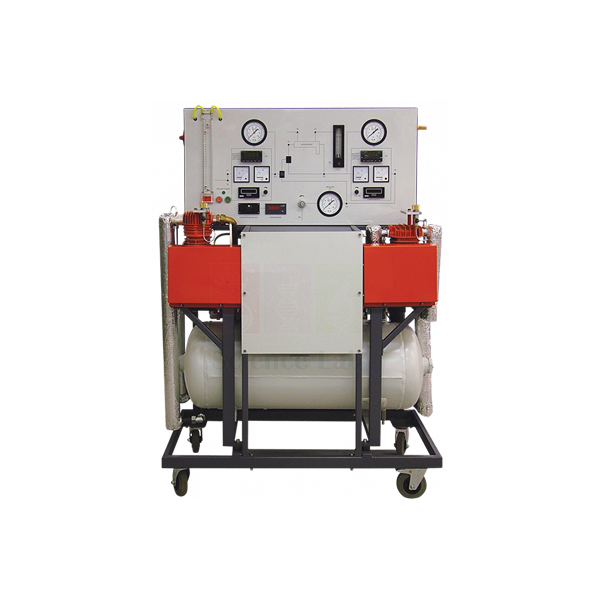
Two Stage Compressor Test Set
Two Stage Compressor Test Set (Product Code: SLE/EA/09) is a self-contained, mobile two-stage reciprocating air compressor test set used to investigate compressor operation and performance in single-stage, two-stage and intercooled two-stage modes in thermodynamics laboratories. As technical educational equipment it stands out because each of its two twin-cylinder compressors has its own electronic drive, load cell and speed sensor, so true shaft power is measured for each stage. It is made by Jain Scientific Equipments Pvt Ltd (ScienceLab), an OEM manufacturer, at its own factory in Ambala, India.
Key Details
| Parameter | Detail |
|---|---|
| Compressors | Two twin-cylinder, air-cooled reciprocating compressors, each driven by an electric motor through a low-maintenance toothed belt |
| Operating modes | Single-stage; two-stage; two-stage with inter-cooling |
| Motor control | Electronic drive units control both motors independently |
| Electrical power | Meters show the electrical power consumption of each motor |
| Torque | Close-coupled load cell on each motor |
| Speed | Sensor on each motor, shown on a digital indicator |
| Shaft power | True shaft power from the product of torque and speed |
| Intercooler | Integral, water-cooled |
| Air receiver | Included |
| Air routing | Diverter valves direct air from the first stage to the receiver, directly to the second stage, or to the second stage through the intercooler |
| Controls | All controls and instrumentation on an easy-to-operate mimic panel |
| Construction | Self-contained, mobile |
| Product code | SLE/EA/09 |
| Manufacturer | Jain Scientific Equipments Pvt Ltd (ScienceLab) — OEM |
| Country of origin | India (made in Ambala, Haryana) |
What Is the Two Stage Compressor Test Set Used For?
Students first run one compressor as a single-stage machine delivering straight to the receiver, then route air from the first stage directly into the second, and finally pass it through the water-cooled intercooler before the second stage. Comparing shaft power and electrical input across the three set-ups shows why staged compression with inter-cooling reduces the work needed, a central idea in compressor design.
Because the two compressor speeds are controlled independently, the stages can be matched under different conditions and the effect of speed matching on overall performance explored. Before each run, check that intercooler water is flowing when that mode is selected, confirm the diverter valves are set for the intended air path, and keep hands clear of the toothed belt drives while the motors run.
What to Specify When Ordering
- Number of test sets required
- Cooling-water availability for the water-cooled intercooler
- The electrical supply at your laboratory, so it can be confirmed in the quotation
OEM Manufacturer
ScienceLab, the trading name of Jain Scientific Equipments Private Limited, is the OEM of the Two Stage Compressor Test Set and manufactures it at its own licensed factory at Saha, Ambala, Haryana, India. Procurement teams registering the company as a vendor can use GSTIN 06AAECJ8618A1ZT and LEI 3358004HRD1JIVXKYX49.
Colleges, dealers and importers buy direct from the maker, and repeat orders or spares questions go to the same team — ask us. Visit the company profile for background.
Related Thermodynamics & Heat Transfer Lab Equipment
Compression and gas-law practicals continue on these units:
- Rotary Air Compressor Test Bench — a rotary vane compressor for comparison with reciprocating machines
- Air Blower Test Setup — a low-pressure radial fan at the other end of the air-machine range
- Two Stage (Series And parallel) — a fluid mechanics rig on series and parallel staging
- Expansion Of Perfect Gas — the gas-law behaviour behind compression and expansion
Explore the full Thermodynamics & Heat Transfer Lab Equipment category for more compressor and thermal trainers.
Frequently Asked Questions
Which operating modes does the Two Stage Compressor Test Set offer?
The Two Stage Compressor Test Set works as a single-stage compressor, a two-stage compressor, or a two-stage compressor with inter-cooling; diverter valves route the air to the receiver, directly to the second stage, or through the water-cooled intercooler.
How is shaft power measured on the Two Stage Compressor Test Set?
On the Two Stage Compressor Test Set, a close-coupled load cell on each motor measures torque and a sensor measures speed; the product of torque and speed gives true shaft power for each compressor.
What type of compressors does the Two Stage Compressor Test Set use?
The Two Stage Compressor Test Set uses two twin-cylinder, air-cooled reciprocating compressors, each driven by an electric motor through a low-maintenance toothed belt and controlled by its own electronic drive unit.
Can the two compressor speeds be set separately?
Yes. The Two Stage Compressor Test Set controls the two compressor speeds independently, which gives flexibility to match the stages under different conditions and to study how speed matching affects performance.
Who manufactures the Two Stage Compressor Test Set?
The Two Stage Compressor Test Set is manufactured by Jain Scientific Equipments Pvt Ltd (ScienceLab), the OEM, at its own factory in Ambala, Haryana, India; quotations and technical questions are answered directly by the manufacturer.
What information is needed to quote the Two Stage Compressor Test Set?
For a Two Stage Compressor Test Set quotation, share the quantity, the electrical supply available at your laboratory, cooling-water availability for the intercooler and the delivery location in India or abroad.
Is a calibration certificate available for the load cells and sensors?
Whether a calibration certificate can be provided for the load cells and speed sensors of the Two Stage Compressor Test Set should be discussed with us before ordering; list your needs on the contact page.
Request a Quote
Request your Two Stage Compressor Test Set quotation through the contact page, or add it to the enquiry cart with your other laboratory items. The quote comes straight from the manufacturer.
Last updated: 24 September 2026
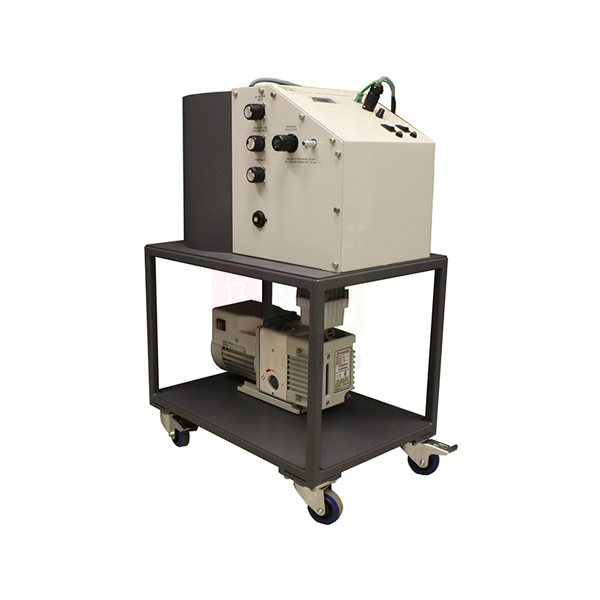
Emissivity Natural Convection And Radiation
Emissivity Natural Convection And Radiation (Product Code: SLE/EA/10) is a heat transfer apparatus used to separate radiant heat loss from natural (free) convection around a heated element in engineering college laboratories. Students run its pressure vessel from 1 bar (gauge) of compressed air down to about 5 Pa (absolute) and extrapolate towards a total vacuum, where convection disappears. This engineering lab equipment in India is made by Jain Scientific Equipments Pvt Ltd (ScienceLab), an OEM manufacturer, at its own factory in Ambala, India.
Specifications
| Parameter | Detail |
|---|---|
| Principle | Compares heat transfer by radiation and by natural (free) convection at different pressures and under vacuum |
| Test element | Small heated element hanging in the centre of a pressure vessel |
| Element surface | Matt black, with a thermocouple attached to measure its temperature |
| Vessel interior | Black, with a thermocouple fitted to the vessel wall |
| Pressure range | Charged with compressed air up to 1 bar (gauge) or evacuated down to about 5 Pa (absolute) |
| Pressure measurement | Two pressure transducers – one for pressures above atmospheric, one for pressures below atmospheric |
| Instrumentation | Instruments and a digital display for temperatures, pressures and power to the element |
| Learning outcomes | Emissivity of a surface; verification of the Stefan-Boltzmann equation; Nusselt, Grashof, Prandtl and Knudsen numbers |
| Product code | SLE/EA/10 |
| Manufacturer | Jain Scientific Equipments Pvt Ltd (ScienceLab) — OEM |
| Country of origin | India (made in Ambala, Haryana) |
What Is the Natural Convection and Radiation Apparatus Used For?
In a typical practical, students heat the element and log its surface temperature, the vessel wall temperature and the electrical power at several vessel pressures, then plot heat loss against pressure. Because convection weakens as the gas thins out, extending the curve towards zero pressure leaves the radiation component on its own. From that value the emissivity of the matt black surface is calculated and checked against the Stefan-Boltzmann equation.
The same readings let learners work with dimensionless groups such as the Nusselt, Grashof, Prandtl and Knudsen numbers, which makes the unit a strong fit among lab equipments for technical institutes teaching heat transfer. Let the element and vessel settle at each pressure before recording, because steady values give a cleaner extrapolation.
OEM Manufacturer
ScienceLab is the trading name of Jain Scientific Equipments Private Limited, the OEM (original equipment manufacturer) of this apparatus. It is produced at the company's own licensed factory at Saha, Ambala, Haryana, India, and supplied factory-direct to engineering colleges, polytechnics, universities, dealers and importers. When a department needs a replacement thermocouple or a repeat unit for a second lab, it deals with the manufacturer itself — just ask us. Company background is on the ScienceLab company profile.
Related Thermodynamics & Heat Transfer Lab Equipment
These apparatus extend a radiation and convection practical into other heat transfer modes:
- Computerized Emissivity Measurement Apparatus — a second route to surface emissivity for comparing methods.
- Free and Force Convection Apparatus — moves the study from natural convection to forced air flow.
- Extended Surface Heat Transfer — conduction along a bar that loses heat by convection and radiation.
- Conductivity Of Liquid And Gases — measures conduction through a thin gas or liquid layer.
Browse the complete range of Thermodynamics & Heat Transfer Lab Equipment.
Frequently Asked Questions
What does the Emissivity Natural Convection And Radiation apparatus measure?
The Emissivity Natural Convection And Radiation apparatus measures the temperatures, vessel pressure and electrical power needed to find how a heated matt black element loses heat by radiation and by natural convection, so students can calculate its surface emissivity.
What pressure range does the vessel cover?
The pressure vessel of the Emissivity Natural Convection And Radiation apparatus can be charged with compressed air up to 1 bar (gauge) or evacuated down to about 5 Pa (absolute), giving a wide span of test points for the extrapolation to vacuum.
Why does the apparatus have two pressure transducers?
The Emissivity Natural Convection And Radiation apparatus uses one pressure transducer for pressures above atmospheric and another for pressures below atmospheric, so both pressurised and evacuated test points are measured accurately instead of stretching a single sensor across the whole range.
How is radiation separated from convection?
Students record the heat loss from the element at several pressures and extrapolate the results down to a total vacuum, where no convection can occur. The heat transfer that remains on the Emissivity Natural Convection And Radiation apparatus is then due to radiation alone.
Who manufactures the Emissivity Natural Convection And Radiation apparatus?
Jain Scientific Equipments Pvt Ltd, trading as ScienceLab, manufactures the Emissivity Natural Convection And Radiation apparatus as the OEM at its own licensed factory at Saha, Ambala, Haryana, India, and quotes it directly to institutions, dealers and importers.
Is a calibration certificate available?
Calibration-certificate availability for the Emissivity Natural Convection And Radiation apparatus should be discussed with us before ordering. Please state the requirement through the contact page so that it can be addressed in your quotation.
What should a quotation request include?
For the Emissivity Natural Convection And Radiation apparatus (SLE/EA/10), mention the quantity, your institution, the delivery location in India or abroad and any questions about electrical supply or accessories, so the manufacturer can prepare an accurate quote.
Request a Quote
To order the Emissivity Natural Convection And Radiation apparatus, send your requirement through the contact page or add it to the enquiry cart. Quotations come direct from the manufacturer for single units and multi-lab orders across India and international markets.
Last updated: 24 September 2026
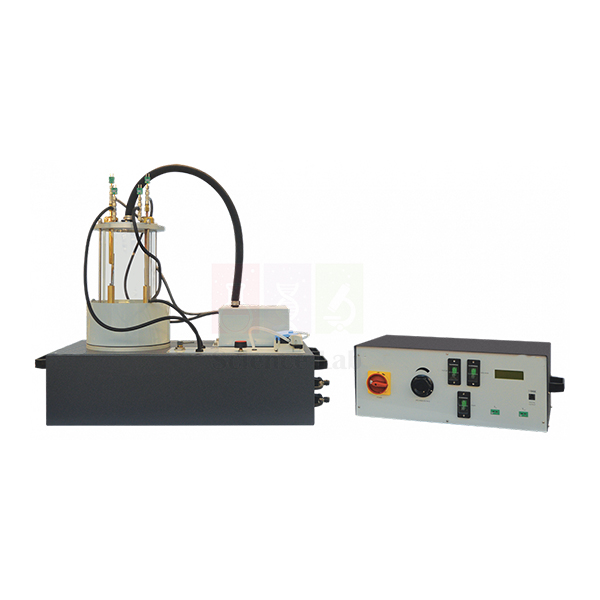
Filmwise And Dropwise Condensation And Boiling
Filmwise And Dropwise Condensation And Boiling (Product Code: SLE/EA/11) is a phase-change heat transfer apparatus used to demonstrate boiling and condensation inside a partially filled glass vessel in engineering laboratories. Students vary the current through a resistance wire heater in the water to move between boiling regimes, while two water-cooled vertical cylinders act as condensing surfaces. It is made by Jain Scientific Equipments Pvt Ltd (ScienceLab), an OEM engineering lab equipment manufacturer, at its own factory in Ambala, India.
Specifications
| Parameter | Detail |
|---|---|
| Test vessel | Partially filled glass vessel in which both heating and condensing take place |
| Heater | Heater coil (resistance wire heater element) in the water, with adjustable current |
| Heater wire temperature | Reaches significantly higher than 100 °C |
| Boiling regimes observed | Subcooled boiling (small bubbles form and rise); nucleate boiling (large bubbles form and rise); unstable and stable film boiling (a vapour blanket forms and radiation becomes important) |
| Condensing surfaces | Two water-cooled vertical cylinder specimens |
| Condensation measurement | Heat transfer found from the cooling water flow rate and its temperature change at each cylinder |
| Product code | SLE/EA/11 |
| Manufacturer | Jain Scientific Equipments Pvt Ltd (ScienceLab) — OEM |
| Country of origin | India (made in Ambala, Haryana) |
What Is the Filmwise and Dropwise Condensation Unit Used For?
For boiling experiments, students raise the heater current in steps and watch the water move from subcooled boiling, through nucleate boiling, to film boiling, where a vapour blanket surrounds the wire and radiation starts to matter. Because the vessel is glass, the whole group sees each regime form instead of inferring it from numbers alone.
For condensation work, vapour condenses on the two water-cooled vertical cylinders, and the cooling water flow rate and temperature change at each cylinder give the heat transferred. The name refers to the two condensation modes taught with it: filmwise, where condensate spreads as a continuous film, and dropwise, where it gathers as separate droplets. Raise the current gradually and let each condition settle before logging, a habit that suits any college buying engineering lab equipment in India for heat transfer courses.
OEM Manufacturer
Jain Scientific Equipments Private Limited, which trades as ScienceLab, is the OEM (original equipment manufacturer) of this condensation and boiling apparatus and makes it at its own licensed factory at Saha, Ambala, Haryana, India. Because the unit comes straight from the maker rather than through a trader, questions about a replacement glass vessel or heater element go directly to the people who build it — ask us and we will advise. More about the company is on our company profile.
Related Thermodynamics & Heat Transfer Lab Equipment
Pair this apparatus with other phase-change and temperature experiments from the same range:
- Computerized Boiling Heat Transfer Apparatus — an alternative boiling set-up with computerised readings.
- Saturated Steam The Marcet Boiler — links boiling to saturated steam pressure and temperature.
- Emissivity Natural Convection And Radiation — studies the radiation heat transfer that becomes important in film boiling.
- Temperature Measurement and Calibration Apparatus — builds the temperature measurement skills these tests rely on.
See every item in Thermodynamics & Heat Transfer Lab Equipment.
Frequently Asked Questions
Which boiling regimes can students observe?
The Filmwise And Dropwise Condensation And Boiling apparatus shows subcooled boiling with small rising bubbles, nucleate boiling with large rising bubbles, and unstable and stable film boiling, where a vapour blanket forms around the heater wire as its current is increased.
How is condensation heat transfer measured?
On the Filmwise And Dropwise Condensation And Boiling apparatus, water condenses on two water-cooled vertical cylinders; students measure the cooling water flow rate and its temperature change at each cylinder and use these values to calculate the heat transferred.
Why is the test vessel made of glass?
The partially filled glass vessel of the Filmwise And Dropwise Condensation And Boiling apparatus lets students watch the boiling process directly and note how bubbles and the vapour blanket change, which makes the different regimes much easier to recognise and discuss.
How hot does the heater wire become?
The heater wire in the Filmwise And Dropwise Condensation And Boiling apparatus reaches significantly higher than 100 °C during the boiling experiments, so students should switch off and allow the unit to cool before handling any part of the vessel.
Does the apparatus need a cooling water supply?
Yes, the two condensing cylinders of the Filmwise And Dropwise Condensation And Boiling apparatus are water-cooled, so a cooling water supply is used during condensation tests. Ask us through the contact page about connection details for your lab.
Who manufactures the Filmwise And Dropwise Condensation And Boiling apparatus?
The Filmwise And Dropwise Condensation And Boiling apparatus is manufactured by Jain Scientific Equipments Pvt Ltd (ScienceLab), the OEM, at its own licensed factory in Saha, Ambala, India, and is supplied factory-direct to colleges, dealers and importers.
What details help with a quotation?
When requesting a quote for the Filmwise And Dropwise Condensation And Boiling apparatus (SLE/EA/11), give the number of units, your institution name, the delivery destination and any questions on water or electrical connections, so the manufacturer can reply accurately.
Request a Quote
For prices and availability of the Filmwise And Dropwise Condensation And Boiling apparatus, use our contact page or place it in the enquiry cart. Your quotation comes direct from the manufacturer, for delivery in India and international markets.
Last updated: 24 September 2026
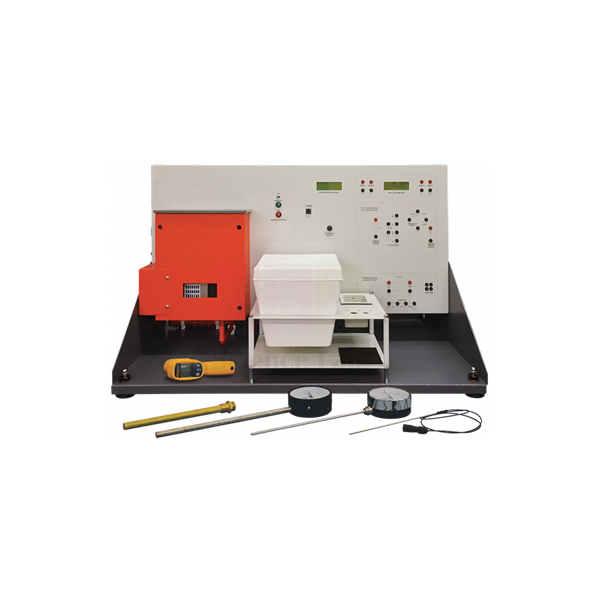
Temperature Measurement and Calibration Apparatus
Temperature Measurement and Calibration Apparatus (Product Code: SLE/EA/12) is a benchtop teaching unit used to compare eight different temperature measurement devices and calibrate them against a precision reference sensor in engineering and physics laboratories. Students work between an insulated ice box and a guarded tank that heats water steadily up to boiling, while a display gives the reference temperature, local pressure and local boiling point. It is made by Jain Scientific Equipments Pvt Ltd (ScienceLab), an OEM maker of thermometry apparatus in India, at its own factory in Ambala.
Specifications
| Parameter | Detail |
|---|---|
| Mounting | Fits on a desk or benchtop |
| Devices included | Eight different temperature measurement devices, for studying their characteristics and calibrating them against a standard |
| Temperature reference | Built-in precision reference sensor |
| Display | Shows the reference temperature and the local pressure from a built-in pressure sensor; calculates the local boiling point of water from barometric pressure |
| Heating | Carefully rated immersion heater that warms the tank water steadily up to boiling |
| Ice point | Insulated icebox filled with crushed ice by the students |
| Water heater tank | Fully guarded, with a drain tap for connection to a suitable container or local water drain |
| Safety | Water level float switch and safety temperature cut-out switch that turn off the heater if the water level is low |
| Product code | SLE/EA/12 |
| Manufacturer | Jain Scientific Equipments Pvt Ltd (ScienceLab) — OEM |
| Country of origin | India (made in Ambala, Haryana) |
What Is the Temperature Calibration Apparatus Used For?
Students place the temperature devices beside the reference sensor, first in the crushed-ice box and then in the heater tank as the water warms, recording readings at intervals. Comparing each device with the reference shows its characteristics, such as offset and response, and teaches how a calibration against a standard is built up. The slow, steady heating leaves time to take accurate results at every step.
Because the display works out the local boiling point from barometric pressure, learners see why water rarely boils at exactly the textbook value and correct their upper fixed point accordingly. The unit suits physics departments as well as lab equipments for technical institutes where instrumentation courses cover sensor calibration. Draining the tank through its tap between groups keeps each session short.
OEM Manufacturer
ScienceLab is the brand under which Jain Scientific Equipments Private Limited (CIN U29309HR2020PTC087597) produces this calibration apparatus as the OEM (original equipment manufacturer). Manufacturing takes place at the company's own licensed factory, 449, HSIIDC Industrial Area, Saha, Ambala, Haryana, India (Factory Licence AMB-ONLINE-CHD-J-414). Buying factory-direct means laboratories, dealers and importers have quotations, repeat orders and spare-part enquiries handled by the maker itself. Read more on the ScienceLab profile page.
Related Thermodynamics & Heat Transfer Lab Equipment
Useful additions for a temperature measurement practical:
- Digital Thermometer — a handheld instrument students can add to their comparison readings.
- Immersion Thermometer — a further thermometer for side-by-side checks against the reference.
- Saturated Steam The Marcet Boiler — extends the pressure and boiling point link to saturated steam.
- Unsteady State Heat Transfer — puts transient temperature measurement into practice.
Explore the full Thermodynamics & Heat Transfer Lab Equipment range.
Frequently Asked Questions
How many temperature devices come with the apparatus?
The Temperature Measurement and Calibration Apparatus includes eight different temperature measurement devices, so students can compare their characteristics and calibrate each one against the built-in reference. Ask us for the list of device types when you request a quotation.
What acts as the temperature standard?
A built-in precision reference sensor is the standard on the Temperature Measurement and Calibration Apparatus. Its reading appears on the display together with the local pressure from the built-in pressure sensor, giving a trusted value to compare other devices against.
Why does the display calculate the local boiling point?
Water boils at different temperatures as barometric pressure changes, so the Temperature Measurement and Calibration Apparatus calculates the local boiling point from its pressure sensor. Students then use the correct upper fixed point instead of assuming a fixed textbook figure.
What safety features does the heater tank have?
The water heater tank of the Temperature Measurement and Calibration Apparatus is fully guarded and has a water level float switch and a safety temperature cut-out switch, which turn off the heater if the water level becomes too low.
How is the hot water changed between experiments?
The heater tank on the Temperature Measurement and Calibration Apparatus has a drain tap that connects to a suitable container or local water drain, so hot water can be changed safely and quickly, which reduces the time each experiment takes.
Who manufactures the Temperature Measurement and Calibration Apparatus?
Jain Scientific Equipments Pvt Ltd (ScienceLab) is the OEM of the Temperature Measurement and Calibration Apparatus and manufactures it at its own licensed factory in Saha, Ambala, Haryana, India, supplying institutions and trade buyers directly.
Is a calibration certificate supplied?
Calibration-certificate availability for the Temperature Measurement and Calibration Apparatus or its reference sensor should be discussed with us before you order. Please mention it through the contact page so the quotation can address it.
Request a Quote
Request pricing for the Temperature Measurement and Calibration Apparatus through the contact page, or add it to the enquiry cart with other laboratory items. Quotes are issued direct by the manufacturer for buyers in India and international markets.
Last updated: 24 September 2026

Jacketed Vessel and Coil
Jacketed Vessel and Coil (Product Code: SLE/EA/13) is a process-style heat exchanger used to show how a stirred vessel is heated either through its outer jacket or through an internal coil in chemical and mechanical engineering laboratories. Students run it with a continuous feed or a fixed batch, using a motorised stirrer and a dedicated batch thermocouple to see how agitation changes heat transfer. It is made by Jain Scientific Equipments Pvt Ltd (ScienceLab), an OEM and technical educational equipment manufacturer, at its own factory in Ambala, India.
Key Details
| Parameter | Detail |
|---|---|
| Type | Heat exchanger that mimics those used in the process industry |
| Heating methods | Through the outer skin (‘jacket’) of the vessel, or through a coil inside the vessel |
| Operating modes | Continuous feed to the vessel for heating, or a fixed batch |
| Agitation | Motorised stirrer to show how stirring affects heat transfer |
| Temperature measurement | Extra thermocouple to measure the batch temperature |
| Fluid connections | Self-sealing quick connectors between the Service Module and the heat exchanger, for safety and simplicity |
| Error-proofing | Hot and cold fluid streams use different connectors |
| Product code | SLE/EA/13 |
| Manufacturer | Jain Scientific Equipments Pvt Ltd (ScienceLab) — OEM |
| Country of origin | India (made in Ambala, Haryana) |
What Is the Jacketed Vessel and Coil Used For?
The unit recreates the stirred-tank heating found across the process industry, so students can compare jacket heating with coil heating in the same vessel. Switching the motorised stirrer on and off between runs shows clearly how agitation raises the rate of heat transfer to the liquid.
In batch mode, a fixed charge is heated and the extra thermocouple tracks the batch temperature over time; with continuous feed, liquid flows through while it is heated, giving a steady-state comparison. Always couple the hot and cold streams to their own connectors, which are deliberately different to prevent mix-ups. This makes it a realistic piece of engineering lab equipment in India for unit-operations teaching.
What to Specify When Ordering
- Whether you also need the Service Module that supplies the hot and cold fluid streams through the quick connectors.
- Which other heat exchangers from the same range you want for side-by-side comparison.
- The number of units required for your laboratory.
OEM Manufacturer
Jain Scientific Equipments Private Limited, known by its trading name ScienceLab, is the OEM (original equipment manufacturer) of the Jacketed Vessel and Coil and builds it at its own licensed factory at Saha, Ambala, Haryana, India. Colleges setting up a unit-operations or heat transfer lab can have this vessel quoted together with other exchangers from the same range, all from one manufacturer. Dealers and importers are supplied factory-direct too. See our company profile for more background.
Related Thermodynamics & Heat Transfer Lab Equipment
Other heat exchangers and services that fit the same practical programme:
- Heat Exchanger — the hot and cold water service unit for the heat exchanger range.
- Shell and Tube Heat Exchanger — a common industrial design for comparison with jacket heating.
- Plate Heat Exchanger — a compact alternative built from gasketed plates.
- Concentric Tube Heat Exchanger — the simplest tube-in-tube layout for baseline tests.
View all Thermodynamics & Heat Transfer Lab Equipment.
Frequently Asked Questions
Can the vessel be heated by both the jacket and the coil?
Yes. The Jacketed Vessel and Coil can transfer heat through the outer skin, or jacket, of the vessel or through a coil inside it, so students can compare the two methods on the same batch of liquid.
Does it run in batch or continuous mode?
The Jacketed Vessel and Coil works both ways: you can set a fixed batch for heating or run a continuous feed through the vessel, which lets students compare transient batch heating with steady continuous operation.
What does the motorised stirrer show?
The motorised stirrer on the Jacketed Vessel and Coil demonstrates how stirring affects heat transfer. Running the same test with and without agitation shows students why stirred vessels are standard practice in the process industry.
Does the Jacketed Vessel and Coil need a service module?
The Jacketed Vessel and Coil is designed to connect to a Service Module through self-sealing quick connectors for its hot and cold fluid streams. Ask us through the contact page which service unit to include in your quotation.
How are connection errors prevented?
All fluid connections on the Jacketed Vessel and Coil use self-sealing quick connectors, and the hot and cold streams have different connector types, so students cannot easily swap them and set-up stays safe and simple.
Who manufactures the Jacketed Vessel and Coil?
The Jacketed Vessel and Coil is manufactured by Jain Scientific Equipments Pvt Ltd (ScienceLab), the OEM, at its own licensed factory at Saha, Ambala, India, and quotations are issued directly by the manufacturer to institutions and trade buyers.
Request a Quote
Ask for a quotation for the Jacketed Vessel and Coil on our contact page or add it to the enquiry cart along with any companion exchangers. The manufacturer replies directly, for delivery within India and to international markets.
Last updated: 24 September 2026
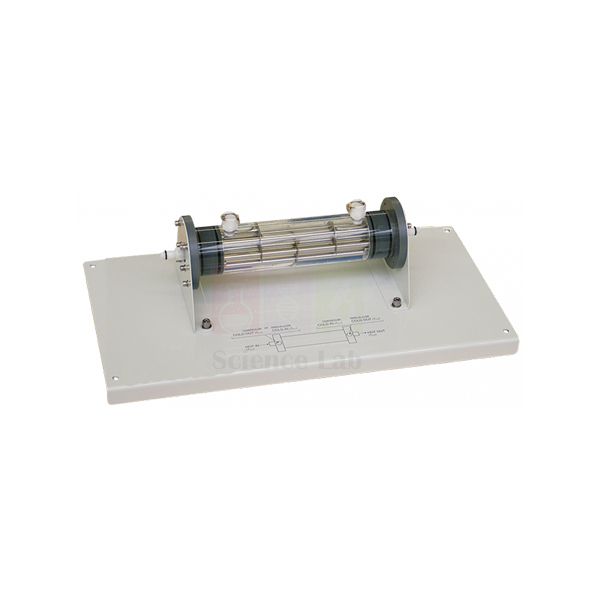
Shell and Tube Heat Exchanger
Shell and Tube Heat Exchanger (Product Code: SLE/EA/14) is a teaching heat exchanger used to demonstrate one of the most common designs in industry, with one fluid flowing through a bundle of small tubes and the other through the surrounding shell, in engineering laboratories. Baffles around the tube bundle create turbulent mixed flow on the shell side, helping students link lab results with plant practice. It is made by Jain Scientific Equipments Pvt Ltd (ScienceLab), an OEM manufacturer, at its own factory in Ambala, India.
Key Details
| Parameter | Detail |
|---|---|
| Construction | A large tube (the shell) surrounding several smaller tubes (the tube bundle) |
| Flow arrangement | One fluid passes through the shell and the other through the tube bundle, transferring heat between them |
| Baffles | Fitted around the bundle to create a turbulent mixed flow |
| Design advantage | Compact, yet able to work at higher pressures than other designs |
| Industrial relevance | One of the most common heat exchanger types used in industry |
| Product code | SLE/EA/14 |
| Manufacturer | Jain Scientific Equipments Pvt Ltd (ScienceLab) — OEM |
| Country of origin | India (made in Ambala, Haryana) |
What Is the Shell and Tube Heat Exchanger Used For?
In a typical exercise, students record the inlet and outlet temperatures and flow rates of the shell-side and tube-side streams, work out the heat transferred, and compare the result with other exchanger types. Seeing the tube bundle inside a shell also makes the textbook diagrams of industrial exchangers much easier to follow.
The baffles force the shell-side fluid across the tubes rather than simply along them, which raises turbulence and improves heat transfer. Polytechnics and TVET colleges value the unit because it is the exchanger trainees are most likely to meet on a plant, and ScienceLab builds it as a TVET lab equipment manufacturer in India.
OEM Manufacturer
Jain Scientific Equipments Private Limited, trading as ScienceLab, is the OEM (original equipment manufacturer) of this Shell and Tube Heat Exchanger and produces it at its own licensed factory in Saha, Ambala, Haryana, India. Institutions receive it factory-direct rather than through a trading intermediary, so technical questions and follow-up orders reach the team that makes it. Distributors and importers can also buy directly for projects in India and international markets. Background on the company is on the ScienceLab profile.
Related Thermodynamics & Heat Transfer Lab Equipment
Compare the shell-and-tube design with these exchangers and services:
- Concentric Tube Heat Exchanger — the simplest tube-in-tube design for baseline results.
- Plate Heat Exchanger — a compact plate design to set against the tube bundle.
- Heat Exchanger — a hot and cold water service unit built for heat exchanger experiments.
- Parallel and Counter Flow Heat Exchanger — shows how flow direction changes performance.
The complete range is listed under Thermodynamics & Heat Transfer Lab Equipment.
Frequently Asked Questions
How does the Shell and Tube Heat Exchanger work?
In the Shell and Tube Heat Exchanger, one fluid flows through a bundle of smaller tubes while the other flows through the large surrounding shell, so heat passes through the tube walls from the hotter stream to the colder one.
What do the baffles do?
The baffles around the tube bundle of the Shell and Tube Heat Exchanger create a turbulent mixed flow on the shell side. Turbulence disturbs the slow-moving layer next to the tubes, which helps heat move between the two fluids more effectively.
Why is this design so common in industry?
The Shell and Tube Heat Exchanger represents a design widely used in industry because it is compact but can work at higher pressures than other designs, which is why it appears in so many process and power plants.
What supply and measuring equipment does it need?
Water supply and measurement requirements for the Shell and Tube Heat Exchanger depend on the set-up being quoted. Ask us through the contact page and we will confirm which service unit and instruments it is used with.
Who manufactures the Shell and Tube Heat Exchanger?
The Shell and Tube Heat Exchanger is manufactured by Jain Scientific Equipments Pvt Ltd, trading as ScienceLab, which is the OEM and makes it at its own licensed factory at Saha, Ambala, India, for supply to colleges, dealers and importers.
What should a quotation request mention?
For the Shell and Tube Heat Exchanger (SLE/EA/14), mention the quantity, your institution, the delivery destination and whether you also need other exchangers or a service unit, so the manufacturer can send one complete quotation.
Request a Quote
For a price on the Shell and Tube Heat Exchanger, write to us through the contact page or add it to the enquiry cart. Quotations come straight from the manufacturer, for buyers in India and international markets.
Last updated: 24 September 2026
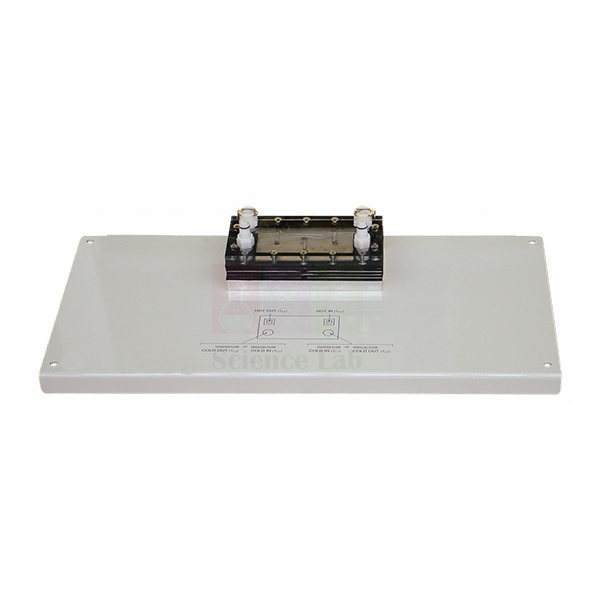
Plate Heat Exchanger
Plate Heat Exchanger (Product Code: SLE/EA/15) is a gasketed-plate heat exchanger used to teach how compact exchangers pass heat between hot and cold streams flowing on alternate sides of metal plates in engineering laboratories. Students examine how flow disturbers on the plates boost heat transfer and how capacity changes when plates and spacers are added or removed. It is made by Jain Scientific Equipments Pvt Ltd (ScienceLab), an OEM manufacturer of engineering educational equipments in India, at its own factory in Ambala.
Key Details
| Parameter | Detail |
|---|---|
| Construction | A set of metal plates separated by spacers (gaskets) |
| Plate surface | Flow disturbers on the plate sides to help improve heat transfer |
| Flow path | Holes in the plates and gaskets make the hot and cold flows run on alternate sides of the plates |
| Capacity | Altered simply by adding or removing plates and spacers |
| Footprint | Compact, suited to applications with limited space |
| Product code | SLE/EA/15 |
| Manufacturer | Jain Scientific Equipments Pvt Ltd (ScienceLab) — OEM |
| Country of origin | India (made in Ambala, Haryana) |
What Is the Plate Heat Exchanger Used For?
The plate exchanger works on the same principle as tube types — a metal wall separating hot and cold fluids — but thin plates with flow disturbers pack a large surface into a small volume. Students log the temperatures and flow rates of both streams, calculate the heat transferred and compare the figures with tube-in-tube and shell-and-tube results.
Since capacity depends on the number of plates, instructors can use it to discuss how transfer area sets performance. When the plate pack is opened for inspection or cleaning, reassemble plates and gaskets in their original order so the flows stay on alternate sides. It suits polytechnics buying vocational training lab equipment for courses covering dairy, HVAC or process plants, where plate exchangers are widely used.
OEM Manufacturer
This Plate Heat Exchanger is produced by Jain Scientific Equipments Private Limited, which trades as ScienceLab and acts as the OEM (original equipment manufacturer), at its own licensed factory in Saha, Ambala, Haryana, India. Because you are dealing with the maker, questions about replacement gaskets or extra plates go straight to the people who assemble the exchanger — ask us and we will advise. Schools of engineering, dealers and importers are all supplied factory-direct; read more on our company profile.
Related Thermodynamics & Heat Transfer Lab Equipment
Build a comparative heat exchanger practical with these items:
- Shell and Tube Heat Exchanger — the higher-pressure industrial design to contrast with plates.
- Concentric Tube Heat Exchanger — a simple tube-in-tube reference for comparison.
- Heat Exchanger — the hot and cold water service unit for the exchanger range.
- Jacketed Vessel and Coil — adds stirred-vessel heating from the process industry.
More options are in Thermodynamics & Heat Transfer Lab Equipment.
Frequently Asked Questions
How are the hot and cold fluids kept apart?
In the Plate Heat Exchanger, holes in the metal plates and gaskets route the hot and cold flows along alternate sides of each plate, so the two streams never mix while heat passes through the thin plate walls.
What are the flow disturbers for?
The flow disturbers on the sides of the Plate Heat Exchanger plates break up smooth flow over the metal surface, which helps improve heat transfer between the hot and cold streams compared with a plain, flat plate.
Can the capacity be changed?
Yes. The capacity of the Plate Heat Exchanger can be altered simply by adding or removing plates and spacers, which is one reason plate designs are easy to adapt. Ask us before changing the plate pack on a teaching unit.
Why choose a plate design over a tube design?
A Plate Heat Exchanger is compact, so it suits applications with limited space, and its capacity is easy to change. Tube designs such as shell-and-tube exchangers, by contrast, are preferred where higher working pressures are needed.
Can I get replacement gaskets?
Replacement gaskets or plates for the Plate Heat Exchanger are handled by the manufacturer itself. Send the product code SLE/EA/15 and your requirement through the contact page and we will confirm what can be supplied.
Who manufactures the Plate Heat Exchanger?
The Plate Heat Exchanger is manufactured by Jain Scientific Equipments Pvt Ltd (ScienceLab) as the OEM at its own licensed factory in Saha, Ambala, Haryana, India, and is supplied factory-direct to institutions, dealers and importers.
Request a Quote
To receive a quotation for the Plate Heat Exchanger, contact us via the contact page or add the item to the enquiry cart. Quotes are sent directly by the manufacturer to buyers in India and international markets.
Last updated: 24 September 2026
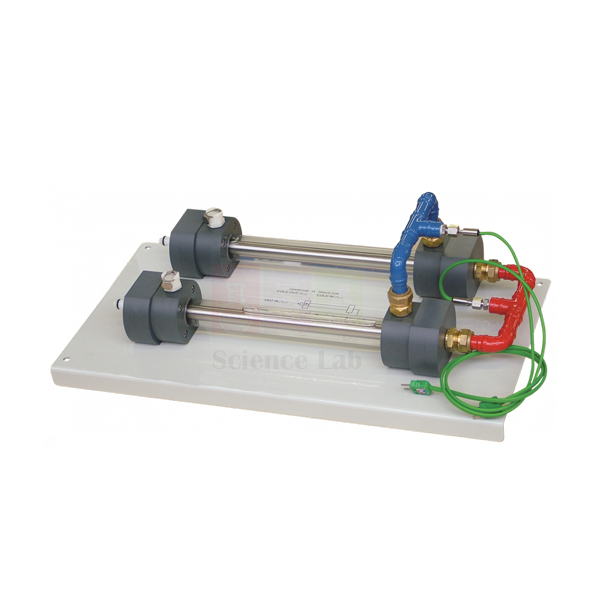
Concentric Tube Heat Exchanger
Concentric Tube Heat Exchanger (Product Code: SLE/EA/16) is a tube-in-tube heat exchanger used to show how heat passes from a hot fluid in one tube to a cold fluid in the other in college engineering laboratories. The simplest of the optional heat exchangers, it is built in two equal halves joined by intermediate pipes, giving two extra measurement points at the midpoint. This lab equipment for technical institutes is made by Jain Scientific Equipments Pvt Ltd (ScienceLab), an OEM manufacturer, at its own factory in Ambala, India.
Key Details
| Parameter | Detail |
|---|---|
| Design | Two tubes, one inside the other (tube-in-tube) |
| Fluid streams | One tube carries the hot fluid and the other the cold fluid; heat transfers between them |
| Construction | Two equal parts joined by intermediate pipes |
| Extra measurement | Two additional measurement points at the midpoint |
| Position in range | The simplest of the optional heat exchangers |
| Product code | SLE/EA/16 |
| Manufacturer | Jain Scientific Equipments Pvt Ltd (ScienceLab) — OEM |
| Country of origin | India (made in Ambala, Haryana) |
What Is the Concentric Tube Heat Exchanger Used For?
With readings at the inlets, the outlets and the two midpoint positions, students can plot how the hot and cold fluid temperatures change along the exchanger rather than seeing only the end values. That clearer temperature profile makes it easier to explain the log mean temperature difference and why the rate of heat transfer falls as the two streams approach each other in temperature.
Because the geometry is so simple, this is where many learners first calculate an overall heat transfer coefficient. Colleges planning engineering lab equipment in India for a heat transfer course can start with this unit and add plate and shell-and-tube types later for comparison.
OEM Manufacturer
ScienceLab is the trading name of Jain Scientific Equipments Private Limited, a registered MSME manufacturer (Udyam UDYAM-HR-01-0003714) and the OEM (original equipment manufacturer) of this Concentric Tube Heat Exchanger. The exchanger is built at the company's own licensed factory at Saha, Ambala, Haryana, India. For overseas orders, export shipments are handled under Importer-Exporter Code AAECJ8618A (DGFT), with quotations coming directly from the manufacturer. Further details are on the ScienceLab profile.
Related Thermodynamics & Heat Transfer Lab Equipment
Items that extend a concentric tube practical:
- Heat Exchanger — the service unit that supplies hot and cold water to the optional exchangers and measures their performance.
- Parallel and Counter Flow Heat Exchanger — explores how flow direction affects heat transfer.
- Plate Heat Exchanger — a compact plate design for the next comparison.
- Shell and Tube Heat Exchanger — the baffled industrial design.
See the whole Thermodynamics & Heat Transfer Lab Equipment category.
Frequently Asked Questions
Why is it called a concentric tube heat exchanger?
The Concentric Tube Heat Exchanger has two tubes, one inside the other, sharing a common centre line. One tube carries the hot fluid and the other the cold fluid, and heat transfers through the wall that separates them.
What is the benefit of the two-part construction?
The Concentric Tube Heat Exchanger is made in two equal parts joined by intermediate pipes, which adds two measurement points at the midpoint. These readings show more clearly how the fluid temperatures change during heat transfer, giving more useful results.
Is it suitable as a first heat exchanger experiment?
Yes. The Concentric Tube Heat Exchanger is the simplest of the optional heat exchangers, so its tube-in-tube layout is easy for students to understand before they progress to plate or shell-and-tube designs.
What supply unit does it work with?
The Concentric Tube Heat Exchanger is one of the optional heat exchangers used with a hot and cold water service unit. Ask us through the contact page to confirm which service unit should be included in your quotation.
Who manufactures the Concentric Tube Heat Exchanger?
Jain Scientific Equipments Pvt Ltd, which trades as ScienceLab, manufactures the Concentric Tube Heat Exchanger as the OEM at its own licensed factory in Saha, Ambala, Haryana, India, and supplies it directly to colleges and trade buyers.
Can the Concentric Tube Heat Exchanger be shipped abroad?
Yes. ScienceLab supplies the Concentric Tube Heat Exchanger to buyers in India and international markets, with export paperwork handled by the manufacturer. Share your destination country and quantity through the contact page to receive a quotation.
Request a Quote
Send an enquiry for the Concentric Tube Heat Exchanger through our contact page, or add it to the enquiry cart together with a service unit or other exchangers. You will receive a quotation direct from the manufacturer.
Last updated: 24 September 2026
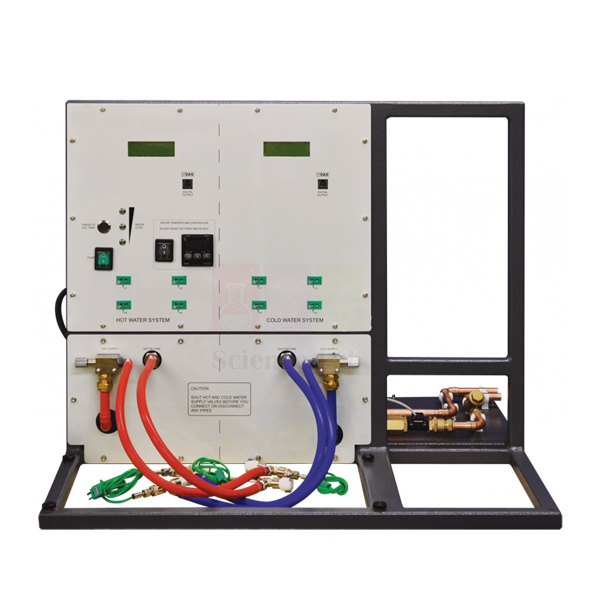
Heat Exchanger
Heat Exchanger (Product Code: SLE/EA/17) is a heat exchanger service unit used to supply stable hot and cold water streams to optional heat exchangers and measure their performance in engineering laboratories. Precision needle valves and turbine flow meters control and measure both streams, while thermocouples and multiline digital displays report inlet and outlet temperatures and flow rates. It is made by Jain Scientific Equipments Pvt Ltd (ScienceLab), an OEM manufacturer of vocational training and engineering lab equipment, at its own factory in Ambala, India.
Key Details
| Parameter | Detail |
|---|---|
| Function | Provides hot and cold water to the heat exchangers and all the instruments needed to measure their performance |
| Hot water system | Gives stable flow rates and temperatures |
| Tank filling | Electrically operated valve opens to let water in to fill the tank |
| Tank protection | Against over temperature, low water level and overfilling |
| Flow control and measurement | Precision needle valves and turbine flow meters on both the hot and cold water systems |
| Cold water circuit | Flow regulator and connection for an external mains water supply |
| Temperature measurement | Thermocouples at the connectors for hot and cold inlet and outlet temperatures; some heat exchangers also have built-in thermocouples |
| Displays | Clear, multiline digital displays of fluid stream temperatures and flow rates |
| Connections | Self-sealing quick connectors to the optional heat exchangers; different connectors for the hot and cold streams |
| Comparability | All optional heat exchangers share the same nominal heat transfer area and wall thickness |
| Product code | SLE/EA/17 |
| Manufacturer | Jain Scientific Equipments Pvt Ltd (ScienceLab) — OEM |
| Country of origin | India (made in Ambala, Haryana) |
What Is the Heat Exchanger Service Unit Used For?
This unit is the common base of a heat exchanger practical. Students couple an optional exchanger to it with the quick connectors, set the hot and cold flows on the needle valves, and read temperatures and flow rates from the displays. Because every optional exchanger has the same nominal heat transfer area and wall thickness, differences in results come from the exchanger design itself, giving a fair comparison.
Connect the cold water circuit to the mains supply, fill the tank through the electrically operated valve and let the hot water system settle before logging data. For multi-bench laboratories, several service units can be quoted together as one scientific equipment bulk supply order.
What to Specify When Ordering
- Which heat exchangers from the same range you plan to use with it, so connections can be confirmed.
- Whether an external mains water supply is available for the cold water circuit.
- How many service units you need for your bench groups.
OEM Manufacturer
Jain Scientific Equipments Private Limited, trading as ScienceLab, is the OEM (original equipment manufacturer) of this Heat Exchanger service unit and makes it at its own licensed factory at Saha, Ambala, Haryana, India. Sourcing the service unit and its exchangers from one manufacturer means a single point of contact for questions on connections, spares and add-on exchangers. Engineering colleges, dealers and importers are supplied factory-direct. Visit our company profile for more.
Related Thermodynamics & Heat Transfer Lab Equipment
Heat exchangers from the same range to test on this unit:
- Concentric Tube Heat Exchanger — the simplest optional exchanger, with midpoint readings.
- Plate Heat Exchanger — a compact gasketed-plate design.
- Shell and Tube Heat Exchanger — the baffled tube-bundle design common in industry.
- Jacketed Vessel and Coil — stirred-vessel heating through a jacket or coil.
Find more in Thermodynamics & Heat Transfer Lab Equipment.
Frequently Asked Questions
What does the Heat Exchanger service unit provide?
The Heat Exchanger service unit provides hot and cold water to the optional heat exchangers, together with all the instruments needed to measure their performance, including flow meters, thermocouples and digital displays for temperatures and flow rates.
How are the flow rates controlled and measured?
Both the hot and cold water systems of the Heat Exchanger service unit have precision needle valves and turbine flow meters. The cold water circuit also includes a flow regulator and a connection for an external mains water supply.
What protection does the water tank have?
The tank of the Heat Exchanger service unit is protected against over temperature, low water level and overfilling. An electrically operated valve opens to let water in to fill it, which keeps set-up simple for students.
Why can different exchangers be compared directly?
All the optional heat exchangers used with the Heat Exchanger service unit have the same nominal heat transfer area and wall thickness, so students can compare their results directly and attribute differences to the exchanger design.
How are temperatures measured?
Thermocouples at the connectors of the Heat Exchanger service unit measure the hot and cold inlet and outlet temperatures. Some heat exchangers also carry built-in thermocouples for extra readings, all shown on clear multiline digital displays.
Who manufactures the Heat Exchanger service unit?
The Heat Exchanger service unit (SLE/EA/17) is manufactured by Jain Scientific Equipments Pvt Ltd (ScienceLab), the OEM, at its own licensed factory in Saha, Ambala, India. Quotations for the unit and its exchangers come straight from the manufacturer.
Request a Quote
To price the Heat Exchanger service unit, with or without its optional exchangers, write to us on the contact page or add items to the enquiry cart. The manufacturer quotes directly for India and international markets.
Last updated: 24 September 2026
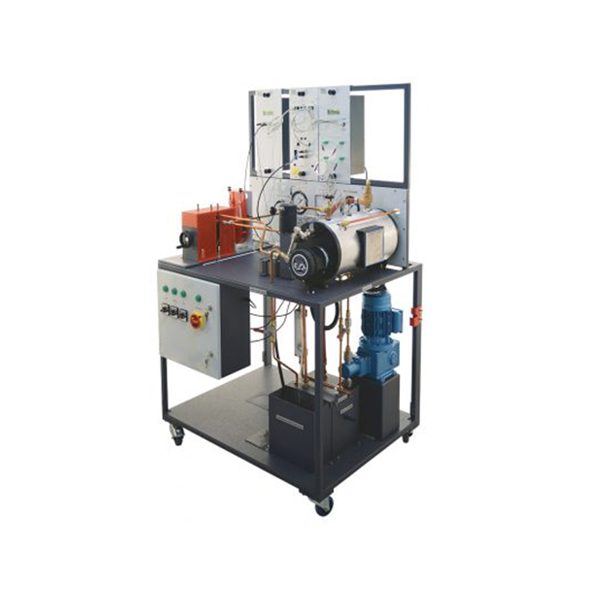
Thermal Power Plant with Steam Engine Trainer
Thermal Power Plant with Steam Engine Trainer (Product Code: SLE/EA/18) is a mobile steam plant test set used to demonstrate the full cycle of a small thermal power plant, from boiler to engine to condenser, in mechanical engineering laboratories. An electrically heated boiler drives a two-cylinder steam motor loaded by a band-brake dynamometer, and a throttling calorimeter measures the dryness fraction of the steam. It is made by Jain Scientific Equipments Pvt Ltd (ScienceLab), an OEM technical educational equipment manufacturer, at its own factory in Ambala, India.
Specifications
| Parameter | Detail |
|---|---|
| Frame | Mobile frame containing all parts of the test set |
| Feed water | Electric pump draws from a reservoir (included) to deliver water to the boiler |
| Boiler | Electrically heated, with safety valve, water level gauge and blow-down cock |
| Heater power | Meter shows the electrical power supplied to the boiler heaters |
| Steam quality | Throttling calorimeter for measuring the dryness fraction of the steam |
| Pressure gauges | Two mechanical gauges showing boiler pressure and engine inlet pressure |
| Engine | Two-cylinder steam motor turned by steam from the boiler |
| Dynamometer | Band-brake dynamometer with digital torque and speed display, measuring motor speed, torque and power |
| Temperatures | Thermocouples at key points, connected to a digital temperature display |
| Condenser | Mains water-cooled; used steam then passes to a waste tank or a measuring vessel |
| Instrumentation | Includes all instruments needed for the experiments |
| Also used | A stopwatch and thermometer for accurate measurement of condensate flow and temperature |
| Product code | SLE/EA/18 |
| Manufacturer | Jain Scientific Equipments Pvt Ltd (ScienceLab) — OEM |
| Country of origin | India (made in Ambala, Haryana) |
What Is the Thermal Power Plant Trainer Used For?
Students follow the whole steam power cycle on one frame: the pump feeds the boiler, steam turns the engine against the band brake, and the exhaust is condensed. Comparing the electrical power into the boiler heaters with the shaft power from the dynamometer gives the overall efficiency, while the throttling calorimeter reading shows how wet or dry the steam is.
Collecting condensate in the measuring vessel and timing it with a stopwatch gives the steam flow rate, and a thermometer reading completes the energy balance across the condenser. Keep an eye on the water level gauge and pressure gauges throughout a run. The trainer is a strong fit for lab equipments for technical institutes teaching power plant engineering.
What to Specify When Ordering
- Whether a stopwatch and thermometer for condensate measurements should be added to the quotation.
- That a mains cooling water supply is available for the condenser.
- The number of trainers required and the delivery location.
OEM Manufacturer
ScienceLab, the trading name of Jain Scientific Equipments Private Limited, is the OEM (original equipment manufacturer) of this steam plant trainer and makes it as a complete test set at its own licensed factory at Saha, Ambala, Haryana, India. Maintenance questions about items such as the boiler safety valve, blow-down cock or dynamometer band go straight to the manufacturer — ask us whenever you need guidance or parts. Institutions, dealers and importers buy factory-direct; see our company profile.
Related Thermodynamics & Heat Transfer Lab Equipment
Instruments and apparatus that support steam plant experiments:
- Stopwatch, Digital — times condensate collection for the steam flow rate.
- Digital Thermometer — measures the condensate temperature.
- Saturated Steam The Marcet Boiler — explores saturated steam pressure and temperature.
- Separating & Throttling Calorimeter with mini boiler Test Bench — a dedicated set-up for steam dryness fraction.
- Steam Engine Model — shows the working of a steam engine visually.
Browse Thermodynamics & Heat Transfer Lab Equipment for more.
Frequently Asked Questions
What is included in the Thermal Power Plant with Steam Engine Trainer?
The Thermal Power Plant with Steam Engine Trainer includes a mobile frame, reservoir, electric pump, electrically heated boiler, two-cylinder steam motor, band-brake dynamometer, throttling calorimeter, condenser, pressure gauges and digital displays, with all instruments needed for the experiments.
How is engine output measured?
The Thermal Power Plant with Steam Engine Trainer uses a band-brake dynamometer with a digital torque and speed display, which measures and displays the steam motor speed, torque and power so students can calculate shaft output and efficiency.
How is steam quality checked?
A throttling calorimeter on the Thermal Power Plant with Steam Engine Trainer lets students measure the dryness fraction of the steam, showing how much moisture it carries before it reaches the two-cylinder steam motor.
What boiler safety features are fitted?
The boiler of the Thermal Power Plant with Steam Engine Trainer includes a safety valve, a water level gauge and a blow-down cock, and two mechanical gauges show the boiler pressure and the engine inlet pressure during operation.
Does the trainer need a cooling water supply?
Yes. Exhaust steam from the Thermal Power Plant with Steam Engine Trainer passes through a mains water-cooled condenser, so a mains water connection is needed. Ask us through the contact page about connection details.
Who manufactures the Thermal Power Plant with Steam Engine Trainer?
Jain Scientific Equipments Pvt Ltd (ScienceLab) manufactures the Thermal Power Plant with Steam Engine Trainer as the OEM at its own licensed factory in Saha, Ambala, Haryana, India, and supplies it direct to colleges, dealers and importers.
Request a Quote
For a quotation on the Thermal Power Plant with Steam Engine Trainer, use the contact page or add it to the enquiry cart along with a stopwatch or thermometer if needed. Quotes are issued directly by the manufacturer for India and international markets.
Last updated: 24 September 2026
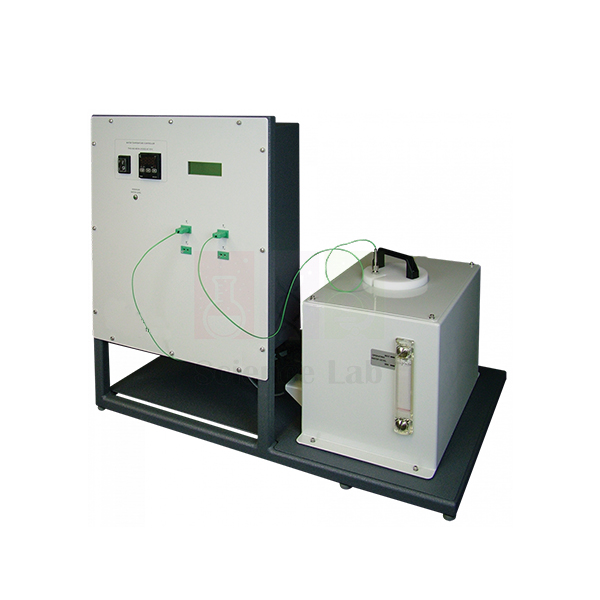
Unsteady State Heat Transfer
Unsteady State Heat Transfer (Product Code: SLE/EA/19) is a transient heat transfer apparatus used to measure the temperature changes in solid test shapes suddenly immersed in a temperature-controlled water vessel in engineering laboratories. Its test shapes differ in dimensions and material, so students see how surface area, shape and thermal conductivity alter the rate of heat transfer. It is made by Jain Scientific Equipments Pvt Ltd (ScienceLab), an OEM engineering lab equipment manufacturer, at its own factory in Ambala, India.
Key Details
| Parameter | Detail |
|---|---|
| Heating control | Controller switches the electric heater to keep a constant bulk water temperature in the vessel |
| Test condition | Temperature controller maintains a constant water temperature for the test shape |
| Test shapes | Different dimensions and materials, giving different heat transfer areas and thermal conductivities |
| Method | Sudden immersion of a test shape, with measurement of the resulting transient temperature changes |
| Bath stability | Large water volume compared with the test shapes, so immersion has a negligible effect on the bulk temperature |
| Instrumentation | Precision instruments measure temperatures at key points, shown on clear multi-line displays |
| Scope | Multiple experiments in heat transfer |
| Product code | SLE/EA/19 |
| Manufacturer | Jain Scientific Equipments Pvt Ltd (ScienceLab) — OEM |
| Country of origin | India (made in Ambala, Haryana) |
What Is the Unsteady State Heat Transfer Apparatus Used For?
Many real heating and cooling processes, from quenching a metal part to warming food, never reach a steady state, and this apparatus lets students study that transient behaviour directly. They immerse one test shape, record how its temperature changes with time, then repeat with the other shapes and compare the curves. The exercise goes a step beyond a simple Newton law of cooling apparatus, because shape and material become variables as well.
The results can be checked against lumped-capacitance and transient conduction theory, introducing ideas such as the Biot number. Let the water reach its controlled temperature and start each shape from the same initial condition, so the comparison between shapes stays fair.
OEM Manufacturer
This apparatus is manufactured by Jain Scientific Equipments Private Limited, trading as ScienceLab, which is its OEM (original equipment manufacturer), at the company's own licensed factory in Saha, Ambala, Haryana, India. Departments equipping a thermal lab from scratch can have it quoted alongside other heat transfer apparatus from the same manufacturer. If additional or replacement test shapes are needed later, ask us directly. The ScienceLab company profile has more background.
Related Thermodynamics & Heat Transfer Lab Equipment
Pair transient tests with these steady-state and measurement experiments:
- Radial Heat Conduction Experiment — steady radial conduction for contrast with transient results.
- Extended Surface Heat Transfer — conduction along a heated bar with surface heat loss.
- Computerized Thermal Conductivity of Powder — measures the conductivity property that drives transient response.
- Temperature Measurement and Calibration Apparatus — builds confidence in temperature readings.
The full list is in Thermodynamics & Heat Transfer Lab Equipment.
Frequently Asked Questions
What does unsteady state heat transfer mean?
Unsteady state heat transfer means temperatures change with time rather than staying fixed. On the Unsteady State Heat Transfer apparatus, students measure the transient temperature changes in a test shape after it is suddenly immersed in the controlled water.
Why are the test shapes of different sizes and materials?
The test shapes of the Unsteady State Heat Transfer apparatus have different dimensions and materials, giving different heat transfer areas and thermal conductivities. Comparing their results shows how surface area, shape and thermal properties affect heat transfer.
How is the water temperature kept constant?
A controller switches the electric heater of the Unsteady State Heat Transfer apparatus to hold a constant bulk water temperature, and the large water volume means immersing a test shape has a negligible effect on that temperature.
How are temperatures read during a test?
Precision instruments on the Unsteady State Heat Transfer apparatus measure temperatures at key points and show them on clear multi-line displays, so students can follow the transient changes as they happen after immersion.
Who manufactures the Unsteady State Heat Transfer apparatus?
The Unsteady State Heat Transfer apparatus is manufactured by Jain Scientific Equipments Pvt Ltd (ScienceLab) as the OEM at its own licensed factory at Saha, Ambala, India, and is supplied factory-direct to institutions, dealers and importers.
Can extra test shapes be ordered?
Additional or replacement test shapes for the Unsteady State Heat Transfer apparatus should be requested from the manufacturer. Send the product code SLE/EA/19 and your needs through the contact page and we will confirm what can be supplied.
Request a Quote
Request a quotation for the Unsteady State Heat Transfer apparatus through the contact page or by adding it to the enquiry cart. Quotations are prepared directly by the manufacturer for customers in India and international markets.
Last updated: 24 September 2026
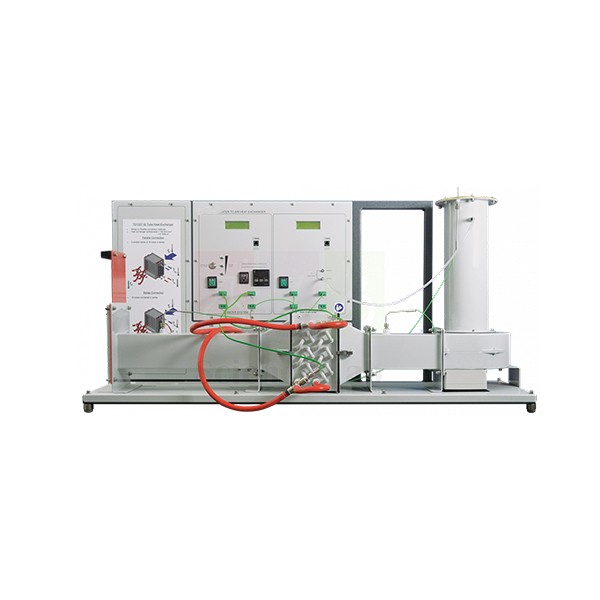
Water To Air Heat Exchangers
Water To Air Heat Exchangers (Product Code: SLE/EA/20) is a benchtop test unit used to study cross-flow heat exchangers that pass heat from hot water to a stream of cooling air in engineering laboratories. Mirroring air heating and water cooling applications, it combines a hot water supply, an orifice-metered air duct with a centrifugal fan, and all the instruments needed for testing. It is made by Jain Scientific Equipments Pvt Ltd (ScienceLab), an OEM manufacturer and lab equipment exporter in India, at its own factory in Ambala.
Key Details
| Parameter | Detail |
|---|---|
| Application | Mirrors air heating and water cooling applications; tests on cross-flow heat exchangers |
| Mounting | Fits on a benchtop; includes hot water supply, cooling air duct and all instruments needed |
| Water side | Electrically operated valve fills the tank; precision needle valve and flow meter control and measure the water flow rate |
| Tank protection | Against over temperature, low water level and overfilling |
| Air path | Air passes down a vertical duct with an orifice plate, through a fixed speed centrifugal fan, along a horizontal duct containing the heat exchanger, and exits through a hand-operated slide valve |
| Air flow measurement | Orifice plate connected to a differential pressure transducer; flow controlled with the slide valve |
| Temperatures | Thermocouples at the water connectors and in the air duct for hot and cold inlet and outlet temperatures |
| Connections | Self-sealing quick connectors for the heat exchangers' water supply |
| Room impact | Heat output gives good results without greatly affecting the temperature of a reasonable-size classroom or laboratory |
| Product code | SLE/EA/20 |
| Manufacturer | Jain Scientific Equipments Pvt Ltd (ScienceLab) — OEM |
| Country of origin | India (made in Ambala, Haryana) |
What Is the Water to Air Heat Exchanger Unit Used For?
Students set the hot water flow on the needle valve and the air flow on the slide valve, read the air flow from the orifice plate pressure difference, and record the inlet and outlet temperatures of both streams. Comparing the heat given up by the water with the heat picked up by the air gives an energy balance, the same principle behind a car radiator or an air-conditioning coil.
Changing the air flow while holding the water conditions steady shows how strongly the air side governs the heat transfer rate. Because its heat output does not greatly warm a reasonable-size room, the unit is practical for polytechnics buying vocational training lab equipment for HVAC and thermal courses.
What to Specify When Ordering
- Which water-to-air heat exchangers you want supplied for the unit, since they connect by self-sealing quick connectors.
- The bench space available, as the unit is designed to fit on a benchtop.
- The number of units needed for your laboratory groups.
OEM Manufacturer
ScienceLab is the trading name of Jain Scientific Equipments Private Limited, the OEM (original equipment manufacturer) that produces this water-to-air unit at its own licensed factory at Saha, Ambala, Haryana, India. Institutional and tender buyers who need vendor registration details can note the company's GSTIN 06AAECJ8618A1ZT and LEI 3358004HRD1JIVXKYX49. Quotations, repeat orders and questions about additional heat exchangers are handled by the manufacturer itself. More is on our company profile.
Related Thermodynamics & Heat Transfer Lab Equipment
Other air-side and heat exchanger experiments to consider:
- Cross Flow Heat Exchangers — forced convection across rods in a wind tunnel working section.
- Heat Exchanger — a water-to-water service unit for comparing liquid-side exchangers.
- Free and Force Convection Apparatus — the convection fundamentals behind air-side heat transfer.
- Computerized Cooling Tower Test Bench — another way of rejecting heat from water to air.
See the complete Thermodynamics & Heat Transfer Lab Equipment range.
Frequently Asked Questions
What type of heat exchanger does the unit test?
The Water To Air Heat Exchangers unit is built for tests on cross-flow heat exchangers, in which hot water flows through the exchanger while cooling air passes across it along the horizontal duct, mirroring air heating and water cooling applications.
How is the air flow measured and controlled?
On the Water To Air Heat Exchangers unit, air passes an orifice plate connected to a differential pressure transducer to measure flow, is driven by a fixed speed centrifugal fan, and is controlled with a hand-operated slide valve at the duct exit.
How is the water flow set?
A precision needle valve and flow meter on the Water To Air Heat Exchangers unit control and measure the water flow rate, while an electrically operated valve fills the tank, which is protected against over temperature, low level and overfilling.
Where are the temperatures measured?
Thermocouples at the water connectors and in the air duct of the Water To Air Heat Exchangers unit measure the hot and cold inlet and outlet stream temperatures, giving everything needed for an energy balance.
Will the unit heat up the classroom?
No, not greatly. The Water To Air Heat Exchangers unit is designed so that its heat output produces good results without greatly affecting the temperature of a reasonable-size classroom or laboratory.
Who manufactures the Water To Air Heat Exchangers unit?
Jain Scientific Equipments Pvt Ltd, trading as ScienceLab, manufactures the Water To Air Heat Exchangers unit as the OEM at its own licensed factory in Saha, Ambala, Haryana, India, and supplies it directly to colleges and trade buyers.
Request a Quote
For a quotation on the Water To Air Heat Exchangers unit, contact us through the contact page or add it to the enquiry cart. Quotations are sent directly by the manufacturer to buyers in India and international markets.
Last updated: 24 September 2026
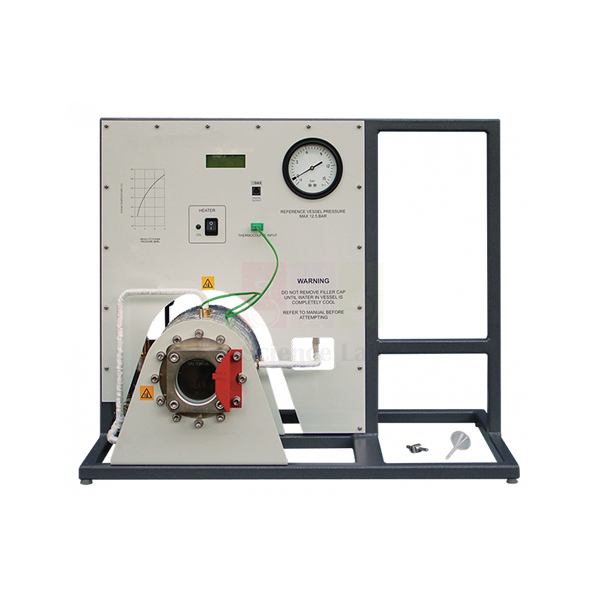
Saturated Steam The Marcet Boiler
Saturated Steam The Marcet Boiler (Product Code: SLE/EA/21) is a Marcet boiler apparatus used to show how the pressure of saturated steam rises with its temperature in thermodynamics laboratories. An insulated, electrically heated pressure vessel with a special-purpose glass window lets students watch water boil while a transducer, thermocouple and Bourdon gauge track the changing conditions. It is made by Jain Scientific Equipments Pvt Ltd (ScienceLab), an OEM manufacturer of engineering educational equipments in India, at its own factory in Ambala.
Key Details
| Parameter | Detail |
|---|---|
| Construction | Rigid frame holding an insulated pressure vessel (boiler) and an instrumentation and control unit |
| Boiler | Electrically heated; holds water |
| Viewing window | Special-purpose glass window to see the internal construction, the boiling process and the water level |
| Pressure relief | Pressure relief valve limits the maximum boiler pressure |
| Heater protection | Thermostat limits the maximum heater temperature |
| Measurement | Transducer and thermocouple for boiler pressure and temperature |
| Digital display | Shows values in both SI and traditional units |
| Mechanical gauge | Bourdon type pressure gauge that works independently of the electrical supply |
| Steam venting | High temperature pipe directs any vented steam away from the working area to a suitable drain |
| Expansion | Extra space on the frame for the optional interface |
| Design | Safety and low maintenance features for educational use |
| Product code | SLE/EA/21 |
| Manufacturer | Jain Scientific Equipments Pvt Ltd (ScienceLab) — OEM |
| Country of origin | India (made in Ambala, Haryana) |
What Is the Marcet Boiler Used For?
Students heat the water and record pairs of pressure and temperature readings as both rise, then compare their curve with published steam tables. The exercise makes the idea of saturated conditions concrete and leads naturally to the Clausius-Clapeyron relation. Watching the boiling through the glass window helps learners connect the numbers with what is happening inside the vessel.
Before switching on, check the water level through the window, and never obstruct the high temperature vent pipe that carries steam to the drain. It is a natural first thermodynamics practical for colleges and lab equipments for technical institutes.
OEM Manufacturer
Jain Scientific Equipments Private Limited, which trades as ScienceLab, is the OEM (original equipment manufacturer) of this Marcet boiler and produces it at its own licensed factory at Saha, Ambala, Haryana, India. Because the boiler is a pressure vessel, buyers want to know who stands behind it; here it is the manufacturer itself, so questions on the relief valve, thermostat or gauge come straight to us. Colleges, dealers and importers are supplied factory-direct — see the ScienceLab profile.
Related Thermodynamics & Heat Transfer Lab Equipment
Continue from saturated steam properties with these experiments:
- Thermal Power Plant with Steam Engine Trainer — puts steam to work in a two-cylinder motor.
- Separating & Throttling Calorimeter with mini boiler Test Bench — measures steam dryness fraction.
- Temperature Measurement and Calibration Apparatus — relates boiling point to barometric pressure.
- Expansion Of Perfect Gas — a companion gas-law thermodynamics experiment.
Browse all Thermodynamics & Heat Transfer Lab Equipment.
Frequently Asked Questions
What does the Marcet boiler demonstrate?
Saturated Steam The Marcet Boiler demonstrates that as the water temperature in a closed boiler increases, so does the pressure. Students record pressure and temperature together to trace the saturated steam relationship and compare it with steam tables.
Can students see inside the boiler?
Yes. Saturated Steam The Marcet Boiler has a special-purpose glass window that lets students see the internal construction of the vessel, watch the boiling process and check the water level before and during a test.
What safety features does it have?
Saturated Steam The Marcet Boiler has a pressure relief valve that limits maximum boiler pressure, a thermostat that limits heater temperature, and a high temperature pipe that directs vented steam away from the working area to a drain.
Why is there a Bourdon gauge as well as a digital display?
For sound engineering practice, Saturated Steam The Marcet Boiler adds a mechanical Bourdon type gauge that works independently of the electrical supply, so the user can always see the pressure in the vessel even if the power is off.
Which units does the display use?
The digital display of Saturated Steam The Marcet Boiler shows values in both SI and traditional units, using readings from a pressure transducer and a thermocouple, so students can work in whichever system their course requires.
Is a computer interface available?
The frame of Saturated Steam The Marcet Boiler has extra space for an optional interface. Ask us through the contact page whether an interface can be included and what it would involve for your lab.
Who manufactures Saturated Steam The Marcet Boiler?
Saturated Steam The Marcet Boiler is manufactured by Jain Scientific Equipments Pvt Ltd (ScienceLab), its OEM, at the company's own licensed factory in Saha, Ambala, India, with quotations issued directly by the manufacturer.
Request a Quote
Ask for a price on Saturated Steam The Marcet Boiler through our contact page or add it to the enquiry cart. The manufacturer quotes directly for customers in India and international markets.
Last updated: 24 September 2026
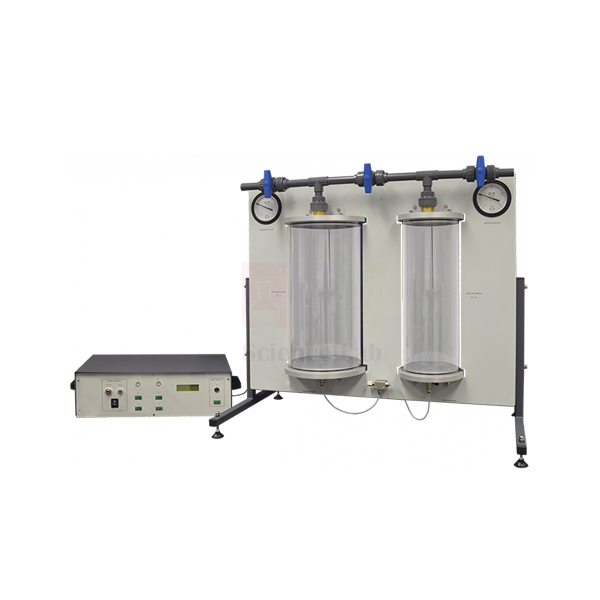
Expansion Of Perfect Gas
Expansion Of Perfect Gas (Product Code: SLE/EA/22) is a thermodynamics apparatus used to study how air behaves as a perfect gas when it moves between a pressurised vessel and an evacuated vessel in engineering laboratories. Two transparent, rigid, interconnected vessels are charged by an electrical air pump, and the important readings are captured, displayed and charted on a computer in real time. It is made by Jain Scientific Equipments Pvt Ltd (ScienceLab), an OEM technical educational equipment manufacturer, at its own factory in Ambala, India.
Key Details
| Parameter | Detail |
|---|---|
| Vessels | Two frame-mounted, interconnected, transparent and rigid vessels |
| Pressure vessel | One vessel equipped for operation under pressure |
| Vacuum vessel | The second vessel equipped for operation under vacuum |
| Pressurising and evacuating | Electrical air pump together with valves and tappings |
| Data handling | Accurate real-time data capture, monitoring, display, calculation and charting of the important readings on a computer |
| Flexibility | Vessels are independent and can also be used together to study various thermodynamic processes |
| Product code | SLE/EA/22 |
| Manufacturer | Jain Scientific Equipments Pvt Ltd (ScienceLab) — OEM |
| Country of origin | India (made in Ambala, Haryana) |
What Is the Perfect Gas Expansion Apparatus Used For?
Students pressurise one vessel, evacuate the other and then open the valves between them, watching the readings respond as gas expands from one vessel into the other. The results are compared with perfect gas relationships such as Boyle's law. Using a single vessel gives simpler exercises, while the pair together opens up a wider set of thermodynamic processes.
Because readings are charted on a computer in real time, fast pressure changes that are hard to note by hand are captured cleanly for later calculation. Close the valves correctly before running the pump, and protect the transparent vessels from knocks. It is a modern option for colleges sourcing engineering lab equipment in India with computer-based data.
OEM Manufacturer
ScienceLab, the trading name of Jain Scientific Equipments Private Limited, is the OEM (original equipment manufacturer) of the Expansion Of Perfect Gas apparatus, which it manufactures at its own licensed factory in Saha, Ambala, Haryana, India. Questions about the data capture arrangement, the air pump or the valves are answered by the manufacturer rather than a reseller — just ask us. Universities, polytechnics, dealers and importers are supplied directly; more on our company profile.
Related Thermodynamics & Heat Transfer Lab Equipment
Gas-law and thermodynamics apparatus that complement this unit:
- Boyle’s Law — the pressure and volume relationship on its own.
- Gay-Lussac’s Law — how gas pressure changes with temperature.
- Saturated Steam The Marcet Boiler — pressure and temperature of a vapour rather than a gas.
- Two Stage Compressor Test Set — air compression in a practical machine.
View the whole Thermodynamics & Heat Transfer Lab Equipment range.
Frequently Asked Questions
What does the Expansion Of Perfect Gas apparatus consist of?
The Expansion Of Perfect Gas apparatus consists of two frame-mounted, interconnected, transparent and rigid vessels — one for pressure and one for vacuum — with an electrical air pump, valves and tappings, and computer-based data capture.
Can the two vessels be used separately?
Yes. The vessels of the Expansion Of Perfect Gas apparatus are independent, so each can be used on its own, and they can also be used together to enable the study of various thermodynamic processes involving expansion between them.
How are the vessels pressurised and evacuated?
The Expansion Of Perfect Gas apparatus uses an electrical air pump together with valves and tappings to pressurise one vessel and draw a vacuum in the other, so no separate compressor is described for the basic set-up.
Does the apparatus need a computer?
The Expansion Of Perfect Gas apparatus provides real-time data capture, monitoring, display, calculation and charting of readings on a computer. Ask us through the contact page what computer arrangement is included in your quotation.
Which courses use this apparatus?
The Expansion Of Perfect Gas apparatus suits applied thermodynamics courses in mechanical, chemical and aeronautical engineering, where students must connect the perfect gas laws with measured pressure behaviour in real vessels.
Who manufactures the Expansion Of Perfect Gas apparatus?
Jain Scientific Equipments Pvt Ltd (ScienceLab) manufactures the Expansion Of Perfect Gas apparatus as the OEM at its own licensed factory at Saha, Ambala, Haryana, India, and quotes it directly to institutions and trade buyers.
Request a Quote
To get a quotation for the Expansion Of Perfect Gas apparatus, reach us on the contact page or add it to the enquiry cart. The manufacturer quotes directly for India and international markets.
Last updated: 24 September 2026
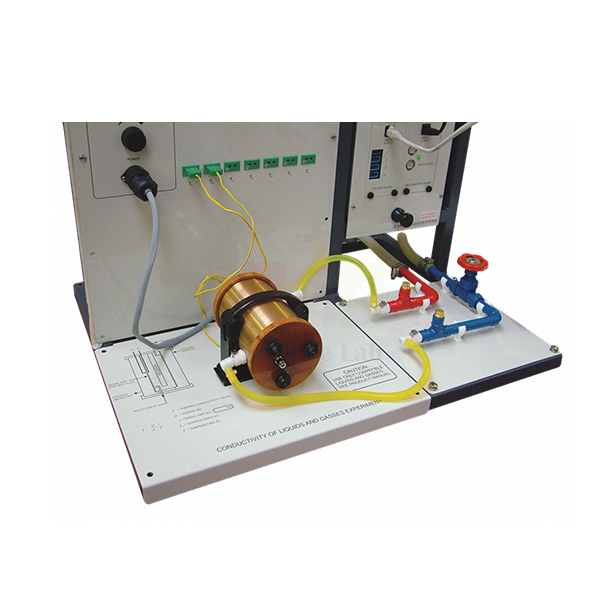
Conductivity Of Liquid And Gases
Conductivity Of Liquid And Gases (Product Code: SLE/EA/23) is a thermal conductivity apparatus used to measure how well a liquid or gas conducts heat across a thin layer between a heater and a water-cooled heat sink in engineering laboratories. Three concentric cylinders hold the electric heater, the test fluid and the cooling water, with thermocouples on both edges of the fluid layer. It is made by Jain Scientific Equipments Pvt Ltd (ScienceLab), an OEM and scientific instruments manufacturer in India, at its own factory in Ambala.
Key Details
| Parameter | Detail |
|---|---|
| Arrangement | Three concentric cylinders |
| Heat source | Inner cylinder containing an electric heater |
| Test layer | Test liquid or gas forming a second, thin cylinder around the heat source |
| Heat sink | Third, water-cooled cylinder surrounding the other two |
| Heat path | Conduction from the heat source, through the test liquid or gas, to the heat sink |
| Temperature measurement | Thermocouples on the inside and outside edges of the test fluid cylinder |
| Mounting | Base plate with a clear schematic of the experiment layout |
| Product code | SLE/EA/23 |
| Manufacturer | Jain Scientific Equipments Pvt Ltd (ScienceLab) — OEM |
| Country of origin | India (made in Ambala, Haryana) |
What Is the Liquid and Gas Thermal Conductivity Apparatus Used For?
Students fill the thin annular gap with the chosen fluid, start the cooling water and heater, and wait for the thermocouple readings to settle. From the heat input and the temperature difference across the layer, they calculate the fluid's thermal conductivity using the equation for radial conduction through a cylindrical shell. The printed schematic on the base plate helps them identify each measuring point quickly.
Keeping the fluid layer thin limits convection, so heat crosses it mainly by conduction. Repeating the test with different fluids shows clearly why gases are far poorer conductors than liquids, a useful result for heat transfer and fluid-property courses using engineering lab equipment in India.
OEM Manufacturer
Jain Scientific Equipments Private Limited, trading as ScienceLab, is the OEM (original equipment manufacturer) of this conductivity apparatus and manufactures it at its own licensed factory in Saha, Ambala, Haryana, India. Buying from the maker means one contact for set-up questions, replacement thermocouples or additional units for new benches — ask us for any of these. The company supplies engineering colleges, dealers and importers directly; its background is on the ScienceLab profile.
Related Thermodynamics & Heat Transfer Lab Equipment
Conduction experiments and support units from the same field:
- Heat Transfer — the range's base unit that supplies heater power and cooling water to bench experiments on base plates.
- Radial Heat Conduction Experiment — radial conduction through a solid disc for comparison with a fluid layer.
- Computerized Thermal Conductivity of Powder — conductivity measurement for powders.
- Extended Surface Heat Transfer — conduction along a heated bar.
Explore more in Thermodynamics & Heat Transfer Lab Equipment.
Frequently Asked Questions
How does the Conductivity Of Liquid And Gases apparatus work?
The Conductivity Of Liquid And Gases apparatus uses three concentric cylinders: an inner electric heater, a thin layer of test liquid or gas, and an outer water-cooled heat sink. Heat conducts from the heater through the fluid layer to the sink.
Can it test both liquids and gases?
Yes. In the Conductivity Of Liquid And Gases apparatus, either a test liquid or a test gas forms the thin second cylinder around the heat source, so students can compare the conductivity of different fluids on the same apparatus.
Where are temperatures measured?
Thermocouples on the Conductivity Of Liquid And Gases apparatus measure the temperature at the inside and outside edges of the cylinder of test liquid or gas, giving the temperature difference needed to calculate its thermal conductivity.
Why is the test fluid layer thin?
The test fluid in the Conductivity Of Liquid And Gases apparatus forms a thin cylinder so that convection currents have little room to develop, which means the heat crossing the layer travels mainly by conduction, as the calculation assumes.
What else is needed to run the apparatus?
The Conductivity Of Liquid And Gases apparatus uses cooling water for its outer cylinder, plus a supply for the heater and a readout for the thermocouples. Ask us via the contact page which unit is quoted to provide these.
Who manufactures the Conductivity Of Liquid And Gases apparatus?
The Conductivity Of Liquid And Gases apparatus is manufactured by Jain Scientific Equipments Pvt Ltd (ScienceLab), the OEM, at its own licensed factory in Saha, Ambala, India, and is supplied directly to institutions and trade buyers.
Request a Quote
Request a price for the Conductivity Of Liquid And Gases apparatus on our contact page or add it to the enquiry cart. Quotations come directly from the manufacturer for buyers in India and international markets.
Last updated: 24 September 2026
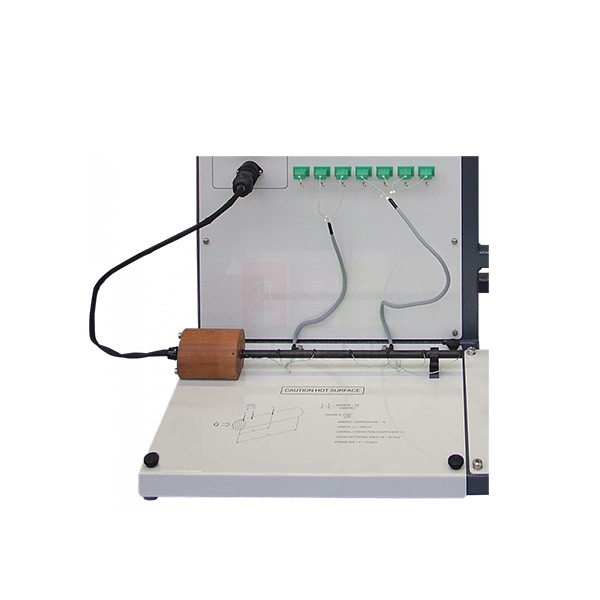
Extended Surface Heat Transfer
Extended Surface Heat Transfer (Product Code: SLE/EA/24) is a fin experiment used to study how heat conducts along a thin solid bar and escapes to the surroundings by natural convection and radiation in engineering laboratories. The bar is heated at one end, has a matt black coating for a predictable emissivity, and carries thermocouples at equally spaced intervals along its surface. It is made by Jain Scientific Equipments Pvt Ltd (ScienceLab), an OEM manufacturer of lab equipment for technical institutes, at its own factory in Ambala, India.
Key Details
| Parameter | Detail |
|---|---|
| Test piece | Thin solid bar with an electric heater at one end |
| Surface finish | Matt black coating for a consistent and predictable emissivity value |
| Temperature measurement | Thermocouples along the bar surface at equally spaced intervals |
| Heat transfer modes | Conduction along the bar; loss to the local surroundings by natural convection and radiation |
| Mounting | Base plate with a clear schematic of the experiment layout |
| Connections | Heater and thermocouples connect to sockets on the Heat Transfer Experiments Base Unit |
| Learning approach | Initial test results are used to predict temperatures and heat flow along the bar |
| Product code | SLE/EA/24 |
| Manufacturer | Jain Scientific Equipments Pvt Ltd (ScienceLab) — OEM |
| Country of origin | India (made in Ambala, Haryana) |
What Is the Extended Surface Heat Transfer Apparatus Used For?
Fins on engine cylinders and heat sinks on electronics work on the same principle as this bar. Students connect the heater and thermocouples to the base unit, let the bar reach a steady state and record the temperature at each point, then plot the temperature profile along its length and compare it with fin theory, including fin efficiency.
Because the matt black coating gives a known emissivity, the radiation share of the heat loss can be calculated and separated from natural convection. Students then use their first results to predict temperatures and heat flow for a new condition and test the prediction, which makes it dependable lab equipment for college heat transfer courses in India.
What to Specify When Ordering
- Whether you need the Heat Transfer Experiments Base Unit, since the heater and thermocouples plug into its sockets.
- Which other experiments from the same base-unit range you want to add.
- The number of experiment sets required for your laboratory.
OEM Manufacturer
Jain Scientific Equipments Private Limited (CIN U29309HR2020PTC087597) trades as ScienceLab and is the OEM (original equipment manufacturer) of this extended surface experiment. It is produced at the company's licensed factory at 449, HSIIDC Industrial Area, Saha, Ambala, Haryana, which operates under Factory Licence AMB-ONLINE-CHD-J-414. Laboratories can order the bar together with its base unit and companion experiments straight from the manufacturer, and spares enquiries are handled the same way. Visit the company profile to learn more.
Related Thermodynamics & Heat Transfer Lab Equipment
Base unit and companion experiments for a complete heat transfer bench:
- Heat Transfer — the base unit of this experiment range, with heater supply and thermocouple sockets.
- Radial Heat Conduction Experiment — a companion base-plate experiment on radial conduction.
- Emissivity Natural Convection And Radiation — isolates radiation from convection at different pressures.
- Free and Force Convection Apparatus — convection from heated surfaces in still and moving air.
The full selection is in Thermodynamics & Heat Transfer Lab Equipment.
Frequently Asked Questions
What is an extended surface?
An extended surface, or fin, is a part that projects from a hot body to increase its heat loss. The Extended Surface Heat Transfer apparatus models one as a thin solid bar heated at one end, losing heat along its length.
Why is the bar coated matt black?
The matt black coating on the Extended Surface Heat Transfer bar gives a consistent and predictable emissivity value, so students can calculate the heat lost by radiation with confidence and separate it from the heat lost by natural convection.
How are temperatures measured along the bar?
Thermocouples on the Extended Surface Heat Transfer apparatus measure the temperature along the surface of the bar at equally spaced intervals, which lets students plot a clear temperature profile from the heated end to the tip.
Does it need the Heat Transfer Experiments Base Unit?
Yes. The heater and thermocouples of the Extended Surface Heat Transfer apparatus connect to sockets on the Heat Transfer Experiments Base Unit. Ask us through the contact page to quote both together.
How does heat leave the bar?
In the Extended Surface Heat Transfer apparatus, heat conducts along the bar from the heater and then transfers to the local surroundings by natural convection and radiation, the combination that governs real fins in still air.
Who manufactures the Extended Surface Heat Transfer apparatus?
Jain Scientific Equipments Pvt Ltd (ScienceLab) is the OEM of the Extended Surface Heat Transfer apparatus and manufactures it at its own licensed factory in Saha, Ambala, India, supplying colleges, dealers and importers directly.
Request a Quote
For a quotation on the Extended Surface Heat Transfer apparatus, with or without its base unit, write to us via the contact page or add it to the enquiry cart. Quotes come direct from the manufacturer for India and international markets.
Last updated: 24 September 2026
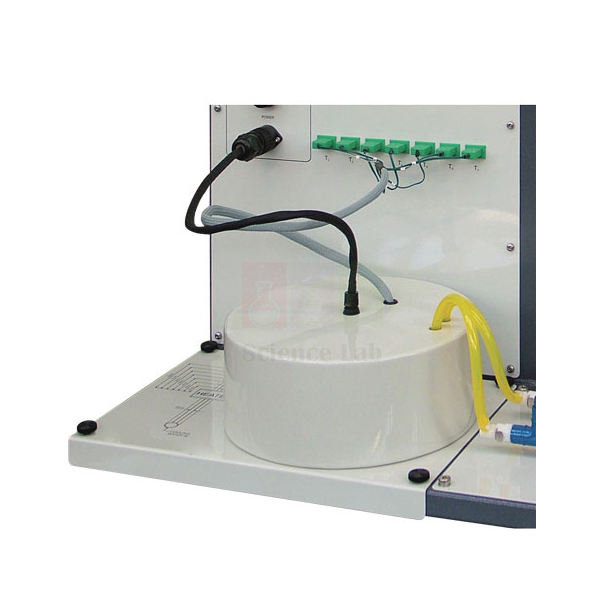
Radial Heat Conduction Experiment
Radial Heat Conduction Experiment (Product Code: SLE/EA/25) is a teaching module used to study steady-state heat conduction outwards through a solid disc in engineering heat transfer laboratories. Mechanical engineering students use it to map the radial temperature profile, read by seven thermocouples set at equally spaced radii on a solid brass disc heated at its centre. It is made by Jain Scientific Equipments Pvt Ltd (ScienceLab), an OEM manufacturer of engineering lab equipment in India, at its own factory in Ambala.
Specifications
| Parameter | Detail |
|---|---|
| Test piece | Solid brass disc |
| Heat source | Electric heater at the centre of the disc |
| Heat sink | Circular cross-section cooling tube around the circumference of the disc |
| Temperature sensors | Seven thermocouples at equally spaced radii on the disc |
| Insulation | Around the disc, reducing heat loss by convection and radiation |
| Mounting | Base plate with a clear schematic of the experiment layout |
| Electrical connections | Heater and thermocouples plug into sockets on the Heat Transfer Experiments Base Unit |
| Cooling water | Cold water feed and drain for the heat sink, provided through the base unit |
| Product code | SLE/EA/25 |
| Manufacturer | Jain Scientific Equipments Pvt Ltd (ScienceLab) — OEM |
| Country of origin | India (made in Ambala, Haryana) |
What Is the Radial Heat Conduction Experiment Used For?
Students turn on the cooling water flow through the rim tube, then adjust the heater power and wait until the disc reaches equilibrium. At steady state, the seven thermocouple readings give temperature against radius from the hot centre to the cooled edge. Because the heat spreads through an ever-larger circumference as the radius grows, the temperature does not fall in a straight line, and students compare their curve with the logarithmic profile that Fourier's law predicts for radial conduction.
Typical practicals include estimating the thermal conductivity of the brass from the heater power and the measured temperature gradient, then repeating the test at a second heater setting to check consistency. The insulation around the disc limits convection and radiation losses, so results should match simple radial conduction theory — a good check on careful technique. The module suits lab equipment for technical institutes, polytechnics and university heat transfer courses.
What to Specify When Ordering
- Whether you already have the Heat Transfer Experiments Base Unit, since the module's heater and thermocouples connect to its sockets.
- The number of radial conduction modules needed for your student groups.
- Whether a cold water feed and drain are available at the bench for the heat sink.
- Any other optional experiments you plan to run on the same base unit.
OEM Manufacturer
Jain Scientific Equipments Private Limited, which trades as ScienceLab, is the OEM (original equipment manufacturer) of the Radial Heat Conduction Experiment and makes it at its own licensed factory at Saha, Ambala, Haryana, India. Buying from the maker rather than a trader means the quotation, technical questions and any later request for replacement thermocouples or spare parts go to the people who manufacture the module — just ask us. Colleges, institutions, dealers and importers are supplied factory-direct. Learn more on the ScienceLab company profile.
Related Thermodynamics & Heat Transfer Lab Equipment
These items are often ordered with the radial conduction module to build a complete heat transfer practical bench.
- Heat Transfer — the base unit that supplies cold water, heater power and multi-line temperature displays to optional heat transfer experiments.
- Extended Surface Heat Transfer — another experiment that plugs into the Heat Transfer Experiments Base Unit, studying heat flow along a thin bar.
- Unsteady State Heat Transfer — moves students from steady conduction to transient temperature changes in immersed test shapes.
- Computerized Thermal Conductivity of Powder — extends conductivity measurement from solid metal to powdered materials.
See the full Thermodynamics & Heat Transfer Lab Equipment range for heat exchangers, convection and radiation apparatus.
Frequently Asked Questions
What is included with the Radial Heat Conduction Experiment?
The Radial Heat Conduction Experiment includes a solid brass disc with a central electric heater, a circular cross-section cooling tube around its rim as the heat sink, seven thermocouples at equally spaced radii, insulation around the disc and a base plate showing the experiment layout.
Can the Radial Heat Conduction Experiment be used on its own?
No. The Radial Heat Conduction Experiment connects its heater and thermocouples to sockets on the Heat Transfer Experiments Base Unit, which also provides the cold water feed and drain for the heat sink. Tell us whether you already own a base unit when you request a quotation.
Why is the disc of the Radial Heat Conduction Experiment insulated?
The insulation around the brass disc of the Radial Heat Conduction Experiment reduces heat loss by convection and radiation, so heat travels mainly by radial conduction from the central heater to the cooled rim and student results should match simple radial conduction theory.
How many temperature points does the Radial Heat Conduction Experiment measure?
The Radial Heat Conduction Experiment measures temperature at seven points, using seven thermocouples placed at equally spaced radii on the brass disc. Together they give students a temperature-versus-radius profile from the heated centre to the water-cooled edge once the disc reaches equilibrium.
Who manufactures the Radial Heat Conduction Experiment?
The Radial Heat Conduction Experiment is manufactured by Jain Scientific Equipments Pvt Ltd (ScienceLab), the OEM, at its own licensed factory at Saha, Ambala, Haryana, India. It is supplied factory-direct to colleges, institutions, dealers and importers in India and international markets.
Is a calibration certificate available for the Radial Heat Conduction Experiment?
Calibration-certificate availability for the Radial Heat Conduction Experiment and its thermocouples should be discussed with us before ordering. Please raise it through our contact page so the documentation that can accompany your order is confirmed in the quotation.
What information is needed for a Radial Heat Conduction Experiment quotation?
For a Radial Heat Conduction Experiment quotation, send the product code SLE/EA/25, the quantity, whether the Heat Transfer Experiments Base Unit is also required, and your delivery destination. We quote institutions and dealers across India and international markets.
Request a Quote
To buy the Radial Heat Conduction Experiment, send your requirement through the contact page or add it to the enquiry cart. Your quotation comes direct from the manufacturer, without a trader in between.
Last updated: 24 September 2026
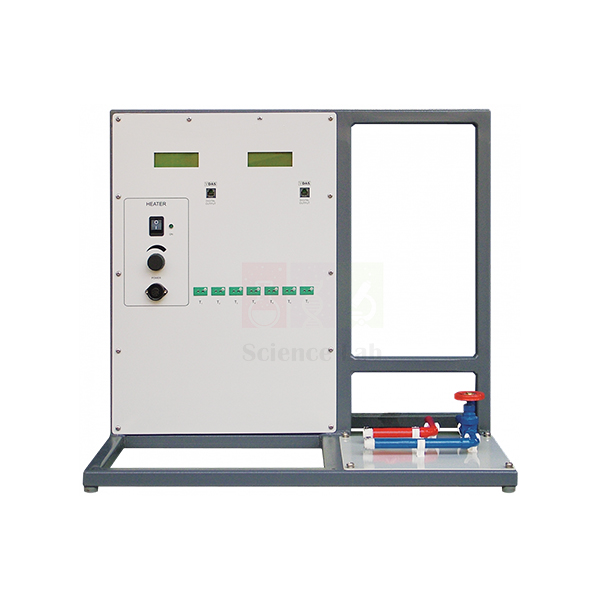
Heat Transfer
Heat Transfer (Product Code: SLE/EA/26) is a base unit used to supply cold water, heater power and temperature measurement to optional heat transfer experiments in engineering teaching laboratories. Lab instructors connect each optional experiment to it and read temperatures and heater power on clear, multi-line digital displays, while a safety switch stops the heater from becoming too hot. It is supplied by Jain Scientific Equipments Pvt Ltd (ScienceLab), Ambala, India, within its range of lab equipment for technical institutes.
Specifications
| Parameter | Detail |
|---|---|
| Role in the range | Core unit serving the optional heat transfer experiments |
| Water system | Connects to a suitable cold water supply and drain |
| Water flow control | Hand-operated valve for a controllable flow, with a simple return pipe (both colour-coded) |
| Water connections to experiments | Self-sealing quick connectors |
| Thermocouple inputs | Sockets for the thermocouples built into each optional experiment |
| Heater supply | Variable and measured electrical current to the heater in each experiment |
| Heater protection | Works with a safety switch to stop the heater from becoming too hot |
| Displays | Clear, multi-line digital displays of temperatures and heater power |
| Expansion space | Spare area to the right of the frame for fitting optional data-acquisition hardware |
| Optional experiments | Each on a bedplate with a clear schematic of connections and measuring point positions |
| Product code | SLE/EA/26 |
| Supplied by | Jain Scientific Equipments Pvt Ltd (ScienceLab), Ambala, India |
What Is the Heat Transfer Base Unit Used For?
The base unit turns a single bench into a heat transfer teaching station. Each optional experiment sits on its own bedplate; students link its water lines through the self-sealing quick connectors, plug its thermocouples into the sockets, set the heater current and watch the displays until the temperatures settle. They then record temperatures and heater power for their calculations, and because one unit serves every experiment in the range, a department can add experiments over time without duplicating the water supply and instruments.
The colour-coded valve and return pipe help students route water correctly, and the schematic printed on each bedplate shows where every connection and measuring point sits, which cuts set-up mistakes in busy practical sessions. For colleges and polytechnics sourcing engineering educational equipment in India, a shared base unit is a practical way to cover conduction and other heat transfer topics on one bench.
What to Specify When Ordering
- Which optional experiments you want with the base unit, for example the Radial Heat Conduction Experiment.
- How many base units you need for the student groups working at the same time.
- Confirmation that a cold water supply and drain are available where the unit will stand.
- Whether you plan to fit optional data-acquisition hardware in the spare area of the frame.
Supplier
ScienceLab is the trading name of Jain Scientific Equipments Private Limited, which supplies this Heat Transfer base unit from Ambala, Haryana, India, as the core of a range of optional heat transfer experiments. Because the base unit and the experiments that connect to it can be quoted together, you can ask us about adding experiments, replacement parts or repeat orders in a single enquiry. Engineering colleges, polytechnics, dealers and importers can request quotations directly from us. Read more on our company profile page.
Related Thermodynamics & Heat Transfer Lab Equipment
Pair the base unit with these experiments and apparatus from the same heat transfer range.
- Radial Heat Conduction Experiment — an optional module whose heater and thermocouples plug into the base unit sockets for radial conduction tests on a brass disc.
- Extended Surface Heat Transfer — another experiment that connects to the base unit, for heat flow along a thin bar.
- Free and Force Convection Apparatus — adds convection studies from heated elements in an air flow.
- Unsteady State Heat Transfer — covers transient heating of immersed test shapes.
Browse the Thermodynamics & Heat Transfer Lab Equipment category for heat exchangers, refrigeration trainers and more.
Frequently Asked Questions
What does the Heat Transfer base unit provide to each experiment?
The Heat Transfer base unit (SLE/EA/26) provides cold water, a variable and measured heater current, sockets for the experiment's thermocouples and clear multi-line digital displays of temperatures and heater power, so each optional experiment has the instruments needed to measure its performance.
Are experiments included with the Heat Transfer base unit?
The experiments used with the Heat Transfer base unit are optional items, each mounted on its own bedplate with a schematic diagram of connections and measuring points. List the experiments you need, such as the Radial Heat Conduction Experiment, when you ask for a quotation.
What water supply does the Heat Transfer base unit need?
The Heat Transfer base unit needs a suitable cold water supply and a drain. A hand-operated valve gives a controllable flow, a colour-coded return pipe carries water away, and self-sealing quick connectors link the water to each optional experiment safely and simply.
How is the heater protected on the Heat Transfer base unit?
The Heat Transfer base unit works with a safety switch that stops an experiment's heater from becoming too hot, while its variable, measured electrical current lets students set and record the heater power used in each test.
Who supplies the Heat Transfer base unit?
The Heat Transfer base unit (SLE/EA/26) is supplied by Jain Scientific Equipments Pvt Ltd (ScienceLab), Ambala, Haryana, India, which also quotes the optional experiments that connect to it, so one enquiry can cover the base unit and the modules your laboratory needs.
Can a calibration certificate be supplied with the Heat Transfer base unit?
Calibration-certificate availability for the Heat Transfer base unit's temperature and power displays should be discussed with us at the enquiry stage. Raise it through our contact page and we will tell you what documentation can be offered with your quotation.
Do you supply the Heat Transfer base unit for export?
Yes, the Heat Transfer base unit is quoted for institutions, dealers and importers in India and international markets. Share product code SLE/EA/26, the quantity, the optional experiments required and the delivery destination so the quotation is complete.
Request a Quote
Send your Heat Transfer base unit enquiry, together with the optional experiments you want, through the contact page, or add the item to the enquiry cart. We reply with a quotation covering the base unit and each experiment you list.
Last updated: 24 September 2026

Gay-Lussac's Law
Gay-Lussac's Law (Product Code: SLE/EA/27) is a bench-mounted apparatus used to show how the pressure of a fixed volume of air rises with temperature in engineering thermodynamics and physics laboratories. Students heat the air in a low-pressure vessel surrounded by an insulated heater under electronic control, then read absolute pressure, two air temperatures and their average on a digital display. It is made by Jain Scientific Equipments Pvt Ltd (ScienceLab), an OEM and engineering lab equipment manufacturer, at its own factory in Ambala, India.
Specifications
| Parameter | Detail |
|---|---|
| Mounting | Bench-mounting, with a back plate that holds the vessel |
| Vessel | Low-pressure vessel holding a fixed volume of air |
| Heating | Insulated heater around the vessel, controlled by an electronic temperature controller |
| Controller sensor | Thermocouple measuring the heater surface temperature |
| Air temperature | Two thermocouples measuring the air inside the vessel |
| Pressure measurement | Pressure transducer measuring the pressure of the heated air |
| Display | Digital display of absolute pressure, both air temperatures and their average |
| Venting | Hand-operated valve at the bottom of the vessel to normalise the air to ambient conditions |
| Working gas | Normal clean, dry air (behaves as an ideal gas over the pressure range used) |
| Product code | SLE/EA/27 |
| Manufacturer | Jain Scientific Equipments Pvt Ltd (ScienceLab) — OEM |
| Country of origin | India (made in Ambala, Haryana) |
What Is the Gay-Lussac's Law Apparatus Used For?
Gay-Lussac's law, often called the pressure law, states that for a fixed mass of gas held at constant volume, pressure is directly proportional to absolute temperature. With this apparatus, students first open the hand-operated valve at the bottom of the vessel to bring the trapped air to ambient conditions, close it, and set the electronic controller for the temperature range the experiment needs. As the insulated heater warms the air, they record pressure from the transducer against the average of the two air thermocouples, then plot the results to prove the law.
Converting the readings to kelvin gives a straight line through the origin, while extending a plot of pressure against Celsius temperature back to zero pressure gives an estimate of absolute zero — a classic extension exercise. Ordinary clean, dry air is used because it behaves as an ideal gas over the pressure range of this equipment, so no special gas supply is needed. The unit suits engineering thermodynamics courses as well as colleges looking for advanced physics lab equipment in India.
OEM Manufacturer
Jain Scientific Equipments Private Limited trades as ScienceLab and is the OEM (original equipment manufacturer) of this Gay-Lussac's Law apparatus, which it makes at its own licensed factory at Saha, Ambala, Haryana, India. Dealing with the manufacturer directly helps when you need matching gas-law equipment for several benches, a repeat order for a later session or advice on spare parts — ask us and we will guide you. Institutions, dealers and importers are quoted factory-direct. Company background is on the ScienceLab profile.
Related Thermodynamics & Heat Transfer Lab Equipment
These gas-law and temperature-measurement items support the same practical sessions.
- Boyle's Law — the companion bench apparatus that studies the pressure–volume relationship of trapped air.
- Boyle’s Law – Simple Type — a simple syringe-based demonstration for introductory gas-law lessons.
- Temperature Measurement and Calibration Apparatus — helps students understand the temperature sensors behind their readings.
- Gas Laws Poster — a wall reference for the gas laws beside the bench.
More thermodynamics apparatus is listed in the Thermodynamics & Heat Transfer Lab Equipment category.
Frequently Asked Questions
What does the Gay-Lussac's Law apparatus measure?
The Gay-Lussac's Law apparatus measures the absolute pressure of the heated air with a pressure transducer and its temperature with two thermocouples; a digital display shows the pressure, both air temperatures and their average. A further thermocouple on the heater surface feeds the temperature controller.
Why does the Gay-Lussac's Law apparatus use ordinary air?
The Gay-Lussac's Law apparatus uses normal clean, dry air because air behaves as an ideal gas over the range of pressures used in this equipment, so results follow the pressure law closely without any special gas supply.
What is the valve at the bottom of the Gay-Lussac's Law vessel for?
The hand-operated valve at the bottom of the Gay-Lussac's Law apparatus vessel lets students normalise the trapped air to ambient conditions before a run, so each test starts from room pressure and temperature.
Can students choose the temperature range on the Gay-Lussac's Law apparatus?
Yes. Students set the electronic temperature controller of the Gay-Lussac's Law apparatus for the range of temperatures needed during the experiment, and the insulated heater around the vessel warms the fixed volume of air through that range while they record the pressure changes.
Who manufactures the Gay-Lussac's Law apparatus?
The Gay-Lussac's Law apparatus (SLE/EA/27) is manufactured by Jain Scientific Equipments Pvt Ltd (ScienceLab), the OEM, at its own licensed factory at Saha, Ambala, Haryana, India, and it is supplied factory-direct to institutions, dealers and importers.
Is a calibration certificate available for the Gay-Lussac's Law apparatus?
Calibration-certificate availability for the Gay-Lussac's Law apparatus, including its pressure transducer and thermocouples, should be discussed with us before you order. Please ask through the contact page so the answer is included with your quotation.
What should a Gay-Lussac's Law apparatus quotation request include?
A quotation request for the Gay-Lussac's Law apparatus should state product code SLE/EA/27, the number of units, whether the companion Boyle's Law apparatus is also needed, and the delivery destination in India or in international markets.
Request a Quote
For a Gay-Lussac's Law apparatus quotation direct from the manufacturer, write to us through the contact page or place the item in the enquiry cart.
Last updated: 24 September 2026

Boyle's Law
Boyle's Law (Product Code: SLE/EA/28) is a bench-mounted apparatus used to prove that the pressure of trapped air varies inversely with its volume in engineering and physics laboratories. Students work hand-operated pumps that pressurise one of two clear-walled oil cylinders and so move a 'liquid piston' of oil in the other, while a mechanical gauge, a digital indicator and a thermocouple record pressure, air-column height and temperature. This Boyle law apparatus is made in India by Jain Scientific Equipments Pvt Ltd (ScienceLab), an OEM manufacturer, at its own factory in Ambala.
Specifications
| Parameter | Detail |
|---|---|
| Mounting | Bench-mounting, with a back plate |
| Cylinders | Two clear-walled cylinders containing oil |
| Pressure control | Hand-operated pumps to increase or decrease the pressure in the left-hand cylinder |
| Liquid piston | Oil moving in the right-hand cylinder compresses or decompresses a trapped column of air in the test cylinder |
| Volume measurement | Digital indicator for the change in height of the trapped air column (height change × cross-sectional area = volume change) |
| Pressure measurement | Mechanical pressure gauge on the trapped air |
| Temperature measurement | Thermocouple and digital display for the trapped air temperature |
| Working gas | Normal, clean, dry air (behaves as an ideal gas over the pressure range used) |
| Product code | SLE/EA/28 |
| Manufacturer | Jain Scientific Equipments Pvt Ltd (ScienceLab) — OEM |
| Country of origin | India (made in Ambala, Haryana) |
What Is the Boyle's Law Apparatus Used For?
Boyle's law says that, for a fixed mass of gas at constant temperature, pressure multiplied by volume stays constant. Students pump in steps, reading the trapped-air pressure on the mechanical gauge and the change in air-column height on the digital indicator; multiplying that height change by the column's cross-sectional area gives the change in volume. Plotting pressure against the reciprocal of volume should give a straight line, confirming the inverse relationship.
The thermocouple matters because compressing air warms it: students watch the air temperature and pause between steps so it stays constant, which is the condition the law requires. The same readings let a teacher demonstrate how the air temperature changes during a quick compression or expansion. The apparatus is equally suited to university thermodynamics courses and to institutes sourcing TVET lab equipment in India.
OEM Manufacturer
The Boyle's Law apparatus is manufactured by its OEM, Jain Scientific Equipments Private Limited (trading as ScienceLab), at the company's own licensed factory at Saha, Ambala, Haryana, India. The company is a registered MSME whose major activity is manufacturing (Udyam UDYAM-HR-01-0003714), and export consignments are handled under Importer-Exporter Code AAECJ8618A issued by the DGFT. Buying straight from the maker keeps quotations, repeat orders and questions about replacement parts with the people who build the apparatus — just ask us. See the ScienceLab profile for more about the company.
Related Thermodynamics & Heat Transfer Lab Equipment
Useful companions and alternatives for gas-law practicals:
- Gay-Lussac's Law — the companion bench apparatus relating pressure and temperature at constant volume.
- Boyle’s Law – Simple Type — a simple syringe-based alternative for introductory classes.
- Apparatus for Demonstrating the Boil-Marriott Law — a horizontal-tube alternative with a pressure gauge for the same pressure–volume relationship.
- Two Stage Compressor Test Set — takes air compression from the gas-law bench to a working machine test.
The complete Thermodynamics & Heat Transfer Lab Equipment category lists further thermodynamics apparatus.
Frequently Asked Questions
How does the Boyle's Law apparatus change the air volume?
The Boyle's Law apparatus changes the air volume with a 'liquid piston' of oil: hand-operated pumps raise or lower the pressure in the left-hand cylinder, pushing the oil in the right-hand cylinder up or down to compress or decompress the trapped air column.
How is volume measured on the Boyle's Law apparatus?
Volume on the Boyle's Law apparatus is worked out from the air-column height: a digital indicator measures the change in height, and multiplying it by the cross-sectional area of the column gives the change in volume, while a mechanical gauge reads the pressure.
Why does the Boyle's Law apparatus have a thermocouple?
The thermocouple and digital display on the Boyle's Law apparatus show the trapped air temperature, so students can keep it constant during tests as the law requires; the readings also help to demonstrate how air temperature changes during compression.
What gas does the Boyle's Law apparatus use?
The Boyle's Law apparatus uses normal, clean, dry air, which behaves as an ideal gas over the range of pressures used in this equipment, so no gas cylinder or special filling is needed for the experiment.
Who manufactures the Boyle's Law apparatus?
The Boyle's Law apparatus (SLE/EA/28) is made by its OEM, Jain Scientific Equipments Pvt Ltd (ScienceLab), at the company's own licensed factory at Saha, Ambala, Haryana, India, and is sold factory-direct to colleges, institutions, dealers and importers.
Is a calibration certificate available for the Boyle's Law apparatus?
Calibration-certificate availability for the Boyle's Law apparatus pressure gauge, digital indicator and thermocouple should be discussed with us before ordering. Send the question through the contact page and the reply will accompany your quotation.
What details are needed to quote the Boyle's Law apparatus?
To quote the Boyle's Law apparatus we need product code SLE/EA/28, the quantity, whether the Gay-Lussac's Law apparatus is wanted as well, and the delivery destination; vendor-registration details can be shared for institutional purchases in India and international markets.
Request a Quote
Ask for a Boyle's Law apparatus quotation through the contact page, or add it to the enquiry cart together with other gas-law items; the manufacturer replies with the quotation directly.
Last updated: 24 September 2026
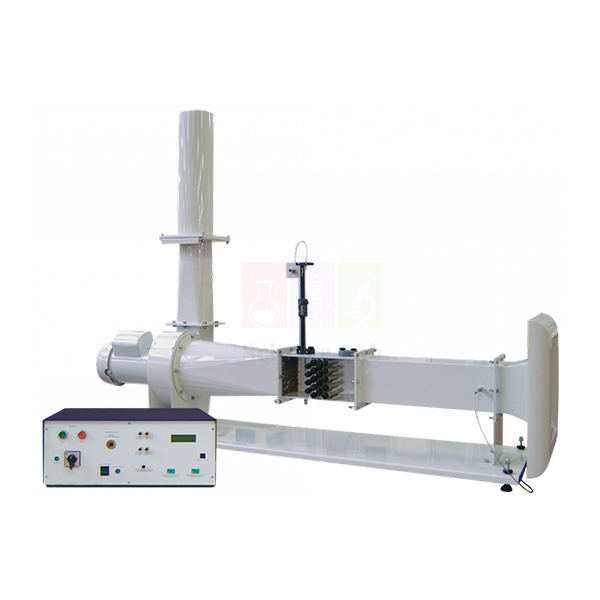
Cross Flow Heat Exchangers
Cross Flow Heat Exchangers (Product Code: SLE/EA/29) is a horizontal wind tunnel apparatus used to measure forced-convection heat transfer from a cylinder in a bank of rods in engineering heat transfer laboratories. Students replace any one rod of the working-section matrix with a copper element of known thermal capacity and a built-in thermocouple, then monitor how quickly it cools in the air flow. It is made by Jain Scientific Equipments Pvt Ltd (ScienceLab), an OEM supplying lab equipment for technical institutes, at its own factory in Ambala, India.
Specifications
| Parameter | Detail |
|---|---|
| Configuration | Horizontal wind tunnel |
| Tunnel sections | Contraction cone, working section, diffuser, constant speed fan and exhaust with silencer |
| Air flow control | Variable slide valve |
| Working section | Series of rods arranged in a matrix at right angles to the air flow; any one rod can be removed |
| Test element | Cylindrical copper element of known thermal capacity with a built-in thermocouple |
| Inlet air temperature | Second thermocouple at the wind tunnel inlet |
| Air velocity | Pitot traverse measuring velocity at any vertical point, before or after the rods |
| Pressure tappings | Two static pressure tappings in the base of the working section, one before and one after the rods |
| Product code | SLE/EA/29 |
| Manufacturer | Jain Scientific Equipments Pvt Ltd (ScienceLab) — OEM |
| Country of origin | India (made in Ambala, Haryana) |
What Is the Cross Flow Heat Exchanger Used For?
In a cross flow heat exchanger one fluid passes at right angles to tubes carrying the other, and this apparatus models the air side of that arrangement with a rod bank inside a wind tunnel. Students place the copper element in the rod matrix, set the air flow with the slide valve and log the element temperature as it cools, while the inlet thermocouple gives the temperature of the incoming air. Because the element's thermal capacity is known, its rate of cooling gives the forced-convection heat transfer rate quickly, without a long wait for steady conditions.
Moving the element to different positions in the matrix shows how upstream rods disturb the flow and change heat transfer deeper in the bank. The pitot traverse maps air velocity at any height before or after the rods, and the two static pressure tappings give the pressure difference across the bank, so students can relate heat transfer to flow and pressure loss. It gives mechanical and chemical engineering departments a practical link between heat transfer theory and measurement, alongside our other engineering lab equipment in India.
OEM Manufacturer
Jain Scientific Equipments Private Limited, trading as ScienceLab, is the OEM (original equipment manufacturer) of the Cross Flow Heat Exchangers apparatus and produces it at its own licensed factory at Saha, Ambala, Haryana, India. Because the wind tunnel, rod matrix and copper test element come from one manufacturer, questions about extra copper elements, replacement rods or repeat orders can be settled directly with the maker — just ask us. Universities, polytechnics, dealers and importers receive factory-direct quotations. More about the company is on the ScienceLab profile page.
Related Thermodynamics & Heat Transfer Lab Equipment
Buyers equipping a heat exchanger laboratory often add these items.
- Water To Air Heat Exchangers — a water-to-air exchanger with thermocouples on both fluid streams, for comparing a full exchanger with the single-element test.
- Parallel and Counter Flow Heat Exchanger — lets students compare parallel and counter flow arrangements with cross flow.
- Free and Force Convection Apparatus — convection from heating elements of different geometries in an air duct.
- Flow Visualisation Wind Tunnel — shows air flow patterns, complementing the pitot traverse readings.
View all items in the Thermodynamics & Heat Transfer Lab Equipment category.
Frequently Asked Questions
How does the Cross Flow Heat Exchangers apparatus measure heat transfer?
The Cross Flow Heat Exchangers apparatus measures heat transfer by monitoring how quickly a copper element of known thermal capacity, fitted with a built-in thermocouple, cools in the air flow; a second thermocouple at the tunnel inlet records the air temperature for the calculation.
Can the copper element be tested at different positions in the Cross Flow Heat Exchangers apparatus?
Yes. Students can remove any one rod from the matrix in the Cross Flow Heat Exchangers working section and replace it with the cylindrical copper element, so heat transfer can be compared at different positions within the rod bank.
How is air velocity controlled and measured in the Cross Flow Heat Exchangers apparatus?
On the Cross Flow Heat Exchangers apparatus a variable slide valve controls the air flow from the constant speed fan, and a pitot traverse measures air velocity at any vertical point in the working section, before or after the rods.
Can students measure the pressure drop across the rods?
Yes. The base of the Cross Flow Heat Exchangers working section has two static pressure tappings, one before the rods and one after, which let students measure the static pressure difference across the rod bank.
Who manufactures the Cross Flow Heat Exchangers apparatus?
Jain Scientific Equipments Pvt Ltd (ScienceLab) is the OEM that manufactures the Cross Flow Heat Exchangers apparatus at its own licensed factory at Saha, Ambala, Haryana, India; engineering colleges, dealers and importers buy it factory-direct.
Is a calibration certificate available for the Cross Flow Heat Exchangers apparatus?
Calibration-certificate availability for the Cross Flow Heat Exchangers apparatus, including its thermocouples, should be discussed with us before you place an order. Reach us through the contact page and we will clarify what documentation can come with the quotation.
Is the Cross Flow Heat Exchangers apparatus available for export?
Yes, the Cross Flow Heat Exchangers apparatus is offered to buyers in India and international markets. Include product code SLE/EA/29, the number of units and the delivery destination in your enquiry so the manufacturer can prepare an accurate quotation.
Request a Quote
Request a Cross Flow Heat Exchangers quotation straight from the manufacturer through the contact page, or save the item to your enquiry cart while you plan the rest of your heat transfer lab.
Last updated: 24 September 2026