- Physics Lab Equipment
- Chemistry Lab Equipment
- Biology Lab Equipment
- Anatomical Lab Equipment
- Learning
- Educational Lab Equipment
- Magnets
- Agriculture
- Astronomy
- Earth Science
- Geography Lab Equipment
- Safety Lab Coat
- Laboratory
- Meteorological
- Electricity & Magnetism
- Heat
- School Lab Equipment
- Lab Glassware
- Science Lab Equipment
- Tvet Lab Equipment
- Robotics Kits Supplier and Manufacturer for Schools India
- Math Lab Equipment Manufacturers and Exporters in Ambala
- STEM Kits Manufacturers and Supplier India
- Engineering Lab Equipment
- Hospital Lab Equipment
- Water, Sanitation & Hygiene Supplies
- Cold Chain, Solar & Communication Equipment
- Nutrition
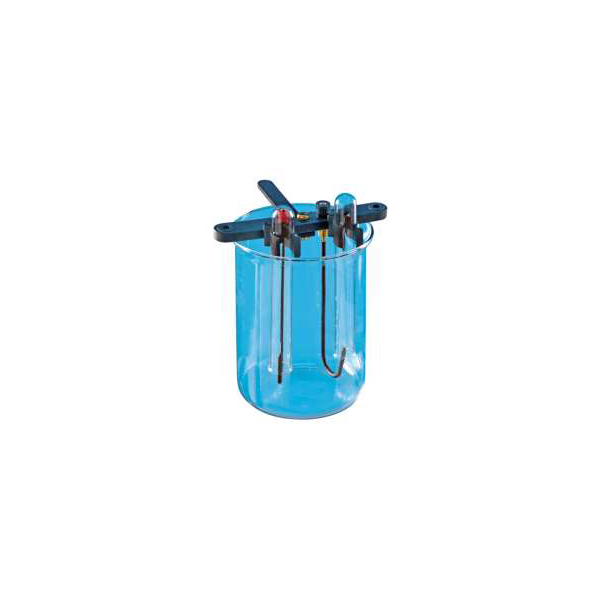
Device to Study Electric Current In Electrolytes
Device to Study Electric Current In Electrolytes (Product Code: SCL222/034) is a small electrolysis cell for showing that solutions of acids, bases and salts conduct electricity while pure water barely does, and for watching what happens at the electrodes while current flows. A transparent plastic vessel with a lid holds the solution, and interchangeable electrodes of different materials connect to external contacts. This electrolysis apparatus for school laboratories in India is manufactured by Jain Scientific Equipments Pvt Ltd (ScienceLab), Ambala.
Specifications
| Parameter | Detail |
|---|---|
| Vessel | Electrolysis vessel with lid, transparent plastic |
| Vessel volume | 200 ml |
| Electrodes | Two or more: one copper, the others graphite or coal and zinc or lead |
| Electrode diameter | 4 mm |
| Connections | External contacts fixed on the plastic support |
Typical Use
Fill the vessel with the test liquid, fit two electrodes, and connect them through a lamp or ammeter to a low-voltage DC source. Distilled water gives little or no current; adding a pinch of salt or a few drops of acid makes the reading jump, which is the core observation of the topic. With copper sulphate solution and a copper electrode, students can watch copper build up on the negative electrode, and switching between graphite, zinc or lead electrodes shows how electrode material affects the products.
The same parts can be used without an external supply: copper and zinc electrodes in a salt or acid solution form a simple cell whose voltage can be read on a meter. Keep voltages low, work in a ventilated room because gases may form at the electrodes, and rinse the electrodes and vessel after every class. It fits neatly into an electrochemical cell kit for school chemistry and physics practicals.
Manufacturer
Jain Scientific Equipments Private Limited makes this electrolyte cell and trades under the ScienceLab name from Ambala in Haryana, India, where it produces teaching apparatus for chemistry and physics departments. The company profile explains who we are and how we work with institutions.
Related Lab Equipment
These products complete a conductivity and electrolysis practical:
- Cupric Sulphate (Copper Sulphate) — the usual electrolyte for copper deposition experiments.
- Battery Eliminator 12 Volt — a low-voltage source to drive current through the cell.
- Digital Multimeter — measures current through the solution or the voltage of a copper-zinc cell.
- Crocodile Clips & Leads — quick connections between the external contacts and the circuit.
- Hoffman Electrolysis Apparatus — the next step when gas volumes need to be collected and compared.
See the full Lab Equipment category for more.
Frequently Asked Questions
Which electrodes come with the device?
The listing gives two or more 4 mm electrodes: a copper one, plus graphite or coal and zinc or lead. Tell us which combination you need and we will confirm it in the quotation.
How much solution does the vessel hold?
The transparent plastic vessel has a volume of 200 ml and comes with a lid.
Is a power supply included?
No power source is listed with this device. A low-voltage DC supply or battery is needed for electrolysis work; see the related items above or ask us to quote one.
Are the chemicals supplied?
Electrolytes are not part of this item. Solutions such as copper sulphate are available separately from our chemicals range.
Can the vessel be heated?
The vessel is plastic, so it should be used with room-temperature solutions only and never placed over a burner.
How do I clean it after use?
Empty the vessel, rinse it and the electrodes with water, dry them, and lightly clean any deposits off the electrodes before storing.
Do you supply schools in bulk and overseas?
Yes. Quote the code SCL222/034 with your quantity and delivery location; we supply institutions in India and international markets.
Request a Quote
Send your requirement for the Device to Study Electric Current In Electrolytes via the contact page, or add it to the enquiry cart together with any electrolytes you need.
Last updated: 24 September 2026