- Physics Lab Equipment
- Chemistry Lab Equipment
- Biology Lab Equipment
- Anatomical Lab Equipment
- Learning
- Educational Lab Equipment
- Magnets
- Agriculture
- Astronomy
- Earth Science
- Geography Lab Equipment
- Safety Lab Coat
- Laboratory
- Meteorological
- Electricity & Magnetism
- Heat
- School Lab Equipment
- Lab Glassware
- Science Lab Equipment
- Tvet Lab Equipment
- Robotics Kits Supplier and Manufacturer for Schools India
- Math Lab Equipment Manufacturers and Exporters in Ambala
- STEM Kits Manufacturers and Supplier India
- Engineering Lab Equipment
- Hospital Lab Equipment
- Water, Sanitation & Hygiene Supplies
- Cold Chain, Solar & Communication Equipment
- Nutrition
Last updated: 22 October 2026
Quick Answer
Jain Scientific Equipments Pvt Ltd (ScienceLab), Ambala, Haryana, lists 57 individual teaching apparatus for school and college physics and general-science labs, arranged as a school lab instruments list in 10 groups from measuring tools, mechanics and pressure to heat, electrostatics, magnetism, electrical meters, components, light and spectra. 50 of the items are manufactured by ScienceLab at its factory at Saha, Ambala, and 7 are supplied by ScienceLab. Each item has its own product page, linked from the product listing under this description. The company supplies buyers in India and in 110 countries.
Quick links: Request a quotation · Jump to specifications by group · Open your enquiry cart
Explore the Lab Equipment Range
| Range | Items | What it covers |
|---|---|---|
| Measuring tools, mass and force | 8 | A vernier caliper, a lock-type micrometer, a 100 cm metal ruler, a 3-metre tape measure, a digital stopwatch, an equal-arm balance, a set of marked masses and a spring dynamometer. |
| Mechanics and equilibrium | 9 | A graduated wooden lever, a pulley, an inclined plane with accessories, an equilibrium disc, a deformable parallelepiped, a set of springs, a long cylindrical spring, Newton's cradle and a support stand. |
| Pressure, fluids and air | 7 | A vacuum pump with pressure gauge, a glass bell on its support, Newton's tube, Pascal's sphere, a set of capillary tubes, an Archimedes' principle set and an aneroid barometer. |
| Heat, humidity and sound | 4 | An aluminium calorimeter with accessories, a Gravesande ring-and-ball for thermal expansion, a digital hygrometer-thermometer and an adjustable tuning fork on a resonator box. |
| Electrostatics | 5 | A leaf electroscope with accessories, an electrostatic sultan, rods for electrification by rubbing, a Wimshurst electrostatic machine and a demonstration parallel-plate capacitor. |
| Magnetism and induction | 7 | A student compass, a large demonstration compass needle, a magnetic field lines device, a U-shaped electromagnet, a Lenz's law rocker, a demonstration transformer and an open generator model. |
| Electrical meters and power source | 6 | DC and AC analogue ammeters and voltmeters, a digital multimeter and an AC/DC power source for the teacher's table. |
| Electrolysis and electronic components | 4 | A device to study electric current in electrolytes, a white LED, rectifier diodes and an NPN transistor. |
| Light, spectra, radiation and astronomy | 6 | A green laser, a prism spectroscope, a spectral tube set with voltage source, a digital dosimeter, a model of the celestial sphere and field binoculars. |
| Operating theatre equipment | 1 | A high-definition laparoscopic set for hospital operating theatres, with camera, medical-grade monitor and LED light source. |
| Total | 57 | All items listed in the Lab Equipment range |
Lab Equipment Specifications
Key specifications below are taken from each product's own page; open a product for its full specifications and product code.
Measuring tools, mass and force (8)
| Product | Key specification |
|---|---|
| Balance | Maximum measurement mass: 200 g; Precision: 0.1 g; Height: 200 mm |
| Caliper | Precision: 0.1 mm; Maximum measurement length: 120 mm; Material: Nonius steel |
| Digital Chronometer (Stopwatch) | Size: 30 x 50 x 15 mm, with a deviation of 10 mm on each side; Display figure height: 10 mm; Accuracy: 0.01 s |
| Dynamometer | Maximum force: 5 N; Newton scale divisions: 0.1 N; Gram scale divisions: 10 g |
| Metal Ruler | Length: 100 cm; Width: Between 2 cm and 3 cm; Thickness: 0.5 mm |
| Micrometer | Range: 0–25 mm x 0.01 mm; Precision: 1/100 mm; Minimum measuring accuracy: 0.01 mm |
| Set Of Marked Masses | Pieces in set: 4; Mass of each piece: 50 g; Hooks: 2 wire hooks per piece |
| Tape Measure | Length: 3 metres; Blade width: 2-10 mm; Tape material: Steel, graduated strip in mm |
Mechanics and equilibrium (9)
| Product | Key specification |
|---|---|
| Deformable Parallelepiped | Dimensions: Not smaller than 140x200 mm; Construction: Four vertical rods, two bases and a median articulated support |
| Disc to Demonstrate Equilibrium (Balance) | Diameter: 200 mm; Attachment points: 18 holes of 2 mm diameter, or the same number of nails; Material: Plastic disc |
| Inclined Plane With Accessories | Plane dimensions: Length 900 mm, width 100 mm, thickness 25 mm; Accessory bar: One wooden bar, minimum 30 x 40 x 120 mm |
| Lever | Length: 400 mm; Cross-section: Minimum 30 x 4 mm; Rotation axis: Median (central) axis, minimum diameter 4 mm |
| Long Cylindrical Spring (Resort) | Diameter: 20 mm; Length: 3 metres; Shape: Cylindrical |
| Newton's Pendulum (Newton's Cradle) | Balls: 5 steel balls; Ball diameter: Minimum 15 mm; Suspension wire length: 120 mm |
| Pulley | Wheel diameter: 40 mm; Wheel thickness: 5 mm; Wheel material: Polypropylene |
| Set of Springs | Contents: 5 steel spiral springs; Diameter of spring spirals: 15–20 mm; Elastic constants: 20–80 N/m |
| Stand | Base: Massive steel or cast-iron base, minimum 120 x 200 x 5 mm; Rod length: 600 mm; Rod diameter: 12 mm |
Pressure, fluids and air (7)
| Product | Key specification |
|---|---|
| Aneroid Barometer | Longitudinal dimension: 150 mm (brass barometric box); Measuring range: 700–800 mm Hg; Body: Plastic, cylindrical |
| Glass Bell on The Support | Diameter: Minimum 200 mm; Height: Minimum 250 mm; Bell: Transparent glass, with a handle |
| Newton's Tube | Diameter: 30–100 mm; Length: Minimum 1,500 mm; Tube: Transparent glass |
| Pascal's Sphere | Nozzles: 10, equidistant over the sphere; Main parts: Hollow sphere connected to a hand pump with plunger |
| Set of Capillary Tubes | Tube length: 20 cm; Tube diameters: 1 mm, 1.5 mm and 2 mm; Mounting: Plastic stand |
| Set to Demonstrate Archimedes' Principle/Law | Water vessel: Plastic bowl with a side water-drainage connection; Force meter: Dynamometer graduated in N (newtons) |
| Vacuum Pump with Pressure Gauge | Power: Minimum 90 W; Evacuation: Tap allows air to be exhausted down to a pressure of 130 Pa; Indication: Pressure gauge |
Heat, humidity and sound (4)
| Product | Key specification |
|---|---|
| Calorimeter With Accessories | Inner cup: Aluminium, minimum volume 150 ml; Outer cup: Aluminium, with thermal insulation; Accessory: Stirrer |
| Digital Hygrometer - Thermometer | Temperature range: -10 °C to +40 °C; Relative humidity range: From 20-25% to 80-95%; Dimensions: 20x100x150 mm |
| Gravesande Ring-Device to Demonstrate Thermal Expansion | Ball diameter: 15 mm; Fit: Ball passes through the ring at room temperature; does not pass when the ball is heated |
| Tuning Fork | Calibration: 7 frequencies; Vibrator: U-shaped, fixed on the resonator box; Resonator: Wooden box |
Electrostatics (5)
| Product | Key specification |
|---|---|
| Demonstrative Plan Condenser/Capacitor | Plate diameter: 250 mm; Plate spacing: 0–160 mm; the support allows coaxial approach of the discs down to zero distance |
| Electroscope with Accessories | Sensing element: Electrode with one or two thin metallic sheets attached; Type: Leaf-type electroscope |
| Electrostatic Sultan | Rod height: 200 mm; Strip length: 100 mm; Number of strips: 20 |
| Rods (wands) to Study Electrification | Suitable for: School physics and general science lessons on static electricity; Type: Rods (wands) for studying electrification |
| Wimshurst Electrostatic Machine (for lyceum) | Disc diameter: 20 cm; Discs: Two plastic discs with deposited tinfoil sheets, rotating in opposite directions |
Magnetism and induction (7)
| Product | Key specification |
|---|---|
| Compass | Needle length (longitudinal dimension): 40 mm; Case: Cylindrical transparent plastic box, 45 mm diameter |
| Demonstrative Transformer (for high school) | Primary coil: 220 V / 0.3 A, 1400 turns; Secondary coil: 60 V / 1 A, 400 turns; Coils: Enamelled copper |
| Device for Demonstrating Magnetic Field Lines | Plates: Six transparent plates, diametrically and equally spaced; Interchangeable plate: One of the plates is interchangeable |
| Device to Verify The Lenz's Law (for high school) | Ring diameter: 25 mm; Rocker arm length: In the range of 130 to 180 mm; Ring arrangement: One ring with a slot, the other closed |
| Generator Model (for high school) | Support: Plastic or metal; Field system: Stator coils or permanent magnets; Rotor: Coil rotors |
| Magnetic Compass Needle | Needle length (longitudinal dimension): 100 mm; Mounting: Support for the centre axis, with a conical bearing and pivot needle |
| U-Shaped Electromagnet | Coils: Two, each with 200 turns of enamelled copper wire; Distance between core-arm axes: 5 cm; Power supply: 4–6 V DC source |
Electrical meters and power source (6)
| Product | Key specification |
|---|---|
| Analogue Ammeter | Measuring ranges: 0–50 mA / 500 mA / 5 A; Scale division: 1/50 of the maximum limit of the range in use; Current type: DC |
| Analogue Ammeter AC | Measuring range: 0–2 A; Scale division: 0.1 A; Dimensions: 100 x 100 x 140 mm |
| Analogue Voltmeter | Measuring range: 0–10 V; Scale division: 0.1 V; Dimensions: 100 x 100 x 140 mm |
| Analogue Voltmeter AC | Measuring ranges: 0–3 V / 15 V / 30 V; Dimensions: 100 x 100 x 140 mm; Current type: Alternating current (AC) |
| Multimeter | Display: Figures 15 mm high, with automatic disconnection; Voltage: Up to 600 V, AC and DC; Capacitance: 20 µF |
| Power Source For Teacher | Voltage adjustment: From 2 to 24 V (minimum), graduated; Maximum current: 5 A; Protection: Short-circuit protection |
Electrolysis and electronic components (4)
| Product | Key specification |
|---|---|
| Device to Study Electric Current In Electrolytes | Vessel volume: 200 ml; Electrode diameter: 4 mm; Vessel: Electrolysis vessel with lid, transparent plastic |
| Light-Emitting Diode (LED) | Capsule diameter: Minimum 5 mm; Colour: White luminescent; Leads: Tinned copper wire ends |
| Semiconductor Diodes (for high school) | Direct voltage rating: 1000 V; Maximum direct current: 5 A; Intended level: High school physics and electronics practicals |
| Transistor (for high school) | Maximum allowable collector current: 1 A; Type: Bipolar transistor, NPN |
Light, spectra, radiation and astronomy (6)
| Product | Key specification |
|---|---|
| Binocular | Optics: BAK-4 lenses; Lens diameter: 40 mm; Magnification: Minimum 8x |
| Dosimeter Digital | Dose measuring range: 0.1 µSv – 1 000 µSv; Mass: Maximum 200 g; Batteries: Included |
| Laser (for high school) | Colour and wavelength: Green, 550 nm; Power: 5 mW; Power source: Stationary or rechargeable battery |
| Spectral Tube Set with Voltage Source (for high school) | Number of tubes: 5; Gases: Hydrogen (H2), oxygen (O2), argon (Ar), carbon dioxide (CO2), neon (Ne); Tube length: About 200 mm |
| Spectroscope (for high school) | Dispersing element: Table with a three-edged prism; Collimator: Tube with a lens and a slit; Adjustment: Micrometer screw |
| The Model of The Celestial Sphere (for high school) | Model diameter: 300 mm; Globe: Transparent celestial globe with the Earth indicated inside; Support: Gyroscopic |
Operating theatre equipment (1)
| Product | Key specification |
|---|---|
| Laparoscopic Set | Camera interface and outputs: Touch screen LCD interface; two DVI outputs and one S-Video output |
Related Equipment in Other ScienceLab Ranges
Demonstrations with this apparatus usually also need these items from other ScienceLab ranges:
Who Buys This Range
Secondary schools order single pieces for front-bench demonstrations and student practicals, such as the Archimedes' principle set, the equilibrium disc, the magnetic field lines device and the items marked for high school, such as the spectroscope, the spectral tube set, the transformer and the Lenz's law rocker. Upper-secondary schools and colleges add the Wimshurst electrostatic machine, the demonstration capacitor and Newton's tube. Institutions building a laboratory from an apparatus list use the range to order individual instruments rather than boxed kits, and dealers and tender suppliers order these items against school instrument lists.
Other ScienceLab Equipment Ranges
| Range | What it covers |
|---|---|
| Physics Lab Equipment | Physics apparatus for mechanics, heat, electricity and magnetism, optics, waves and measurement |
| Physics Lab | Physics apparatus from vernier callipers to diode boards and logic gates |
| Measuring | Classroom measuring tools for mass, length, volume, temperature, time and pH |
| Magnets | Alnico bar, steel horseshoe, ring, ceramic and neodymium magnets and magnet kits |
| Heat | Apparatus for thermal expansion, conduction, convection, radiation, calorimetry and heat engines |
| Electricity & Magnetism | Sub-ranges for electrical apparatus, electromagnetism experiments and DIY electronics kits |
| Educational Lab Equipment | Educational laboratory sub-ranges, from glassware and microscopes to STEM kits and toys |
Frequently Asked Questions
What does the Lab Equipment range include?
57 listed items in 10 groups, from measuring tools and mechanics apparatus to pressure, heat, electrostatics, magnetism, electricity, light and spectra. The range also lists a Laparoscopic Set for hospital operating theatres.
Which items are manufactured by ScienceLab and which are supplied?
50 of the 57 items are manufactured by ScienceLab, including the Caliper, Micrometer, Pascal's Sphere, Wimshurst Electrostatic Machine (for lyceum), Spectroscope (for high school) and the analogue meters. The 7 supplied items are the Binocular, Dosimeter Digital, Laser (for high school), Light-Emitting Diode (LED), Semiconductor Diodes (for high school), Transistor (for high school) and Laparoscopic Set.
Which measuring instruments are in the range?
The Caliper reads to 0.1 mm up to 120 mm and the Micrometer measures 0–25 mm x 0.01 mm. There is also a 100 cm metal ruler, a 3-metre tape measure, a digital stopwatch accurate to 0.01 s, a 200 g balance reading to 0.1 g and a 5 N dynamometer.
What meters and power supply are included?
The DC Analogue Ammeter has 0–50 mA, 0–500 mA and 0–5 A ranges and the Analogue Voltmeter reads 0–10 V, with AC versions for 0–2 A and 0–3/15/30 V. The Multimeter measures up to 600 V, and the Power Source For Teacher gives AC and DC outputs adjustable from 2 to 24 V at up to 5 A.
Which pressure and vacuum demonstrations are available?
The Vacuum Pump with Pressure Gauge exhausts air down to 130 Pa and pumps up to 0.3 MPa, for use with the Glass Bell on The Support (at least 200 mm across and 250 mm high). Newton's Tube is at least 1,500 mm long, and Pascal's Sphere has 10 equidistant nozzles.
What are the key electrostatics and induction items?
The Wimshurst Electrostatic Machine (for lyceum) has two 20 cm discs and two Leyden jars, and the demonstration capacitor has 250 mm plates with 0–160 mm spacing. The U-Shaped Electromagnet carries two 200-turn coils for a 4–6 V DC source, and the Demonstrative Transformer (for high school) has a 1400-turn primary and a 400-turn secondary.
Do you accept bulk, tender and export orders?
Yes. Single pieces, bulk quantities, tender enquiries and export orders are accepted, and product specifications are provided on request so they can be checked against your instrument list or tender documents.
What should I include in a quotation request?
Product names or codes (for example SCL1208/02 for the Caliper), quantities, the delivery location and your instrument list or tender specification.
Request a Quote
Send product names or codes and quantities through the contact page, or add items to your enquiry cart and submit it.
ScienceLab (Jain Scientific Equipments Pvt Ltd)
1226/1-5, Bengali Mohalla, Science Market, Ambala Cantt, Haryana 133001, India
Phone: +91-7082934803
Email: sales@scilabexport.com
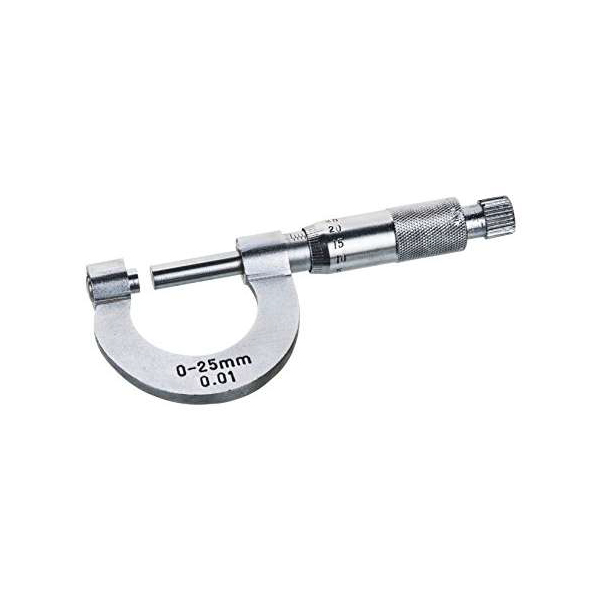
Micrometer
The Micrometer (Product Code: SCL105/01) is a horseshoe micrometer — also called a micrometer screw gauge — that uses a calibrated screw to take accurate outside measurements up to 25 mm, reading to 0.01 mm. Made of nickel-plated brass with a ratchet top and a lock, it is widely applicable in mechanical engineering, machining and most mechanical trades, and in the physics practicals of schools and colleges. It is manufactured by Jain Scientific Equipments Pvt Ltd (ScienceLab), Ambala, as a lock-type screw gauge for lab work in India and international markets.
Specifications
| Parameter | Detail |
|---|---|
| Type | Horseshoe micrometer (micrometer screw gauge), lock type |
| Range | 0–25 mm x 0.01 mm |
| Precision | 1/100 mm |
| Minimum measuring accuracy | 0.01 mm |
| Maximum measured length | 25 mm (outside measurements) |
| Material | Nickel-plated brass, with ratchet top |
| Rod | Accurately machined stainless steel |
| Screw | Ratchet micrometric screw |
| Rollers | Tungsten carbide alloy |
| Supplied with | Storage plastic box and calibration standard |
Typical Use
In school and college practicals the micrometer is used to find the diameter of a wire, the thickness of a glass plate or metal sheet, and the diameter of small spheres — measurements where a ruler, or even a vernier caliper, is not fine enough. Place the object between the measuring faces, turn the screw until the ratchet slips, then take the reading from the main and circular scales and apply any zero correction.
Before each set of readings, close the faces gently using the ratchet and check whether the scale reads zero; if it does not, record the zero error and correct every reading for it. The lock holds the screw in position so a reading is not disturbed while you note it. As with other precision physics lab instruments, wipe the measuring faces clean before use and return the micrometer to its plastic box afterwards.
Manufacturer
Jain Scientific Equipments Private Limited, incorporated under CIN U29309HR2020PTC087597, trades as ScienceLab and is based in Ambala, Haryana; the company manufactures at its licensed factory in the HSIIDC Industrial Area, Saha, Ambala (Factory Licence AMB-ONLINE-CHD-J-414). Learn more on our company profile.
Related Lab Equipment
Measuring tools used alongside the micrometer in length-measurement practicals:
- Caliper — for larger components beyond the micrometer’s 25 mm range
- Caliper Vernier (Metal) — the usual companion for vernier practicals before moving to the screw gauge
- Micrometer Screw Gauge, Lock Type — an alternative lock-type screw gauge from our physics range
- Metal Ruler — for rough measurement before a precise reading is taken
Browse the full Lab Equipment range for more measurement and demonstration apparatus.
Frequently Asked Questions
What are the range and least count?
The range is 0–25 mm and the micrometer reads to 0.01 mm (1/100 mm).
Can it measure internal diameters or depths?
No. It is specified for outside measurements up to 25 mm; use a caliper for inside and depth measurements.
What does the ratchet do?
The ratchet slips once the faces touch the object, so every reading is taken with the same gentle pressure and the object is not squeezed.
What is the lock for?
It fixes the screw in place so a reading stays set while it is recorded or while the instrument is moved.
What comes in the box?
The micrometer is supplied in a storage plastic box together with a calibration standard.
Is a calibration certificate available?
The calibration standard in the box is a reference piece for checking the instrument, not a certificate. Whether a calibration certificate can be provided should be discussed with us — please contact us before ordering.
Can you quote for a class set or a tender?
Yes. Send the quantity, delivery location and any vendor documents your tender requires; we supply schools, colleges and distributors in India and international markets.
Request a Quote
For pricing on the Micrometer, contact our sales team or add it to the enquiry cart together with calipers and rulers for a complete measurement kit.
Last updated: 24 September 2026
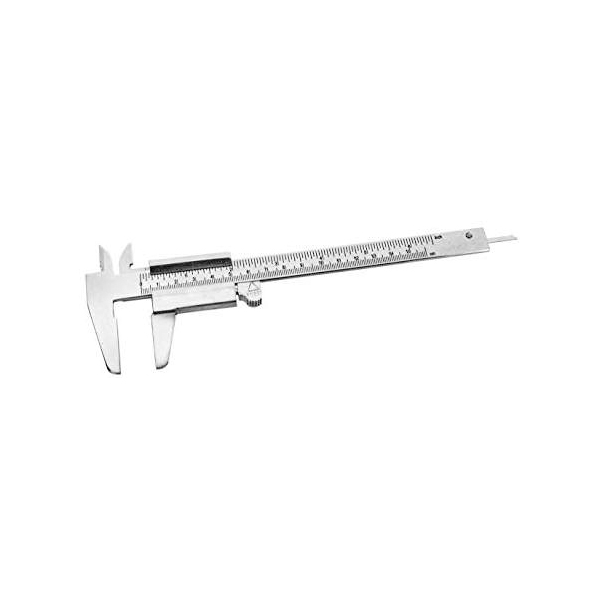
Caliper
Caliper (Product Code: SCL1208/02) is a vernier (nonius) caliper that lets a student read a length falling between two graduations of the main scale by mechanical interpolation, giving readings to a precision of 0.1 mm instead of relying on eye estimation. Physics and general science classes use it to measure the outside size of small objects and the inside width of holes up to 120 mm. It is made by Jain Scientific Equipments Pvt Ltd (ScienceLab) in Ambala, India, and is a practical choice for institutions sourcing a Vernier caliper for school labs in India and abroad.
Specifications
| Parameter | Detail |
|---|---|
| Type | Vernier (nonius) caliper |
| Material | Nonius steel |
| Precision | 0.1 mm |
| Maximum measurement length | 120 mm |
| Measuring jaws | External measuring rods for outside dimensions; internal measuring jaws for holes |
| Reading principle | Vernier scale – mechanical interpolation between main-scale markings to reduce estimation error |
Typical Use
In a first measurement practical, learners use the caliper to find the diameter of a cylinder or sphere, the thickness of a block, or the bore of a small tube, then work out areas and volumes from their readings. Combined with a balance, the same measurements let a class calculate the density of regular solids. Before each set of readings, close the jaws fully and check whether the vernier zero lines up with the main-scale zero; any offset is the zero error and must be corrected in every result.
Good technique matters as much as the tool: hold the object square between the jaws without forcing them, keep the eye level with the scale, and take the reading where a vernier line coincides exactly with a main-scale line. Because vernier reading is a standard exercise in secondary physics, the caliper belongs in the set of physics practical equipment that CBSE and state-board laboratories keep for every student group.
Manufacturer
This caliper is produced by Jain Scientific Equipments Private Limited, the Ambala, Haryana company that trades as ScienceLab and builds measuring and demonstration apparatus for school and college teaching. Institutions in India and international markets order from its catalogue; background on the business is on the ScienceLab company profile.
Related Lab Equipment
Items that are usually needed alongside this caliper in measurement and density practicals:
- Micrometer — for wires and thin sheets that need finer readings than a vernier scale gives.
- Metal Ruler — for lengths beyond the caliper's 120 mm range.
- Metal Density Cubes (Set of 6) — regular solids whose sides students measure to calculate volume and density.
- Balance — to find the mass that goes with each measured volume.
- Vernier Calliper — another vernier model from our physics range, for comparison.
More measuring and demonstration apparatus is listed in our Lab Equipment category.
Frequently Asked Questions
What is the smallest reading this caliper gives?
It reads to a precision of 0.1 mm using its vernier scale. For very thin items such as wires, a micrometer is the better instrument.
Can it measure the inside of holes and tubes?
Yes. In addition to the external measuring rods, it has internal measuring jaws for holes, so the bore of a tube or ring can be measured within the 120 mm maximum length.
What material is it made from, and how should it be cared for?
The caliper is made of nonius steel. Wipe it clean and dry after each class, avoid dropping it or using the jaws as a tool, and store it in a dry drawer so the measuring faces stay true.
How do students allow for zero error?
Close the jaws and note where the vernier zero sits against the main-scale zero. If they do not coincide, record the offset and subtract or add it to every reading taken with that instrument.
Is a calibration certificate available?
Please discuss any calibration-certificate requirement with us through the contact page before ordering, and we will confirm what can be provided for this item.
What should an institutional enquiry include?
State the quantity, product code SCL1208/02, delivery address and any documents your purchase process requires. Bulk orders for schools, colleges and distributors in India and international markets are welcome.
Request a Quote
To order the Caliper or ask about quantities, send your requirement through our contact page, or add it to the enquiry cart along with the other laboratory items your department needs.
Last updated: 24 September 2026
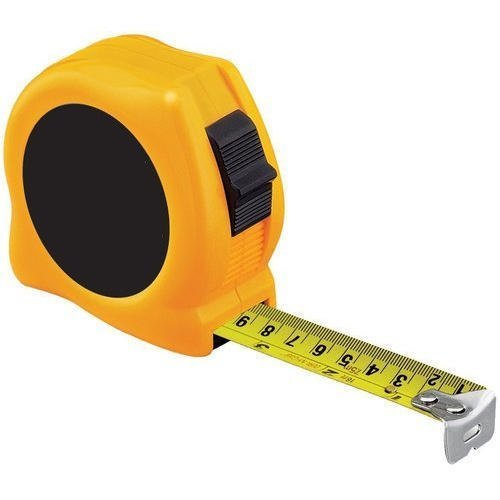
Tape Measure
Tape Measure (Product Code: SCL1209/03) is a 3-metre measuring tape with a steel strip graduated in millimetres, wound inside a resistant plastic body. Teachers and students reach for it whenever a length is too long for a ruler: the run of a trolley track, the height of a ramp, the size of a bench or the distance a ball rolls in a motion experiment. It is made by Jain Scientific Equipments Pvt Ltd (ScienceLab), Ambala, a laboratory equipment supplier in India, and is a basic item on any list of physics lab equipment for schools in India.
Specifications
| Parameter | Detail |
|---|---|
| Type | Tape measure with millimetre divisions |
| Length | 3 metres |
| Tape material | Steel, graduated strip in mm |
| Body material | Plastic, resistant body |
| Blade width | 2-10 mm |
| Construction | Durable |
Typical Use
A common lesson on speed starts with the tape: students mark a start and a finish line on the floor, measure the gap between them, then time a rolling ball or toy car over that distance and divide distance by time. The same tape gives the length and height of an inclined plane when a class works out slope, and it helps technicians set out benches, stands and apparatus at the spacing an experiment sheet asks for.
For accurate readings, pull the steel strip out straight and flat, hold the end firmly at the starting mark, and read the millimetre division square-on rather than at an angle. Guide the tape back into the plastic body instead of letting it snap shut, and wipe it dry if it gets wet. It is one of the simplest entries on a school lab instruments list, yet it is used in almost every mechanics practical.
Manufacturer
ScienceLab is the trading name of Jain Scientific Equipments Private Limited, a company based in Ambala, Haryana, whose catalogue runs from everyday measuring tools such as this tape to full physics demonstration sets for schools and colleges. You can read about the company on its profile page.
Related Lab Equipment
Useful companions for distance, speed and ramp experiments:
- Digital Chronometer (Stopwatch) — times the run over a distance measured with the tape, so students can calculate speed.
- Inclined Plane With Accessories — a ramp whose length and height the tape measures in slope and friction work.
- Metal Ruler — a rigid straight edge for shorter bench measurements and ruling lines.
- Caliper — for small diameters and thicknesses that a tape cannot resolve.
See the full Lab Equipment category for other measuring and mechanics items.
Frequently Asked Questions
How long is the tape and how is it marked?
The steel tape is 3 metres long and graduated in millimetres along the strip.
What are the body and tape made of?
The housing is a resistant plastic body and the measuring strip is steel, a combination chosen for durability in everyday classroom handling.
Can it be used for longer distances such as a sports ground?
It covers 3 metres in one pull, so longer distances have to be measured in sections. If your syllabus needs long outdoor measurements, tell us through the contact page and we will suggest a suitable option.
How should students look after it?
Retract the strip slowly, avoid kinking or stepping on it, and dry it after any contact with water so the steel stays in good condition.
Can you supply enough for every student group?
Yes. Class sets and bulk quantities for schools, colleges and distributors in India and international markets can be quoted; mention the number of pieces and the delivery location.
What warranty applies?
Warranty terms are confirmed in our written quotation. Please ask about them when you send your enquiry.
Request a Quote
For prices and delivery on the Tape Measure, message us through the contact form or place it in the enquiry cart and submit your full apparatus list in one go.
Last updated: 24 September 2026
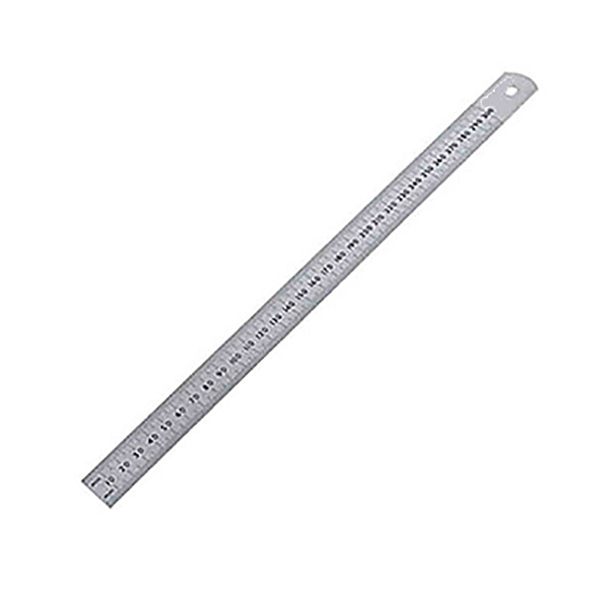
Metal Ruler
Metal Ruler (Product Code: SCL1211/04) is a graduated stainless steel rule 100 cm long, with a true straight edge that serves both for reading lengths and for ruling lines. Physics teachers use it where a short plastic scale is not enough: reading the extension of a spring, setting the length of a pendulum or spacing a lens and screen on the bench. The ruler is made by Jain Scientific Equipments Pvt Ltd (ScienceLab), Ambala, as part of its mechanics lab equipment in India for schools and colleges.
Specifications
| Parameter | Detail |
|---|---|
| Material | Stainless steel |
| Length | 100 cm |
| Width | Between 2 cm and 3 cm |
| Thickness | 0.5 mm |
| Scale | Graduated |
| Edge | Straight edge |
Typical Use
In a Hooke's law practical the ruler is clamped upright beside a hanging spring, and students note the position of a pointer each time a mass is added, turning the readings into a force-extension graph. It is equally handy for measuring the length of a simple pendulum from the point of suspension to the centre of the bob, for object and image distances in lens work, and for drawing long, clean lines on charts and posters.
Because the strip is only 0.5 mm thick, the graduations sit close to the object being measured, which helps students avoid parallax when they look straight down on the scale. A thin steel rule can flex, so support it along its length on the bench when taking a reading. Stainless steel does not swell like wood and wipes clean easily, which keeps this ruler serviceable in busy school physics lab equipment sets in India for many batches of students.
Manufacturer
Jain Scientific Equipments Private Limited makes this ruler under its ScienceLab brand in Ambala, Haryana, where the company develops teaching apparatus for physics, chemistry and biology laboratories. More about who we are is on the company profile.
Related Lab Equipment
Items that pair with this ruler in spring, pendulum and general measurement work:
- Set of Springs — springs whose extension is read against the ruler in elasticity experiments.
- Stand — to hold the ruler upright next to a hanging spring or pendulum.
- Caliper — for small diameters and thicknesses beyond the resolution of a rule.
- Tape Measure — for distances longer than the ruler, such as floor tracks.
- Meter Stick, White — an alternative scale for general classroom use.
Other measuring and mechanics items are grouped in our Lab Equipment category.
Frequently Asked Questions
How long is the ruler and is it graduated along its length?
It is 100 cm long and graduated. If you need the exact graduation interval before ordering, we can confirm it on request.
Why choose stainless steel over a wooden or plastic scale?
Stainless steel keeps a straight edge, does not warp with humidity and is easy to clean. Its 0.5 mm thickness also keeps the scale close to the object, reducing parallax.
Can it be held vertically in a clamp?
Yes, it can be held upright in a clamp on a stand for spring and pendulum work. Make sure your clamp jaws close firmly on a thin strip 2 to 3 cm wide.
How should it be stored?
Store it flat in a drawer or hang it from a hook so it is not bent under other apparatus, and wipe off any moisture after use.
Is the edge safe for students?
It is a thin metal strip, so students should carry it carefully and not use it for cutting or prising. Normal classroom handling is otherwise straightforward.
What details should a school include in its purchase request?
Give the product code SCL1211/04, the quantity, the delivery address and any vendor documents your institution needs. We quote bulk orders for India and international markets.
Request a Quote
Ready to order the Metal Ruler? Write to us via the contact page with your quantity, or use the enquiry cart to combine it with other items in one request.
Last updated: 24 September 2026
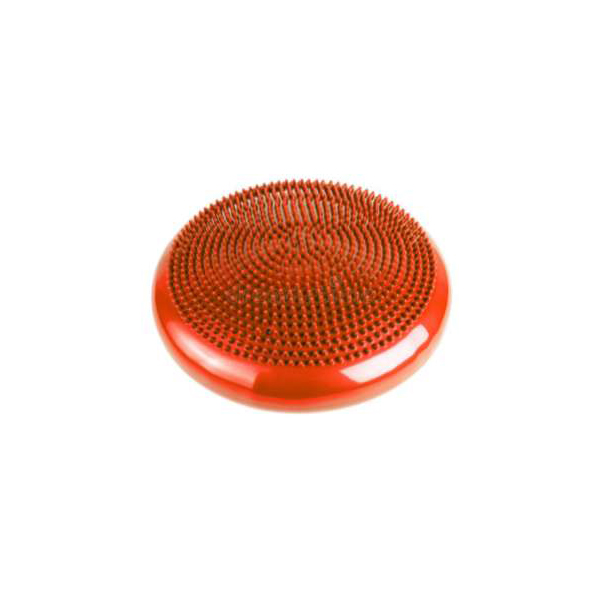
Disc to Demonstrate Equilibrium (Balance)
Disc to Demonstrate Equilibrium (Balance) (Product Code: SCL1213/05) is a 200 mm plastic disc that turns on a rotation axis and carries 18 attachment points – 2 mm holes or the same number of nails – laid out radially and symmetrically across its face. By hanging loads at different points, a teacher shows when a body that is free to rotate stays at rest: the turning effects on either side of the axis must cancel. Made by Jain Scientific Equipments Pvt Ltd (ScienceLab), Ambala, it works as a circular alternative to a moment bar apparatus in school physics.
Specifications
| Parameter | Detail |
|---|---|
| Type | Demonstration disc for the equilibrium of a body with a rotation axis |
| Material | Plastic disc |
| Diameter | 200 mm |
| Rotation axis | Provided |
| Attachment points | 18 holes of 2 mm diameter, or the same number of nails |
| Layout | Radially and symmetrically distributed on the surface of the disc |
Typical Use
With the disc mounted on its axis, students hang masses from holes on opposite sides and adjust them until the disc stays still in any position they leave it. They then measure the perpendicular distance from the axis to the line along which each thread hangs and compare the sum of clockwise moments with the sum of anticlockwise moments. Because the attachment points lie on radial lines, the class quickly sees an important subtlety: a load hung from a point above or below the horizontal diameter has a shorter lever arm than one at the same radius on that diameter, so it is the perpendicular distance, not the distance along the radius, that counts.
Before loading, check that the empty disc turns freely and settles without a preferred position; otherwise friction or imbalance will mask the result. Light masses on fine thread give the cleanest readings. For teachers building a set of mechanics lab equipment in India, the disc complements straight levers by showing the same principle on a rotating body.
Manufacturer
The disc is manufactured by Jain Scientific Equipments Private Limited, the Ambala, Haryana company behind the ScienceLab name, which designs demonstration apparatus for teaching mechanics and other physics topics. The company is a registered MSME enterprise (Udyam UDYAM-HR-01-0003714) and handles overseas shipments under Importer-Exporter Code AAECJ8618A issued by the DGFT. Further background is on the ScienceLab profile page.
Related Lab Equipment
To run a complete moments and equilibrium lesson, these items are often ordered with the disc:
- Set Of Marked Masses — known loads to hang from the holes or nails.
- Stand — a support for the rotation axis during the demonstration.
- Dynamometer — to apply and read a measured pulling force instead of a hanging mass.
- Lever — the straight-bar version of the principle of moments, for comparison.
- Deformable Parallelepiped — extends the topic to the balance of bodies standing on a base.
Browse all items in our Lab Equipment category.
Frequently Asked Questions
Does the disc come with holes or with nails?
It is specified with 18 holes of 2 mm diameter or the same number of nails. Tell us which version suits your lesson when you enquire and we will confirm it in the quotation.
Are masses included?
The specification covers the disc with its rotation axis and attachment points; masses are not listed. A Set Of Marked Masses can be ordered alongside it.
Which topics does it support?
The principle of moments, the conditions for equilibrium of a body with a fixed axis, and the idea of the perpendicular lever arm.
How is the axis supported during a demonstration?
The disc turns on its rotation axis, which is normally held on a laboratory support. If you need a particular mounting arrangement, please discuss it with us through the contact page.
How do I keep the plastic disc in good condition?
Keep it away from heat sources, clean it with a damp cloth, and store it flat so the disc does not warp.
Can you supply multiple units for student groups or export?
Yes. We quote class sets and bulk orders for schools, colleges and distributors in India and international markets.
Request a Quote
For a price on the Disc to Demonstrate Equilibrium (Balance), send your quantity through our contact page or add it to the enquiry cart with the masses and supports you need.
Last updated: 24 September 2026

Deformable Parallelepiped
Deformable Parallelepiped (Product Code: SCL1215/06) is a hinged frame with a base – four vertical rods joining two bases, plus a median articulated support – that can be folded obliquely into a leaning box shape. As the frame leans further, students watch the moment a body standing on a base stops being stable and tips over, which makes the idea of centre of gravity and support base visible at a glance. It is made by Jain Scientific Equipments Pvt Ltd (ScienceLab), Ambala, a laboratory equipment supplier in India, for schools looking for a simple center of gravity apparatus.
Specifications
| Parameter | Detail |
|---|---|
| Type | Parallelepiped frame with base that can be folded obliquely |
| Construction | Four vertical rods, two bases and a median articulated support |
| Dimensions | Not smaller than 140x200 mm |
| Purpose | Device to show the balance of bodies with a support base |
Typical Use
Stand the frame upright on the bench, then tilt it step by step so that the rods lean and the upper base moves sideways over the lower one. A plumb line hung from the upper part of the frame marks the vertical through its centre of gravity. While that line still falls inside the lower base, the frame stays standing; once it passes beyond the edge, the frame overturns. Students can mark the tipping angle and relate it to everyday cases such as loaded vehicles, tall cupboards and why stable objects have wide, low bases.
Tilt slowly and keep a hand close so the frame does not fall off the bench, and do not force the joints past their natural travel. Used as a demonstration model in the physics lab, it pairs well with rotating-disc and lever experiments to give a complete lesson on equilibrium.
Manufacturer
ScienceLab apparatus such as this frame is made by Jain Scientific Equipments Private Limited, a company registered in Ambala, Haryana, that focuses on hands-on equipment for teaching science. See the company profile for more about its range and export activity to international markets.
Related Lab Equipment
Items that support the same stability and equilibrium lesson:
- Plumb Line Level — shows the vertical through the centre of gravity as the frame leans.
- Disc to Demonstrate Equilibrium (Balance) — covers equilibrium of a body turning about an axis.
- Metal Ruler — for measuring base width, height and sideways shift before tipping.
- Inclined Plane With Accessories — lets students compare toppling with sliding on a slope.
You will find further mechanics apparatus in our Lab Equipment category.
Frequently Asked Questions
What principle does the deformable parallelepiped demonstrate?
It shows that a body resting on a base stays in balance only while the vertical line through its centre of gravity falls within that base, and topples once it moves outside.
What size is the frame?
Its dimensions are not smaller than 140x200 mm. If you need the exact measurements for a display cabinet or lesson plan, we can confirm them on request.
Is a plumb line supplied with it?
The specification lists the frame with its four vertical rods, two bases and median articulated support. A plumb line is not listed, so order a Plumb Line Level separately if you want to show the vertical.
Is it meant for the teacher or for student groups?
It is mainly a front-bench demonstration piece, but small groups can also use it to record the tilt at which the frame overturns.
How should it be looked after?
Return the frame to its upright position after use, keep the joints free of dust, and avoid bending the rods or forcing the articulated support.
What does a school need to send for a quotation?
The product code SCL1215/06, quantity and delivery address are enough to start. We supply institutions and distributors in India and international markets.
Request a Quote
Ask for pricing on the Deformable Parallelepiped through our contact page, or collect it in the enquiry cart with the other mechanics items on your list.
Last updated: 24 September 2026
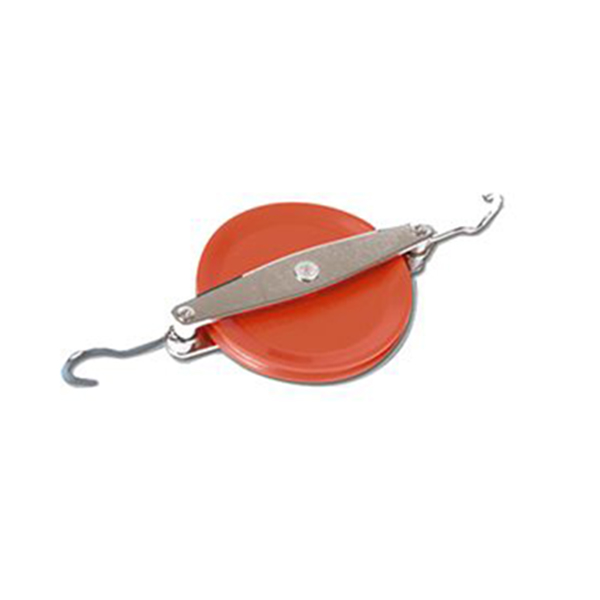
Pulley
Pulley (Product Code: SCL1217/07) is a single 40 mm polypropylene wheel with a peripheral groove, turning on its rotation axis inside an aluminium frame that carries hooks on two sides. One hook lets it hang from a support as a fixed pulley; the other takes a load or a second pulley, so the same unit can be used fixed or movable. Made by Jain Scientific Equipments Pvt Ltd (ScienceLab), Ambala, it is the basic building block for any pulley system lab in India, from middle school to junior college.
Specifications
| Parameter | Detail |
|---|---|
| Type | Peripheral groove wheel on support |
| Wheel material | Polypropylene |
| Frame | Aluminium |
| Wheel diameter | 40 mm |
| Wheel thickness | 5 mm |
| Rotation | Turns on a rotation axis |
| Fittings | Hooks on two sides |
Typical Use
Hung from a stand as a fixed pulley, it shows that a pulley changes the direction of a force: students pull down on a string passing over the groove to raise a mass, and a spring balance reveals that the effort is close to the load. Used as a movable pulley, with the load on the lower hook and one end of the string anchored, the effort needed falls to roughly half the load while the string travels twice as far. Several units combined give a block and tackle, from which a class calculates mechanical advantage, velocity ratio and efficiency.
For consistent results, use light, non-stretch string that runs cleanly in the groove, check that the wheel spins freely before each trial, and include the weight of the pulley itself when working out a movable arrangement. These are the classic force and simple-machine practicals found in school physics lab equipment in India.
Manufacturer
This pulley comes from Jain Scientific Equipments Private Limited, which operates as ScienceLab from Ambala in Haryana and produces mechanics apparatus for classrooms and training institutes in India and international markets. The ScienceLab profile gives an overview of the company.
Related Lab Equipment
Items that complete a pulley and simple-machines practical:
- Stand — a rigid support to hang the pulley from its hook.
- Set Of Marked Masses — known loads to lift in effort-load measurements.
- Dynamometer — measures the effort applied to the string.
- Pulley, Metal, Double — a two-wheel block for building a block and tackle.
- Inclined Plane With Accessories — another simple machine often studied in the same unit.
For more mechanics items, visit our Lab Equipment category.
Frequently Asked Questions
Can it be used as both a fixed and a movable pulley?
Yes. With hooks on two sides, it can hang from a support as a fixed pulley or carry the load as a movable one.
What size is the wheel?
The polypropylene wheel is 40 mm in diameter and 5 mm thick, with a peripheral groove for the string, and it is mounted in an aluminium frame.
Are string and masses included?
They are not listed in the specification. Masses and a force meter can be ordered with it, and any light, strong cord will run in the groove.
What load can it carry?
A load rating is not specified for this item. For heavier or unusual loads, please ask us through the contact page before use.
How do I keep it running smoothly?
Keep the axis free of dust and grit, avoid dropping the frame, and store it on a hook or in a tray rather than loose under heavier apparatus.
Can you supply pulleys in class quantities?
Yes, we quote bulk quantities for schools, colleges and distributors in India and international markets. Include the code SCL1217/07 and the number required.
Request a Quote
Send your Pulley requirement through the contact page, or add it to the enquiry cart together with stands and masses for a single combined quotation.
Last updated: 24 September 2026
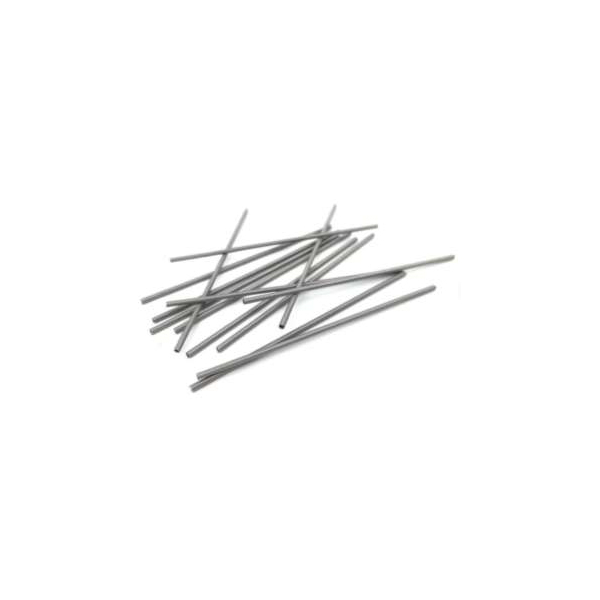
Long Cylindrical Spring (Resort)
Long Cylindrical Spring (Resort) (Product Code: SCL1219/08) is a long helical spring in silver-coloured stainless steel, 20 mm in diameter and 3 metres long, specified for an elongation of 3 times. Laid on the floor or a long bench and stretched between two students, it carries pulses and waves slowly enough for a whole class to follow them, so transverse and longitudinal motion can be compared side by side. It is made by Jain Scientific Equipments Pvt Ltd (ScienceLab), Ambala, and forms the heart of a wave motion kit for schools in India.
Specifications
| Parameter | Detail |
|---|---|
| Type | Long cylindrical helical spring (resort) |
| Shape | Cylindrical |
| Material | Stainless steel |
| Colour | Silver |
| Diameter | 20 mm |
| Length | 3 metres |
| Elongation | 3 times |
Typical Use
With one student holding each end, a quick sideways flick sends a transverse pulse along the coils, while a sharp push along the spring's length sends a band of compression that models how sound travels. Holding one end firmly shows that a pulse returns inverted from a fixed end; letting that end move freely shows it returning the same way up. Shaking one end at a steady rate sets up standing waves, and the class can point out nodes and antinodes, measure the wavelength with a tape and time pulses to estimate wave speed.
Work on a smooth, clear floor or a long bench, keep the stretch within the specified elongation so the coils are not permanently deformed, and never let go of a stretched end suddenly. Easy to see from the back of the room, the spring earns its place in any physics demonstration kit in India.
Manufacturer
Jain Scientific Equipments Private Limited, known to schools by its trade name ScienceLab, produces this spring in Ambala, Haryana, alongside a wide range of apparatus for teaching waves, sound and mechanics. Visit the company profile to learn more about the business.
Related Lab Equipment
Apparatus that supports wave demonstrations with this spring:
- Tape Measure — for marking out wavelengths and the stretched length on the floor.
- Digital Chronometer (Stopwatch) — times a pulse over a known distance to estimate wave speed.
- Apparatus for demonstrating the phenomenon of wave propagation and reflection — a bench-top follow-up on propagation and reflection.
- Metal Slinky, Helical Spring — a shorter helical spring for small-group work.
See the whole Lab Equipment category for more physics apparatus.
Frequently Asked Questions
How far can the spring be stretched?
It is specified for an elongation of 3 times. Staying within that limit keeps the coils evenly spaced and prevents permanent stretching.
Can it show both transverse and longitudinal waves?
Yes. A sideways movement of one end produces transverse pulses, and a push along the axis produces compressions and rarefactions.
What is it made of?
The spring is silver-coloured stainless steel with a cylindrical shape and a diameter of 20 mm.
How much space is needed for a demonstration?
It is 3 metres long before it is stretched, so a corridor, a long bench or a clear strip of classroom floor works best.
How can we stop it from tangling in storage?
Let the coils close up gently, tie the bundle loosely at a few points and store it in a box or bag so the turns cannot twist through each other.
Do you supply schools in bulk and abroad?
Yes. We quote class and bulk quantities for institutions and distributors in India and international markets; share the quantity and destination with your enquiry.
Request a Quote
To receive a price for the Long Cylindrical Spring (Resort), use our contact page or add it to the enquiry cart with the rest of your waves and sound apparatus.
Last updated: 24 September 2026
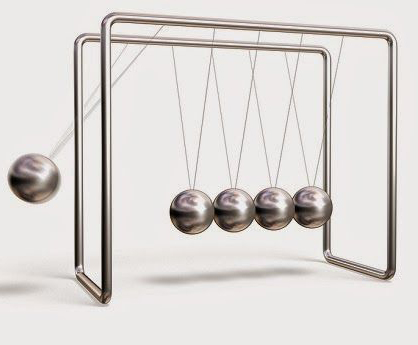
Newton's Pendulum (Newton's Cradle)
Newton's Pendulum (Newton's Cradle) (Product Code: SCL1321/09) is a row of suspended steel balls used to show how momentum and energy pass along a line of colliding bodies in school and college physics lessons. Its 5 steel balls, at least 15 mm across, hang on two 120 mm wires in a straight line, so a released end ball sends the far ball swinging while the middle ones stay still. It is manufactured by Jain Scientific Equipments Pvt Ltd (ScienceLab), an OEM scientific instruments manufacturer in India, at its own factory in Ambala.
Specifications
| Parameter | Detail |
|---|---|
| Type | Newton's cradle on a support |
| Balls | 5 steel balls |
| Suspension | Each ball attached with two wires; balls aligned on a straight line |
| Ball diameter | Minimum 15 mm |
| Suspension wire length | 120 mm |
| Demonstrates | Impulse and energy passing from an end ball to the ball at the opposite end without the intermediate balls changing position |
| Product code | SCL1321/09 |
| Manufacturer | Jain Scientific Equipments Pvt Ltd (ScienceLab) — OEM |
| Country of origin | India (made in Ambala, Haryana) |
What Is the Newton's Cradle Used For?
Start by releasing a single end ball and ask the class to predict what will happen; then release two together and watch two leave from the far side. Discussing why the number of balls leaving always matches the number released leads students to see that both momentum and kinetic energy are conserved in these near-elastic collisions. Raising the first ball higher makes the far ball rise higher too, a neat link between potential and kinetic energy, and the gradual dying away of the motion opens a discussion of energy lost as sound and heat.
Place the cradle on a level bench, check that the balls hang in a straight line and just touch before you begin, and release the ball rather than pushing it. The two-wire suspension keeps each ball swinging in one plane, which is why the effect is so clear when the set is well aligned. It is a favourite demonstration model in physics lab equipment across India, for classroom lessons and science exhibitions alike.
OEM Manufacturer
Jain Scientific Equipments Private Limited, trading as ScienceLab, is the OEM (original equipment manufacturer) of this Newton's cradle and makes it at its own licensed factory at Saha, Ambala, Haryana, India, rather than sourcing it from a trader. Schools, colleges, dealers and importers order it factory-direct, and replacement balls or wires for sets already in use can be requested from the manufacturer — ask us. For vendor registration, institutional buyers can record the company's GSTIN 06AAECJ8618A1ZT and its Legal Entity Identifier (LEI) 3358004HRD1JIVXKYX49. More about the company is on the company profile.
Related Lab Equipment
Follow-up apparatus for momentum, energy and oscillation lessons:
- Apparatus Collision 2 Dimension — takes collisions from a straight line into two dimensions.
- Apparatus Newton’s Second Law — links force, mass and acceleration in the same unit of study.
- Mathematical Pendulum Demonstration Apparatus — for studying the swing of a single pendulum in detail.
- Caliper — lets students measure ball diameters when discussing the set-up.
More demonstration apparatus is listed in our Lab Equipment category.
Frequently Asked Questions
How many balls does it have and how large are they?
The Newton's Pendulum (Newton's Cradle) has 5 steel balls with a minimum diameter of 15 mm. Each ball hangs on two wires 120 mm long, and the balls are aligned in a straight line on the support.
What happens if two balls are released together?
When two end balls of the Newton's Pendulum (Newton's Cradle) are released together, two balls swing out from the opposite end. The number leaving matches the number released because both momentum and kinetic energy are conserved in the collisions.
Why does the motion eventually stop?
The swinging of the Newton's Pendulum (Newton's Cradle) dies away because each collision is not perfectly elastic. A little energy is lost as sound and heat and to air resistance with every swing, so the motion gradually stops.
What should I do if the balls fall out of line?
If the balls of the Newton's Pendulum (Newton's Cradle) drift out of line, gently untwist the wires until every ball hangs in a straight row and just touches its neighbours. For a damaged wire, ask us about a replacement through the contact page.
Who manufactures the Newton's Pendulum (Newton's Cradle)?
The Newton's Pendulum (Newton's Cradle) is manufactured by Jain Scientific Equipments Pvt Ltd (ScienceLab), the OEM, at its own licensed factory at Saha, Ambala, Haryana, India. Schools and distributors receive quotations directly from the manufacturer.
Do you supply it for bulk and export orders?
Yes. The Newton's Pendulum (Newton's Cradle) is quoted for single units, class sets and distributor quantities. Send the code SCL1321/09, the quantity and your delivery location in India or international markets through the contact page.
Request a Quote
Request a price for the Newton's Pendulum (Newton's Cradle) straight from the manufacturer on our contact page, or add it to the enquiry cart if you are building a list of mechanics demonstrations.
Last updated: 24 September 2026
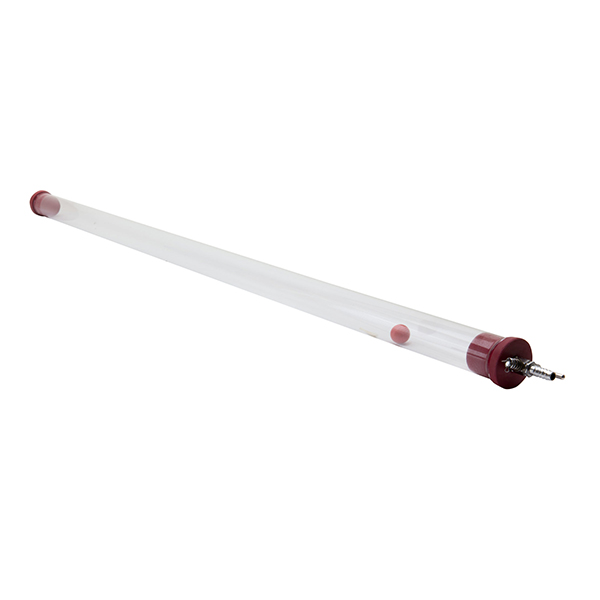
Newton's Tube
Newton's Tube (Product Code: SCL1223/010) is a long, sealed glass tube used to show that light and heavy bodies fall together once air resistance is removed, in school and college physics demonstrations. At least 1,500 mm long, it holds a wedge, a piece of sponge and a 5 mm metal ball, and its lid carries a tap and an air-outlet connection for a vacuum pump. It is manufactured by Jain Scientific Equipments Pvt Ltd (ScienceLab), an OEM manufacturer, at its own factory in Ambala, India, as mechanics lab equipment.
Specifications
| Parameter | Detail |
|---|---|
| Tube | Transparent glass |
| Diameter | 30–100 mm |
| Length | Minimum 1,500 mm |
| Ends | One end closed; the other end with a sealed lid carrying a tap and an air-outlet connection |
| Objects inside | A wedge, a piece of sponge and a metal ball of 5 mm external diameter |
| Product code | SCL1223/010 |
| Manufacturer | Jain Scientific Equipments Pvt Ltd (ScienceLab) — OEM |
| Country of origin | India (made in Ambala, Haryana) |
What Is the Newton's Tube Used For?
The demonstration runs in two stages. First, with the tube full of air, the teacher closes the tap, holds the tube upright and turns it over smoothly: the metal ball drops quickly while the sponge drifts down slowly, just as everyday experience suggests. Next, the air outlet is connected to a vacuum pump, the air is drawn out and the tap is closed before the tube is inverted again. This time the objects fall side by side, showing that without air resistance all bodies fall with the same acceleration.
Letting a little air back in and repeating shows the effect of air resistance returning step by step, which makes a strong closing question for the class. An evacuated glass tube must be handled with care: turn it in a controlled way, never knock it against the bench, keep students at a safe distance and wear eye protection while it is under vacuum. Wipe the glass clean before class so the falling objects are easy to see from the back of the room.
What to Specify When Ordering
- The tube diameter you need within the 30–100 mm range (the length is a minimum of 1,500 mm).
- Whether a vacuum pump and vacuum tubing should be quoted with the tube, as no pump is listed with it.
- The number of tubes and the delivery location, so packing for the glass can be planned.
OEM Manufacturer
Jain Scientific Equipments Private Limited, trading as ScienceLab, is the OEM (original equipment manufacturer) of the Newton's Tube and makes it at its own licensed factory at Saha, Ambala, Haryana, India. Because the tube comes from its maker rather than a trader, schools and distributors get quotations, packing advice and repeat orders straight from the source, and a replacement part can be requested if one is damaged — ask us. Read more on the about-us profile.
Related Lab Equipment
Items needed to evacuate the tube, plus alternatives for the same lesson:
- Vacuum Pump with Pressure Gauge — removes the air through the tube's outlet and shows the pressure reached.
- Vacuum Tubing — connects the air outlet to the pump.
- Vacuum Pump, Hand — a manual option for evacuating the tube.
- Guinea & Feather Apparatus — an alternative apparatus for the same free-fall demonstration.
- Apparatus for Demonstrating the Free Fall of Bodies — continues the topic of free fall in air.
Explore other items in the Lab Equipment category.
Frequently Asked Questions
What objects are inside the Newton's Tube?
The Newton's Tube contains a wedge, a piece of sponge and a metal ball of 5 mm external diameter. The contrast between the light sponge and the dense ball makes the effect of air resistance, and its removal, easy to see.
Is a vacuum pump supplied with the tube?
No pump is listed with the Newton's Tube. The tube connects through its tap and air-outlet connection to a separate vacuum pump, such as the Vacuum Pump with Pressure Gauge, using suitable vacuum tubing.
What diameter will the tube be?
The Newton's Tube is specified with a diameter of 30–100 mm and a minimum length of 1,500 mm. Tell us the diameter your syllabus or tender needs, and the exact dimensions will be confirmed in your quotation.
Can the demonstration be done without a vacuum?
Partly. With air inside, the Newton's Tube shows the sponge falling far more slowly than the metal ball, which demonstrates air resistance. The equal-fall result needs the air to be pumped out through the air outlet first.
What precautions apply to an evacuated glass tube?
Handle the evacuated Newton's Tube gently: turn it in a controlled way, avoid knocks and sudden temperature changes, keep observers at a safe distance and wear eye protection while the glass tube is under vacuum.
Who manufactures the Newton's Tube?
The Newton's Tube is manufactured by Jain Scientific Equipments Pvt Ltd (ScienceLab), the OEM, at its own licensed factory at Saha, Ambala, Haryana, India. Quotations for the tube, with or without a pump and tubing, come directly from the manufacturer.
Request a Quote
To price the Newton's Tube together with a pump and tubing, send your list to the manufacturer through our contact page or add everything to the enquiry cart.
Last updated: 24 September 2026
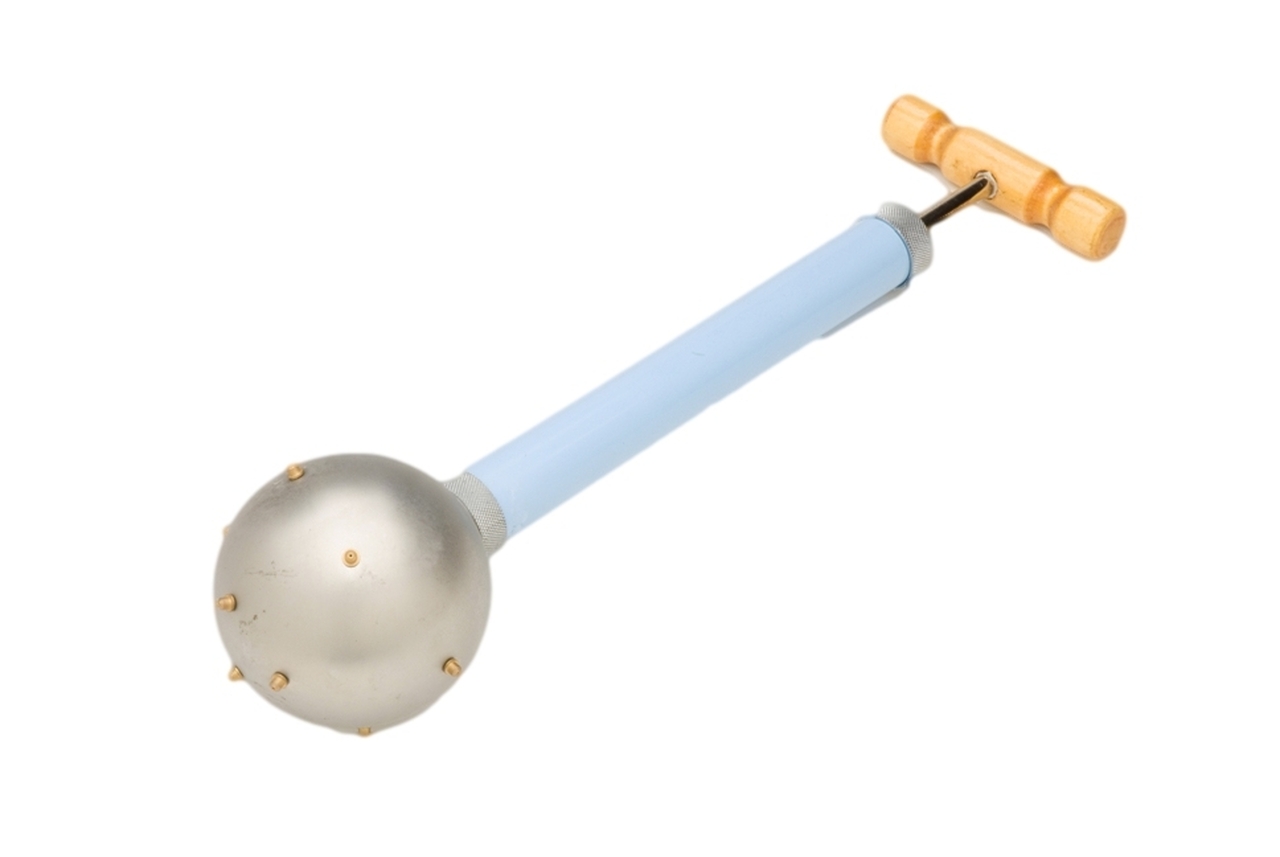
Pascal's Sphere
Pascal's Sphere (Product Code: SCL1225/011) is a complete demonstration of Pascal's law: a hollow sphere with 10 equidistant nozzles, connected to a hand pump whose plunger applies pressure to the fluid inside. Push the plunger and fluid leaves every nozzle with equal force in all directions, showing that a change in pressure in a fluid is transmitted equally to all its parts. Supplied with instructions, it is made by Jain Scientific Equipments Pvt Ltd (ScienceLab), Ambala, as part of its educational laboratory equipment in India for fluid-pressure lessons.
Specifications
| Parameter | Detail |
|---|---|
| Type | Pascal's law demonstration apparatus |
| Main parts | Hollow sphere connected to a hand pump with plunger |
| Nozzles | 10, equidistant over the sphere |
| Principle shown | A change in pressure in a fluid is transmitted equally in all directions to all parts of the fluid |
| Documentation | With instructions |
Typical Use
The sphere is filled with water, the teacher pushes the plunger steadily, and thin jets spring from all the nozzles at once – upwards, downwards and sideways alike. Because the jets leave with equal force whichever way the nozzles point, students can see that the pressure applied at the pump is passed on undiminished throughout the liquid. The lesson leads naturally to hydraulic jacks, presses and vehicle brakes, where a small force on a small piston produces a large force on a larger one.
Carry out the demonstration over a sink or a large tray, and push the plunger smoothly rather than in jerks for even jets. After class, empty out the water, let the sphere and pump dry, and check that no nozzle is blocked, since a blocked opening spoils the symmetry of the display. Follow the supplied instructions for filling and use.
Manufacturer
Jain Scientific Equipments Private Limited, trading as ScienceLab, builds this sphere in Ambala, Haryana, as one of several apparatus it makes for teaching pressure and fluids to secondary students. You can find out more from the company profile.
Related Lab Equipment
Other items for a fluids and pressure unit:
- Glass Beaker — a container of water for filling the sphere through its nozzles.
- Pascal’s Principle Demonstrator — an alternative apparatus for the same law.
- Set to Demonstrate Archimedes’ Principle/Law — the next step in the fluids syllabus, on buoyancy.
- Set of Capillary Tubes — shows another property of liquids, capillary rise.
More fluids and mechanics apparatus is in our Lab Equipment category.
Frequently Asked Questions
How many nozzles does the sphere have?
It has 10 equidistant nozzles, so jets appear in every direction when pressure is applied.
Which liquid should be used?
Clean water is the usual choice for classroom demonstrations. Use the instructions supplied with the apparatus for filling and operation.
Are instructions included?
Yes, the apparatus is supplied with instructions.
Why do the jets leave with equal force from every nozzle?
The plunger raises the pressure of the enclosed liquid, and that increase is transmitted equally in all directions, which is exactly what Pascal's law states.
What materials are the sphere and pump made from?
Materials are not listed in the current specification. Please ask through the contact page if your tender or purchase order needs them stated.
Can you supply several units for a school network or distributor?
Yes, bulk quantities can be quoted for institutions and distributors in India and international markets. Include the product code SCL1225/011.
Request a Quote
For a quotation on Pascal's Sphere, write to us through the contact page, or add it to the enquiry cart along with other fluids apparatus.
Last updated: 24 September 2026
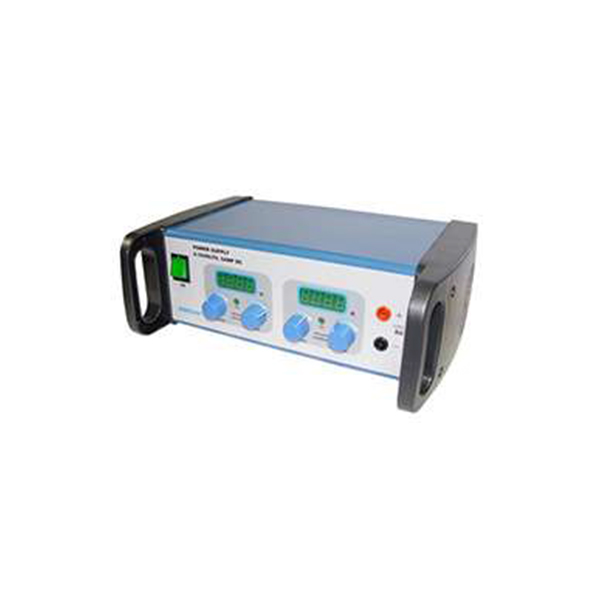
Power Source For Teacher
Power Source For Teacher (Product Code: SCL1427/012) is a demonstration-table power unit with two separate outputs: an alternating (AC) source on one pair of terminals and a continuous (DC) source on the other pair. The output is adjustable from 2 to 24 V (minimum range) on a graduated control, supplies a maximum current of 5 A, and is protected against short circuits, while a built-in voltmeter and ammeter let the whole class see the voltage and current. Made by Jain Scientific Equipments Pvt Ltd (ScienceLab), Ambala, a laboratory equipment supplier in India, it is a practical power supply unit for lab demonstrations.
Specifications
| Parameter | Detail |
|---|---|
| Outputs | Alternating (AC) source on two terminals; continuous (DC) source on the other two terminals |
| Voltage adjustment | From 2 to 24 V (minimum), graduated |
| Maximum current | 5 A |
| Protection | Short-circuit protection |
| Indication | Voltmeter and ammeter for voltage and current |
| Mains connection | Plug with conductor for earth connection |
| Power supply | 220 V |
Typical Use
From the front bench, a teacher can run the DC terminals into an electrolysis cell, an electromagnet or a resistance wire to show chemical, magnetic and heating effects of current, then switch to the AC terminals for a demonstration transformer or induction experiment. Because the meters are built in, students read the voltage and current straight from the unit while the teacher varies the setting, which makes Ohm's law and power calculations easy to follow in real time.
Good practice is to turn the control to its lowest setting before switching on, make all connections with the unit off, and raise the voltage gradually while watching the ammeter. If the short-circuit protection operates, switch off and check the wiring before trying again. Always plug into an earthed 220 V socket so the earth conductor can do its job.
Manufacturer
The unit is built by Jain Scientific Equipments Private Limited, which trades as ScienceLab from Ambala, Haryana, and produces electrical demonstration apparatus for school and college physics. Further information is available on the ScienceLab company profile.
Related Lab Equipment
Items commonly powered by, or wired to, this source in electricity demonstrations:
- Connecting Wire — for wiring demonstration circuits to the output terminals.
- Rheostat — fine control of current in a demonstration circuit.
- Multimeter — for measuring at points in the circuit away from the unit's own meters.
- Demonstrative Transformer (for high school) — an AC demonstration that uses the alternating output.
- Device to Study Electric Current In Electrolytes — a DC experiment on conduction in liquids.
Browse other electrical apparatus in our Lab Equipment category.
Frequently Asked Questions
Does it provide both AC and DC?
Yes. Two terminals give an alternating (AC) output and the other two give a continuous (DC) output.
What voltage and current can it deliver?
The output is adjustable from 2 to 24 V (minimum range) on a graduated control, with a maximum current of 5 A.
What happens if the output is short-circuited?
The unit has short-circuit protection. Switch it off, find and correct the fault in the circuit, then switch on again at a low setting.
What mains supply does it need?
It is specified for a 220 V supply through a plug with an earth conductor. If your country uses a different mains voltage, tell us before ordering so we can confirm suitability.
Is it intended for student benches?
It is designed as the teacher's source for demonstrations. If you also need supplies for student groups, mention the number of benches in your enquiry.
Can a calibration certificate be provided for the meters?
Please discuss calibration-certificate needs with us through the contact page before placing an order.
What warranty applies?
Warranty terms are stated in our written quotation; ask for them when you request a price.
Request a Quote
Send your requirement for the Power Source For Teacher via the contact page, or place it in the enquiry cart with leads, meters and other electrical items.
Last updated: 24 September 2026
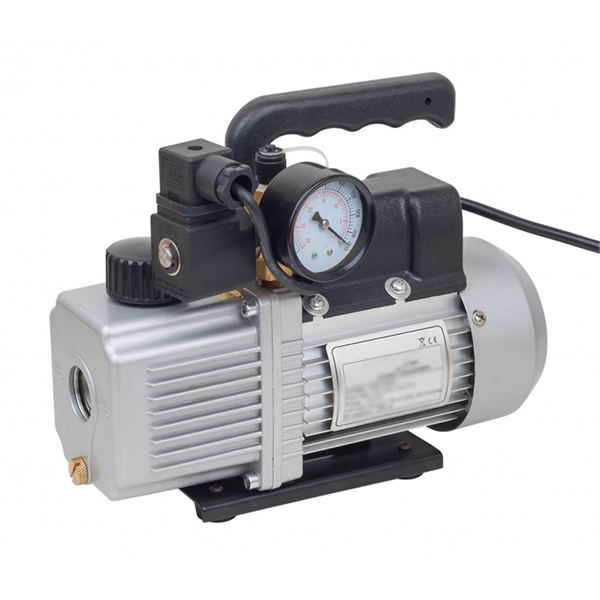
Vacuum Pump with Pressure Gauge
Vacuum Pump with Pressure Gauge (Product Code: SCL1429/013) is a mechanical or electrical installation with a minimum power of 90 W that both removes air from, and pumps air into, the apparatus used to study gas processes. Through its tap, air can be exhausted down to a pressure of 130 Pa, and by pumping, a pressure of up to 0.3 MPa can be obtained, while the pressure gauge lets the class follow each change. It is made by Jain Scientific Equipments Pvt Ltd (ScienceLab), Ambala, for schools that want a single physics instruments supplier in India for pump and accessories.
Specifications
| Parameter | Detail |
|---|---|
| Type | Mechanical or electrical installation for evacuation and pumping of air |
| Power | Minimum 90 W |
| Evacuation | Tap allows air to be exhausted down to a pressure of 130 Pa |
| Pumping | Pressure up to 0.3 MPa can be obtained |
| Indication | Pressure gauge |
| Application | Experiments for studying gas processes |
Typical Use
Connected to a glass bell on its sealed support, the pump draws out the air so students can watch a partly inflated balloon swell, water begin to boil at room temperature, or a ringing bell fade into silence as the medium for sound is removed. The same pump evacuates a Newton's tube for the free-fall demonstration and supports other experiments on gases where pressure is the variable being changed. In pumping mode it raises the pressure inside suitable apparatus, so the class can explore how a gas responds to compression.
Check hoses and seals before each lesson, close the tap to hold a vacuum once the gauge shows the pressure you want, and open it slowly to let air back in. Only pressurise vessels that are intended to take pressure – never ordinary thin glassware – and keep students behind a safe line when glass is under vacuum.
Manufacturer
ScienceLab is the brand of Jain Scientific Equipments Private Limited in Ambala, Haryana, which supplies gas-law and pressure apparatus to schools and colleges. The company is incorporated under CIN U29309HR2020PTC087597 and manufactures at its licensed factory at 449, HSIIDC Industrial Area, Saha, Ambala (Factory Licence AMB-ONLINE-CHD-J-414). See the company profile for more.
Related Lab Equipment
Apparatus that is evacuated or connected with this pump:
- Glass Bell on The Support — a sealed enclosure for vacuum experiments.
- Newton’s Tube — evacuated by the pump to show bodies falling together.
- Vacuum Tubing — for connecting the pump to apparatus.
- Bell In Glass Jar and Base — demonstrates that sound needs a medium once air is removed.
Our Lab Equipment category lists further apparatus for pressure and gas experiments.
Frequently Asked Questions
Is the pump hand-operated or electric?
The specification covers a mechanical or electrical installation with a minimum power of 90 W. Tell us your preference and we will confirm the drive type in the quotation.
How low a pressure can it reach?
Through its tap, air can be exhausted down to a pressure of 130 Pa, which is enough for the usual school vacuum demonstrations.
Can it also be used to compress air?
Yes. By pumping, a pressure of up to 0.3 MPa can be obtained. Use this only with vessels designed to hold pressure.
Is a bell jar or tubing included?
They are not listed in the specification. The Glass Bell on The Support and Vacuum Tubing can be ordered alongside the pump.
How should the pump be looked after?
Keep the inlet free of dust, do not let water or vapour be drawn into the pump, and store it with the connections capped. For servicing questions, contact us through the contact page.
Is a calibration certificate available for the gauge?
Please discuss any calibration-certificate requirement with us before ordering, and we will tell you what can be provided.
Do you ship to other countries?
Yes, we supply institutions and distributors in India and international markets. Share the destination and quantity with your enquiry.
Request a Quote
For a price on the Vacuum Pump with Pressure Gauge and matching accessories, contact us via the enquiry form or add the items to the enquiry cart.
Last updated: 24 September 2026
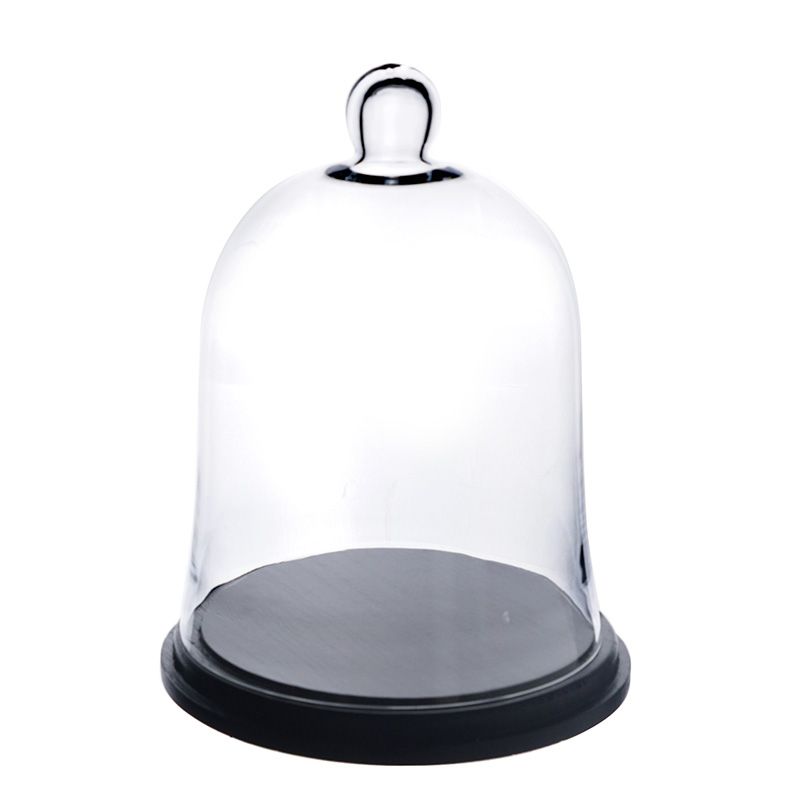
Glass Bell on The Support
Glass Bell on The Support (Product Code: SCL1431/014) is a transparent glass bell with a handle, at least 200 mm in diameter and 250 mm high, standing on a plastic holder fitted with a sealing gasket. Placed over small apparatus and used with a vacuum pump, it forms a clear, sealed enclosure in which students can watch what happens as the air is taken away. It is made by Jain Scientific Equipments Pvt Ltd (ScienceLab), Ambala, a school laboratory equipment supplier in India for air-pressure and vacuum lessons.
Specifications
| Parameter | Detail |
|---|---|
| Bell | Transparent glass, with a handle |
| Diameter | Minimum 200 mm |
| Height | Minimum 250 mm |
| Support | Plastic holder with sealing gasket |
Typical Use
Typical experiments under the bell include a partly blown-up balloon that swells as the surrounding air is pumped away, warm water that starts to boil at reduced pressure, and a small ringing device whose sound fades as the air thins. Once the bell has been evacuated, students can also try to lift it by the handle and feel how firmly the outside air presses it onto the gasket – a memorable way to show that atmospheric pressure is real and large.
Before each use, inspect the glass for chips or cracks and never evacuate a damaged bell. Keep the rim and the sealing gasket clean and free of grit so the seal holds, and let air back in slowly before lifting the bell off the support. Carry it with one hand on the handle and the other under the glass.
Manufacturer
This bell and support come from Jain Scientific Equipments Private Limited, the Ambala, Haryana company that sells its teaching apparatus under the ScienceLab name to schools in India and international markets. For company details, see the ScienceLab profile.
Related Lab Equipment
Items used with the bell to create and study a vacuum:
- Vacuum Pump with Pressure Gauge — removes the air from under the bell and shows the pressure.
- Vacuum Pump, Hand — a manual option for simpler demonstrations.
- Vacuum Tubing — for the connection between pump and enclosure.
- Bell In Glass Jar and Base — a ready set for the sound-in-a-vacuum experiment.
Find more apparatus in our Lab Equipment category.
Frequently Asked Questions
What size is the glass bell?
It has a minimum diameter of 200 mm and a minimum height of 250 mm. We can confirm the exact dimensions of the supplied bell in the quotation.
Is a vacuum pump included?
No. The item consists of the glass bell with handle and the plastic holder with sealing gasket; a pump is ordered separately.
How does it connect to my pump?
The connection arrangement depends on the pump you use. Please describe your pump through the contact page so we can confirm the connection before dispatch.
Why is the bell hard to lift after the air is removed?
Atmospheric pressure outside pushes the bell onto the gasket. Let air back in slowly and it lifts off easily.
How should the gasket and glass be cared for?
Wipe the gasket and rim clean after use, store the bell upright on its support away from the bench edge, and check the glass for damage before every evacuation.
Can we order several sets for a school group or export?
Yes. We quote multiple sets for institutions and distributors in India and international markets; include product code SCL1431/014.
Request a Quote
Ask for a quotation on the Glass Bell on The Support through our contact page, or add it and a suitable pump to the enquiry cart.
Last updated: 24 September 2026
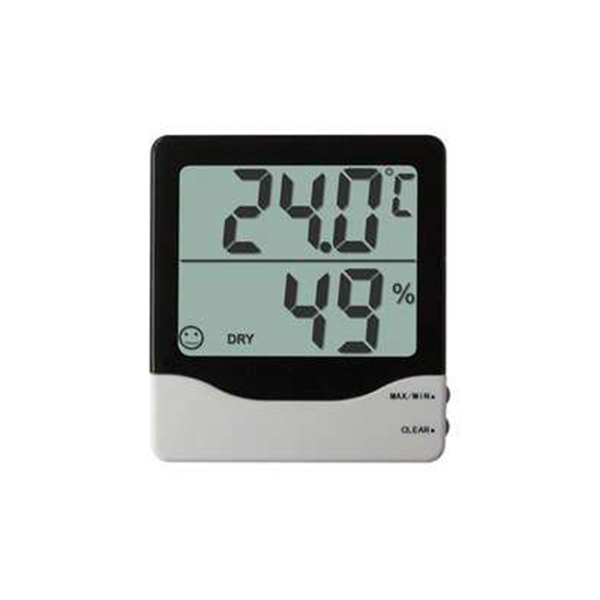
Digital Hygrometer - Thermometer
Digital Hygrometer - Thermometer (Product Code: SCL1235/015) is a digital device for measuring humidity and temperature, equipped with a measuring probe so that readings can be taken both inside and outside. It covers temperatures from -10 °C to +40 °C and relative humidity from 20-25% up to 80-95%, in a compact 20x100x150 mm body with the battery included. Made by Jain Scientific Equipments Pvt Ltd (ScienceLab), Ambala, it is one of the simple digital measuring instruments in India's school labs that students can read at a glance.
Specifications
| Parameter | Detail |
|---|---|
| Type | Digital hygrometer and thermometer |
| Measures | Relative humidity and temperature |
| Temperature range | -10 °C to +40 °C |
| Relative humidity range | From 20-25% to 80-95% |
| Probe | Measuring probe for both inside and outside readings |
| Dimensions | 20x100x150 mm |
| Power | Battery included |
Typical Use
A class weather project is the classic use: students record indoor conditions on the display and outdoor conditions through the probe at the same time each day, then plot how temperature and humidity change with the weather and the season. The readings feed discussions on evaporation, why washing dries slowly on humid days, dew and human comfort. In biology the instrument checks conditions around germination trays or potted plants in transpiration work, and laboratory staff use it to keep an eye on humidity where hygroscopic chemicals or balances are stored.
After moving the unit from one room to another, allow the reading to settle before recording it. Keep the probe out of direct sun and rain for true air readings, stay within the stated temperature range, and replace the battery when the display becomes faint. As a practical addition to an environmental science kit for schools, it gives students real data rather than textbook values.
Manufacturer
ScienceLab, the trading name of Jain Scientific Equipments Private Limited in Ambala, Haryana, offers this instrument alongside its thermometers, barometers and other measuring apparatus for teaching laboratories. Company background is on the profile page.
Related Lab Equipment
Instruments that complete a school weather station or climate study:
- Aneroid Barometer — adds air-pressure readings to the daily weather log.
- Laboratory Thermometer — for liquid temperatures and for cross-checking air readings.
- Thermometer, Electronic, Max/Min — records the highest and lowest temperatures between readings.
- Indoor/Outdoor Thermometer — a simpler alternative when humidity is not needed.
Browse all measuring instruments in our Lab Equipment category.
Frequently Asked Questions
What ranges does it measure?
Temperature from -10 °C to +40 °C, and relative humidity from 20-25% at the low end to 80-95% at the high end.
Is a battery supplied?
Yes, the battery is included. If you need to know the battery type for spares, ask us through the contact page.
Can the probe be dipped into liquids?
The specification describes a device for measuring humidity and temperature in air, inside and outside; it does not state that the probe is suitable for immersion. Use a laboratory thermometer for liquids.
What accuracy does it offer?
An accuracy figure is not given in the current specification. Please contact us if your purchase requires a stated accuracy.
Is a calibration certificate available?
Discuss any calibration-certificate requirement with us before ordering so we can confirm what can be provided.
Why does the humidity reading change slowly?
Humidity sensors need time to come into balance with the surrounding air, so wait a few minutes after moving the unit before noting a value.
Do you supply larger quantities?
Yes, we quote class sets and distributor quantities for India and international markets.
Request a Quote
To order the Digital Hygrometer - Thermometer, send your quantity through our contact page or add it to the enquiry cart with any other weather instruments you need.
Last updated: 24 September 2026
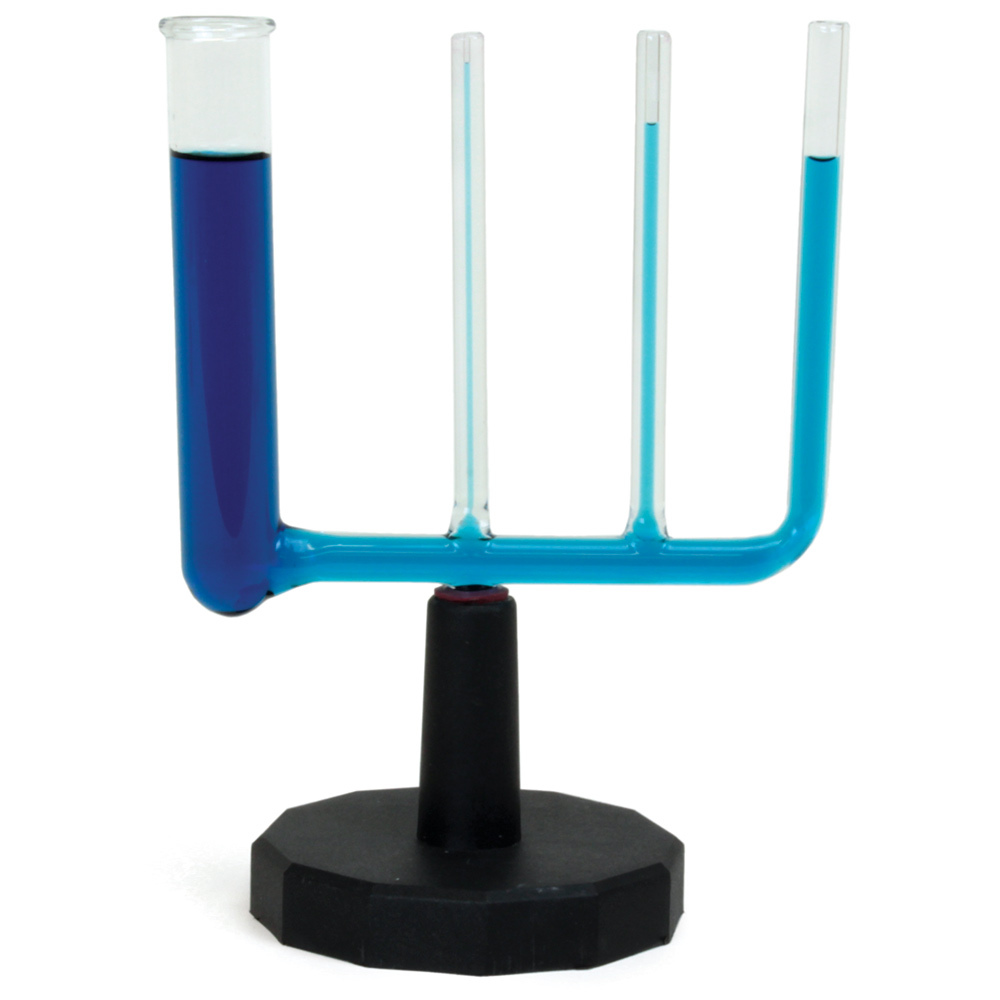
Set of Capillary Tubes
Set of Capillary Tubes (Product Code: SCL1240/016) is a device of three interconnected tubes, each 20 cm long, with different diameters of 1 mm, 1.5 mm and 2 mm, mounted on a plastic stand. When coloured water is poured in, the liquid settles at different heights in the three tubes – highest in the narrowest – so capillarity and surface tension become visible at a glance. The set is made by Jain Scientific Equipments Pvt Ltd (ScienceLab), Ambala, for any school running a capillary tube experiment in India.
Specifications
| Parameter | Detail |
|---|---|
| Type | Three interconnected capillary tubes |
| Tube length | 20 cm |
| Tube diameters | 1 mm, 1.5 mm and 2 mm |
| Mounting | Plastic stand |
Typical Use
Because the tubes are connected, students might expect the water to stand at one common level, as it does in ordinary communicating vessels. Instead, it climbs highest in the 1 mm tube, less in the 1.5 mm tube and least in the 2 mm tube. Measuring each height with a ruler lets the class show that the rise gets larger as the bore gets smaller, which introduces the balance between surface tension pulling the liquid up and the weight of the raised column pulling it down. The same effect explains water moving up through soil, paper towels, lamp wicks and the fine vessels of plants.
Clean tubes are essential: any trace of grease lowers the rise and makes the levels uneven, so rinse with clean water after use and let the set drain and dry upright on its stand. A drop of food colour makes the meniscus easy to see from the back of the room. Alongside other surface tension apparatus in India's school physics labs, the set gives a quick, reliable demonstration that needs no power or pump.
Manufacturer
Jain Scientific Equipments Private Limited produces this set under its ScienceLab trade name at Ambala in Haryana, where it develops properties-of-matter apparatus for secondary and senior secondary science. Learn more on the company profile.
Related Lab Equipment
Items that support a capillarity and fluids lesson:
- Metal Ruler — for measuring the height of the liquid in each tube.
- Glass Beaker — to hold and pour the coloured water.
- Capillary Tube Apparatus — an alternative apparatus for studying capillary rise.
- Pascal's Sphere — another liquid-properties demonstration for the same unit.
Other demonstration apparatus is available in our Lab Equipment category.
Frequently Asked Questions
What are the tube sizes?
Three tubes, each 20 cm long, with diameters of 1 mm, 1.5 mm and 2 mm, joined together and mounted on a plastic stand.
Why does water rise highest in the narrowest tube?
Surface tension lifts the liquid around the edge of the meniscus, and in a narrower tube that lift supports a taller column relative to its weight, so the rise is greater.
Which liquid works best?
Clean water with a little colouring is ideal for class use and makes the levels easy to compare.
How should the set be cleaned?
Rinse with clean water after each use, avoid oily or greasy substances, and let it drain upright on its stand. Do not push anything into the fine tubes.
What are the tubes made of?
The tube material is not listed in the current specification. Please ask through the contact page if your order needs it confirmed.
Can you supply sets for every lab group?
Yes. We quote class sets and bulk quantities for schools, colleges and distributors in India and international markets.
Request a Quote
For a price on the Set of Capillary Tubes, reach us through the contact page or add the item to your enquiry cart with other properties-of-matter apparatus.
Last updated: 24 September 2026
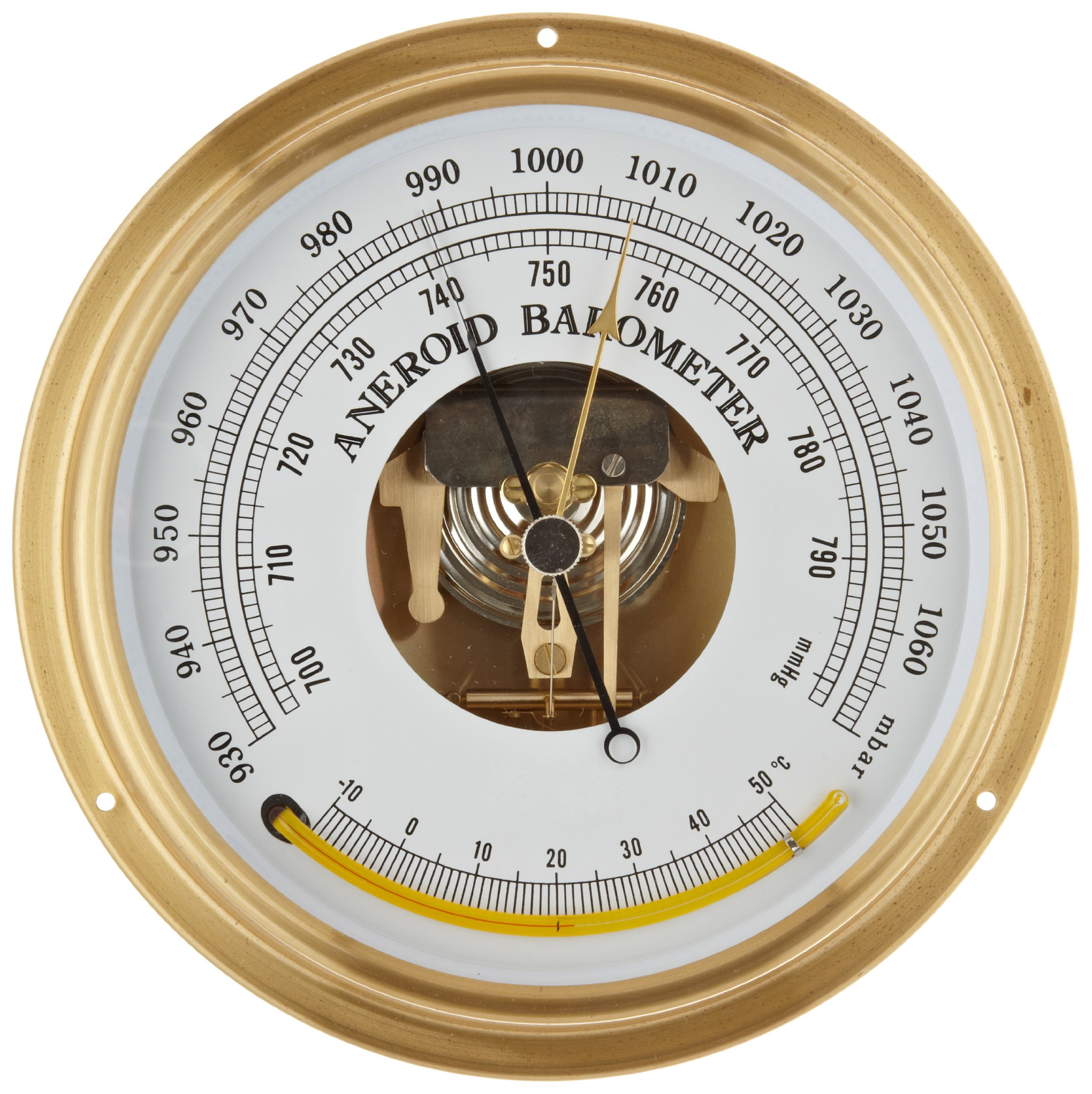
Aneroid Barometer
Aneroid Barometer (Product Code: SCL1544/017) measures atmospheric pressure without any liquid column: a sealed brass barometric box flexes as the air pressure rises or falls, and that movement drives an indicator across the scale of a plastic cylindrical body. Physics, geography and environmental-science teachers use it for weather lessons and to show students how pressure is read in both mm Hg and pascals. It is made by Jain Scientific Equipments Pvt Ltd (ScienceLab), Ambala, a scientific instruments manufacturer in India that builds physics lab instruments for schools, colleges and training institutes.
Specifications
| Parameter | Detail |
|---|---|
| Instrument type | Aneroid barometer with indicator |
| Body | Plastic, cylindrical |
| Pressure-sensing element | Brass barometric box |
| Longitudinal dimension | 150 mm (brass barometric box) |
| Measuring range | 700–800 mm Hg |
| Scale units | mm Hg, with an additional scale graduated in pascals |
Typical Use
In a classroom the barometer is usually placed where students can read it at the same time every day, building a pressure log they compare with the weather they observe; a reading that keeps falling over a day or two is a good starting point for discussing approaching rain or wind. Because the dial carries both mm Hg and pascals, every reading also becomes a unit-conversion exercise that links the traditional mercury-based unit with the SI unit used in textbooks.
Keep the instrument upright on a steady shelf, away from heaters, sunny windows and air-conditioning vents, because rapid temperature changes can disturb the reading, and give the case a light tap before reading so the indicator settles. Schools setting up physics lab equipment for school labs in India often keep an aneroid unit beside a mercury Fortin barometer, so learners can compare two different measuring principles side by side.
Manufacturer
Jain Scientific Equipments Private Limited, trading as ScienceLab, is based in Ambala, Haryana, and makes teaching apparatus for school, college and technical-institute laboratories; the company profile gives background on the business. The company is a registered MSME enterprise (Udyam UDYAM-HR-01-0003714), and its export consignments move under Importer-Exporter Code AAECJ8618A issued by the DGFT.
Related Lab Equipment
Pressure and weather lessons usually call for more than one instrument. These items from the same catalogue fit the same lab sessions:
- Fortin Barometer — a mercury-column reference for comparing against the aneroid reading.
- Metal Barometer — another barometer in the range, handy when several groups or stations need their own instrument.
- Digital Hygrometer - Thermometer — adds humidity and temperature to a daily weather log.
- Vacuum Pump with Pressure Gauge — for follow-up demonstrations of pressures below atmospheric.
Browse more apparatus in the Lab Equipment category.
Frequently Asked Questions
What pressure range does this aneroid barometer cover?
It reads from 700 to 800 mm Hg, with a second scale in pascals. If your school is at a high altitude where normal pressure may fall below that band, tell us your location through the contact page before ordering.
Does the instrument contain mercury?
No. An aneroid barometer works through a sealed metal box — brass in this model — so there is no liquid to spill, which makes it easier to handle in a classroom than a mercury barometer.
Can students record readings in SI units?
Yes. Besides mm Hg, the scale is graduated in pascals, so readings can be taken directly in the SI unit and cross-checked against the mm Hg value.
How should the barometer be cared for?
Wipe the plastic body with a soft dry cloth, keep it away from heat and strong sunlight, avoid dropping it, and do not open the case, since the brass barometric box and the indicator linkage are delicate.
Is a calibration certificate supplied?
The product listing does not include one. If your institution needs calibration documentation, raise it with us through the contact page so availability can be discussed before you order.
What details help us prepare an institutional quotation?
Quote product code SCL1544/017, the quantity, the delivery address and any paperwork your purchase department requires, such as vendor registration details or a delivery schedule.
Do you supply schools and distributors outside India?
Yes. ScienceLab supplies institutions and distributors across India and in international markets; share your destination and quantity for an export quotation.
Request a Quote
For pricing and delivery of the Aneroid Barometer, send us an enquiry or add it to the enquiry cart together with the other apparatus you need for pressure and weather lessons.
Last updated: 24 September 2026
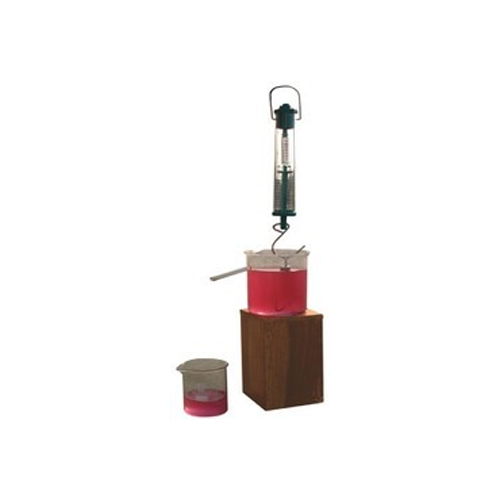
Set to Demonstrate Archimedes' Principle/Law
Set to Demonstrate Archimedes' Principle/Law (Product Code: SCL1247/018) is a buoyancy demonstration set used to prove that the upthrust on an immersed body equals the weight of the liquid it displaces, in secondary-school physics lessons. It combines a plastic bowl with a side drainage connection, a dynamometer graduated in newtons and two plastic cylinders, the full one fitting strictly into the empty one. It is manufactured by Jain Scientific Equipments Pvt Ltd (ScienceLab), an OEM manufacturer, at its own factory in Ambala, India, as a physics demonstration kit.
Specifications
| Parameter | Detail |
|---|---|
| Water vessel | Plastic bowl with a side water-drainage connection |
| Force meter | Dynamometer graduated in N (newtons) |
| Full cylinder | Plastic, full (solid), with handle |
| Empty cylinder | Plastic, empty, with handle and a hook at the bottom |
| Cylinder fit | The full cylinder fits strictly into the empty one |
| Product code | SCL1247/018 |
| Manufacturer | Jain Scientific Equipments Pvt Ltd (ScienceLab) — OEM |
| Country of origin | India (made in Ambala, Haryana) |
What Is the Archimedes' Principle Set Used For?
The classic procedure hangs the empty cylinder from the dynamometer, with the full cylinder suspended from the hook underneath, and notes the force reading in air. The full cylinder is then lowered into the water in the bowl: the reading drops because of the buoyant force, and the displaced water runs out through the side drainage connection. When students fill the empty cylinder with water, the dynamometer returns to its original reading, and because the full cylinder fits strictly into the empty one, the water added has exactly the volume of the immersed body.
Teachers can extend the lesson by collecting the drained water in a beaker and weighing it, or by repeating the test with salt water to discuss density. Hang the dynamometer from a firm stand so it reads vertically, zero it before each run, and fill the bowl up to the drain level before immersing the cylinder so that all the displaced water is captured. The set sits comfortably alongside other mechanics lab equipment in India's secondary-school physics rooms.
OEM Manufacturer
This Archimedes' principle set is made by Jain Scientific Equipments Private Limited, trading as ScienceLab, as the OEM (original equipment manufacturer) at its own licensed factory at Saha, Ambala, Haryana, India. Schools, colleges, distributors and importers buy it factory-direct, so quotations, class-set orders and questions about a replacement cylinder or dynamometer are answered by the maker itself — ask us. More about the company's background and range is on the ScienceLab company profile.
Related Lab Equipment
These items support the same buoyancy practical or the fluid lessons that follow it:
- Stand — a rigid support for hanging the dynamometer and cylinders above the bowl.
- Dynamometer — an extra force meter so several student groups can work at once.
- Balance — for weighing the water collected from the drainage connection as a cross-check.
- Pascal's Sphere — a natural next demonstration on how pressure acts in liquids.
See the full Lab Equipment category for more mechanics and fluids apparatus.
Frequently Asked Questions
What comes in the set?
The Set to Demonstrate Archimedes' Principle/Law contains a plastic bowl with a side water-drainage connection, a dynamometer graduated in newtons, a full plastic cylinder with handle, and an empty plastic cylinder with handle and a hook at the bottom.
Why must the full cylinder fit exactly inside the empty one?
In the Set to Demonstrate Archimedes' Principle/Law the full cylinder fits strictly into the empty one, so the empty cylinder holds exactly the volume of the immersed body. Filling it with water therefore restores the original dynamometer reading, proving the principle.
What is the range of the dynamometer?
The dynamometer in the Set to Demonstrate Archimedes' Principle/Law is graduated in newtons, but its full-scale value is not given in our listing. Ask us through the contact page if you need the range confirmed for worksheets or a tender.
Is a stand included?
A stand is not listed among the contents of the Set to Demonstrate Archimedes' Principle/Law. Any laboratory stand that lets the dynamometer hang freely above the bowl will work, or the Stand linked above can be added to your order.
Who manufactures the Set to Demonstrate Archimedes' Principle/Law?
The Set to Demonstrate Archimedes' Principle/Law is manufactured by Jain Scientific Equipments Pvt Ltd (ScienceLab), the OEM, at its own licensed factory at Saha, Ambala, Haryana, India, and quotations for single sets or class quantities come straight from the manufacturer.
How do I look after the set?
After each class, empty and dry the bowl and cylinders of the Set to Demonstrate Archimedes' Principle/Law, store the dynamometer unloaded, and never hang more on it than its marked capacity, so the spring keeps its accuracy.
Request a Quote
To receive a quotation direct from the manufacturer for the Set to Demonstrate Archimedes' Principle/Law, use our contact form or place the item in your enquiry cart and submit the list in one go.
Last updated: 24 September 2026
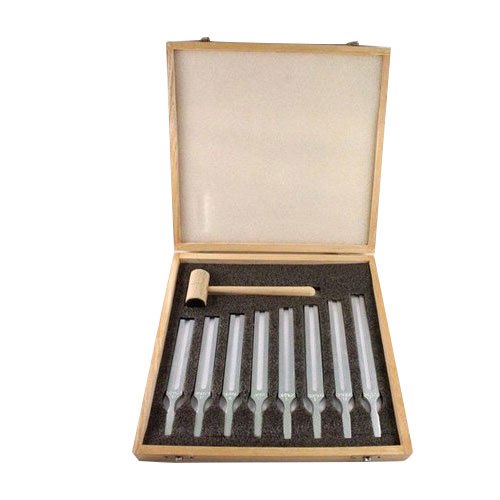
Tuning Fork
Tuning Fork (Product Code: SCL1531/019) is an adjustable sound source: a U-shaped vibrator fixed on a wooden resonator box, with two slidable bodies on the vibrator that change its oscillation frequency across the instrument’s range. It is calibrated to 7 frequencies, so one instrument can do much of the work that usually needs a tuning fork set in an Indian school physics room. Physics teachers use it to demonstrate pitch, resonance and the link between mass and frequency. It is made by Jain Scientific Equipments Pvt Ltd (ScienceLab), Ambala, and supplied with a rubber-tipped metal hammer.
Specifications
| Parameter | Detail |
|---|---|
| Vibrator | U-shaped, fixed on the resonator box |
| Resonator | Wooden box |
| Frequency adjustment | Two slidable bodies on the vibrator modify the oscillation frequency within its range |
| Calibration | 7 frequencies |
| Hammer | Metal, with handle and rubber-coated impact element |
Typical Use
Strike one prong with the rubber-coated hammer and the wooden box amplifies the note so a whole class can hear it. Moving the two sliding bodies along the U-shaped vibrator shifts the pitch, which lets students hear directly how adding mass towards the prong tips lowers the frequency of a vibrating body. Setting the fork to each of its calibrated positions in turn gives a series of known notes for listening tests, for comparing with a second fork, or for tuning a string on a sonometer by ear.
Placed near the open end of a resonance tube, the fork also serves as the source in speed-of-sound experiments, making it a useful companion to a resonance tube experiment kit. Hold the instrument by its box rather than the prongs, strike firmly but never against the bench or a hard object, and damp the sound by touching the prongs lightly when the demonstration ends.
Manufacturer
ScienceLab is the trading name of Jain Scientific Equipments Private Limited, an Ambala, Haryana manufacturer of acoustics, mechanics and electricity apparatus for teaching laboratories. Buyers who want to know more about the organisation behind the brand can read the company profile.
Related Lab Equipment
Sound and wave practicals often combine this fork with the apparatus below:
- Tuning Fork on Resonance Box — a second source for resonance and beat demonstrations.
- Tuning Fork Set, Steel — fixed-pitch forks for individual student practicals.
- Resonance Tube Apparatus — for measuring the speed of sound with the fork as the source.
- Sonometer, Simple Pattern — for matching a vibrating string to the fork’s note.
- Long Cylindrical Spring (Resort) — shows the wave motion that underlies sound.
More teaching apparatus is listed in the Lab Equipment category.
Frequently Asked Questions
How many frequencies can this tuning fork be set to?
It is calibrated to 7 frequencies. The individual frequency values are not given in the product listing, so ask us through the contact page if you need them for lesson planning.
How is the pitch changed?
By sliding the two bodies attached to the U-shaped vibrator. Their position changes the vibrating mass distribution and therefore the oscillation frequency.
Is a hammer included?
Yes. A metal hammer with a handle and a rubber-coated impact element comes with the instrument, so the prongs are struck without metal-on-metal contact.
Why is the fork mounted on a wooden box?
The box acts as a resonator: it vibrates with the fork and radiates the sound more strongly, so the note carries across a classroom.
Can it be used to demonstrate beats?
Yes, when paired with a second sound source of nearly the same pitch, such as another fork. Detuning one of them slightly with its sliding bodies produces audible beats.
How should the instrument be stored?
Keep it in a dry cupboard, away from damp walls, because moisture can affect the wooden box; store the hammer with it so it is not replaced by a hard striker.
Can you quote for several units or for export?
Yes. Share the quantity and destination; ScienceLab supplies schools and distributors in India and international markets.
Request a Quote
To price this Tuning Fork for your lab, write to us with the quantity, or collect it with other items in the enquiry cart and send a single request.
Last updated: 24 September 2026
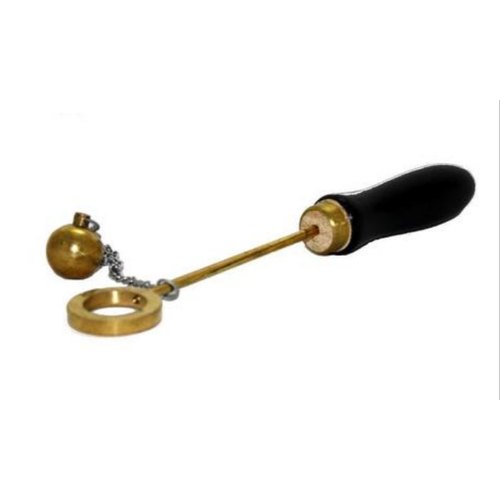
Gravesande Ring-Device to Demonstrate Thermal Expansion
Gravesande Ring-Device to Demonstrate Thermal Expansion (Product Code: SCL1255/020) is the traditional ’s Gravesande ring-and-ball apparatus: a ball and a ring matched so closely that the ball slips through the ring at room temperature but sticks once the ball has been heated. It gives students an instant, visible proof that solids expand when heated, and is used in middle- and secondary-school heat lessons as a simple demonstration model for the physics lab. This ring device is made by Jain Scientific Equipments Pvt Ltd (ScienceLab), a laboratory equipment supplier in India, at Ambala, Haryana.
Specifications
| Parameter | Detail |
|---|---|
| Type | Gravesande ring (ring-and-ball thermal expansion device) |
| Ball diameter | 15 mm |
| Fit | Ball passes through the ring at room temperature; does not pass when the ball is heated |
| Handles | Both the ball and the ring have handles |
Typical Use
Start by passing the cold ball through the ring to show the class that it fits. Then hold the ball by its handle in the flame of a spirit lamp or Bunsen burner for a short while and try again: the ball now rests on top of the ring instead of dropping through. Leave it there and, as it cools, it eventually falls through — a second observation that shows contraction on cooling. Heating the ring as well opens its hole a little, which makes a good discussion question on whether the hole in a heated plate grows or shrinks.
The demonstration links naturally to everyday examples such as gaps in railway lines, loosening a tight jar lid under hot water and the sag of power lines in summer. Always hold both parts by their handles, rest the hot ball on a heat-resistant mat, and let it cool in air before storage. As a small, reusable piece of heat apparatus it complements a heat energy science kit in the school lab.
Manufacturer
ScienceLab apparatus such as this ring device comes from Jain Scientific Equipments Private Limited in Ambala, Haryana, a company that produces demonstration and practical equipment for physics, chemistry and biology teaching. Visit the about-the-company page for details of who we are.
Related Lab Equipment
To run and extend a thermal-expansion lesson, teachers often order these alongside the ring device:
- Glass Spirit Lamp — a simple heat source for classrooms without a gas supply.
- Bunsen Burner — heats the ball faster in labs fitted with gas.
- Ball & Ring Apparatus — an alternative ring-and-ball design for additional student groups.
- Bar Compound Copper & Iron — shows that different metals expand by different amounts.
- Expansion Apparatus — moves the topic on to measuring linear expansion.
Other heat and mechanics items are grouped in the Lab Equipment category.
Frequently Asked Questions
How does the ring device show thermal expansion?
The 15 mm ball passes through the ring when both are at room temperature; after the ball is heated it expands and no longer passes, which students can see immediately.
Is a heat source included?
No burner or lamp is listed with the device. A spirit lamp or a Bunsen burner is suitable, and both are available from our catalogue.
Can students handle it safely?
Both the ball and the ring have handles so the metal parts need not be touched, but the ball stays hot for some time after heating. Under teacher supervision, set it down on a heat-resistant surface and allow it to cool naturally.
What metal are the ball and ring made of?
The product listing does not specify the material. If your syllabus or tender needs it stated, please ask us through the contact page.
Why is the name spelled “Gravesande”?
It refers to the Gravesande ring, named after the Dutch scientist Willem ’s Gravesande, who used this ring-and-ball arrangement to demonstrate expansion; the listing uses a shortened spelling.
What should I include when requesting a quotation?
Give the product code SCL1255/020, the number of units, your institution’s name and the delivery location. We quote for schools across India and for buyers in international markets.
Request a Quote
Ready to order the ring device? Contact ScienceLab for a quotation, or add it to the enquiry cart with the heat source and other apparatus you need.
Last updated: 24 September 2026
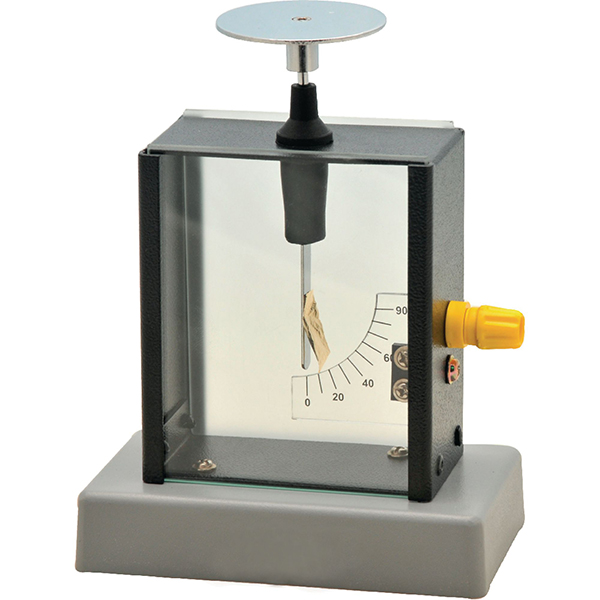
Electroscope with Accessories
Electroscope with Accessories (Product Code: SCL1357/021) detects electric charge: an electrode carrying one or two thin metallic sheets is fixed in a plastic support with two transparent glass sides, and when the electrode is touched with an electrified rod the sheet or sheets swing away from their rest position. It is a basic piece of electrostatics apparatus for school physics rooms, where it forms the core of many an electricity experiment kit for school classes. Jain Scientific Equipments Pvt Ltd (ScienceLab) makes this electroscope in Ambala for school and college laboratories.
Key Details
| Parameter | Detail |
|---|---|
| Type | Leaf-type electroscope |
| Sensing element | Electrode with one or two thin metallic sheets attached |
| Housing | Plastic support with two transparent glass sides |
| Operating principle | Touching the electrode with an electrified rod makes the sheet(s) deviate from the equilibrium position |
| Supplied as | Electroscope with accessories (confirm the accessory list with your quotation) |
| Suitable for | Electrostatics demonstrations and student practicals |
Typical Use
Rub a rod with a suitable cloth and touch it to the electrode: the metallic sheets take on the same charge, repel each other or the fixed electrode, and open out behind the glass windows. From there teachers can show charging by contact and by induction, compare how strongly different rods charge, and identify an unknown charge by watching whether the divergence grows or shrinks when a rod of known charge approaches. Touching the electrode with a finger earths it and lets the sheets fall back.
Electrostatics works best in dry air, so run the demonstration away from open windows on humid days and keep the glass sides and electrode free of dust and fingerprints. Among physics lab instruments in India this is one of the first that students meet when they study charge, and it pairs well with other electrostatic apparatus for later lessons.
Manufacturer
The electroscope is produced by Jain Scientific Equipments Private Limited, which trades as ScienceLab from Ambala, Haryana, and supplies teaching apparatus to schools, colleges and distributors; our company profile has more background. Purchase departments that need vendor registration details can use GSTIN 06AAECJ8618A1ZT and LEI 3358004HRD1JIVXKYX49.
Related Lab Equipment
These items are used with an electroscope in the same electrostatics lessons:
- Rods (wands) to Study Electrification — rods for charging the electrode by friction.
- Ebonite Rod — a classic rod for producing charge of a known sign.
- Electrostatic Sultan — makes the field around a charged conductor visible with paper strips.
- Wimshurst Electrostatic Machine (for lyceum) — a stronger charge source for advanced demonstrations.
- Electroscope, Gold Leaf — an alternative design for comparison between groups.
Explore further electricity and magnetism apparatus in the Lab Equipment category.
Frequently Asked Questions
Which accessories are included?
The product listing does not itemise the accessories. Please confirm the exact contents with us through the contact page when you request a quotation, so you know whether charging rods need to be ordered separately.
Does it have one leaf or two?
The electrode carries one or two thin metallic sheets; state your preference when you enquire and we will confirm what will be supplied.
Why does the electroscope not respond on some days?
Humid air lets charge leak away quickly. Warm the rod and cloth slightly, work away from damp areas and wipe the housing dry before the lesson.
How do I discharge it between experiments?
Touch the electrode briefly with your finger; this earths it and the sheets return to their equilibrium position.
How should it be cleaned?
Use a soft, dry, lint-free cloth on the glass sides and plastic support. Avoid solvents and never pull on the thin sheets, which are easily bent or torn.
Do you supply larger quantities for schools or distributors?
Yes. We handle orders from single units to bulk institutional supply across India and international markets; send the quantity and destination for a quote.
Request a Quote
For a price on the Electroscope with Accessories, send your requirements or build a list in the enquiry cart and submit it to our sales team.
Last updated: 24 September 2026
Electrostatic Sultan
Electrostatic Sultan (Product Code: SCL1362/022) is a metallic rod on an insulated support with a plume of narrow paper strips at its upper end. When an electrified wand is brought near the rod, the strips lift and spread out, tracing the pattern of electric field lines around the charged conductor. Teachers use this plume-style indicator to turn an abstract idea into something a whole class can see. It is made by Jain Scientific Equipments Pvt Ltd (ScienceLab), Ambala, as one of its physics demonstration items for schools.
Specifications
| Parameter | Detail |
|---|---|
| Conductor | Metallic rod on an insulated support |
| Rod height | 200 mm |
| Indicator | Narrow paper strips at the upper end of the rod |
| Strip length | 100 mm |
| Number of strips | 20 |
| Function | Outlines electric field lines when an electrified wand approaches the rod |
Typical Use
Stand the sultan on a dry bench and bring a charged rod slowly towards the metal conductor. The 20 paper strips pick up like charge, repel one another and fan outwards in radial directions, much like the field-line diagrams in a textbook. Removing the rod lets them droop again, and connecting the sultan to an electrostatic machine keeps the plume standing for longer so students can walk round and study it from every side.
Two sultans charged with opposite signs and placed a short distance apart show the strips reaching towards each other, while like charges make them bend away — a memorable way to compare attraction and repulsion. Because paper absorbs moisture, store the device in a dry cupboard and let it sit in a warm, dry room before a lesson. For schools buying electrostatics apparatus as part of their physics lab equipment in India, it adds a strong, memorable visual to the topic.
Manufacturer
ScienceLab is a brand of Jain Scientific Equipments Private Limited, a private limited company in Ambala, Haryana, that makes physics apparatus for classroom demonstrations and student benches. The ScienceLab profile page introduces the company and its work.
Related Lab Equipment
These products provide the charge source or the next step in the same electrostatics sequence:
- Wimshurst Electrostatic Machine (for lyceum) — keeps the strips charged for a sustained demonstration.
- Rods (wands) to Study Electrification — the electrified wands used to bring charge near the rod.
- Electroscope with Accessories — detects and compares the charge on the wands.
- Friction Rod, Brass/Ebonite — another rod option for charging by friction.
Find more demonstration apparatus in the Lab Equipment category.
Frequently Asked Questions
What are the main dimensions?
The rod is 200 mm high and carries 20 paper strips, each 100 mm long, at its upper end.
What do I need to operate it?
Only a source of charge, such as a rubbed rod or wand, or an electrostatic machine for a stronger effect. No power supply or batteries are involved.
Why is the support insulated?
An insulated support keeps the charge on the rod and strips instead of letting it drain to the bench, so the strips stay spread long enough to observe.
Can the paper strips be replaced if they tear?
Worn strips can be discussed with our team; tell us what you need through the contact page and we will advise.
What warranty applies?
Warranty terms are confirmed with each quotation rather than on this page. Please ask when you request pricing.
Can you ship it abroad?
Yes. ScienceLab supplies customers in India and international markets; include your country and quantity so we can quote with the right packing and shipping.
Request a Quote
Interested in the Electrostatic Sultan? Reach our sales desk through the contact page, or add the item to the enquiry cart to include it in a wider order.
Last updated: 24 September 2026
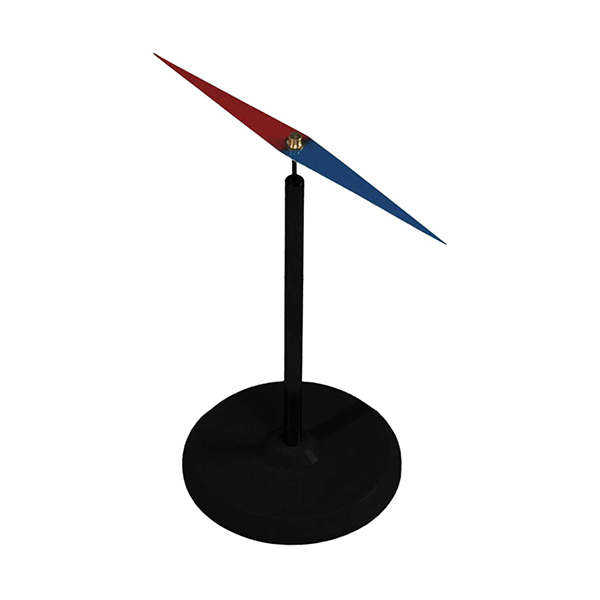
Magnetic Compass Needle
Magnetic Compass Needle (Product Code: SCL1465/023) is a large demonstration needle, 100 mm long, that turns freely on a conical bearing mounted on a centre-axis support. Its north and south poles are painted blue and red respectively, so the whole class can see which way the needle settles. Teachers use it to show the Earth’s magnetic field, the attraction and repulsion of poles and the magnetic effect of an electric current. It is made by Jain Scientific Equipments Pvt Ltd (ScienceLab), Ambala, a laboratory instruments supplier in India, and fits well into a magnetism experiment kit for Indian schools.
Specifications
| Parameter | Detail |
|---|---|
| Needle length (longitudinal dimension) | 100 mm |
| Mounting | Support for the centre axis, with a conical bearing and pivot needle |
| Pole marking | N pole painted blue, S pole painted red |
Typical Use
Set on the teacher’s bench away from steel objects, the needle swings and comes to rest along the north–south line, opening a lesson on the Earth as a magnet. Bringing one end of a bar magnet close to each painted pole shows that like poles repel and unlike poles attract, and because the needle is long, the movement is easy to follow from the back of the room.
The same needle is ideal for repeating Oersted’s observation: lay a straight wire over it along the north–south direction, switch on a current, and the needle turns across the wire; reversing the current reverses the deflection. It can also be moved around a magnet or an electromagnet to show how the field direction changes from point to point. Keep it away from strong magnets during storage, as prolonged contact can weaken or even reverse its magnetisation.
Manufacturer
Jain Scientific Equipments Private Limited manufactures this needle and the rest of the ScienceLab range from its base in Ambala, Haryana, serving laboratories in schools, colleges and vocational institutes. Background on the company is available on the profile page.
Related Lab Equipment
The following items are commonly used with a demonstration compass needle:
- Bar Magnet (Plastic) — for showing attraction and repulsion between poles.
- Steel Horseshoe Magnet — lets students probe the field between two close poles.
- Oersted’s Law Apparatus — a dedicated set-up for the magnetic effect of current.
- Compass — a small cased compass for individual student use.
- Magnetic Needle, Brass — an alternative needle design for additional stations.
More magnetism and electricity apparatus appears in the Lab Equipment category.
Frequently Asked Questions
How long is the needle?
Its longitudinal dimension is 100 mm, a size chosen for demonstration rather than for pocket use.
Which end points north?
The N pole is painted blue and the S pole red. Point this out to students, because many pocket compasses use a different colour convention.
How is the needle mounted?
It rests on a conical bearing on a pivot needle carried by a support for the centre axis, which keeps friction low so it can respond to weak fields.
Can it be used for Oersted’s experiment?
Yes. Place a current-carrying wire above or below the needle, parallel to it, and the needle deflects; a suitable DC supply and leads are needed and are ordered separately.
How should it be stored?
Store it away from strong magnets and iron tools, and handle it gently when moving it so the conical bearing and pivot are not knocked or bent.
What information should a tender or quotation request include?
List the product code SCL1465/023, quantity, delivery address and any documents your institution needs; we respond to buyers across India and international markets.
Request a Quote
To buy the Magnetic Compass Needle, request a quotation from our team or save it in the enquiry cart while you choose magnets and other apparatus.
Last updated: 24 September 2026
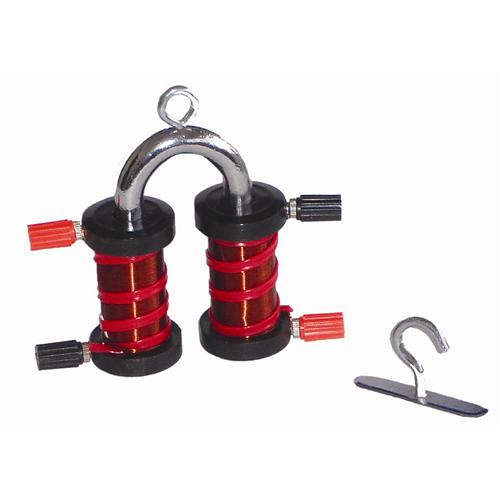
U-Shaped Electromagnet
U-Shaped Electromagnet (Product Code: SCL174/024) is a teaching electromagnet built from a U-shaped core and two coils of enamelled copper wire, each with 200 turns, that slide onto the core’s side arms. Powered from a 4–6 V DC source, it shows students how an electric current produces magnetism and how that magnetism can be switched on and off, strengthened or reversed. It is made by Jain Scientific Equipments Pvt Ltd (ScienceLab), Ambala, for use as part of an electromagnetic kit in school physics labs across India.
Specifications
| Parameter | Detail |
|---|---|
| Core | U-shaped, with two lateral arms |
| Coils | Two, each with 200 turns of enamelled copper wire |
| Coil mounting | Coils can be placed freely on the lateral arms of the core |
| Distance between core-arm axes | 5 cm |
| Power supply | 4–6 V DC source |
Typical Use
With both coils on the arms and connected to a DC supply, the core becomes a horseshoe-shaped magnet that can hold iron objects or attract a keeper plate. Students can switch the current off to show that the magnetism disappears, use one coil or both to compare the strength of the effect, and reverse the connections to swap the poles, checking each result with a compass needle. Adding an ammeter and a rheostat to the circuit turns the demonstration into a simple investigation of how current affects magnetic strength.
Because the coils are removable, the same apparatus also introduces transformer ideas: with one coil fed and the other connected to a meter, switching the current on or off induces a brief reading in the second coil. Keep the supply within the stated 4–6 V DC, switch off between runs so the coils do not warm up, and use proper leads rather than bare wire for the connections.
Manufacturer
Made by Jain Scientific Equipments Private Limited, the company behind the ScienceLab brand in Ambala, Haryana, which designs electricity and magnetism apparatus alongside its wider range of school laboratory equipment. The company profile explains more about the business.
Related Lab Equipment
These items complete the circuit or help students observe the electromagnet’s field:
- Power Source For Teacher — a bench power source to consider for energising the coils; match its output to the 4–6 V DC requirement.
- Analogue Ammeter — measures the coil current during strength comparisons.
- Rheostat — varies the current smoothly for investigations.
- Banana Plug Connectors Leads — tidy, secure connections between supply, meter and coils.
- Magnetic Compass Needle — identifies which arm is the north pole.
Browse the Lab Equipment category for further electromagnetism apparatus.
Frequently Asked Questions
What supply voltage does the electromagnet need?
It is designed for a 4–6 V DC source. Staying in that range keeps the demonstration effective without overheating the coils.
Is a power supply included?
A supply is not listed as part of the product. You can use a suitable school DC power supply or battery pack, or ask us to quote for one through the contact page.
How many turns are on each coil?
Each of the two coils has 200 turns of enamelled copper wire.
Can the coils be taken off the core?
Yes. They can be placed freely on the lateral arms, so you can use one coil, both coils, or rearrange them for induction demonstrations.
How do I set the polarity of the two arms?
The pole at each arm depends on the direction of current in its coil. Connect the coils, test each arm with a compass needle, and swap the leads on one coil if both arms show the same pole.
Is a keeper or armature supplied?
The product listing does not mention one. Please confirm the exact contents with us before ordering if your lesson plan needs a keeper.
Do you accept bulk and export orders?
Yes. We quote for institutional quantities and ship to India and international markets; give us the quantity and destination.
Request a Quote
To get pricing for the U-Shaped Electromagnet, contact our team or add it with the supply and meters you need to the enquiry cart.
Last updated: 24 September 2026
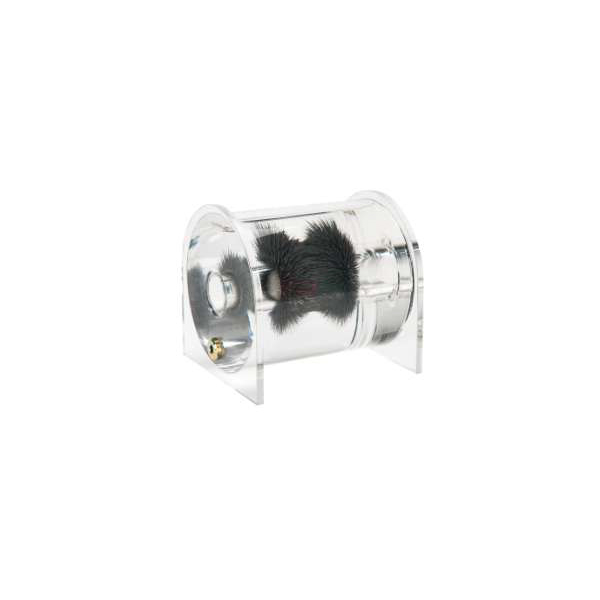
Device for Demonstrating Magnetic Field Lines
Device for Demonstrating Magnetic Field Lines (Product Code: SCL1577/025) makes the invisible field around a magnet visible without iron filings. It has six transparent plates arranged diametrically at equal spacing, each carrying many small ferromagnetic arrows that move easily and line up with the local field, so students see both the shape and the direction of the field lines. One plate is interchangeable, and an interchangeable plate with an arcuate notch lets the device sit on a U-shaped magnet model. It is made by Jain Scientific Equipments Pvt Ltd (ScienceLab), Ambala, as a clean, reusable demonstration model for the physics lab.
Specifications
| Parameter | Detail |
|---|---|
| Plates | Six transparent plates, diametrically and equally spaced |
| Interchangeable plate | One of the plates is interchangeable |
| Field indicators | Many easily moving ferromagnetic arrows on the plates |
| U-magnet fitting | An interchangeable plate with an arcuate notch for installation on a U-shaped magnet model |
Typical Use
Bring a bar magnet to the device and every arrow swings to point along the field at its own position. Because the plates are spaced evenly around the device, the arrows show the pattern in several planes at once, helping students understand that a magnetic field fills the space around a magnet rather than lying flat on a sheet of paper. The arrowheads also show direction, from the north pole round to the south pole, which iron filings cannot do.
Swapping in the notched plate and seating it on a U-shaped magnet model reveals the concentrated, nearly parallel field between the two poles, a useful comparison with the bar-magnet pattern. Teachers can also place the device near an energised electromagnet to show that a current-carrying coil produces the same kind of field. After use, keep strong magnets away from the device during storage and clean the plates with a soft dry cloth.
Manufacturer
ScienceLab is the trading name of Jain Scientific Equipments Private Limited, incorporated under CIN U29309HR2020PTC087597, with its base in Ambala, Haryana. The company manufactures at its licensed factory at 449, HSIIDC Industrial Area, Saha, Ambala (Factory Licence AMB-ONLINE-CHD-J-414); the company profile gives further background.
Related Lab Equipment
Magnets and detectors that work with this field-lines device in the same lesson:
- Horseshoe-Shaped Magnets — U-shaped magnets for the notched-plate demonstration.
- Bar Magnet (Plastic) — produces the classic bar-magnet field pattern.
- U-Shaped Electromagnet — shows that an electric current creates a comparable field.
- Compass — lets students check field direction point by point.
- Magnetic Field Demonstrator — another way to display field patterns for comparison.
See the Lab Equipment category for more magnetism apparatus.
Frequently Asked Questions
How many plates does the device have?
Six transparent plates, arranged diametrically and equally spaced, each carrying freely moving ferromagnetic arrows.
Are magnets included?
The listing describes the plates and arrows but does not include magnets. Order bar or horseshoe magnets separately, or ask us to confirm contents through the contact page.
What is the notched plate for?
Its arcuate notch lets the plate be installed on a U-shaped magnet model, so students can study the field between and around the two poles.
How is this better than iron filings?
There is no loose powder to spill or clean up, the display is ready again instantly, and the arrows show the direction of the field as well as its shape.
How should the device be maintained?
Wipe the plates with a soft dry cloth, avoid solvents that could cloud the transparent material, and store it away from strong magnets so the arrows are not left permanently magnetised in one direction.
Can you supply it for school tenders or overseas buyers?
Yes. Send the quantity, delivery location and any vendor documents you need; we quote for institutions in India and international markets.
Request a Quote
For a quotation on the Device for Demonstrating Magnetic Field Lines, get in touch or add it to the enquiry cart together with the magnets you plan to use.
Last updated: 24 September 2026
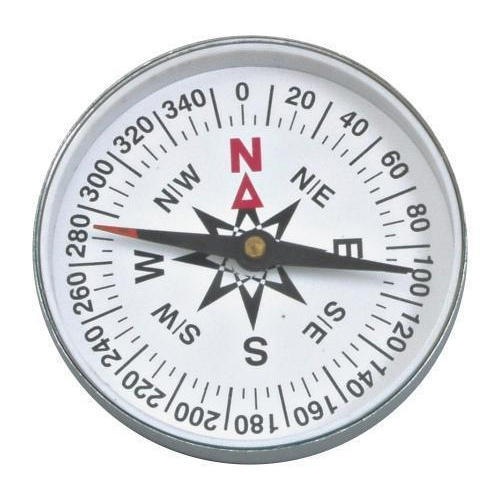
Compass
Compass (Product Code: SCL1379/026) is a compact student compass: a 40 mm magnetic needle on a conical bearing, enclosed in a cylindrical transparent plastic box 45 mm across. The needle is held on its median axis so that it does not drop off when the box is turned or tilted, which makes it practical to hand out to every pair of students. Its N and S ends are coloured blue and red. It is made by Jain Scientific Equipments Pvt Ltd (ScienceLab), Ambala, and suits bulk supply for school physics lab equipment in India.
Specifications
| Parameter | Detail |
|---|---|
| Needle length (longitudinal dimension) | 40 mm |
| Needle mounting | Support for the median axis with a conical bearing and pivot needle |
| Pole colours | N blue, S red |
| Case | Cylindrical transparent plastic box, 45 mm diameter |
| Retention | Needle stays on its axis and does not fall when the box is twisted |
Typical Use
The most common classroom task is plotting field lines: students place a bar magnet on paper, set the compass near one pole, mark where the needle points, move the compass to that mark and repeat, joining the dots into a field line. The transparent case lets them see the paper beneath, and because the needle is retained on its axis the compass can be picked up and repositioned again and again without the needle falling off.
It is equally useful for finding north before setting up experiments that need a fixed orientation, for showing that a current-carrying wire deflects a nearby needle, and for simple outdoor direction-finding activities. Remind students that the blue end marks N on this model, keep the compasses away from magnets when they are stored together, and wipe the plastic case clean with a dry cloth.
Manufacturer
The compass comes from Jain Scientific Equipments Private Limited, an Ambala, Haryana manufacturer that markets its classroom and laboratory products as ScienceLab. Learn about the company on the ScienceLab profile.
Related Lab Equipment
Magnetism practicals that use this compass usually need these items too:
- Bar Magnet (Plastic) — the magnet whose field students plot.
- Magnetic Compass Needle — a larger needle for the teacher’s front-of-class demonstration.
- Compass Plotting (Clear) — an alternative plotting compass for larger groups.
- Device for Demonstrating Magnetic Field Lines — shows the whole field pattern at once for comparison with plotted results.
More student apparatus is available in the Lab Equipment category.
Frequently Asked Questions
How big is the compass?
The needle is 40 mm long and sits in a transparent plastic box with a 45 mm diameter, small enough for field-line plotting on an exercise-book page.
Will the needle fall out if a student turns the compass over?
No. The needle pivots on its axis in a way that keeps it from falling when the box is twisted, which suits handling by students.
Which colour marks north?
On this compass the N pole is blue and the S pole is red, so it is worth pointing this out before a plotting exercise.
Why does the needle sometimes point the wrong way?
A compass stored touching a strong magnet can have its needle remagnetised in reverse. Store compasses apart from magnets and check them against a known north before class.
Can I order a full class set?
Yes. Tell us how many compasses you need and where they should be delivered; we quote for schools across India and buyers in international markets.
Is there a warranty?
Warranty terms are given with each quotation. Please ask through the contact page if you need them before placing an order.
Request a Quote
To order compasses for your class, send us the quantity or add the Compass to the enquiry cart and submit your list.
Last updated: 24 September 2026
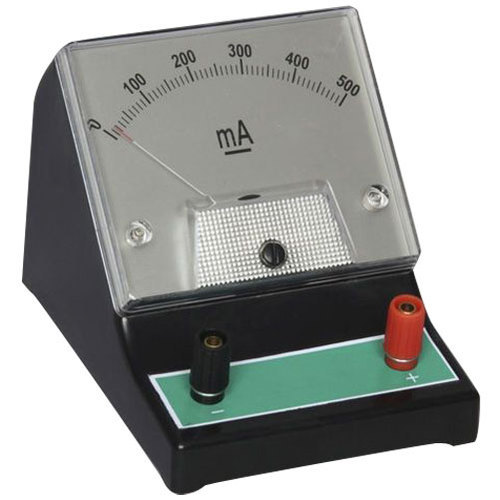
Analogue Ammeter
Analogue Ammeter (Product Code: SCL1285/027) is a stationary moving-pointer meter for direct current with three measuring ranges: 0–50 mA, 0–500 mA and 0–5 A. Each scale division equals 1/50 of the selected range’s maximum, the pointer rests at a left-hand zero, and a zero-adjustment lets the teacher correct the rest position before a reading. Schools and colleges use it as the current meter in DC circuit practicals, and it forms one half of the ammeter and voltmeter pair that every school physics lab in India needs. The meter is built by Jain Scientific Equipments Pvt Ltd (ScienceLab), Ambala, for bench use in teaching labs.
Specifications
| Parameter | Detail |
|---|---|
| Current type | DC |
| Measuring ranges | 0–50 mA / 500 mA / 5 A |
| Scale division | 1/50 of the maximum limit of the range in use |
| Zero position | Left zero indicator, with zero-position adjustment |
| Construction | Stationary (bench) instrument |
| Dimensions | 100 x 100 x 140 mm |
Typical Use
The ammeter is connected in series with the component under test, observing polarity, and the range is chosen to suit the expected current: the 50 mA scale for small currents through resistors and LEDs, the 500 mA scale for lamps and small motors, and the 5 A scale for heavier loads such as electromagnets. Together with a voltmeter, a rheostat and a DC supply, it makes up the core of an Ohm’s law experiment kit in India’s secondary and senior-secondary labs, where students plot current against voltage and calculate resistance.
Good practice is to start on the highest range when the current is unknown and step down until the pointer sits in the upper part of the scale, where the reading is most precise. Check that the pointer rests exactly on zero before switching on, using the zero adjustment if needed, and never connect the meter directly across a supply without a load in the circuit.
Manufacturer
Jain Scientific Equipments Private Limited produces this meter under its ScienceLab trade name at Ambala in Haryana, alongside a catalogue of electrical and physics teaching apparatus for institutions. For more on the company, see the company profile.
Related Lab Equipment
A DC current meter is only one part of the circuit; these items complete a typical practical:
- Analogue Voltmeter — the DC voltmeter listed alongside it, for Ohm’s law work.
- Power Source For Teacher — a bench power source for driving the circuit.
- Rheostat — varies the current in steps for a set of readings.
- Resistance Box — provides known resistances to test against.
- Banana Plug Connectors Leads — secure leads for connecting the meter in series.
Further measuring instruments are listed in the Lab Equipment category.
Frequently Asked Questions
What ranges does this ammeter have?
Three DC ranges: 0–50 mA, 0–500 mA and 0–5 A, with each division equal to 1/50 of the selected maximum.
Can it measure alternating current?
No, it is a DC instrument. For AC circuits choose the Analogue Ammeter AC instead.
How is the meter zeroed?
With no current flowing, turn the zero-position adjuster until the pointer sits exactly on the left-hand zero mark.
What are its dimensions?
The stationary case measures 100 x 100 x 140 mm, a size that stands steadily on a student bench.
Is a calibration certificate available?
The listing does not mention one. If your lab or tender requires calibration documentation, please discuss availability with us through the contact page before ordering.
What should I include in a quotation request for several lab tables?
Give the product code SCL1285/027, the number of meters, whether you also need voltmeters and power sources, and the delivery location. We supply institutions across India and international markets.
Request a Quote
To price the Analogue Ammeter, with or without matching voltmeters, send an enquiry or add it to the enquiry cart.
Last updated: 24 September 2026
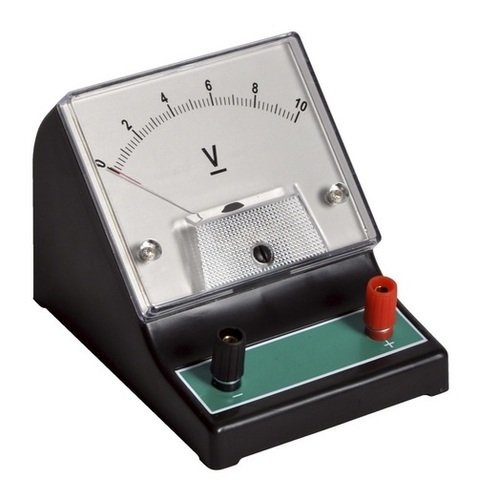
Analogue Voltmeter
Analogue Voltmeter (Product Code: SCL1589/028) measures DC potential difference on a single 0–10 V range, read in 0.1 V divisions on a pointer scale that starts from a left-hand zero. A zero-position adjustment keeps the pointer true between lessons, and the stationary 100 x 100 x 140 mm case sits squarely on a student bench. It is the voltage half of the classic ammeter and voltmeter set used in school physics practicals across India, covering the low-voltage DC circuits built from cells and bench supplies. The voltmeter is manufactured in Ambala by Jain Scientific Equipments Pvt Ltd (ScienceLab) for student benches and teacher demonstrations.
Specifications
| Parameter | Detail |
|---|---|
| Current type | DC |
| Measuring range | 0–10 V |
| Scale division | 0.1 V |
| Zero position | Left zero indicator, with zero-position adjustment |
| Construction | Stationary (bench) instrument |
| Dimensions | 100 x 100 x 140 mm |
Typical Use
A voltmeter is always connected in parallel, across the component whose potential difference is being measured, with its positive terminal towards the positive side of the supply. On this meter the fine 0.1 V divisions let students record voltage across a resistor, a lamp or a cell to one decimal place, which is exactly what is needed to draw a smooth V–I graph, compare the terminal voltage of a cell with and without a load, or check how potential difference is shared between resistors in series.
Before each practical, confirm the pointer rests on zero and adjust it if necessary. Keep circuits within the 10 V full-scale value — if a supply could exceed it, switch the supply to a lower setting first. Pairing the voltmeter with the matching DC ammeter gives students a consistent set of instruments for AC DC circuits experiment kit activities and Ohm’s law investigations.
Manufacturer
This voltmeter is one of the electrical measuring instruments made by Jain Scientific Equipments Private Limited, which operates as ScienceLab from Ambala, Haryana. You can read about the company’s background and product range on its profile page.
Related Lab Equipment
Pair the voltmeter with these items for complete DC circuit practicals:
- Analogue Ammeter — the DC current meter listed alongside it.
- Power Source For Teacher — supplies the circuit being measured.
- Rheostat — changes the voltage across the test component in steps.
- Connecting Wire — for wiring the meter across components.
- Digital Voltmeter — a digital alternative for comparing analogue and digital readings.
More measuring instruments can be found in the Lab Equipment category.
Frequently Asked Questions
What is the measuring range?
A single DC range of 0–10 V, with 0.1 V per scale division.
Can it be used on AC circuits?
No, it is designed for DC. For alternating voltage, choose the Analogue Voltmeter AC instead.
How should it be connected?
In parallel with the component, observing the polarity marked on the terminals. Connecting it in series will give a misleading reading.
What if the pointer does not return to zero?
Disconnect the meter and use the zero-position adjustment to bring the pointer back to the left zero mark before measuring.
What warranty and after-sales support is offered?
Warranty terms are set out in each quotation. Contact us through the contact page for details or for help with a meter already in use.
Do you supply matched sets for a whole lab?
Yes. We quote voltmeters, ammeters and accessories together for schools and colleges in India and in international markets.
Request a Quote
For pricing on the Analogue Voltmeter, contact ScienceLab with your quantity, or add it to the enquiry cart together with the matching ammeter.
Last updated: 24 September 2026
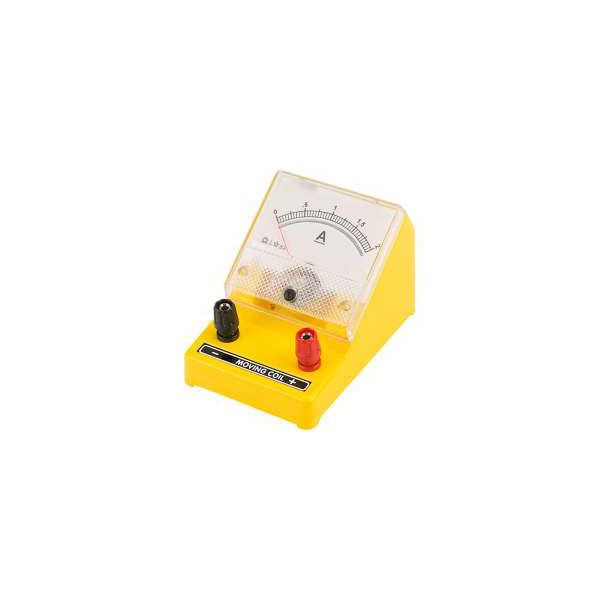
Analogue Ammeter AC
Analogue Ammeter AC (Product Code: SCL1296/029) is a bench meter for alternating current, reading from 0 to 2 A in 0.1 A divisions. Its pointer rests at a left-hand zero that can be trimmed with the zero-position adjustment, and it is housed in a stationary 100 x 100 x 140 mm case. Physics teachers use it where DC meters cannot be used — in transformer, AC motor and mains-derived low-voltage circuits — so students can measure current in AC circuits experiment kit activities with the same kind of analogue display they know from DC work. This AC meter comes from Jain Scientific Equipments Pvt Ltd (ScienceLab), Ambala, a laboratory equipment supplier in India.
Specifications
| Parameter | Detail |
|---|---|
| Current type | Alternating current (AC) |
| Measuring range | 0–2 A |
| Scale division | 0.1 A |
| Zero position | Left zero indicator, with zero-position adjustment |
| Construction | Stationary (bench) instrument |
| Dimensions | 100 x 100 x 140 mm |
Typical Use
In a transformer lesson the meter is placed in series with the primary or secondary winding so students can compare the currents on each side and relate them to the turns ratio. It also measures the current drawn by a lamp or a small AC motor running from a low-voltage AC supply, and, with an AC voltmeter across the same load, allows a simple estimate of apparent power. Because there is no polarity to observe on AC, connections are straightforward, but the meter must still be wired in series and never directly across the supply.
Keep circuit currents inside the 2 A full-scale value; if the load is unknown, begin with a high-resistance setting and increase the current gradually. Always use a low-voltage AC source from a proper school supply rather than mains directly. Check the zero before each session and store the meter flat in a dry cupboard. Schools equipping an electromagnetic kit for school labs in India often buy it together with the matching AC voltmeter.
Manufacturer
Behind the ScienceLab name is Jain Scientific Equipments Private Limited, an Ambala, Haryana company making teaching and laboratory apparatus; its details are on the company profile. It is registered as an MSME with Udyam number UDYAM-HR-01-0003714, and overseas orders are shipped under its DGFT Importer-Exporter Code, AAECJ8618A.
Related Lab Equipment
For complete AC practicals, these items are used alongside the meter:
- Analogue Voltmeter AC — the AC voltage meter listed alongside it.
- Demonstrative Transformer (for high school) — primary and secondary currents to compare.
- Demonstration Motor AC/DC — a load whose running current students can measure.
- Crocodile Clips & Leads — quick connections into series circuits.
More electrical apparatus appears in the Lab Equipment category.
Frequently Asked Questions
What current range does the AC ammeter cover?
It measures alternating current from 0 to 2 A, with 0.1 A per division.
Can I use it for DC measurements?
It is specified for alternating current. For DC circuits, use the Analogue Ammeter instead.
Is it safe to connect to mains?
Student circuits should always run from a low-voltage AC output of a school power supply or transformer, not directly from the mains socket.
How is the pointer zeroed?
With the circuit switched off, turn the zero-position adjustment until the pointer lines up with the left-hand zero mark.
Can a calibration certificate be provided?
One is not included in the product listing. If you need calibration paperwork, discuss availability with us through the contact page before placing the order.
What do you need from us to prepare an institutional quote?
The product code SCL1296/029, quantity, delivery address and any vendor registration documents your purchase office requires. We serve institutions in India and international markets.
Request a Quote
Ask for a price on the Analogue Ammeter AC through our contact page, or place it in the enquiry cart alongside the AC voltmeter and transformer.
Last updated: 24 September 2026
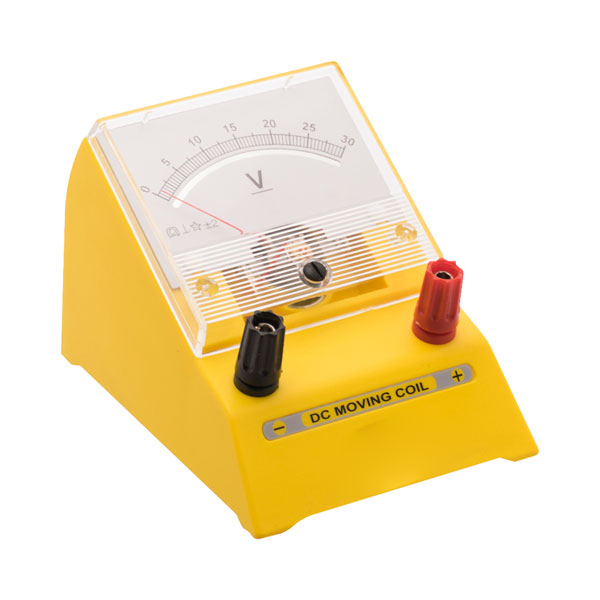
Analogue Voltmeter AC
Analogue Voltmeter AC (Product Code: SCL1399/030) measures alternating voltage on three ranges — 0–3 V, 0–15 V and 0–30 V — with a 0.1 V division listed for its scale. The meter has a left-hand zero indicator, a zero-position adjustment and a stationary 100 x 100 x 140 mm bench case. Its multi-range design lets one instrument follow the low voltages of a transformer’s secondary coil as well as the higher outputs of a school AC supply, making it a practical addition to the physics lab instruments that schools in India use for AC work. Manufacturer: Jain Scientific Equipments Pvt Ltd (ScienceLab), based in Ambala, Haryana.
Specifications
| Parameter | Detail |
|---|---|
| Current type | Alternating current (AC) |
| Measuring ranges | 0–3 V / 15 V / 30 V |
| Scale division | 0.1 V (as listed) |
| Zero position | Left zero indicator, with zero-position adjustment |
| Construction | Stationary (bench) instrument |
| Dimensions | 100 x 100 x 140 mm |
Typical Use
The classic application is the transformer ratio experiment: students measure the primary voltage on one range, the secondary voltage on another, and compare the ratio with the number of turns on each coil. Step-up and step-down arrangements are easy to follow because switching between the 3 V, 15 V and 30 V ranges keeps the pointer in a readable part of the scale. The meter also checks the output of a low-voltage AC supply before a lesson and shows how voltage divides across lamps or resistors connected in series on AC.
Connect it in parallel across the component being tested. When the voltage is unknown, begin on the 30 V range and move down only once the reading is clearly within a lower range. Use it with low-voltage AC sources only — never on the mains directly — and zero the pointer before each session for consistent results.
Manufacturer
Jain Scientific Equipments Private Limited, known to customers as ScienceLab, builds electrical measuring instruments like this at Ambala in Haryana for schools, colleges and dealers. The company profile gives a fuller introduction.
Related Lab Equipment
These items are used with an AC voltmeter in transformer and AC circuit practicals:
- Analogue Ammeter AC — the AC current meter listed alongside it.
- Demonstrative Transformer (for high school) — for primary and secondary voltage measurements.
- Multimeter — a digital cross-check on the analogue reading.
- Stackable Leads — allow the meter to be connected across a component without disturbing the circuit.
Browse related instruments in the Lab Equipment category.
Frequently Asked Questions
Which voltage ranges are available?
Three AC ranges: 0–3 V, 0–15 V and 0–30 V.
What is the scale division on each range?
The product listing gives a 0.1 V division. If you need the division confirmed for each individual range, for example for a worksheet, please ask us through the contact page.
Can it measure DC voltage?
It is specified for alternating current. For DC circuits choose the Analogue Voltmeter instead.
Is it suitable for mains voltage?
No. Its highest range is 30 V, so it is intended for low-voltage AC from a school supply or transformer secondary.
How should the meter be looked after?
Store it flat in a dry place, avoid knocks that can bend the pointer, and never leave it connected to a voltage above the selected range.
Do you supply schools abroad as well as in India?
Yes. ScienceLab supplies institutions and distributors in India and international markets; share your quantity and destination for a quotation.
Request a Quote
To receive a quotation for the Analogue Voltmeter AC, message our sales team or add it to the enquiry cart with any meters and transformers you need.
Last updated: 24 September 2026
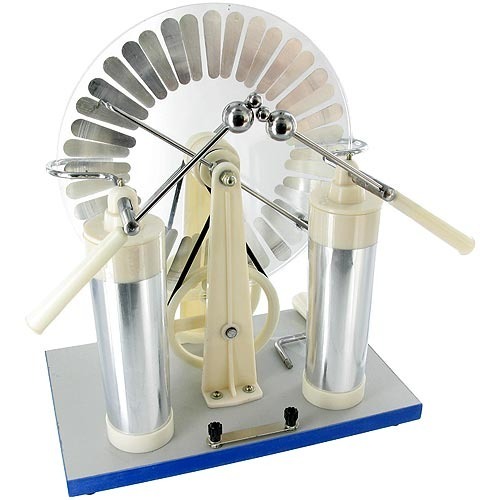
Wimshurst Electrostatic Machine (for lyceum)
Wimshurst Electrostatic Machine (for lyceum) (Product Code: SCL2301/031) is a high-voltage influence machine of the Wimshurst type for upper-secondary physics. Two plastic discs, 20 cm in diameter and carrying tinfoil sheets, rotate in opposite directions; brushes collect the separated charge and store it in two condensers (Leyden jars), whose electrodes connect to a pair of metal discharger rods with an insulated handle. Adjusting the gap between the rods produces bright sparks that make static electricity dramatic and memorable. It is made by Jain Scientific Equipments Pvt Ltd (ScienceLab), Ambala, as a centrepiece physics demonstration kit for electrostatics in India’s senior classes.
Specifications
| Parameter | Detail |
|---|---|
| Type | High-voltage electrostatic generator |
| Discs | Two plastic discs with deposited tinfoil sheets, rotating in opposite directions |
| Disc diameter | 20 cm |
| Charge collection | Two sets of brushes collect the charge and store it in two condensers |
| Condensers | Two Leyden (Leiden) jars |
| Discharger | Condenser electrodes connected to two metal rods with an insulated handle; the distance between the rods can be varied |
| Main parts | Two discs, two Leyden jars, collector combs (listed as crests), brushes, dischargers and support |
Typical Use
As the discs turn, charge builds up in the two Leyden jars until it jumps the gap between the discharger rods as a visible, audible spark. Teachers vary the rod separation to show that a larger gap needs more charge — and more turns of the discs — before a spark appears, which opens a discussion on potential difference and the breakdown of air. The machine also powers other electrostatics demonstrations: connected to an electrostatic plume it makes field lines stand out, it charges an electroscope from a distance, and it can illustrate lightning and point discharge in a simple, controlled way.
Electrostatic machines work best in dry conditions, so wipe the discs and jars with a clean dry cloth and keep the machine in a dry room before use. Always discharge the jars by bringing the discharger rods together, using the insulated handle, before touching any part of the machine, and keep students at a sensible distance during spark demonstrations; anyone with an implanted medical device should stay well clear.
Manufacturer
The machine is built by Jain Scientific Equipments Private Limited, the Ambala, Haryana firm that sells laboratory and demonstration apparatus as ScienceLab to institutions and dealers. Find out more about the company on its profile page.
Related Lab Equipment
These electrostatics items are commonly used with the machine or taught in the same unit:
- Electrostatic Sultan — its paper strips show the field when connected to the machine.
- Electroscope with Accessories — detects the charge the machine produces.
- Demonstrative Plan Condenser/ Capacitor — extends the lesson on how condensers store charge.
- Wimshurst Machine — an alternative machine from our electricity range.
- Electrostatic Investigation — further electrostatics apparatus for student work.
Explore the complete Lab Equipment category for related apparatus.
Frequently Asked Questions
What size are the discs?
Each of the two plastic discs is 20 cm in diameter and carries tinfoil sheets; the discs turn in opposite directions.
Is “Wimshurst” the same as a Wimshurst machine?
Yes. The product name uses the spelling “Wimshurst”, but the construction described — counter-rotating discs, collectors, brushes and Leyden jars — is that of the Wimshurst influence machine.
What does “for lyceum” mean?
Lyceum refers to upper-secondary level; the machine is intended for demonstrations in senior school and introductory college classes.
What spark length can it produce?
The product listing does not state a spark length or output voltage. It depends on conditions such as humidity; ask us through the contact page if you need further technical detail.
How do I make the machine safe after a demonstration?
Bring the discharger rods together with the insulated handle so the Leyden jars discharge fully, then wait a moment before touching the discs, jars or brushes.
Why does it not spark on a humid day?
Moisture on the discs and jars lets charge leak away. Dry and warm the machine gently, wipe all insulating parts clean and run it in the driest room available.
Can you supply it to colleges and export buyers?
Yes. We quote for schools, colleges and distributors across India and in international markets; include your quantity and destination.
Request a Quote
For a quotation on the Wimshurst Electrostatic Machine, write to our team or add it to the enquiry cart along with the electrostatics apparatus you plan to use with it.
Last updated: 24 September 2026
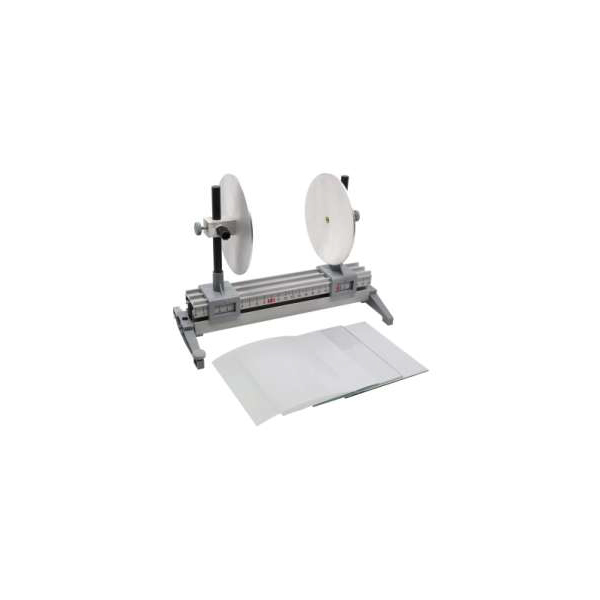
Demonstrative Plan Condenser/Capacitor
Demonstrative Plan Condenser/Capacitor (Product Code: SCL2405/032) is a large parallel-plate capacitor used to demonstrate how plate separation changes stored charge and capacitance in secondary-school and college electrostatics lessons. Two 250 mm metal discs stand on an insulated stand and can be moved coaxially from 160 mm apart down to touching, so a whole class can watch the gap change. It is manufactured by Jain Scientific Equipments Pvt Ltd (ScienceLab), an OEM manufacturer and laboratory instruments supplier in India, at its own factory in Ambala.
Specifications
| Parameter | Detail |
|---|---|
| Type | Demonstration plane (parallel-plate) capacitor |
| Plates | Two metal discs attached vertically to an insulated stand |
| Plate diameter | 250 mm |
| Plate material | Solid castings, stainless steel or corrosion-resistant steel |
| Electrode | Attached to the middle of the disc |
| Plate spacing | 0–160 mm; the support allows coaxial approach of the discs down to zero distance |
| Plate adjustment | Possible between 0 and 20 mm |
| Finish | No burrs |
| Product code | SCL2405/032 |
| Manufacturer | Jain Scientific Equipments Pvt Ltd (ScienceLab) — OEM |
| Country of origin | India (made in Ambala, Haryana) |
What Is the Demonstration Plate Capacitor Used For?
The classic lesson connects the two discs to an electroscope, charges them, and then slowly widens the gap. Because the charge on the plates cannot escape, the electroscope leaves open further as the plates move apart: the same charge now sits at a higher potential difference, which shows students that capacitance falls as separation grows. Closing the gap again brings the leaves back down, and sliding an insulating sheet between the discs at a fixed spacing introduces the idea of a dielectric in the same period.
For clean results, set the discs parallel before charging, keep hands away from the plate faces during readings, and run the demonstration on a dry day, since humid air bleeds charge away. The large 250 mm plates keep the effect visible from the back of a classroom, making this a useful physics demonstration kit for India's senior secondary syllabus.
What to Specify When Ordering
- The plate material, if your tender names one: solid castings, stainless steel or corrosion-resistant steel.
- Whether an electroscope and a charging source, such as an EHT power supply, should be quoted with it, as neither is listed.
- The quantity and delivery location for single schools or bulk supply.
OEM Manufacturer
Jain Scientific Equipments Private Limited, which sells under the ScienceLab name, is the OEM (original equipment manufacturer) of this plate capacitor and produces it at its own licensed factory at Saha, Ambala, Haryana, India. Schools, colleges, dealers and importers receive it factory-direct instead of through a trader, and the maker itself handles quotations, repeat orders and any replacement-part request — ask us. Read more on the company profile page.
Related Lab Equipment
These items are used alongside a demonstration plate capacitor in electrostatics lessons:
- Electroscope with Accessories — shows the change in potential difference as the plate gap is varied.
- EHT Power Supply — a steady source for charging the plates in place of friction methods.
- Capacitor Study Kit — lets students follow up the demonstration with their own capacitor experiments.
- Capacitor (Charging and Discharging) — extends the topic to charging and discharging in circuits.
Browse more apparatus in our Lab Equipment category.
Frequently Asked Questions
How large are the plates?
Each disc of the Demonstrative Plan Condenser/Capacitor is 250 mm in diameter. The plate material is listed as solid castings, stainless steel or corrosion-resistant steel, so tell us if your tender specifies one of these.
How far apart can the plates be set?
The plates of the Demonstrative Plan Condenser/Capacitor can be spaced from 0 to 160 mm, with plate adjustment possible between 0 and 20 mm. The support lets the discs approach each other coaxially until the gap is zero.
Is an electroscope or power source included?
No electroscope or voltage source is listed with the Demonstrative Plan Condenser/Capacitor. An electroscope is normally needed to see the effect of changing the gap; ask us to quote one, and a charging source, together with the capacitor.
Can dielectric sheets be used with it?
Yes. An insulating sheet placed between the discs of the Demonstrative Plan Condenser/Capacitor shows how a dielectric changes capacitance. Dielectric sheets are not listed as part of this item, so ask us about suitable options.
Who manufactures the Demonstrative Plan Condenser/Capacitor?
The Demonstrative Plan Condenser/Capacitor is manufactured by Jain Scientific Equipments Pvt Ltd (ScienceLab), the OEM, at its own licensed factory at Saha, Ambala, Haryana, India. Quotations and repeat orders for schools and distributors are handled by the manufacturer itself.
Is test documentation available?
The Demonstrative Plan Condenser/Capacitor is a qualitative demonstration apparatus, so no calibration document is listed with it. If your institution needs any test documentation, discuss it with us through the contact page before you place the order.
What should an institutional quotation request include?
For a Demonstrative Plan Condenser/Capacitor quotation, send the product code SCL2405/032, the quantity, delivery location and any tender specification. We handle single-school orders and bulk supply within India and to international markets.
Request a Quote
To order the Demonstrative Plan Condenser/Capacitor with a quotation straight from the manufacturer, send your requirements through our contact page or add it to the enquiry cart with the rest of your physics list.
Last updated: 24 September 2026
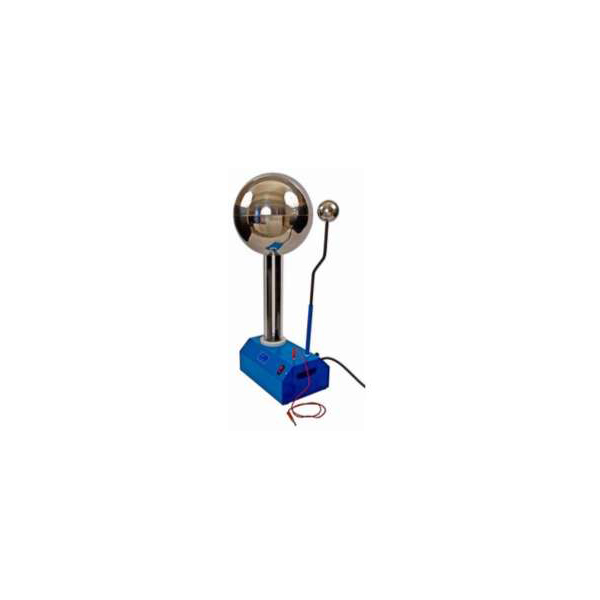
Rods (wands) to Study Electrification
Rods (wands) to Study Electrification (Product Code: SCL2309/033) are hand-held rods used in school electrostatics lessons to show how objects become charged when they are rubbed, and how charged objects attract or repel one another. Teachers use them for quick front-of-class demonstrations and students use them in simple bench activities. As part of the physics lab equipment range for schools in India, they are offered by Jain Scientific Equipments Pvt Ltd (ScienceLab), Ambala, India.
Key Details
| Parameter | Detail |
|---|---|
| Type | Rods (wands) for studying electrification |
| Purpose | Producing static charge by rubbing, and showing attraction and repulsion between charged objects |
| Supplied as | Rods for classroom electrostatics work; rod materials and quantity per set confirmed on enquiry |
| Suitable for | School physics and general science lessons on static electricity |
Typical Use
In a typical lesson a rod is rubbed briskly with a dry cloth and then held near small scraps of paper, which jump up to it. The charged rod can next be brought close to an electroscope cap to make the leaves diverge, or towards a second charged rod hung from a thread so that students see it swing away (like charges) or swing closer (unlike charges). Rods of different materials charge with opposite signs, which is how the idea of two kinds of charge is usually introduced.
Static experiments are sensitive to moisture, so work in a dry room, keep the rods clean and free of grease, and wipe them with a dry cloth before each trial. Grouping these wands with an electroscope and a small indicator gives a compact electricity experiment kit for school practicals on charging by friction and induction.
Manufacturer
ScienceLab is the brand under which Jain Scientific Equipments Private Limited, based in Ambala, Haryana, manufactures and sells school science apparatus. Buyers who must register a vendor can use the company's GSTIN 06AAECJ8618A1ZT and LEI 3358004HRD1JIVXKYX49. See the company profile for more background.
Related Lab Equipment
These items are commonly used with electrification rods in static electricity lessons:
- Electroscope with Accessories — detects the charge picked up by a rubbed rod.
- Gold Leaf Electroscope — a sensitive indicator for comparing how strongly rods are charged.
- Electrostatic Sultan — an electrostatic indicator for showing repulsion between like charges.
- Friction Rod, Brass/Ebonite — a rod with a listed material pairing, for comparing charge signs.
- Friction Rod, Perspex — an acrylic alternative for charging-by-rubbing activities.
More apparatus is listed in our Lab Equipment category.
Frequently Asked Questions
What materials are the rods made from?
The rod materials and the number of rods per set are not stated on this listing. Please contact us and we will confirm them before you order.
Is a rubbing cloth included?
Rubbing materials are not listed with this item. Ask us when you enquire and we can advise on what is supplied or recommended.
Why does the demonstration sometimes fail?
Moist air lets charge leak away quickly. Choose a dry day, keep the rods dry and clean, and rub them firmly just before testing.
Can the rods be used with an electroscope?
Yes. Bringing a charged rod near an electroscope cap is one of the standard ways to show charging, and touching it to the cap shows charging by contact.
Are the rods suitable for students to handle?
Static charges from rubbed rods are small and are routinely used in school practicals. As with any rods, students should handle them carefully and not wave them near faces.
How do I request a quotation for a school or tender?
Share the product code SCL2309/033, the quantity and your delivery address. We supply schools across India and international markets and can quote in bulk.
Request a Quote
For prices and availability of the Rods (wands) to Study Electrification, write to us through the contact page or add them to your enquiry cart.
Last updated: 24 September 2026
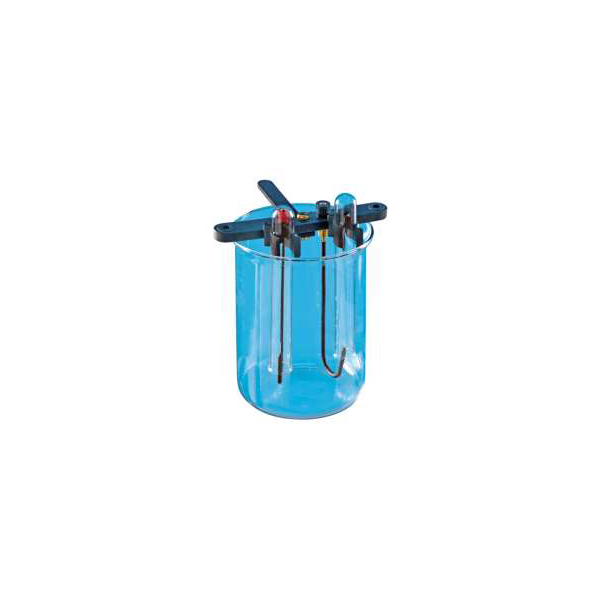
Device to Study Electric Current In Electrolytes
Device to Study Electric Current In Electrolytes (Product Code: SCL222/034) is a small electrolysis cell for showing that solutions of acids, bases and salts conduct electricity while pure water barely does, and for watching what happens at the electrodes while current flows. A transparent plastic vessel with a lid holds the solution, and interchangeable electrodes of different materials connect to external contacts. This electrolysis apparatus for school laboratories in India is manufactured by Jain Scientific Equipments Pvt Ltd (ScienceLab), Ambala.
Specifications
| Parameter | Detail |
|---|---|
| Vessel | Electrolysis vessel with lid, transparent plastic |
| Vessel volume | 200 ml |
| Electrodes | Two or more: one copper, the others graphite or coal and zinc or lead |
| Electrode diameter | 4 mm |
| Connections | External contacts fixed on the plastic support |
Typical Use
Fill the vessel with the test liquid, fit two electrodes, and connect them through a lamp or ammeter to a low-voltage DC source. Distilled water gives little or no current; adding a pinch of salt or a few drops of acid makes the reading jump, which is the core observation of the topic. With copper sulphate solution and a copper electrode, students can watch copper build up on the negative electrode, and switching between graphite, zinc or lead electrodes shows how electrode material affects the products.
The same parts can be used without an external supply: copper and zinc electrodes in a salt or acid solution form a simple cell whose voltage can be read on a meter. Keep voltages low, work in a ventilated room because gases may form at the electrodes, and rinse the electrodes and vessel after every class. It fits neatly into an electrochemical cell kit for school chemistry and physics practicals.
Manufacturer
Jain Scientific Equipments Private Limited makes this electrolyte cell and trades under the ScienceLab name from Ambala in Haryana, India, where it produces teaching apparatus for chemistry and physics departments. The company profile explains who we are and how we work with institutions.
Related Lab Equipment
These products complete a conductivity and electrolysis practical:
- Cupric Sulphate (Copper Sulphate) — the usual electrolyte for copper deposition experiments.
- Battery Eliminator 12 Volt — a low-voltage source to drive current through the cell.
- Digital Multimeter — measures current through the solution or the voltage of a copper-zinc cell.
- Crocodile Clips & Leads — quick connections between the external contacts and the circuit.
- Hoffman Electrolysis Apparatus — the next step when gas volumes need to be collected and compared.
See the full Lab Equipment category for more.
Frequently Asked Questions
Which electrodes come with the device?
The listing gives two or more 4 mm electrodes: a copper one, plus graphite or coal and zinc or lead. Tell us which combination you need and we will confirm it in the quotation.
How much solution does the vessel hold?
The transparent plastic vessel has a volume of 200 ml and comes with a lid.
Is a power supply included?
No power source is listed with this device. A low-voltage DC supply or battery is needed for electrolysis work; see the related items above or ask us to quote one.
Are the chemicals supplied?
Electrolytes are not part of this item. Solutions such as copper sulphate are available separately from our chemicals range.
Can the vessel be heated?
The vessel is plastic, so it should be used with room-temperature solutions only and never placed over a burner.
How do I clean it after use?
Empty the vessel, rinse it and the electrodes with water, dry them, and lightly clean any deposits off the electrodes before storing.
Do you supply schools in bulk and overseas?
Yes. Quote the code SCL222/034 with your quantity and delivery location; we supply institutions in India and international markets.
Request a Quote
Send your requirement for the Device to Study Electric Current In Electrolytes via the contact page, or add it to the enquiry cart together with any electrolytes you need.
Last updated: 24 September 2026
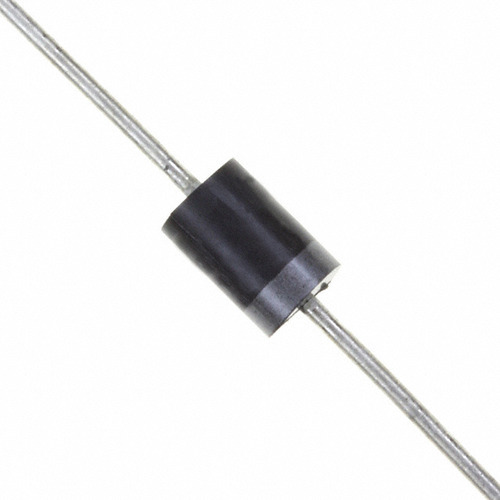
Semiconductor Diodes (for high school)
Semiconductor Diodes (for high school) (Product Code: SCL226/035) are rectifier diodes for practical lessons on one-way conduction, forward and reverse bias, and converting alternating current into direct current. Their 1000 V direct voltage rating and 5 A maximum direct current leave a wide margin for the low-voltage circuits used in school laboratories. These components are supplied by Jain Scientific Equipments Pvt Ltd (ScienceLab), Ambala, a laboratory equipment supplier in India, for use in any semiconductor diode kit for physics practicals.
Specifications
| Parameter | Detail |
|---|---|
| Type | Semiconductor rectifier diode |
| Direct voltage rating | 1000 V |
| Maximum direct current | 5 A |
| Intended level | High school physics and electronics practicals |
Typical Use
The first experiment is usually the simplest: place a diode in series with a small lamp and a cell, then reverse it. The lamp lights one way round and stays dark the other, which makes the idea of forward and reverse bias concrete. With a variable supply, a resistor and two meters, students then record current against voltage and plot the characteristic curve, noting the sharp rise once the forward threshold is passed.
Senior classes use the same diodes to build a half-wave rectifier from a low-voltage AC source, then combine four of them into a bridge for full-wave rectification, a standard rectifier circuit kit exercise. Always include a series resistor to limit current, check the band that usually marks the cathode before connecting, and never feed the circuits directly from the mains.
Supplier
Jain Scientific Equipments Private Limited, known to customers as ScienceLab, operates from Ambala, Haryana and supplies electronic components like these diodes alongside its own physics apparatus, so a school can source a complete practical from one place. Visit the company profile to learn more.
Related Lab Equipment
Useful items for diode and rectifier practicals:
- Light-Emitting Diode (LED) — a diode that shows forward bias by lighting up.
- Zener Diode — for comparing ordinary diode behaviour with reverse breakdown.
- Zener Diode Experiment Circuit Board — a ready board for characteristic-curve experiments.
- Multimeter — reads current and voltage when plotting the diode curve.
- Battery Eliminator 12 Volt — a low-voltage source for bias and rectifier circuits.
Explore the rest of our Lab Equipment category.
Frequently Asked Questions
What are the diode ratings?
The direct voltage rating is 1000 V and the maximum direct current is 5 A, which comfortably covers low-voltage school circuits.
How many diodes are in each pack?
The pack quantity is not stated on this listing. Please contact us with the number your class needs and we will confirm how they are supplied.
Can they be used to build a bridge rectifier?
Yes. Four diodes arranged in a bridge give full-wave rectification from a low-voltage AC supply; one diode alone gives half-wave rectification.
Do I need a resistor in the circuit?
Yes. A series resistor limits the current, protects the diode and the supply, and gives students a steady reading when plotting the curve.
How do students identify the terminals?
On most rectifier diodes a band on the body marks the cathode. Check the marking on the parts you receive before wiring.
Can you quote for a whole lab or export order?
Yes. Give us the code SCL226/035, the quantity and delivery address; we supply schools in India and international markets.
Request a Quote
To request pricing for Semiconductor Diodes (for high school), use our contact page or place them in the enquiry cart with the rest of your electronics list.
Last updated: 24 September 2026
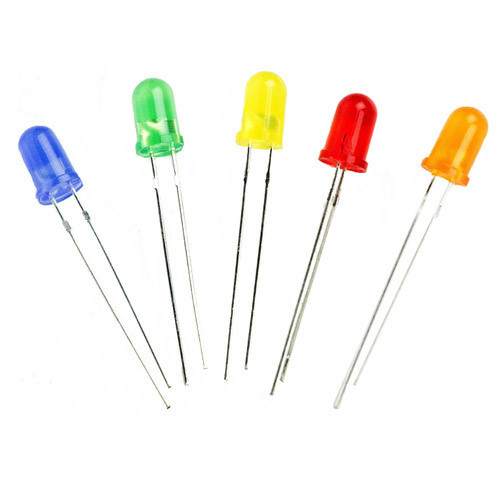
Light-Emitting Diode (LED)
Light-Emitting Diode (LED) (Product Code: SCL2529/036) is a white luminescent diode that glows when current passes through it in the forward direction, making it a clear visual indicator for circuit and semiconductor lessons. The capsule is at least 5 mm across and the wire ends are tinned copper, so it can be soldered, clipped or pushed into a circuit board. Schools use it in LED characteristics experiment kits and simple circuit builds; it is supplied by Jain Scientific Equipments Pvt Ltd (ScienceLab), Ambala, India.
Specifications
| Parameter | Detail |
|---|---|
| Type | Light-emitting diode |
| Colour | White luminescent |
| Capsule diameter | Minimum 5 mm |
| Leads | Tinned copper wire ends |
Typical Use
Younger classes use the LED as a polarity test: connected one way it lights, reversed it stays dark, which introduces the idea that some components only let current pass in one direction. In senior practicals it becomes a subject of study in its own right, with students raising the voltage in small steps and recording the point at which it starts to glow, then comparing that turn-on voltage with other LED colours.
Because it draws little current, the white LED also serves as a status light in student-built circuits such as a light-sensing switch or a continuity tester. Always wire a resistor in series with it, since connecting an LED straight across a battery can burn it out. Tinned leads take solder easily, but keep soldering brief to avoid overheating the capsule. It is an inexpensive addition to any electricity experiment kit for school benches.
Supplier
Components such as this LED are sourced and supplied by Jain Scientific Equipments Private Limited, which trades as ScienceLab from its base in Ambala, Haryana, so schools can order them together with other circuit apparatus. Our company profile has more about the business.
Related Lab Equipment
Pair this LED with the following items for circuit and optics-electronics work:
- LED Bright Red — a second colour for comparing turn-on voltages.
- Simple Circuit Module LED Board Green — a mounted LED module for younger students.
- Battery Snap with Crocodile Clip — a quick way to power the LED from a battery.
- Light Dependent Resistor — combines with an LED in light-sensing circuit projects.
- Semiconductor Diodes (for high school) — ordinary rectifier diodes for contrasting with the LED.
More items are available in the Lab Equipment category.
Frequently Asked Questions
What colour and size is this LED?
It is a white luminescent diode with a capsule diameter of at least 5 mm. For a red LED, see the related item above.
Which resistor should I use with it?
A series resistor is always needed; its value depends on your supply voltage. Ask us with your circuit details and we will suggest a suitable value.
Why does my LED not light?
The most common reason is reversed polarity. Swap the leads round; if it still stays dark, check the battery and the connections.
Can the leads be soldered?
Yes. The wire ends are tinned copper, which accepts solder readily. Keep the iron on the joint only briefly.
Are larger quantities available?
Yes. Pack sizes are not fixed on this listing, so tell us how many you need for your classes and we will confirm supply.
Do you ship outside India?
Yes. Quote code SCL2529/036 with your quantity and destination; we supply customers in India and international markets.
Request a Quote
Ask for a price on the Light-Emitting Diode (LED) through our contact page, or add it to the enquiry cart along with resistors and leads.
Last updated: 24 September 2026
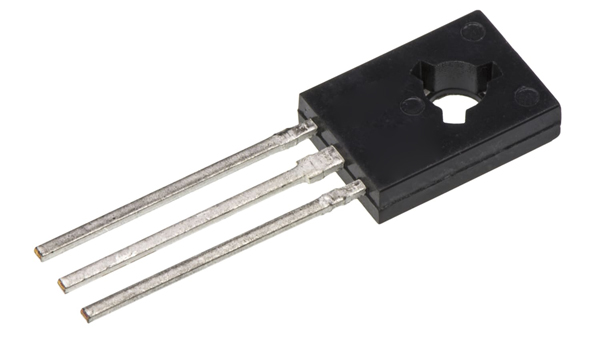
Transistor (for high school)
Transistor (for high school) (Product Code: SCL234/037) is an NPN bipolar transistor used to show how a small base current controls a much larger collector current in school electronics and physics practicals. Rated for a maximum allowable collector current of 1 A, it suits switching circuits with LEDs or small lamps as well as the curves plotted with a transistor characteristics kit. It is supplied by Jain Scientific Equipments Pvt Ltd (ScienceLab), Ambala, India.
Specifications
| Parameter | Detail |
|---|---|
| Type | Bipolar transistor, NPN |
| Maximum allowable collector current | 1 A |
| Maximum allowable voltage | 300 V (as listed for the collector and emitter) |
| Maximum junction temperature | Confirmed on enquiry |
| Product code | SCL234/037 |
| Supplied by | Jain Scientific Equipments Pvt Ltd (ScienceLab), Ambala, India |
What Is the High School Transistor Used For?
A good starting circuit uses the transistor as a switch: an LED or small lamp sits in the collector circuit, and a resistor feeds the base from a second, weaker path. Touching the base connection on and off turns the load on and off, showing that a tiny control current can govern a larger one. Adding a light dependent resistor to the base divider turns this into an automatic night light, a popular project for class 11 and 12 students.
For quantitative work, students hold the collector-emitter voltage steady, vary the base current and record the collector current, then repeat at other voltages to draw the output characteristics used in common emitter amplifier experiments. Identify the emitter, base and collector leads from the part marking before wiring, always include a base resistor, and keep currents well below the 1 A limit.
Supplier
Jain Scientific Equipments Private Limited, which trades as ScienceLab from Ambala, Haryana, supplies this transistor to schools and colleges together with the LEDs, resistors and meters used in the same practicals. For vendor registration, the supplying company is Jain Scientific Equipments Private Limited (CIN U29309HR2020PTC087597, GSTIN 06AAECJ8618A1ZT). More details are on our company profile.
Related Lab Equipment
These items are typically used in the same transistor practicals:
- PNP Transistor — the opposite polarity type, for comparing current directions.
- NPN Transistor — an alternative NPN listing for larger class sets.
- Light Dependent Resistor — turns the transistor switch into a light-operated circuit.
- Light-Emitting Diode (LED) — a simple load that shows when the transistor conducts.
- Multimeter — measures base and collector currents for characteristic curves.
Find more apparatus in the Lab Equipment category.
Frequently Asked Questions
Is this an NPN or a PNP transistor?
The Transistor (for high school) is an NPN bipolar transistor. If you also want PNP devices so students can compare current directions and biasing, the PNP Transistor listed above can be added to the same order.
What current and voltage can it handle?
The Transistor (for high school) has a maximum allowable collector current of 1 A, and its voltage rating is listed as 300 V. Typical school circuits run far below both limits, which leaves a wide safety margin.
What is the maximum junction temperature?
The junction temperature figure in our source listing for the Transistor (for high school) is unclear, so it is not quoted here. Contact us and we will confirm the rating for the parts supplied with your order.
How do I tell which lead is which?
Use the part marking on the Transistor (for high school) you receive to identify the emitter, base and collector before wiring. If you need the pin arrangement in writing for student worksheets, ask us when you place the order.
Can it be used without a base resistor?
No. The Transistor (for high school) should always be used with a base resistor, which limits the base current and protects the device. Connecting the base straight to a supply can pass excessive current and destroy the transistor.
Who supplies the Transistor (for high school)?
The Transistor (for high school) is supplied by Jain Scientific Equipments Pvt Ltd (ScienceLab), Ambala, Haryana, India. Schools can order it with LEDs, light dependent resistors and multimeters in one enquiry through the contact page.
Can you supply class sets or export orders?
Yes. For class sets of the Transistor (for high school), send the code SCL234/037, the quantity and your delivery location, and we will quote for schools in India or international markets.
Request a Quote
For availability of the Transistor (for high school), write to us through the contact page or add it to the enquiry cart with your other electronics items.
Last updated: 24 September 2026
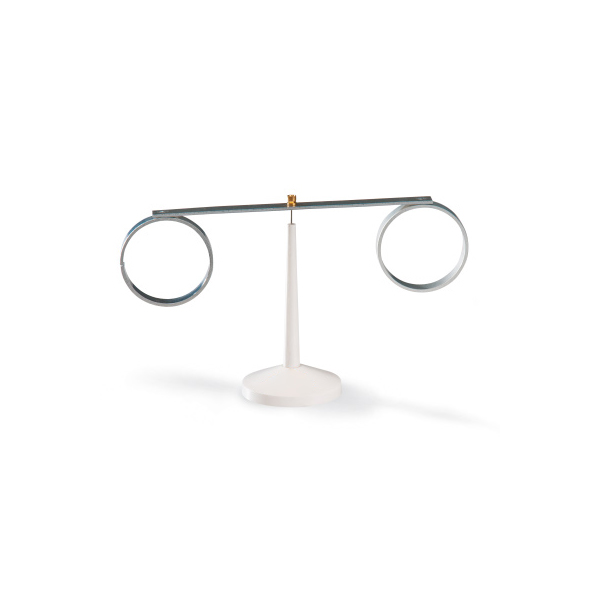
Device to Verify The Lenz's Law (for high school)
Device to Verify The Lenz's Law (for high school) (Product Code: SCL239/038) is a balanced rocker carrying two aluminium rings, used to show that an induced current opposes the change that produces it in school physics lessons on electromagnetic induction. A magnet pushed into the closed ring makes the arm swing away, while the slotted ring does not respond at all. It is manufactured by Jain Scientific Equipments Pvt Ltd (ScienceLab), an OEM manufacturer and laboratory equipment supplier in India, at its own factory in Ambala, as physics practical equipment for schools.
Specifications
| Parameter | Detail |
|---|---|
| Construction | Two identical aluminium rings fixed to the ends of an aluminium rocker arm, a tripod with a needle, and a stand |
| Ring arrangement | One ring with a slot, the other closed |
| Ring diameter | 25 mm |
| Rocker arm length | In the range of 130 to 180 mm |
| Pivot | Beam mounted on the tripod needle |
| Product code | SCL239/038 |
| Manufacturer | Jain Scientific Equipments Pvt Ltd (ScienceLab) — OEM |
| Country of origin | India (made in Ambala, Haryana) |
What Is the Lenz's Law Device Used For?
Set the stand on a level bench, balance the arm on the needle and wait for it to settle. Push one pole of a strong bar magnet quickly into the closed ring: the changing magnetic field induces a current in the ring, and the field of that current repels the magnet, so the arm turns away. Withdraw the magnet and the ring is drawn after it. Repeat with the slotted ring and nothing happens, because the slot breaks the conducting loop and no current can circulate.
That side-by-side comparison lets students reason out Lenz's law for themselves before it is written on the board, and it links naturally to energy conservation and eddy current braking. Move the magnet briskly, keep the room free of draughts, and avoid knocking the arm off its needle between trials. It fits well into an electromagnetic kit for school physics in India alongside coils, magnets and galvanometers.
OEM Manufacturer
The Lenz's law rocker is made by Jain Scientific Equipments Private Limited, trading as ScienceLab, which is its OEM (original equipment manufacturer) and builds it at its own licensed factory at Saha, Ambala, Haryana, India. Physics departments, dealers and importers buy it factory-direct, and a quotation, repeat order or replacement tripod needle comes from the maker rather than a middleman — ask us. Learn more on the company profile.
Related Lab Equipment
These items support induction lessons alongside this device:
- Magnet Set of 4 — provides the magnets needed to move in and out of the rings.
- Lenz’s Law – Open & closed loop — an alternative open and closed loop version of the same experiment.
- Eddy Current Unit — extends the lesson to eddy current damping.
- Faraday's Law Apparatus — measures the induced pulse that Lenz's law gives a direction to.
- Device for Demonstrating Magnetic Field Lines — shows the field shape around the magnet first.
Visit our Lab Equipment category for more.
Frequently Asked Questions
Is a magnet included?
No magnet is listed with the Device to Verify The Lenz's Law (for high school). A strong bar magnet works well; the Magnet Set of 4 linked above can be added, or ask us to include a magnet in your quotation.
Why does one ring have a slot?
On the Device to Verify The Lenz's Law, the slot breaks the conducting loop so no induced current can flow round that ring. It acts as a control, proving the closed ring moves because of induced current, not simple attraction.
How big are the rings and the arm?
Each aluminium ring of the Device to Verify The Lenz's Law (for high school) is 25 mm in diameter, and the aluminium rocker arm carrying them has a length in the range of 130 to 180 mm.
Do aluminium rings stick to the magnet?
No. Aluminium is not attracted to a magnet in the ordinary way, so any movement of the closed ring on the Device to Verify The Lenz's Law must come from the current induced in it by the moving magnet.
Who manufactures the Device to Verify The Lenz's Law?
The Device to Verify The Lenz's Law (for high school) is manufactured by Jain Scientific Equipments Pvt Ltd (ScienceLab), the OEM, at its own licensed factory at Saha, Ambala, Haryana, India. Quotations and repeat orders come directly from the manufacturer.
How should the device be stored?
Before moving or storing the Device to Verify The Lenz's Law, lift the rocker arm off the tripod needle so the pivot is not damaged, and keep the aluminium rings free of dents so the arm stays balanced.
Request a Quote
Send an enquiry for the Device to Verify The Lenz's Law (for high school) to the manufacturer through our contact page, or add it to the enquiry cart together with a suitable magnet.
Last updated: 24 September 2026
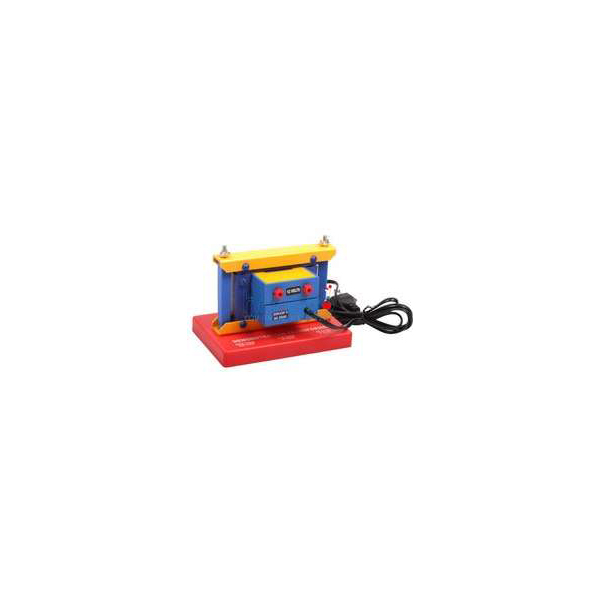
Demonstrative Transformer (for high school)
Demonstrative Transformer (for high school) (Product Code: SCL241/039) is a working model of a U-shaped steel core transformer that lets students see every part of a real step-down transformer: the steel core that carries the magnetic flux, a clamped bar that closes the field lines, and two enamelled copper coils on a wooden or plastic support. The 1400-turn primary takes 220 V and the 400-turn secondary delivers 60 V, so the turns ratio can be checked directly against measured voltages. It is manufactured by Jain Scientific Equipments Pvt Ltd (ScienceLab), Ambala, India.
Specifications
| Parameter | Detail |
|---|---|
| Type | Functional model of a U-shaped steel core transformer |
| Core | U-shaped steel core with a bar that closes the clamped field lines |
| Coils | Enamelled copper |
| Support | Wooden or plastic |
| Primary coil | 220 V / 0.3 A, 1400 turns |
| Secondary coil | 60 V / 1 A, 400 turns |
| Transformer power | 30 W |
Typical Use
With the closing bar clamped in place, the teacher energises the primary and students read both voltages on AC meters. Dividing 1400 turns by 400 turns and comparing the result with the ratio of the measured voltages is the central calculation of the topic. Loosening or removing the bar then shows a clear drop in secondary output, because the flux now leaks through air instead of staying in the steel, which explains why real transformers use closed cores.
A small lamp on the secondary lets the class compare input and output power and discuss efficiency and heating losses. Because the primary works at 220 V, the model should be connected and switched only by the teacher, using insulated leads, and all rewiring should be done with the supply off. It suits any transformer experiment kit for school physics labs.
Manufacturer
This demonstration transformer comes from Jain Scientific Equipments Private Limited, which manufactures teaching apparatus at its Ambala, Haryana factory and sells it, with the rest of its electromagnetism range, under the ScienceLab brand. For more about the company and its manufacturing base, open the company profile.
Related Lab Equipment
These items are used with the transformer when teaching electromagnetic induction:
- Analogue Voltmeter AC — reads primary and secondary voltages on a large dial.
- Multimeter — checks voltages and currents while comparing input and output.
- Demountable Transformer Kit — lets students assemble their own coil combinations.
- Transformer Parts Kit — for hands-on work on how cores and windings fit together.
- U-Shaped Electromagnet — introduces the magnetised core before the transformer lesson.
See more in our Lab Equipment category.
Frequently Asked Questions
What are the coil ratings?
The primary is rated 220 V / 0.3 A with 1400 turns and the secondary 60 V / 1 A with 400 turns. Total transformer power is 30 W.
Can students operate it themselves?
The primary runs at 220 V, so it should be connected and switched by a teacher. Students can safely take readings from the secondary side under supervision.
What does the closing bar do?
It completes the magnetic circuit across the open ends of the U-core. Removing it shows how much output is lost when flux has to cross an air gap.
Is the base wooden or plastic?
The support is listed as wooden or plastic. Mention your preference in the enquiry and we will confirm what is available.
Are meters included?
No meters are listed with this model. AC voltmeters or a multimeter are needed for measurements; contact us to add them.
Is a test report or calibration certificate provided?
This is a teaching model rather than a measuring instrument. If your purchase rules call for any documentation, please discuss it with us before ordering.
What details should a tender quotation include?
The code SCL241/039, the quantity, delivery location and any required specification. We supply institutions in India and international markets.
Request a Quote
To price the Demonstrative Transformer (for high school), use our contact page or add it to the enquiry cart with any meters you need.
Last updated: 24 September 2026
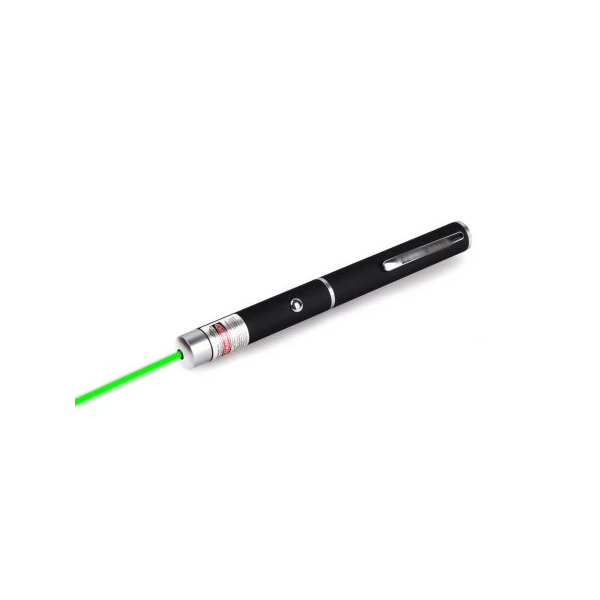
Laser (for high school)
Laser (for high school) (Product Code: SCL248/040) is a portable green laser that gives a narrow, bright beam for ray optics and wave optics lessons. Its listed wavelength is 550 nm with a power of 5 mW, and it runs either from a stationary supply or from a rechargeable battery, with the charger included. Physics teachers use it to make reflection, refraction and diffraction visible to a whole class. It is supplied by Jain Scientific Equipments Pvt Ltd (ScienceLab), Ambala, India, as part of its laser experiment range for schools.
Specifications
| Parameter | Detail |
|---|---|
| Type | Portable laser |
| Colour and wavelength | Green, 550 nm |
| Power | 5 mW |
| Power source | Stationary or rechargeable battery |
| Charger | Included |
Typical Use
Aimed at a plane mirror, the beam shows the law of reflection with a precision that ray boxes cannot match; sent through a glass block or prism, it traces refraction and total internal reflection, and a little chalk dust or water mist makes the path visible in the air. Passing the beam through a narrow slit or a fine grating produces a diffraction pattern on a far wall, giving students a way to estimate spacing or wavelength from simple measurements.
Safe handling matters as much as the physics. Never look into the beam or point it at anyone, keep the beam below eye level, remove shiny objects from the bench, and let the teacher keep and switch the laser. Charge the battery fully before practical sessions so the output stays steady. Used this way, it becomes a core part of any optics experiment kit for school laboratories.
Supplier
This laser is supplied by Jain Scientific Equipments Private Limited, the Ambala, Haryana business behind the ScienceLab name, which offers optical accessories so that the full ray optics practical can be ordered together. Read about the company on its profile page.
Related Lab Equipment
These products are used with the laser in optics practicals:
- Prism, Clear Glass — for refraction and total internal reflection with the beam.
- Mirror, Plane Glass — for measuring angles of incidence and reflection.
- Optical Bench Kit — keeps the source, lenses and screen aligned on one axis.
- Laser Pen, Red — a red source for comparing colours and diffraction patterns.
Browse our Lab Equipment category for more.
Frequently Asked Questions
What colour is the beam and how powerful is it?
The laser is green with a listed wavelength of 550 nm and a power of 5 mW.
Is the charger included?
Yes. The laser works from a stationary supply or a rechargeable battery, and a charger comes with it.
What laser safety class does it carry?
A safety class is not stated on this listing. Please contact us and we will confirm the labelling of the unit supplied before you order.
Can students use it on their own?
We recommend that a teacher controls the laser at all times. Beams of this kind can harm eyes, so it should never be aimed at people or reflective surfaces at head height.
Will it fit on an optical bench?
Mounting depends on your bench fittings. Tell us which bench you use and we will advise on holding the laser in line with lenses and screens.
Can it be shipped internationally?
Yes. Send the code SCL248/040, the quantity and destination; shipping arrangements for battery-powered items are confirmed at quotation stage for India and international markets.
Request a Quote
Ask for pricing on the Laser (for high school) via our contact page, or add it to the enquiry cart along with prisms and mirrors.
Last updated: 24 September 2026
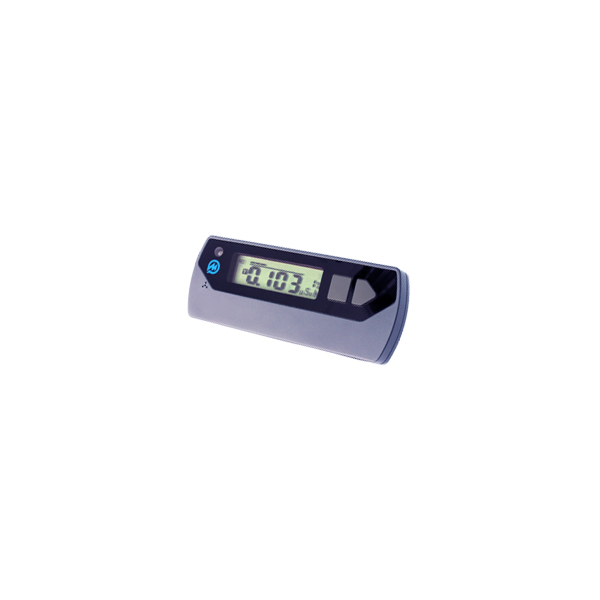
Dosimeter Digital
Dosimeter Digital (Product Code: SCL249/041) is a digital radiation dosimeter used to measure accumulated dose during radioactivity and radiation-safety lessons in school and college physics labs. It reads from 0.1 µSv to 1 000 µSv, weighs no more than 200 g and comes with batteries, so it is ready to use on arrival. It is supplied by Jain Scientific Equipments Pvt Ltd (ScienceLab), Ambala, a laboratory instruments supplier in India, alongside other nuclear physics lab equipment for teaching.
Specifications
| Parameter | Detail |
|---|---|
| Type | Digital dosimeter |
| Dose measuring range | 0.1 µSv – 1 000 µSv |
| Mass | Maximum 200 g |
| Batteries | Included |
| Product code | SCL249/041 |
| Supplied by | Jain Scientific Equipments Pvt Ltd (ScienceLab), Ambala, India |
What Is the Digital Dosimeter Used For?
A useful first activity is to leave the dosimeter on a bench for a lesson and read the dose from natural background radiation, which gives the class a baseline for everything that follows. The teacher can then place it near a sealed school source for a fixed time and compare the reading, before repeating the exposure at a greater distance or behind a sheet of shielding to show how dose falls off. Turning these readings into everyday comparisons helps students see why time, distance and shielding are the three rules of radiation safety.
Teachers who handle sources can also carry the dosimeter during practical sessions as a check on their own accumulated dose. Keep it away from strong heat and moisture, switch it off or remove the batteries for long storage, and log readings so the data can be reused in later lessons. It pairs well with a Geiger counter in any radiation experiment kit for India's senior secondary classes.
Supplier
Jain Scientific Equipments Private Limited, trading as ScienceLab from Ambala, Haryana, supplies this dosimeter to schools, colleges and distributors together with its radioactivity apparatus. For vendor and import-export records, the supplying company's Importer-Exporter Code is AAECJ8618A (DGFT) and its GSTIN is 06AAECJ8618A1ZT. See the company profile for more information.
Related Lab Equipment
These items complete a school radioactivity practical:
- Geiger Counter — counts individual events, complementing the dosimeter's dose reading.
- Sealed Radioactive Source, Cobalt — a sealed source for distance and shielding measurements.
- Apparatus for studying the value of the half-decay period during radioactive decay — extends the topic to half-life.
- Digital Chronometer (Stopwatch) — times each exposure so readings can be compared fairly.
More apparatus is available in our Lab Equipment category.
Frequently Asked Questions
What dose range does it measure?
The Dosimeter Digital measures dose from 0.1 µSv to 1 000 µSv and shows the result on a digital display, giving students a direct number for background radiation and for classroom exposure experiments.
Are batteries included?
Yes. Batteries are included with the Dosimeter Digital, so it can be used as soon as it arrives. For long storage between terms, remove the batteries or switch the unit off to avoid unnecessary drain.
Is a calibration certificate available?
A calibration certificate is not stated on the Dosimeter Digital listing. If your institution needs calibration documentation, please contact us before ordering so we can tell you what can be provided with the unit.
Can it be used for official occupational dose records?
The Dosimeter Digital is listed for teaching use. If you need a dosimeter for regulated personal monitoring of radiation workers, discuss your requirements with us before ordering rather than relying on this classroom instrument.
Does it replace a Geiger counter?
Not entirely. The Dosimeter Digital totals the dose received, while a Geiger counter counts individual events and suits count-rate experiments, so many physics departments use both instruments in the same radioactivity practical.
Who supplies the Dosimeter Digital?
The Dosimeter Digital is supplied by Jain Scientific Equipments Pvt Ltd (ScienceLab), Ambala, Haryana, India. Send the product code SCL249/041, quantity and delivery location through the contact page for a quotation within India or to international markets.
Request a Quote
To enquire about the Dosimeter Digital, contact us through the contact page or add it to the enquiry cart with your radioactivity apparatus.
Last updated: 24 September 2026
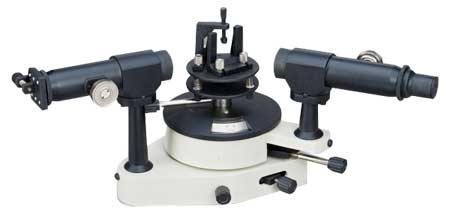
Spectroscope (for high school)
Spectroscope (for high school) (Product Code: SCL255/042) is a prism spectroscope that splits light into its component colours so students can study continuous and line spectra. Light enters through a slit in the collimator tube, is dispersed by a three-edged prism on a table, and is viewed through a telescope with a moving eyepiece, while a micrometer screw allows fine adjustment. As a prism spectrometer for India’s school and junior college optics labs, it is manufactured by Jain Scientific Equipments Pvt Ltd (ScienceLab), Ambala.
Specifications
| Parameter | Detail |
|---|---|
| Type | Prism spectroscope |
| Dispersing element | Table with a three-edged prism |
| Collimator | Tube with a lens and a slit |
| Telescope | With a lens and a moving eyepiece |
| Adjustment | Micrometer screw |
| Mounting | Stand for installing the device on a support |
Typical Use
Point the collimator at an ordinary filament lamp first: the class sees an unbroken band from red to violet, the continuous spectrum of a hot solid. Swap the lamp for a sodium lamp or a glowing gas discharge tube and the band is replaced by a few sharp bright lines, each one a fingerprint of the element. Comparing these patterns is how students meet the idea that atoms emit only particular wavelengths.
To set up, focus the telescope on a distant object, narrow the slit until lines look sharp, then turn the prism table until the spectrum appears and settle it at the position of least deviation. The micrometer screw helps line up the eyepiece on individual lines when recording their positions. Keep the prism faces free of fingerprints and cover the instrument when not in use; it is a lasting part of the optics lab equipment in any school.
Manufacturer
ScienceLab spectroscopes come from Jain Scientific Equipments Private Limited, a manufacturer of teaching apparatus in Ambala, Haryana, which supplies optics instruments to schools and colleges in India and international markets. Our company profile gives further background.
Related Lab Equipment
Light sources and accessories used with this spectroscope:
- Spectral Tube Set with Voltage Source (for high school) — gas tubes whose line spectra are viewed through the spectroscope.
- Sodium Spectral Lamp — a bright line source for alignment and first observations.
- Spectral Lamp Power Supply with Lamp Holder — runs and holds the spectral lamp at the slit.
- Spectroscope, Direct Vision — a hand-held option for quick student viewing.
See more in our Lab Equipment category.
Frequently Asked Questions
What parts make up the spectroscope?
A table with a three-edged prism, a collimator tube with a lens and a slit, a telescope with a lens and a moving eyepiece, a micrometer screw, and a stand for mounting it on a support.
Is a light source included?
No lamp is listed with the spectroscope. Sodium lamps and gas spectral tubes are available separately; ask us to quote them together.
What can students observe with it?
Continuous spectra from incandescent lamps and line spectra from sodium lamps or gas discharge tubes, which is the basis for lessons on atomic emission.
Does it have an angle scale for measurements?
A graduated circle is not listed for this model. If you need angle readings for refractive index work, contact us so we can suggest a suitable instrument.
How should the optics be cleaned?
Blow off dust first, then wipe lenses and prism faces gently with lens tissue. Avoid solvents and never touch the prism faces with bare fingers.
Can you supply a full optics lab?
Yes. Send the code SCL255/042 and your list of items, quantities and delivery location; we quote for India and international markets.
Request a Quote
For a price on the Spectroscope (for high school), reach us through the contact page or add it to the enquiry cart with the light sources you need.
Last updated: 24 September 2026
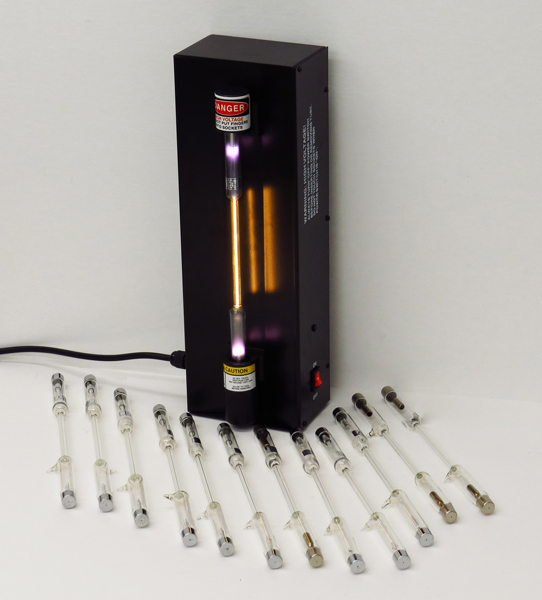
Spectral Tube Set with Voltage Source (for high school)
Spectral Tube Set with Voltage Source (for high school) (Product Code: SCL267/043) contains five gas discharge tubes and the high voltage source needed to light them, so a class can see the characteristic glow and emission lines of different gases. When the source is connected, an electrical discharge passes through the gas and the tube lights up in a colour that belongs to that gas alone. The set is manufactured by Jain Scientific Equipments Pvt Ltd (ScienceLab), Ambala, India, and is a natural companion to a spectrometer in India’s school and college physics labs.
Specifications
| Parameter | Detail |
|---|---|
| Number of tubes | 5 |
| Gases | Hydrogen (H2), oxygen (O2), argon (Ar), carbon dioxide (CO2), neon (Ne) |
| Electrodes | Two, at the ends of each tube |
| Tube length | About 200 mm |
| Tube shape | Narrowed in the middle to allow spectroscopic observation of the emission lines |
| Voltage source | High voltage source with adaptable support for connecting the tubes, included in the set |
| Power consumption | 4.5 W |
Typical Use
Fit one tube into the support, switch on, and darken the room: the narrow middle section glows brightly, and each gas gives a visibly different colour, with neon’s red-orange standing out at once. Viewing the glowing capillary through a spectroscope or a direct-vision spectroscope then reveals a set of separate bright lines rather than a rainbow. Hydrogen is usually studied first because its few visible lines are easy to pick out and connect to the energy levels of the atom.
Working through all five gases lets students build their own table of spectral fingerprints and discuss how astronomers identify elements in stars. The source works at high voltage, so switch it off before changing tubes, let each tube cool for a moment, and hold tubes by their ends. Treat the set as teacher-operated physics lab equipment for India’s senior secondary classes.
Manufacturer
Jain Scientific Equipments Private Limited manufactures laboratory apparatus at its factory in Ambala, Haryana, and markets this spectral tube set under the ScienceLab brand for physics and chemistry teaching. More about the company is on our company profile.
Related Lab Equipment
These items are used with the spectral tubes in emission spectra practicals:
- Spectroscope (for high school) — resolves the glow of each tube into separate lines.
- Spectroscope, Direct Vision — lets several students view the lines quickly by hand.
- Hydrogen Spectrum Set — a focused option for detailed hydrogen line work.
- Spectrum Tube Power Supply — an additional source when running two tubes side by side.
- Sodium Spectral Lamp — a reference line source for comparison.
Browse the Lab Equipment category for more.
Frequently Asked Questions
Which gases are in the set?
Five tubes filled with hydrogen, oxygen, argon, carbon dioxide and neon, each about 200 mm long with an electrode at each end.
Is the voltage source included?
Yes. The set includes a high voltage source with an adaptable support for connecting the tubes. Its power consumption is 4.5 W.
Why is each tube narrow in the middle?
The narrow section concentrates the discharge into a bright, thin line of light, which is ideal for viewing through a spectroscope slit.
Is a spectroscope needed?
The colour differences are visible by eye, but separate emission lines can only be seen with a spectroscope. See the related items above or contact us for a combined quotation.
Can students operate the set?
Because the source produces high voltage, a teacher should connect and switch it. Students can view the tubes and record observations safely from the bench.
Can replacement tubes be ordered?
Please contact us with the gas you need. We will confirm whether single tubes can be supplied for your set.
What should a school quotation request include?
Include code SCL267/043, the number of sets and your delivery location. We supply schools in India and international markets.
Request a Quote
Send your enquiry for the Spectral Tube Set with Voltage Source via the contact page, or add it to the enquiry cart together with a spectroscope.
Last updated: 24 September 2026
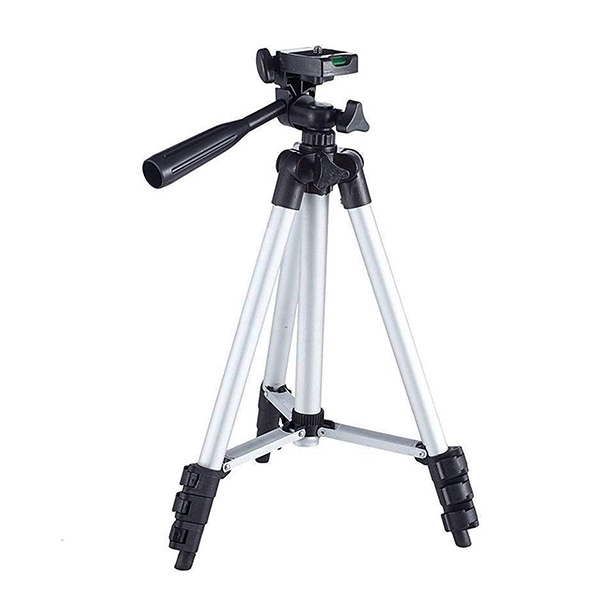
Binocular
Binocular (Product Code: SCL274/044) is a pair of field binoculars with BAK-4 lenses, 40 mm lens diameter and a minimum magnification of 8x, suited to nature study, bird watching, geography field trips and simple sky observation. Multi-layer antireflection coating, a central focus wheel and a tripod mount make it practical for students to share during outdoor sessions. It is supplied by Jain Scientific Equipments Pvt Ltd (ScienceLab), Ambala, a school and laboratory equipment supplier in India serving institutions at home and in international markets.
Specifications
| Parameter | Detail |
|---|---|
| Optics | BAK-4 lenses |
| Lens diameter | 40 mm |
| Magnification | Minimum 8x |
| Interpupillary distance | In the range of 56 to 76 mm |
| Coatings | Anti-reflex coating; multiple lens antireflection coating |
| Focusing | Central focus |
| Mounting | Tripod mount |
| Protection | Lids for lens and eyepiece |
Typical Use
In biology and environmental studies the binocular lets students identify birds, record behaviour and count animals at a distance without disturbing them. Geography classes use it to read landforms, vegetation zones and distant landmarks on field trips, while astronomy clubs turn it on the Moon’s craters or bright star clusters at night. The 40 mm lenses gather enough light for early morning or evening sessions, when birds and wildlife are most active.
Before each use, hinge the barrels until the interpupillary distance matches the viewer’s eyes, then turn the central focus until the image is sharp. For long observations or group viewing, fix the binocular to a tripod through its mount so the image stays steady. Never look at the Sun through binoculars. Replace the lens and eyepiece lids after use and store it in a dry place; it serves as lab equipment for college and school outdoor programmes alike.
Supplier
This binocular is supplied by Jain Scientific Equipments Private Limited of Ambala, Haryana, which trades as ScienceLab and offers optical field instruments together with its classroom apparatus. Visit the company profile for more.
Related Lab Equipment
Items that pair well with binoculars for field and sky observation:
- Astronomical Telescope — higher magnification for Moon and planet observation.
- Telescope Refractor — a refracting telescope for fixed-position viewing.
- Hand Lens — for close-up study of leaves, insects and rocks collected in the field.
- Microfiber Lens Cloth — cleans the coated lenses without scratching.
- Lens Tissue — removes fingerprints from objective and eyepiece lenses.
More apparatus is listed in the Lab Equipment category.
Frequently Asked Questions
What magnification and lens size does it have?
The binocular has a minimum magnification of 8x and a lens diameter of 40 mm, with BAK-4 lenses.
Will it suit younger students?
The interpupillary distance adjusts between 56 and 76 mm. Very small children may find the lower end still too wide, so check your age group with us if unsure.
Can it be mounted on a tripod?
Yes, it has a tripod mount. A tripod is not listed as included; ask us if you need one quoted.
Is a carry case or strap included?
Lids for the lens and eyepiece are included. A case or strap is not stated on this listing, so please confirm with us when ordering.
How should the lenses be cleaned?
Brush or blow off grit first, then wipe gently with a microfibre cloth or lens tissue. Do not use household glass cleaners on the coated lenses.
Can you supply sets for field clubs or export?
Yes. Send the code SCL274/044 with quantity and delivery location; we supply schools and colleges in India and international markets.
Request a Quote
Request a price for the Binocular through our contact page or add it to the enquiry cart with any other field equipment you need.
Last updated: 24 September 2026
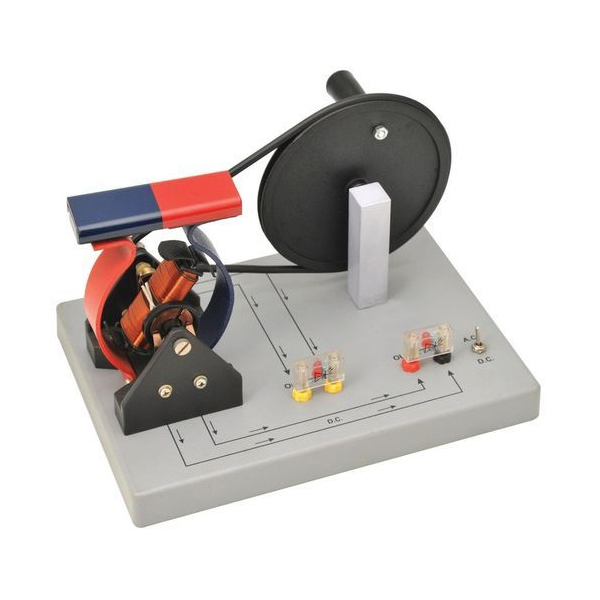
Generator Model (for high school)
Generator Model (for high school) (Product Code: SCL280/045) is an open teaching model that shows how mechanical rotation is turned into electrical energy. Every constructive element is visible: the support, the stator coils or permanent magnets, the coil rotor and the copper or carbon blade brushes that carry current out of the moving coil. The model is designed to demonstrate the working principle of a generator in both its alternating current (AC) and direct current (DC) forms. It is manufactured by Jain Scientific Equipments Pvt Ltd (ScienceLab), Ambala, India, as a demonstration model for the physics lab.
Key Details
| Parameter | Detail |
|---|---|
| Type | Open generator demonstration model |
| Support | Plastic or metal |
| Field system | Stator coils or permanent magnets |
| Rotor | Coil rotors |
| Brushes | Copper or carbon blade brushes |
| Construction | All constructive elements visible |
| Demonstrates | Working principle of the generator, of the AC generator and of the DC generator |
Typical Use
The teacher turns the rotor slowly with the output connected to a centre-zero galvanometer. As the coil cuts the magnetic field the needle swings, and students can link each swing to the coil’s position in the field. In an AC generator the current reverses every half turn, so the needle swings first one way and then the other; in a DC generator the current is kept flowing in one direction, and the needle stays on one side of zero. Seeing both behaviours on one open model makes the role of the brushes and the output connection easy to explain.
Turning faster produces larger deflections, which leads naturally to the factors that affect induced voltage: speed of rotation, strength of the field and number of turns. Because nothing is hidden inside a casing, students can trace the path of current from the coil through the brushes to the meter. The model fits any electromagnetic kit for school lessons on power generation and complements motor demonstrations, since a motor is a generator run in reverse.
Manufacturer
This generator model is made by Jain Scientific Equipments Private Limited, an Ambala, Haryana manufacturer that brands its educational apparatus as ScienceLab. For vendor registration, the company’s GSTIN is 06AAECJ8618A1ZT and its LEI is 3358004HRD1JIVXKYX49. Read more on the company profile.
Related Lab Equipment
These items are used with the generator model in electromagnetism lessons:
- Galvanometer, Centre Zero Universal Meter — shows the direction of the output current as the rotor turns.
- Demonstration Motor AC/DC — shows the reverse process of turning current into motion.
- A.C. Generator — a dedicated AC generator for further study.
- Working Model of Dynamo — a working dynamo for comparing with the open model.
- Device to Verify The Lenz’s Law (for high school) — explains why turning the rotor under load takes effort.
Explore the Lab Equipment category for more.
Frequently Asked Questions
Does the model show both AC and DC generation?
Yes. It is designed to demonstrate the working principle of the generator, the AC generator and the DC generator.
Does it use magnets or field coils?
The field is listed as stator coils or permanent magnets, and the brushes as copper or carbon blades. Tell us if your syllabus needs a particular arrangement and we will confirm it.
Is a meter included to show the output?
No meter is listed with the model. A centre-zero galvanometer is recommended; contact us to include one.
Can it light a lamp?
Output depends on how fast the rotor is turned and the arrangement supplied. Ask us before ordering if lighting a lamp is part of your lesson plan.
How should it be maintained?
Keep the brushes and contact surfaces clean and dry, turn the rotor by hand without force, and store the model covered so dust does not settle on the open parts.
What should a quotation request include?
Quote the code SCL280/045, the number of models, delivery location and any tender wording. We supply institutions in India and international markets.
Request a Quote
Enquire about the Generator Model (for high school) through our contact page, or add it to the enquiry cart along with a galvanometer.
Last updated: 24 September 2026
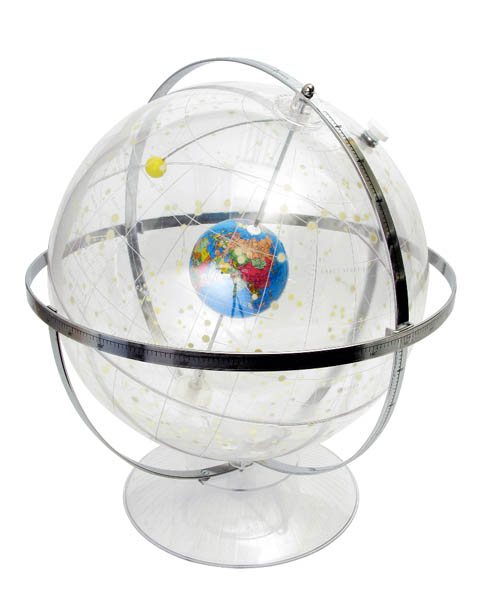
The Model of The Celestial Sphere (for high school)
The Model of The Celestial Sphere (for high school) (Product Code: SCL282/046) is a 300 mm transparent celestial globe on a gyroscopic support, with a small Earth shown at its centre. The main reference circles, the celestial equator and the celestial meridians, are marked on the sphere, together with an equatorial or horizontal plane, so students can see how astronomers locate stars on the sky as seen from Earth. This item of astronomy lab equipment is manufactured in India by Jain Scientific Equipments Pvt Ltd (ScienceLab), Ambala.
Specifications
| Parameter | Detail |
|---|---|
| Type | Model of the celestial sphere |
| Model diameter | 300 mm |
| Globe | Transparent celestial globe with the Earth indicated inside |
| Reference circles | Celestial equator and celestial meridians |
| Reference plane | Equatorial or horizontal plane |
| Support | Gyroscopic |
Typical Use
Because the globe is transparent, students can look through it from the Earth’s point of view and relate what they see on the model to the real sky. Turning the sphere on its support shows the apparent daily rotation of the heavens: stars near the celestial pole circle without setting, while those near the celestial equator rise and set. The marked equator and meridians give a concrete picture of declination and right ascension, the sky’s equivalents of latitude and longitude.
With the horizontal plane set for the school’s own latitude, the teacher can show why the pole star stands at the same height above the horizon as the observer’s latitude, and why the Sun’s path changes through the year. The model links geography lessons on the Earth’s axis with physics and astronomy club work, and it pairs naturally with geography models such as globes and planetaria. Dust it with a soft dry cloth and store it covered to keep the transparent sphere clear.
Manufacturer
Jain Scientific Equipments Private Limited, an educational equipment manufacturer based in Ambala, Haryana, produces this celestial sphere model and sells it under its ScienceLab brand to schools in India and international markets. Find out more on the company profile.
Related Lab Equipment
These items support astronomy and Earth-and-sky lessons:
- Celestial Star Globe — shows the constellations that the sphere’s coordinates describe.
- Earth Globe Model — compares terrestrial latitude and longitude with celestial coordinates.
- Solar System Model — places the Earth in the wider solar system.
- Project Planetarium Set — projects the night sky for whole-class viewing.
- Astronomical Telescope — for observing the real sky after the model lesson.
See more in the Lab Equipment category.
Frequently Asked Questions
How big is the model?
The celestial sphere has a diameter of 300 mm, large enough for a teacher to demonstrate at the front of a class.
Which reference circles are marked?
The celestial equator and the celestial meridians are indicated, along with an equatorial or horizontal plane.
Are constellations shown on the sphere?
Star patterns are not described on this listing. If you need constellations, see the Celestial Star Globe or contact us to confirm the markings.
Is it suitable for geography as well as physics classes?
Yes. It helps explain the Earth’s axis, latitude and the apparent motion of the sky, topics shared by geography and physics syllabi.
How should the transparent globe be cleaned?
Use a soft, dry or slightly damp cloth. Avoid solvents and abrasive cleaners, which can cloud or scratch the surface.
Can you quote for several schools or an export order?
Yes. Provide code SCL282/046, the quantity and delivery locations; we supply institutions in India and international markets.
Request a Quote
For a quotation on The Model of The Celestial Sphere, use our contact page or add it to the enquiry cart with your other astronomy items.
Last updated: 24 September 2026
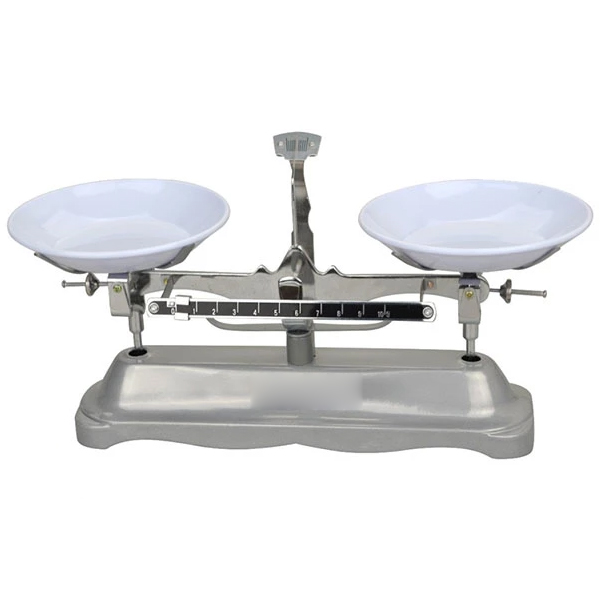
Balance
Balance (Product Code: SCL-541/01a) is an equal-arm beam balance with two plastic trays that lets students find the mass of small objects by comparing them against known masses. Science teachers use it to introduce mass, equilibrium and weighing by comparison in middle and secondary classes. It is made by Jain Scientific Equipments Pvt Ltd (ScienceLab), Ambala, India, as part of its range of school physics lab equipment in India.
Specifications
| Parameter | Detail |
|---|---|
| Type | Equal-arm balance with balancing mechanism |
| Pans | Plastic trays |
| Support | Steel support |
| Maximum measurement mass | 200 g |
| Precision | 0.1 g |
| Height | 200 mm |
| Included | Marked mass set |
Typical Use
Students place the object on one tray and add marked masses to the other until the beam settles level; the total of the masses gives the object's mass, readable to the balance's 0.1 g precision. Before each lesson, set the empty beam level with the balancing mechanism so that every reading starts from a true zero, and keep the combined load within the 200 g maximum to protect the pivot.
The balance works well in practical sessions on density (weigh a sample, then find its volume), on conservation of mass, and on the difference between mass and weight. Used next to a spring dynamometer and other mechanics lab equipment in India, it helps learners see that a balance compares masses directly, while a spring scale measures the pull of gravity as a force.
Manufacturer
This balance is produced by Jain Scientific Equipments Private Limited, the Ambala, Haryana company that trades under the ScienceLab name and builds teaching apparatus for schools, colleges and science distributors. Read more about the company on its company profile page.
Related Lab Equipment
These catalogue items are often ordered with the balance for weighing and equilibrium lessons:
- Set Of Marked Masses — extra hooked masses for the comparison tray or for hanging experiments.
- Weight Box — a boxed set of reference weights for comparison weighing.
- Dynamometer — measures weight as a force in newtons, a useful contrast to weighing by comparison.
- Lever — extends the equal-arm idea to moments at unequal distances from the pivot.
- Triple Beam Balance — an alternative single-pan balance with sliding riders.
See the full Lab Equipment category for more school physics apparatus.
Frequently Asked Questions
What is the capacity and precision of this balance?
It measures up to 200 g with a precision of 0.1 g. For heavier samples, choose a balance with a higher capacity from our catalogue.
Are masses supplied with the balance?
Yes, a marked mass set is included. For the exact pieces in the set, please ask through our contact page before ordering.
How do I set the balance to zero?
With both trays empty, adjust the balancing mechanism until the beam rests level. Recheck this at the start of each class, since moving the balance can shift the zero.
How should the balance be cleaned and stored?
Wipe the plastic trays with a soft, slightly damp cloth and dry them. Store the balance unloaded, with the masses kept together so pieces are not lost.
Can a calibration certificate be provided?
Please discuss calibration-certificate availability with our team via the contact page when you enquire.
What should an institutional quotation request include?
Give the product code SCL-541/01a, the quantity, the delivery address and any tender specification you must match, so we can respond accurately.
Do you supply schools in bulk and overseas?
Yes. We supply institutions and distributors across India and international markets; packing and shipping terms are confirmed with each quotation.
Request a Quote
To request a quotation for the Balance (SCL-541/01a), send your quantity and delivery details through our contact page, or add it to the enquiry cart along with other apparatus you need.
Last updated: 24 September 2026
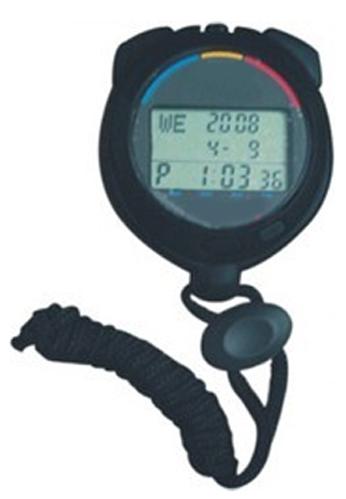
Digital Chronometer (Stopwatch)
Digital Chronometer (Stopwatch) (Product Code: SCL-059/01b) is a compact digital electronic stopwatch for timing motion, oscillation and reaction experiments in the school laboratory. Its 10 mm display figures are easy for a whole group to read, and its stated accuracy is 0.01 s. It is made by Jain Scientific Equipments Pvt Ltd (ScienceLab), Ambala, India, alongside its wider line of physics lab instruments in India.
Specifications
| Parameter | Detail |
|---|---|
| Type | Digital electronic stopwatch |
| Size | 30 x 50 x 15 mm, with a deviation of 10 mm on each side |
| Display figure height | 10 mm |
| Accuracy | 0.01 s |
| Power | Battery (provided) |
Typical Use
The stopwatch is the everyday timer for experiments where students start and stop the count by hand: the period of a pendulum, the time a block takes to slide down an inclined plane, or the oscillation of a mass on a spring. In simple pendulum apparatus India practicals, a good habit is to time 10 or 20 complete swings and divide, because this spreads the delay of pressing the button over many oscillations and gives a far more reliable period.
It is also handy for rate experiments in chemistry and biology, such as timing a colour change or counting pulse beats over a fixed interval. Ask students to repeat each reading at least three times and average the results, then discuss why reaction time, rather than the 0.01 s display, limits the accuracy of hand timing.
Manufacturer
This stopwatch is manufactured by Jain Scientific Equipments Private Limited, which trades as ScienceLab from Ambala in Haryana and prepares physics and general science apparatus for educational buyers. Details of the business are on our company profile.
Related Lab Equipment
Timing is only half of most motion experiments; these catalogue items complete the set-up:
- Inclined Plane With Accessories — time a block or bar sliding down the wooden plane.
- Set of Springs — time the oscillation of a hanging mass for spring-constant work.
- Stopwatch, Digital — an alternative handheld digital timer from our measuring range.
- Bench Stopwatch — a bench-top timer that a whole class can watch during demonstrations.
- Stop Clock — a classic stop clock option for physics practicals.
More timing and measuring apparatus is listed in the Lab Equipment category.
Frequently Asked Questions
How fine are the readings on this stopwatch?
The stated accuracy is 0.01 s. With hand timing, human reaction time is usually the larger source of error, so repeat and average readings.
Does it come with a battery?
Yes, it is provided with a battery, so it is ready to use on arrival.
How big is the stopwatch?
It measures 30 x 50 x 15 mm, with a stated deviation of 10 mm on each side, and the display figures are 10 mm high.
How should it be looked after?
Keep it dry and away from direct heat, wipe it with a dry cloth, and remove the battery if the stopwatch will be stored for a long break such as the summer vacation.
Is a calibration certificate available for timing accuracy?
Please raise this with us before ordering through the contact page so we can discuss what documentation is possible.
What warranty applies?
Warranty terms are confirmed in each quotation; ask our team through the contact page.
Can you supply class sets for several laboratories?
Yes. Quote the product code SCL-059/01b with the number of units and delivery location; we supply schools and distributors across India and international markets.
Request a Quote
For pricing on the Digital Chronometer (Stopwatch), write to us via the contact page or place it in the enquiry cart with the rest of your laboratory list.
Last updated: 24 September 2026
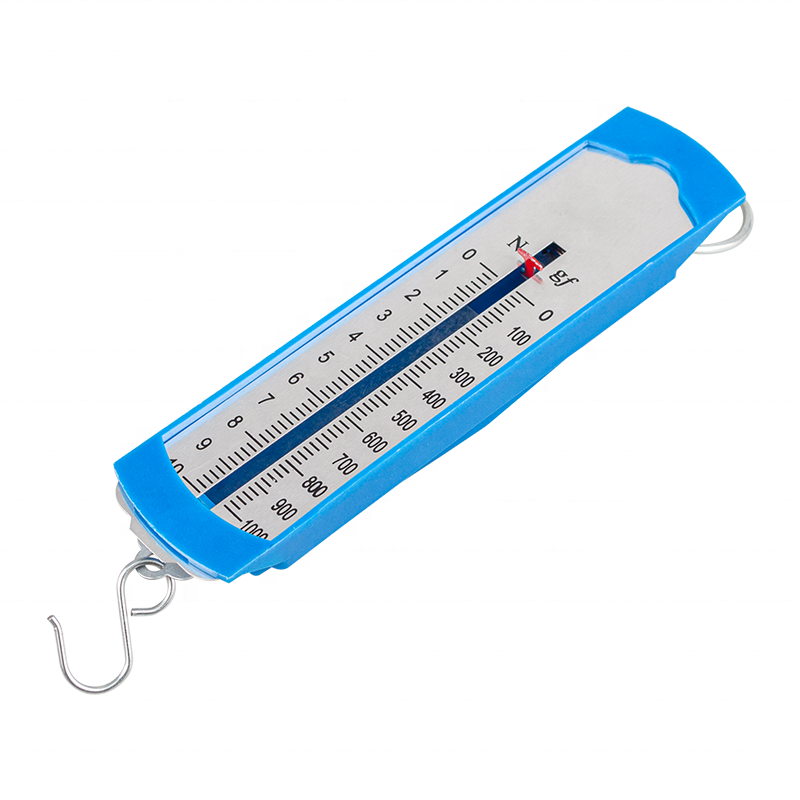
Dynamometer
Dynamometer (Product Code: SCL-583/01c) is a spring force meter that reads forces up to 5 N, with a scale marked both in newtons and in grams. Students hang a load from its hook, or pull an object with it, and read the force directly from the metal scale. This piece of physics lab equipment for school India classrooms is made by Jain Scientific Equipments Pvt Ltd (ScienceLab), Ambala, India.
Specifications
| Parameter | Detail |
|---|---|
| Type | Spring dynamometer with plastic support |
| Maximum force | 5 N |
| Newton scale divisions | 0.1 N |
| Gram scale divisions | 10 g |
| Scale | Metal scale with zero adjuster, reading in both grams and newtons |
| Body | Rectangular plastic body |
| Fittings | Suspension ring and load hook |
Typical Use
Hang the dynamometer from its suspension ring, set the pointer to zero with the adjuster, then attach a load to the hook: students read the weight in newtons and the equivalent in grams on the same scale, which makes the link between mass and weight very clear. Adding masses one at a time and recording each reading also gives a quick demonstration that the spring stretches in proportion to the force applied.
Held horizontally, it becomes the pulling gauge in a friction experiment kit India teachers set up with a wooden block on a board: drag the block at a steady speed, note the force, then change the surface or the load and compare. Always re-zero when changing between vertical and horizontal use, and never pull beyond 5 N, as overstretching can permanently alter the spring.
Manufacturer
Jain Scientific Equipments Private Limited, based in Ambala, Haryana, and known to customers as ScienceLab, manufactures the dynamometer for school and college physics laboratories. ScienceLab is the trading name of the company (CIN U29309HR2020PTC087597), which manufactures at its licensed factory at 449, HSIIDC Industrial Area, Saha, Ambala (Factory Licence AMB-ONLINE-CHD-J-414). Learn more on the company profile.
Related Lab Equipment
Force measurements usually call for loads, supports and something to pull; these items fit the same practical:
- Set Of Marked Masses — hooked 50 g masses to check readings against known loads.
- Stand — a steel rod stand to hang the dynamometer from during load tests.
- Inclined Plane With Accessories — its hooked wooden bar is pulled with the dynamometer in friction work.
- Set of Springs — compare springs of different stiffness under the same force.
- Force Meter/Spring Balance — an alternative spring balance from our measuring range.
Explore the Lab Equipment category for the rest of the mechanics apparatus.
Frequently Asked Questions
What range does the dynamometer cover?
It reads up to a maximum of 5 N, with 0.1 N divisions on the newton scale and 10 g divisions on the gram scale.
Why does the scale show both grams and newtons?
The dual scale lets students see the weight of a load in newtons alongside the mass it corresponds to, which is useful when teaching the difference between the two.
How do I correct a reading that does not start at zero?
Use the zero adjuster on the metal scale with nothing on the hook, in the same orientation you will measure in.
How can the spring be kept accurate over time?
Do not exceed 5 N, do not let a load snap back against the stop, and store the dynamometer unloaded in a dry cupboard.
Is a calibration certificate available?
Please discuss calibration-certificate requirements with us through the contact page before placing the order.
What details are needed for a tender or institutional quotation?
Share the product code SCL-583/01c, quantity, delivery location and any required specification sheet; we reply with a formal quotation.
Request a Quote
Ask for a price on the Dynamometer through our contact page, or add it to the enquiry cart to combine it with masses, springs and stands in one request.
Last updated: 24 September 2026
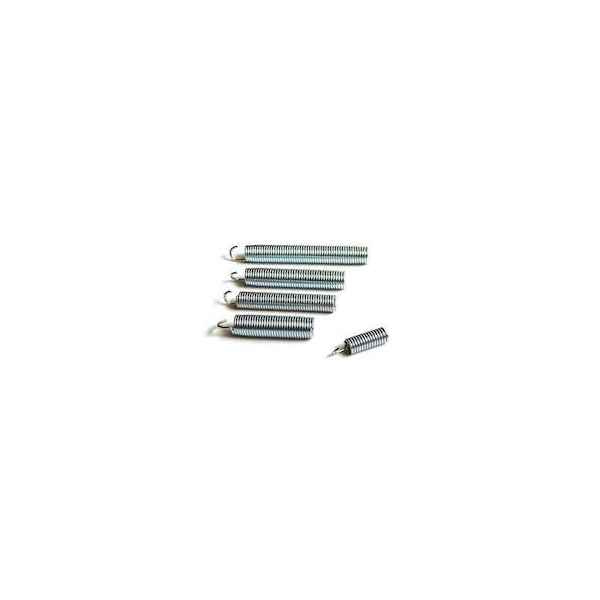
Set of Springs
Set of Springs (Product Code: SCL-485/01d) contains five rust-resistant steel spiral springs of different stiffness, each with a hook at one end, for investigating how springs stretch under load. Because the elastic constants span 20–80 N/m, students can compare soft and stiff springs in a single lesson. Made by Jain Scientific Equipments Pvt Ltd (ScienceLab), Ambala, a scientific instruments manufacturer in India, it serves as a ready Hooke's law spring kit for class practicals.
Specifications
| Parameter | Detail |
|---|---|
| Contents | 5 steel spiral springs |
| Material | Steel, rust resistant |
| Diameter of spring spirals | 15–20 mm |
| Elastic constants | 20–80 N/m |
| End fitting | Hook at one end |
Typical Use
Hang a spring by its hook from a stand, fix a ruler beside it, and add known masses in equal steps. Plotting extension against force gives a straight line whose slope is the spring constant, and repeating the test with each of the five springs shows how stiffness varies across the set. Groups can then combine two springs in series or in parallel and predict the new constant before measuring it.
The same springs work as the core of an SHM experiment kit India teachers use for oscillation studies: pull a loaded spring down a little, release it, and time several oscillations to find the period, then compare how the period changes with mass and with stiffness. Keep loads modest so each spring returns to its original length when unloaded, which is the sign it has stayed within its elastic limit.
Manufacturer
The springs are manufactured by Jain Scientific Equipments Private Limited, an Ambala, Haryana company whose educational products carry the ScienceLab name and are sent to schools and colleges nationwide. Visit the company profile for background on the business.
Related Lab Equipment
A spring investigation also needs a support, loads, a scale and a timer; these catalogue items complete it:
- Stand — the steel rod and base from which the springs are suspended.
- Set Of Marked Masses — hooked masses for loading the springs in equal steps.
- Metal Ruler — for measuring each extension beside the hanging spring.
- Dynamometer — shows how a calibrated spring is used to read force directly.
- Digital Chronometer (Stopwatch) — times oscillations for period measurements.
Find more mechanics apparatus in the Lab Equipment category.
Frequently Asked Questions
How many springs are in the set and how stiff are they?
There are five steel spiral springs, with elastic constants in the range 20–80 N/m. For the constant of each individual spring, please ask us via the contact page.
Will the springs rust in a humid laboratory?
They are made of rust-resistant steel. Wiping off moisture after use and storing them dry will keep them in good condition for longer.
Do the springs have hooks at both ends?
Each spring has a hook at one end for hanging. Masses can be attached at the other end using a hooked mass or a small loop of thread.
Can I use the springs without a stand?
You need some rigid support to hang them from; a laboratory stand with a rod is the most convenient option and keeps the spring vertical beside a ruler.
How do I avoid damaging a spring?
Add load gradually and remove it if the spring no longer returns to its unloaded length. Store the springs unstretched and separately so the coils do not tangle.
Do you supply multiple sets for group practicals?
Yes. Mention the product code SCL-485/01d and the number of sets; we supply institutions across India and international markets.
Request a Quote
Send your requirement for the Set of Springs through the contact page, or add it to the enquiry cart with stands and masses for a combined quotation.
Last updated: 24 September 2026
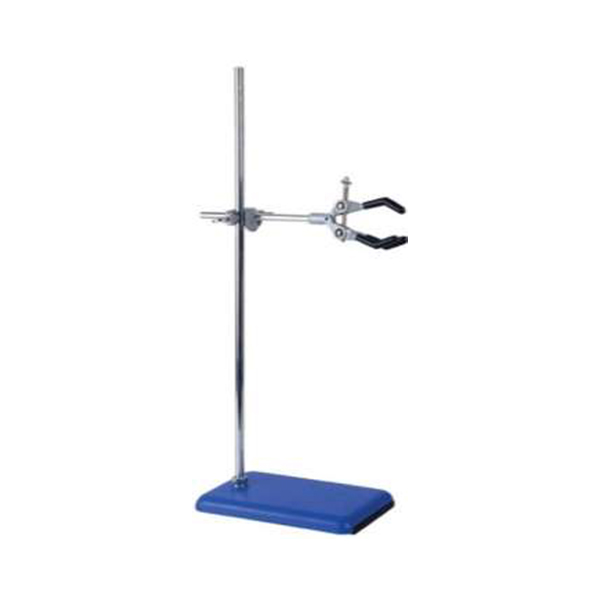
Stand
Stand (Product Code: SCL-987/01e) is a heavy laboratory support stand with a massive steel or cast-iron base and a 600 mm vertical steel rod, used to hold springs, dynamometers, pulleys, levers and other apparatus steady during experiments. It is a basic item in any school lab setup India institutions plan for physics and general science. The stand is made by Jain Scientific Equipments Pvt Ltd (ScienceLab), Ambala, India.
Specifications
| Parameter | Detail |
|---|---|
| Base | Massive steel or cast-iron base, minimum 120 x 200 x 5 mm |
| Rod | Vertical steel rod with anticorrosive coating |
| Rod length | 600 mm |
| Rod diameter | 12 mm |
| Rod fixing | Perpendicular thread on the base |
| Supplied with | Two sockets and pliers |
Typical Use
Screw the rod firmly into the threaded hole so it stands perpendicular to the base, then slide the sockets onto the rod at the heights you need and lock the pliers in them to grip the apparatus. A typical mechanics bench uses one stand to hang a spring or dynamometer, another to carry a pulley or a lever pivot, and sometimes a third to hold a ruler upright for reading extensions.
Teachers comparing lab stand clamp boss head India options should look at stability first: the heavy base resists tipping when a load hangs from the rod, but always position the load over the base rather than beyond its edge. For wider or heavier set-ups, clamp the base to the bench or add weight on it, and check the socket screws are tight before a class begins.
Manufacturer
Jain Scientific Equipments Private Limited manufactures this stand in Ambala, Haryana, and sells its laboratory apparatus under the ScienceLab brand to schools, colleges and dealers. The company profile gives more information about who we are.
Related Lab Equipment
A stand becomes useful once it carries apparatus; these items are commonly mounted on or ordered with it:
- Boss Head — spare connectors for fixing extra clamps or cross-rods to the stand.
- Universal Clamp — grips tubes, rulers and small apparatus of varying sizes.
- Set of Springs — hung from the stand for Hooke's law and oscillation work.
- Pulley — mounted on the rod for simple machine and tension experiments.
- Retort Stand — an alternative stand design from our chemistry range.
Browse the Lab Equipment category for further supports and accessories.
Frequently Asked Questions
What size are the base and rod?
The base is at least 120 x 200 x 5 mm in steel or cast iron, and the rod is 600 mm long with a 12 mm diameter.
What fittings come with the stand?
It is supplied with two sockets and pliers for holding apparatus on the rod. Extra boss heads and clamps can be ordered separately.
Will the rod rust?
The steel rod carries an anticorrosive coating. Wipe off spills promptly and avoid scratching the coating with tools to keep that protection intact.
Can the rod be removed for storage?
Yes, it is fixed by a thread in the base, so it can be unscrewed for compact storage or transport and screwed back in before use.
Is the stand suitable for chemistry work as well as physics?
It can hold light glassware with suitable clamps, but for heating set-ups choose clamps suited to hot glassware and keep the load centred over the base.
How do I order stands for a whole laboratory?
Send the product code SCL-987/01e, the quantity and your delivery address; we quote for institutions across India and international markets.
Request a Quote
For a quotation on the Stand, contact us through the contact page or add it to your enquiry cart together with the clamps and apparatus it will carry.
Last updated: 24 September 2026
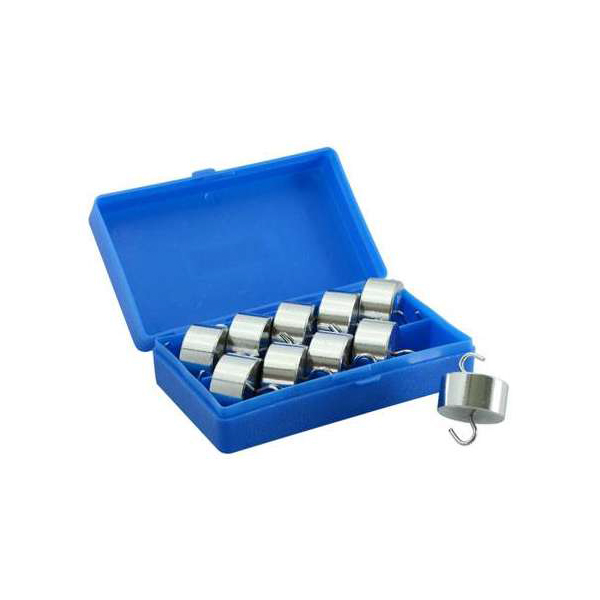
Set Of Marked Masses
Set Of Marked Masses (Product Code: SCL-059/01f) is a boxed set of four 50 g nickel-plated steel masses, each shaped as a cylinder with a central hole and fitted with two wire hooks. The hooks let students hang the masses quickly from springs, levers, pulleys and force meters, making the set a practical piece of laboratory equipment school India teachers reach for in almost every mechanics lesson. It is made by Jain Scientific Equipments Pvt Ltd (ScienceLab), Ambala, India.
Specifications
| Parameter | Detail |
|---|---|
| Pieces in set | 4 |
| Mass of each piece | 50 g |
| Material | Nickel-plated steel |
| Shape | Cylinder with a hole in the middle |
| Hooks | 2 wire hooks per piece |
| Storage | Storage box provided |
Typical Use
Equal 50 g steps make it simple to load a spring or dynamometer progressively and draw a force–extension graph, or to add a known mass to a balance tray when checking a reading. With a moment bar apparatus school students can hang one mass at a measured distance on one side of the pivot and find where two masses must sit on the other side to restore balance, a direct test of the principle of moments.
Over a pulley, the masses provide a steady pulling force for simple machine and friction studies. Encourage students to handle them by the hooks rather than dropping them into place, and to return every piece to the storage box at the end of the lesson so the set stays complete and the plating stays clean.
Manufacturer
ScienceLab is the trading name of Jain Scientific Equipments Private Limited, whose Ambala, Haryana operation manufactures this mass set among many other teaching aids for physics laboratories. More about the company is available on its company profile page.
Related Lab Equipment
Marked masses are the load in many set-ups; these items are the apparatus they are most often used with:
- Lever — a graduated wooden bar with holes for hanging masses at set distances.
- Set of Springs — load the springs in equal steps to find their stiffness.
- Balance — an equal-arm balance for weighing by comparison.
- Pulley — turns the weight of the masses into a horizontal or lifting force.
- Dynamometer — check that each 50 g piece reads as expected on a force scale.
For more mechanics apparatus, open the Lab Equipment category.
Frequently Asked Questions
How many masses are included, and what does each weigh?
The set has 4 pieces of 50 g each, supplied in a storage box.
Why does each mass have two wire hooks?
The hooks make the masses easy to hang from springs, levers and force meters, and to lift without touching the plated surface.
Can I use these masses on a pan balance?
Yes, they can be placed on a balance tray as known masses. For fine weighing, a dedicated weight box is more suitable.
How should the masses be cleaned?
Wipe them with a dry, lint-free cloth. Avoid abrasive cleaners, which can wear the nickel plating, and keep them in the box between lessons.
Can you confirm the accuracy of each mass with a certificate?
Please discuss calibration-certificate availability with us through the contact page before you order.
Are larger quantities available for a school or distributor?
Yes. Send the product code SCL-059/01f with the number of sets; we supply buyers across India and international markets.
Request a Quote
Request pricing for the Set Of Marked Masses via our contact page, or put it in the enquiry cart with the springs, lever or stand you plan to use it with.
Last updated: 24 September 2026
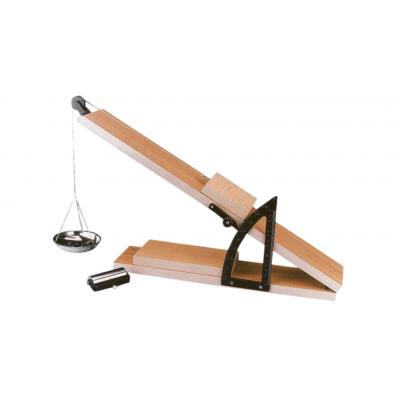
Inclined Plane With Accessories
Inclined Plane With Accessories (Product Code: SCL-871/01g) is a polished wooden tribometer board, 900 mm long, with a metal pulley at one end and a drilled wooden bar that slides along it. Students use it to study friction, forces on a slope and the mechanical advantage of an inclined plane. Schools use this inclined plane apparatus in mechanics practicals. It is made by a scientific instruments manufacturer in India, Jain Scientific Equipments Pvt Ltd (ScienceLab), Ambala, India.
Specifications
| Parameter | Detail |
|---|---|
| Plane (tribometer) | Polished wood, coniferous species, without stubs (knots) |
| Plane dimensions | Length 900 mm, width 100 mm, thickness 25 mm |
| Mounting | Fixing element for attaching to a stand |
| Pulley | Metal pulley at one end, maximum diameter 40 mm, thickness 4 mm |
| Accessory bar | One wooden bar, minimum 30 x 40 x 120 mm |
| Bar holes | Three blind holes of 10 mm diameter, drilled to the middle of the body, symmetrically distributed on each of two adjacent sides |
| Bar hook | Hook in the middle of the small side |
Typical Use
Laid flat on the bench, the board acts as a friction track: hook a force meter to the wooden bar and pull it along at a steady speed to measure sliding friction, then turn the bar onto its other face to compare contact areas, or add masses to see how friction grows with the normal force. Because the bar has holes on two adjacent sides, students can load it evenly in more than one orientation.
Raised on a stand through its fixing element, the board becomes an inclined plane. Tie a thread from the bar's hook over the end pulley to a hanger of masses and you have a simple pulley system lab India teachers use to show the force needed to hold or raise a load up a slope. Gradually tilting the plane until the bar just starts to slide is also a neat way to estimate the coefficient of static friction from the angle.
Manufacturer
Jain Scientific Equipments Private Limited, which trades as ScienceLab in Ambala, Haryana, manufactures the inclined plane and its accessory bar for school physics departments. The company is a registered MSME enterprise (Udyam UDYAM-HR-01-0003714) and handles export shipments under Importer-Exporter Code AAECJ8618A issued by the DGFT. See the company profile for more.
Related Lab Equipment
To run full friction and slope experiments on this board, these catalogue items are the usual companions:
- Dynamometer — hook it to the bar to read the pulling force directly in newtons.
- Stand — supports the plane at an angle through its fixing element.
- Set Of Marked Masses — hang over the pulley or add to the bar to change the load.
- Digital Chronometer (Stopwatch) — time the bar sliding down the slope.
- Inclined Plane with Roller & Pan — an alternative inclined plane design with a roller and pan.
Further mechanics apparatus is listed in the Lab Equipment category.
Frequently Asked Questions
What is included with the inclined plane?
The polished wooden plane with its end pulley and fixing element, plus one wooden bar with blind holes and a hook. Force meters, masses and stands are ordered separately.
How long and wide is the plane?
It is 900 mm long, 100 mm wide and 25 mm thick, made from knot-free coniferous wood with a polished surface.
What are the holes in the wooden bar for?
The three 10 mm blind holes on each of two adjacent sides let you add small loads evenly and use the bar in different orientations when comparing friction.
Can I use it without a stand?
Yes, laid flat it works as a horizontal friction track. To use it as an inclined plane you need a stand or another support attached through the fixing element.
How do I keep the friction results consistent?
Keep the polished surface clean, dry and free of chalk or oil, and wipe both the board and bar before each set of readings.
Can you supply several units for a tender or export order?
Yes. Share the product code SCL-871/01g, quantity and destination; we supply institutions across India and international markets.
Request a Quote
To get a price for the Inclined Plane With Accessories, reach us through the contact page or add it to the enquiry cart along with a dynamometer and masses.
Last updated: 24 September 2026
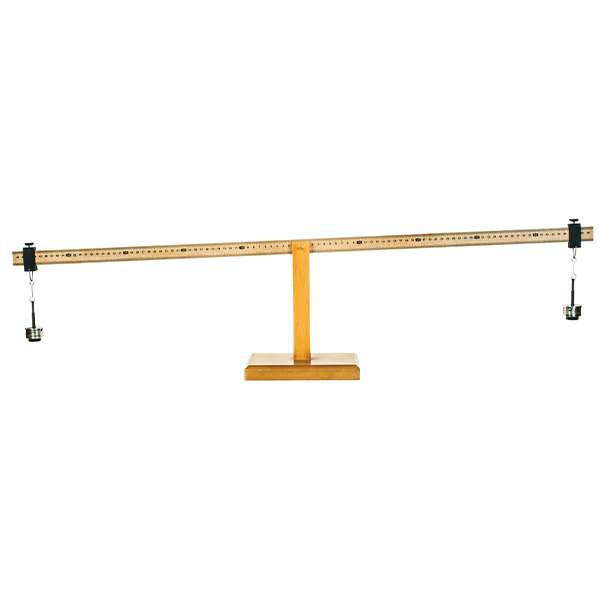
Lever
Lever (Product Code: SCL-121/01h) is a 400 mm graduated wooden bar that pivots on a central rotation axis, used to demonstrate the principle of moments and the conditions for equilibrium. A row of small holes along its centre line lets students hang loads at precise distances from the pivot, and adjusting nuts at each end let the empty bar be balanced first. It is made by Jain Scientific Equipments Pvt Ltd (ScienceLab), Ambala, India, for the physics lab equipment India schools and colleges need for mechanics.
Specifications
| Parameter | Detail |
|---|---|
| Material | Wooden bar |
| Length | 400 mm |
| Cross-section | Minimum 30 x 4 mm |
| Rotation axis | Median (central) axis, minimum diameter 4 mm |
| Holes | 2 mm diameter holes every 15 mm along the median line |
| Graduation | Every 5 mm |
| Balancing | Nuts at both ends for balancing the lever |
Typical Use
Mount the lever on its axis, then turn the end nuts until the unloaded bar rests horizontal; this removes the bar's own weight from the calculation. Hang a mass from a hole on one side, balance it with masses on the other, and read both distances from the 5 mm graduations. Students quickly find that load times distance on the left equals load times distance on the right, and can go on to test first-, second- and third-class lever arrangements.
Used as a simple center of gravity apparatus India teachers can set up in minutes, the bar also shows what happens when the balancing nuts are deliberately moved off-centre: the bar tilts until a compensating load is added. Replacing one set of masses with a force meter lets classes measure an unknown force from its moment.
Manufacturer
From its base in Ambala, Haryana, Jain Scientific Equipments Private Limited manufactures the lever and sells it under its ScienceLab trade name to schools and laboratory suppliers. The company profile explains more about the business.
Related Lab Equipment
These items are needed, or useful, when running moments experiments with the lever:
- Set Of Marked Masses — hooked masses to hang from the lever's holes.
- Stand — a rod stand to support the lever's axis at a convenient height.
- Dynamometer — measures an applied force for calculating unknown moments.
- Balance Demonstration Fulcrum/Lever — an alternative demonstration lever from our physics range.
- Apparatus for Demonstrating the Moment of Force — a dedicated moments demonstrator for the teacher's bench.
See the Lab Equipment category for other mechanics apparatus.
Frequently Asked Questions
How long is the lever and how is it marked?
The bar is 400 mm long and graduated every 5 mm, with 2 mm holes at 15 mm intervals along its centre line.
What are the nuts at the ends for?
They are balancing nuts: turn them to make the empty bar hang level before you add any loads.
Does the lever come with masses or a stand?
The listing covers the lever bar. Masses and a support stand are available separately; ask us if you would like them quoted together.
What loads can hang from the holes?
Use light hooked masses or thread loops through the 2 mm holes, and keep loads moderate so the wooden bar does not bend.
How should the wooden bar be stored?
Store it flat in a dry place, away from heat and damp, so the wood does not warp and the balance point stays true.
What information helps you prepare a quotation?
Please give the product code SCL-121/01h, quantity and delivery location. We serve schools and distributors across India and international markets.
Request a Quote
Ask for pricing on the Lever through the contact page, or add it to the enquiry cart with masses and a stand for a complete moments set-up.
Last updated: 24 September 2026
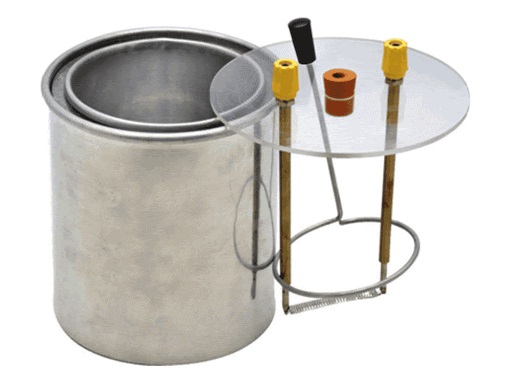
Calorimeter With Accessories
Calorimeter With Accessories (Product Code: SCL-054/02a) is an aluminium double-cup calorimeter with an insulated outer cup, a transparent plastic cap with a thermometer hole, two heating electrodes and a stirrer. It lets students measure heat transfer, specific heat capacity and the heating effect of an electric current with reduced heat loss to the surroundings. This calorimeter lab India schools and colleges use is made by Jain Scientific Equipments Pvt Ltd (ScienceLab), Ambala, India.
Specifications
| Parameter | Detail |
|---|---|
| Inner cup | Aluminium, minimum volume 150 ml |
| Outer cup | Aluminium, with thermal insulation |
| Cap | Transparent plastic, with hole for thermometer |
| Heating | Two heating resistant electrodes, tightened with nuts |
| Accessory | Stirrer |
Typical Use
For the method of mixtures, weigh the empty inner cup, add a known amount of cold water, then drop in a heated solid and stir while watching the thermometer through the cap. The insulated outer cup slows heat exchange with the room, so the final steady temperature is closer to the true value and the specific heat capacity of the solid can be calculated with confidence.
For electrical heating, connect the two electrodes to a suitable low-voltage supply through an ammeter and voltmeter, record current, voltage and time, and compare the electrical energy supplied with the heat gained by the water. The same set-up doubles as thermometry apparatus India teachers use for cooling-curve work: heat the water, switch off, and log the temperature at regular intervals while stirring gently.
Manufacturer
This calorimeter set is manufactured in Ambala, Haryana, by Jain Scientific Equipments Private Limited, a company that trades as ScienceLab and serves physics and chemistry laboratories. For institutional vendor registration, the company's GSTIN is 06AAECJ8618A1ZT and its Legal Entity Identifier is 3358004HRD1JIVXKYX49. More details are on the company profile.
Related Lab Equipment
A complete heat experiment also needs temperature, time, mass and electrical readings; these items cover them:
- Laboratory Thermometer — fits through the cap to follow the water temperature.
- Multimeter — measures the current and voltage fed to the heating electrodes.
- Power Source For Teacher — a bench power source for electrical heating; confirm the output you need with us.
- Digital Chronometer (Stopwatch) — times the heating or cooling period.
- Balance — weighs the cup, water and sample before and after mixing.
More heat and physics apparatus is available in the Lab Equipment category.
Frequently Asked Questions
What does the calorimeter set include?
An aluminium inner cup of at least 150 ml, an insulated aluminium outer cup, a transparent plastic cap with thermometer hole, two heating electrodes fixed with nuts, and a stirrer.
Is a thermometer supplied?
A thermometer is not listed in the set; the cap has a hole to take one. Our laboratory thermometers can be quoted alongside it.
What power supply should I use with the heating electrodes?
Use a low-voltage laboratory supply. Please confirm the recommended voltage and current with us through the contact page before connecting.
Can it be used without the electrical heating part?
Yes. For method-of-mixtures experiments you only need the cups, cap, stirrer and a thermometer; the electrodes simply stay unconnected.
How do I clean the aluminium cups?
Rinse with clean water after each use and dry thoroughly. Avoid strong alkaline cleaners, which attack aluminium.
Is a calibration certificate offered?
Please discuss any calibration-certificate requirement with us via the contact page.
Can you quote for a tender or bulk supply?
Yes. Quote the product code SCL-054/02a with quantity and destination; we supply across India and international markets.
Request a Quote
For prices on the Calorimeter With Accessories, write to us through the contact page or add it to the enquiry cart with thermometers and meters for one combined quotation.
Last updated: 24 September 2026
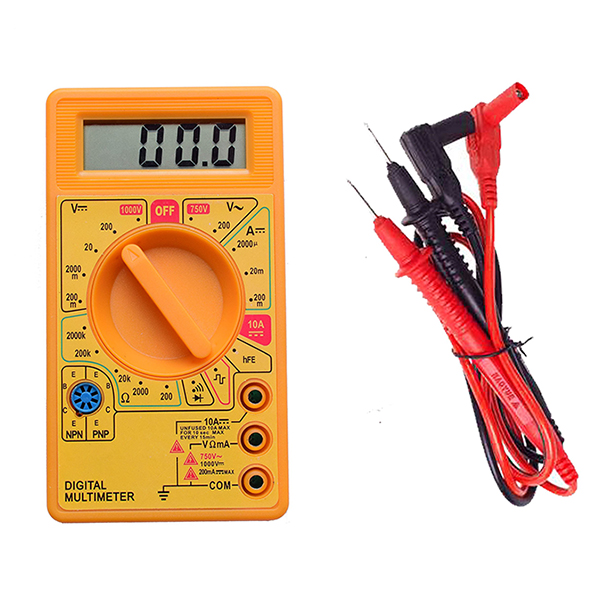
Multimeter
Multimeter (Product Code: SCL-658/03a) is a digital multimeter with a rotary position selector for AC and DC voltage up to 600 V, current on 20 mA and 10 A ranges, capacitance up to 20 µF and resistance from 200 Ω to 200 kΩ. Its 15 mm display figures are easy to read on a crowded bench, and it switches itself off automatically to save the battery. Supplied with probes and battery, it replaces a separate ammeter voltmeter school India labs would otherwise buy, and is made by Jain Scientific Equipments Pvt Ltd (ScienceLab), Ambala, a manufacturer of test and measurement instruments in India.
Specifications
| Parameter | Detail |
|---|---|
| Display | Figures 15 mm high, with automatic disconnection |
| Range selection | Position selector |
| Voltage | Up to 600 V, AC and DC |
| Current (intensity) | 20 mA and 10 A, AC and DC |
| Capacitance | 20 µF |
| Resistance | 200 Ω to 200 kΩ |
| Supplied with | Conductor with probes; battery included |
Typical Use
In an Ohm law experiment kit India students assemble, the multimeter is first placed in series on the milliamp range to read current, then moved across the resistor on a DC voltage range; plotting voltage against current gives the resistance, which can be checked directly on the resistance range once the circuit is switched off. The capacitance range adds a quick check of capacitor values before charging and discharging experiments.
Good practice keeps both students and meter safe: choose the function and a range above the expected value before connecting, move the red lead to the correct socket for the 10 A range, never measure resistance or capacitance in a live circuit, and keep school practicals to low-voltage supplies. The automatic switch-off means a meter left on at the end of a lesson will not flatten its battery.
Manufacturer
Jain Scientific Equipments Private Limited, trading as ScienceLab, makes and distributes electrical measuring apparatus for education from Ambala in Haryana. The company is incorporated under CIN U29309HR2020PTC087597, and its manufacturing premises in the HSIIDC Industrial Area, Saha, Ambala operate under Factory Licence AMB-ONLINE-CHD-J-414. Visit the company profile for more.
Related Lab Equipment
These catalogue items are commonly used with the multimeter in circuit practicals:
- Ohm's Law Apparatus — a ready circuit for voltage–current measurements.
- Connecting Wire — for wiring the meter into series and parallel circuits.
- Analogue Ammeter — a dedicated moving-needle meter for current demonstrations.
- Analogue Voltmeter — pairs with the multimeter so current and voltage are read at once.
- Digital Multimeter — an alternative model from our electricity equipment range.
Find more electrical apparatus in the Lab Equipment category.
Frequently Asked Questions
What can this multimeter measure?
AC and DC voltage up to 600 V, AC and DC current on 20 mA and 10 A ranges, capacitance up to 20 µF, and resistance from 200 Ω to 200 kΩ.
Are test probes and a battery included?
Yes, it is supplied with a conductor with probes, and the battery is included.
What does automatic disconnection mean?
The meter switches itself off after a period without use, which saves the battery when students forget to turn it off.
Is it safe for students to measure mains voltage?
Although the voltage range extends to 600 V, school practicals should use low-voltage supplies; mains measurements should be done only by trained staff following safe procedures.
Can a calibration certificate be supplied?
Please discuss calibration-certificate availability with us through the contact page before ordering.
What warranty is offered?
Warranty terms are stated in each quotation. Ask our team via the contact page for details.
Do you supply multimeters in quantity for laboratories and dealers?
Yes. Send the product code SCL-658/03a, quantity and delivery location; we supply across India and international markets.
Request a Quote
Request a price for the Multimeter via the contact page, or add it to the enquiry cart with leads and circuit apparatus for a single quotation.
Last updated: 24 September 2026

Laparoscopic Set
Laparoscopic Set (Product Code: SLE/LE/003) is a complete high-definition laparoscopy system for hospital operating theatres, combining a 3-chip CMOS full HD camera, a 26-inch medical-grade LED monitor, an LED light source with Safelight optic cable, 5.0 mm and 10.0 mm HD telescopes, a high-flow 45 L CO2 insufflator with gas heating, an HD recorder and documentation system, and a mobile cart with isolation transformer. It is supplied by Jain Scientific Equipments Pvt Ltd (ScienceLab), Ambala, a laboratory instruments supplier in India that also handles operating theatre system enquiries.
Specifications
| Parameter | Detail |
|---|---|
| Camera system | 3-chip CMOS high definition endoscopic video camera with progressive scan; one camera control unit/console and one camera head; HD video at 1920x1080p native resolution |
| Camera head controls | 4 programmable buttons; control of ICG fluorescent viewing; adjustment of cavity backlighting and ICG fluorescence vibrancy; 18 mm coupler with single-handed focusing; ergonomic, lightweight design |
| Image processing | Dynamic Range Enhancement (DRE) for a brighter image in dark and posterior compartments by up to 150%; desaturation to reduce colour saturation; 9 cross-specialty settings for colour and brightness; customisable colour and button settings per surgical specialty |
| Camera interface and outputs | Touch screen LCD interface; two DVI outputs and one S-Video output |
| Monitor | HD medical grade 26" LED flat-panel colour monitor; 1920 x 1080 progressive scan; matches camera head acquisition resolution; supports 16:9; viewing angle > 150 degrees; PAL system compatible; DVI and S-Video inputs; compact and lightweight |
| LED light source | 220 volts, 300 watts; red, green and blue light engine; white light, infrared and endoscopic near-infrared (ICG) visualisation; adjustable intensity in white light and ENV modes; integrated infrared lighted fibres for ureteral detection; capacitive LCD/LED touch screen |
| Light source safety | Stand-by mode to help prevent accidental injury; integrated Safelight technology puts the source into stand-by when the scope is disconnected from the light cable |
| HD telescopes | 5.0 mm and 10.0 mm HD laparoscopes with endoscopic near-infrared visualisation; lens technology for fluorescent and near-infrared wavelengths; aspherical lenses for minimised optical distortion; improved light transmission and edge brightness; laser welded enclosures for durability |
| CO2 insufflator | High flow 45 L with LCD touch display; soft approach pressure control for safe recovery of abdominal pressure; neonatal, bariatric and high flow modes with visual and audible alarms and minimum 0.1 L flow rate; integrated gas heating; internal leakage detection; hose and yoke, heated tubing, tube set adaptor and patient tubing included |
| HD recorder and documentation | Records, manages and archives surgical images and video in native full HD; export to CD/DVD, USB flash drive and hospital network; real-time MPEG-2 HD / MPEG-4 compression with full IBP encoding; progressive scan; image capture 1080p, 720p, 1280x1024p (NTSC/PAL); stereo audio inputs; 1 TB disc capacity |
| Recorder inputs and outputs | Inputs minimum: 2 DVI, 2 S-Video, 1 composite. Outputs: S-Video, composite, DVI and XGA |
| Recorder formats | Images: BMP, JPEG, JPEG2K, TIFF, TGA, PNG. Video: MPEG-1, MPEG-2, MPEG-4. Discs: CD-R, DVD-R, DVD+R (single session), DVD+RW |
| Recorder controls | Wireless infrared remote; camera head triggering remote; on-screen touch panel for patient information and device management; on-console LCD touch screen |
| Mobile cart | Extendible video arm for the monitor; minimum 3 adjustable shelves; 1 CO2 bottle holder; main switch at vertical beam; rides on 4 antistatic dual wheels, 2 with locking brakes |
| Cart electrical | Isolation transformer 230VAC (50/60Hz); inbuilt switches channelled through the isolation transformer; input 240V~50Hz 2.4KVA; output 220/240V~50Hz 2.4KVA max |
Typical Use
The set equips a theatre for minimally invasive abdominal and pelvic surgery. After the insufflator establishes a controlled, warmed CO2 pneumoperitoneum, the surgeon introduces a 5.0 mm or 10.0 mm telescope, the light source illuminates the cavity through the optic cable, and the camera sends a full HD image to the monitor on the cart's video arm. Specialty presets and the programmable camera-head buttons let each surgical team call up its preferred colour and brightness settings without leaving the sterile field.
Where near-infrared imaging is used, the ICG fluorescence mode and infrared lighted fibres help the team visualise structures such as the ureters. The recorder captures still images and video for patient records, teaching and case review, and exports them to disc, USB or the hospital network. Clean and reprocess the telescopes and cables according to your hospital's protocol, and always put the light source into stand-by before disconnecting a scope.
Supplier
Jain Scientific Equipments Private Limited supplies this laparoscopy system through its ScienceLab business in Ambala, Haryana, working with hospitals, medical colleges and procurement agencies on complete theatre requirements. The company profile describes the business in more detail.
Related Lab Equipment
A laparoscopy theatre is normally fitted out with the table, lighting and instrument furniture below:
- O.T. Table Remote Control — its translucent sliding top is designed for laparoscopy and C-arm work.
- Fixed Ceiling O.T lights LED Dual Room — dimmable double-dome lighting for conversion or open steps.
- Instrument Table Mayo type SS On Castors — keeps trocars and hand instruments within reach.
- Instrument Table SS 2 Trays On Castors — a mobile table for cables, tubing and consumables.
The set is listed in our Lab Equipment category.
Frequently Asked Questions
Which units make up the Laparoscopic Set?
A 3-chip CMOS HD camera system, a 26" LED monitor, an LED light source with Safelight optic cable, 5.0 mm and 10.0 mm HD telescopes, a 45 L CO2 insufflator with heated tubing, an HD recorder and documentation system, and a mobile cart with isolation transformer.
Does the system support ICG fluorescence imaging?
Yes. The camera head controls ICG fluorescent viewing, and the light source supports endoscopic near-infrared visualisation using ICG technology.
Is the insufflator suitable for paediatric and bariatric cases?
It offers neonatal, bariatric and high flow modes with visual and audible alarms; clinical suitability for a specific case remains the surgical team's decision.
How are recorded images and videos stored?
On the recorder's 1 TB storage, with export to CD/DVD, USB flash drive or the hospital network in common image and MPEG video formats.
What warranty is offered?
Warranty terms and coverage for each Laparoscopic Set unit are confirmed in the quotation for your order.
Can installation, user training or documentation be arranged?
Please describe your requirements through the contact page; our team will confirm what can be provided with your order.
What should a hospital send for a quotation?
The product code SLE/LE/003, quantity, delivery address and your tender specification. We supply buyers across India and international markets.
Request a Quote
For a quotation on the Laparoscopic Set, contact us via the contact page or add it to the enquiry cart together with the theatre table and lights.
Last updated: 24 September 2026