- Physics Lab Equipment
- Chemistry Lab Equipment
- Biology Lab Equipment
- Anatomical Lab Equipment
- Learning
- Educational Lab Equipment
- Magnets
- Agriculture
- Astronomy
- Earth Science
- Geography Lab Equipment
- Safety Lab Coat
- Laboratory
- Meteorological
- Electricity & Magnetism
- Heat
- School Lab Equipment
- Lab Glassware
- Science Lab Equipment
- Tvet Lab Equipment
- Robotics Kits Supplier and Manufacturer for Schools India
- Math Lab Equipment Manufacturers and Exporters in Ambala
- STEM Kits Manufacturers and Supplier India
- Engineering Lab Equipment
- Hospital Lab Equipment
- Water, Sanitation & Hygiene Supplies
- Cold Chain, Solar & Communication Equipment
- Nutrition
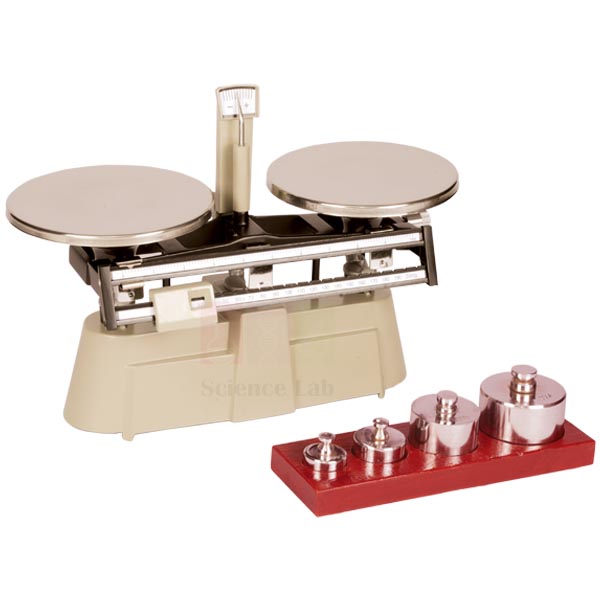
Double Beam Balance
The Double Beam Balance is a two-pan mechanical balance with two beams: one reads 0–200 g in 10 g steps and the other 0–10 g in 0.1 g steps, giving 210 g on the beams. Supplementary masses extend it to 2 kg. Centre-reading sliding masses, a spring-loaded zero adjuster and magnetic damping help groups take readings quickly on its 150 mm stainless steel pans.
Double beam balance specifications
| Parameter | Detail |
|---|---|
| Type | Two-pan balance with two beams |
| Beam ranges | 0–200 g × 10 g and 0–10 g × 0.1 g |
| Total on beams | 210 g |
| Extended range | Up to 2 kg with supplementary masses (whether they are packed with the balance is not stated) |
| Sliding masses | Centre reading |
| Zero adjustment | Spring-loaded zero adjuster |
| Damping | Magnetic damping |
| Pans | Stainless steel, 150 mm diameter |
| Product code | SLE/LB/01 |
| Minimum order | 10 units |
| Dispatch | Usually within 7 to 10 working days |
| Manufacturer | ScienceLab (Jain Scientific Equipments Pvt Ltd), Ambala, India |
Practicals on the two-pan double beam balance
Osmosis in potato cylinders. Make up salt solutions of several strengths with sodium chloride and a measuring cylinder set. Blot and weigh each potato cylinder to 0.1 g, leave it in its solution for a set time, then blot and weigh it again. A graph of percentage change in mass against salt concentration shows where the cells neither gain nor lose water.
Checking packed portions. Put a reference portion of dried peas in a plastic weighing boat on the right pan and a matching empty boat on the left. Fill the left boat with each new portion in turn; the pointer shows at once whether it is heavier or lighter. For a heavier portion, slide the beam masses until the pointer centres to read the excess.
Water lost when fruit dries. Weigh an empty shallow dish, then the dish with thin apple slices, using supplementary masses on the other pan once the load passes 210 g and the beams for the rest. Dry the slices in a warm, airy place for a few days and weigh them again. The loss as a share of the fresh slice mass estimates the water content of the fruit.
Frequently Asked Questions About the Double Beam Balance
Can the balance be used to compare items against a reference?
Yes. Its two pans make comparative weighing simple: put the reference item on one pan and the item under test on the other. The pointer shows straight away which side is heavier. Sliding the beam masses then measures the difference, to 0.1 g on the smaller beam.
What should be checked after the balance is moved to another bench?
Check that the new surface is firm and level, since a sloping bench shifts the rest point. Then recheck the zero with both pans empty and the sliding masses at their zero marks, and correct it with the spring-loaded zero adjuster. Repeat the zero check during long sessions.
How are the supplementary masses used above 210 g?
Place the sample on one pan and the supplementary masses on the other until the sample side is only slightly heavier. Finish the weighing with the two beams. The result is the total of the supplementary masses plus the beam readings, up to the 2 kg limit.
Why must nothing touch the pans or beams while weighing?
A sleeve, a cable, a wall or the edge of a large object can carry part of the load or hold a pan up, and the reading is then wrong. Keep the balance clear on all sides, and ask pupils not to lean on the bench while the pointer settles.
Why can a mass reading not identify what a solid is made of?
Objects of different materials can have the same mass if their sizes differ. To identify a material, measure the volume as well, for example by displacement in a measuring cylinder, and work out the density. Density belongs to the material, while mass depends on how much of it there is.
Why should each pair of pans stay with its own balance?
The pans of one balance are set together with its beam and zero. A pan from another balance can differ slightly in mass, so the zero shifts and readings change. In a room with several balances, keep each pair with its own unit and check the zero if pans are ever swapped.
Accessories and other mechanical balances
- Weighing Paper
- Plastic Weighing Boats
- Triple-Beam Balance
- Balance Single Pan
- Balance Anti-Vibration Table
To request a quotation, send the product name, code and quantity through our contact page or add the item to your enquiry cart.
Last updated: 14 November 2026