- Physics Lab Equipment
- Chemistry Lab Equipment
- Biology Lab Equipment
- Anatomical Lab Equipment
- Learning
- Educational Lab Equipment
- Magnets
- Agriculture
- Astronomy
- Earth Science
- Geography Lab Equipment
- Safety Lab Coat
- Laboratory
- Meteorological
- Electricity & Magnetism
- Heat
- School Lab Equipment
- Lab Glassware
- Science Lab Equipment
- Tvet Lab Equipment
- Robotics Kits Supplier and Manufacturer for Schools India
- Math Lab Equipment Manufacturers and Exporters in Ambala
- STEM Kits Manufacturers and Supplier India
- Engineering Lab Equipment
- Hospital Lab Equipment
- Water, Sanitation & Hygiene Supplies
- Cold Chain, Solar & Communication Equipment
- Nutrition
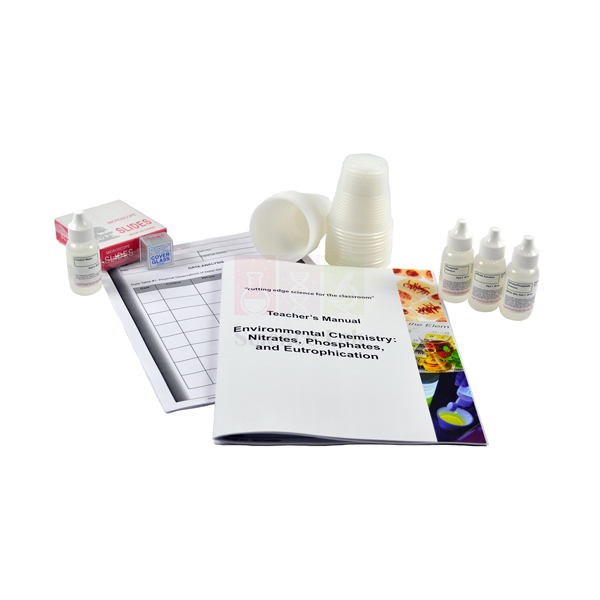
Environmental Chemistry: Nitrates, Phosphates & Eutrophication
Environmental Chemistry: Nitrates, Phosphates & Eutrophication (Product Code: SLE/CH/128) is a water-pollution investigation in which students build miniature ‘ponds’ and compare what happens when nitrates, phosphates, or a combination of the two are added. Along the way learners come to appreciate the importance and value of fresh water and the need to protect and conserve it. With enough materials for 15 groups and a teacher’s manual plus student copy masters, it works as a complete ecology science kit for India’s secondary classrooms and is supplied by Jain Scientific Equipments Pvt Ltd (ScienceLab), Ambala, India.
Key Details
| Parameter | Detail |
|---|---|
| Type | Water-pollution activity kit |
| Investigation | Effects of nitrates, of phosphates and of both together in miniature ‘ponds’ |
| Group capacity | Enough materials for 15 groups |
| Teaching material | Teacher’s manual and student copy masters |
| Learning outcomes | Point-source versus non-point-source pollution; role of nitrates and phosphates in eutrophication; natural and human contributions to water pollution |
Typical Use
Eutrophication begins when excess nutrients reach a lake or pond, feeding a surge of algae; when that growth dies and decays, oxygen in the water is used up and other aquatic life suffers. In this lab each group prepares a set of small ponds, doses them with nitrate, phosphate or both, and then observes and examines how the water changes over time – colour, cloudiness and visible growth. Comparing the three treatments shows students which nutrient drives the change and why the combination matters, while the accompanying discussion shows that a variety of factors, including natural ones, contribute to the overall problem of water pollution.
Keep every pond in the same light and temperature, label them clearly and ask students to keep a dated log with sketches or photographs. Many teachers add a plain-water pond for comparison. By the end, learners should be able to explain the difference between a point source, such as a single discharge pipe, and non-point sources like run-off from fields, which is exactly the kind of outcome a well-structured science kit with manual in India is expected to deliver.
Supplier
The kit is supplied by Jain Scientific Equipments Private Limited, which trades as ScienceLab and operates from Ambala, Haryana, India, serving schools, colleges and training institutes. Our company profile describes the business in more detail.
Related Chemistry Lab Equipment
Items that extend a fresh-water pollution project:
- Water Monitoring Kit, Microscience — lets students test water quality alongside their visual observations
- Water Analysis Kit — for analysing local pond or tap water samples
- Hand Magnifier — to examine growth in the miniature ponds more closely
- Environmental Chemistry: Water Treatment & Filtration — shows how polluted water is made fit for use
- Environmental Chemistry: Acid Rain, Weathering & Erosion — another pollution topic from the same series
See the full Chemistry Lab Equipment range for more classroom kits.
Frequently Asked Questions
What exactly do students compare?
The effects of nitrates, the effects of phosphates, and the effects of the two combined, each in its own miniature pond.
How many groups does the kit serve?
There are enough materials for 15 groups working at the same time.
What is the difference between point and non-point source pollution?
A point source enters water from one identifiable place, such as an outlet pipe; non-point pollution arrives from many diffuse places, such as run-off from farms and streets. The kit’s activity is designed so that students can explain this distinction.
Are the chemicals safe to handle in class?
Use normal laboratory precautions: goggles, hand-washing and supervised disposal. If you need safety information for the kit contents, request it through our contact page.
Is teacher guidance provided?
Yes, a teacher’s manual and student copy masters are included.
Can you supply kits for several schools or overseas?
Yes. We supply institutions in India and international markets; include product code SLE/CH/128, the number of kits and your delivery address in the enquiry.
Request a Quote
Ask for pricing on the eutrophication kit via our contact page, or place it in the enquiry cart together with water-testing items for one consolidated quote.
Last updated: 24 September 2026