- Physics Lab Equipment
- Chemistry Lab Equipment
- Biology Lab Equipment
- Anatomical Lab Equipment
- Learning
- Educational Lab Equipment
- Magnets
- Agriculture
- Astronomy
- Earth Science
- Geography Lab Equipment
- Safety Lab Coat
- Laboratory
- Meteorological
- Electricity & Magnetism
- Heat
- School Lab Equipment
- Lab Glassware
- Science Lab Equipment
- Tvet Lab Equipment
- Robotics Kits Supplier and Manufacturer for Schools India
- Math Lab Equipment Manufacturers and Exporters in Ambala
- STEM Kits Manufacturers and Supplier India
- Engineering Lab Equipment
- Hospital Lab Equipment
- Water, Sanitation & Hygiene Supplies
- Cold Chain, Solar & Communication Equipment
- Nutrition
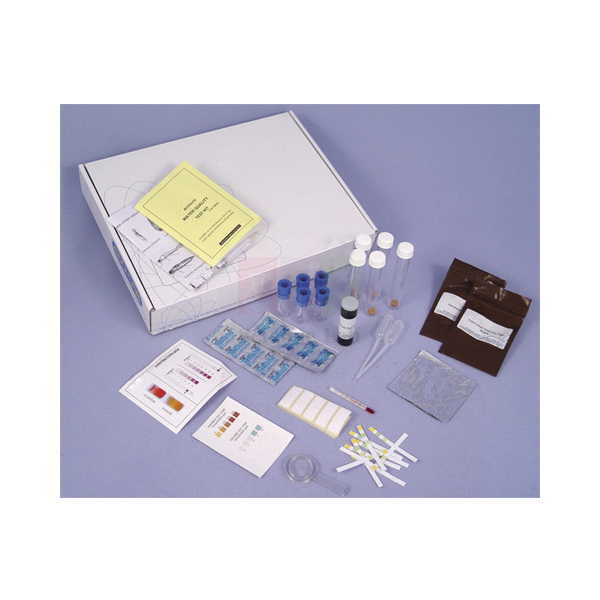
Water Monitoring Kit, Microscience
Water Monitoring Kit, Microscience (Product Code: SLE/CH/180) gives students a simple and safe way to carry out basic water quality tests, with enough equipment for most of the chemical tests on ten different water samples. Its written material is aimed at surface water from rivers and dams, and it helps learners decide whether a source is in good, fair or bad condition and what could be done to improve it. A hands-on environmental science kit for schools and part of our chemistry lab equipment in India, it is manufactured by Jain Scientific Equipments Pvt Ltd (ScienceLab), Ambala.
Specifications
| Parameter | Detail |
|---|---|
| Type | Microscience basic water quality testing kit |
| Sample capacity | Equipment for most of the chemical tests on ten different water samples |
| Written material | Applies to surface water from rivers and dams; some tests can also be done on ground water |
| Residual chlorine test | Applies to treated water only |
| Outcome | Classifies the water tested as good, fair or bad condition |
| Nature of results | Rough qualitative guide for educational purposes only; samples require confirmatory testing at a recognised reference centre |
Typical Use
The kit works best as a project that takes students out of the classroom. Groups collect samples from a nearby river, pond, dam or borewell, label each one with the place, date and time, and bring them back to run the chemical tests using the microscale equipment. Because the kit covers ten different samples, a class can compare upstream and downstream points, or a natural source against treated tap water, where the residual chlorine test becomes meaningful.
Once the results are recorded, students rate each source as good, fair or bad and suggest practical actions, from reducing waste dumping to improving local treatment, which links chemistry to the lives of the people who depend on that water. Teachers should stress that the kit gives a rough qualitative guide only and that any real concern must be confirmed by a recognised reference centre. Wear gloves when handling untreated water, keep samples cool and covered until testing, and wash hands afterwards.
Manufacturer
Jain Scientific Equipments Private Limited makes this kit in Ambala, Haryana, under the ScienceLab name, as part of its range of microscale and environmental science equipment for schools and colleges. The company profile explains who we are and how we support institutions.
Related Chemistry Lab Equipment
Pair the kit with these items for sampling, follow-up study and further analysis:
- Water Sampler — collects samples from below the surface of a river or dam.
- Bottle, Polyethylene, Widemouthed — convenient containers for carrying samples back to school.
- Environmental Chemistry: Water Treatment & Filtration — lets students try improving the water they have tested.
- Titration Kit, Student, Microscience — adds quantitative microscale analysis to the project.
More options are available in our Chemistry Lab Equipment category.
Frequently Asked Questions
How many water samples can be tested with one kit?
There is enough equipment to conduct most of the chemical tests on ten different water samples.
Which types of water is it suitable for?
The written material applies to surface water from rivers and dams, and some tests can also be done on ground water. The residual chlorine test applies to treated water only.
Can the results be used to declare water safe to drink?
No. Results are a rough qualitative guide for educational purposes only, and samples require confirmatory testing at a recognised reference centre.
Which individual tests does the kit cover?
Apart from residual chlorine, the individual tests are not itemised in our product details. Please ask through our contact page for the full test list.
Can consumables be replenished after ten samples?
Tell us what has been used up and we will advise on replacement items and quantities.
Do you supply schools outside India?
Yes. We supply institutions in India and international markets; include the delivery country and number of kits in your enquiry.
Request a Quote
To request pricing for the Water Monitoring Kit, Microscience, use our contact page or add it to the enquiry cart with sampling bottles and other field-work items.
Last updated: 24 September 2026