- Physics Lab Equipment
- Chemistry Lab Equipment
- Biology Lab Equipment
- Anatomical Lab Equipment
- Learning
- Educational Lab Equipment
- Magnets
- Agriculture
- Astronomy
- Earth Science
- Geography Lab Equipment
- Safety Lab Coat
- Laboratory
- Meteorological
- Electricity & Magnetism
- Heat
- School Lab Equipment
- Lab Glassware
- Science Lab Equipment
- Tvet Lab Equipment
- Robotics Kits Supplier and Manufacturer for Schools India
- Math Lab Equipment Manufacturers and Exporters in Ambala
- STEM Kits Manufacturers and Supplier India
- Engineering Lab Equipment
- Hospital Lab Equipment
- Water, Sanitation & Hygiene Supplies
- Cold Chain, Solar & Communication Equipment
- Nutrition
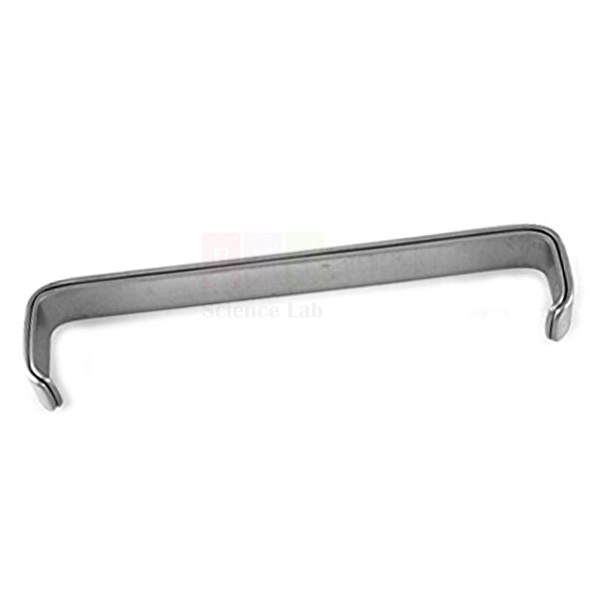
Farabeuf Retractor Double Ended Pair
Farabeuf Retractor Double Ended Pair (Product Code: SLE/SI/10) is a set of two hand-held, double-ended retractors used to hold back skin, fatty tissue, muscle or viscera during superficial surgery in hospital theatres. Surgical assistants work the two retractors together, and the pair is always supplied as two pieces in the large size of approximately 15 cm. It is supplied by Jain Scientific Equipments Pvt Ltd (ScienceLab), Ambala, India, a laboratory instruments supplier in India to hospitals and medical colleges.
Specifications
| Parameter | Detail |
|---|---|
| Material | Austenitic steel (non-quenched, non-magnetic) |
| Composition | 18 to 20% chromium; 8 to 10% nickel |
| Design | Double-ended retractor |
| Supply | Always supplied in pairs |
| Size | Large: approximately 15 cm |
| Intended use | Retracting skin, fatty tissue, muscles or viscera during superficial surgery |
| Product code | SLE/SI/10 |
| Supplied by | Jain Scientific Equipments Pvt Ltd (ScienceLab), Ambala, India |
What Is the Farabeuf Retractor Used For?
A Farabeuf retractor is held by an assistant to draw the edges of a shallow incision apart so the surgeon can see and work in the field. Because each instrument is double-ended, the assistant can turn it round and use the other end without reaching for a new instrument. Used as a pair, one on each side of the wound, the retractors open the field evenly.
In teaching hospitals and surgical skills labs the pair is a routine part of a basic instrument set, and trainees learn to retract with steady, gentle tension rather than force. Clean the retractors promptly after each list and store them together so a pair is never split. Institutions issuing laboratory equipment tenders in India can enter the pair as a single line item.
What to Specify When Ordering
- Number of pairs required (the retractors are only supplied as pairs)
- Confirmation that the large size, approximately 15 cm, suits your procedures
- Companion instruments to be quoted for the same set, such as scalpel handles and tissue forceps
- Delivery address or port
Supplier
Jain Scientific Equipments Private Limited supplies the Farabeuf Retractor Double Ended Pair under its trading name, ScienceLab, from Ambala, Haryana, to hospitals, surgical training centres, dealers and importers.
You can read more about us on the company profile page.
Related Surgical Instruments
Other instruments used when opening and working in a superficial field:
- Scalpel Handle No. 3 — carries the blade that makes the incision before retraction begins
- Tissue Forceps Standard Straight — toothed forceps for lifting the tissue edges
- Collin Abdominal Retractor 3 Blades — a self-holding retractor for deeper abdominal work
- Backhaus Towel Clamp — secures the drapes around the operative field
- Surgical Instruments, Basic Surgery /SET — a grouped set for basic surgical procedures
Browse all items in Surgical Instruments.
Frequently Asked Questions
Why is the Farabeuf Retractor Double Ended Pair sold as a pair?
The Farabeuf Retractor Double Ended Pair is always supplied as two retractors because they are normally used together, one on each side of an incision. Holding both edges back at once opens a superficial wound evenly and gives the surgeon a clear view.
How big is the Farabeuf Retractor Double Ended Pair?
The Farabeuf Retractor Double Ended Pair offered here is the large size, approximately 15 cm long. Each retractor is double-ended, so the assistant can switch to the other end during a procedure without changing instruments.
What is the Farabeuf Retractor Double Ended Pair made of?
The Farabeuf Retractor Double Ended Pair is made of austenitic steel in the non-quenched, non-magnetic condition, containing 18 to 20% chromium and 8 to 10% nickel. A retractor needs no cutting edge, so an unhardened steel of this type suits it.
Is the Farabeuf Retractor Double Ended Pair meant for deep abdominal surgery?
The Farabeuf Retractor Double Ended Pair is intended for superficial surgery, retracting skin, fatty tissue, muscle or viscera close to the surface. For deeper abdominal fields a self-holding design, such as the Collin Abdominal Retractor 3 Blades, is the usual choice.
Who supplies the Farabeuf Retractor Double Ended Pair?
Jain Scientific Equipments Pvt Ltd (ScienceLab), Ambala, Haryana, India, supplies the Farabeuf Retractor Double Ended Pair to hospitals, medical and nursing colleges, dealers and importers in India and international markets.
How do I get a quotation for the Farabeuf Retractor Double Ended Pair?
To get a quotation for the Farabeuf Retractor Double Ended Pair, state the number of pairs, the delivery address or port and any other instruments for the same set, then send the list through our contact page.
Request a Quote
Ask for pricing on the Farabeuf Retractor Double Ended Pair through the contact page, or place the pair in the enquiry cart and submit your full surgical instrument list in one enquiry.
Last updated: 24 September 2026