- Physics Lab Equipment
- Chemistry Lab Equipment
- Biology Lab Equipment
- Anatomical Lab Equipment
- Learning
- Educational Lab Equipment
- Magnets
- Agriculture
- Astronomy
- Earth Science
- Geography Lab Equipment
- Safety Lab Coat
- Laboratory
- Meteorological
- Electricity & Magnetism
- Heat
- School Lab Equipment
- Lab Glassware
- Science Lab Equipment
- Tvet Lab Equipment
- Robotics Kits Supplier and Manufacturer for Schools India
- Math Lab Equipment Manufacturers and Exporters in Ambala
- STEM Kits Manufacturers and Supplier India
- Engineering Lab Equipment
- Hospital Lab Equipment
- Water, Sanitation & Hygiene Supplies
- Cold Chain, Solar & Communication Equipment
- Nutrition
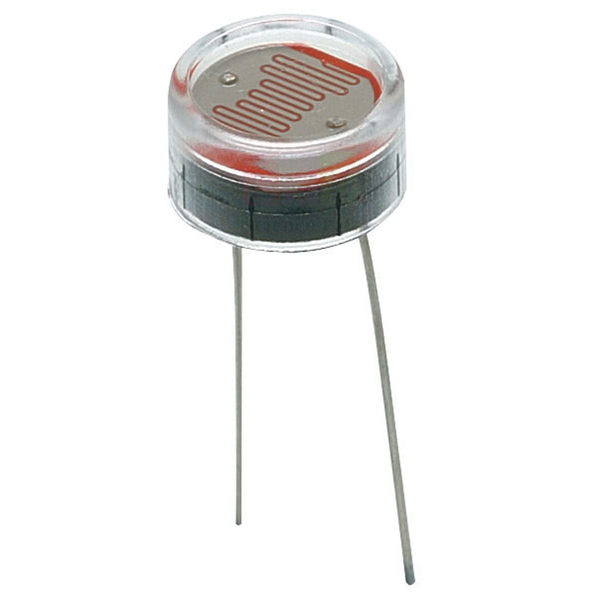
LDR
LDR (Product Code: SLE/PHY/262) is a cadmium sulphide light dependent resistor, a photoconductive cell whose resistance falls as more light reaches it, used for light-sensing experiments in school and college physics and electronics labs. Teachers choose it because its spectral response is similar to that of the human eye, its dark resistance is 1MΩ, and it sits in a robust clear plastic case with a clear end window. It is supplied by Jain Scientific Equipments Pvt Ltd (ScienceLab), Ambala, a physics instruments supplier in India.
Specifications
| Parameter | Detail |
|---|---|
| Type | Cadmium sulphide (CdS) light dependent resistor — photoconductive cell |
| Spectral response | Similar to that of the human eye |
| Behaviour | Resistance reduces as the light falling on the LDR increases |
| Dark resistance | 1MΩ |
| Resistance at 1 ftc (foot-candle) | 5.4kΩ min, 12.6kΩ max |
| Maximum voltage | 250V peak AC or DC |
| Power dissipation | 250mW max. |
| Operating temperature | –60°C to +75°C |
| Dimensions, top | 14.35 x 7mm (dia. x d) |
| Pin length | 9.53mm |
| Protection | Moisture-resistant coating; enclosed in a robust clear plastic case with a clear end window |
| Product code | SLE/PHY/262 |
| Supplied by | Jain Scientific Equipments Pvt Ltd (ScienceLab), Ambala, India |
What Is an LDR Used For?
In class, the simplest investigation is to connect the LDR to a multimeter set to resistance and take readings in darkness, in room light and under a lamp, or at several distances from the lamp, then plot resistance against light level. In circuits, an LDR is combined with a fixed resistor as a potential divider so that the output voltage changes with brightness — the principle behind automatic night lights, light meters and light-operated alarms. Its eye-like spectral response makes it a sensible choice for any opto-electronics experiment kit that measures light as people perceive it.
Keep within the 250V peak and 250mW limits by adding a suitable series resistor, bend the pins gently when fitting it to a board, and keep the clear window free of fingerprints. Because the sensing element contains cadmium, do not break open the casing, and dispose of damaged units according to local rules for electronic waste.
Supplier
Jain Scientific Equipments Private Limited, known by its trading name ScienceLab, supplies this LDR from Ambala, Haryana, as part of its range of physics and electronics teaching components. Schools, colleges, training institutes and dealers in India and international markets can order it with meters, resistors and power sources in one enquiry. Visit the ScienceLab profile for company information.
Related Physics Lab Equipment
Items that help students build and measure light-sensing circuits:
- Simple Circuit Module Light Dependent Resistor Board — an LDR on a module for plug-together circuit kits
- Miniature LDR — a smaller alternative for compact circuits
- Standard Digital Multimeter — to measure the change in resistance with light
- Lamp Holder — to hold a bulb as a controllable light source
- Mounted Solar Cell — a light-sensitive device that generates a voltage, for comparison
More items are listed under Physics Lab Equipment.
Frequently Asked Questions
How does the LDR work?
The LDR is a cadmium sulphide photoconductive cell: light falling on it frees charge carriers in the material, so its resistance drops as the light gets brighter. In darkness its resistance is high, at 1MΩ, which gives a large and easily measured change.
What is the resistance of the LDR in light and dark?
The LDR has a dark resistance of 1MΩ. At an illumination of 1 foot-candle its resistance lies between 5.4kΩ minimum and 12.6kΩ maximum, so students see a clear fall in resistance as light increases.
What voltage and power can the LDR handle?
The LDR is rated for a maximum of 250V peak AC or DC and a power dissipation of 250mW maximum. In student circuits, a series resistor keeps the current, and therefore the power in the LDR, safely below that limit.
Can the LDR be used in humid or cold conditions?
The LDR is encapsulated in a moisture-resistant coating inside a plastic case, and its operating temperature range is –60°C to +75°C. It should still be kept away from direct water and stored dry between practicals.
What experiments can students do with the LDR?
Students can use the LDR to plot resistance against light level, build a potential divider whose output voltage changes with brightness, or make a simple light-activated switch or alarm. Each shows how a sensor turns light into an electrical signal.
Who supplies the LDR?
The LDR is supplied by Jain Scientific Equipments Pvt Ltd (ScienceLab) of Ambala, Haryana, India. The company provides it to schools, colleges, electronics training centres and dealers in India and international markets, alongside other circuit components.
What should I send to get a quote for the LDR?
To get a quote for the LDR, send the product code SLE/PHY/262, the number of pieces, any meters or circuit boards you want with it, and the delivery location through the contact page or the enquiry cart.
Request a Quote
To buy LDRs for your lab, add the item to the enquiry cart or use the contact page; mention the quantity and whether you need matching components.
Last updated: 24 September 2026