- Physics Lab Equipment
- Chemistry Lab Equipment
- Biology Lab Equipment
- Anatomical Lab Equipment
- Learning
- Educational Lab Equipment
- Magnets
- Agriculture
- Astronomy
- Earth Science
- Geography Lab Equipment
- Safety Lab Coat
- Laboratory
- Meteorological
- Electricity & Magnetism
- Heat
- School Lab Equipment
- Lab Glassware
- Science Lab Equipment
- Tvet Lab Equipment
- Robotics Kits Supplier and Manufacturer for Schools India
- Math Lab Equipment Manufacturers and Exporters in Ambala
- STEM Kits Manufacturers and Supplier India
- Engineering Lab Equipment
- Hospital Lab Equipment
- Water, Sanitation & Hygiene Supplies
- Cold Chain, Solar & Communication Equipment
- Nutrition
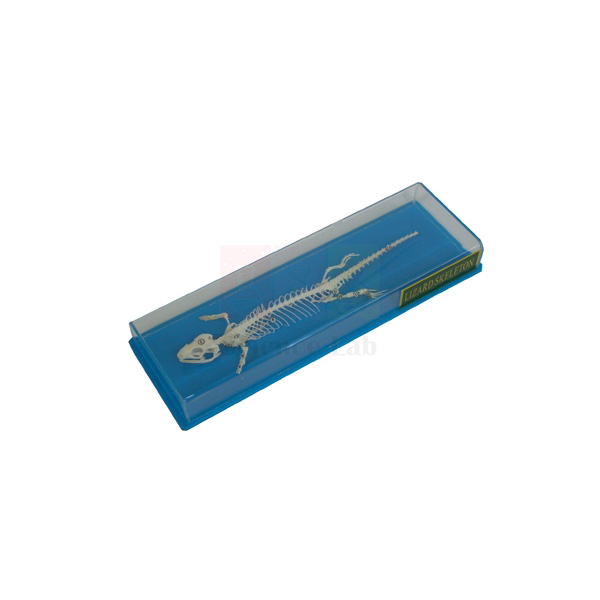
Lizard Skeleton
Lizard Skeleton (Product Code: SLE/EZ/06) is a real lizard skeleton, mounted in its natural position, used to teach reptile anatomy in school and college zoology laboratories. Teachers and students use it to study the skull, backbone, ribs and sprawling limbs of a reptile, presented on a base under an acrylic cover in a 230 x 77 x 30 mm case. It is supplied by Jain Scientific Equipments Pvt Ltd (ScienceLab), Ambala, India, as part of its zoology lab equipment range.
Specifications
| Parameter | Detail |
|---|---|
| Specimen | Natural bone |
| Mounting | Mounted in natural position |
| Presentation | On a base with acrylic cover |
| Case size | 230 x 77 x 30 mm |
| Product code | SLE/EZ/06 |
| Supplied by | Jain Scientific Equipments Pvt Ltd (ScienceLab), Ambala, India |
What Is the Lizard Skeleton Used For?
In a vertebrate practical, the lizard skeleton lets students pick out the features that mark a reptile: limbs that project sideways from the body, a long tail built from many small vertebrae, and ribs running along much of the trunk. Because the bones are mounted in the animal's natural stance, learners can see how the shoulder and hip girdles hold the body close to the ground, and relate that posture to how lizards move and hunt.
Teachers often place it next to amphibian and snake skeletons so a class can sort the three by limb structure and body plan, which makes it a practical lab specimen for biology teaching in India and elsewhere. Pass the case around rather than opening it, and use a hand lens for the fine toe bones and teeth. Keep it away from direct sunlight, and dust the acrylic with a soft, dry cloth.
Supplier
Jain Scientific Equipments Private Limited, which trades as ScienceLab, supplies this natural lizard skeleton from Ambala, Haryana. Schools, colleges, universities and distributors can source it together with other vertebrate skeletons and zoology teaching aids, for delivery across India and to international markets. More about the company is on the company profile page.
Related Zoology Equipment
Items that pair well with the lizard skeleton in a vertebrate comparison lesson:
- Snake Skeleton — a limbless reptile to compare with the lizard's four limbs and girdles.
- Frog Skeleton — an amphibian skeleton for contrasting ribs, spine and limb proportions.
- Lizard Dissection — a preserved specimen showing the soft organs the skeleton supports.
- Magnifying Glass — for close viewing of small bones such as toes and teeth.
The Zoology category lists more skeletons, nets, trays and field-study equipment.
Frequently Asked Questions
Is the Lizard Skeleton made from real bone?
Yes. The Lizard Skeleton (SLE/EZ/06) is natural bone, mounted in the animal's natural position rather than cast in plastic. As with any real specimen, small differences in size and bone detail from one piece to the next are normal.
What size is the Lizard Skeleton case?
The Lizard Skeleton is presented on a base with an acrylic cover in a case measuring 230 x 77 x 30 mm. The compact case suits bench-top display and can be passed around a class for close viewing.
Can students handle the bones of the Lizard Skeleton?
The Lizard Skeleton is meant to be viewed through its acrylic cover rather than handled. Keeping the cover in place protects the fine limb, toe and tail bones, so the same specimen can serve many classes over the years.
Which lizard species is used for the Lizard Skeleton?
The listing does not name the species used for the Lizard Skeleton. If your syllabus needs a particular species, ask through our contact page before ordering and we will tell you what can be supplied.
How should the Lizard Skeleton be stored?
Store the Lizard Skeleton in a dry cupboard away from heat and direct sunlight, and clean only the acrylic cover with a soft, dry cloth. Avoid solvent cleaners, which can cloud acrylic, and keep the cover closed.
Who supplies the Lizard Skeleton?
The Lizard Skeleton is supplied by Jain Scientific Equipments Pvt Ltd (ScienceLab), Ambala, Haryana, India. The company quotes single pieces and sets of vertebrate skeletons to schools, colleges and dealers in India and international markets.
What does a quotation request for the Lizard Skeleton need?
To quote the Lizard Skeleton we need the quantity, the delivery city or country, and any other zoology specimens you want on the same order. Send these details through the contact page or add the item to the enquiry cart.
Request a Quote
For a quotation on the Lizard Skeleton, send the quantity and delivery location through our contact page, or add it with other specimens to the enquiry cart.
Last updated: 24 September 2026