- Physics Lab Equipment
- Chemistry Lab Equipment
- Biology Lab Equipment
- Anatomical Lab Equipment
- Learning
- Educational Lab Equipment
- Magnets
- Agriculture
- Astronomy
- Earth Science
- Geography Lab Equipment
- Safety Lab Coat
- Laboratory
- Meteorological
- Electricity & Magnetism
- Heat
- School Lab Equipment
- Lab Glassware
- Science Lab Equipment
- Tvet Lab Equipment
- Robotics Kits Supplier and Manufacturer for Schools India
- Math Lab Equipment Manufacturers and Exporters in Ambala
- STEM Kits Manufacturers and Supplier India
- Engineering Lab Equipment
- Hospital Lab Equipment
- Water, Sanitation & Hygiene Supplies
- Cold Chain, Solar & Communication Equipment
- Nutrition
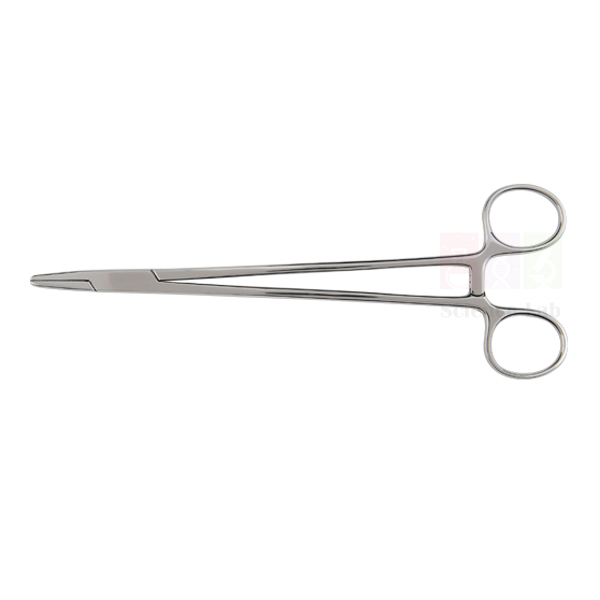
Mayo Hegar Needle Holder Straight
Mayo Hegar Needle Holder Straight (Product Code: SLE/SI/17) is an 18 cm straight needle holder used to grip suture needles while stitching in operating theatres, emergency rooms and suturing workshops. Surgeons and trainees rely on its ridged jaws, a longitudinal groove that protects the needle from deterioration, and a ratchet that sets the grip at varying tightness. It is supplied by Jain Scientific Equipments Pvt Ltd (ScienceLab), Ambala, India, a laboratory equipment supplier in India for hospitals and clinical skills labs.
Specifications
| Parameter | Detail |
|---|---|
| Material | Martensitic steel (quenched, magnetic) |
| Composition | 0.20% carbon; 13% chromium |
| Jaws | Pronounced ridges, with a well-defined longitudinal groove to prevent deterioration of the needle |
| Lock | Ratchet allowing the needle to be gripped with varying tightness |
| Shape | Straight |
| Length | 18 cm |
| Intended use | Holding suture needles while stitching |
| Product code | SLE/SI/17 |
| Supplied by | Jain Scientific Equipments Pvt Ltd (ScienceLab), Ambala, India |
What Is the Mayo Hegar Needle Holder Used For?
A needle holder clamps a curved suture needle so it can be driven through tissue with a controlled wrist rotation. The Mayo Hegar pattern looks like a short, heavy-jawed forceps: the ridged jaws stop the needle from twisting, the longitudinal groove seats it without flattening it, and the ratchet holds the chosen grip so the surgeon does not need to squeeze throughout each bite.
Grip the needle about two-thirds of the way back from the point, engage only the first notches of the ratchet for finer needles, and release fully before repositioning. The instrument is also used for instrument-tied knots. Medical and nursing colleges choosing lab equipment for college suturing practice in India pair it with toothed forceps and suture scissors at each student station.
Supplier
Under its ScienceLab brand, Jain Scientific Equipments Private Limited supplies the Mayo Hegar Needle Holder Straight from Ambala, Haryana, to theatres, emergency departments, clinical skills centres and distributors. Suturing instruments are often ordered as complete student or ward sets, and the company can price every component in one quotation.
Company details are on our profile page.
Related Surgical Instruments
Instruments that complete a suturing setup:
- Tissue Forceps Standard Straight — holds the wound edge while the needle passes through
- Mayo Scissors Curved Blunt/Blunt — trims the thread after each knot
- Surgical Instruments, suture /SET — a grouped set for suturing work
- Allis Tissue Forceps — grips soft tissue that needs holding during closure
- Dressing Forceps Standard Straight — applies the dressing once the wound is closed
See more in Surgical Instruments.
Frequently Asked Questions
What is the Mayo Hegar Needle Holder Straight used for?
The Mayo Hegar Needle Holder Straight is used for holding suture needles while stitching. It clamps the needle firmly so it can be driven through tissue, and it is also used to tie knots with the instrument.
How long is the Mayo Hegar Needle Holder Straight?
The Mayo Hegar Needle Holder Straight is 18 cm long with straight jaws. This general-purpose length suits skin and superficial closure and is a common size for suturing practice in teaching labs.
Why do the jaws of the Mayo Hegar Needle Holder Straight have a groove?
The jaws of the Mayo Hegar Needle Holder Straight have a well-defined longitudinal groove to prevent deterioration of the needle. The groove seats the needle, while the pronounced ridges on the jaws stop it from rotating.
How does the ratchet on the Mayo Hegar Needle Holder Straight work?
The ratchet on the Mayo Hegar Needle Holder Straight locks the handles at successive notches, so the needle can be gripped with varying tightness. A lighter setting suits fine needles and a firmer one suits heavier needles.
What steel is the Mayo Hegar Needle Holder Straight made of?
The Mayo Hegar Needle Holder Straight is made of quenched, magnetic martensitic steel with 0.20% carbon and 13% chromium, a hardened steel type commonly used for instrument jaws.
Who supplies the Mayo Hegar Needle Holder Straight?
The Mayo Hegar Needle Holder Straight is supplied by Jain Scientific Equipments Pvt Ltd (ScienceLab), Ambala, Haryana, India, to hospitals, colleges and distributors in India and international markets. Ask for a quote through our contact page.
Request a Quote
Price the Mayo Hegar Needle Holder Straight by sending your quantity through the contact page, or add it to the enquiry cart with the forceps and scissors for your suturing sets.
Last updated: 24 September 2026