- Physics Lab Equipment
- Chemistry Lab Equipment
- Biology Lab Equipment
- Anatomical Lab Equipment
- Learning
- Educational Lab Equipment
- Magnets
- Agriculture
- Astronomy
- Earth Science
- Geography Lab Equipment
- Safety Lab Coat
- Laboratory
- Meteorological
- Electricity & Magnetism
- Heat
- School Lab Equipment
- Lab Glassware
- Science Lab Equipment
- Tvet Lab Equipment
- Robotics Kits Supplier and Manufacturer for Schools India
- Math Lab Equipment Manufacturers and Exporters in Ambala
- STEM Kits Manufacturers and Supplier India
- Engineering Lab Equipment
- Hospital Lab Equipment
- Water, Sanitation & Hygiene Supplies
- Cold Chain, Solar & Communication Equipment
- Nutrition
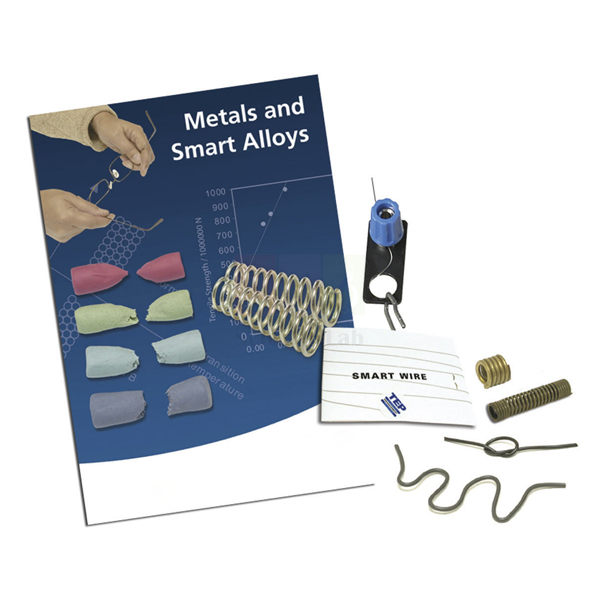
Metals and Smart Alloys Starter Pack
Metals and Smart Alloys Starter Pack (Product Code: SLE/CH/149) is school chemistry lab equipment in India that brings together a variety of smart alloys — a two-way memory spring, a smart spring, smart wire, memory wire and superelastic wire — with wire holders for securing the materials during experiments. It gives students hands-on contact with metals that recover a remembered shape when warmed or spring back from bending that would permanently deform an ordinary wire, topics that many GCSE courses refer to under smart alloys and shape memory alloys. The practical activities are described in the accompanying booklet ‘Metals and smart alloys’. It makes a compact STEM science kit for India’s secondary classrooms and is supplied by Jain Scientific Equipments Pvt Ltd (ScienceLab), Ambala.
Specifications
| Parameter | Detail |
|---|---|
| Smart alloy items | Two-way memory spring, smart spring, smart wire, memory wire, superelastic wire |
| Accessories | Wire holders for securing the materials |
| Activity guide | Accompanying booklet ‘Metals and smart alloys’ |
| Curriculum link | Smart alloys and shape memory alloys, referred to in many GCSE courses |
Typical Use
A typical first demonstration is the shape memory effect: bend a length of memory wire into a new shape at room temperature, then lower it into warm water and watch it return to its original form. The two-way memory spring goes a step further, changing shape as it is warmed and changing back as it cools, which shows students that the alloy “remembers” two states. The superelastic wire makes a striking contrast — it can be bent sharply and springs straight again without any heating at all. The wire holders keep each sample in place so students can observe and compare them safely.
Placing an ordinary metal wire alongside the smart alloys helps students see the difference between permanent deformation and shape recovery, and leads naturally into discussion of real applications such as spectacle frames, dental braces and small actuators. Use warm water rather than a naked flame to trigger shape changes, and handle hot beakers with tongs. The pack is also a strong starting point for a science fair project kit in India, where students can investigate the temperatures at which each item changes shape.
Supplier
ScienceLab — the trading name of Jain Scientific Equipments Private Limited, based in Ambala, Haryana — supplies this starter pack as part of its chemistry and materials-science teaching range. The company can quote the pack together with the beakers, thermometers and tongs used in the activities, for schools and colleges in India and international markets. Our company profile has more about the business.
Related Laboratory Equipment
Smart alloy lessons rely on warm water, temperature readings and safe handling; these items support that work or extend the materials topic.
- Fabrics Sample Pack — another materials sample set for properties lessons.
- Physical Properties of Glass — a companion activity on how materials behave.
- Glass Beaker — for the warm-water baths that trigger shape recovery.
- Digital Thermometer — records the water temperature at which each item changes.
- Beaker Tongs — safe handling of hot beakers during demonstrations.
More teaching kits are in our Chemistry Lab Equipment category.
Frequently Asked Questions
What is included in the pack?
A two-way memory spring, smart spring, smart wire, memory wire, superelastic wire, wire holders and the booklet ‘Metals and smart alloys’.
Does it come with activity instructions?
Yes. The practical activities are described in the accompanying booklet.
How is the shape memory effect triggered?
Usually by warming, for example in warm water. Follow the booklet for each item, since the springs and wires respond differently.
Can the alloys be used again and again?
Smart alloys can generally be cycled repeatedly if handled with care. Avoid heating them in a flame or kinking them sharply, and store them as the booklet advises.
What lengths or quantities of wire are supplied?
These are not stated on this page. Please ask through our contact page if you need exact quantities for planning.
Is it only for GCSE courses?
Many GCSE courses refer to smart alloys, but the pack suits any secondary syllabus that covers the properties and uses of metals and materials.
Can you supply several packs or ship abroad?
Yes. Send the product code SLE/CH/149, quantity and delivery address; we supply India and international markets.
Request a Quote
To price the Metals and Smart Alloys Starter Pack, reach us through the contact page or add it to the enquiry cart with any beakers or thermometers you need.
Last updated: 24 September 2026