- Physics Lab Equipment
- Chemistry Lab Equipment
- Biology Lab Equipment
- Anatomical Lab Equipment
- Learning
- Educational Lab Equipment
- Magnets
- Agriculture
- Astronomy
- Earth Science
- Geography Lab Equipment
- Safety Lab Coat
- Laboratory
- Meteorological
- Electricity & Magnetism
- Heat
- School Lab Equipment
- Lab Glassware
- Science Lab Equipment
- Tvet Lab Equipment
- Robotics Kits Supplier and Manufacturer for Schools India
- Math Lab Equipment Manufacturers and Exporters in Ambala
- STEM Kits Manufacturers and Supplier India
- Engineering Lab Equipment
- Hospital Lab Equipment
- Water, Sanitation & Hygiene Supplies
- Cold Chain, Solar & Communication Equipment
- Nutrition
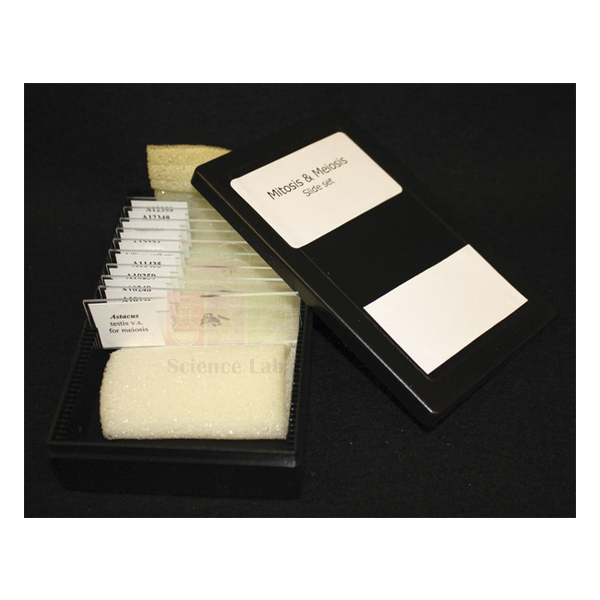
Mitosis & Meiosis Set, Microscope Slides
Mitosis & Meiosis Set, Microscope Slides (Product Code: SLE/PS/78) is a set of 10 prepared microscope slides used to compare mitosis and meiosis in plant and animal tissue during biology practicals. An onion root tip shows mitosis, five lily anther sections follow meiosis from early prophase to the second division, and crayfish and locust slides add animal material. It is supplied by Jain Scientific Equipments Pvt Ltd (ScienceLab), Ambala, India, as a microscope slides set for schools and colleges.
Specifications
| Parameter | Detail |
|---|---|
| Number of slides | 10 |
| Plant mitosis | Allium (onion) root tip LS |
| Plant meiosis | Lilium (lily) anthers TS – early prophase; late prophase; metaphase; late first division; second division |
| Animal testis | Astacus (crayfish) testis VS; Locust testis VS; Locust testis squash |
| Embryo | Locust embryo squash |
| Product code | SLE/PS/78 |
| Supplied by | Jain Scientific Equipments Pvt Ltd (ScienceLab), Ambala, India |
What Is a Mitosis and Meiosis Slide Set Used For?
Students first examine the onion root tip, where dividing cells show the stages of mitosis, then move to the five lily anther slides, which follow meiosis in sequence from early prophase to the second division. Seeing the stages in order lets them identify chromosome pairing, alignment and separation for themselves instead of relying only on textbook diagrams.
The animal slides widen the comparison: the crayfish and locust testis preparations show meiosis in developing sperm cells, while the locust embryo squash shows dividing cells in a growing animal. Ask students to draw each stage with labels and then list how the products of mitosis and meiosis differ in chromosome number.
Supplier
Jain Scientific Equipments Private Limited trades as ScienceLab from Ambala, Haryana, and supplies this ten-slide cell division set to schools, colleges, universities, dealers and importers in India and international markets. The set can be combined with other prepared slide collections, models and microscopes in a single order. Company details are on the ScienceLab profile.
Related Prepared Slides
Resources that support the same cell division lessons:
- Cell Division Slide Set of 9 — additional cell division slides for comparison.
- Microslide Meiosis — a lesson-based set focused on meiosis.
- Meiosis Model — a model to explain the stages before students look at slides.
- Basic Botany Slide (Set of 25) — wider plant material, including an onion root apex slide.
- Binocular Microscope 1000x mag — for viewing chromosomes at high magnification.
Explore all slide sets in the Prepared Slides category.
Frequently Asked Questions
Which slides are in the Mitosis & Meiosis Set, Microscope Slides?
The Mitosis & Meiosis Set, Microscope Slides contains 10 slides: Astacus testis VS, Allium root tip LS, five Lilium anther TS slides from early prophase to second division, Locust testis VS, Locust testis squash and Locust embryo squash.
Which slide in the set shows mitosis?
In the Mitosis & Meiosis Set, Microscope Slides, the Allium (onion) root tip LS is the main slide for mitosis, because the root tip is a region of rapid cell division. The Locust embryo squash also shows dividing cells in animal tissue.
Which stages of meiosis does the set show?
The five Lilium anther slides in the Mitosis & Meiosis Set, Microscope Slides show early prophase, late prophase, metaphase, late first division and the second division. Studying them in order lets students follow meiosis step by step.
What is a squash preparation?
A squash preparation, used for the locust testis and locust embryo slides in the Mitosis & Meiosis Set, Microscope Slides, is made by gently pressing tissue flat under a cover slip. This spreads the cells into a thin layer so chromosomes are easier to see.
Which courses is the Mitosis & Meiosis Set, Microscope Slides suited to?
The Mitosis & Meiosis Set, Microscope Slides suits senior school and undergraduate biology, where students compare the two types of cell division using plant and animal material. Teachers can also use it for class demonstrations at the microscope.
Who supplies the Mitosis & Meiosis Set, Microscope Slides?
The Mitosis & Meiosis Set, Microscope Slides (SLE/PS/78) is supplied by Jain Scientific Equipments Pvt Ltd (ScienceLab), Ambala, India. Institutions, dealers and importers in India and international markets can order single sets or several sets for parallel practical groups.
Request a Quote
Add the Mitosis & Meiosis Set, Microscope Slides to the enquiry cart or tell us through the contact page how many sets you need and where they should be delivered.
Last updated: 24 September 2026