- Physics Lab Equipment
- Chemistry Lab Equipment
- Biology Lab Equipment
- Anatomical Lab Equipment
- Learning
- Educational Lab Equipment
- Magnets
- Agriculture
- Astronomy
- Earth Science
- Geography Lab Equipment
- Safety Lab Coat
- Laboratory
- Meteorological
- Electricity & Magnetism
- Heat
- School Lab Equipment
- Lab Glassware
- Science Lab Equipment
- Tvet Lab Equipment
- Robotics Kits Supplier and Manufacturer for Schools India
- Math Lab Equipment Manufacturers and Exporters in Ambala
- STEM Kits Manufacturers and Supplier India
- Engineering Lab Equipment
- Hospital Lab Equipment
- Water, Sanitation & Hygiene Supplies
- Cold Chain, Solar & Communication Equipment
- Nutrition
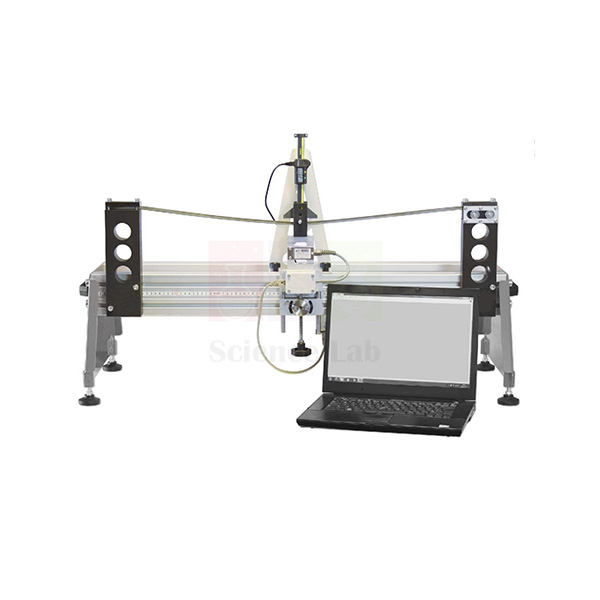
Plastic Bending Of Beams
Plastic Bending Of Beams (Product Code: SLE/EG/10) is an experiment in which a specimen beam is loaded at mid-span until it yields and forms plastic hinges, under three different end conditions: simply supported, fixed, or propped cantilever. A load cell assembly both applies and measures the force, a precision indicator tracks deformation, and one support runs on roller bearings to allow horizontal movement. It helps students see how a structural element can yield yet keep carrying load. The apparatus is made by Jain Scientific Equipments Pvt Ltd (ScienceLab), Ambala, as lab equipment for college and university structures courses.
Key Details
| Parameter | Detail |
|---|---|
| Type | Plastic bending and hinge formation experiment for beams |
| Support conditions | Simply supported, fixed or propped cantilever |
| Supports | Two; one includes roller bearings to allow horizontal translation |
| Loading | Load cell assembly applies and measures force at mid-span |
| Deformation measurement | Precision indicator |
| Concepts covered | Hinge position, failure load, yield moment, fully plastic moment and form (shape) factor |
| Prediction methods | Textbook beam equations and bending moment diagrams |
Typical Use
For each end condition, students first sketch the elastic bending moment diagram, work out the load at first yield, and predict where plastic hinges will form and what load will cause collapse. They then fit a specimen, apply load at mid-span with the load cell assembly and record force against deformation. A simply supported beam fails once a single hinge forms under the load; a propped cantilever or a fixed beam needs further hinges before it becomes a mechanism, so it carries noticeably more load beyond first yield.
Comparing the load at first yield with the collapse load leads to the ratio between yield moment and fully plastic moment, the form or shape factor, and shows how it gives an extra margin of safety. Students leave with a clear, physical sense of why ductile structures give warning before failure, which is central to modern design codes. It is well matched to departments investing in engineering educational equipment for advanced strength of materials.
Manufacturer
This apparatus is manufactured in Ambala, Haryana by Jain Scientific Equipments Private Limited, operating under the brand ScienceLab. Visit the company profile to learn about our range and approach.
Related Laboratory Equipment
Experiments and tools that fit alongside plastic beam testing:
- Plastic Bending of Portals — applies the same hinge concepts to a complete portal frame
- Bending Stress In a Beam — measures elastic bending stress, the starting point before yield
- Deflection of Beams and Cantilevers — elastic deflection for beam and cantilever cases
- Caliper Vernier (Metal) — for measuring specimen width and depth when calculating plastic moment
All structures modules are grouped in our General Products category.
Frequently Asked Questions
Which end conditions can be tested?
Simply supported, fixed and propped cantilever, allowing students to compare hinge positions and failure loads.
Where is the load applied?
At mid-span, through a load cell assembly that both applies and measures the force.
Why does one support have roller bearings?
They let that support move horizontally, so the beam is not restrained axially when that is not intended.
Are specimen beams reusable?
A beam taken into the plastic range is permanently bent. The number of specimens supplied is not stated in our current description, so please contact us about spares.
Is a Vernier caliper included?
Our description for this item does not list one; a caliper is available separately in our range.
What load capacity and specimen material apply?
Not stated in the current product text; we can provide the technical datasheet on request.
How are warranty, certificates and bulk orders handled?
Warranty is confirmed in the quotation; calibration documentation is discussed per order; and we supply multiple units to institutions in India and international markets.
Request a Quote
For a quotation on Plastic Bending Of Beams and spare specimens, contact us through the contact page or add it to your enquiry cart.
Last updated: 24 September 2026